


When Does Club Soccer Start? a 2026-27 Season Guide

Club soccer in the United States typically starts training in late August, with first matches arriving in mid-September and league play running through November; the spring phase begins practicing in late February, plays its first games in early March and continues through June. Those are the standard windows, and each club sets its exact tryout, training and match dates on its own calendar.
So why do three parents on the same sideline give three different answers to "when does club soccer start"? Because the question is really three questions wearing one coat: when are tryouts, when does training begin, and when is the first game that counts. Clubs rarely separate those out loud, and families plan around whichever date they heard first.
There's a second wrinkle. The rule clubs use to build age groups changes for the 2026-27 season, which moves the planning window for families who thought they already had the calendar figured out. Here's how the dates work, season by season, and what to confirm before you register.
Typical Start Dates for Fall and Spring Club Seasons
In most US club soccer calendars the fall season is the main event and spring is its companion phase. Fall teams train from late August, play their first league matches in mid-September and finish league play in November, while spring teams practice from late February, open in early March and play through June. A regional soccer club's published season schedule shows exactly this two-phase shape, listing fall competition as August to November and spring competition as March to June.
Season phase | Tryouts and registration | Training starts | First matches |
|---|---|---|---|
Fall season | Late spring to midsummer | Late August | Mid-September, league play through November |
Spring season | January to February | Late February | Early March, running through June |
Read the table by row, not by column. The tryout window for fall sits months before the first practice, which is why families who start looking in August are already late. The spring row works differently: registration and tryouts compress into January and February, and the season launches almost immediately after.
Why the windows sit where they do
Four forces decide the timing: school calendars, weather, tournament scheduling and the annual job of forming teams. A club can't hold outdoor evening practices in a January freeze any more than it can ask families to travel to tournaments during the first week of school. So the fall block anchors to the start of the academic year and the spring block avoids the deepest part of winter.
There's a technical reason the gap between first practice and first match matters. Coaches use it to establish positional principles, build physical load progressively and assess players inside the correct age-group roster. Squeeze that window and you get a team that learns its shape during games instead of before them.
Practical rule: if the first match lands in mid-September, the two weeks at the end of August are where the season is actually built. Don't schedule vacation over them.
For families in Greater Houston, the planning benchmark is straightforward. Watch tryouts and registration from late spring through midsummer for an August start, and treat January and February as the window for spring opportunities. Find your child's season phase in the table above, note the month to check the club calendar, and put a reminder in your phone for eight weeks before it.
How Birth-Year Cutoffs Shift Your Start Date
Your child's birthday doesn't decide the start date. The rule your club uses to form age groups does, and that rule is changing. Under a new framework that grew out of U.S. Soccer's review of player registration, US Youth Soccer, US Club Soccer and the American Youth Soccer Organization will form age groups on an August 1 to July 31 seasonal year starting with the 2026-27 season, making fall 2026 the practical start of the new national setup.
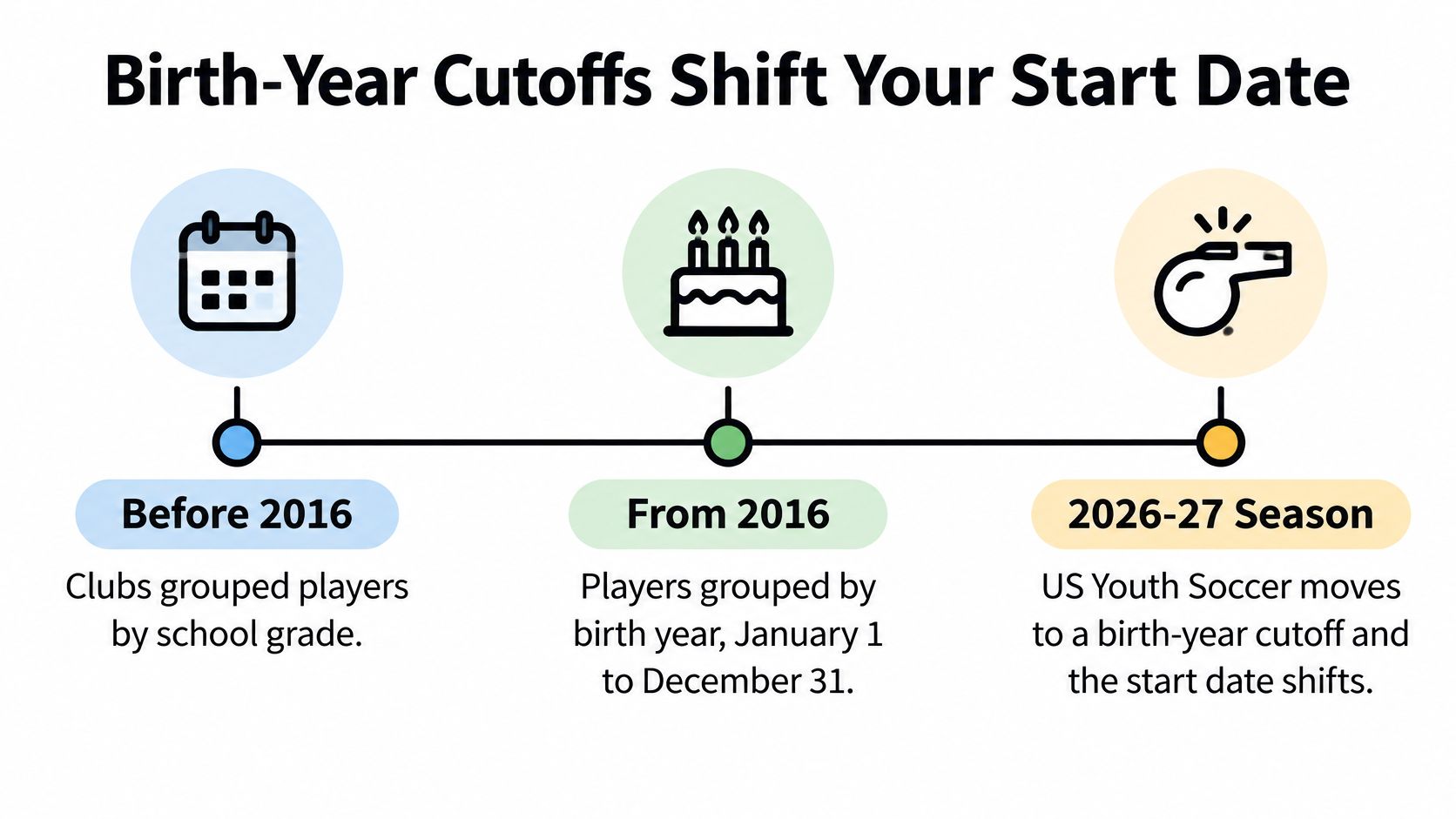
Before 2016, most clubs grouped players by school grade. A 2016 U.S. Soccer decision switched the country to a January 1 to December 31 birth-year system, which is what most families have lived with ever since. The 2026-27 change reverses it on purpose: the goal is to put club teammates back alongside school classmates.
Age-year system | Cutoff date | Status |
|---|---|---|
Birth-year system | January 1 to December 31 | Used since the 2016 U.S. Soccer decision |
School-year system | August 1 to July 31 | Adopted from the 2026-27 season |
School-year alternative | September 1 to August 31 | Considered during the registration review |
The consultation behind the decision wasn't unanimous. The same review reported that 47% of surveyed respondents preferred a school-year model (August 1 to July 31 or September 1 to August 31), while 41% preferred the birth-year model and 12% chose another option. A September 1 start also lines up with the calendars of roughly 68% of US school districts, which helps explain why so many clubs already lean toward late-summer kickoffs.
What the cutoff means for one child
Take two nine-year-olds in the same classroom, one born in September and one born the following July. Under the birth-year system they land in different age groups even though they eat lunch together. Under the August 1 to July 31 year they can share a roster, which is the whole point of the change.
A shifted cutoff can also move a family's entire planning window. If your child moves into a different age group than last season, that can mean a different tryout date, a different first training block and a different opening weekend. Confirm the age group before you circle any dates on the calendar.
The change sets a framework, not a schedule. Clubs and leagues still publish their own tryout, training and competition calendars, and many will keep operating exactly as they do now for another cycle. For the full picture of how brackets map to birth dates, this guide to youth soccer age groups walks through it.
So ask one question before you plan anything: which age-year system is my club using for this registration cycle? The answer can differ by age band even inside one club. At the Fall Creek Sports Complex location, the Villarreal Junior Academy covers ages 5-9 and Villarreal Competitive Teams cover ages 10-18, so a child's start date can vary by band under the same roof.
Start Dates Beyond the US
Families who follow European academies online sometimes assume there's a global opening date. There isn't. UEFA's comparative review of 54 European top-flight leagues found that 28 leagues started their most recent season on a Friday, 17 opened on a Saturday and 9 on a Sunday. Even the day of the week is staggered.

The month varies just as much. Continental European leagues traditionally begin in July or August and run through the following spring, while the League of Ireland Premier Division is a summer competition whose 2018 season opened on February 16. Climate, school calendars and each country's competition structure drive the difference.
Here's where parents get confused. "When does club soccer start" has two meanings: the competitive season and the player-development cycle. In North America, youth clubs usually hold evaluations and form rosters in late spring or summer, then start structured fall programming in August or September. In Europe, an academy's calendar may follow the professional league, local federation rules or the academic year.
If you're evaluating an academy abroad, confirm four things separately: the registration year, the tryout window, the training start and the tournament calendar. One date won't cover it.
The rest of this guide sticks to the US calendar, because that's the one most Houston families are registering against.
Key Dates to Confirm With Your Club
Ask three questions before you register: when is the tryout, when is the first training session, and when is the first official game? Clubs often answer as if those were one date, and that blur is where registration mistakes come from. U.S. Soccer's player registration review sets the seasonal frame: member organizations use an August 1 to July 31 age-group formation cycle beginning with the 2026-27 registration year, while sanctioned leagues and competitions keep flexibility to choose their own registration option. That cycle change matters because eligibility, roster placement and even the tryout window can move with it.
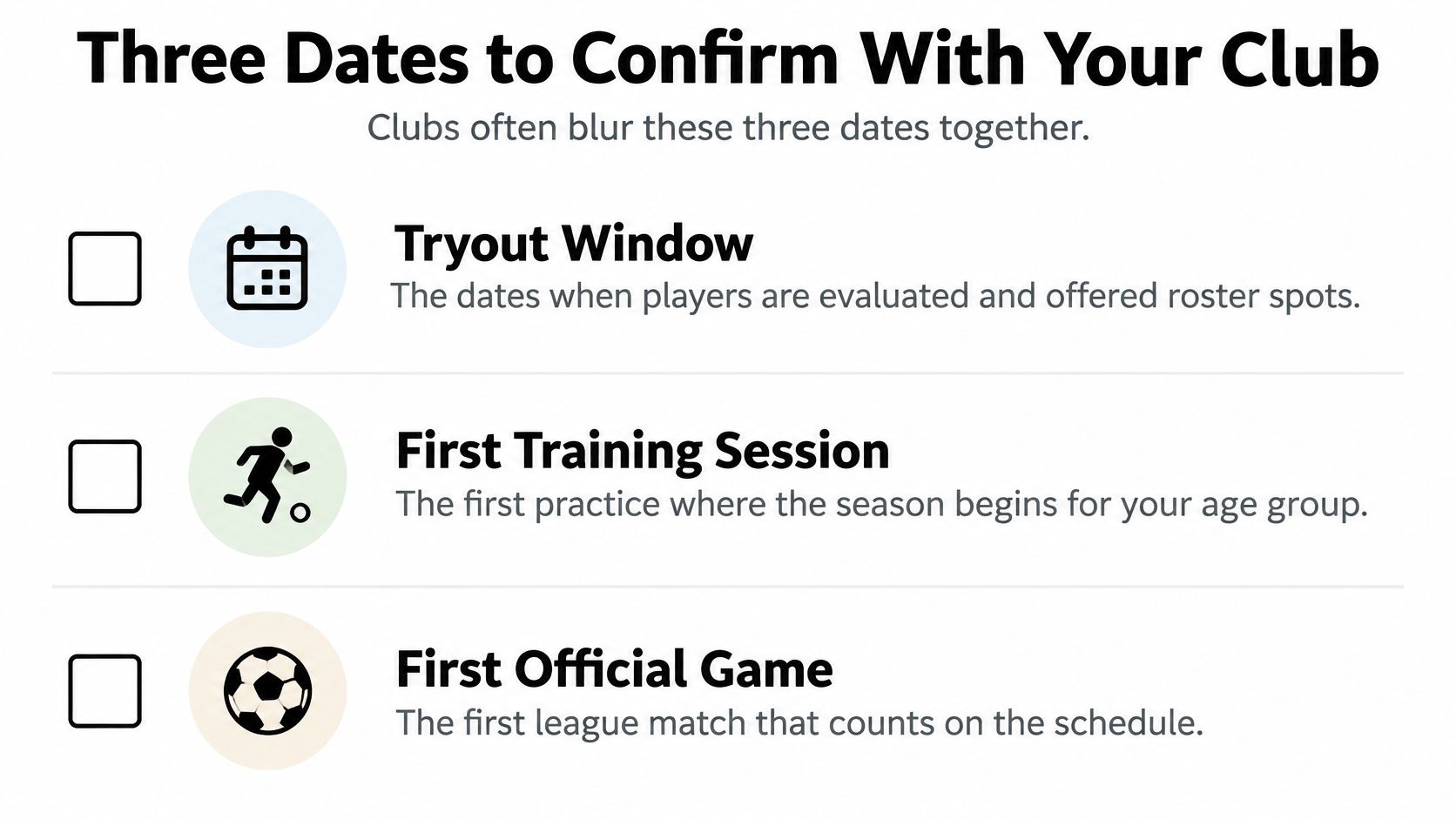
Work through these checks in order, in one email to the club's registration contact:
The tryout or registration window for your age group. Age bands often run on different dates, so a date posted for the 10U group tells you nothing about the 7U group.
The first training session, and whether attendance is required. Missing the first week can mean starting behind on fitness work and positional reps.
The first official game and the league calendar. The match date shows when the season begins; everything before it is preparation.
Which age cycle the club uses for 2026-27. Roster placement, tryout eligibility and team continuity all hinge on the cutoff.
The registration deadline and any added evaluation dates. Some programs run a second look before finalizing rosters.
If you're still mapping how evaluations, training blocks and league play stack up across a year, this overview of the club soccer schedule lays the blocks side by side. Contact the academy before fall registration closes so evaluations do not happen after early roster decisions are already set. Villarreal Houston Academy runs select and competitive programs for boys and girls as young as 4, so ask which dates apply to the exact age band your child would join rather than to the club as a whole.
One email, five questions. Send it in May, not August. You'll get a calendar back while there's still time to plan around it.
Starting Club Later and Moving From Rec to Select
The assumption worth challenging is that club soccer has a single annual deadline, and a child who misses it loses a year. Youth soccer participation has grown in recent years, and clubs have responded with rolling evaluations, mid-year openings and programs built for players who are new to the competitive level. Entry points exist across the calendar.
A late start also involves three separate dates that clubs often blur together: the tryout or evaluation, the first training session and the first official game. Missing an evaluation window can matter less than it looks, because some teams add players after the season begins. One caution applies here. The age-cycle change arriving for 2026-27 can move which band your child trials for, so confirm the cutoff for that season before assuming which team a late starter would join.
Readiness markers that beat a birth date
Coaches weighing a late starter or a rec-to-select move watch for a handful of things, none of them chronological:
Ball control under light pressure. Can the player receive a pass and take a first touch away from a defender, or does the ball stop dead at their feet?
Coachability. Do they take a correction and try it on the next rep? This matters more than current skill level.
Baseline fitness. Can they train for 60 minutes without needing extended breaks?
Confidence to fail. Do they attempt the harder pass, or hide from the ball after one mistake?
Willingness to train alone. Ten minutes a day with a ball at home separates players faster than most club sessions.
A child who shows three of those five can usually handle a competitive environment. A child who shows one benefits from another rec season plus a clinic or two, and that path reaches the same destination a season later.
Reframe the deadline: club soccer works like a school system. Players enter at different grades, and a season spent in an introductory or developmental program still counts toward the same destination.
That structure exists in practice. At Villarreal Houston Academy, the Junior Academy serves ages 5-9 with structured coaching before full competitive commitment, while competitive teams cover ages 10-18 for players who develop on a later timeline.
Cost is the barrier that keeps plenty of children out of formal pathways entirely, so ask directly about fees, payment plans and whether a recreational option exists as a stepping stone. For a side-by-side look at local entry points, this guide to soccer teams to join compares the options.
Decide Your Next Step This Week
Put the three dates in writing before anything else: the tryout window, the first training session and the first official game. Start from the season phase in the first table, send the five readiness checks to the club's registration contact, and ask for one calendar for your child's age band. You'll either get dates back or learn they are not posted yet, and both answers help you plan.

Once the first training date is known, work backward and decide on preparation. A summer clinic, a few weeks of technical sessions or a camp in July can put a player on the front foot before roster evaluations begin, and booking it early is easier than finding a spot in August. If your player is stepping into a longer competitive season, treat the physical side as its own checklist too. If supplements enter the conversation, ask your pediatrician before adding anything to a young athlete's routine; any guide to creatine and electrolytes for match day should be background for that medical conversation, not a shopping list.
Keep a backup plan. Submitting a registration doesn't guarantee acceptance into any program, so a recreational team or a camp as a fallback protects the season if a roster spot doesn't come through. That's realism, and it keeps the calendar intact when a tryout doesn't go the way you hoped.
Younger children need the same questions asked at their own level. At United City Church, the academy runs the Villarreal Developmental Program "Future Stars" for ages 4-5 and the Villarreal Junior Academy for ages 5-9. Ask for the start dates attached to your child's age band rather than assuming the club runs one schedule.
Then put the whole thing on repeat. Recheck the dates every year, because the 2026-27 age-cycle framework changes what clubs publish, and a calendar that was accurate this spring may not describe next fall.
Villarreal Houston Academy is the official partner academy of Villarreal CF in the Greater Houston area, running select and competitive programs for boys and girls from age 4 upward, with training across Humble, Fall Creek, Cypress, Tomball and the Kingwood-Porter-New Caney area. If you want your child's tryout window, first training date and first match confirmed for the coming season, our staff will walk you through all three for your age group. Visit Villarreal Houston Academy to find the program that fits your player and get the calendar in writing.
Comments