


Soccer Training Program for Beginners: A Step-by-Step Plan

Your child comes home from a birthday party with grass stains on both knees and one question you weren't ready for: can I play soccer? You find a recreational program, sign the form, and then a schedule arrives that assumes you already know how this works. How many days a week? How long should a session run? Is one practice enough, or does skipping the second one put your child behind?
The honest answer a coach would give you across a kitchen table is that beginners don't need more soccer. They need the right amount of it, arranged in the right order, with enough rest and free play around it to keep them wanting more. What follows is the session plan, the weekly load, the skill sequence, the injury rules and a one-page log, so you can judge progress in weeks instead of guessing after one practice.
Choose a Weekly Plan and Load That Fits Your Child's Age
A five-year-old may be ready for a short, play-based soccer session, while a teenager new to the sport may manage longer practices. Use age as a starting point, then count all the soccer your child does in a week, not just club training.
Age group | Sessions per week | Session length | Weekly soccer minutes | Full rest days | Free play per week | Main focus |
|---|---|---|---|---|---|---|
Ages 4-5 | 1 play-based session | 45-60 min | 45-60 min | 2+ | 2+ hours | Ball familiarity through play |
Ages 6-8 | 1-2 sessions | 45-60 min | 45-120 min | 2+ | 2+ hours | Ball mastery and basic movement |
Ages 9-12 | 2 sessions | 60-75 min | 120-150 min | 2+ | 2+ hours | Passing, first touch and simple 1v1 moves |
Ages 13-18, new to soccer | 2-3 sessions | 75-90 min | 150-270 min | 2+ | 2+ hours | Decision-making and small-sided games |
Treat these figures as a weekly planning guide, not a quota. Recess games, PE and informal kicking around add to the workload even when they do not appear on the club calendar.
Build the weekly load in three steps
1. Count every soccer minute. Include warm-ups, team games, PE class and backyard shooting. Counting only paid sessions can make a busy week look lighter than it is.
2. Set at least two full rest days. A rest day means no training, game or make-up session. Choose the days before the week begins so extra activities do not fill them by default.
3. Protect two or more hours for unstructured play. Backyard kicking, tag, a park basketball game or a bike ride can all provide a break from organized drills. A second sport at low volume fits; a third organized practice does not. Families looking for another activity can find safe kids jiu jitsu classes.
What a heavy week looks like before anyone gets hurt
A workload that is too high can show up as reluctance to get out of the car, grumpiness after a normal bedtime or heavy legs in every session. If these signs persist, reduce the weekly load by removing a session rather than adding conditioning.
Research reviews have found an association between early specialization and greater overuse-injury risk in several youth-athlete populations, though the relationship varies by sport and may partly reflect total workload, according to a review of early specialization research. Count team practices alongside everything else when judging the week.
At week's end, ask whether your child still wants to play and has had at least two full days away from soccer.
How to Structure a 75-Minute Beginner Training Block
A child who starts a 75-minute session keen to play may lose focus if the final part becomes a long queue. Keep activities moving and save time for a small-sided game, where players can use what they have practised.
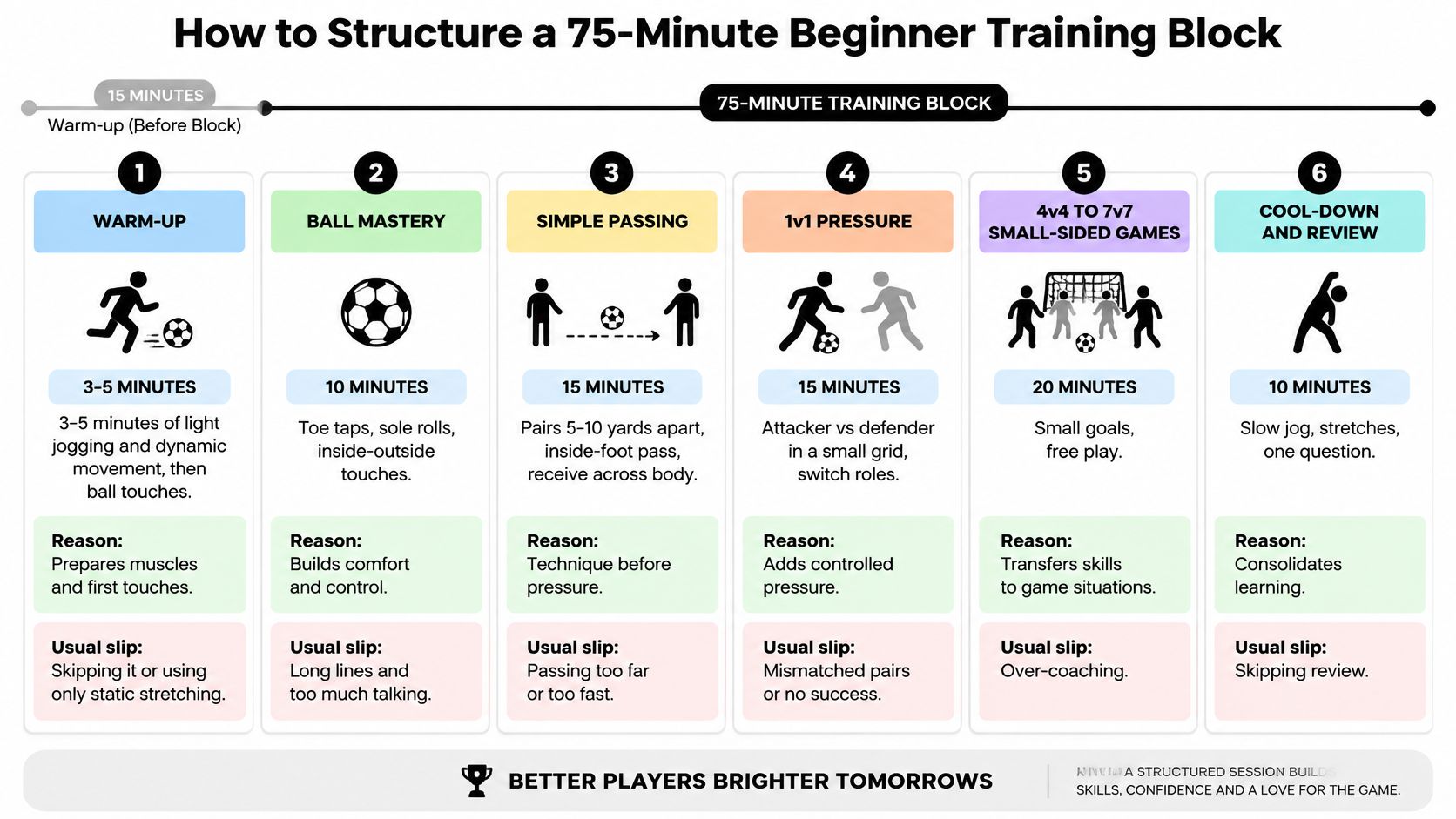
The five-part block
1. Warm-up, 15 minutes. Start with three to five minutes of easy movement, then use the rest for balance, landing, coordination and body-control exercises. A warm-up can teach useful movement skills as well as prepare players for practice.
2. Ball control and coordination, 15 minutes. Give each player a ball where possible. Practise individual touches, sole taps and inside-foot rolls, with one clear instruction at a time. Beginners learn through repeated touches, not long explanations.
3. Passing and receiving, 20 minutes. Work in pairs or small triangles. Ask players to receive the ball across their body and turn into space. Keep the pass at a pace that lets them practise control rather than chase the ball.
4. 1v1 decisions, 15 minutes. Set up a small grid and have players switch between attacking and defending after each turn. Vary the challenge so attackers have a chance to get past a defender and defenders can practise positioning.
5. Small-sided game, 10 minutes. Finish with 4v4 or 5v5 on a reduced field, using small goals where available. Keep players involved rather than leaving them in long substitution lines.
Timing the block
The five parts add up to 75 minutes: 15 + 15 + 20 + 15 + 10. For a 60-minute session, use 10 minutes for the warm-up, 10 for ball control, 15 for passing and receiving, 10 for 1v1s and 15 for the game. For a 75-minute session, follow the full plan above. Both versions keep the game at the end without squeezing the earlier practice blocks.
Training-specific injury rates for non-elite young players range from 0.58 to 7.1 injuries per 1,000 hours of exposure, and injuries occur more often in matches than in training, according to a systematic review of youth soccer injury research. Gradually increasing intensity, using a structured warm-up and choosing age-appropriate movements can help keep a beginner session manageable.
A well-paced session gives players frequent turns and a chance to use what they have practised. By the end, they should feel tired without limping.
Skills to Teach in Order and How to Raise the Challenge
A step-over learned in week one and never used in a game is a trick, not a skill. Beginners need an order that puts technique before pressure and pressure before the game, so each piece gives the next one something to work with. Footwork habits are the foundation, and these soccer footwork drills for beginners give you a starting set you can run in a driveway or a small grid.
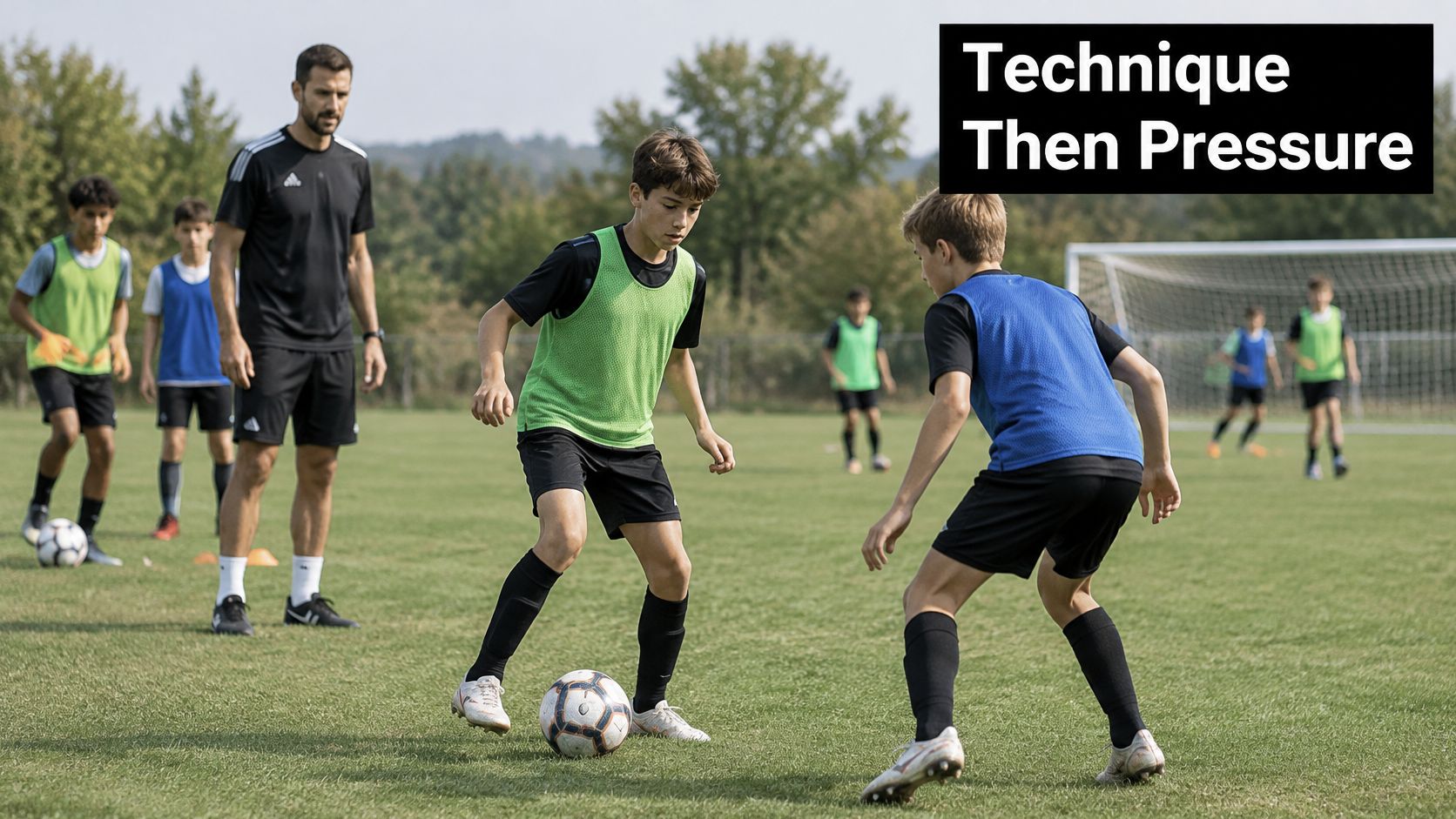
The sequence runs from ball mastery and simple passing, to 1v1 pressure, to 4v4 through 7v7 small-sided games. The mistake that shows up in almost every beginner program is players performing technically correct movements without learning when or why to use them. Pressure in the middle of the session is what forces the question of timing, and the game at the end is where the answer gets tested.
Small-sided games belong at the finish because fewer players on a smaller field means more ball contacts and more technical actions for every child, including the ones who would go quiet in an 11v11 match.
What progress actually looks like in the data
A meta-analysis of small-sided game interventions found a statistically significant improvement in technical execution compared with controls, with an effect size of 0.59 (95% CI 0.29-0.89; p < 0.001); programs running beyond 17 sessions reached 0.68, while shorter programs reached 0.44. Judge progress across a multiweek block, not after one clinic.
Two touches by week four
Say a U10 group starts with pairs passing inside a 20-yard square, no defender, unlimited touches, five yards apart. By week two the square is narrower. In week three, the rule becomes two touches maximum, so the first touch has to set up the second. By week four one defender steps in and the passer has to scan before the ball arrives.
Nothing about the technique changed between week one and week four. The demand around it did, which is how a beginner learns to use a skill rather than rehearse it.
Levers that raise difficulty without adding risk
Restrict touches. Two touches, then one, forces faster decisions and a better first touch.
Change the direction of play. Reversing the goal a team attacks makes them lift their heads.
Add a defender. One more body in the grid changes every decision in it.
Narrow the space. A tighter square makes the same pass harder without making it faster.
What doesn't work is demanding faster execution. Speed without a decision adds risk and teaches nothing. When you want to see the model in motion, this short clip shows the small-sided format in a real session.
Protect Young Beginners From Injury Risk
A prevention block belongs in the session plan the same way passing does. Treat it as a technical requirement and children learn to land, stop and change direction safely. Treat it as an optional warm-up and it disappears the first time the group runs late.
The practical order is three to five minutes of low-intensity movement, then eight to ten minutes of balance, landing, coordination and body-control work, and only then progressive ball work before any high-speed games.
FIFA 11+ Kids is built around spatial orientation, anticipation, attention during dual-task situations, body stability, movement coordination and safe falling, according to a review of injury prevention programs in youth sport. It takes about 20 minutes and progresses through five difficulty stages with seven exercises per stage, which means a child with low motor-skill confidence starts at stage one alongside a more coordinated teammate.
For ages 4-12, use the version that emphasizes single-leg balance, controlled deceleration, changes of direction and landing with knees aligned over the feet. Progress only when players demonstrate control.
Four ways beginner programs go wrong
Skipping the prevention block. It's the first thing dropped and the one that protects the rest.
Adult intensity with young beginners. Beginners need coordination before conditioning, every time.
Repetitive conditioning piled on. Laps and long runs train a child to pace themselves, not to sprint, stop and restart.
Treating pain as low effort. A child who says something hurts is reporting information, not making an excuse.
The rule that prevents most problems
Stop or modify any exercise the moment fatigue changes how a child lands or cuts. Report pain the same day so the coach can adjust before the next session, rather than after a week of limping.
Next-day soreness after a hard session is normal and settles with sleep, food and gentle movement, and some families use approaches like cold therapy for sore muscles between sessions. Pain during a session is a different category and gets a conversation with the coach before the next training day.
Attendance, sleep and mood tell you more about recovery than any single number. Our guide to injury prevention in soccer covers what to do when something does go wrong.
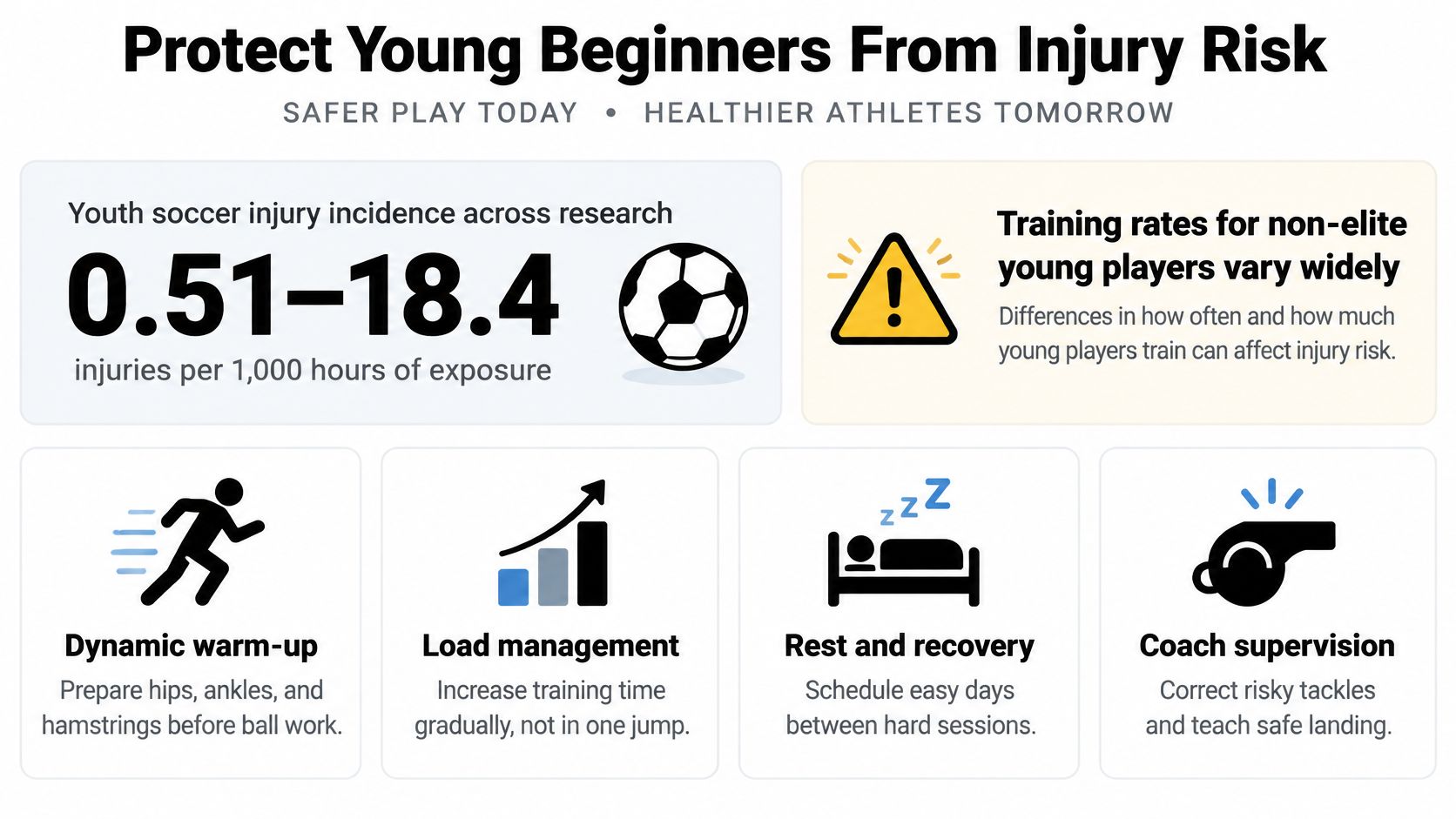
The goal isn't only avoiding injury. It's keeping a child in the same sport long enough to get good at it.
Track Progress With Simple Benchmarks
Progress across the first four to six weeks shows up in a log, not in a scoreline. The table below is the whole tracking system, and it fits on one page.
Measure | How to record it | What to look for |
|---|---|---|
First touch under passive pressure | Count controlled touches in ten attempts per session | Control holding steady or rising across the block |
Pass completed after scanning | Count completed passes during a small-sided game | Completion rising week to week |
Decision within three seconds | Note how often the player chooses an action within three seconds of receiving | Fewer hesitations each week |
Attendance | Sessions attended divided by sessions scheduled | Steady attendance across the block |
Perceived exertion | Rate effort 1-10 after each session | Stable ratings, not climbing every week |
Pain or missed sessions | Log each report or absence the same day | Any pain reviewed before the next session |
The first three rows are skill measures. Count them during normal sessions, not in a separate test, because a child who knows they're being scored plays differently.
The last three rows are operational, and they're the ones coaches use to spot a training problem early. Attendance tells you whether the plan is realistic for the family. Perceived exertion that creeps from a six to an eight over three weeks means the load rose faster than the recovery. A pain report logged the same day gives you something to compare against next week instead of a vague memory.
Keep the log in a notes app or on one printed page, and review it with the coach every fourth week. A single weak session means nothing. Three weeks of a stalled first touch means the challenge needs to change.
What a Beginner Program Really Costs and How to Keep Attending
Most beginner guides discuss registration and a ball and stop there. The full-cost question is the one that decides whether a child finishes the season.
U.S. families of youth soccer players spent an average of $910 in 2024, up from $537 in 2019, according to Aspen Institute Project Play data reported in coverage of rising youth soccer costs. Participation among children ages 6-12 fell 5.5% from 2013 to 2023, and in a youth soccer ecosystem study, team fees were a major issue for 32% of surveyed players, rising to 41% among low-income households.
Build a four-week budget before you enroll
1. List every line. Registration, uniform, cleats, shin guards, a second ball for the backyard, tournament travel and parking. Keep the list to the block in front of you.
2. Ask about assistance. Fee assistance, sibling discounts and included equipment exist at many programs and are rarely advertised. Ask before you commit, not after.
3. Estimate travel time and cost per session. Missed sessions usually come from logistics, not from lost interest. A 45-minute drive each way is a real cost that shows up as attendance.
Then apply an attendance rule. If the family can't sustain two sessions a week at the chosen cost, a lower-cost plan with two sessions and free play beats an expensive plan the child attends half the time. Understanding what academy fees actually cover makes that comparison easier.
Context matters here. In 2024, 58% of U.S. youth ages 6-17 played on a team or took sports lessons during the past year, according to Project Play's analysis of the National Survey of Children's Health. Many beginners arrive through school or community programs, which is exactly why the inexpensive, well-run option deserves a fair hearing.
Start Your First Four-Week Block This Week
Pick the age band from the table, put two sessions in most weeks of the next four, and write the rest days on the calendar before anything else fills them. Run the 75-minute block using the five-part structure, keep the benchmark log on one page, and set a review date for the end of week four. That's a full plan, and it takes one evening to schedule.
Habits this small are easier to keep when you attach them to something already fixed, which is the reasoning behind small habits that make goals stick. A four-week block beats a vague plan to practice more.
Five questions to ask before you commit
How long does each session run, and how much of it is actual ball work?
How are coaches trained, and who supervises them?
How are injury reports handled, and who contacts the parent?
How many sessions per week are expected, including games?
How are missed sessions handled, and are there credits or make-ups?
Compare every program against those five answers rather than against its marketing. Villarreal Houston Academy offers select and competitive youth soccer programs for boys and girls as young as 4 years old, and we'd expect you to hold us to the same questions.
A good beginner program is measured by whether the child still wants to show up in month three. Everything else is a detail.
At Villarreal Houston Academy, the official partner academy of Villarreal CF in the Greater Houston area, beginners from age 4 train under coaches who learn the Villarreal CF methodology and work alongside the club's sports psychologists, with age-appropriate sessions built for exactly the kind of weekly rhythm described above. If you want a first season that protects a child's love of the game while building real technique, visit Villarreal Houston Academy to see our programs, locations and upcoming tryout dates.
Comments