


Club Soccer Schedule: A Season, Week and Travel Guide

You're staring at a club soccer schedule on your phone and trying to make it fit real life. There's a league game on Saturday, a tournament game on Sunday in the next town, and a midweek practice that lands on the same night as a school concert. The dates themselves aren't the hard part. The hard part is what those dates cost in time, energy, driving, and money.
Treat the calendar like a household budget before you register. A good schedule shows you when your child trains, when they compete, when they rest, and how far you'll travel to make it happen. If any one of those pieces is invisible, you're not ready to commit yet.
A Typical Club Soccer Season at a Glance
Say your family starts in July. Your child has tryouts on a hot weekday evening, then a first practice before school even starts. By September, you're packing a cooler on Saturday morning, driving to a different complex on Sunday, and wondering how homework fits on the nights between.
That pileup isn't bad luck. It's a layered calendar. At the top level, the FIFA International Match Calendar was first used for 2006 FIFA World Cup qualifying and serves as an agreement among FIFA, the six continental confederations, the European Club Association, and FIFPRO governing dates available for official and friendly international matches. Clubs pause or adjust when players leave for national team duty, and dates can move when competitions overlap.
What Each Phase Actually Holds
Your youth season follows the same logic on a smaller scale. League games, tournaments, practices, school dates, travel, and recovery have to share the same weeks, so not every open weekend can become a competition weekend.
Phase | Typical months | What the schedule holds |
|---|---|---|
Pre-season | July to August | Tryouts, fitness testing, team formation and first practices |
Fall league | August to November | Weekly league matches plus a few practices each week |
Fall tournaments and showcases | September to November | Weekend events that add travel and lodging |
Winter break | December to January | Indoor training, fewer matches and recovery time |
Spring league | February to May | League matches, cup play and playoffs |
Summer | June to July | Tournaments, camps and planned rest weeks |
Pre-season is about placement and preparation, not results. Coaches form teams, test fitness, and set training habits before league play starts.
Fall league settles into a rhythm of weekday training and weekend matches. Tournaments and showcases layered into those same months are where travel, lodging, and back to back games start to change the cost for your family.
Winter break isn't dead time. Indoor sessions, clinics, and lighter technical work keep skills moving while legs recover from the fall, which is why many families use that window to review a plan for year-round development across the full calendar rather than treating December as a stop and start.
Spring league brings league matches back with cup play and playoffs, so the stakes and travel can rise again. Summer then mixes tournaments and camps with planned rest weeks, and that rest needs protecting just as firmly as a match date.
A season calendar is a framework that balances competition, development, travel, and rest. Check every phase against school and work before the season starts, not after the first conflict hits.
Families who put soccer, school events, and sibling activities on one shared view spot clashes weeks earlier. If you're building that system at home, planning daily routines for kids from Family Xchange offers a practical starting point for turning separate team messages into one family calendar you can live with.
How the Weekly Load Balances Matches and Training
A week isn't seven equal practices. It's a weekly microcycle, a short cycle that rises and falls on purpose so your child arrives at the match trained but not drained.
Start by naming which kind of week you're in. That one decision changes how much training makes sense.
Week type | Matches | Training sessions | Recovery days |
|---|---|---|---|
Standard week | 1 | 5 | 1 |
Congested week | 2 | 4 | 1 |
A standard week has room to build. A congested week has two matches eating into that room, so training has to give something back even though the session count still looks high on paper.
Numbers That Put the Week in Perspective
In elite youth soccer, the University of Groningen research summary on monitoring load, recovery, and performance reports one monitored season averaged 394.4 minutes per week of training and match play, with an average session rating of perceived exertion, or sRPE, of 14.4/20 and a recovery score of 14.7/20. It also found that an additional hour of weekly training or game exposure was associated with improved interval-endurance test performance.
Don't copy those figures as a target for your child. They're elite benchmarks, useful for showing that coaches measure load instead of guessing. Your club team may train far less, and that's fine if the pattern is right.
You can follow the same measurement at home without special equipment.
Track minutes: Write down session duration and match minutes for your child, not just for the team.
Rate effort: Ask how hard the session felt on the same scale the coach uses and note the sRPE.
Calculate internal load: Multiply duration × sRPE to get one number you can compare across days.
Then read the trend, not a single day. When cumulative load rises while recovery or wellness falls, cut optional training first and keep the work that's tied directly to the next match. A child who's sleeping poorly, dragging through school, and rating every session harder than usual doesn't need an extra private workout that week.
One Saturday Match Week, Day by Day
For a Saturday match, a sensible pattern looks like this. Sunday is recovery and light movement. Monday is rest.
Tuesday and Wednesday carry the highest physical and tactical load, because there's still time to recover before the weekend. Thursday drops to moderate, progressive work. Friday is short and technical, focused on sharpness and the game plan, then Saturday is the match.
If the match moves to Sunday, shift that same pattern by one day instead of cramming it. Families comparing this pattern with their own club soccer schedule can use our guide to a weekly plan that balances training days and match day to see where their current week rises, tapers, or never lets up.
Before you judge any single practice, identify the week type first. A hard Tuesday in a standard week can be exactly right, while the same session squeezed between two matches can be the one that pushes your child over the edge.
Session Timing Around Each Match
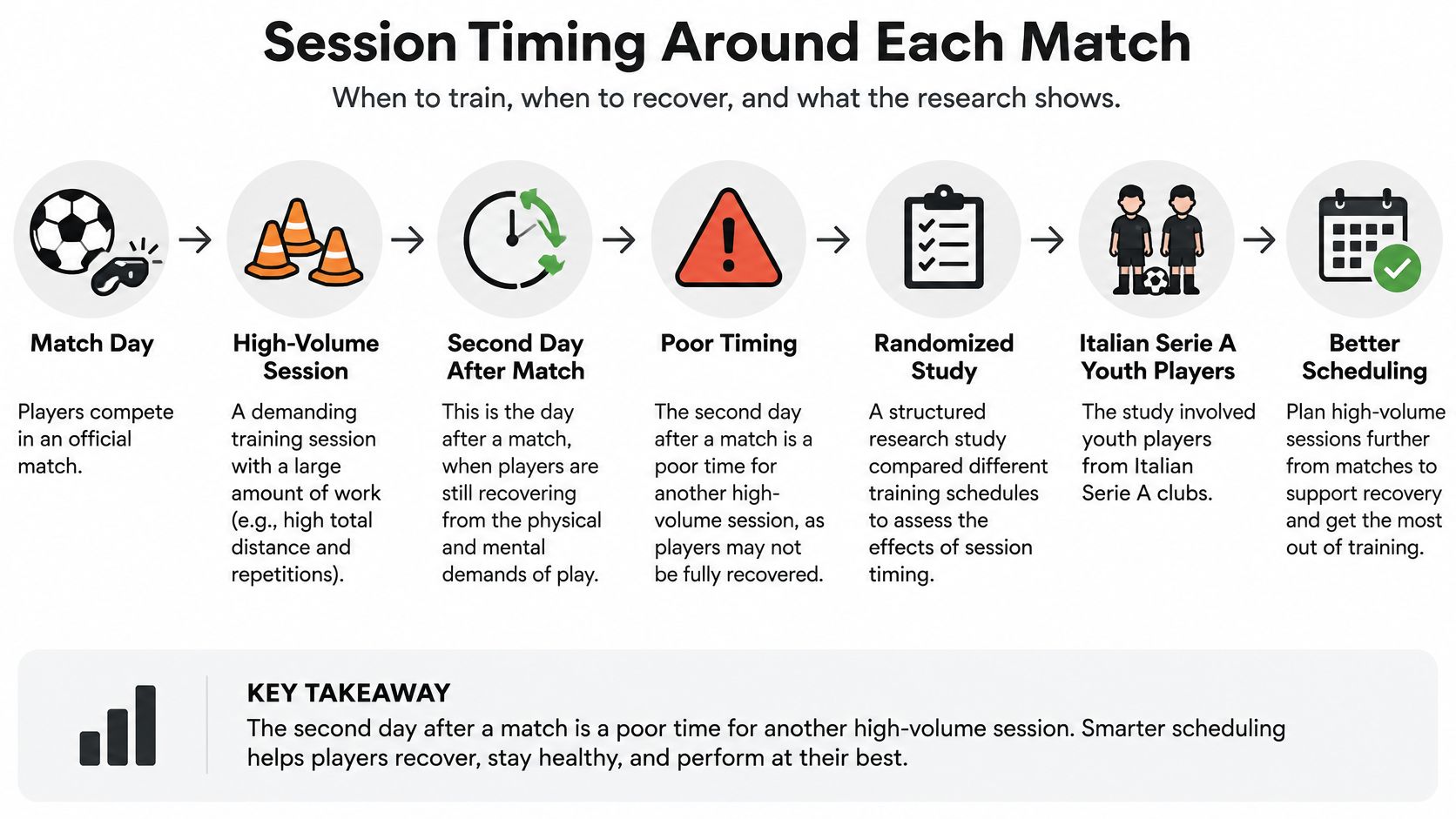
A Saturday match has ended, but the next demanding practice is already on the calendar. Before treating that session as routine, look at how much the player did in the game and how they recovered afterward. The calendar sets the framework; the player's condition helps determine the actual load.
In a randomized study of Italian Serie A youth players, researchers compared a complete 100-minute session with a reduced 70-minute session 48 hours after a match. The players who completed the longer session showed greater impairment in physical recovery than those in the moderate session, according to the published study on session volume 48 hours after a match.
The infographic below shows how a week can shift from match recovery to harder work, then taper toward the next game.
Reading the Days Around a Match
Coaches often label sessions by their distance from the game. Match minus one is the day before, while match plus one is the day after. These labels describe a planning framework, not a promise that every player will be ready for the same workload.
Days from match | Session focus | Target load |
|---|---|---|
Match minus 4 to minus 3 | Highest physical and tactical load | High |
Match minus 2 | Progressive loading with moderate tactical work | Moderate |
Match minus 1 | Short technical and tactical session | Low |
Match plus 1 | Recovery, mobility and light movement | Low |
Match plus 2 | Technical work and individual conditioning | Low to moderate |
After a match, match plus one generally calls for recovery, mobility, and light movement. Match plus two can remain focused on technical work and individual conditioning rather than a normal high-load session. The study's comparison is a useful reminder that adding more minutes during recovery can increase the physical cost.
Earlier in the week, match minus four to minus three is the place for the hardest physical and tactical work, when the plan allows time to absorb it. Match minus two can continue the build at a moderate level. Keep match minus one short and technical, with attention to tactics, so players can approach kickoff feeling sharp.
Spacing the Hardest Work
High-intensity strength and plyometric sessions, including jumping and explosive lifting, should be separated across the week. Give players enough time to return to normal sprinting and jumping before another hard session.
Spacing rule: If a session leaves your child unable to sprint or jump normally two days later, the next hard session may be too soon, whatever the calendar says.
A table cannot account for every player. Someone who played most of the match and then spent hours traveling may need a different match-plus-two session from a teammate who played briefly and went home. Match minutes, travel, wellness, and sRPE all help coaches adjust the plan.
Playing Role and Age Group Load
Two players can attend the same practices, travel to the same tournament, and leave with completely different levels of fatigue. The difference is often role. A starter who plays most of every match carries a load a reserve does not, even though both names sit on the same club soccer schedule.
That gap shows up sharply in tournaments. Separate 2025 research on a youth tournament summarized in the International Journal of Sports Science and Coaching study on academy load found starters playing five matches separated by only 24 hours experienced a significant reduction in vertical-jump performance by the fifth match, while reserves did not show the same decline.
That same academy research analyzed 456 player observations across five competitive seasons and found meaningful age-group differences in training duration and perceived load. Match day produced the highest weekly load, while training load and duration were deliberately reduced during the two days before a match.
Why Age Changes the Same Calendar
A schedule that suits an older academy player can overwhelm a younger one. Younger athletes are still growing, still learning to coordinate a changing body, and often less able to tell you they're overloaded until they're already exhausted or hurt.
Keep the weekly plan simpler for younger players. Protect sleep first, limit extra sessions stacked on top of team training, and watch children who play for a school team and a club team at the same time. Their total load is the sum of both calendars, not whichever one you're looking at.
Older players can usually handle more structure and more specific work, but they also play longer matches at higher intensity. More capacity doesn't mean unlimited capacity, and it doesn't remove the need for lighter days before games.
Questions That Reveal How Load Is Managed
You don't need a sports science degree to test whether a club thinks about this. Ask direct questions and listen for specific answers.
Expected minutes: Which players are expected to play heavy minutes, and how does that change their training that week?
Tournament rotation: Are starters rotated across a multi game weekend, or does the same group start every match?
Session labels: Which sessions are developmental, which are competitive fixtures, and which days are marked recovery or optional?
After tournaments: Is attendance expected at the next regular session, or do heavy minute players get modified work?
Vague reassurance isn't a plan. A coach who can point to high load days, recovery days, and a rotation approach is showing you the system behind the dates.
Don't assume more sessions automatically produce better development. A starter finishing a crowded tournament with declining jump performance isn't gaining an edge from one more hard workout. They're spending energy they haven't recovered yet, and the quality of every touch drops with it.
Take three questions to your next coach meeting. How do you adjust training for starters versus reserves, how does the plan change by age group, and what should we stop doing at home during tournament weeks? The answers tell you whether the schedule protects your child or fills their week.
How Villarreal Houston Structures Schedules Across Locations
A weeknight practice can fit the calendar and still strain a household if the drive is long or the match site is elsewhere. Compare the full trip, not just the start time.
The photo below shows a coach planning sessions before players take the field.
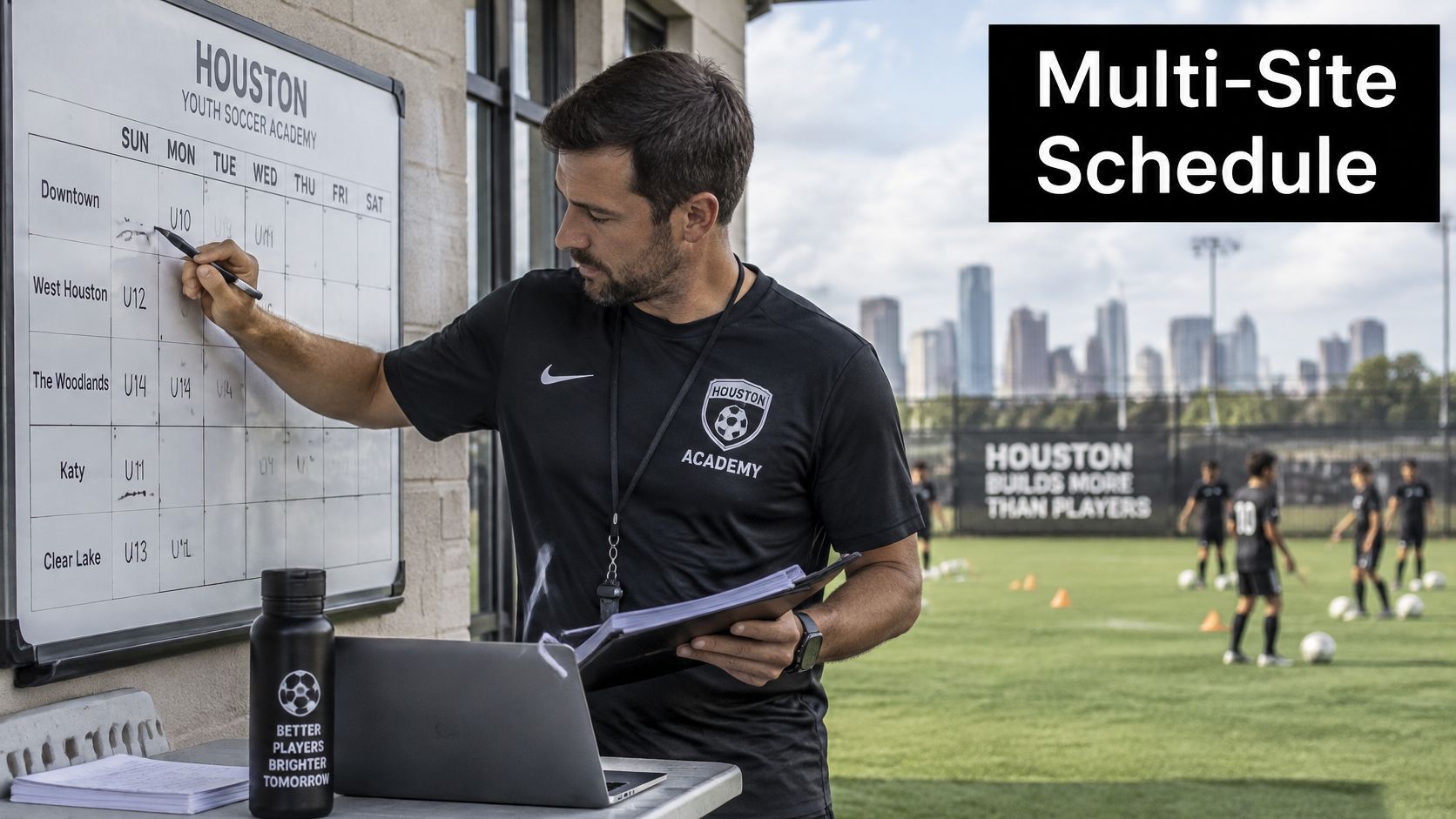
Comparing the Houston Area Sites
Villarreal Houston Academy's fields at United City Church, HKA North, are located at 19901 Townsen Blvd, Humble, TX 77338. Its fields at Fall Creek Sports Complex, HKA South, are at 9810 Wyatt Shores Dr, Humble, TX. For families comparing the two Humble locations, the more workable choice may be the one that keeps weeknight travel manageable.
The Cypress-Tomball location has boys categories for birth years 2010, 2011, 2012, and 2013. Confirm that your child's category is available at the site you are considering before building your routine around it.
In the Kingwood, Porter, and New Caney area, call Villarreal Houston Academy at 281-962-4920 to confirm which teams and age groups train at each site. A location's distance matters only if it offers a suitable program for your player.
How to Read Any Site Schedule
Start by identifying your child's regular training site. Then check the drive during practice hours and account for the return trip on a school night. Finally, ask whether matches take place at the same location or require separate weekend travel. Those details turn a list of dates into a realistic household time budget.
The video below shows a training environment, which can help you picture a typical session at a site.
A workable calendar connects the home site, travel time, and age band. If the practice time fits but the location does not, the weekly plan may be hard to sustain across a season.
Confirm Time Cost and Policies Before You Register
Registration day is the wrong time to discover what a season demands. The 2025 National Youth Sports Parent Survey reports parents spend more than three hours per day on average engaged in their child's sport activities, including practices and competitions. Another 2025 report citing Aspen Institute research says the average U.S. sports family spent $1,016 on a child's primary sport in 2024, up 46% from 2019, with travel and lodging for non-local play among the major cost drivers.
Those figures describe youth sports broadly, not one club's fees. Use them as a warning about where the true burden hides, in daily time and in travel, then run the checks below on the actual club soccer schedule in front of you.
The checklist below turns that warning into a routine you can finish before you pay anything.
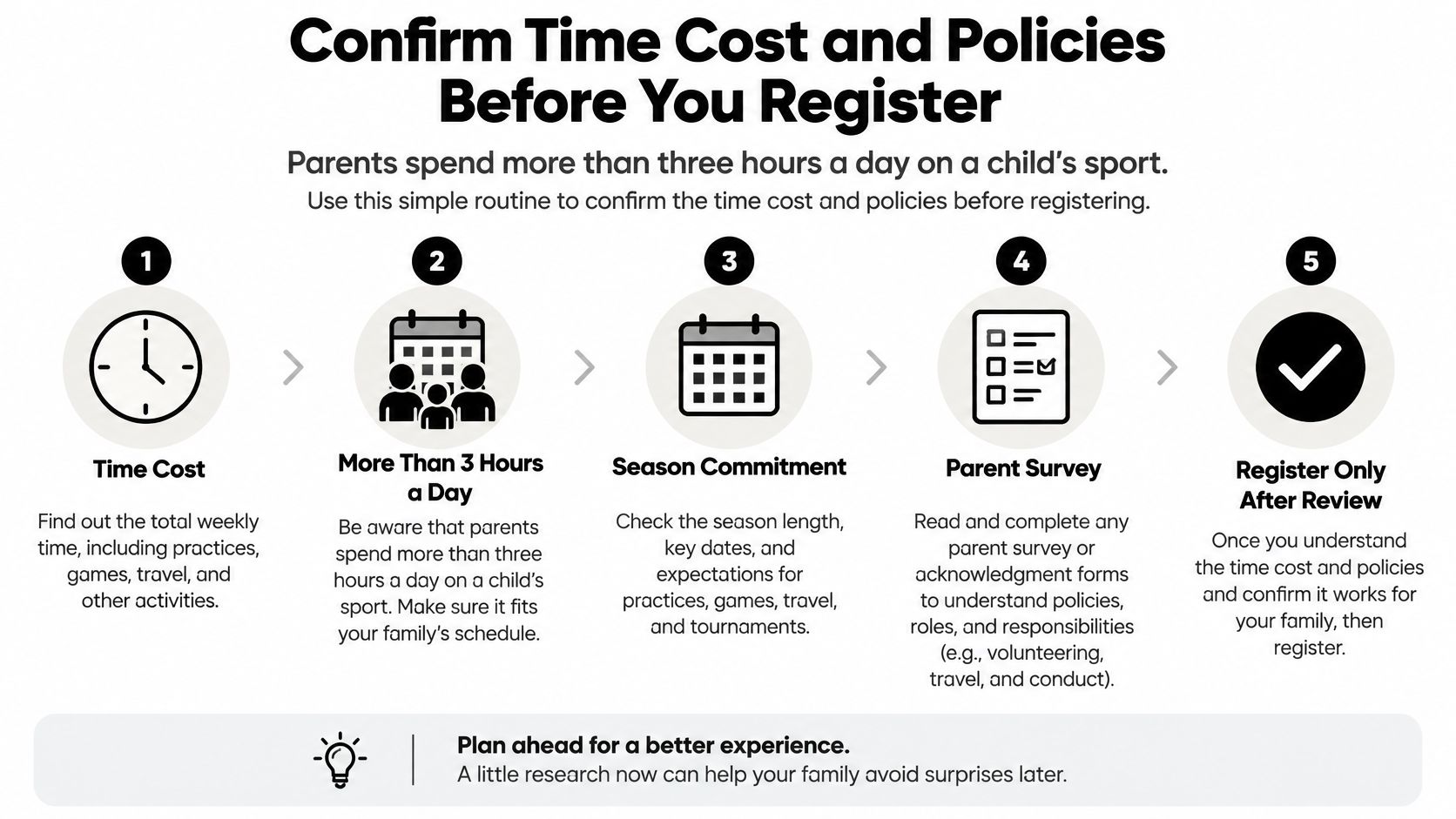
Six Checks Before You Commit
Request separate calendars: Ask for training, league matches, tournaments, tryouts, camps, and travel as separate views, each with the facility, approximate end time, and home site. One blended list hides congestion.
Add hours: Total training, matches, and round trip drive time for a normal week, then lay it against school, work, homework, and sibling pickups. If it only works on a perfect week, it doesn't work.
Price the travel: Mark every two match week and showcase weekend, estimate the travel radius, and price lodging, fuel, and meals before the season. Our overview of how travel teams structure trips and weekends away can help you list the costs families often forget.
Confirm policies in writing: Ask whether every tournament is required, how a missed game is handled, and how make-up dates are set when weather, school, or religious commitments conflict. With us, no refunds are issued for voluntary withdrawal, player transfer to another club, dissatisfaction with playing time, coaching decisions, team placement, or schedule conflicts, so a clash you spot now is far cheaper than one you find in October.
Ask about rotation and recovery: Confirm how starters, reserves, and younger players are rotated, then plan sleep, hydration, and light recovery into tournament weekends at home. Cancel the extra private session that week before you cancel rest.
Call and confirm directly: Families can call us at 281-962-4920 to confirm dates, sites, and age groups. We offer select and competitive youth soccer programs for boys and girls as young as 4 years old, and a short call can verify whether your child's category trains where you think it does.
What a Calendar Can and Cannot Promise
A published calendar can promise planned dates, sites, and the shape of a typical week. It can't promise that weather won't move a match, that a tournament won't release game times late, or that your child will play a set number of minutes.
Commit only when competition, development, travel, and rest are all visible on the page. If one of the four is missing, you're guessing, and your family budget absorbs the guess.
Schedule transparency can keep families in organized sport as surely as extra programming can. Parents rarely quit because they stopped caring. They quit because time, travel, and surprise costs made a schedule they never agreed to impossible to sustain.
Ready to test a real club soccer schedule against your family's week, budget, and drive time? We offer select and competitive programs for boys and girls from age 4 upward across our Houston area sites, with age appropriate training that balances development, competition, and recovery. Visit Villarreal Houston Academy to check locations and age groups, then call us to confirm the dates before you register.
Comments