


Soccer Teams to Join: How to Choose the Right Team in 2026

You're looking at two sign-up options in the same week, a Saturday rec league and a select side that wants three practices plus a tournament hotel. The crests look official. The emails say pathway. Neither tells you whether these are the right soccer teams to join for your child.
Score every option on four things only: weekly hours, total cost, injury load, and enjoyment. The team label is the least useful signal on the page. A nine-year-old who still plays pickup in the yard will learn more on a sane calendar than on a roster that sounds impressive and empties the evening.
Houston families feel this in spring, when school, a second sport, and a new club fee all land at once. Choose the week you can repeat for months. Everything else is branding.
Recreational, Select, Academy and School Teams Compared
Two families can stare at the same spring sheet and want opposite things. One wants a fun Saturday league close to home. The other is pricing the drive for a select team. Both are choosing among soccer teams to join, and the name on the jersey is the weakest clue they have.
Team type | Typical age entry | Weekly training load | Travel and tournaments | Selection | Relative cost |
|---|---|---|---|---|---|
Recreational | From about age 4 | 1-2 practices plus a weekend game | Local, rarely overnight | Open registration, no tryout | Lowest |
Select (competitive) | Often from age 8-10 | 2-3 practices plus games | Regional tournaments, some overnight | Tryout or evaluation | Moderate to high |
Academy | Often from age 4-6 onward | 3-4 sessions plus conditioning | Regional and occasional international events | Ongoing evaluation | High |
School team | High school age | Practice most weekdays in season | District and state games | Tryout with roster limits | Low, gear fees apply |
What the grid leaves out
Recreational teams use open registration. Plan on one or two practices and a weekend game, almost always in town. This is the right rung when the goal is friends, touches on the ball, and a low bill.
Select soccer starts with a tryout or an evaluation, often around ages 8 to 10. Expect two or three practices, weekend games, and regional tournaments that sometimes mean a hotel. The player gets more competition. The family gets a tighter calendar and a higher bill.
Academy soccer is a longer contract with the sport. Entry often starts around ages 4 to 6, with three or four sessions plus conditioning, ongoing evaluation, and events that can leave the region. Pay the highest fees only if the child wants that volume and you can still protect a rest day.
School teams sit on a different clock. They're for high school age, with tryouts and roster caps, and they practice most weekdays while the season is live. Cost stays low past gear, but a school season stacked on a club season is how weeks break.
A higher level changes the whole family's calendar, not only the player's skill. If a club won't publish age entry, weekly hours, or fees, don't guess. Confirm each number with the club before you decide.
How to Gauge Fit, Time and Money Before You Commit
Do the weekly math tonight, before anyone pays a deposit.
Weekly hours
Add practices, games, travel, and homework. Say a nine-year-old has three 90-minute practices, a Saturday game, and schoolwork still due Sunday night. That week still needs at least one full rest day. If the only open slot is a rushed Tuesday between basketball and math, the schedule is too heavy. Drop a team or drop a night. Cutting sleep to fit it all in costs more than the extra session gains.
Basketball season changes the answer. In winter, two sports can fit if soccer means one practice and a game. In spring, three soccer sessions plus weekend travel crowd out recovery. The right team in March can be the wrong team in November.
Practical rule: If the week has no full rest day, the team is too big for this season.
Seasonal load
During childhood, 328 skilled players from seven countries averaged about 180 hours per year of coach-led soccer practice and a similar amount of peer-led play, while high specialization (one sport, quitting other sports, and training or competing more than eight months a year) lines up with greater overuse-injury risk, with initial youth-soccer overuse-injury rates of 1.7 to 19.4 per 1,000 athlete-hours and repeat injuries at roughly twice that rate, in a coaching review in the International Journal of Sports Science & Coaching. Coach-led work builds technique. Peer-led play builds decisions. Adding a second team raises the injury count faster than it raises skill.
Set two or three goals for the season, like receiving toward the right side or making a recovery run after losing the ball. Review them every 6 to 8 weeks. If something hurts, say it that day. A prestige roster is a bad trade for a second injury.
What the average bill leaves out
U.S. families spent an average of $910 per youth soccer player in 2024, up from $537 in 2019, a rise of roughly 69%, as reported by Cronkite News. That average hides the line items that decide whether you can stay.
Cost item | Typical amount |
|---|---|
Average annual spend per youth soccer player, 2024 | $910 |
Average annual spend per youth soccer player, 2019 | $537 |
Registration and club fees | Often the largest single charge, set per season |
Uniforms and gear | Usually sold as a bundled kit package by the club |
Cleats, shin guards and equipment | Family purchase, replaced as feet grow |
Private training or tournament fees | Optional add-ons at most clubs, billed per event or per block |
Transportation and lodging | Gas, hotels, and meals on overnight weekends |
Time away from work | Weekday practices and weekend shifts you can't bill |
Ask three access questions before you commit. Does financial help exist? Is travel mandatory? Which charges are optional? For a look at how practices, games, and travel stack into one week, read our note on a club soccer schedule.
Questions to Ask Coaches and Clubs Before You Join
The highest team isn't automatically the best team. Only 26% of U.S. youth coaches had recent training in general safety and injury prevention in 2024, down from 34% in 2019, 88% of youth-sports parents said a coach should pass a criminal-background check, and a 2025 student survey found that 45% of students who quit said the sport had become too competitive and was no longer fun, according to Project Play's coaching trends. Wins, rankings, and a familiar crest don't tell you whether the room is safe or whether your child will still be there next fall.
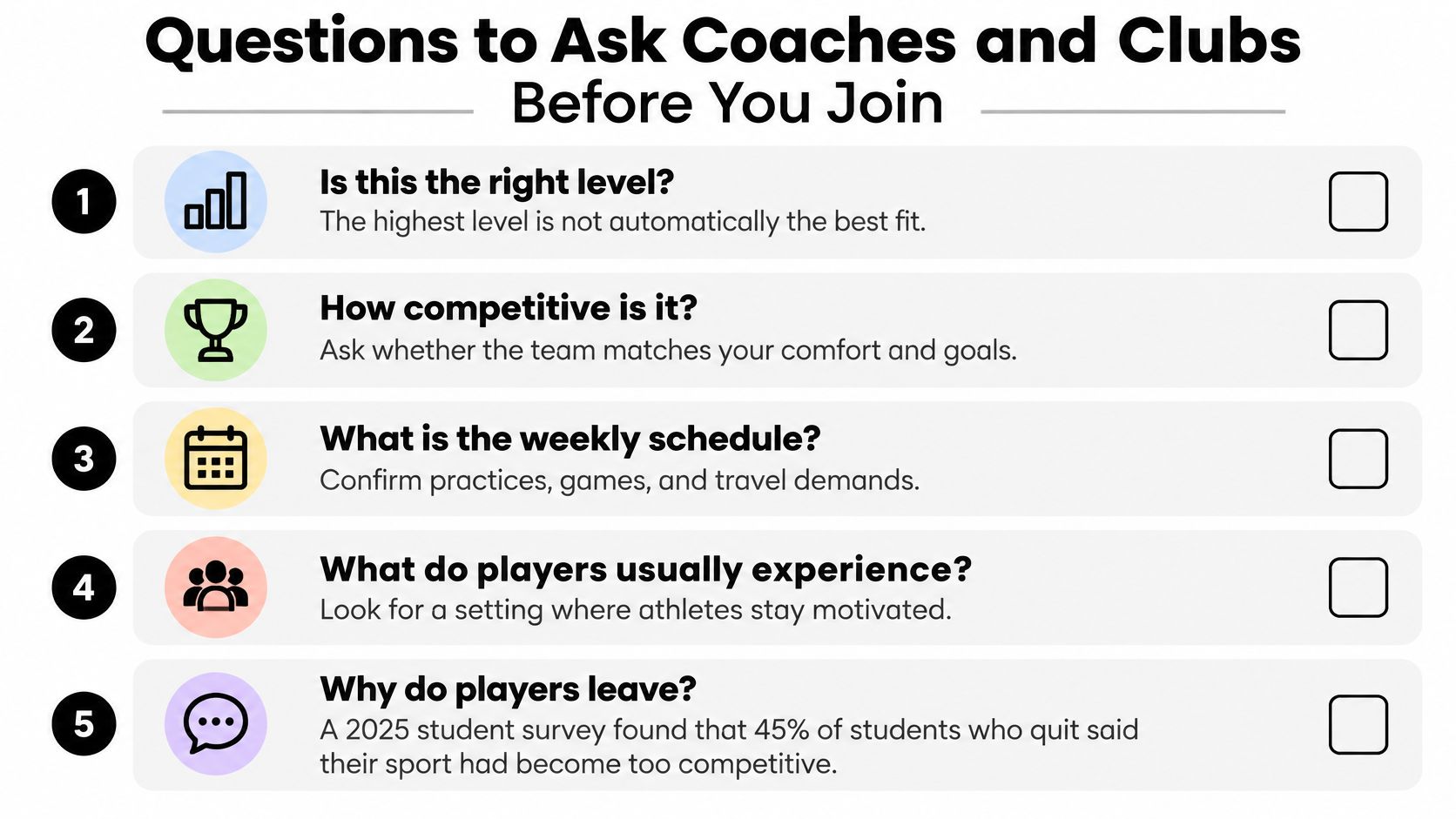
Ask these before you pay
Credentials and safeguarding. What license does each coach hold, and did every adult on the sideline pass a criminal-background check? If staff can't name the check and the safety training, walk.
Injury protocols. Which concussion, heat, and ACL-prevention steps does the team follow? You want a named plan, not a shrug after a hot Saturday.
Playing time. How are minutes decided, and is feedback written down? Unfair minutes are a common reason players, including girls in recent attrition work, leave.
Support for girls and late developers. Ask how a smaller or later-maturing player gets coached, not benched into quitting. Physical size at 10 isn't a career forecast.
The next age group. What team exists when this roster ends? A dead end at 14 wastes the years you already paid for.
Why players leave. Ask directly about late kickoffs, long weekends, travel clashes, thin rosters, coaches who don't show, and whether older players still have a team.
Fuel belongs in that same check. Before you lock a heavy week, find nutrition advice for active children so meals match the minutes, not the logo.
Match ambition to age, motivation, schedule, money, and well-being. Skip the elite label if your child already dreads Tuesday.
Registration Timeline From First Look to First Practice
The usual mistake is starting the week registration opens. Tryouts are closed and rosters are full. Work backward from the first whistle.
Timing | Action | What to check |
|---|---|---|
12+ weeks out | Shortlist two or three teams | Age group, cutoff date, level |
8-10 weeks out | Attend an open house or evaluation | Coach ratio, session format, playing time approach |
4-6 weeks out | Register or request a tryout slot | Acceptance isn't guaranteed, confirm the backup option |
2-3 weeks out | Submit forms and pay fees | Refund terms, transfer rules, fee schedule |
1 week out | Confirm roster and schedule | Practice location, first-week calendar |
First week | Confirm the team is set | Written roster policy and contact for concerns |
Traps to confirm in writing
Acceptance. A submitted form isn't a spot. We may accept, deny, suspend, or end a player or family's participation at our discretion. Keep a second team in view until the roster is confirmed.
Refunds. Read the terms before you pay. We don't issue refunds for voluntary withdrawal, a transfer to another club, dissatisfaction with playing time, coaching decisions, team placement, or schedule conflicts. If another club won't show refund terms in writing, treat that silence as an answer.
Eligibility. Confirm the age-group cutoff date. A birth year can move a child up or down a team. Ask which date the club uses and which team that date assigns.
Written policy. If a program won't show its roster rules and refund terms on paper, you already learned something useful. Our registration walkthrough sits in this guide to youth soccer registration.
How to Prepare for a Tryout Step by Step
A single tryout is a snapshot, not a verdict. Coaches see one hour. You need a week of prep that shows how your child plays.
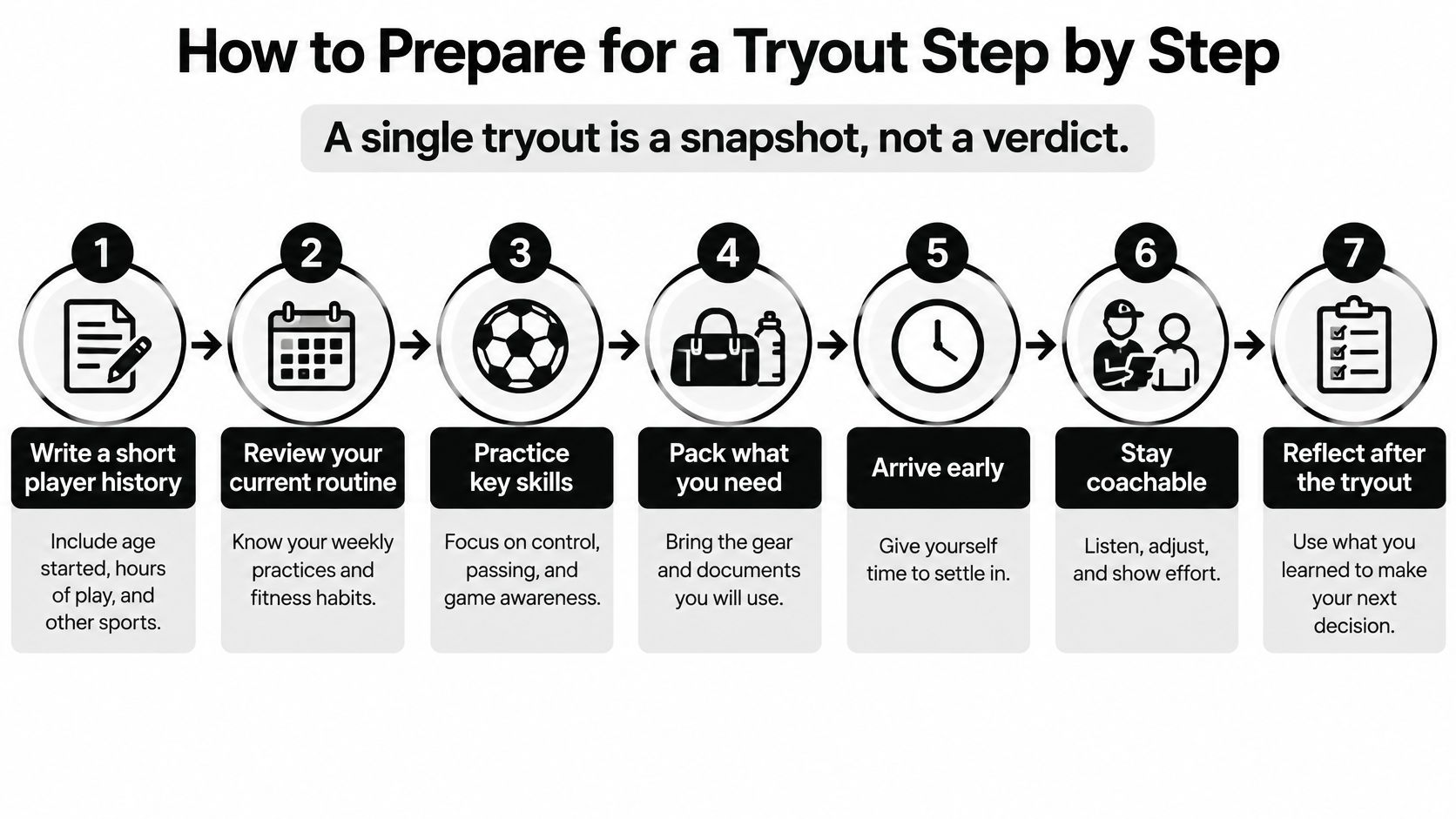
Write a short player history. Note the age your child started, weekly hours, other sports, injuries, and positions. Coaches weigh that history next to the touch they see on the day.
Train first touch and 1v1 defending three times a week with a partner, not cones alone. Evaluators reward the pass and the tackle when someone is closing.
Play small-sided games so passing accuracy and ball carrying show up under pressure. Isolated drills hide the decision.
Practice scanning before the ball arrives. Decision speed matters as much as the skill itself. Look, then receive.
Arrive early with cleats, shin guards, water, and printed paperwork. A calm start beats a sprint from the parking lot.
Write one or two notes after each session so you can compare weeks, not moods.
Ask for one area to improve. Specific feedback beats "you looked good."
In a longitudinal study of 502 U9 players, only 7.97% reached the highest provincial level by U17, while 23 of 120 selected U9 players succeeded, a 19.16% selection yield, in this study of youth team selection. Ask whether the program repeats evaluations and still has a path for late developers. Early speed and height can fake a verdict.
One afternoon on a field doesn't measure a player who is still growing.
Pack a recovery snack for the ride home. A practical list of snacks for workout recovery beats a gas-station guess after a hot session. A tryout doesn't guarantee selection, minutes, or a later invite. For a fuller prep list, use these soccer tryout tips.
Where Villarreal Houston Academy Fits in a Development Path
Soccer development climbs a ladder of separate commitments. Recreational play builds comfort with the ball and with teammates. Select teams add competition and travel. An academy is the rung for families who want a structured path across several years and who have already priced out the weekly hours, the fees, the injury load, and whether their child still enjoys the ride to practice.
A session only helps when the coach can say what the player is supposed to learn.

US Youth Soccer reports approximately 2.5 million annual registrations across 54 state associations. A local club can connect Tuesday training to state and regional play. The weekly calendar picks the right rung long before the crest on the jersey does.
Where we sit on that ladder
We're the official partner academy of Villarreal CF. Our coaches learn the Villarreal CF methodology and work side by side with Villarreal CF sports psychologists, and the development path focuses on competing at full potential with respect, integrity, and personal responsibility. Players also get the chance to visit Villarreal CF in Spain, train at the Ciudad Deportiva and the Pamesa Training Ground, and play alongside the club's elite Academy teams. That pathway separates an academy rung from a strong select team.
Participation doesn't guarantee playing time, starting spots, team selection, advancement, college recruitment, or a professional contract. Submitting a registration doesn't guarantee acceptance either. What you should expect is a straight answer on how our weekly load compares to the arithmetic you already ran for your child.
An academy spread across United City Church and Fall Creek Sports Complex has to keep tryout dates, field assignments, and schedule changes in one place. EventUploader for sports clubs is the kind of tool that keeps the calendar out of a group text, which matters when your week depends on accurate times.
See how a session looks when decision-making drives the work alongside fitness.
Confirm Your Shortlist Before You Register
Pick two or three teams whose level, weekly hours, and budget you can live with.
Ask the coach questions on safety, minutes, and the next age group before you pay a fee.
Book the tryout early and keep a backup team until acceptance is real.
Test the week for each shortlisted team so the calendar is proven before the season starts.
The decision is which weekly calendar your family can sustain, not which label sounds most impressive.
We offer select and competitive youth soccer for boys and girls as young as 4. At United City Church, Future Stars covers ages 4-5 and the Villarreal Junior Academy covers ages 5-9. At Fall Creek Sports Complex, the Junior Academy covers ages 5-9 and competitive teams cover ages 10-18. Confirm current sessions, age groups, and tryout dates with us before you register.

Villarreal Houston Academy offers select and competitive youth soccer for boys and girls, with training shaped by the Villarreal CF methodology and a focus on respect, integrity, and personal responsibility. If you're comparing soccer teams to join around Humble and greater Houston, start with the week you can sustain and the answers a coach will put in writing. Visit Villarreal Houston Academy to confirm age groups, locations, and tryout dates before you register.
Comments