


Youth Soccer Tryout Evaluation Form and Scoring Guide

The most popular advice about a youth soccer tryout evaluation form is to add more detail: more skills, more tests, more scores. That can make selection less fair. A spreadsheet that rewards size and sprint speed can turn a temporary physical advantage into an apparently objective judgment about a child's future.
A useful form does something harder. It records what the player can do today, identifies how the player learns, and makes uncertainty visible. Coaches still have to exercise judgment, but they should be able to explain that judgment through observed behavior, not a total that looks more precise than the evidence behind it.
The Complete Evaluation Form at a Glance
Use this as a sample scoring design, not a validated selection formula. The weights below are illustrative coaching choices that a club should agree on before evaluating players.
Block | What is observed | Suggested weight | Evidence required |
|---|---|---|---|
Player record | Full birth date, birth year, age group, playing-up or playing-down status | Not scored | Recorded before any score |
Technical | First touch under pressure, passing decisions, ball control | 30% | A specific touch or pass with context |
Tactical | Scanning, positioning, transition response | 25% | A moment from small-sided or match play |
Physical, age-adjusted | Speed, agility, strength compared with the age band | 15% | Test conditions and maturity context |
Psychosocial | Coachability, motivation, communication, respect | 15% | Behavior observed during activities |
Development potential | Learning speed, response to mistakes, plausible development priorities | 15% | Evidence of adjustment and written follow-up priorities |
Welfare and availability | Medical restrictions, consent, fatigue or pain flags | Not scored | Written information before participation |
The player record is administrative, not another performance category. Put the player's bib identifier, evaluator names, session date, preferred and observed positions, observation duration, and follow-up priorities in the header. Otherwise, a useful note can become impossible to interpret when staff compare sessions.
Complete identification before scoring. A defender playing against older opponents needs a different interpretation from a defender working in the usual age group. Record the context while it's known rather than reconstructing it during the selection meeting.
Make the evidence field usable
Outdoor soccer participation in the United States reached a record 16.8 million participants in 2025, up 15.8% from 2024, according to the Sports & Fitness Industry Association. That national participation context reinforces a practical problem for busy youth programs: informal impressions are difficult to compare across crowded sessions.
Keep each evidence field short enough to complete beside the field. A useful entry describes the situation, action, and outcome: received with a defender tight behind, opened away from pressure, and connected with the supporting midfielder. Writing good touch doesn't explain what happened.
Separate overlapping observations. Passing execution belongs under technical performance; recognizing an available passing lane belongs under tactical performance. Don't reward the same successful pass repeatedly without identifying the different behaviors being scored.
Practical rule: If an evaluator can't explain a score through an observable action, the score isn't ready for a selection meeting.
Keep welfare outside the total
The welfare block should never award points for being healthy or subtract points for reporting pain. Its purpose is to show whether the session offered a fair opportunity to observe the player.
Use not observed when a criterion wasn't tested. Don't replace missing evidence with a low score, and don't calculate a complete total from an incomplete form.
Before accepting the sheet, check that every scored block has supporting evidence, every recorded block is complete, and any observation gap has a follow-up action. A full page isn't necessarily a complete evaluation.
Adjusting the Form by Age Group
Use this age-band layout as a working template, then confirm the competition's actual registration and playing rules before assigning groups.
Age band | Game format | Weighting focus | Physical caution |
|---|---|---|---|
U6–U8 | 4v4 small-sided | Enjoyment, coordination, ball familiarity | Avoid timed sprint ranking |
U9–U10 | 7v7 small-sided | Decision-making, technique, willingness to participate | Compare within the same registration group |
U11–U12 | 9v9 small-sided | Add position-specific technical execution | Attach maturity context to physical observations |
U13–U18 | Full-sided or 11v11 | Tactical understanding and competitive consistency | Don't confuse maturity-related advantages with lasting potential |
The younger small-sided formats and developmental emphasis follow the framework in U.S. Soccer's Player Development Initiatives standards, which establish age-related playing standards through U12. The older full-sided row is a practical form-design example, not a claim that every tryout must use that format.
Record the registration context accurately
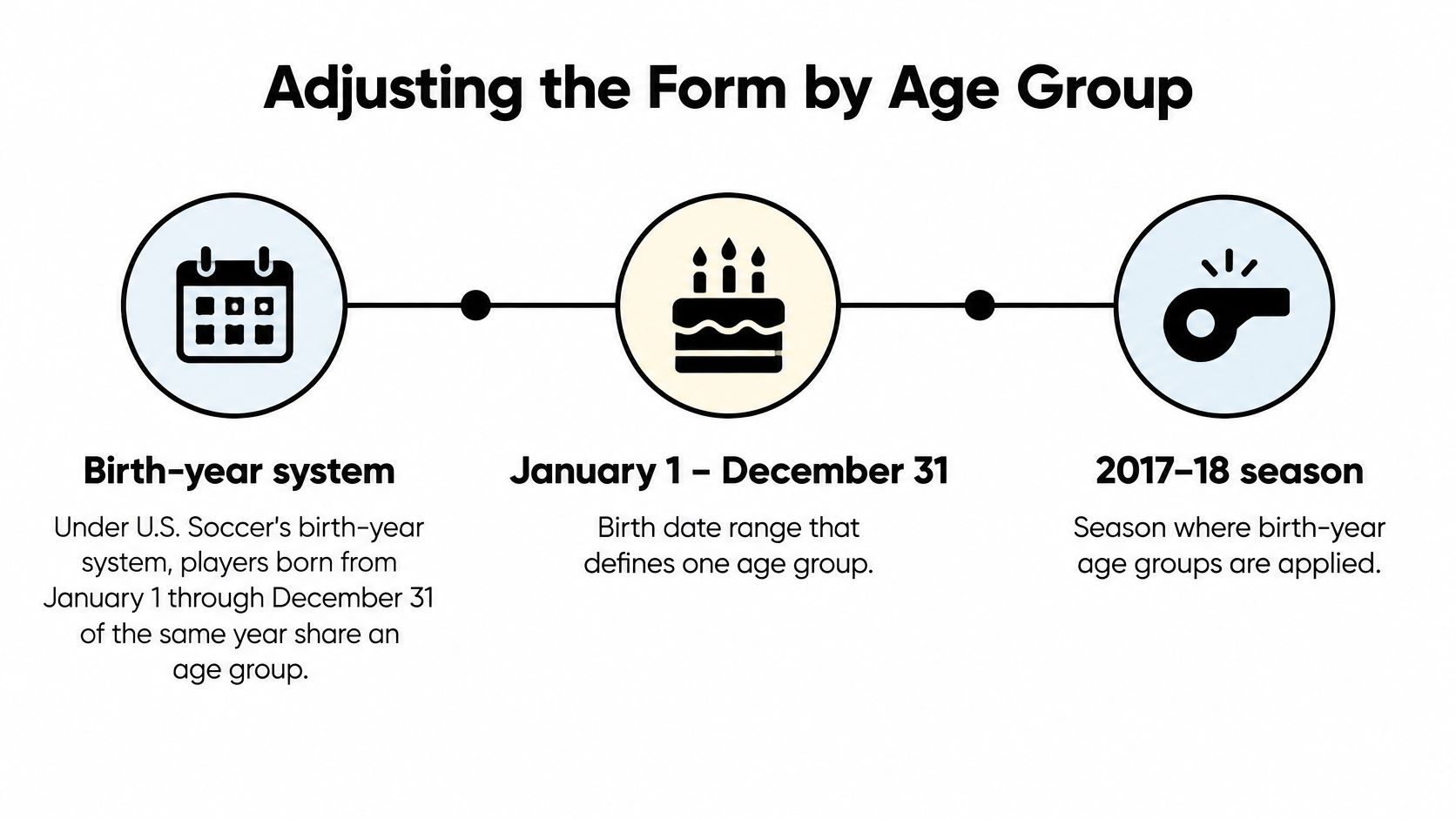
U.S. Soccer's explanation of its Player Development Initiatives describes the birth-year framework introduced in 2017: players born from January 1 through December 31 shared an age group, and players born in 2007 were classified as U-11 during the 2017–18 season. Treat that as the historical framework described by the source, not a substitute for checking the rules governing the player's upcoming season.
The distinction matters because a birth date and an age-group label aren't interchangeable. Record both, together with the competition and season. If a player is playing up or down, make the difference explicit.
The infographic illustrates that historical birth-year approach.
Change the question, not just the label
For the youngest players, ask whether they engage with the ball, recover their balance, try an unfamiliar action, and remain willing to participate. Don't translate an adult tactical checklist into smaller print. A child exploring space shouldn't automatically receive a poor positioning score.
As players develop, add demands gradually. Assess receiving shape, support angles, defensive responsibility, and execution in an appropriate role. Our guide to soccer development by age gives families a useful framework for understanding why those expectations change.
For a player trying an older group, write two distinct conclusions: how the player managed that group's demands and what the performance suggests within the player's own developmental context. Don't hide the challenge inside an unexplained low score.
Physical notes should describe relevant context without diagnosing maturity from appearance. A coach can record that strength affected a duel; the coach shouldn't claim to know biological maturity just because a player is tall.
Anchored Scores for Each Criterion
The following is an illustrative anchored rubric. Apply each description relative to the agreed age band, role, and activity rather than treating it as a universal standard.
Criterion | Score 1: emerging | Score 3: functional | Score 5: consistently effective |
|---|---|---|---|
First touch under pressure | Often loses control when marked | Usually controls a playable service | Receives under pressure and prepares the next action |
Passing decisions | Forces passes into occupied lanes | Finds available options with occasional misreads | Recognizes and selects an appropriate option early |
Scanning | Usually gathers information after receiving | Checks surroundings before most receptions | Scans and uses the information to adjust play |
Positioning | Frequently leaves the assigned space uncovered | Maintains the basic role | Adjusts with the ball, teammates, and danger |
Transition response | Delays involvement after possession changes | Recognizes the change and joins the next action | Responds promptly with an appropriate recovery or pressing action |
Speed and agility | Struggles with the activity's movement demands | Meets age-appropriate movement demands | Moves effectively while preserving soccer execution |
Coachability | Doesn't yet demonstrate the requested adjustment | Applies a clear correction with support | Applies feedback and transfers it to later actions |
Communication and respect | Misses needed exchanges or shows dismissive behavior | Shares necessary information and responds respectfully | Helps teammates through useful communication and respectful conduct |
Use the anchors as descriptions
FIFA's talent-identification guidance recommends combining quantitative information with qualitative observations and reassessing players over time. That supports evaluating technical, tactical, physical, and psychosocial dimensions rather than treating a test result as the whole player.
In this sample rubric, intermediate scores sit between the named anchors. Use them when repeated observations fall between descriptions, not because an evaluator wants to avoid committing.
An emerging score means the behavior wasn't yet effective in the observed context. It doesn't mean the child lacks intelligence, character, or future ability. Likewise, a consistently effective score describes the performance shown, not a prediction of professional success.
Give each criterion an evidence sentence. For scanning, an illustrative note might read: checked behind before receiving, noticed the defender closing the inside lane, and played outside. That distinguishes seeing information from merely turning the head.
Test whether the behavior transfers
An isolated drill can reveal a technical limitation, but it can't establish every match-related criterion. A player may complete an unopposed passing pattern without recognizing the same option against a defender. Use appropriately designed youth soccer tryout drills to create opportunities, then check the behavior in game-like play.
Avoid personality labels. Quiet isn't the same as disrespectful, and loud isn't the same as helpful. A player who communicates through a clear supporting gesture may contribute more than someone shouting instructions that teammates can't use.
For coachability, first confirm that the instruction was understandable and that the player had a genuine chance to apply it. If the next activity never requires the correction, the evaluator hasn't tested learning.
Score the response to an opportunity, not the absence of an opportunity.
Build the rubric before players arrive
Kuraplan's free rubric generator for teachers can help draft observable descriptions in a consistent format. Coaches still need to replace classroom language with soccer actions and check that each anchor can be seen during the planned session.
Don't add criteria because the tool makes them easy to generate. A short rubric that staff can observe consistently is preferable to a long checklist completed through guesswork.
Keep development potential separate from the match-performance anchors. Describe the adjustment the player made, the conditions that helped, and what should be tested next. Potential is a reasoned follow-up judgment, not permission to award extra points to a favorite.
Reducing Age and Maturity Bias in Scores
A study of 951 Swedish U15 players found selection bias favoring relatively older players and moderate-to-large bias toward early-maturing players, with maturation bias increasing at higher competition levels. That finding challenges the assumption that a neatly scored selection process is necessarily a fair one.
A coach can apply the same sprint test to everyone and still make an unfair inference from it. Equal testing conditions don't make every result an equally useful indicator of long-term soccer ability.
Make context visible without making it a ranking
Record birth month alongside the full birth date. During a selection review, check whether the apparent standouts cluster toward the older end of the registration group. Where the pool allows, compare observations among players closer in relative age, without creating a new birth-month quota.
Add optional developmental context. Keep this field descriptive and appropriately restricted. Don't ask coaches to assign biological maturity categories by eye or ask families to provide sensitive information without a clear purpose.
Prioritize soccer actions over raw physical outputs. Look at first touch under pressure, useful scanning, adaptation, and the ability to apply feedback. Physical performance still matters, but it shouldn't determine the tactical and technical scores as well.
Consider a scenario in which a powerful attacker repeatedly runs past defenders. The evaluator should ask what happens when the first route closes: does the player combine, protect the ball, or recognize another option? A successful run establishes something about current effectiveness, but not everything about decision-making.
Now consider a smaller midfielder who avoids contact by receiving on the half-turn. Don't describe that player as lacking competitiveness because the player solves the problem without a collision.
Audit the interpretation
Use a brief selection-review checklist:
Check repeated rewards. Has size increased the physical score, the tackling assessment, and a loosely defined competitiveness score?
Check opponent context. Did a player succeed against comparable pressure, or mainly against less physically capable opponents?
Check learning evidence. Does the potential rating describe an actual adjustment, or merely an evaluator's optimism?
Check uncertainty. Would another observation meaningfully change the decision?
A club may reasonably need a player who can handle a current competitive demand. State that as a roster decision, not proof that another child has a lower ceiling.
False-precision warning: Measuring a sprint carefully doesn't make it a precise measure of soccer potential.
Don't claim that removing physical testing removes bias. Coach impressions can also favor familiar, confident, or physically dominant players. The better safeguard is a clearly limited interpretation: record what the player did, identify what affected it, and avoid turning today's advantage into a permanent label.
Welfare, Injury and Feedback Fields
If a child isn't selected, will the family receive actionable feedback and a safe way to improve? That question belongs in the design of the form, not in a hurried conversation after decisions have gone out.
A player returning from illness or managing pain hasn't necessarily shown a representative performance. The evaluator needs enough availability information to interpret the session, but doesn't need unrestricted access to the child's medical history.
Complete welfare information in participation order
Before arrival. Record guardian consent, relevant medical restrictions, emergency contact information, and any instructions governing participation.
At check-in. Mark availability as full, partial, or absent, and identify which activities the player can safely attempt.
During activity. Record reported pain, unusual fatigue, distress, and any activity stopped or modified. Follow the applicable medical guidance rather than asking the player to push through.
At review. Identify observations that couldn't be completed and whether another evaluation is appropriate.
A soccer-academy practitioner consensus identified the period during and up to 12 months after peak height velocity as an important injury-risk period and supported using maturity information for injury prevention and performance planning, not recruitment or release decisions. That distinction should govern who sees sensitive information and why.
Don't turn a welfare flag into a technical penalty. If a player can't safely complete maximal running, omit that test and preserve the observation gap. A lower-intensity activity may provide useful information, but it isn't an interchangeable substitute for a maximal test.
Our injury prevention in soccer guidance offers families a related starting point for discussing preparation and safe participation. A tryout scorecard itself isn't medical clearance.
Make feedback specific enough to use
The post-tryout summary should identify strengths, a manageable set of development priorities, and a review date where appropriate. Replace improve passing with a task such as receiving across the body and connecting with the supporting player while a defender closes.
Connect each task to the observation that prompted it. Explain what improved execution would look like, and distinguish something the player can practice from a decision controlled by roster needs.
Our coaches are meant to engage players, communicate positively, and help young people find their best on and off the field. That doesn't require avoiding difficult feedback. It requires explaining the decision without treating a child's current performance as a fixed identity.
For a simple player reflection, a coach could adapt a workflow designed to collect student responses with FormBackend. Keep reflection questions about understanding, confidence, and next steps separate from confidential medical information.
Not selected today is a placement outcome, not a verdict on development. The written summary should make that distinction clear while remaining honest about what the club can and can't offer next.
Running Two Evaluators to Score Consistently
Use this sample paired-evaluator protocol to make disagreement visible rather than allowing the strongest voice to settle every decision.
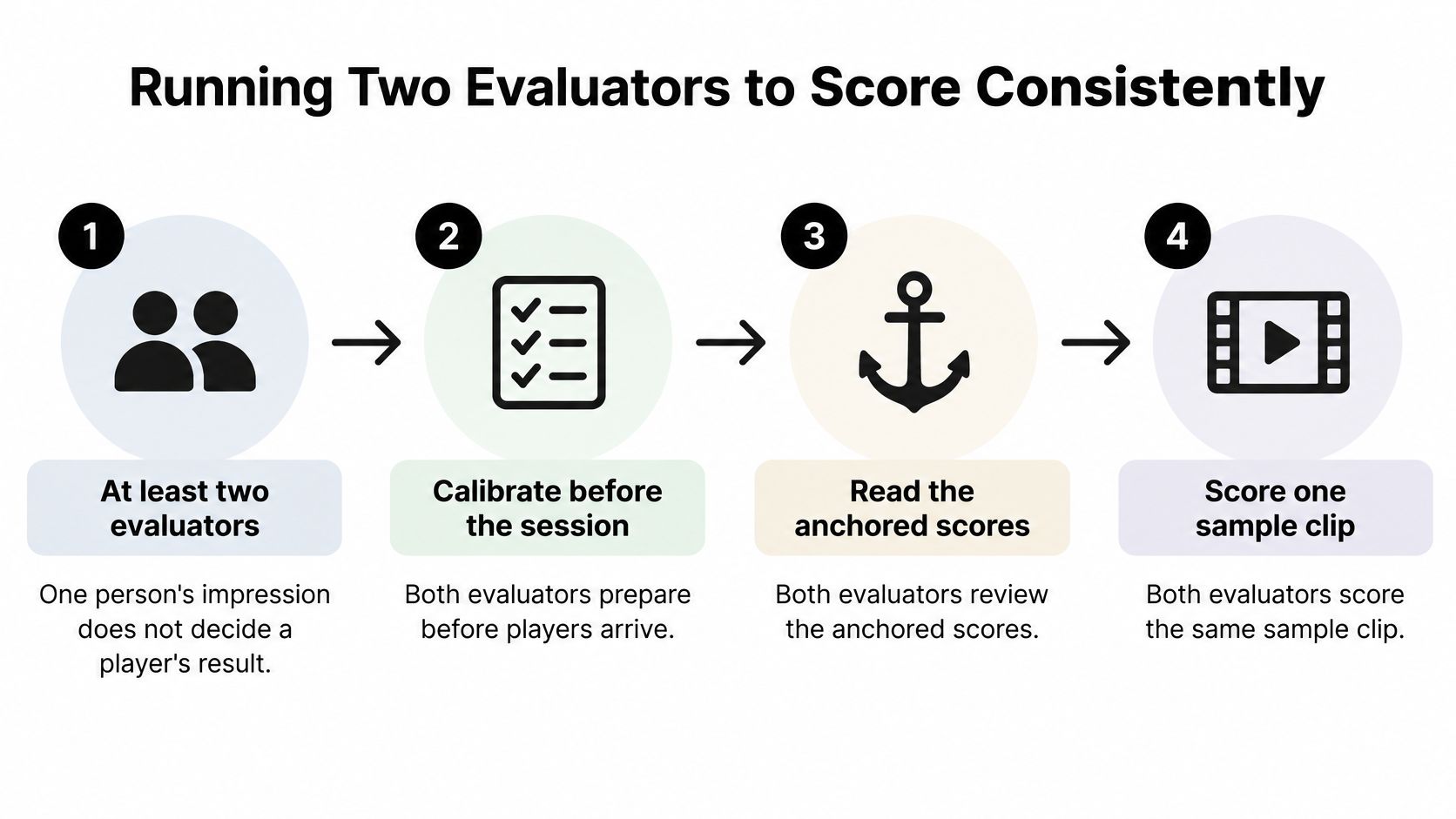
Calibrate beforehand. Independently score a sample clip, then discuss the anchors. Agreeing on a definition without testing it is the common shortcut.
Plan shared coverage. Arrange viewing positions and rotations so both evaluators observe every player. Don't assume standing beside the same field produces equivalent coverage.
Record independently. Capture actions during play and finalize notes at a natural stoppage. Early conversation can pull both ratings toward the first opinion.
Separate context. Keep welfare and maturity information distinct from performance entries. Don't let incomplete availability become an unexplained low mark.
Resolve material gaps. As an illustrative trigger, review any criterion where ratings differ by two points. Use evidence, and request another observation when the notes don't settle it.
Preserve the record. Average the final independent ratings while retaining both originals and calibration notes. An average alone conceals disagreement.
The principle also appears in structured interviewing; MyCulture.ai's discussion of consistent scoring for HR teams offers a useful comparison for separating individual assessment from group discussion.
At Villarreal Houston, our coaches learn the Villarreal CF methodology and work side by side with Villarreal CF sports psychologists. Shared preparation matters, but evaluators should still document their own observations before discussing a player.
Reading Totals and Choosing the Next Step
The following bands are hypothetical operating thresholds, not validated selection standards. A club should approve and test its interpretation before using them with families.
Weighted total | What it means in this sample system | Suggested action |
|---|---|---|
4.0–5.0 | Strong observed fit for the age band | Review role and roster suitability |
3.0 to below 4.0 | Competitive performance with development needs | Consider placement with written priorities |
2.0 to below 3.0 | Current execution needs support | Consider a development setting or re-evaluation |
Below 2.0 | Substantial gaps in the observed context | Give practical feedback and consider another pathway |
Calculate the total by multiplying each scored block's average by its agreed weight, then adding the contributions. Leave the player record and welfare block out of the arithmetic.
A total answers a narrow question: how did the recorded performances compare under this scoring design? It doesn't independently establish future potential, positional suitability, or readiness after injury.
Work through an example
For a hypothetical player, suppose the block averages are technical 4.0, tactical 3.5, physical 3.0, psychosocial 4.5, and development potential 3.0. Applying the illustrative weights produces the following calculation.
Block | Example score | Example weight | Contribution |
|---|---|---|---|
Technical | 4.0 | 30% | 1.20 |
Tactical | 3.5 | 25% | 0.875 |
Physical | 3.0 | 15% | 0.45 |
Psychosocial | 4.5 | 15% | 0.675 |
Development potential | 3.0 | 15% | 0.45 |
Total | 3.65 out of 5 |
That hypothetical result falls in the competitive band. The written recommendation should then identify the actual tactical and physical observations requiring attention, while explaining the evidence behind the development-potential rating.
Don't automatically make every lower-scoring category a training priority. A physical limitation may call for monitoring or appropriate conditioning, while a recurring positioning error may need direct coaching. The evidence determines the task.
Give borderline cases another look
As an example club rule, a result within 0.2 of a band boundary could trigger an evidence review. That is a procedural choice, not a scientifically established margin.
Review the context before changing the number. Was the player observed in an unfamiliar role, against markedly different opposition, or with restricted availability? If the evidence is incomplete, another session is more defensible than negotiating a score until it crosses the line.
A player with strong learning evidence but limited current physical effectiveness may merit a planned reassessment. A partly available player needs a decision based on what was observed, with unfinished areas left explicit.
Write the placement reason separately from the total. A club might rate a player positively yet lack an appropriate roster opening; families deserve to understand that distinction.
Keep feedback private and focused on the child's own actions. Explaining what would support a different future decision is more useful than telling a family how close another player finished.
Confirm the Form Before Your Next Tryout
Complete this readiness check before admitting players to scored activities:
Evaluator approval. Staff have tested the anchors and agreed on the observation plan.
Welfare readiness. Consent, restrictions, and participation status are available to the appropriate staff.
Feedback space. The summary allows specific next steps and a review date.
Family communication. Criteria, decision procedures, and the intended feedback timetable are stated in writing.
Set expectations without turning a developmental process into a promise. Submitting a registration doesn't guarantee acceptance into any program, and our club may accept, deny, suspend, or terminate any player or family's participation at its sole discretion.
Participation doesn't guarantee playing time, starting positions, team selection, advancement opportunities, college recruitment opportunities, or professional opportunities. A positive evaluation should never be described as a guarantee of those outcomes.
Make the review meaningful
For players returning for re-evaluation, check availability, growth-related concerns, injury status, and progress on the assigned tasks. Use the same anchors and, where practical, the same evaluator pairing so staff can interpret change without introducing unnecessary differences.
A youth soccer tryout evaluation form is ready when coaches can explain both its conclusions and its limits. Families should leave knowing what was observed and what the next useful action is.
Villarreal Houston Academy offers select and competitive youth soccer programming with age-appropriate coaching focused on intelligence, skill, and character. Visit Villarreal Houston Academy to explore programs and tryout options, and discuss the right evaluation setting for your child's current development.
Comments