


Cy Falls Soccer Guide: Youth Programs, Ages and Costs

Are you comparing soccer programs by the registration fee, or by what your family will spend and do across a season? A team can look affordable until you add uniforms, tournament weekends, transportation and evenings away from home.
For parents searching for Cy Falls soccer, the first distinction is between Cypress Falls High School's team and the youth programs serving nearby families. They aren't interchangeable. Choose a youth program around your child's readiness and your household's schedule, then consider how that experience supports longer-term goals, including school soccer.
Youth Soccer Options Around Cypress Falls at a Glance
Families usually choose among five program types, each suited to a different purpose. Use this planning comparison to identify a starting point, not to assume that a particular club currently has an opening.
Cypress Falls area program types at a glance
Program type | Typical ages | Commitment | Best fit |
|---|---|---|---|
Recreational league | 4-13 as a starting search range | Weekly practice and weekend games as a planning model | Fun, basic skills, low pressure |
Junior academy or development team | 5-9 as a starting search range | One to two practices a week plus games as a planning model | Structured technical training |
Competitive or select team | 10-18 as a starting search range | Several practices a week plus league and tournament games | Tryouts and higher-level play |
Travel or showcase team | Eligible birth-year roster set by the team | Weekend travel and tournament fees, alongside training | Wider exposure to outside coaches |
High school varsity (Cy-Fair ISD) | Enrolled high school students meeting school eligibility rules | School season with district games and a playoff path | Students aiming for varsity and playoffs |
The age ranges are search filters, not universal eligibility rules. Likewise, the practice descriptions are planning examples rather than confirmed schedules for a local team.
What each choice asks of your child
Recreational soccer is the sensible starting point when a child wants to try the sport without making performance the center of family life. Look for frequent touches on the ball, clear instructions and an environment where mistakes don't stop children from participating.
Junior development adds more deliberate teaching. A useful session connects receiving, dribbling and passing to simple game decisions, rather than having children wait in long lines for isolated drills.
Competitive teams ask players to handle greater pressure and more consistent attendance. A child who enjoys practicing between sessions may welcome that step; a child who mainly enjoys playing with friends may prefer recreational soccer.
Travel and showcase teams add another decision: whether the competition justifies the disruption. Exposure to outside coaches isn't a substitute for suitable playing opportunities and useful feedback.
Turn the commitment into a calendar
Before comparing fees, place the proposed practices and games beside school, work and sibling activities. Include leaving home, parking, warm-up, pickup and the return trip, not just the session itself.
Practical rule: Choose the least demanding program that still meets your child's current goal.
For fun, begin with recreational soccer. For more structured learning, compare development and competitive environments. For varsity ambitions, learn the school's expectations without assuming that an expensive club team guarantees selection.
Finding the Right Age Group and Birth Year
Birth year, approximate age in 2026 and program fit
Birth year | Approximate age in 2026 | Program fit |
|---|---|---|
2022 | 4 | Recreational league |
2021 | 5 | Recreational or junior academy |
2020 | 6 | Recreational or junior academy |
2019 | 7 | Recreational or junior academy |
2018 | 8 | Recreational or junior academy |
2017 | 9 | Recreational or junior academy |
2016 | 10 | Recreational or competitive |
2015 | 11 | Recreational or competitive |
2014 | 12 | Recreational or competitive |
2013 | 13 | Recreational or competitive |
2012 | 14 | Competitive or high school varsity, if enrolled and eligible |
2011 | 15 | Competitive or high school varsity, if enrolled and eligible |
2010 | 16 | Competitive or high school varsity, if enrolled and eligible |
2009 | 17 | Competitive or high school varsity, if enrolled and eligible |
2008 | 18 | Competitive or high school varsity, if enrolled and eligible |
These ages are simple calendar calculations: the age a child turns during the reference year. They're not an official competition age matrix, and program fit describes a possible search direction rather than acceptance.
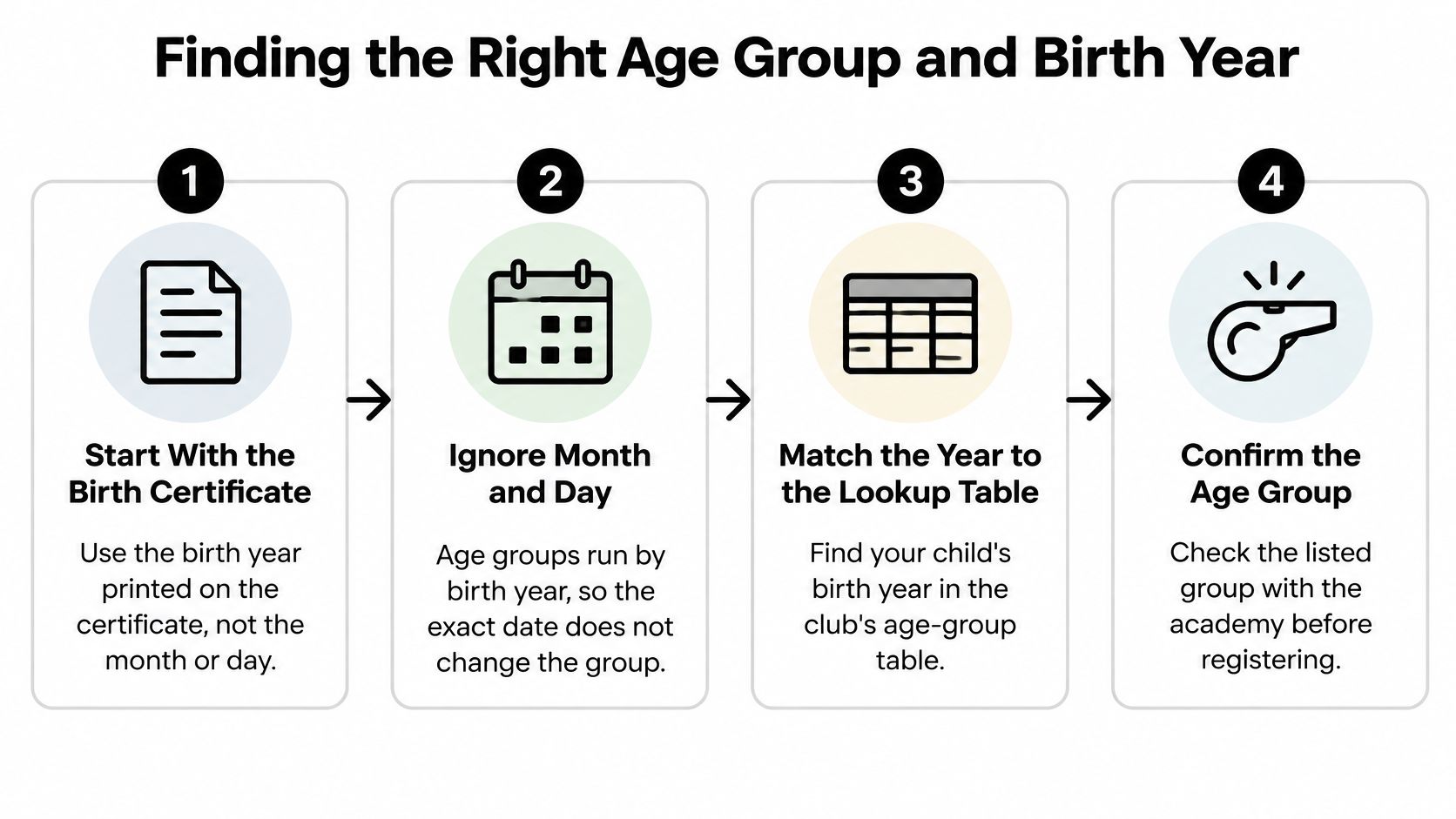
Start with the birth year, but keep the full birth date available. A calendar-year system and a school-year system can place the same child differently, so don't assume the month and day are irrelevant until the program confirms its rules.
Use this visual as an initial birth-year check, then verify the actual cutoff.
Confirm placement before payment
Establish the cutoff. Ask whether the team uses calendar-year grouping, school-year grouping or another competition rule. Use the actual season's eligibility chart.
Separate eligibility from readiness. Being old enough for a team doesn't establish that its pace, physical demands or expectations suit the player.
Check the playing format. Ask about team size, field size and how coaches adapt instruction. Younger players need understandable decisions and meaningful involvement.
Request an evaluation when the fit is unclear. A trial session can show whether the child can follow instructions and participate comfortably without committing to a season.
Prepare the registration conversation. Have the birth date, previous team history, preferred position if relevant, and available training days ready.
Our Cypress-Tomball location has boys categories for birth years 2010, 2011, 2012 and 2013. That identifies the local categories to discuss with us; it doesn't establish an available roster position.
Avoid choosing an older group because it sounds more advanced. Appropriate challenge means the child must think and work while still getting enough successful involvement to learn.
How Cy-Fair High School Soccer Fits the Picture
Cy Falls soccer sits within an established school competition environment. In January 2022, Cy-Fair ISD hosted its 19th annual Men's Varsity Soccer Showcase, featuring 26 teams, according to the Houston Chronicle's tournament preview.
That history matters because youth players aren't preparing for an isolated school team. They're developing toward an environment where opponents also have organized coaching, match experience and tactical preparation.
What the results tell parents
Cypress Falls finished fourth in District 17-6A with a 6-4-4 record during 2024-25, according to Cy-Fair ISD's postseason announcement. Those results show a team capable of earning a playoff place, while also leaving room to turn closely contested matches into wins.
The season ended with a 2-0 bi-district loss to Houston Lamar, as recorded in Cy-Fair ISD's playoff results. A score alone can't diagnose the cause of a defeat, but it provides a reason to prepare players for knockout-game pressure.
As of 2026, MaxPreps' Cypress Falls all-time listing reported a 107-104-58 boys' record, including a 1-4 playoff record. Treat that as the platform's recorded history, not a prediction of the current team or an assessment of an individual player.
Translate results into useful preparation
A strong first touch matters most when it gives the player a useful next action. Receiving across the body, checking over a shoulder and recognizing pressure help a player pass before an opponent closes the space.
Similarly, defending means more than winning tackles. Players need to recognize when to press, when to delay an attacker and when to recover toward the center.
Practice game situations. Rehearse protecting a lead, chasing an equalizer and reorganizing after losing possession.
Learn positional responsibilities. Ask what the player should do when a teammate advances or an opponent changes position.
Contact the school program. Attend information events and clarify tryouts, offseason expectations and conflicts with club activities.
A youth team should help a player become more prepared for school soccer, not promise a school roster spot.
Judge progress through decisions and execution under pressure. A highlight goal is useful, but so is recovering into position after a mistake.
Training Venues and Development Pathways
Say a family near Cypress Falls finds a promising training group in Humble. The coaching looks suitable, but practice overlaps with the evening commute and a sibling's pickup. Before accepting the place, the parents need to test the actual trip.
Our academy fields at Fall Creek Sports Complex, HKA South, are at 9810 Wyatt Shores Dr, Humble, TX. Our academy fields at United City Church, HKA North, are at 19901 Townsen Blvd, Humble, TX 77338.
Those are distinct destinations. Don't select a route using only the academy's name or assume that the nearest facility hosts the child's assigned team.
Test an ordinary school night
Use Google Maps or another route planner for the proposed departure time, then drive the route when practical. Account for the transition from school or after-school care, not just the journey from home.
Confirm the assigned field. Get the team's actual training address and pickup instructions.
Inspect access. Check parking, lighting around pickup areas and where siblings can safely wait.
Understand weather procedures. Establish how cancellations, field closures and replacement sessions are communicated.
Plan the handoff. Decide who handles transport when work runs late or another child has an activity.
The weekly calculation is straightforward: travel time plus training time plus arrival and pickup time. Repeat that calculation for every scheduled visit, then add match-day commitments separately.
Look beyond the next team
Ask the coach to describe what improvement would look like for your child. An answer such as receiving under pressure and finding a forward pass is more useful than a vague promise of advancement.
Find out who evaluates players and how feedback reaches families. Moving to a different group should follow a clear assessment of readiness, not pressure to buy additional training.
Build recovery into the routine too. SunnyBay's tips to reduce workout injuries offer a starting point for a family conversation about preparation and training habits; individual pain or injury concerns belong with a qualified healthcare professional.
A manageable venue helps protect attendance, meals, homework and rest. Those practical conditions deserve as much attention as the field surface.
Real Costs, Travel and Refund Rules to Plan For
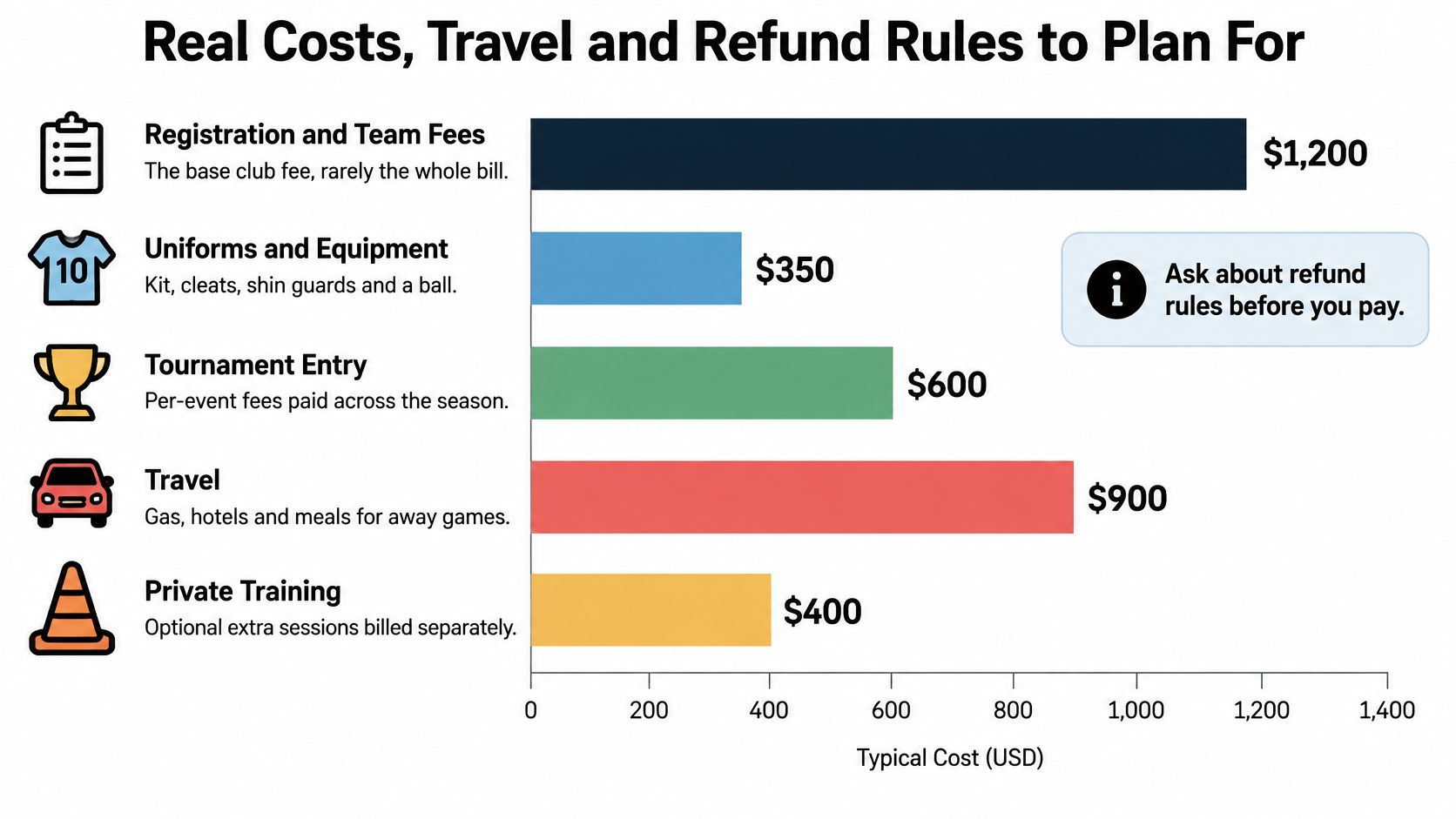
The registration fee isn't the season budget. Parents need to know what they must pay, what they can decline and what they'll spend getting the player to the field.
Nationally, Project Play's youth sports cost information estimates average soccer spending at $1,188 per child per season, while travel averages $260 per sport per child. These are national benchmarks, not local academy prices, and the travel figure isn't a soccer-specific surcharge to add automatically.
Season cost categories and how often they recur
Cost item | Mandatory or optional | How often it recurs |
|---|---|---|
Registration and team fees | Mandatory for an accepted paid place | Once per season, potentially collected in installments |
Uniforms and equipment | Mandatory required items | Annual planning allowance, plus replacements |
Tournament entry and travel | Often optional in some pathways; required when included in the team commitment | Per tournament or trip |
Private training and camps | Optional unless expressly included in the accepted program | Per session or program |
Ask for an itemized estimate rather than a starting price. Tournament costs can be compulsory once a family accepts a team whose calendar includes those events.
This visual identifies spending categories, not verified local prices or proportional costs.
Build the total without double-counting
Create a spreadsheet with columns for included in team fees, paid separately, payment due and required or optional. Put uniforms, tournament entry, accommodation, fuel, parking and meals in their own rows.
Use the club's quoted amounts to build the total. Don't start with the national average and then add every local charge, because that would count spending categories twice.
For recurring expenses, multiply your household's expected cost per outing by the actual calendar. For annual planning, combine the seasons and optional activities your child will attend, rather than assuming that a season quote covers the whole year.
Budget check: A payment plan changes when you pay. It doesn't reduce the total commitment.
Keep time beside money in the same worksheet. Record door-to-door practice commitments, match days and overnight absences so that a cheaper fee doesn't conceal an unworkable routine.
Read the withdrawal rules first
Our academy issues no refunds for voluntary withdrawal, transfer to another club, dissatisfaction with playing time, coaching decisions, team placement or schedule conflicts. Resolve concerns about those matters before paying.
Submitting registration doesn't guarantee acceptance into a program. We may accept, deny, suspend or terminate a player's or family's participation at our sole discretion.
Clarify payment timing and available payment arrangements directly with us. For carpooling, confirm who is responsible for each journey and establish a backup before treating shared transport as guaranteed.
Compare Local Programs and Contact the Academy
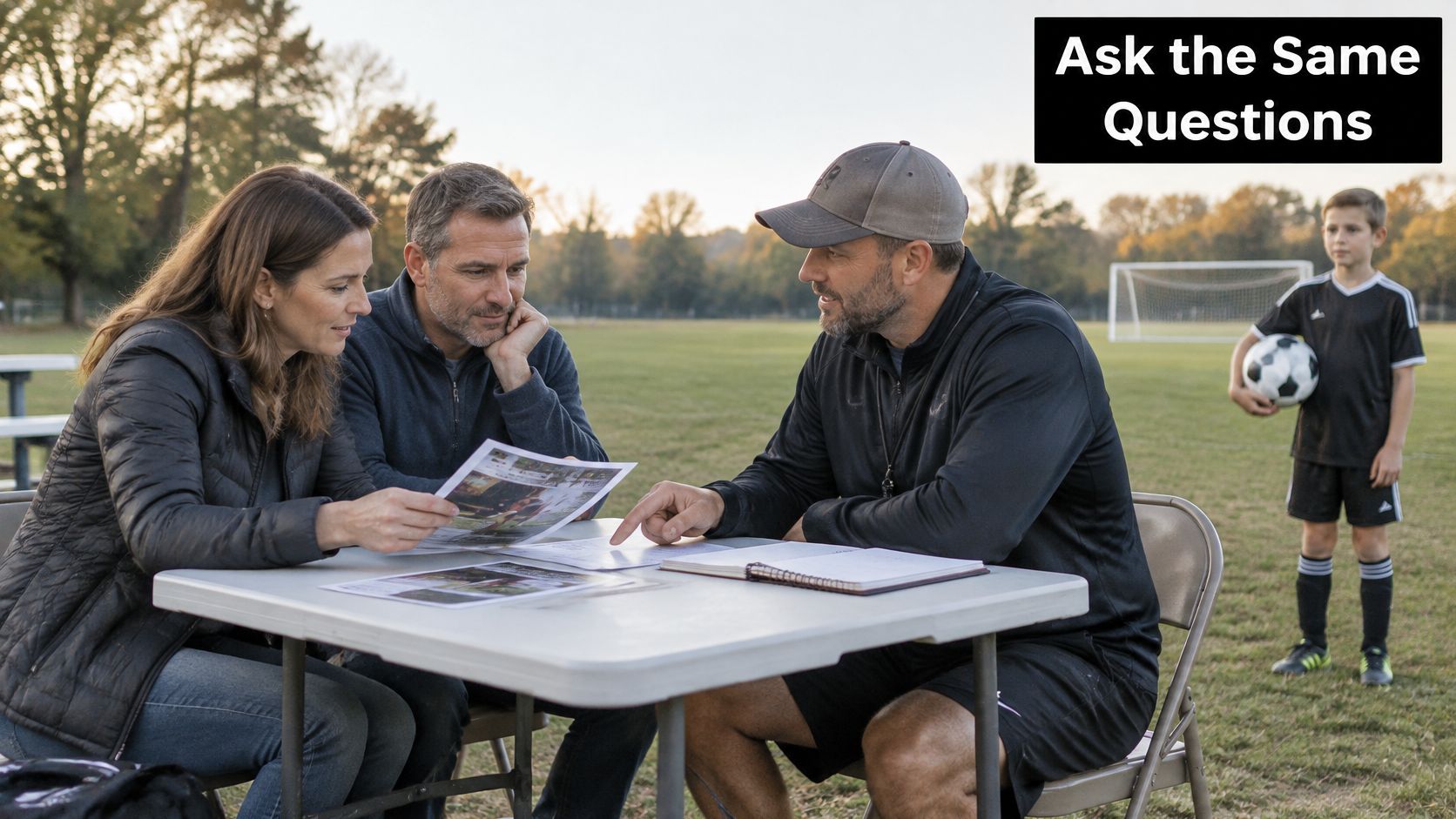
The most useful comparison happens at the team level. A club's reputation won't tell you whether the assigned coach, field and calendar fit your child.
Use a coach conversation to turn general promises into specific answers.
Compare the same evidence
Bring a short comparison sheet to each conversation. Write the child's goal at the top, then evaluate each option against it.
Placement fit. Record the eligible group, evaluation process and whether a place is available.
Calendar fit. Obtain the proposed training days, game expectations and tournament commitments.
Financial fit. Compare itemized totals and payment obligations, not advertised entry fees.
Coaching fit. Watch whether instructions are clear and whether players receive constructive, individual feedback.
Development fit. Ask what the coach wants the player to improve and how progress will be communicated.
Family fit. Decide whether the household can sustain the routine without depending on repeated exceptions.
Our mission is to provide age-appropriate training with qualified coaches so local youth talent can play at its fullest potential. Our development approach emphasizes respect, integrity and personal responsibility.
Use those commitments as observable tests. Notice how a coach responds to mistakes, whether players take responsibility for equipment and how teammates treat each other during competitive exercises.
The video below can support your questions, but observing the assigned group is the stronger test of everyday fit.
Make the call with a clear goal
At Fall Creek Sports Complex, we offer Recreational Soccer for ages 4-13 in partnership with MLS Go, the Villarreal Junior Academy for ages 5-9, and Villarreal Competitive Teams for ages 10-18. Confirm which location and team apply to your child rather than assuming every option operates at every site.
Call us at 281-962-4920 with your child's birth year, preferred location and season goal. Request current evaluation arrangements and the team-specific information needed to finish your comparison.
Choose the program where your child can participate consistently, understand the coaching and enjoy working toward improvement. If a major cost or schedule question remains unanswered, resolve it before accepting the commitment.
Villarreal Houston Academy offers recreational, junior and competitive soccer options that help families match a player's development goals to an appropriate program. Visit Villarreal Houston Academy to explore the available pathways, then contact us to confirm your child's placement, training location and full season commitment.
Comments