


When Do Soccer Tryouts Start? Dates by Age and Club

Competitive youth soccer tryouts in the United States usually start in late spring or early summer, and most formal evaluations happen between May and July for a season that begins in August. The exact date is set locally by the state association and the club, not by a national calendar.
That missing single date is the first thing to understand, and it's where most family confusion starts. One club can finish its evaluations before another club in the same county has even posted dates, and both are on schedule. A recreational league can still be taking sign-ups while a select team has already held its final session.
The word tryout hides a second problem. Sometimes it means a selection day that ends with a roster decision. Sometimes it means an evaluation spread across a month of training. Sometimes it means a development placement for a 6-year-old who was never going to be cut.
The question worth asking: not only when the session is, but which of those three events your child is walking into.
Separate those, and the calendar stops being mysterious. You can build your own dates for the Houston area and know exactly what to do when one slips.
Typical Tryout Months for Each Age Group and Program
For competitive youth soccer in the United States, tryouts usually begin in late spring or early summer for the season that follows, and the timing tracks a seasonal year that U.S. Soccer's player registration framework describes as August 1 to July 31, or September 1 to August 31 depending on the association. Inside that framework, each club publishes its own exact days every season, so treat the windows below as ranges to watch rather than dates you can circle in ink.
Program type | Typical window | When to watch for announcements | Notes |
|---|---|---|---|
Competitive or select teams, U11 to U19 | Late spring to early summer, about May to July | April or May | Older and advanced players may be assessed earlier |
Recreational leagues | Rolling enrollment before each season | From June until the first practice, often late August | Several entry points each year |
Youngest players, 6U to 9U | No formal tryouts in some areas; evaluations or placement instead | Club newsletter and registration portal | Ask whether a placement session is offered |
Late or supplemental evaluations | Extra sessions after the main window | Announced directly by the club | Ask about open roster spots |
How to Read Each Row
Find your child's program first, then read across. Competitive and select teams carry the earliest decisions. Clubs around Greater Houston typically publish announcements in April or May, and many formal evaluations land between May and July. Older and more advanced players often get assessed earlier than younger ones, because coaches want rosters and competition plans settled before the fall season begins.
Recreational leagues run on a different clock. Registration opens weeks before the first practice and stays open in stages, and the same league usually offers winter, spring and summer entry points. A missed deadline there costs you a season, not a year.
The youngest players often skip the selection format entirely. Many clubs place children in the 6U to 9U range through evaluations or development sessions rather than a formal tryout, which is why the email your neighbor received may never use the word tryout. A session at this age tends to look like a coach watching small-sided games, and the youth soccer age groups breakdown shows how clubs label these early brackets so you know which list your child belongs on.
Here's the whole picture on one timeline:
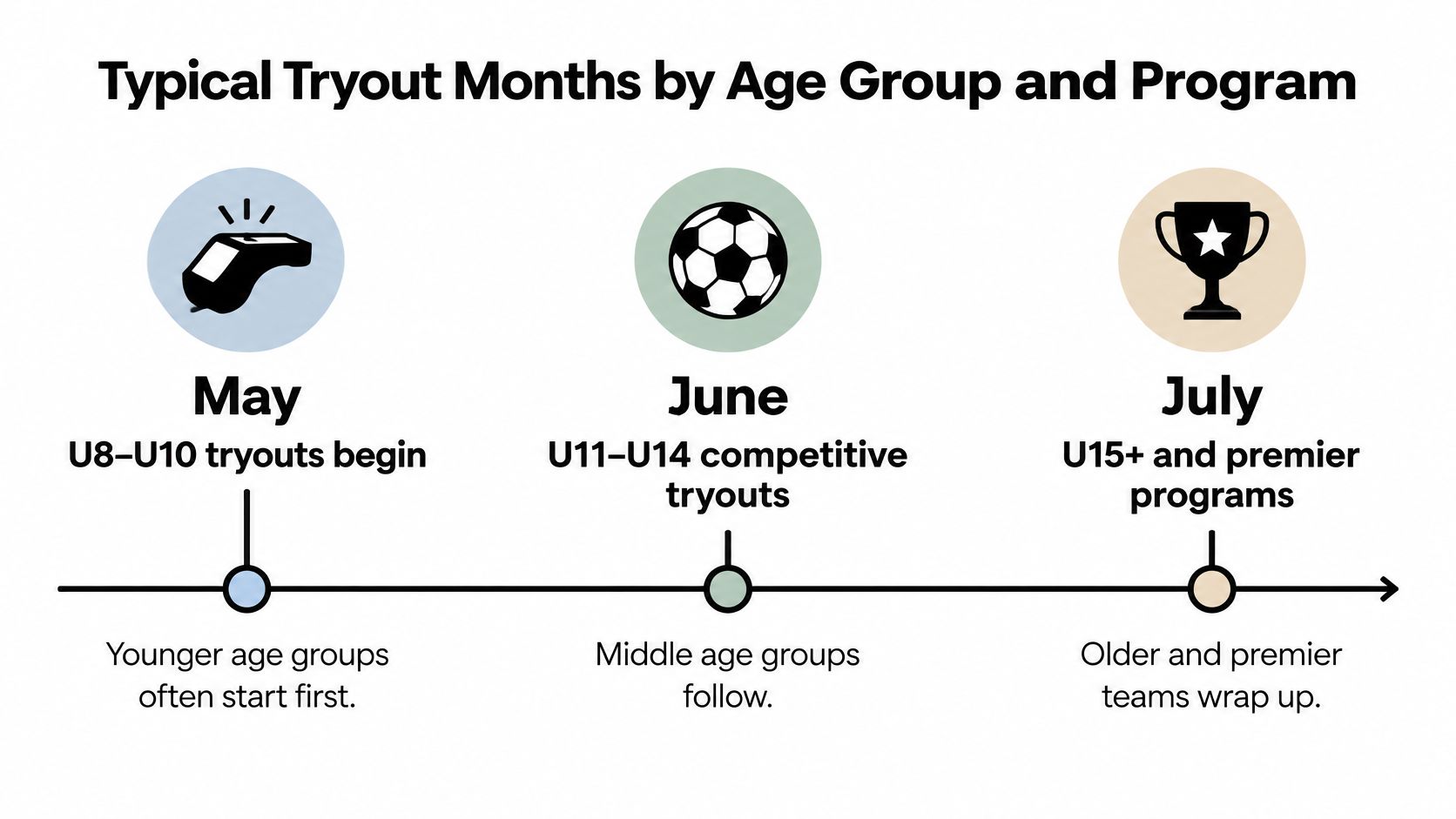
Now work backward. The August season start is your anchor point, and every window in the table exists to get a roster settled before it. Pick the row that matches your child's program, mark the announcement month from the third column on your own calendar, then confirm the exact days with the club as soon as dates post. Popular age groups fill quickly, so making that confirmation call in April rather than June keeps the widest set of options open.
Why the Start Date Changes From Club to Club
A bulletin board of penciled-in dates is the closest most clubs get to a national calendar:
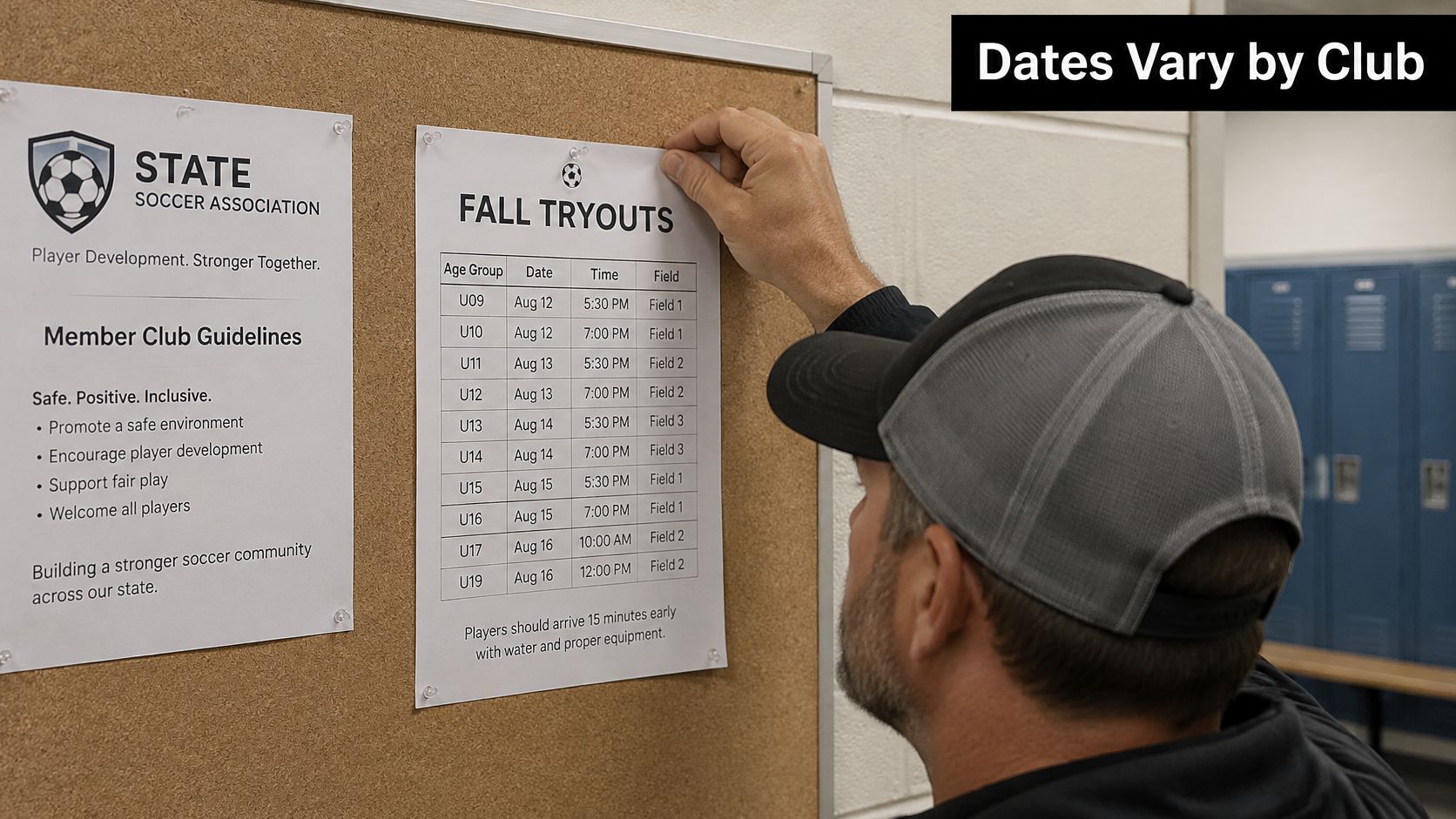
No one expects every school district in the country to open on the same morning. Youth soccer works the same way. Tryout season starts when the local rulebook says it starts, and three variables decide what that rulebook contains.
The Governing Body Owns the Rulebook
Every club competes inside a state association, a league, and often a district or regional body. Those organizations publish the season structure the club has to fit within, and a club that changes leagues can shift its tryout month without changing a thing about its coaching. This is why the useful first question isn't "when does soccer tryout season start" but "who governs this team."
The Birth Year Decides Which List Applies
Age groups are cut by birth year, so the group determines which tryout list matters to your family. A child born near a cutoff can sometimes be considered for two different age groups, and those groups may not evaluate on the same weekend. Confirm the group before you save a date, not after.
The Seasonal Year Sets the Clock
Clubs schedule evaluations to finish before the new seasonal year begins, then start training. If a club runs a fall-to-spring year, its evaluation window is the late spring and summer that come before it. Families are often surprised to find that a strong spring season runs straight into a tryout for next year while the current one is still going.
One more layer sits underneath all three: the club's own choices. Some clubs hold a single formal tryout day and fill rosters from it. Others observe players across several training sessions and decide at the end. That's a coaching decision, not a rule, and it's worth asking about directly.
Coaches talk through what they watch when players arrive:
Three Questions That Pin Down Your Date
Answer these in order and the month usually falls into place on its own.
Which association and league governs this team? Their published season structure comes before the club's own flyer.
Which birth-year group applies this season? Ask the club to state it in writing if your child is near a cutoff.
When does this club's seasonal year begin and end? The evaluation lands in the weeks before that start.
Families comparing programs can read more about how select soccer teams are built while they shortlist clubs.
What It Means
Parents say tryout and usually mean one of three things: a selection, an evaluation, or a development placement. The message in your inbox might use any of those words, plus ID session or placement day, and the label decides which calendar your summer follows.
US Youth Soccer's ODP tryout information notes that each state association sets its own evaluation dates, age groups and fees, so families should confirm their state's rules rather than relying on a national date. Many state competitive rules also limit formal tryouts for the youngest age groups, which explains a lot of the confusion. A young child is more likely to receive an invitation or a placement than a selection decision.
Event type | What it decides | Typical timing | Who it fits |
|---|---|---|---|
Formal tryout | Roster placement at the event | Competitive or select teams, late spring to early summer | Players seeking a select or competitive roster |
Evaluation | May or may not change placement; can span several sessions | Supplemental or late windows announced by the club | Players whose club observes over time instead of one decision day |
Development program or ODP | Level placement or regional pool invitation through a separate track | Set by the state association's own ODP calendar, usually outside the club tryout window | Players invited by state or club development staff |
Camp or clinic | No roster selection | Any time of year, often during school breaks | Families who want training without a roster decision |
Four Events People Call Tryouts
A formal tryout is a selection event. It works like a job interview: coaches watch, compare, and build a roster from what they see that day. The result is an offer, a waitlist spot, or a no.
An evaluation is observation that may or may not change placement. Clubs that spread it across several sessions give a slow starter a fairer look than a single Saturday allows.
A development program moves players between levels through training. ODP and similar state pools sit on a separate invitation track with their own timing, which is why a family can be told "no tryout, we'll be in touch" and still end up in a state pool six weeks later.
A camp or clinic selects nobody. It is training, and a March camp flyer tells you nothing about a fall roster.
The tell: if nobody at the club can tell you when a roster decision will be made, you're looking at an evaluation, not a tryout.
A Test for Your Own Invitation
Read the wording for three things. Does it name a roster decision, or only attendance? Does everyone who registers get in, or is there a cut? Does the club promise feedback afterward? A tryout ends with an offer or a no. An evaluation ends with a conversation.
The label sets your timing too. A selection event has to finish before the roster is set for the August season start, so count backward from the first week of training to find its window. A development invitation can arrive outside that window entirely, and a family waiting for May news may have already missed the route that fits their child best.
Two Sample Calendars Families Can Compare
Two families in Humble can stare at the same August weekend and work toward completely different deadlines.
Calendar One, a Recreational Fall Season
Recreational programs register in stages. The YMCA of Greater Houston's youth soccer schedule shows the pattern: early-bird registration from June 26 to July 31, regular registration August 1 to 15, late registration August 16 to 27, and practices starting August 23. A family who wants that program signs up in early summer and plans for a first practice in late August. No selection day is involved.
Calendar Two, a Select Team
Select soccer inverts the order. Announcements land in April or May, the evaluation happens in June or July, and rosters are set before August so the team starts training on day one of the new seasonal year. A player who waits for a flyer in August is a season behind.
Now put a 10-year-old in Humble in both calendars at once. She can sign up recreationally in June and still attend a select evaluation in July. The risk isn't picking the wrong path. It's missing one deadline while chasing the other, especially with a family vacation sitting in the middle of July.
Plot both dates on one calendar, mark whichever closes first, and set a reminder two weeks before each announcement. That single page replaces a summer of "I think it was sometime in June."
Demand makes the ten minutes worthwhile. Children ages 6 to 12 posted a 7% increase in core soccer participation from 2019 to 2025, and total U.S. soccer participation reached 20.5 million in 2024, according to the Project Play youth sports participation report. Fuller age groups mean fewer spots held open for latecomers.
Work Backward in Three Steps
Start with the first practice date, subtract the registration window, then subtract the evaluation window, and you have the earliest date to act. Using the recreational dates above: practices start August 23, regular registration closes August 15, and early-bird registration closes July 31. Counting backward, the date that matters is July 31, roughly three weeks before anyone touches a ball.
Our guide to the club soccer schedule explains how the fall and spring blocks are organized if you want to see the full year.
Prepare Early and Plan for a Missed Date
The earliest tryout on the calendar is not automatically the best opportunity for your child. One high-pressure session rewards the player who is fast, loud and confident on the day. It can miss the player who reads the game well but needs a second look. When a club offers several observation sessions, a later evaluation, or a development program that runs into winter, that route often reveals more about a player than a single July morning.
Judge the format before you judge the date. Three observations across a month tell a coach more than three hours on a Saturday.
Five habits separate families who are ready from families who scramble:
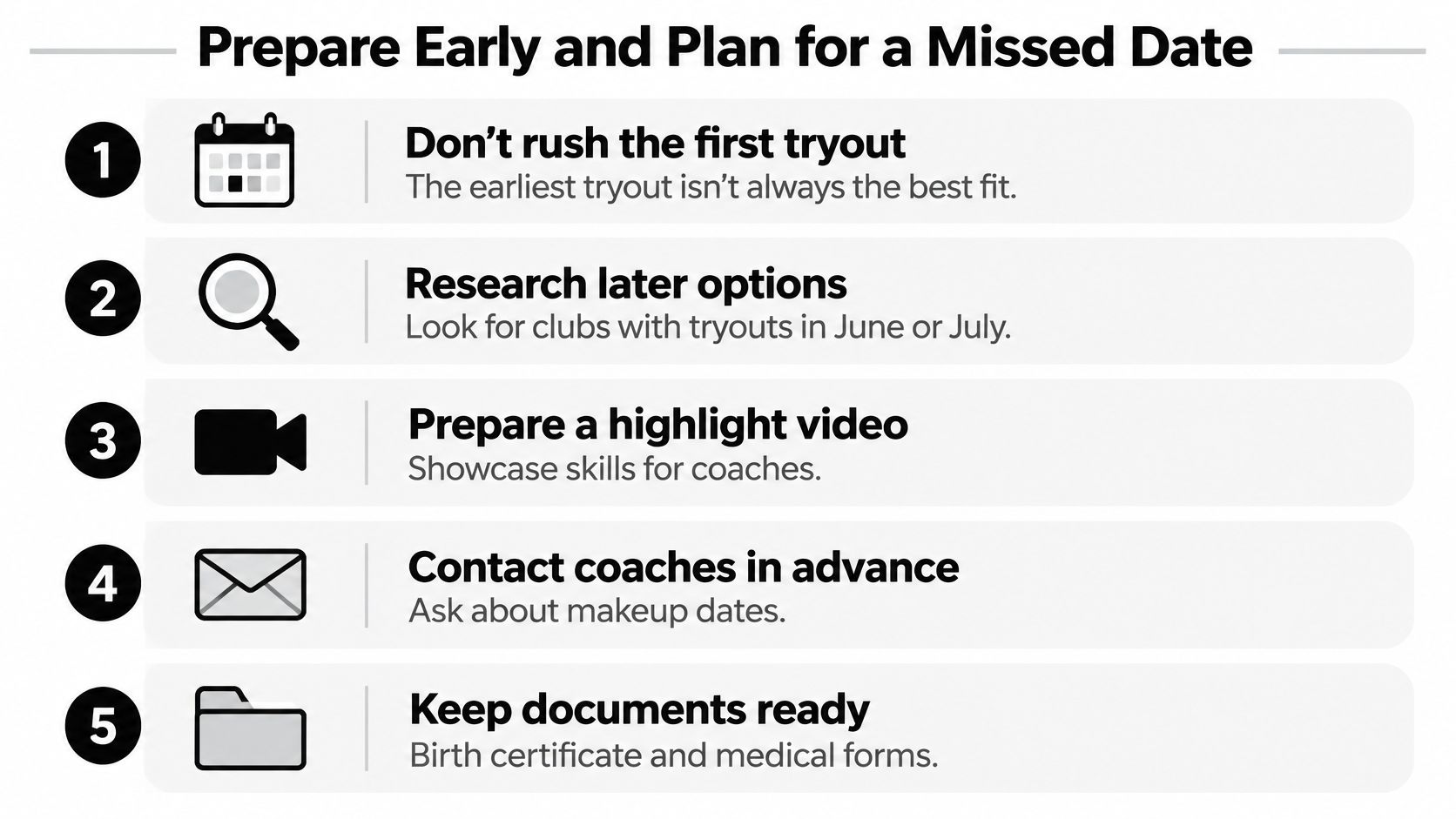
Before the Date
Paperwork folder: a scanned birth certificate, a current medical release, and the physical date on file. Keep the scans in your phone.
Prior club information: last season's team, coach contact, and a release if your current club requires one.
Availability: the training nights your family can commit to, written down before a coach asks.
Money questions: what the fee covers, whether travel and tournaments are separate, and what happens to the deposit if your child is placed on a different team.
A short video: ninety seconds of game footage beats a highlight reel of stepovers.
If paperwork goes sideways, the tactics in this guide to handling late application deadlines transfer directly to club registration: send what you have, name what's still missing, and ask for a written extension rather than hoping nobody notices.
On the Day
Arrive thirty minutes early and let your child warm up away from the sideline crowd. Bring water, both cleats if the surface is uncertain, and a parent who stays quiet. Coaches notice the kid who introduces themselves and the parent who coaches from the fence, and only one of those helps.
If You Miss the Main Date
Ask three specific questions: are there open roster spots, is there a supplemental evaluation, and will the club assess your child in training instead. Roster spots do open after the main window when a family relocates or a player switches sports. Ask to be added to a waitlist in writing, not verbally.
Players who start late, change clubs, or join a girls' program sometimes face a different selection route. Ask directly how selection works in that case instead of assuming the standard calendar applies.
Find Your Local Tryout Dates
Every date that matters flows from the state association and the league beneath it. Clubs operate inside that frame, so work from the top down.
Find the state association. Houston families begin with the Texas association and its regional bodies, whose sites publish the evaluation calendar and age-group rules for the current season.
Check the league that runs your child's age group. Request its published tryout dates in writing, because clubs follow the state calendar but pick their own days inside it.
Confirm the birth-year group. Look up which birth years the season's age group covers. If your child sits near a cutoff, ask the club which group it will place them in before you plan anything.
Join the announcement lists. Ask coaches whether news goes out by email, social media or the registration portal, and get on all three in April or May.
Put every source on one calendar. Record the announcement date, the sign-up window and the tryout date, with a reminder two weeks before each one. Working backward from the August season start shows you which of those dates is a selection event, which is an evaluation, and which is a development placement, so you prepare the right way for each.
Write down one next date. A single entry, such as the club's April announcement, gives you something concrete to check rather than a season's worth of guesswork.
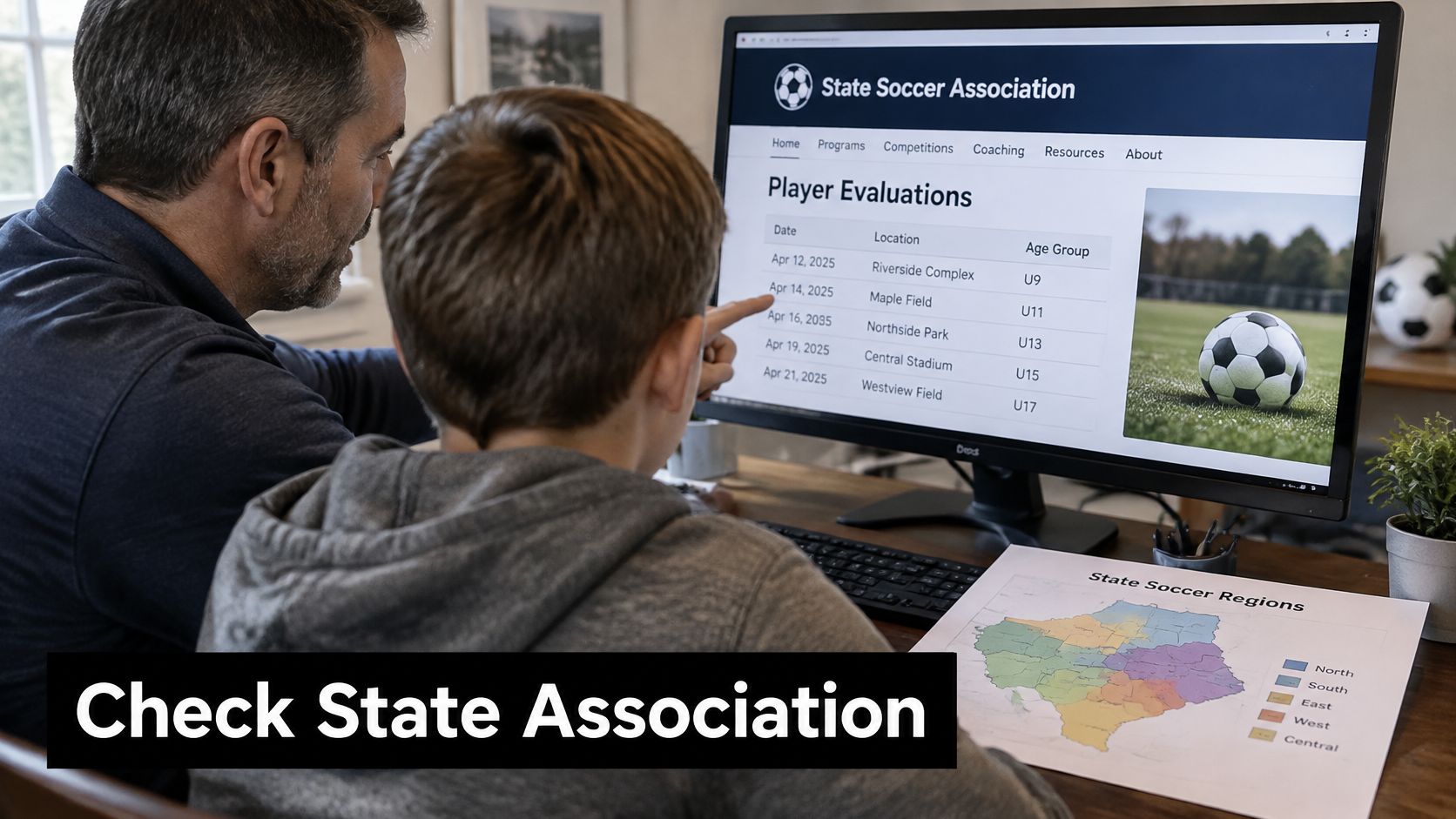
A father and son comparing evaluation listings side by side is the picture of a family that has moved from guessing to planning:
Local pathways often start earlier than families expect. Villarreal Houston Academy runs select and competitive programs for boys and girls from age 4 upward, and the developmental side includes Future Stars for ages 4 to 5 and the Junior Academy for ages 5 to 9 at United City Church in Humble. If your child is 5 or 6, a placement conversation there is a more useful first step than a select tryout calendar.
Repeat the check every spring. Dates shift year to year, and a missed announcement usually means a missed evaluation rather than a short delay.
Villarreal Houston Academy includes tryouts among its teams, camps, and clinics, so families can ask the club directly for its own dates and age-group placement before the spring window opens. If your child is ready for a select or competitive environment, or you want a coach's read on which age group fits, visit Villarreal Houston Academy and start the conversation.
Comments