


Select Soccer Teams in Houston: What Parents Need to Know

Your child has started asking for more competitive soccer, and suddenly Saturday morning means comparing tryout dates, driving across Greater Houston, and trying to understand what a club fee includes. One family is happy with a neighborhood recreational league. Another is discussing tournaments, travel, coaching philosophy, and whether a new team will support development rather than collect wins.
That decision deserves more than a quick answer about which program has the strongest reputation. Select soccer teams can provide structured training, meaningful competition, and clearer player pathways, but they also demand more time, money, travel, and family coordination. The right choice depends on the player's readiness, the program's standards, and whether the commitment remains healthy for the whole household.
What Makes Select Soccer Different from Recreational Play
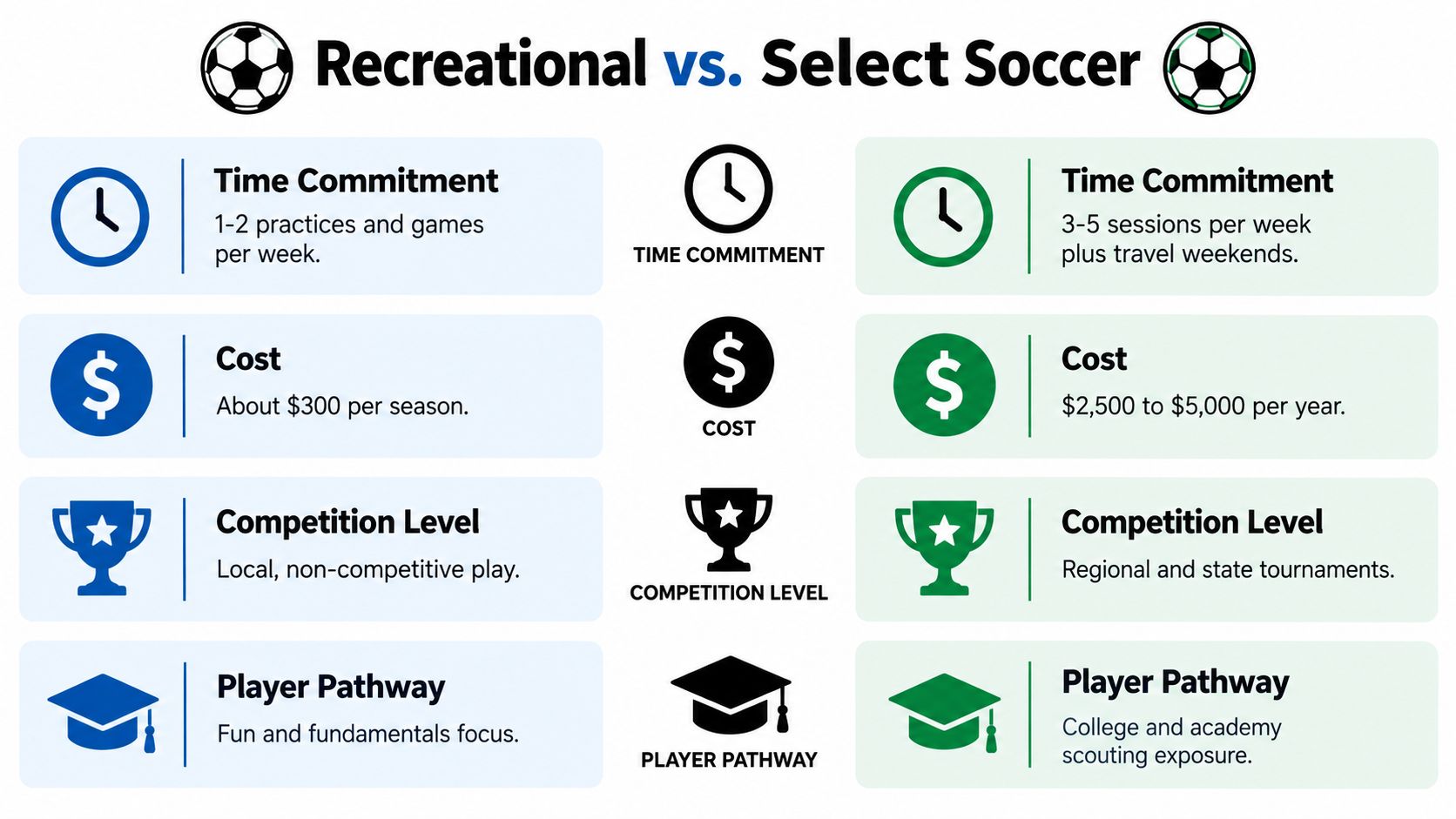
At a Houston park on a typical weekend, two players may enjoy the same sport while having very different experiences. A recreational player might attend a practice and a local game, learn basic skills, and play mostly for enjoyment. A select player may train with a defined curriculum, compete for playing time, travel to stronger opponents, and receive feedback tied to a longer development plan.
The difference isn't just that one child is “more serious.” Recreational soccer usually prioritizes access, participation, and fun. Select soccer teams place greater emphasis on training quality, team formation, competitive standards, and individual progression. Coaches may track a player's first touch, scanning habits, decision-making, defensive effort, and response to instruction, not just goals and assists.
The national context matters. A US Youth Soccer historical publication reports approximately 4.04 million youth soccer players, about double the number recorded in 1990, along with more than 8,200 youth soccer clubs nationwide. More than 6,000 clubs operate within the US Youth Soccer program. That scale explains why families now encounter multiple pathways, age-group levels, and club models in local markets such as Humble, Atascocita, Kingwood, Cypress, Tomball, and the surrounding Houston area.
Recreational vs Select Soccer at a Glance
Dimension | Recreational Soccer | Select Soccer |
|---|---|---|
Training structure | Broad fundamentals and participation | Planned technical, tactical, and physical development |
Coaching approach | General instruction suited to mixed experience | More detailed evaluation and age-group objectives |
Competition | Primarily local games | Stronger local, regional, and state-level competition |
Schedule | Usually easier to fit around other activities | More practices, matches, tournaments, and travel |
Player pathway | Enjoyment, fitness, and basic skill building | Progression through teams, competition, and advanced opportunities |
Parents who want a more detailed explanation of the model can review what select soccer means. The practical test is straightforward: ask whether the program can explain what players are expected to learn this season, how coaches measure progress, and what happens when a player is ready for a different challenge.
What Families Should Expect from Commitment and Cost
Select soccer becomes difficult when families budget only for the advertised registration fee. The predictable expenses may include registration, coaching, uniforms, training facilities, and team administration. Variable expenses can include tournament entry costs, transportation, hotels, meals, private training, equipment replacement, and time away from work.
Recent U.S. youth-sports data reported by The Dallas Morning News indicate that families spent an average of $910 per child on soccer in 2024, up 69% from $537 in 2019. The same report describes a substantial income difference, with households earning more than $100,000 spending an average of $2,361 annually on youth sports, compared with $890 among households earning under $50,000.
Those figures are useful context, not a quote for every Houston club's fee schedule. Each program sets its own costs, and families should request the complete seasonal picture in writing.
Separate the fixed costs from the moving parts
A club that answers only with a team fee hasn't answered the affordability question. Ask for:
Registration and coaching: Confirm what the base payment covers and whether coaching or facility charges appear separately.
Uniforms and equipment: Find out whether kits must be replaced annually and whether training apparel is mandatory.
Tournament travel: Ask which events are required, which are optional, and whether families can decline a distant tournament without affecting roster standing.
Private training: Clarify whether individual sessions are optional or treated as an informal expectation.
Financial assistance: Ask whether scholarships, payment plans, or reduced-cost options exist and how applications are evaluated.
Guest-player costs: Check whether supplemental registration or guest appearances create additional charges.
Time is part of the price. A program may be affordable on paper but unsustainable if parents regularly miss work, siblings lose access to activities, or the player arrives exhausted for school. The best team for your family is one you can support consistently, not one that forces repeated compromises and missed commitments.
Practical rule: Ask, “What will we spend and schedule during a normal month, and what changes during tournament season?” A clear answer reveals more than a single annual number.
How Tryouts Work and What Coaches Look For
A tryout usually starts with registration, a group warm-up, and technical activities. Coaches then watch players in small-sided games or positional exercises because isolated drills show what a player can execute, while game situations reveal how that player perceives pressure, space, teammates, and risk.
You don't need to perform a spectacular trick to earn attention. Coaches commonly look for first touch, passing decisions, movement without the ball, defensive reaction, communication, coachability, and competitive behavior. A player who loses the ball but immediately works to recover it may offer more developmental value than a player who produces one impressive moment and disengages afterward.
Prepare for the assessment, not a highlight reel
In the days before tryouts, maintain normal training rather than adding exhausting sessions. Players should arrive rested, hydrated, appropriately equipped, and familiar with the basic demands of their position, while younger children should be allowed to show creativity instead of being overloaded with instructions.
Bring the items the club requests, including appropriate footwear, water, weather-appropriate clothing, and any required registration materials. Parents should also understand the age-group context. Coaches may focus more on coordination, confidence, and learning habits with younger players, while older players may be assessed more closely on tactical awareness, consistency, physical readiness, and how they handle competitive responsibility.
Read the result with perspective
A roster decision is not a complete judgment of a player's potential. Team balance, available places, positional needs, birth-year structure, and the coach's current priorities can all influence placement. Ask for specific feedback: Which technical behaviors should improve? What does the coach want to see next? Is there another team, clinic, or evaluation route that fits the player?
Families can also prepare by reading what to expect at soccer tryouts. The strongest clubs treat the assessment as part of an ongoing evaluation process, not as a single dramatic verdict.
Age-Appropriate Development and Injury Prevention
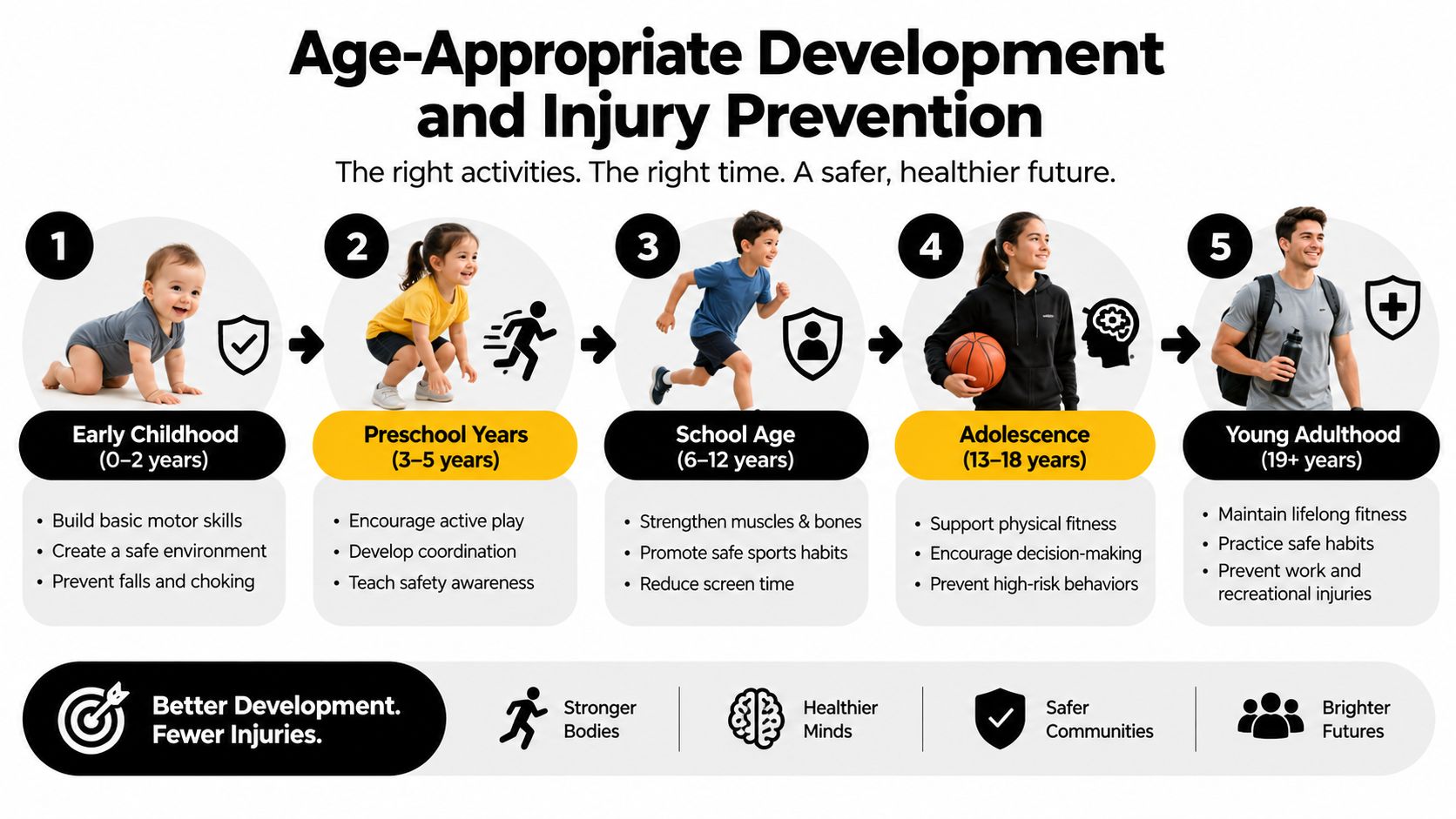
A demanding program isn't automatically a good program. Parents should evaluate whether training matches the player's age, maturity, recovery capacity, school schedule, and total athletic load.
A 2025 systematic review and meta-analysis involving 28,200 youth soccer players aged 7–19 found that structured injury-prevention programs significantly reduced overall injury likelihood. The reported relative risk was 0.615, with a 95% confidence interval of 0.512–0.739, corresponding to an estimated 35–39% reduction in injury risk according to the published review.
Look for prevention inside the curriculum
A useful warm-up includes more than jogging and static stretching. Coaches should develop balance, landing control, deceleration, strength, coordination, and change-of-direction technique, then connect those movements to ball work. The routine should appear consistently in training and should be adjusted as players grow and their demands change.
Parents should ask:
Does every session include purposeful movement preparation?
Does the coach correct landing, cutting, and stopping technique?
Can the staff explain how they respond to pain or repeated soreness?
Does the program monitor school, club, and other-sport workload?
Are rest and recovery treated as part of development?
Families may also want a compact sideline resource, such as the Adventure Medical Kits sports kit, for minor situations during practices and travel. It won't replace professional medical evaluation, but sensible preparation helps parents respond calmly when a small issue occurs.
A player's weekly plan should leave room for sleep, school, recovery, and enjoyment. Year-round soccer can be appropriate for some athletes, but adding sessions without reviewing the complete workload is poor planning.
Here is a short visual reference for movement preparation and player safety:
How to Choose the Right Select Soccer Program in Houston
Greater Houston families need to assess more than a club badge. Travel time, field access, coaching consistency, training methodology, and communication standards shape the player's weekly experience.
A program may use excellent language about development while offering little continuity between age groups. Another may win regularly but provide limited individual feedback. Visit a training session when possible, observe how coaches speak to players, and ask whether the club can describe progression beyond the current season.

Evaluate the environment you can actually use
North Houston families may compare facilities and training locations across Humble, Fall Creek, Cypress, Tomball, and the Kingwood, Porter, and New Caney area. Convenience isn't a minor detail. A long commute can reduce recovery time, complicate school nights, and make consistent attendance harder.
Ask the club director:
Methodology: What technical and tactical principles guide training at each age?
Staff quality: What qualifications and playing or coaching experience do coaches bring?
Continuity: Can players progress within the club as their needs change?
Support: Does the program address confidence, communication, and character as well as technique?
Pathway: Are there realistic opportunities for stronger competition, advanced teams, or international experiences?
Affordability: Are financial-assistance options and payment terms clearly explained?
An academy connected to an established international methodology can give families a useful reference point, provided the local delivery matches the stated approach. Villarreal Houston Academy is one local option offering boys' and girls' select and competitive programming, age-appropriate training, sports-psychology support, and opportunities to train and play in Spain alongside Villarreal CF's academy. The value of that model depends on the daily coaching relationship, not just the international name.
A pathway is credible when a director can explain what changes from one age group to the next, how players receive feedback, and where a family can go with concerns.
Understanding Player Pathways and Long-Term Growth
A player pathway should be visible in the weekly work. It includes technical repetition, tactical problem-solving, physical preparation, character expectations, evaluation, and appropriate movement between teams. It doesn't promise a professional career, and it shouldn't use college or international exposure as a guarantee.
The United States now has a substantial soccer ecosystem. A peer-reviewed study reports more than 15 million youth athletes playing soccer annually and cites more than 3 million registered youth players in 2014. It also records major growth in school soccer and reports 838,573 high-school soccer athletes in the 2016–17 academic year in the published research. Families should read those figures as context for opportunity and competition, not as a promise attached to any individual club.
A sensible pathway uses regular evaluation without making every season a crisis. Younger players need broad technical foundations and freedom to solve problems. Older players need more tactical responsibility, position-specific understanding, consistent habits, and honest conversations about school, health, motivation, and next steps.
The long-term question is whether the environment helps a player become more capable and independent. Wins matter, but so do improved decisions, stronger communication, reliable effort, resilience after mistakes, and the ability to train intelligently. A club that measures those qualities gives parents better evidence than a trophy cabinet alone.
Making the Decision That Fits Your Family
Start with the player, not the logo. Does your child want more challenge, or are adults creating urgency because other families are moving into select soccer? A strong program should stretch the player without making every practice feel like an audition.
Then test the decision against four realities:
Readiness: The player can accept coaching, compete respectfully, and recover from mistakes.
Sustainability: The household can manage the schedule, travel, and full cost without constant strain.
Quality: Coaches provide a clear curriculum, safe training, and age-appropriate expectations.
Alignment: The club's culture matches the values you want your child to develop on and off the field.
Don't choose based only on tournament reputation or the promise of exposure. Ask what the player will learn, who will teach it, how health concerns are handled, and whether the club communicates directly when circumstances change.
The right select soccer team is the one that gives your child meaningful challenge while protecting curiosity, health, education, and enjoyment. Visit practices, speak with the director, review the complete commitment, and let your child's response carry real weight in the final decision.
Villarreal Houston Academy offers select and competitive youth soccer programming, age-appropriate training, camps, clinics, qualified coaching, and a development pathway connected to Villarreal CF methodology. Visit Villarreal Houston Academy to explore current teams, tryouts, training locations, and opportunities for your player.
Comments