


Indoor Field Soccer Explained: Rules, Space and Play

You're in a gym lobby while your child pulls on indoor shoes, and someone says the team plays indoor tonight. You picture one game. The building next door might be running a different one under the same name. One court has walls the ball can hit and stay alive. Another stops play at a line, uses five players, and restarts with the foot.
Indoor field soccer is that whole family of small-sided games under a roof, not a single rulebook. The walls, the head count, and the restarts change how often your child touches the ball, how hard the session feels, and where the bumps come from.
What Indoor Field Soccer Is and Where It Came From
A child can hear “indoor soccer” and arrive expecting one kind of game. Instead, the name covers two formats with different histories: board-based indoor soccer, where walls can keep the ball in play, and futsal, where play stops when the ball crosses a boundary line.
In the United States, board-based indoor soccer was played in professional or semi-professional settings by the early twentieth century. Futsal began in Montevideo, Uruguay, where Juan Carlos Ceriani created rules in 1930 for soccer played on basketball courts, as the U.S. Soccer History Archives' account of indoor soccer explains.
A Chicago season that wasn't futsal
The same archives describe a 1950 National Soccer League of Chicago season with 12 teams competing over 13 weeks. Each side used seven players on a field measuring 60 by 42 yards, with boards and two 10-minute halves. Earlier indoor exhibitions used goals 14 feet wide and 7 feet high, compared with the then-standard outdoor goal of 24 by 8 feet.
For a parent, the quickest way to identify the format is to watch the boundary. If a missed pass hits a wall and play continues, the game uses boards. If the ball crossing a line stops play, it is closer to futsal. The name on an invitation may not tell you which rules apply.
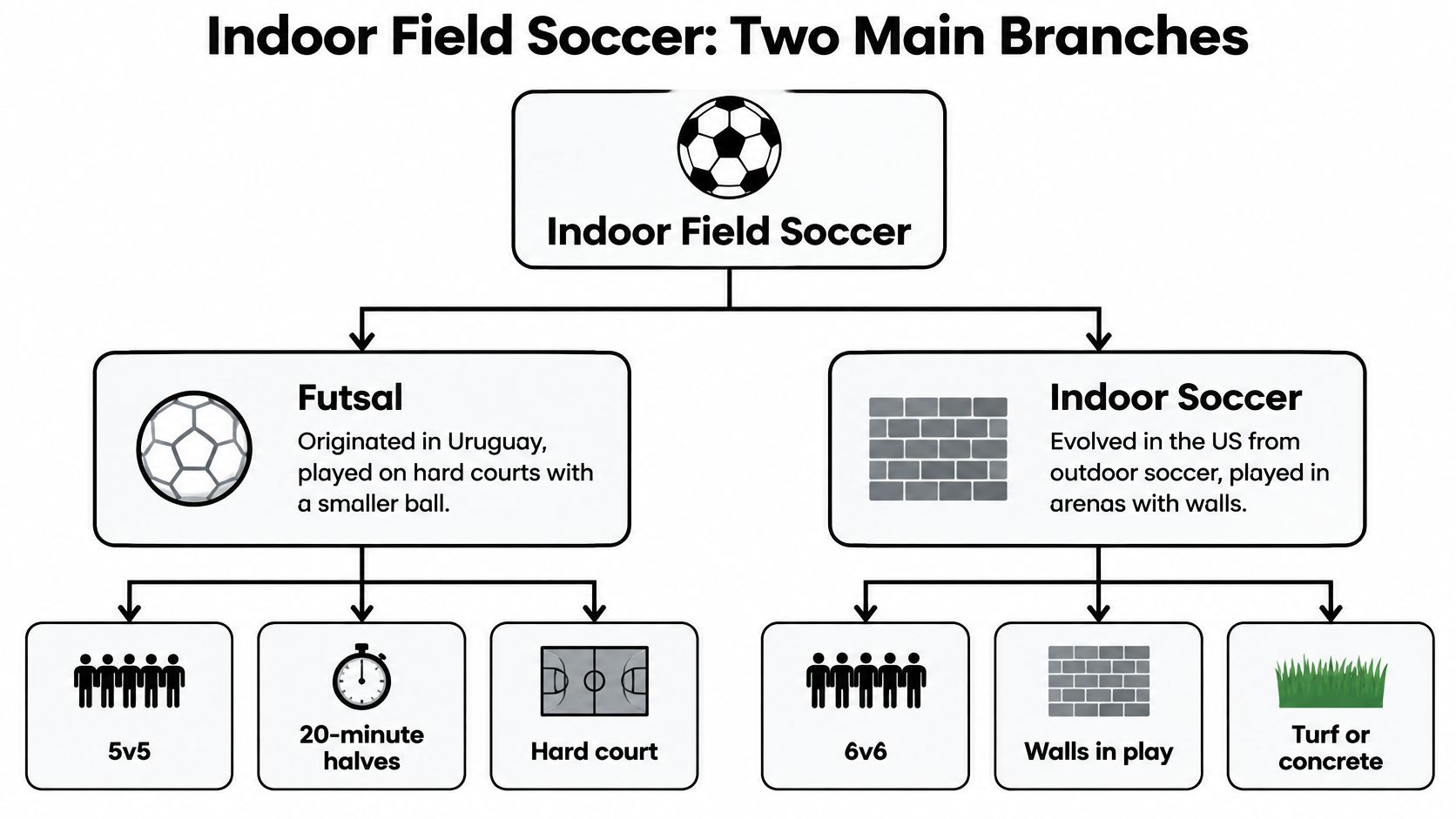
Formats and dimensions at a glance
Format | Field size | Players per side | Goal size |
|---|---|---|---|
Futsal (FIFA futsal laws) | 25–42 m x 16–25 m | 5 including goalkeeper | Smaller target than the outdoor 24 x 8 ft goal |
1950 Chicago National Soccer League | 60 x 42 yards | 7 | Not recorded for that season |
Outdoor 11-a-side (reference) | Full outdoor pitch | 11 | 24 x 8 ft |
Each row represents a different playing environment. With fewer players, each child has more chances to meet the ball. A smaller field shortens the time available to look up, while boards add rebounds that players must read. The earlier exhibition goal was 14 by 7 feet, smaller than the outdoor comparison; that difference can change how a player aims.
Practical check: When a club says “indoor,” ask which format it uses, how large the court is, and whether the ball stays in play off the walls. Those details tell you what your child will practise.
For a shirt idea that suits gym nights, browse creative football tee concepts.
How Compact Space Changes Every Decision
Think of indoor field soccer as a conversation in a small kitchen, not a shout across an open park. Every voice reaches the others fast. A slow reply gets talked over.
Under the FIFA futsal laws, a non-international court may measure 25–42 m long and 16–25 m wide, with boundary lines 8 cm wide. Matches use five players per team, including the goalkeeper, and allow unlimited substitutions during play. That box is where the pressure comes from.
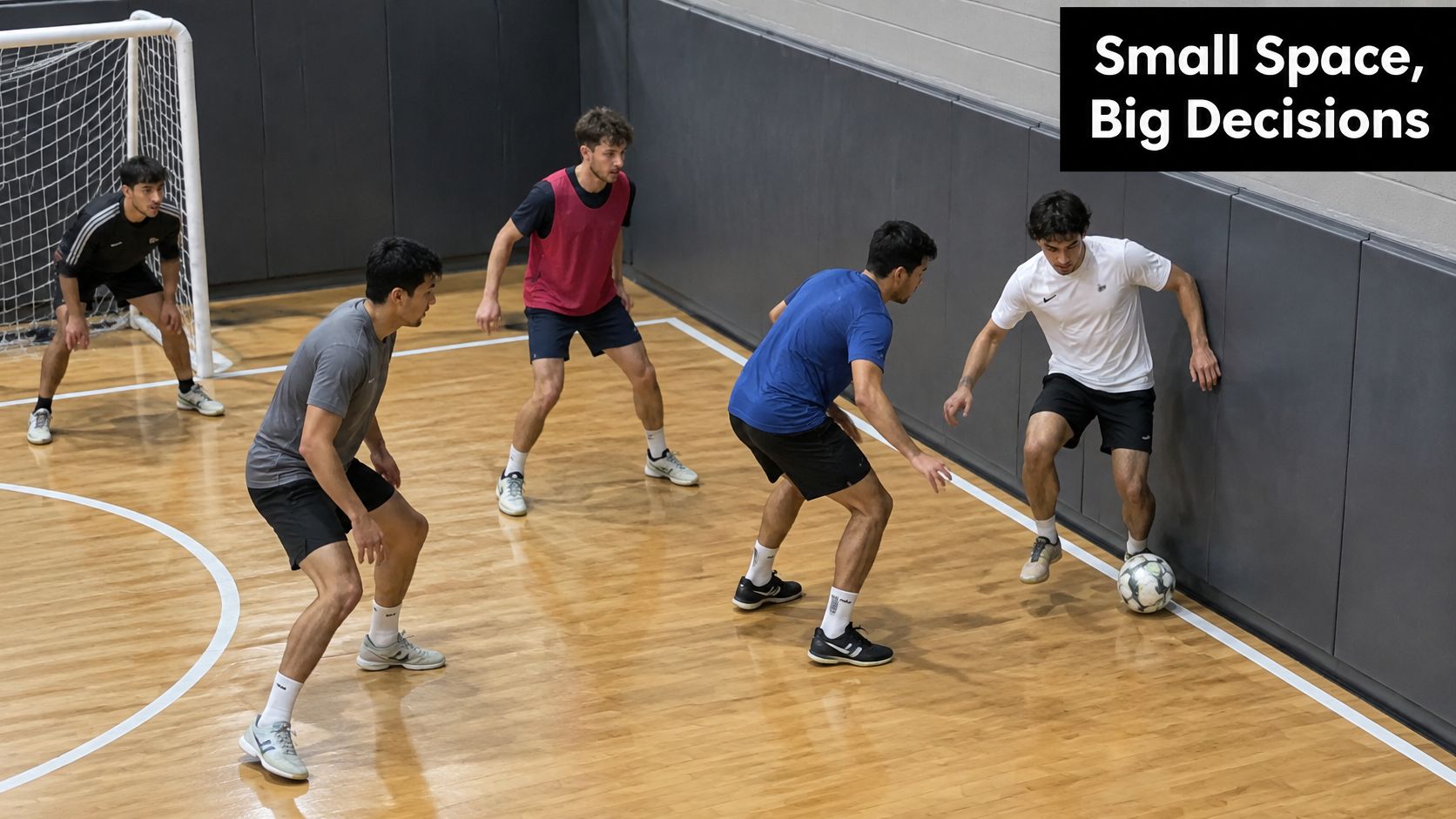
What each touch has to survive
The receiver has less time to scan. The defender arrives sooner. A heavy first touch is often a turnover before the second touch exists. Outdoors, that same touch might still be playable. Indoors, the kitchen is too small.
Three habits follow from that squeeze.
Body shape before the ball arrives: Hips and eyes point toward the next space, not toward the passer.
One- and two-touch play: The game rewards a pass that's already chosen.
Reaction after the loss: The first step back matters more than a long recovery run, because the counter is already in the same room.
Tighter courts build pressure resistance and ball mastery. A larger court inside the allowed range gives a beat more time to scan and lets combinations stretch. Match the size to the age and to the skill, not to whatever lines are painted on the floor that night.
A useful check is a 3v3 to 5v5 game with a clear rule for the moment possession flips. Watch whether players can name the next pass before the ball gets there. If they only look after the touch, the space is still winning. Short, high-intensity shifts fit unlimited subs better than treating the hour like a steady endurance run. The same idea shows up in soccer decision-making drills you can compare with what you see on the court.
This short clip shows how little time a receive gets once bodies are close.
Rules That Change the Game From Outdoor Soccer
Parents often assume indoor field soccer is outdoor soccer with the roof on. The everyday rules say otherwise. Futsal-style play and the full outdoor game don't even restart the ball the same way.
Rule | Indoor field soccer (futsal style) | Outdoor 11-a-side |
|---|---|---|
Substitutions | Unlimited, rolling during play | Limited, usually at stoppages |
Ball out at the side | Kick-in | Throw-in |
Offside | Not applied | Applied |
Boundaries | Boundary lines; board-based version keeps ball in play off boards | Touchlines end play |
Slide tackles | Banned in many youth indoor rules | Permitted under the laws |
Footwear | Molded or metal cleats prohibited; flat-soled indoor shoes | Studded boots allowed |
The three changes your child feels every session
Rolling substitutions are the biggest lifestyle change. A player can come off while the ball is moving, so shifts stay short and sharp. Outdoor soccer usually waits for a stoppage and caps how many swaps you get. Indoors, fitness shows up as repeated bursts, not one long stay on the field.
Kick-ins replace throw-ins when the ball leaves the side in futsal-style play. The foot stays in the game, the pause is shorter, and a weak restart is just another pass an opponent can steal. Board-based indoor soccer often skips that stop entirely, because the ball never left.
No offside lets attackers stand close to goal. Combinations get quicker, and a player who drifts doesn't get flagged for being "too high." Defenders can't rely on a line to do their spacing. They have to arrive on time.
Contact, shoes, and the book you should read first
Slide tackles are banned in many youth indoor rules, so defending is positioning and a timed step, not a lunge. Flat-soled indoor shoes are the normal boot. Molded or metal cleats are prohibited on these surfaces, and shin guards stay on.
Read the league book before the first tournament. Board-based leagues and futsal leagues don't match on walls, restarts, or how subs work.
What a Session Feels Like From the Inside
A youth session can move from warm-up to a fast passing game before a player has time to catch their breath. In a typical hour, the group might start with dynamic movement and easy touches, then play small-sided games, finish with a scoring challenge, and close with a short stretch and reflection. The work feels concentrated: players keep moving, and the ball keeps asking for their attention.
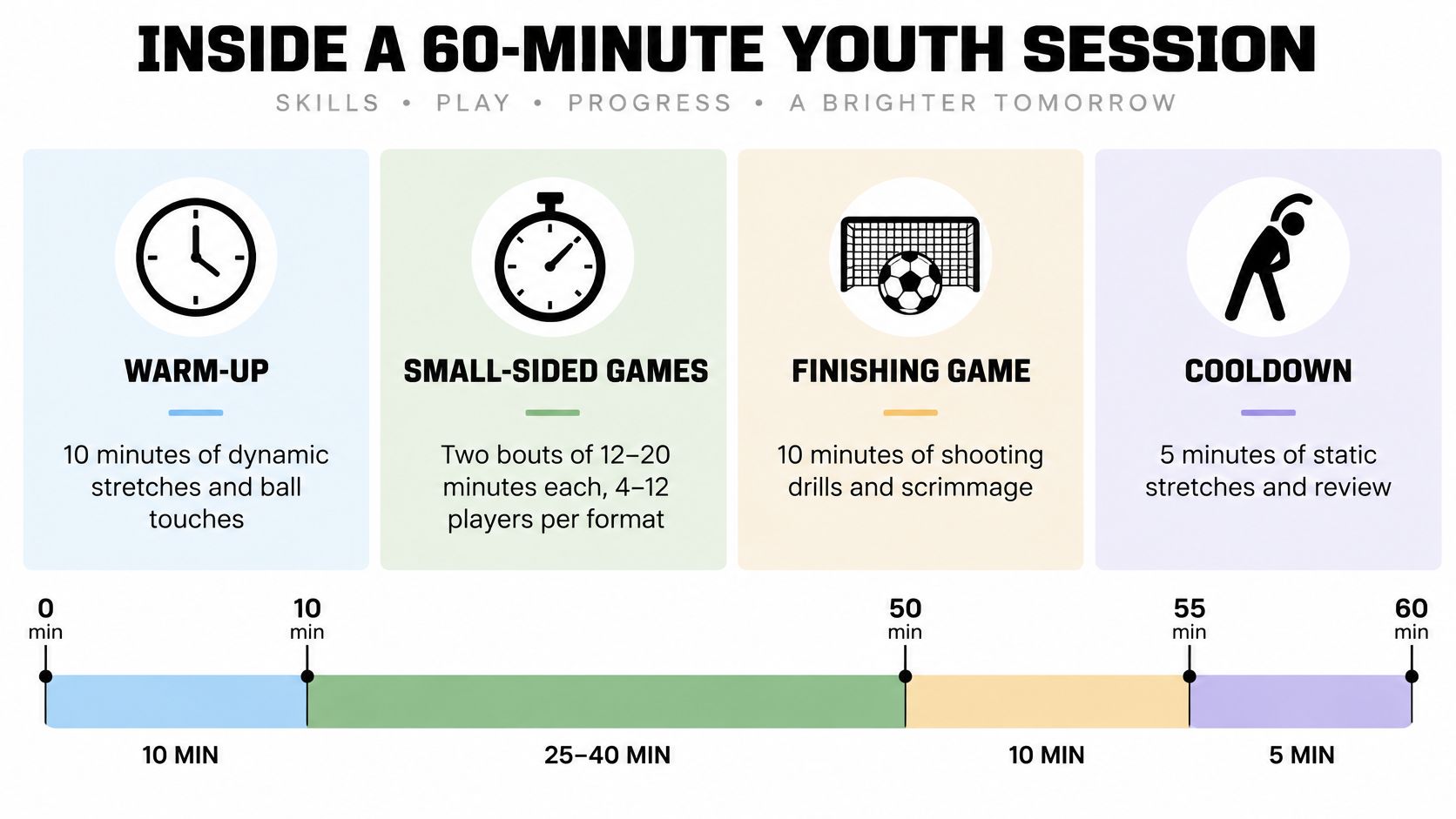
Why a "technical" game still spikes the heart
A passing game can be a demanding workout. In a small space, players make frequent short runs, turn quickly, and look for the next pass without much time to rest. A coach may be working on first touch, but the same drill also asks players to stay active and alert.
That is why breathing hard does not automatically mean a child is unfit. The game may leave fewer quiet moments than an outdoor drill with more room. Like a busy hallway, a compact playing area makes every route and decision feel closer together.
How a coach should dose it
For first-touch practice under pressure, keep bouts short and allow recovery between them. A coach can adjust the pace to the group rather than pressing on when tiredness starts to affect the quality of play.
Watch how the players handle the ball and their choices:
Passing accuracy drops: simple balls begin to miss their targets.
Scanning fades: players receive the ball without noticing their next option.
Decisions slow: players repeatedly dribble into traffic instead of choosing a pass or turn.
When those signs appear, pause or make the playing area larger. A heart-rate watch can show that a bout was strenuous, but it cannot tell whether a player's touch and decisions remain sharp. Ask how the effort feels, too. Younger or less-trained players may need longer recovery and simpler rules; advanced players can add a two-touch limit, a required support run, or an immediate press after losing the ball.
Injury Risk and Protection for Young Players
A child can play confidently on a smooth indoor surface, then meet a rebound or another player in less space than outdoor soccer allows. Indoor field soccer includes different formats, but both demand attention to contact: board play brings the wall close, while a compact court brings players together quickly. Flat shoes and limits on sliding do not remove those risks.
Research on elite youth soccer has reported injuries during competition, with injury rates differing between girls and boys. Those findings are a reminder to treat warm-ups, substitutions, and recovery as part of safe participation for every player, not as optional extras.
Injury-prevention programs can reduce the chance of injury. Parents can ask how a program addresses warm-up, movement, and rest, and use this guide to injury prevention in soccer to understand the role those habits play. For young players, clear routines matter because a tired child may react more slowly when space closes.
What the rules don't decide for you
Match footwear to the playing surface, and check the area where players may meet a wall or board. A rebound can bring the next challenge before a child has time to reset. Keep water and substitution breaks in the session, supervise drills involving board contact, and check the floor for seams or wet spots before play.
Signal | Likely meaning | Action |
|---|---|---|
Head impact followed by headache, dizziness or confusion | Possible concussion | Remove from play, no return the same day, medical check |
Pain that stops the child putting weight on a leg | Possible acute injury | Stop and get a medical assessment before resuming |
Cut or bleeding after wall or board contact | Surface or contact injury | Stop, clean and cover, then check the surface and padding |
Ordinary soreness may ease as a player warms up. Sharp pain, a lasting limp, or recurring tendon pain at the same spot calls for attention rather than another hard shift. If a child is rebuilding tendon load tolerance, a gradual plan is safer than returning straight to the same demands. Ask the coach before the season how they handle injuries and decide when a player should sit out.
Deciding Whether Indoor Field Soccer Fits Your Player
Don't pick a league because the parking lot is close. Match four things, in this order: age and experience, the goal, whether that's recreation, technical work, or competitive play, the actual court you can get, and the evenings you can keep.
A younger child who needs the ball often fits recreational indoor play. Lots of touches, simple restarts, and a coach who stops the game to fix a receive. A player who already copes outdoors but panics in a phone booth fits technical indoor training, where the rep is the first touch and the turn. A player who wants match-speed changes of possession fits competitive indoor play, with quick shifts and less standing around.
A child chasing touches and a child chasing transitions shouldn't share the same plan. If you want both, split the week instead of hoping one scrimmage does every job. Court size has to fit that goal. A tiny box for a brand-new seven-year-old only teaches panic. A roomy court for a player who needs pressure lets them hide again.
At JC Sports Houston we offer indoor Coerver technical training and an indoor Program Just for Girls, both in partnership with Coerver Coaching. The JC Sports Indoor Center is at 18610 Page Forest Dr, Humble, TX. Once the format, the court, and the age group line up, book a trial and watch one session before you commit the season.
Questions to Ask Before Enrolling Your Child
Take this list to any club. The answers matter more than the logo on the flyer.
Which format is it? Futsal laws, with five players and boundary lines, or board-based indoor soccer, where the ball stays live off the boards.
What are the court dimensions? Compare them with the 25–42 m by 16–25 m range in the futsal laws, and ask why this age uses this size.
Who is in the group? Confirm the age band, and whether sessions are split by age and by sex instead of one mixed free-play hour.
How do they manage load? Ask about rolling subs, rest between bouts, and when water breaks happen.
What does the safety plan cover? Footwear, shin guards, concussion response, and the person who decides return to play.
Can you have the rule book now? Board-based and futsal leagues differ on restarts and substitutions, and you want that before tournament week.
At the trial, don't count goals. Count decisions. A useful indoor field soccer session gives your child more choices per minute than they get standing on a full outdoor pitch. If you want a local picture of how those courts are set up, look through indoor soccer field options in Houston and then stand on the sideline and see the format for yourself.
Villarreal Houston Academy trains boys and girls in a structured, age-appropriate setting where tight-space habits are coached on purpose, not left to a random gym scrimmage. If indoor field soccer is the piece your player needs this season, see how our sessions connect first touch, decisions, and recovery. Visit Villarreal Houston Academy and book a look at the next trial.
Comments