


What Is Coaching Philosophy in Youth Soccer

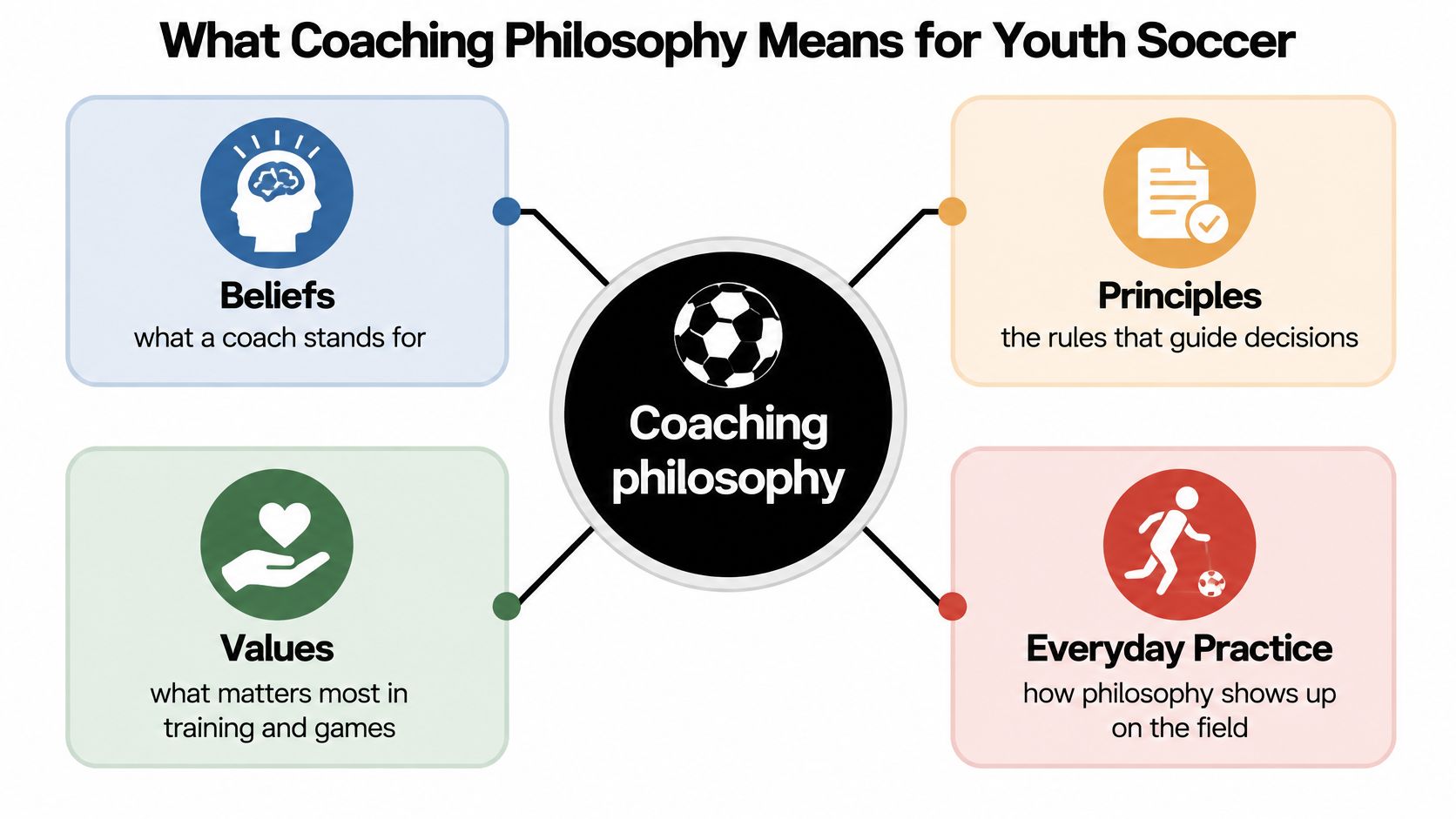
A coaching philosophy is the set of beliefs, principles, and values that guides a coach's behavior and shapes everyday practice. You'll know whether it's real by watching how a coach handles mistakes, feedback, playing time, and challenge when the game gets difficult.
You're likely standing on a sideline right now, or reading two club websites late at night. Both promise development. Both show smiling players. One coach kneels, asks a question, and sends a child back in after an error. The other shouts the next pass before the ball arrives. The words match. The experience doesn't.
What Coaching Philosophy Means for Youth Soccer
Two teams can wear the same slogan on a banner and teach in opposite ways. On one field, a nine-year-old tries to turn away from pressure, loses the ball, and hears, "What did you see?" On the next field, the same mistake brings a groan and a substitution. That difference is where what is coaching philosophy stops being abstract.
Put plainly, it's the set of beliefs, principles, and values that guides a coach's behavior and shapes everyday practice. The International Sport Coaching Framework published in 2012 by the International Council for Coaching Excellence and partner organizations defines sport coaching around guided improvement and long-term development, not merely short-term competitive results, and it treats identity, mindset, philosophy, and ethical perspective as values reflected in everything coaches do.
A Compass, Not a Poster
Think of philosophy as a compass. Values set the direction, methods are the steps, and each age group walks at a different speed on the same heading. A six-year-old needs many touches and simple choices. A fourteen-year-old needs tighter spaces, faster scanning, and more responsibility. The heading stays steady even as the work changes.
That heading should show up when a coach plans a session, talks to a player, manages a match, and judges progress. In youth soccer it can hold together technical learning, tactical understanding, enjoyment, safety, character, inclusion, and progressive independence alongside performance. No single item cancels the others.
A philosophy earns trust when a child can predict how an adult will respond on a bad day, not only after a win.
This is also a change in how coaching itself is understood. It isn't only instruction or picking the early standouts. It's a developmental job with technical, educational, and ethical responsibilities. Coaches teach skills, they teach how to learn, and they set standards for how people treat each other.
The credibility test is observable. Does the coach give players meaningful decisions? Does correction stay respectful? Does challenge change for the child in front of them? Is progress measured over time, rather than by wins, size, or early maturity alone? If those answers are yes, the words on the website have started to become practice.
Philosophy Versus Style, Methodology and Mission
Parents often compare clubs using four words as if they mean the same thing. They don't, and sorting them out makes a visit much clearer.
Philosophy answers why. It's what a club believes development and success mean. Mission is the public purpose, usually the short sentence on a homepage. Methodology answers how sessions are structured week after week. Coaching style is what you hear in the moment, directive, questioning, or demonstrative.
Term | Answers | Example |
|---|---|---|
Philosophy | Why we coach this way | Players grow through informed decisions and mistakes |
Mission | What the club publicly aims for | Develop confident, responsible young players |
Methodology | How sessions are structured | Constraint-based games that progress from small to full-sided play |
Coaching style | How a coach acts in the moment | Asks questions before giving answers |
Check That the Layers Agree
A useful philosophy names a behavior you can watch. "Players choose an option and explain why" tells you what to look for. "Develop the whole player" doesn't, until someone shows you how. Other fields make the same distinction, and families curious about child-led learning can see a parallel in understanding the Reggio Emilia philosophy, where beliefs only matter once they shape daily choices.
On a visit, trace the chain. Does the mission rest on a clear philosophy? Does the session plan express it? Does the coach's voice match it at 6 p.m. when the drill falls apart? Our own breakdown of different soccer coaching methods and how they connect can help you name what you're seeing before you decide whether you like it.
How a Philosophy Shows Up Every Session
Treat philosophy as an operational decision framework. It turns values like development, autonomy, mastery, safety, and character into repeatable behaviors, practice design, feedback rules, and ways of judging progress. The International Olympic Committee consensus statement on youth athletic development recommends autonomy-supportive, mastery-oriented climates because they're associated with lower stress and greater intrinsic motivation, and it stresses development that's well-rounded, flexible, and matched to readiness rather than chronological age alone.
Use this table on the sideline tonight. You're not grading a coach's personality. You're checking whether each principle produces the behavior in the middle column.
Principle | What you should see | Warning sign |
|---|---|---|
Autonomy | Players get meaningful choices and hear why | The coach decides every action |
Mastery | Feedback targets controllable skills and mistakes restart learning | Fear, sarcasm, or public shaming |
Individual readiness | Goals and challenge change by player, not only by birth year | One drill and one standard for every child |
Character | Correction stays respectful and standards are shared | Humiliation or silence as discipline |
Competition | Score sits beside decisions, communication, effort, and responsibility | Wins, size, or early maturity decide a player's value |
Session design | Constraints lead into game-like problems | Only isolated repetition with no decisions |
Evaluation | Progress is reviewed over time, including self-assessment | A single scoreline is the only measure |
Why Each Row Works That Way
Choice plus a reason builds autonomy. Say a winger can cut inside or stay wide, and the coach asks which picture she saw. She starts scanning earlier because the next decision is hers. If the coach calls every pass, she learns to wait for instructions instead.
Information after a mistake builds mastery. "Open your hips before the ball arrives, try again" gives a player something controllable to fix. Sarcasm teaches him to hide. A child who hides touches the ball less, takes fewer informed risks, and gets fewer chances to perceive options under pressure.
Readiness changes the task: A confident player might receive under tighter pressure, while a newer player gets more space to succeed first.
Respect protects standards: A coach can demand effort firmly without mocking a child, so correction stays about behavior, not identity.
Design should progress: Exercises move from constrained choices to game-like problems, so skills connect to perception and action, not isolated repetition.
Staff can audit this without guessing. They can note athlete talk time, question frequency, player-led problem solving, and individualized feedback during a session. It's the same logic families use elsewhere when they look for adaptive AI workout plans that adjust to a person instead of handing everyone an identical routine. The tool differs, but the principle is personal fit.
Participation and performance goals also need separating. A beginner may target confidence and first touch, while an older competitive player targets decision speed against pressure. Both can be challenged and enjoy training. Watch one full session and mark which column you saw most often.
Why Philosophy Shapes Development and Culture
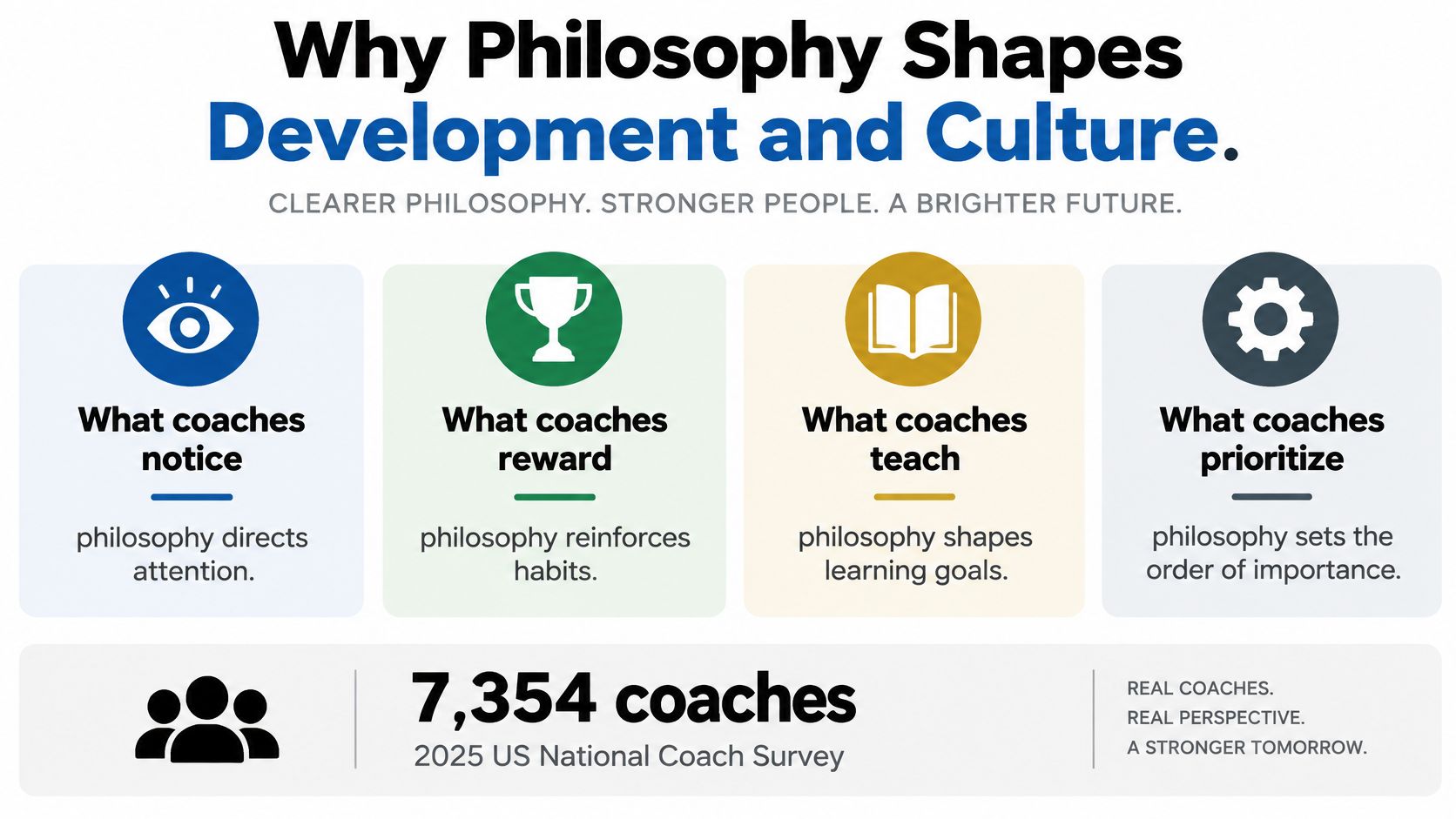
Start with the numbers, then watch what a team praises. A 2025 analysis of the US National Coach Survey of 7,354 coaches found coaches whose philosophy included teaching life skills had a statistically significant positive association with perceived impact on athletes' life-skill development, at β = 9.69 and p < 0.001. Training focused on life-skill development was associated at β = 5.68 and p < 0.001, and satisfaction with coaching at β = 5.23 and p < 0.001.
Those figures don't prove a philosophy causes athletic success. They show something more practical for parents. A philosophy changes what coaches notice, reward, teach, and prioritize, and that repeated pattern becomes culture.
The Tension on the Scoreboard
The same survey reports 66% of coaches working with children ages 5–10 identified winning games as a top philosophy influencing their practices. That's the tension many families feel. A coach can say development matters, then reward only the result when Saturday arrives.
Think of the scoreboard as one instrument, not the whole dashboard. A development-oriented culture also watches teamwork, decision-making, resilience, responsibility, and respect. Competition becomes a learning environment because a brave attempt to play forward, a recovery run after a mistake, or a calm conversation with a referee gets named and valued.
Parents mostly want that broader dashboard too. In 2024, 91% of surveyed parents agreed that sports coaching should inspire children to excel both on and off the field, according to The Harris Poll and First Tee survey reported by First Tee. Alignment is possible, but it isn't automatic.
Cultural test: Listen to what gets praised after a loss. That tells you the philosophy more honestly than the mission statement.
If a coach praises only the scorer, players learn to chase personal moments. If the coach also praises the midfielder who scanned, communicated, and kept working after an error, players repeat those habits. That's how a club builds the kind of environment described in our look at the benefits of a strong coaching culture, one repeated sideline choice at a time.
How the Villarreal Method Lives Its Philosophy
Follow one player through a normal week. She's ten, training in North Houston, and she isn't asked to copy a professional first team. Her session asks her to notice space, control the ball cleanly, and treat teammates well when a pass goes wrong.
Watch what that kind of training looks like in practice.
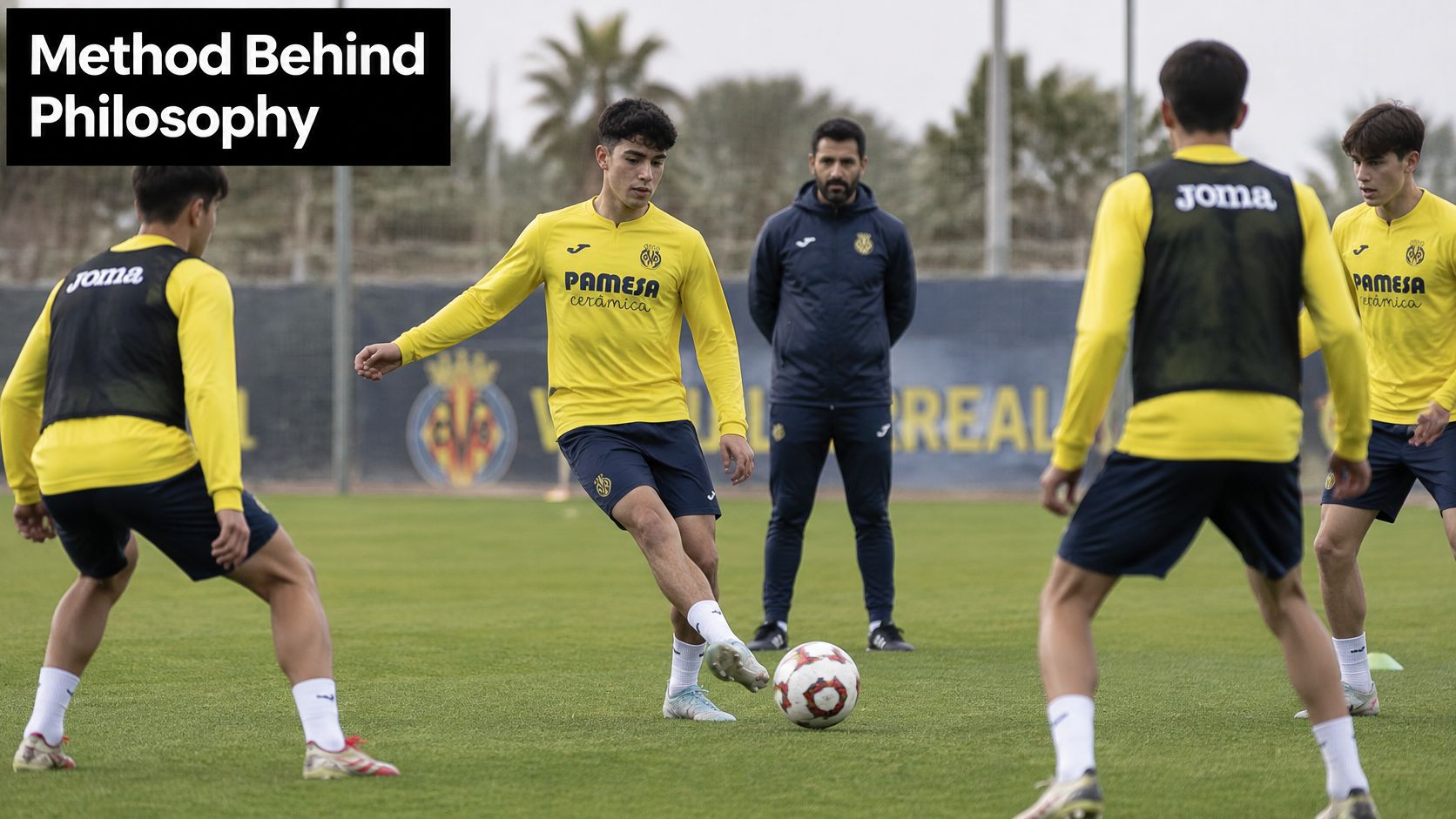
That's the Villarreal CF idea in plain terms. The Yellow Submarine pathway asks young players to build intelligence in the game, technical skill, and character in ways that fit their age. A philosophy only becomes shared when coaches are taught it, though. At Villarreal Houston Academy, the official partner academy of Villarreal CF in Greater Houston, our coaches learn the Villarreal CF methodology and work side by side with Villarreal CF sports psychologists.
Their job is to engage, communicate positively, and influence youth players to find their best on and off the field. Our mission is to provide age appropriate training with qualified coaches so local youth talent can play at their fullest potential, in a structured, safe, and fun setting that protects a long-term love of the game.
Three Links From Belief to Behavior
Questions build game intelligence. Instead of shouting the answer, a coach might freeze play for ten seconds and ask, "Where was the free player?" The child has to reconstruct the picture. Next time, she looks earlier.
Repetition serves skill, not boredom. A passing exercise changes angles, pressure, and choices as players improve. The touch gets repeated, but the problem keeps moving. That's different from lines where children wait, kick once, and jog to the back.
Respect travels off the field. Players shake hands, listen while a teammate explains a choice, and own a mistake without blaming someone else. Those small standards are part of training, not a speech saved for tournament weekends.
Now see the same standards in motion.
Over time, that player builds a technical base at home, meets a consistent style of play across age groups, and may later have chances to train or play in Spain alongside Villarreal CF's academy. The pathway matters because each step feels connected. She isn't starting over with a new language every season.
A famous method still has to pass the same session test as any local club. Don't take the badge as proof. Watch whether questions, purposeful repetition, and respect show up on a Tuesday night.
When Winning and Development Can Share a Plan
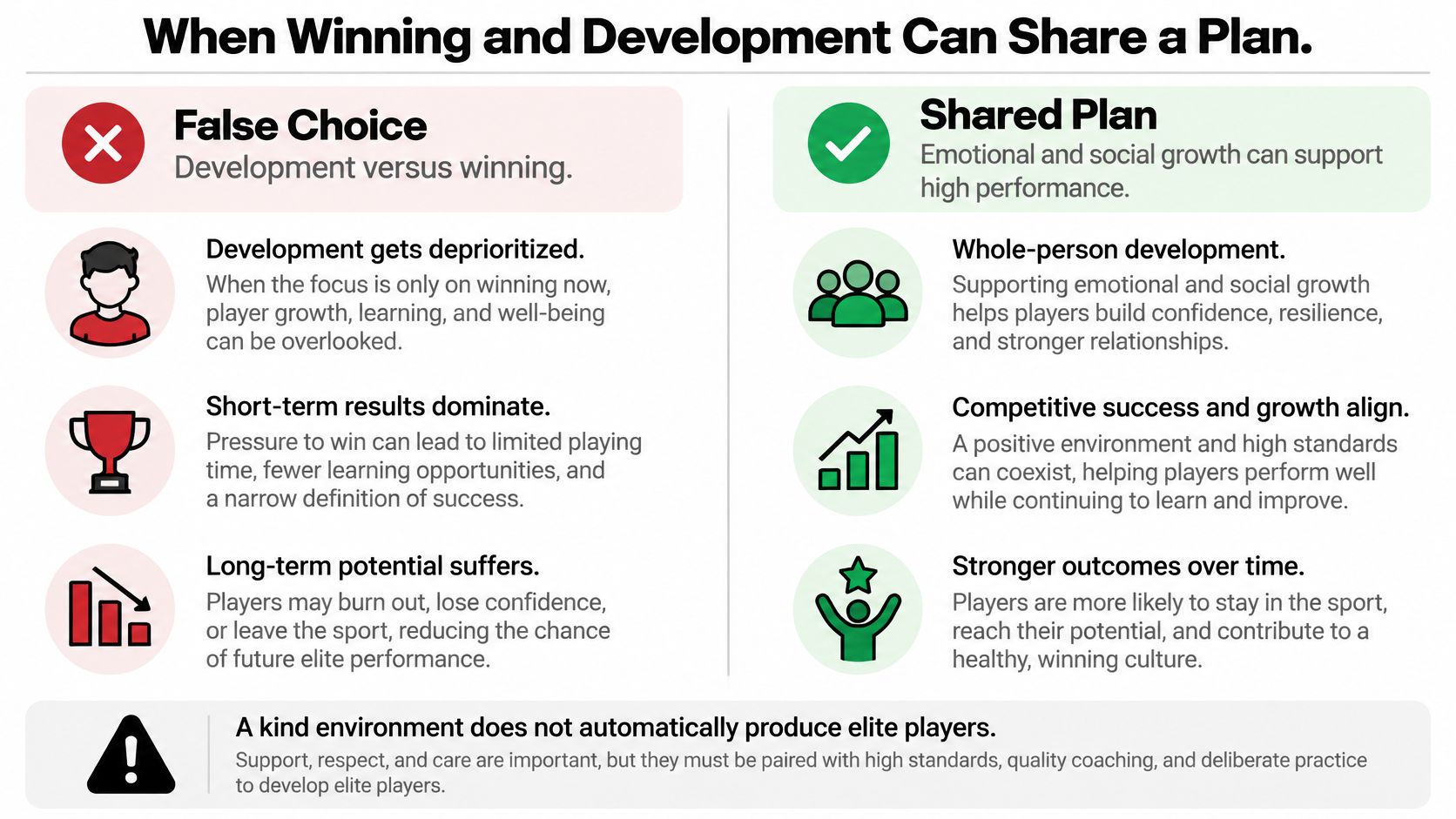
A 10-year-old loses the ball in the final third. The coach's next words decide whether Saturday's score or Tuesday's learning runs the week. A serious philosophy holds both aims at once: players still compete, and the week still builds skill, relationships, and judgment. The words on a poster only count when mistakes, feedback, playing time, and the size of the challenge match them.
The current talent-development guidance summarized in Sports Medicine supports combining emotional and social development with progressively more advanced technical, tactical, and psychological demands as athletes mature. It emphasizes motivating, developmentally appropriate environments and strong interpersonal relationships in childhood, then a gradual increase in sport-specific expertise during adolescence.
Four Decision Rules You Can Expect
Mistakes get information and a retry: The coach corrects positioning, scanning, or touch, not the child's worth. A missed pass becomes a cue about body shape, then another chance in the same exercise.
Selection gets explained in controllable terms: Playing time is tied to something the player can practice, such as receiving on the back foot or recovering after losing possession. The player hears the standard before the lineup is posted.
Health pauses the result: Injury, burnout, or emotional overload moves winning down the list. Families thinking about load and recovery can also learn from a training guide for active women on building capacity without ignoring warning signs.
Winning gains weight later: In later adolescence, once skill, relationships, and health are in place, results can reasonably matter more. Younger players meet a smaller, clearer problem. Older players carry more of the score because that base is already there.
A developmental approach keeps standards, competition, accountability, and ambition, and fits them to age, readiness, and well-being. Early specialization and instant results are a different bet. A twelve-year-old who loves training, understands space, and keeps improving may be on a stronger path than an early maturer who wins duels today but stops learning.
At Villarreal Houston Academy, that fit is the work itself. Coaches learn the Villarreal CF methodology, train alongside sports psychologists, and give age-appropriate sessions so players can compete at full potential with respect, integrity, and personal responsibility. A hard loss still gets reviewed. The review asks what the player could control, not whether the child is "a winner."
Parents sit inside this balance. Trust between parents and coaches strongly affects a child's experience, and excessive pressure can undermine intrinsic motivation. A written plan makes the tradeoffs visible, and a soccer player development plan that grows with your child shows how priorities can shift by stage without changing every season.
Ask one direct question before you commit. Which priority rises this season, and what would make you change it? A clear answer shows whether coach, player, and family are working from the same plan.
Check Alignment and Choose a Club You Can Watch
You arrive on a Tuesday and watch one mistake. A player miscontrols the ball. The next half-minute shows whether "respect" and "development" are a method or only a shirt slogan. In a season-long study of 55 youth volleyball players across five teams, athletes coached by the same coach could still follow distinct paths, corresponding to differences in the coach-athlete interaction profile. Systematic observation of youth soccer coaches has found that neutral interactions often dominate sessions, so academies need to deliberately increase high-value exchanges.
A useful exchange works like a pass into a tight space. It arrives on time, it is aimed at one player, and it asks that player to do something with it. Players should explain choices, get feedback that helps them solve the next problem, and train tasks tied to standards the group already shares. Each month, leaders can review four things: how specific the feedback is, how much the player decides, whether attention is individual, and whether the player gets to judge their own work.
Check | Aligned sign | Misaligned sign |
|---|---|---|
Mistakes | A question and a chance to retry | Punishment or silence |
Playing time | Role explained by controllable development criteria | Mystery decisions or bias toward early maturers |
Feedback | Specific, about a behavior the player can change | Vague praise or criticism only |
Player voice | Athletes explain their choices | Only the coach talks |
Parent role | Support and trust, pressure kept off the sideline | Result demands that override the coach |
Review rhythm | Each player is reviewed over time | The table position is the only review |
Run a Five Step Visit
Watch a full session: Training shows teaching more clearly than a match alone.
Note who talks after an error: Listen for a question, a clear cue, and a calm correction.
Ask how playing time is explained: A useful answer names criteria your child can influence.
Ask how demand changes for this age: The coach should describe progression, not only harder running.
Compare answers with the written philosophy: Words and practice should point the same way.
Then choose by fit. A new child needs enjoyment, safety, and many touches. A player chasing a higher level needs respect, harder game problems, and clear feedback without early burnout. A family that feels sideline pressure needs a club that explains decisions and will not trade well-being for a result.
Write three priorities before you visit, and bring the table. Villarreal Houston Academy's player development path focuses on competing at full potential with respect, integrity, and personal responsibility. Families can judge the official Villarreal CF partner academy in Greater Houston by that same test. Alignment is a pattern across weeks, not one good drill.
If you want to see a philosophy tested in real training, visit Villarreal Houston Academy to explore age-appropriate programs, camps, and tryouts across Greater Houston led by qualified coaches trained in the Villarreal CF methodology. Bring your three priorities, watch a full session, and ask how mistakes, playing time, and challenge are handled for your child's age.

Comments