


Soccer Coaching Methods: A Parent's Practical Guide

A Saturday morning tryout can leave a Houston parent with more questions than answers. One coach runs passing patterns, another starts with a small-sided game, and a third spends much of the session correcting foot position beside a line of cones. All three may describe their program as “player-centered” or “technical,” but the children's experience on the field can be completely different.
The useful question isn't which coach has the most impressive vocabulary. It's whether players are moving, thinking, communicating, and learning to solve problems. Soccer coaching methods shape what a child notices, how often they make decisions, and whether practice feels like preparation for soccer or just an exercise class.
Why Soccer Coaching Methods Matter for Young Players
Two teams can perform the same dribbling exercise and learn different habits. In one session, the coach may ask players to change direction, protect the ball, and identify space before receiving. In another, children may repeat the same route while waiting for a turn and looking toward the coach for the next instruction. The cones are identical. The learning environment isn't.
That difference matters because soccer rarely gives players a perfectly arranged problem. A child must scan before receiving, recognize pressure, choose whether to pass or carry, and recover after a mistake. Training that includes those decisions helps players transfer skills into matches. Training that isolates movement without context can make a player tidy in a drill but hesitant when opponents disrupt the pattern.

What parents can see from the sideline
You don't need a coaching license to notice useful evidence during a practice or tryout. Watch for:
Active involvement: Players spend more time with a ball, teammate, or opponent than standing in lines.
Purposeful questions: The coach occasionally asks what a player saw or why a choice worked, instead of supplying every answer.
Age-appropriate challenge: Activities are difficult enough to require thought, but not so complex that children stop participating.
Positive correction: The coach addresses mistakes without humiliating players or turning every error into a public performance.
Transfer to the game: The practice creates situations players will recognize in a match, such as pressure from behind, support angles, or transition after losing possession.
Winning the next match can be part of development, but it's a poor substitute for it. A team may win because one physically advanced player dominates open space, while teammates get fewer opportunities to make decisions. Stronger soccer coaching methods build capabilities that remain useful when the competition catches up physically.
Practical rule: Judge a session by the quality of decisions players are invited to make, not by how polished the drill looks.
Major Soccer Coaching Methods Explained
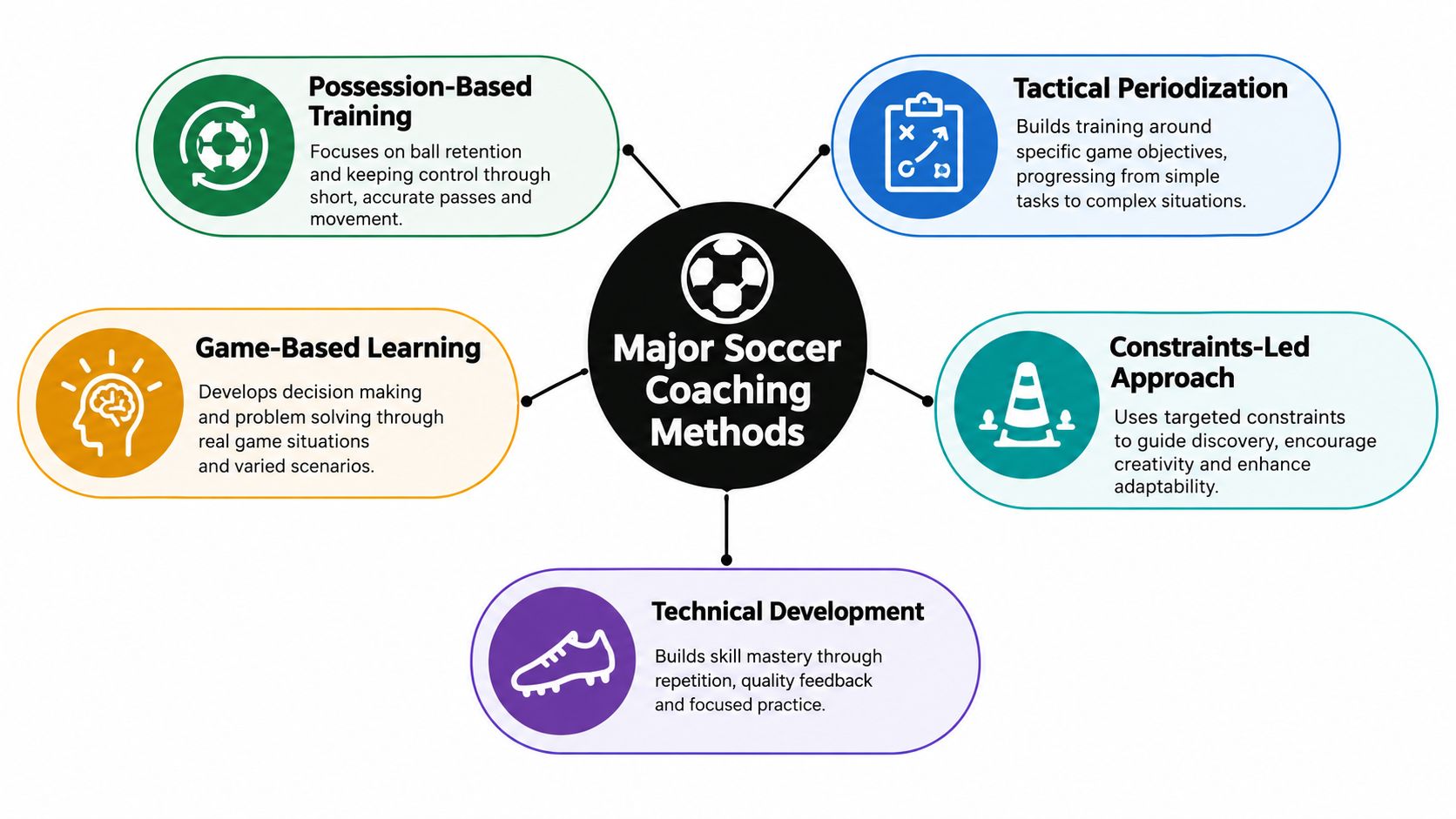
The label matters less than the problem a coach is trying to solve. Possession-based training emphasizes keeping the ball and creating passing options. In a youth session, that might mean a small keep-away game where players learn to move after passing, offer support, and open their body to play forward. Done well, possession work teaches more than safe sideways passing. Done poorly, it produces circulation without penetration or purpose.
Tactical periodization organizes training around the demands of the match and the team's playing model. A coach might use one session to rehearse pressing after a turnover, another to work on building from the back, and another to connect those phases in a realistic game. The method can give an older competitive team clear weekly direction, but younger players need shorter explanations and flexible activities rather than a rigid professional schedule.
Game-based learning places players in modified games so technique and tactics develop together. Instead of teaching a pass in isolation, the coach creates a situation where a player must receive under pressure, identify a teammate, and choose the right weight of pass. Players experience the consequence of each decision immediately.
The constraints-led approach changes the conditions of the task so particular behaviors become more likely. A narrow field can demand faster scanning and quicker support, while wide channels can encourage switching play. The coach guides attention through player numbers, space, rules, touch limits, or scoring targets rather than prescribing one perfect movement.
Technical-focused training isolates skills such as ball control, striking, turning, or passing. It has a legitimate place, especially when a player needs concentrated repetition or a new movement must be introduced. The trade-off is clear: technical work should eventually return to pressure, opposition, and choice.
No single method wins every age group or every learning problem. A good coach blends methods, moving from a focused technical task to a representative game and adjusting the challenge when players are ready.
Matching Coaching Methods to Youth Age Groups
A young child doesn't need a miniature version of an adult professional session. The method must match the player's attention, coordination, physical maturity, and ability to understand a problem.
Early years from U4 to U7
At this stage, playful repetition and simple opposition matter most. Short dribbling activities, tag games with the ball, and 1v1 or 2v2 games help children build coordination while learning to attack space. Instructions should be brief. Coaches can demonstrate, let children try, and then offer one clear adjustment.
Possession training might look like protecting a ball from a defender rather than maintaining a formal passing shape. Technical work can introduce turning, stopping, and striking, but the ball should remain part of an active game whenever possible.
Foundation years from U8 to U11
Players can handle more purposeful combinations and clearer team problems. A coach may use 3v3 or 4v4 games to encourage support, passing, and transition, then pause briefly to ask players where the next option was. Constraints-led activities work well here because changing a boundary or target can create a new problem without a long lecture.
Game-based learning should remain enjoyable. A child still needs freedom to experiment, and excessive specialization can narrow the experiences that help players become adaptable.
Development years from U12 to U15
Players can begin to manage more complex spatial and tactical demands. Possession activities can evolve toward positional play, while tactical periodization can connect the week's sessions to pressing, buildup, or defensive compactness. Coaches should still protect opportunities for creativity instead of turning every action into a fixed instruction.
Advanced years from U16 to U18
Older players can cope with longer sequences, detailed team principles, and more demanding physical preparation. Technical refinement, tactical specificity, and strength work can become more individualized, but match realism remains essential. The progression should be visible in the player's ability to perceive, decide, and execute under pressure.
Families can compare age-stage expectations with the practical guidance in this overview of soccer development by age. The right question isn't whether a program uses an adult-sounding methodology. It's whether the method grows with the child.
The Evidence Behind Modern Training Design
Long-term development depends on purposeful practice, but practice volume alone doesn't explain why players improve at different rates. A foundational study of elite soccer development found a positive linear relationship between accumulated individual and team practice and playing skill. The players studied had completed an average of approximately 3,306 hours of soccer practice, and evidence from the Belgium 1994 World Cup squad indicated that many players practiced about 14 hours per week when assessed. Team practice represented approximately 64% of total practice in one cited analysis. These findings support consistent, structured training, not a race to impose adult workloads on children. The soccer expertise study also cautions against treating a fixed 10,000-hour rule as universal. A later synthesis reported that practice hours explained about 20% of the variance in sport expertise across skill groups, which leaves room for coaching quality, motivation, learning conditions, decision-making, and individual differences.
A second body of work adds an important correction. High-performing players accumulated approximately 5,947 hours of soccer activity by age 18, compared with 4,564 hours for low-performing players and 2,670 hours for recreational players. Yet successful pathways included self-directed play alongside organized sessions. The practical message is not to turn every free afternoon into a formal practice. Children need structured coaching, but they also need room to play, experiment, and own the game. The review of deliberate practice and soccer development describes that balance in detail.
Why small-sided formats change the learning rate
A 2023 systematic review found that 5v5 formats generally produced more total actions than 7v7, while the absolute number of novel or creative actions tended to decline as player numbers increased. Fewer players and less space create more opportunities to receive, scan, pass, support, transition, and defend. The systematic review of small-sided games gives coaches a useful basis for choosing formats by learning objective.
Format | Typical use | Key developmental outcome |
|---|---|---|
3v3 | Frequent 1v1 and quick transitions | Repeated decisions and individual involvement |
5v5 | Combination play with manageable pressure | Passing, support, scanning, and creative action |
7v7 | More team shape and positional relationships | Spacing, circulation, and collective structure |
The format should change when the objective changes. A 3v3 game may expose a player to repeated decisions, while 7v7 can reveal whether that player understands space away from the ball. Coaches can track observable actions such as successful receptions under pressure, forward passes, support movements, and recoveries rather than relying only on goals or match results.
Constraints-led design makes those games more precise. A coach can add two wide target zones to encourage switching, introduce a three-second transition rule to emphasize counterpressing, or use a two-touch limit to increase scanning and support angles. The strongest sessions don't dictate every movement. They create conditions that make useful information visible and invite players to solve the problem.
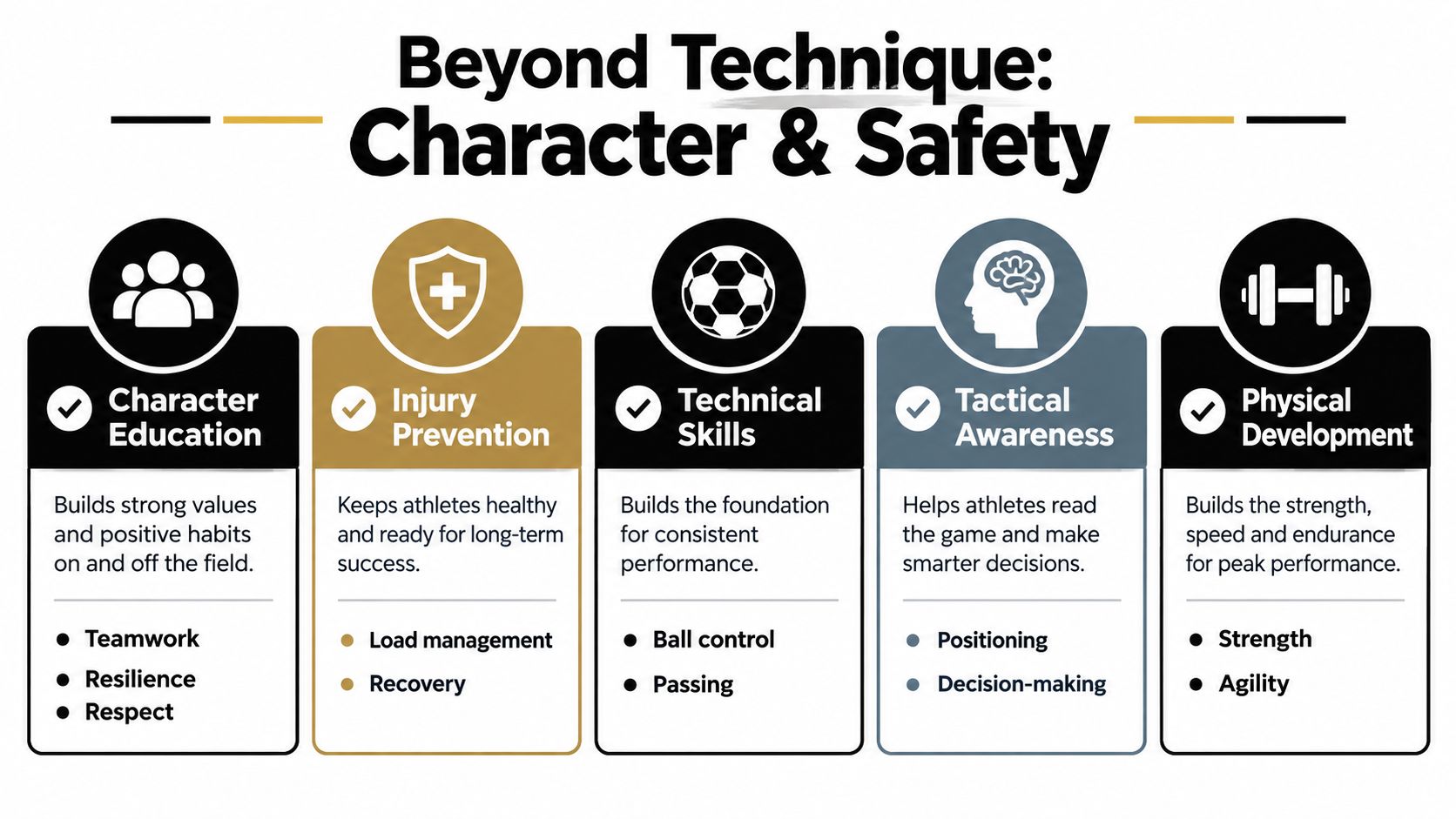
Beyond Technique and Character Development and Injury Prevention
A complete youth program teaches more than ball mastery. It also teaches children how to respond to mistakes, communicate with teammates, take responsibility, and manage the demands placed on their bodies. Those outcomes shouldn't live only in a mission statement.
A 2025 study using a coach-observation tool found a significant mismatch between planned and delivered values and life-skills instruction. Coaches planned significantly more time for those areas than they delivered in practice, with p < 0.001 in both observed sessions. The coach-observation research highlights a common problem: a coach can care about character while allowing technical content, match preparation, and corrections to crowd out deliberate life-skill teaching.
Turn values into visible behavior
Parents should look for actions, not slogans:
Autonomy: Players explain a choice instead of waiting for the coach to solve every problem.
Responsibility: Players help organize equipment, recognize their roles, and respond constructively after errors.
Connection: Coaches create moments for communication and shared problem solving.
Resilience: A mistake becomes a prompt to recover, scan again, and make the next action useful.
Leadership: Players rotate responsibilities rather than allowing the same voices to control every activity.
Physical preparation requires the same level of care. The 2025 randomized study reported that a 12-week high-load strength program reduced injury incidence from 11.34 to 1.31 injuries per 1,000 exposure hours and reduced injury burden from 304.66 to 19.72 absence days per 1,000 hours, while improving physical fitness. That result doesn't mean every child needs the same loading plan. It supports qualified, individualized strength work, supervised according to maturity and total demands.
A separate six-season study of players aged 8–15 found traumatic and overuse injuries in roughly equal proportions, with patterns changing by age. It recommended gradual progression and close monitoring, especially for younger players. Parents should ask how coaches account for school sport, club sessions, tournaments, sleep, and recovery. Rest isn't a sign that development has stopped. It's part of making development sustainable.
For families who want a broader mobility reference, systematic stretching for gymnastics offers useful context on why flexibility work should be structured rather than treated as a one-size-fits-all routine. Soccer programs should apply the same principle to warmups, strength, recovery, and communication.
How Villarreal CF Methodology Applies to Youth Development
A club methodology becomes meaningful only when parents can see it in daily practice. The Yellow Submarine approach connects technical proficiency, tactical understanding, creativity, and character to a long-term player pathway. For a young player, that shouldn't mean copying a professional team's session. It should mean receiving age-appropriate problems that become more demanding as perception, coordination, and understanding develop.
In practice, a possession-based activity for younger players may focus on receiving away from pressure, finding a teammate, and moving after the pass. Older players can work on manipulating opponents, changing the point of attack, or connecting buildup with the next phase. Game-based activities keep those principles connected to actual choices, while short coaching interventions prevent the coach from taking over the problem-solving process.
The same standards apply to character. A coach can rotate leadership, ask players to explain their decisions, and treat recovery after mistakes as part of the task. Players should leave training with more than a corrected technique. They should understand how they contributed, what they noticed, and what they can try next.
Families can learn more about the academy's pathway and partnership in this overview of the Villarreal CF youth academy. Competitive teams, camps, clinics, tryouts, and development opportunities should all express the same underlying principles, even when the session format changes.
A methodology is also tested by progression. The coach should be able to explain why a player is moving from a simpler game to a more complex one, how feedback changes with age, and what evidence shows that the player is ready for greater responsibility.
How to Evaluate a Soccer Program or Coach
Attend a practice before making a decision when possible. Watch the players, not just the coach's presentation.
Count involvement: Are children repeatedly touching the ball and interacting with teammates, or are they waiting in lines?
Observe decisions: Does the activity require players to choose, or does the coach call out every movement?
Check the format: Are small-sided games used for the age and objective?
Listen to feedback: Does the coach use concise corrections and useful questions?
Look for progression: Does the session move from a simpler problem toward a realistic game?
Ask about load: How does the program coordinate training, matches, school sport, tournaments, and recovery?
Test the character claim: Do players lead, communicate, and take responsibility in observable ways?
Review communication: Can the coach explain what players are learning and how families can support it?
A program doesn't need to look identical to another program to be sound. Technical-focused work may be appropriate for a specific weakness, while game-based learning may be better for decision-making. The concern is imbalance, especially when children spend most of practice waiting, listening, or repeating movements with no opponent or choice.
For a deeper set of coaching criteria, families can use this guide to what makes a good soccer coach. Ask direct questions and compare the answers with what you see on the field.
Building a Long-Term Development Pathway
A player's development is built through progressions, not isolated sessions. Early work should create comfort with the ball and enjoyment of play. Later work can add pressure, teammates, tactical relationships, and physical demands. The coach's job is to increase complexity without removing the player's opportunity to think.
Practice matters, but practice hours aren't the whole explanation. The evidence links accumulated activity with skill while also showing that coaching quality, motivation, learning conditions, decision-making, and individual differences influence expertise. A child who spends more time in a thoughtful, engaging environment may gain more than a child who just attends more sessions.
What a durable pathway protects
A strong pathway protects several things at once:
Curiosity: Players still want to try solutions instead of fearing mistakes.
Technical confidence: Players can control, pass, turn, and strike under increasing pressure.
Tactical understanding: Players recognize space, support teammates, and adapt to changing problems.
Physical readiness: Strength, movement, recovery, and workload progress with the athlete.
Personal ownership: Players gradually take responsibility for preparation, communication, and improvement.
Short-term results can obscure whether those foundations are developing. A team may win while relying on direct play, early physical maturity, or one dominant player. Over time, those advantages change. Players who can scan, decide, communicate, and adapt have more ways to contribute.
Parents in Greater Houston should choose a program based on the daily experience it creates, not only its team label or tournament record. Ask what the child will do, decide, and learn at training. Then watch whether the coach's method matches the answer.
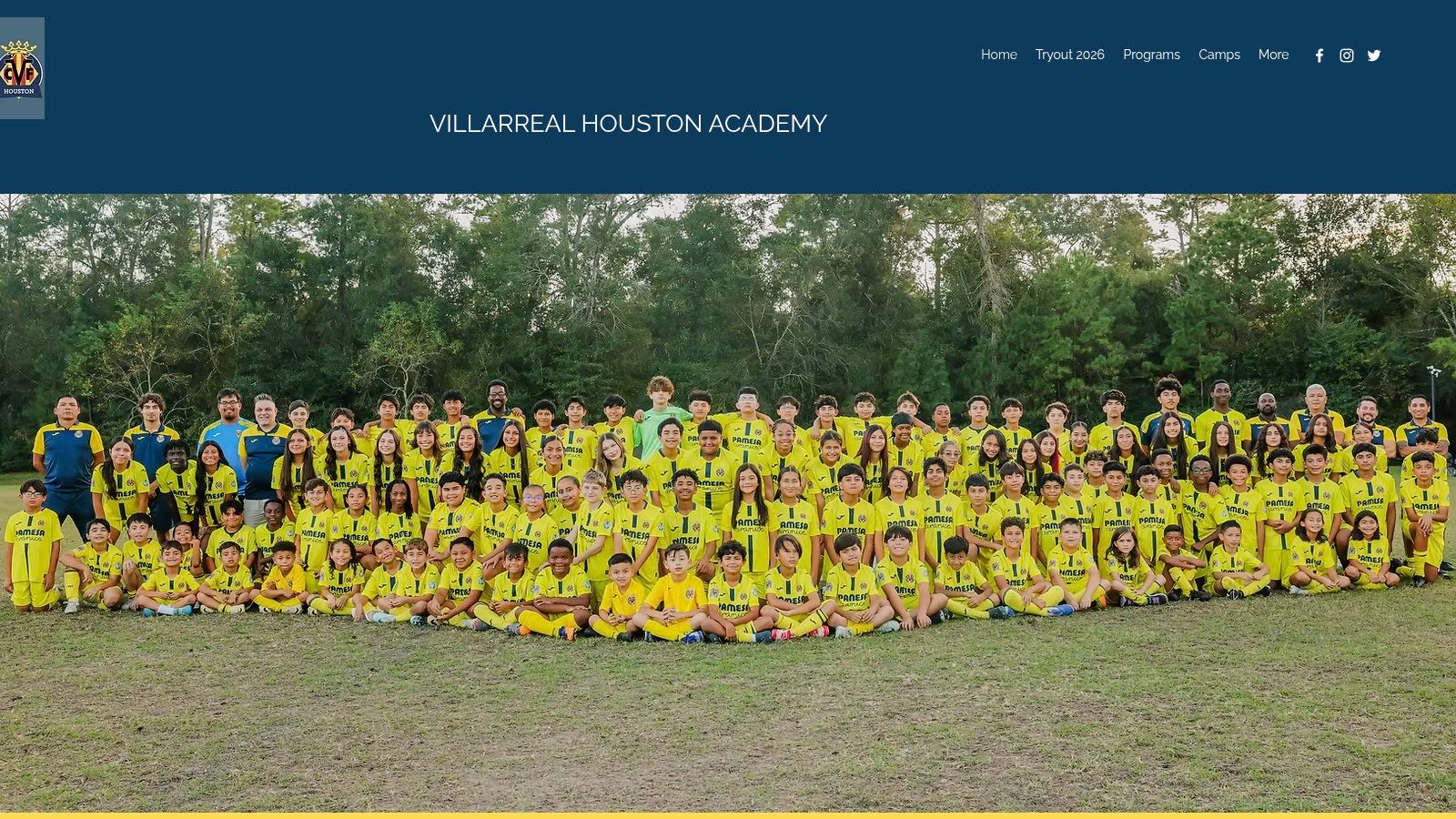
Villarreal Houston Academy offers age-appropriate teams, camps, clinics, tryouts, and a structured pathway for boys and girls from age 4 upward, guided by Villarreal CF methodology and qualified coaches. Visit Villarreal Houston Academy to explore programs and choose a training environment that develops technical skill, decision-making, character, and a lasting connection to soccer.
Comments