


How Does Sports Psychology Help Athletes: A Youth Guide

A 2024 randomized controlled trial in Frontiers in Psychology put a number on something most players feel but can't name. Systematic desensitization training cut competitive state anxiety by 39.19% and raised state self-confidence by 14.42% in a group of Latin dance athletes (Frontiers in Psychology, 2024). Dance isn't soccer and an academy isn't a laboratory. The size of the shift is the point: nerves and confidence behave like trainable states, not fixed parts of a personality.
That answers the question parents ask most often. How does sports psychology help athletes? By teaching specific, practised mental skills that change what a player does in the moments that decide a match.
The honest version has two halves. Mental skills measurably shift confidence, focus and the response to pressure, and they only do that work inside a system of sensible training load, sleep, school demands and proper medical care. Where performance coaching ends and clinical support begins matters, and that line gets blurred in a lot of youth sports marketing. This guide keeps it visible.
What Sports Psychology Actually Changes for Athletes
Sports psychology helps athletes with confidence, attention, emotional control, resilience and the way a team environment shapes all four. Those aren't soft comforts. They've been measured across four decades of published work.
A 2022 systematic review of 30 meta-analyses pooled studies published between 1983 and 2021, covering 16 sport-psychology constructs across a wide range of athletes and sports. Psychological factors intended to improve performance, such as confidence, team cohesion, mindfulness, motivation and effective coping, had an overall moderate positive effect on athletic performance (Cohen's d = 0.51, 95% confidence interval 0.42 to 0.58). Factors associated with poorer performance, including cognitive anxiety, depression and ego-involving motivational climates, produced a small negative effect (d = -0.21).
Moderate is the word the authors used, and it sets the right expectation. Mental skills move performance in a measurable direction. They don't turn an average player into a standout one.
Two things follow. Psychology in sport isn't limited to treating severe mental-health problems; it builds practical resources an athlete applies in training and in matches. In soccer those resources look like a pre-performance routine, constructive self-talk, emotional regulation after a mistake, concentration strategies and a rehearsed plan for the next ball. For a youth player moving up through harder levels of play, that stack of skills supports confidence and resilience at exactly the age when both get tested.
Here's how the performance areas line up with the skills and with the effects the research measured.
Performance area | Skills athletes practise | Evidence from research |
|---|---|---|
Confidence | Imagery, self-talk, goal setting | Psychological skills training measured g = 0.83; imagery measured g = 0.75 |
Focus and attention | Attentional control, mindfulness | Mindfulness and acceptance methods measured g = 0.67 |
Resilience and coping | Effective coping, constructive responses to mistakes | Overall psychological factors d = 0.51 across 30 meta-analyses |
Pressure and arousal | Relaxation, pre-performance routines | Taught inside the wider skills package rather than measured on its own |
Team environment | Team cohesion, supportive motivational climate | Included in the overall d = 0.51; ego-involving climates run the other way at d = -0.21 |
A row without its own number reflects how the studies were bundled, not a weak skill. Relaxation and routines get taught as part of a package, and the package is what got measured.
The question parents ask most: isn't this only for anxious, struggling or elite athletes? No. It's also a developmental tool for any young player building confidence and learning to handle pressure.
One boundary belongs early in the conversation. Psychological training adds to technical, tactical and physical development. It doesn't replace any of them.
How Imagery, Self-Talk and Attention Work
Focused mental preparation looks quiet from the sideline. A player stands over the ball, takes a breath, says something under their breath and steps into the kick. Three separate mechanisms are running at once, and each one has been tested.
Concentration shows in the face and the posture long before the ball moves.
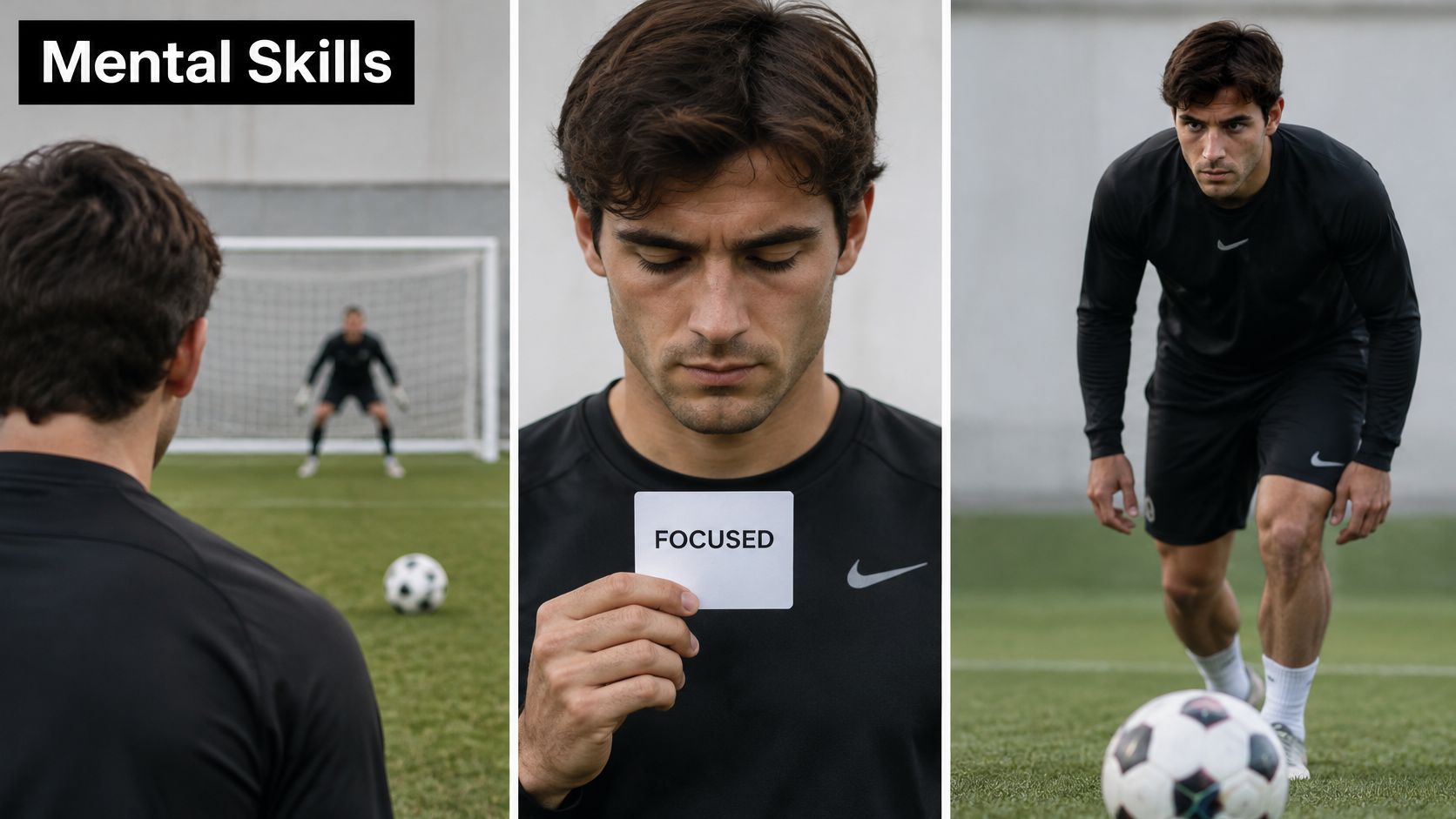
A 2023 systematic review and meta-analysis in Sports Medicine evaluated psychological interventions designed to enhance athletic performance and found moderate benefits for the approaches coaches use most.
Imagery works like a flight simulator
Pilots log hours in a simulator before they fly the aircraft. The value comes from repeating the sequence, not from the scenery. Imagery does the same job for a penalty kick or a defensive shape: the athlete rehearses the skill mentally so the movements and decisions feel familiar when they're performed for real. Imagery interventions produced an effect of g = 0.75 compared with control conditions. The mechanics of visualization in sports run deeper than picturing a goal; players rehearse timing, sound and the feel of contact.
Self-talk and attention control steady the next action
Psychological skills training bundles goal setting, relaxation, self-talk and attentional control. It produced the largest effect in that review at g = 0.83 (95% confidence interval 0.21 to 1.45). The mechanism is regulation. The athlete brings arousal to a level that helps rather than hijacks, and keeps attention on the next action instead of replaying the last mistake.
This is what that regulation looks like when it is taught rather than assumed.
Mindfulness is the referee's whistle
A whistle doesn't stop the game. It resets the phase of play. Mindfulness and acceptance-based methods, measured at g = 0.67, train the same move: notice that attention has drifted to the crowd, the scoreline or the last error, then return it to the present moment without a lecture attached.
The review includes soccer-specific evidence too. A controlled study followed 19 female soccer players through twelve 45-minute sessions built around enjoyment, goal setting, relaxation and self-talk.
Then comes the part most write-ups skip. Once the review authors excluded non-randomized studies and subjective performance measures, the effects were no longer statistically significant. That doesn't make the methods worthless. It tells you to present sports psychology as a structured complement to coaching, not a guaranteed shortcut to better results. For youth academies, that means consistent instruction, qualified support and age-appropriate practice when these methods are introduced.
How to Build a Pre-Performance Routine
The ten minutes before a tryout are the worst ten minutes to improvise. A routine gives a player something to do with that time, and the same sequence works before a league match, a cup tie or a first training session at a new club.
Three moving parts carry most of the value. The detail sits underneath.
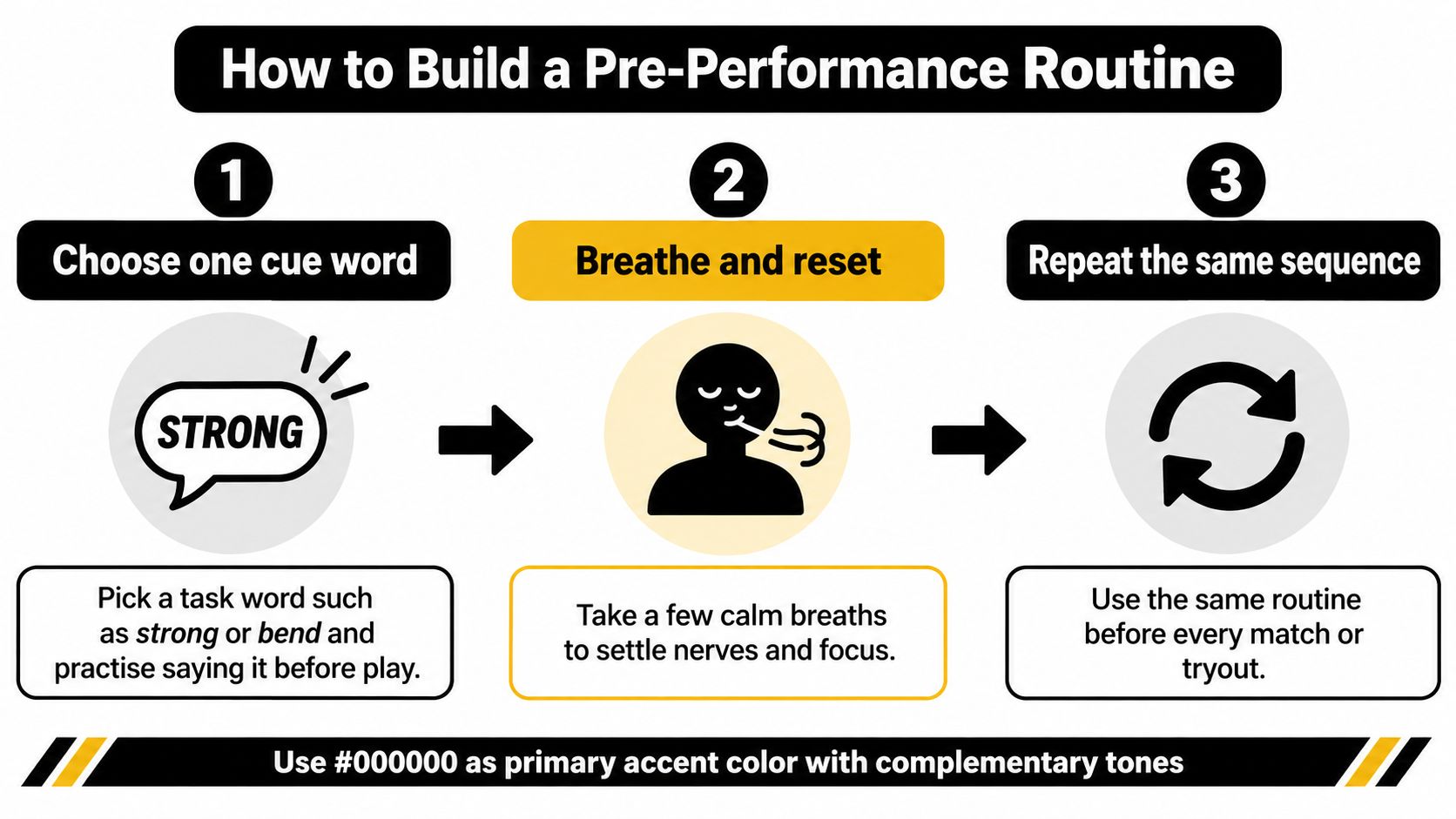
Choose one cue word tied to the task. "Strong" for a defender stepping into a challenge, "bend" for a winger striking across the ball. Say it in training first, so the word picks up the feel of the action. The usual slip is choosing something abstract. "Win" or "be better" tells the body nothing.
Run a 30-second imagery rehearsal of the first two actions. Eyes closed, see the first pass and the first movement after it. Thirty seconds is deliberate. Long rehearsals raise arousal and turn preparation into daydreaming.
Set one process goal, never a result goal. "Every first touch under pressure goes forward" is controllable. "Score twice" isn't, and it hands a player something to fail at inside ten minutes.
Take three slow breaths, four seconds in and six seconds out. The longer exhale is the part that settles heart rate. Players who skip this step tend to breathe only after the panic has already started.
Pick one focus point. The ball, the near post, the space behind the full-back. One. Two targets split attention and slow the first decision.
Use the same routine every time. Same order, same length, home or away. It becomes automatic through repetition, and the most common mistake is rebuilding it after a poor game. Change one element at most, and only after three or four matches.
Scaling the routine down for younger players
A 7-year-old needs two steps: a cue word and one breath. Make the cue physical, a tap on the chest or a sticker inside the boot, and keep the whole thing under 15 seconds. Players aged 9 to 12 can hold three steps. Teenagers can run the full sequence.
What doesn't scale down is the explanation. A child who knows why the routine exists keeps using it when no coach is watching.
A quick test of a good routine: the player can run it in a noisy stadium without anyone reminding them.
Handling Pressure, Mistakes and Injury Setbacks
The cup quarter-final is level at 1-1 and a 15-year-old midfielder places the ball on the spot. She strikes it at a comfortable height, the keeper guesses right, and the miss ends the tie. Over the next two matches she plays within herself: safe passes, no runs beyond the ball, a first touch that keeps getting heavier.
That stretch is where a young player either learns a coping sequence or learns that mistakes are permanent verdicts.
The first move is language. She names what happened out loud to a coach or parent: I'm angry, I'm embarrassed, I don't want the ball again. Naming it drops the intensity to a level she can work with. Then she uses the cue word she already practises in training and applies it to the next action rather than the last one.
Separate the mistake from the player
Constructive self-talk is short, task-focused and forward-facing: next ball, stay wide. Harmful self-talk is a permanent label: I always choke. The first is a coaching point. The second is a verdict on who she is, and players repeat verdicts to themselves for years.
Parents can hear the difference in one sentence. If the words describe an action, you can work with them. If they describe a person, correct the framing before you correct the technique.
Cap the rumination
Give the review a window. Ten minutes in the car after the match, then one specific thing to work on at Tuesday training. An open-ended post-mortem teaches a player to keep replaying the moment in bed at midnight, which is the opposite of useful.
The skills for handling pressure in sports build from repetition of that boundary, not from a single good conversation.
Injury is a mental event too
Time out of training and competition raises distress, and that distress can delay a safe return. Psychological support during rehabilitation belongs in the recovery plan, not bolted on at the end. What no mental skill can fix is pressure to play through injury. Encouraging a player to push through pain is a safety problem, and it's a medical decision, not a test of character.
Three things to do this week:
Write the cue word on the water bottle. Visible beats remembered.
Agree the rumination window out loud, so the player knows when the review ends.
Ask one question after the game instead of giving a verdict. "What did you see before the second goal?" opens a conversation. "You were poor today" closes it.
Where Sports Psychology Fits Alongside Coaching and Medicine
The harder question is what happens when the performance problem isn't in the athlete's head. A 2025 review of student-athletes identified training load and academic pressure as the consistent primary stressors, while psychological skills training, counseling, sleep hygiene and mindfulness were among the better-supported coping approaches. Look at that list again. Two of the four best-supported responses are sleep and counseling, not mindset work.
A recent International Olympic Committee framework makes the same argument at the policy level. It emphasizes coordinated education, qualified mental-health services, monitoring and post-event support, not isolated motivational advice handed to a struggling teenager.
The test of any mental-skills programme: does it change what the athlete does, or does it only help them tolerate a schedule that should have been changed?
Teaching positive self-talk can't compensate for excessive training, poor recovery, an unsafe team culture or pressure to play through injury. Mental work sits inside a wider system, and each part of that system owns something specific.
Coaches own training load, session design and honest communication about selection.
Parents watch sleep, school stress, mood and appetite, and raise a pattern that lasts more than a week or two.
Medical staff own injury and return-to-play decisions, full stop.
Sports psychologists teach coping and performance skills and refer on when the picture turns clinical.
Schools adjust deadlines during heavy competition periods instead of treating sport as an optional extra.
Progress gets judged by behaviour as well as results: sleep quality, whether the player still enjoys training, effort in sessions, and whether they talk openly with a coach. At Villarreal Houston Academy, coaches learn the Villarreal CF methodology and work side by side with Villarreal CF sports psychologists, and the development path is built around competing at full potential with respect, integrity and personal responsibility. That structure only works when positive coaching techniques carry the same message from the sideline to the car park.
Digital mood tracking and screening deserve one clear rule. A flag from an app should lead to a conversation with a person, never to an automated diagnosis.
Warning Signs and Choosing the Right Support
A sports psychologist teaches coping and performance skills. Clinical care treats illness. Serious anxiety, depression, eating concerns, trauma or self-harm need appropriately qualified clinical care and coordinated safeguarding, and the earlier that handover happens, the better it goes for the player.
Search results for how does sports psychology help athletes tend to return visualization, confidence and pre-game routines. Useful, and incomplete. A 2025 systematic review of sport-based adolescent mental-health awareness programs examined interventions designed to improve recognition of symptoms, reduce stigma and encourage help-seeking. Sport settings can be used for prevention rather than waiting for a crisis to force the issue.
Recent research also identifies academic pressure, training load, injury, deselection, peer dynamics and early specialization as overlapping risks for young athletes. They arrive together far more often than they arrive one at a time.
A seven-year-old and a seventeen-year-old need different things
Helping a 7-year-old name an emotion and recover from a bad pass in the next 30 seconds is not the same job as helping a 17-year-old manage selection pressure, identity, injury or recruitment. Same academy, different curriculum, different language.
Age-appropriate training with qualified coaches is the foundation, and it's the stated mission behind the academy's programs for local youth talent. The work starts where the child is.
Warning sign | What it may point to | Who to involve |
|---|---|---|
Withdrawal from friends, school or sport lasting several weeks | Possible depression or significant distress | Doctor and qualified clinician |
Fear or dread before every session, beyond normal nerves | Anxiety that goes past performance nerves | Qualified mental-health professional with sport experience |
Restricted eating or an intense focus on weight | Possible eating concern | Medical team and clinician |
Talk of self-harm or hopelessness | Safeguarding risk | Immediate crisis support and the safeguarding lead |
Drop in mood after injury, with reluctance to return | Injury-related distress | Sports medicine team with a psychology referral |
Signs of self-harm or hopelessness need immediate action through the safeguarding lead or crisis support. Wait-and-see is not a plan.
Parents should share what they observe with the coach and the medical team, so one clear picture reaches the right professional instead of three partial pictures reaching nobody.
A checklist for choosing support
Qualified people, not motivational speakers. Ask whether the coaches work alongside qualified sports psychologists, or just quote them in preseason meetings.
Content that fits the child's age. A session plan for a 9-year-old should look nothing like one for a 16-year-old.
Wellbeing handled alongside skill. Ask what the provider does when a player's mood drops, not only when their finishing does.
A named referral route and a safeguarding process. Every academy should be able to explain both without hesitating.
Recreational entry points matter here too. Fall Creek Sports Complex offers Recreational Soccer for ages 4-13 in partnership with MLS Go, which is often where a family first notices how their child handles mistakes, nerves and teammates.
Three questions for a first conversation
Ask how the coach responds when a player makes a mistake in a match, and listen for whether the answer describes a process or a punishment. Ask how progress is measured beyond goals and results. Ask what happens when a player is struggling and doesn't want to talk to a coach.
A sports psychologist teaches a player how to steady herself before a penalty. A clinician treats the depression that makes her not want to get out of bed. Confusing the two delays help.
A good program answers all three questions directly, and says plainly when a child needs a different kind of help than it can offer. If you're weighing up fit for your own player, ask us directly.
Villarreal Houston Academy delivers select and competitive youth soccer across Humble, Fall Creek, Cypress, Tomball and the Kingwood-Porter-New Caney area, with age-appropriate training led by qualified coaches who work alongside Villarreal CF sports psychologists. If you want a development pathway where confidence, focus and recovering from mistakes are coached alongside technique and tactics, come watch a session and ask how the mental side is handled at each age group. Visit Villarreal Houston Academy to find the location and program nearest your family.

Comments