


Player Development Center: What It Is and How to Choose One

You're comparing soccer programs after another uneven season. Your child might need a stronger challenge, or might be losing confidence and asking to stop. The websites show busy fields, impressive facilities and international opportunities, but you're trying to answer a simpler question: Will my child learn, feel supported and still want to play?
A player development center should give you a clear answer. Judge it by what happens to the child who struggles, the player who matures later and the family who can't afford every extra.
What a Player Development Center Actually Is
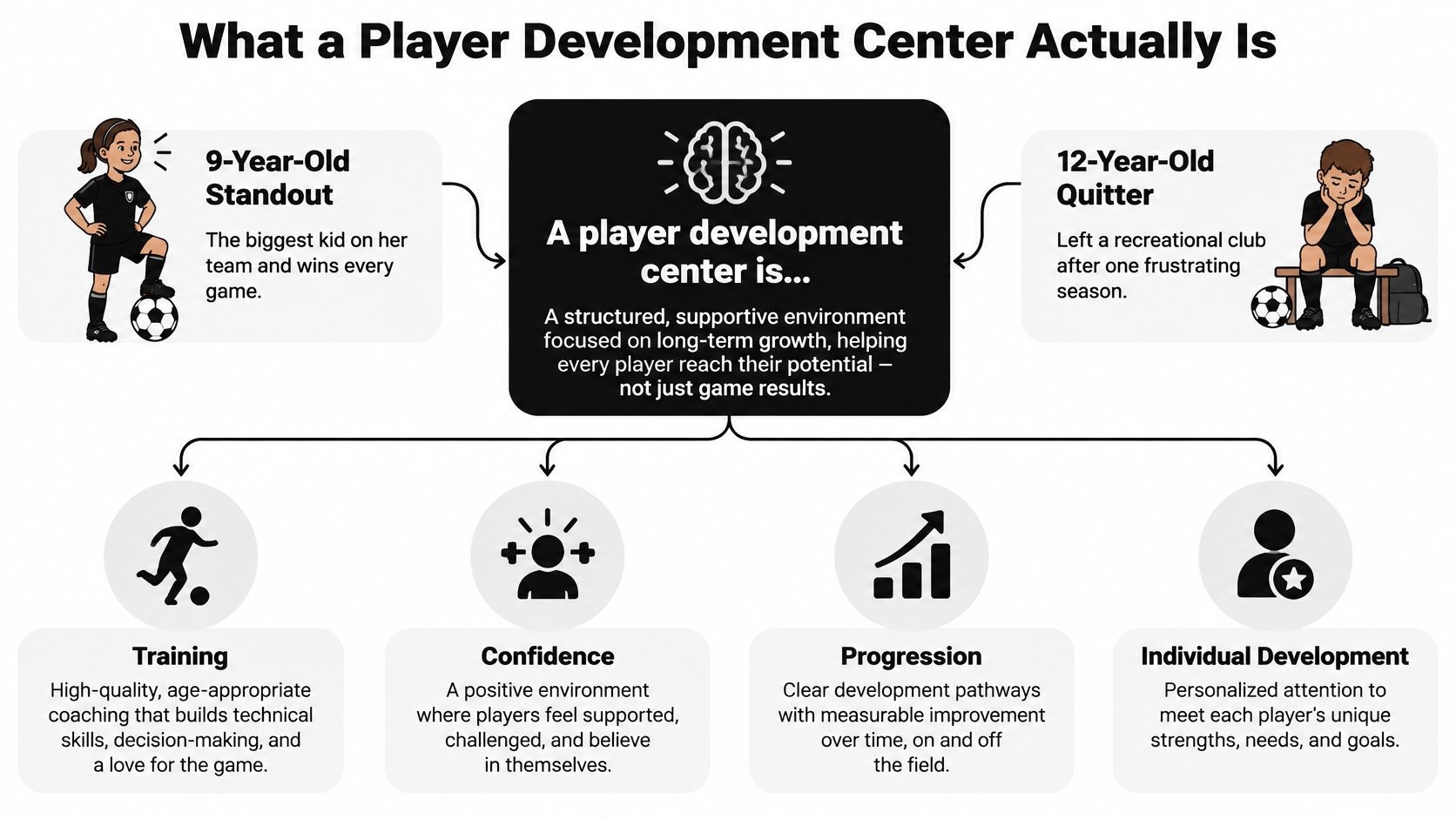
Consider two children: a nine-year-old who's the biggest player on her team and wins every game, and a twelve-year-old who left recreational soccer after a frustrating season. Both could benefit from structured development, but they don't need the same coaching.
The standout might need challenges that size alone can't solve. The returning player might need manageable tasks and a coach who helps rebuild trust. A player development center combines training, competition, coaching and support to help each child progress toward a realistic long-term level.
How a player development center differs from the alternatives
Option | Main aim |
|---|---|
Recreational league | Participation and fun |
Single club team | Results within one season |
Private trainer | One skill at a time |
Player development center | Realistic long-term level for each player |
These are useful distinctions, not rigid boundaries. A club team can care about long-term learning, and a private trainer can address several skills. The difference to look for is coordination: who connects the child's practice, matches, feedback and next steps?
A learning environment, not just a team
Think of driving school. Learners practise in controlled conditions, get feedback and then apply what they've learned on real roads. Soccer development should connect supported practice with decisions made against opponents.
The participation base is substantial: a national-level account of youth soccer participation cited approximately 3.9 million U.S. participants ages 7–11 and roughly 3 million ages 12–17. A center serving this broad population shouldn't define success only through elite advancement.
Before comparing programs, name your child's immediate priority: enjoyment, skill building, competition or an advanced pathway. Those goals can change. A suitable center should explain how it would support the child you have today, rather than sell you an imagined future professional.
The Core Services and What Each One Covers
Core services of a player development center
Service | What It Covers | What Good Delivery Looks Like | Question to Ask |
|---|---|---|---|
Technical training | Ball mastery, first touch, passing and finishing under pressure | Repeated practice with rising difficulty and regular measured skill checks | How often is each player assessed, and what do the results look like? |
Tactical curriculum | Positioning, pressing triggers, transitions and decision-making | Small-sided games built around clear principles, with age-appropriate progression | Which principles are taught at each stage, and in what order? |
Sports psychology | Confidence, coping with mistakes, focus and communication | A psychologist working with coaches, supported by player check-ins | Who delivers this support, and how do players access it? |
Facilities and performance | Indoor and outdoor pitches, video review, fitness and recovery | Timely video feedback, developmentally appropriate strength work and recovery planning | Is video shared with players, and who supervises fitness sessions? |
Look for connections between services
Technical training gives players tools they can repeat under pressure. Watch whether coaches adjust distance, space, speed or opposition as players improve. A passing test can help track progress, but it shouldn't become the only measure of a child's ability.
The tactical curriculum explains when to use those tools. A pressing trigger, for example, is a cue to pressure an opponent, such as a poor touch. Coaches should teach players to recognize that cue in a game, not merely run toward a cone when instructed.
A written soccer academy curriculum gives parents a useful starting point for understanding how training topics connect. Ask the coach to show where the current session fits within that progression.
Support must reach the training field
Psychological support shouldn't sit apart from everyday coaching. Players need practical ways to focus, recover from errors and speak up when they're confused. Access to a specialist matters, but so does the language the coach uses during an ordinary drill.
Facilities deserve the same practical scrutiny. Indoor space can help maintain training continuity, while video can make a decision easier to understand. Neither proves that coaches have a thoughtful plan.
Practical test: Ask how a normal training week connects a technical task, a game problem, player feedback and recovery.
For example, receiving under pressure might begin with controlled first-touch practice. Coaches could then introduce an opponent, use the skill in a small-sided game and review a relevant clip afterward. That's a connected learning experience.
Be cautious when a center can describe its equipment in detail but can't explain its teaching. Strong drills without emotional support leave a gap. So do impressive facilities without a clear tactical purpose.
How Technical and Tactical Training Build on Each Other
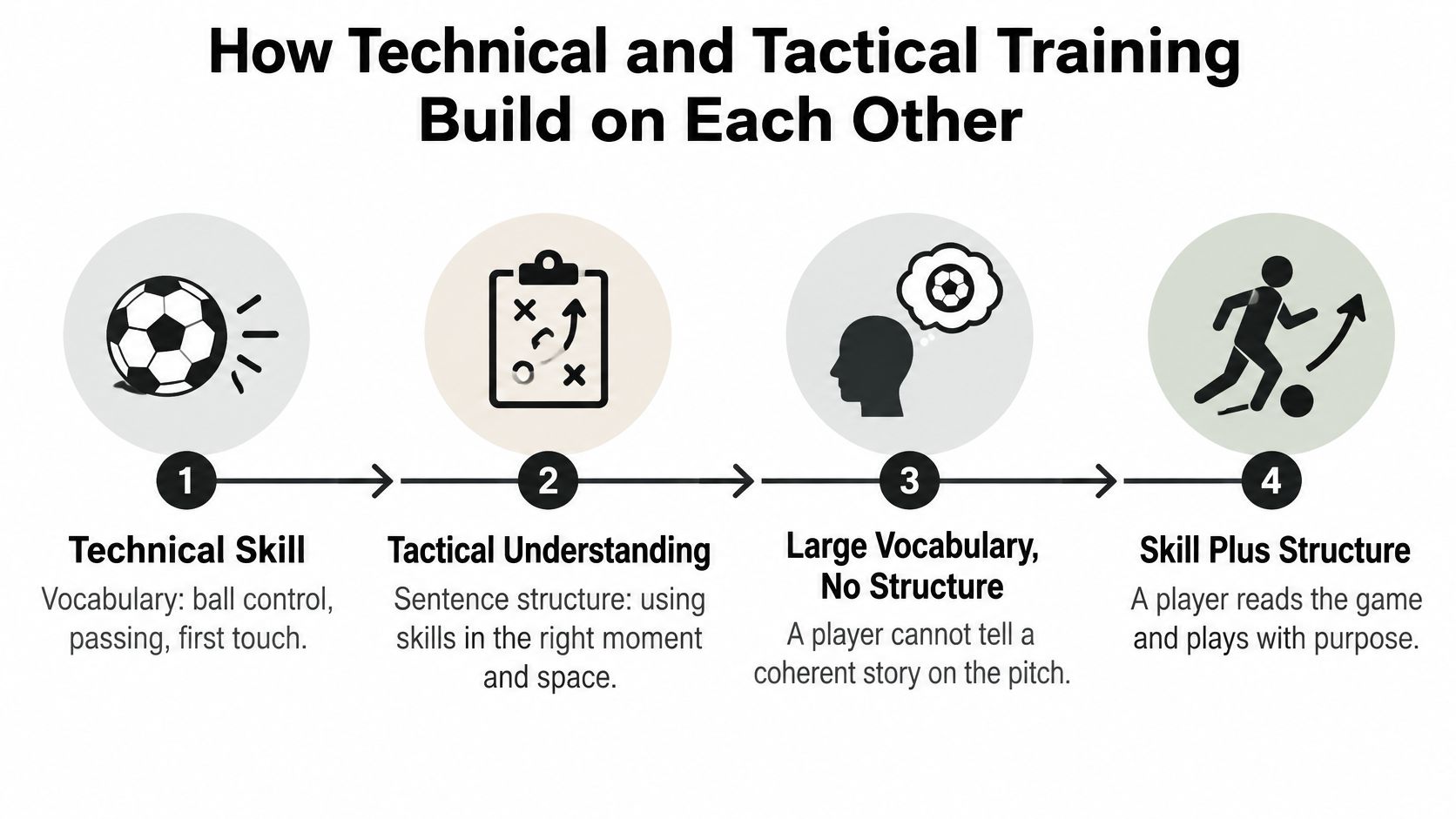
Technical skill is vocabulary. Tactical understanding is sentence structure. A player can know many moves yet struggle to put them together meaningfully during a match.
The reverse also happens. A player may recognize the right passing lane but lack the first touch needed to use it. Technique and tactics should develop together, with coaches adjusting the challenge to what the player can manage.
Training focus by age band
The following is an illustrative planning framework, not a universal timetable or a statement of league rules. Coaches should adjust it for experience, readiness and the competition format.
Age Band | Technical Focus | Tactical Focus | Typical Session Format |
|---|---|---|---|
Ages 4–6 | Ball familiarity, balance, simple dribbling and enjoyment | Playing in small spaces with a simple rule | Short, playful activities with frequent ball contact |
Ages 7–9 | Ball mastery, two-footed control and short passing | Support runs, individual attacking and defending, and simple spacing | Small-sided games with frequent restarts |
Ages 10–12 | Passing accuracy, receiving under pressure and weaker-foot development | Pressing cues, width, depth and transitions | Modified games with coach-led problem solving |
Ages 13–15 | Technical refinement, finishing and first touch at speed | Positional roles, team shape and defensive organization | Larger-sided games, video review and position-specific practice |
Ages 16–18 | Advanced skill refinement and appropriate physical preparation | Match analysis and role-specific decisions | Full-sided play, individual development plans and competition planning |
Add decisions as skills become usable
A coach doesn't need to wait for perfect technique before introducing decisions. Once a child can make a short pass, the coach can ask where the player should move afterward. That's an early tactical problem.
Young players need opportunities to discover answers through play. Constantly stopping them to arrange a formal team shape can replace their decisions with the coach's instructions. A better task might reward finding open space while leaving players free to choose how.
Suppose a player receives the ball and immediately loses it. The coach should work out whether the problem was the touch, a failure to look around or a teammate's lack of support. Repeating an unopposed drill won't address every possible cause.
Adapt the task without fixing the label
A late-maturing player shouldn't automatically become a permanent substitute or receive only simplified work. The coach can adjust contact pressure and space while preserving demanding decisions. Extra technical repetitions should respond to an actual learning need, not an assumption about body size.
A position change requires a different adjustment. A winger moving into central midfield may need practice checking both shoulders, receiving from different directions and protecting central space. Repeating familiar wide attacking patterns won't prepare that player for the new role.
Look for a clear explanation of how tasks progress. Older players shouldn't perform the youngest group's drills faster, and beginners shouldn't be pushed through advanced patterns they don't understand.
Sports Psychology and Character Work in Practice
A center is judged less by its drills than by how it treats a player after a mistake.
A child who expects humiliation may avoid the very actions needed to improve. Psychological safety doesn't mean removing challenge or pretending every attempt was good. It means players can make errors, ask questions and receive correction without being belittled.
A study involving players, parents and coaches in a national girls' talent pathway identified development opportunities in achievement-related communication, success planning and coping skills. Those are practical coaching responsibilities, not extras reserved for elite players.
Turn confidence into teachable actions
Consider a young teenager who stops shooting after missing several chances. Shouting encouragement from the sideline may not reveal what's wrong. A brief private conversation might show that the player fears being blamed for losing.
The coach can set a process goal, such as preparing the body before striking when a suitable chance appears. A manageable finishing activity gives the player opportunities to practise that action successfully. Feedback then addresses the preparation and decision, not just whether the ball enters the net.
Useful psychological work includes:
Confidence: Give specific feedback about actions the player can repeat.
Coping: Practise a reset routine, such as breathing out, looking up and returning to the next task.
Communication: Explain selection and playing-time decisions privately and respectfully.
Belonging: Check whether players feel included, have teammates to work with and know how to report a concern.
Character work belongs in these everyday moments. Personal responsibility might mean acknowledging a poor decision and helping the team recover. It shouldn't mean accepting ridicule or staying silent about bullying.
Keep specialist support connected to coaches
At Villarreal Houston, our coaches learn the Villarreal CF methodology and work side by side with Villarreal CF sports psychologists. Our coaches are meant to engage players, communicate positively and help young people find their best on and off the field.
That working relationship matters because coaches need to recognize stress and respond appropriately, rather than treat every difficulty as poor attitude. Our explanation of sports psychology in youth soccer offers context for that approach. Coaching support also needs boundaries: coaches shouldn't diagnose mental-health conditions or replace qualified clinical care.
Ask to see written coach-behavior standards and identify the person responsible for concerns. A parent should know whom to contact if the coach is part of the problem. Promises of a supportive atmosphere need a clear route for addressing behavior that falls short.
How to Evaluate a Center Before You Commit
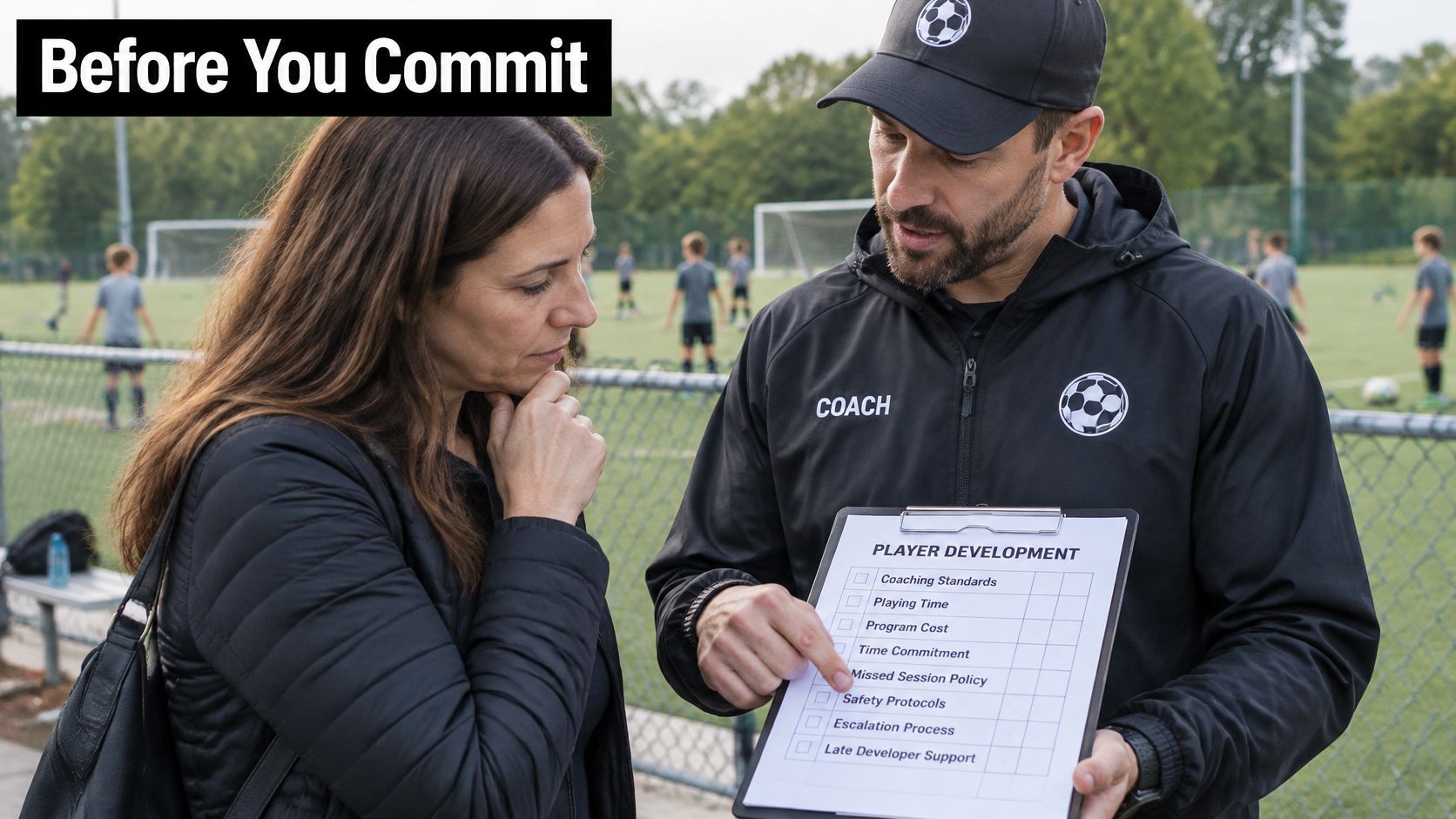
Evaluation checklist for a player development center
Criterion | Strong Sign | Red Flag | Question to Ask |
|---|---|---|---|
Assessment method | Several measures over time, including consideration of late maturation | Selection based on size, speed or dominance alone | How do you assess a late-born child? |
Coach standards | Written conduct rules, positive coaching and qualified staff | Public criticism and no accessible standards | Who enforces coach conduct rules? |
Selection and playing time | Written explanations of decisions and release criteria | Promises of starting spots or college and professional outcomes | How are selection and release decisions communicated? |
Total annual cost | Written budget identifying required and optional expenses | Fees revealed only after registration | What's the full cost, including travel and tournaments? |
Time commitment | Clear weekly schedule and travel expectations | Open-ended mandatory extras | What commitment is required outside regular training? |
Missed sessions and refunds | Policy available before payment | Vague wording about credits or adjustments | What happens when a player misses an activity? |
Safety and escalation | Named contact and written reporting process | No route for reporting bullying or pressure | Who handles a concern about a coach? |
Late-developer pathway | Reassessment and an individual plan | A rejection treated as a permanent judgment | Can a player be reassessed, and on what basis? |
Separate current advantage from potential
Two players can share an age group and still be at very different points in their growth. A tryout works like a photograph: it captures what a child can do that day, and it cannot predict the whole season.
A peer-reviewed review of academy football selection found that relative-age bias was greatest among under-9 players and remained relatively consistent from under-10 through under-16. Children born earlier in a selection year can appear more capable partly because they're temporarily bigger or more mature.
Relative age and biological maturity aren't the same thing. Birth date identifies where a child sits within the selection year; maturation concerns physical development. Coaches should consider both without assuming either determines future ability.
Repeated assessment, position rotation and individual plans give coaches more useful information than a single dominant match. The mission at Villarreal Houston Academy is to provide age-appropriate training with qualified coaches so local youth talent can play at its fullest potential. Participation still does not guarantee playing time, starting positions, team selection, advancement, college recruitment or professional opportunities, so families should ask how decisions are explained rather than listen for promises.
Use a visit to our soccer training facilities to examine how that mission translates into the learning environment. Watch the players who need help, not only those leading the activity. A strong session gives a struggling player a clear correction, a fresh attempt and a way back into the group.
Compare the full commitment
The Aspen Institute's Project Play reports that youth-sports costs increased 46% from 2019, while the average U.S. family spent about $1,016 on a child's primary sport. That's national context, not a quote for a Houston soccer program.
Request a written budget covering registration, uniforms, tournaments, travel, camps and individual training. Separate required expenses from optional ones. Higher fees and more travel don't establish better teaching.
For a cross-sport comparison, Brazilian Jiu-Jitsu Academy Finder's gym selection guide applies the same basic idea to martial arts: examine the training environment before joining. The useful parallel for soccer parents is simple. Look past the badge, the kit and the strongest team. Ask how the center treats the child who arrives late to the game, needs confidence or cannot absorb every add-on.
Budget rule: Choose a commitment your family can sustain without assuming every optional activity is necessary.
Ask about payment plans, sibling or early-registration discounts and financial aid. Don't assume any are available without confirmation. If financial-access terms aren't published, treat them as unconfirmed before registering.
The missed-session policy should be just as clear. At Villarreal Houston Academy, missed practices, games, training sessions, camps, tournaments or events don't result in credits or financial adjustments. Account for school demands, other sports and likely absences before paying, because the cheapest schedule is the one your child can realistically attend.
How Villarreal Houston Academy Works as a Local Hub
For a Greater Houston family, a development hub should make the everyday experience coherent. A player shouldn't need to understand an international pathway before receiving useful feedback at local training. The local coach, the learning plan and the family's practical needs come first.
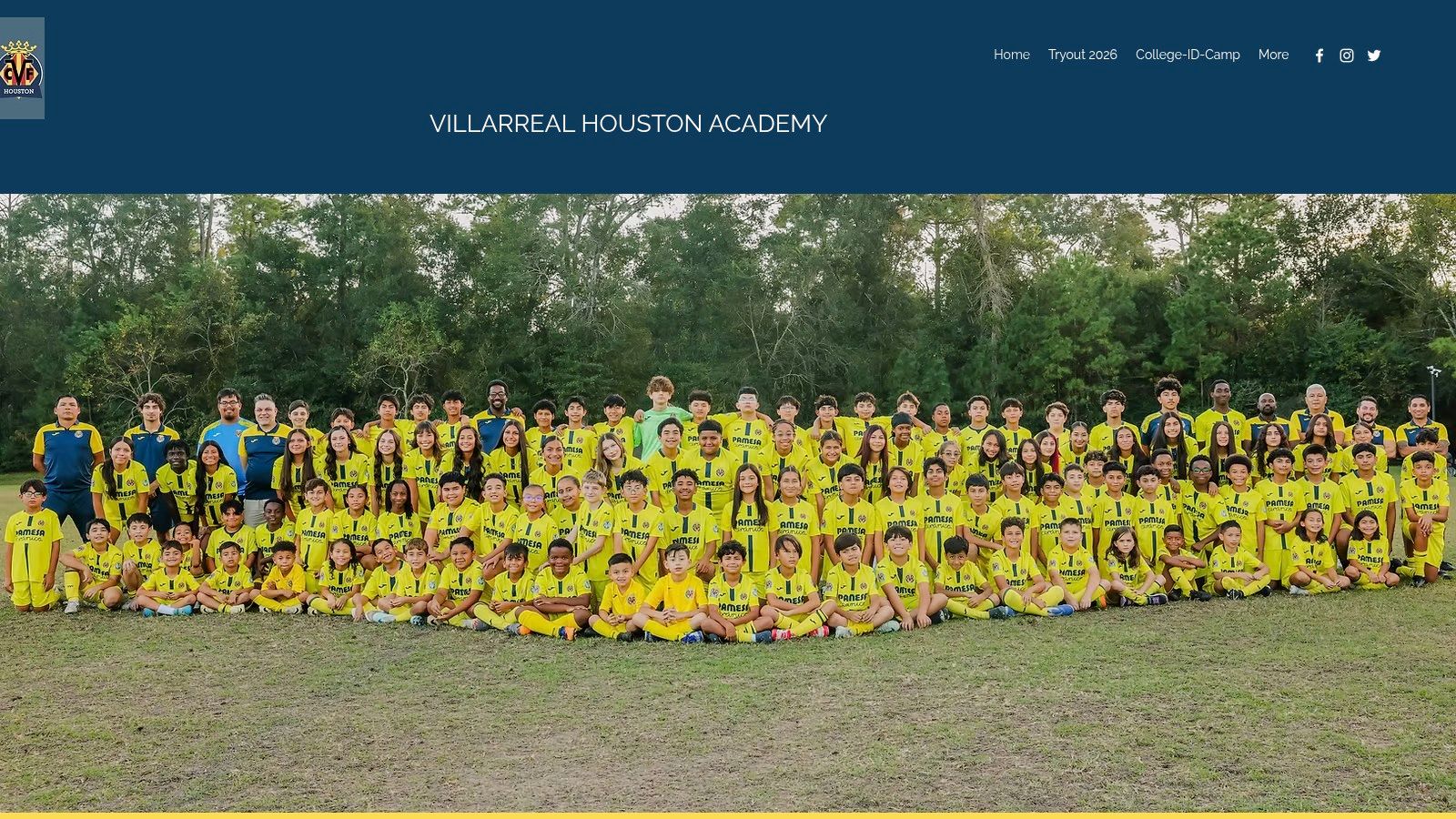
Villarreal Houston Academy is the official partner academy of Villarreal CF in the Greater Houston area. We work with boys and girls from age four upward, with a development approach centered on intelligence, skill and character.
The academy's website is a starting point for checking the local organization and available information.
One methodology across a local network
Our training network serves North Houston communities, including Humble, Fall Creek, Cypress, Tomball and the Kingwood–Porter–New Caney area. Families around Atascocita should compare the actual journey to the relevant site, rather than choose by the academy's overall service area alone.
A shared methodology provides a common coaching foundation. It doesn't mean every location offers identical age groups, schedules or activities. A move between sites therefore needs a conversation about the receiving group and the player's current development needs.
Our coaches learn the Villarreal CF methodology and work alongside Villarreal CF sports psychologists. The expectation is positive engagement and communication, with attention to how players develop both on and off the field. Parents can test that expectation by watching a normal session rather than relying only on a presentation.
Understand opportunity without assuming an outcome
Our development opportunities include the chance to visit Villarreal CF in Spain and play alongside its elite academy teams. Families should treat that as a possible experience within a broader development journey, not the definition of success for every player.
Consider a hypothetical player whose family is interested in international exposure. Their first task is still to identify a suitable local group and establish what the player needs to learn. Before making travel commitments, they should clarify the particular event's eligibility, evaluation process, cost and expectations.
A second family might want no international travel at all. Their child's plan still deserves clear coaching, appropriate challenge and useful feedback. A credible local hub needs to make sense for that family too.
This academy video offers another point of reference before a visit.
Apply the same standards to us that you'd apply elsewhere. Check whether the proposed group suits your child, whether the financial commitment is understandable and whether staff can explain how concerns are handled. An affiliation is meaningful context, but your decision should rest on the experience your child can reasonably expect.
Confirm the Fit Before You Register
Match the player to the site. Confirm which team categories the nearest location offers for your child's birth year. Not every site serves every age group, so establish the actual training location before planning the commute.
Arrange a trial or tryout where available. Watch how the coach responds when a player misunderstands an instruction or makes a mistake. Give your child room afterward to describe the session without being steered toward your preferred answer.
Request the written annual cost. Include travel and tournaments, and distinguish required charges from optional activities. Use the evaluation checklist to resolve any remaining gaps before payment.
Read the participation terms. At Villarreal Houston, submitting a registration doesn't guarantee acceptance, and the club may accept, deny, suspend or terminate a player's or family's participation at its sole discretion. Participation also doesn't guarantee playing time, starting positions, team selection, advancement, college recruitment or professional opportunities.
Agree on a review point. Choose a manageable period after joining to assess confidence, skill development and enjoyment. Ask your child what feels easier, what remains difficult and whether they feel comfortable seeking help.
Commit when the fit is clear, the cost is written down and the expectations are understood. If important answers remain vague, pause rather than let registration pressure make the decision for you. Another center may be a better match, and continuing to look is a responsible choice.
Villarreal Houston Academy offers age-appropriate youth soccer development guided by Villarreal CF methodology, with qualified coaches and attention to technical, tactical and personal growth. Visit Villarreal Houston Academy to explore local options and arrange the next step toward assessing your child's fit.

Comments