


Benefits of a Coaching Culture for Youth Soccer Growth

A Saturday match in Houston can reveal more than a scoreboard. One team may hear a constant stream of commands: “Pass it!” “Move!” “Clear it!” The players react quickly, but they often look toward the sideline before making the next decision. On another field, coaches still guide the action, but they ask questions, explain choices, and help players recognize what they can try next.
Parents can usually feel the difference. In one environment, a mistake brings visible frustration. In the other, a misplaced pass becomes a chance to understand spacing, timing, or communication. The second team isn't free from pressure or standards. It has a clearer learning process.
That process is the foundation of the benefits of a coaching culture. In youth soccer, coaching culture isn't a corporate slogan transferred to the field. It's the shared way coaches, players, and families respond to effort, mistakes, questions, progress, and responsibility. At Villarreal Houston Academy, the Yellow Submarine methodology connects intelligence, skill, and character so development reaches beyond a single drill or match.
Introduction Why Culture Beats Single Coaching Moments
A single coaching moment can help a player. A consistent culture helps shape the player.
Suppose a young midfielder loses the ball while trying to turn under pressure. A directive response might be, “Don't do that again.” The player may avoid the turn next time, but avoidance isn't the same as understanding. A developmental response asks what the player saw, whether a teammate offered support, and which first touch could create a safer option. The player still receives correction, but the correction builds a decision-making tool.
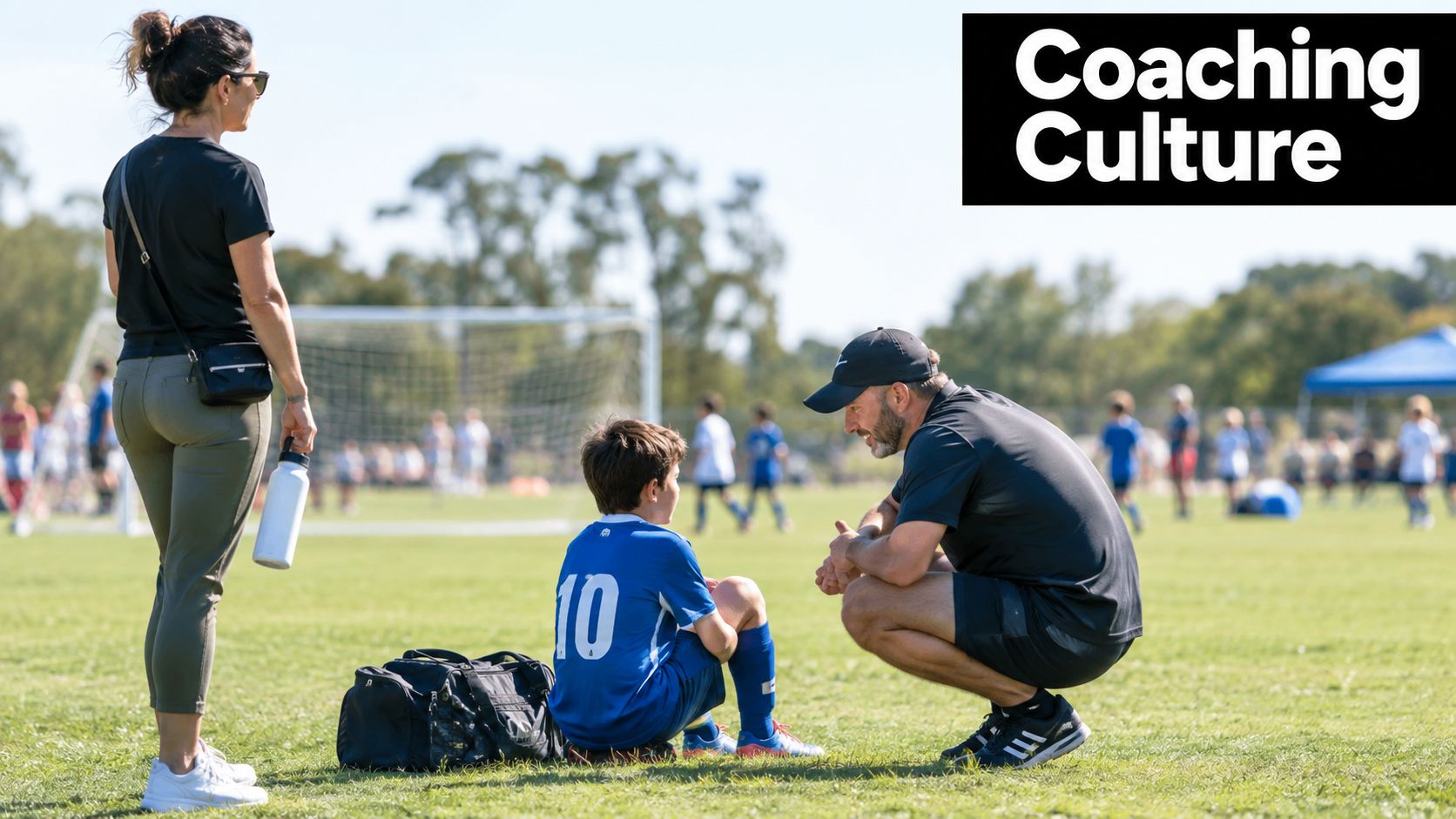
The sideline tells you what the team values
A coaching culture appears in repeated behaviors:
Feedback stays specific: Coaches describe the action, not the child's identity.
Questions have a purpose: Players learn to read the game instead of waiting for instructions.
Mistakes remain useful: The team treats errors as information for the next attempt.
Standards stay clear: Positive coaching doesn't mean accepting poor effort or disrespect.
This approach supports more than technical improvement. Players begin to connect preparation with performance, communication with teamwork, and personal responsibility with trust. They can become more willing to receive the ball, attempt a new solution, and recover after an unsuccessful decision.
For parents, the important question isn't whether a coach gives instructions. Every coach does. The better question is whether the environment teaches players to think, practice, and respond consistently when the coach isn't speaking.
That distinction matters across a youth pathway. A four-year-old needs a different challenge from an older competitive player, but both need an environment that makes learning safe, purposeful, and engaging. The coach's voice should guide development, not replace the player's ability to observe and decide.
What a Coaching Culture Really Means in Youth Soccer
Think of a coaching culture as a garden rather than a single lesson. A coach can plant a useful idea during one training session, but the player's habits grow through repeated care. The soil includes trust. The water is feedback. The sunlight is encouragement, challenge, and meaningful practice.
In youth soccer, culture is the daily system that answers four practical questions:
How do we speak to one another?
How do we respond when something goes wrong?
How do we set goals for improvement?
How do we connect individual growth to the team?
A team may have an enthusiastic coach and still lack a coaching culture if every session feels disconnected. Culture requires consistency between training, matches, coach education, and family expectations. It also requires age-appropriate demands. A young player shouldn't be evaluated with the same language or pressure used for an older select player.
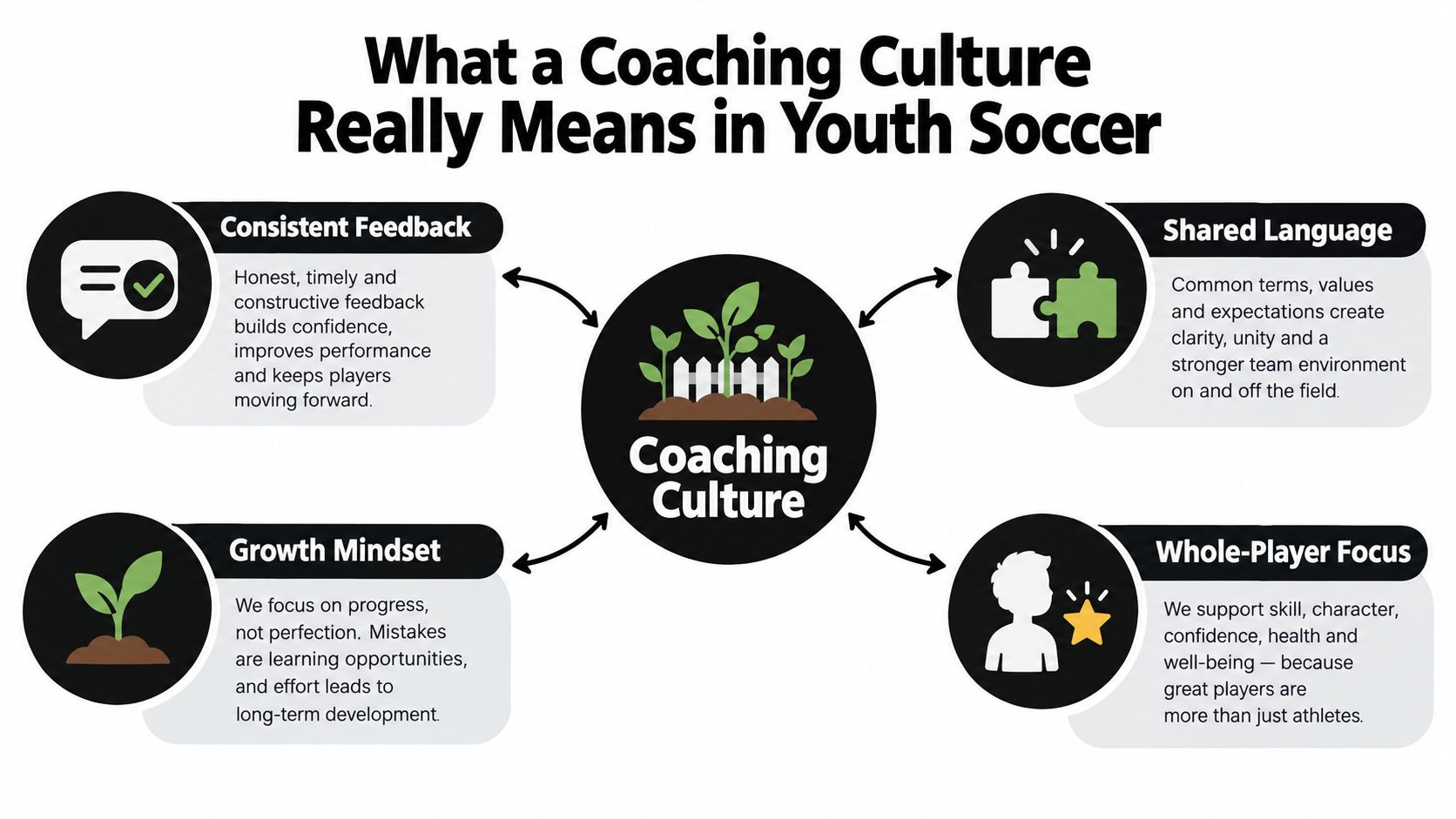
Four elements parents can recognize
Consistent feedback identifies an action and gives the player a next step. “Open your body before the ball arrives” teaches more than “Be ready.”
Shared language helps players understand common ideas such as pressure, support, scanning, width, and transition. A shared vocabulary lets a coach correct quickly without making every instruction feel mysterious.
A growth mindset treats ability as something developed through focused work. It doesn't promise that effort alone guarantees a result. It teaches players to connect effort with specific behaviors.
Whole-player focus includes respect, integrity, responsibility, emotional control, and relationships. Soccer skill matters, but the way a player handles teammates, officials, setbacks, and preparation also shapes development.
Qualified coaches and sports psychology support can strengthen this system because they help adults respond intentionally rather than emotionally. Families can reinforce the same habits with practical equipment and routines, from bringing properly sized training gear to choosing order logo soccer balls for club events or team activities.
Parents who want to understand the academy's approach can explore the Villarreal Houston youth soccer coaching philosophy. The central idea is simple: the coach doesn't only deliver information. The coach creates conditions in which players learn how to use information.
How Players Grow Stronger Inside a Coaching Culture
The most visible player benefit is better soccer understanding, but development usually begins with something smaller: a player receives feedback that makes the next attempt clearer.
A coach might tell a winger, “Attack the space behind the defender when your teammate has time to pass.” That instruction links movement to a game cue. Over time, the player learns to recognize the cue independently. Individualized goals make the process more manageable, whether the focus is receiving across the body, checking the shoulder, recovering after losing possession, or communicating before the ball arrives.
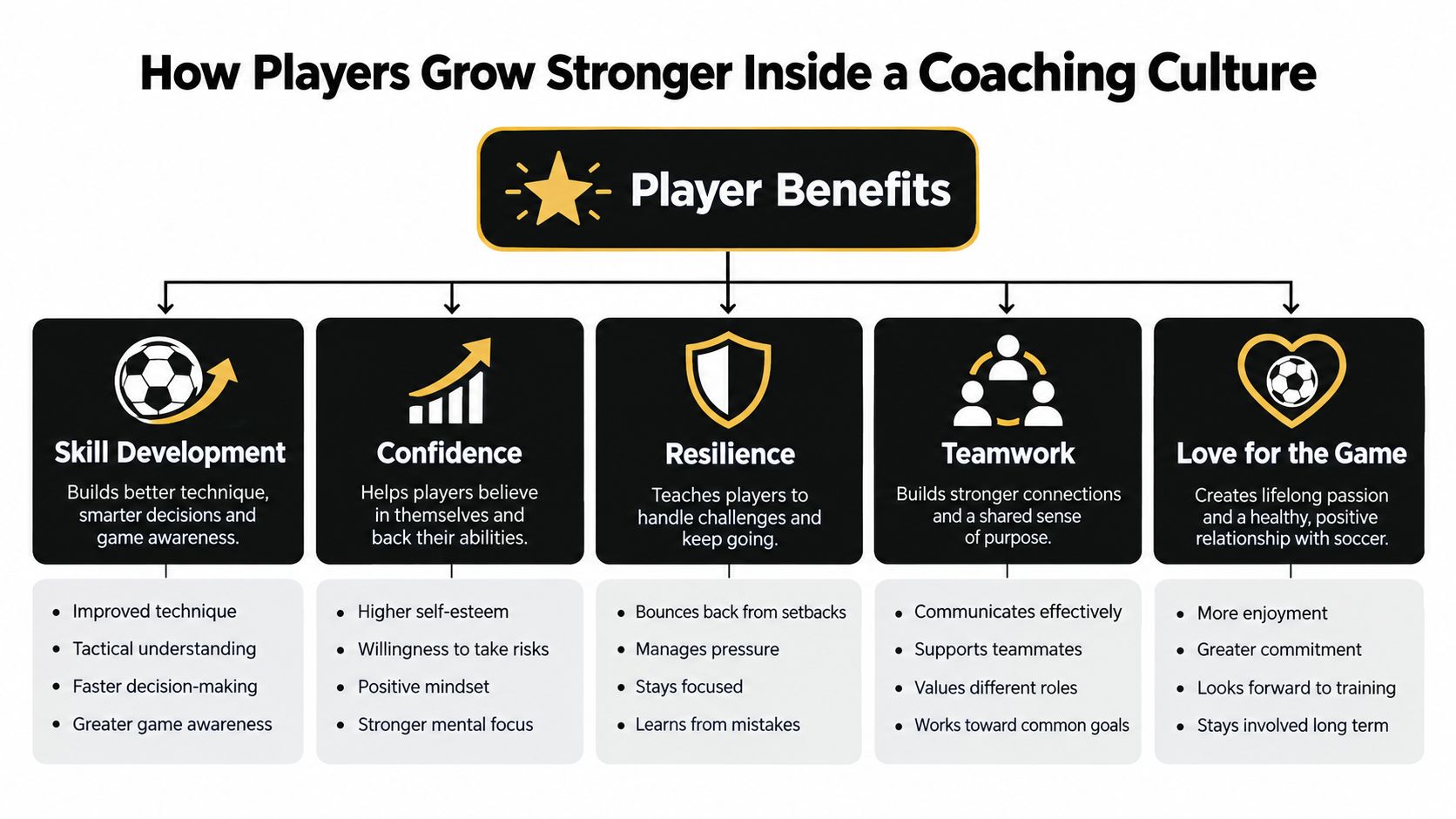
Skill and confidence grow together
Confidence doesn't come from hearing constant praise. It grows when players understand what they're practicing and experience themselves handling challenges.
A coaching culture supports that connection in several ways:
Technical development: Players repeat skills in realistic situations, then receive feedback tied to the action.
Tactical intelligence: Players learn why a decision works, not only which decision a coach prefers.
Resilience: Players practice recovering from mistakes instead of treating mistakes as evidence that they shouldn't try.
Teamwork: Players learn that movement, communication, and support influence everyone's options.
Love for the game: Training feels structured and demanding without becoming defined by fear.
At Villarreal Houston Academy, the emphasis on intelligent play means a player's decision matters alongside execution. A technically clean pass can still be the wrong choice if the player missed a better option. Conversely, a brave attempt may become valuable learning even when the result isn't successful.
Practical rule: Praise the behavior you want repeated, then give the player one clear adjustment for the next attempt.
This kind of feedback also supports emotional wellbeing. Players can separate “that decision needs work” from “I am a bad player.” That distinction protects curiosity. It helps children stay engaged when progress feels slow and gives older athletes a healthier way to handle competition.
Parents can support the same process by asking, “What did you notice?” or “What would you try next?” instead of reviewing every possession from the sideline. For more on this connection, families can read about mental training for young athletes.
The workplace evidence offers a useful, limited comparison. In an MIT Sloan review, salespeople who reported more intense coaching from managers also reported performance gains, and coaching explained 36% of the variance in reported performance among the surveyed salespeople. The finding comes from an organizational setting, not youth soccer, so it shouldn't be treated as a direct sports result. It does support the broader mechanism: regular coaching can influence goal regulation and day-to-day behavior, especially when feedback is specific and repeated. MIT Sloan's review of coaching culture research provides that context.
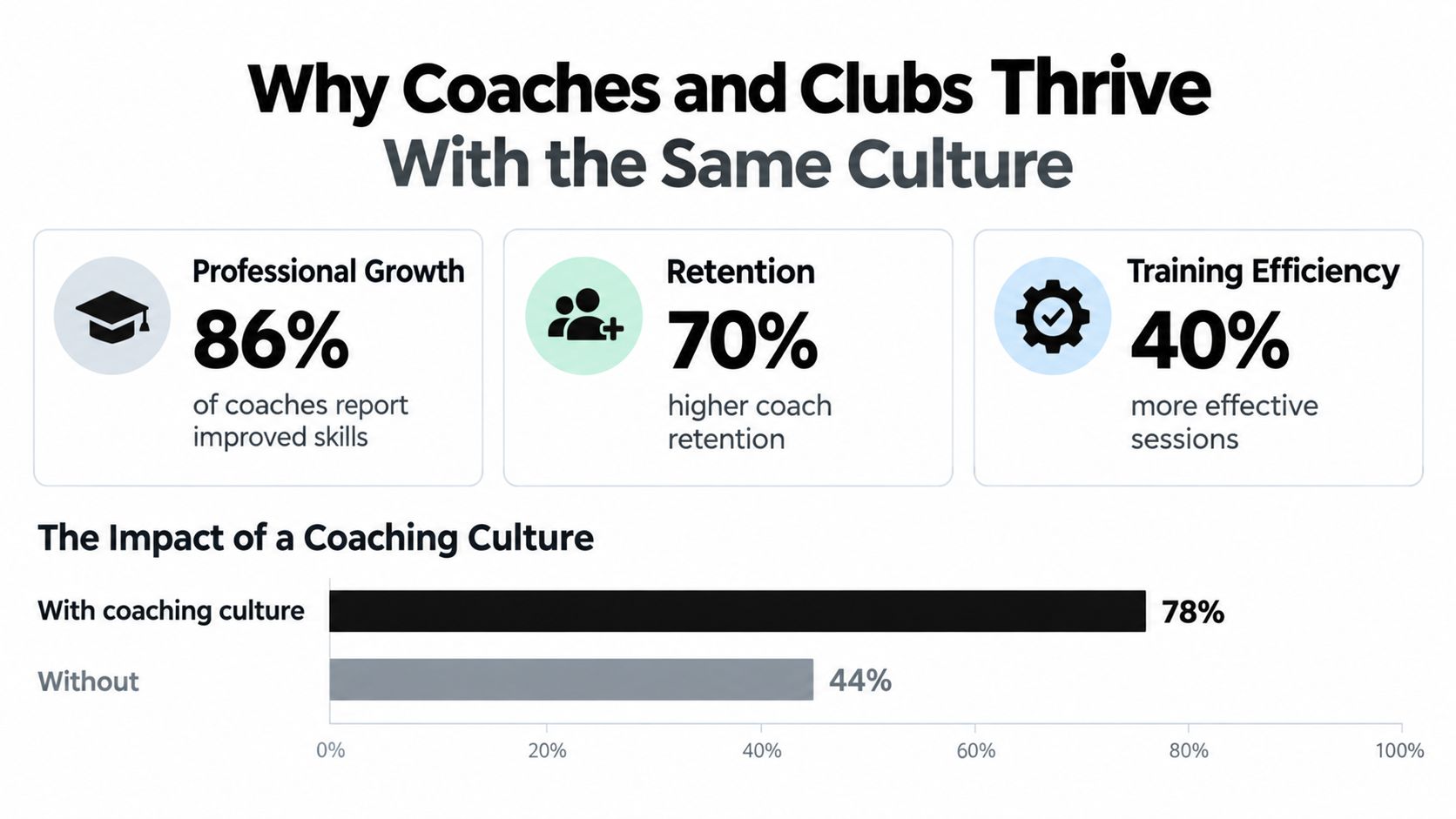
Why Coaches and Clubs Thrive With the Same Culture
Players aren't the only people who develop inside a coaching culture. Coaches also need feedback, shared language, and clear expectations. Without those supports, a club may ask coaches to create confidence and intelligence in players while giving coaches little help in improving their own practice.
A consistent system gives coaches a way to review training. Did the activity create the intended decision? Did the coach speak too often? Did players receive enough opportunities to solve problems? Did the session challenge the group without losing age-appropriate enjoyment?
Better coaching becomes repeatable
Professional growth often starts with observation and reflection. A coach can watch another session, discuss a training design, test a questioning technique, and adjust the next activity. This creates a feedback loop rather than relying on personal instinct alone.
The club benefits when coaches use compatible principles across teams. A player moving from an introductory program into a competitive environment shouldn't feel that every expectation has changed. The language can become more advanced, and the training can become more demanding, but respect, responsibility, effort, and intelligent decision-making remain recognizable.
For an academy serving communities across Humble, Fall Creek, Cypress, Tomball, and the Kingwood, Porter, and New Caney area, that consistency also helps families understand the development pathway. Teams, camps, clinics, and tryouts can serve different needs while still reflecting a common identity.
What the organizational evidence can and cannot tell us
A widely cited 2021 benchmark reported that organizations with strong coaching cultures had higher revenue growth than peers, 51% versus 38%, and that 62% of employees in coaching-culture organizations were highly engaged, compared with 50% in organizations without that culture. Those figures come from organizational research, not youth soccer, and they don't prove that a soccer club will produce the same outcomes. They do show why leaders connect coaching with both performance and workforce commitment. The coaching culture performance summary contains the benchmark details.
For a club, the youth-sports translation is more practical than financial. Coaches who share standards can communicate more clearly. Players can move through a more coherent pathway. Families can recognize what the club values. The result is an environment where development doesn't depend entirely on the personality of one coach.
Coaching Culture Versus Traditional Directive Coaching
Directive coaching has a place. A coach may need to stop unsafe behavior, organize a restart, or give a quick tactical instruction during a match. The concern begins when commands become the team's only learning method.
A coaching culture doesn't eliminate authority. It uses authority to create capable decision-makers. The coach sets standards, designs the environment, and provides guidance. Players gradually take more responsibility for reading situations and selecting responses.
Dimension | Coaching Culture Approach | Traditional Directive Approach |
|---|---|---|
Feedback style | Specific, behavior-based, and connected to the next action | Broad commands or corrections focused on immediate compliance |
Player autonomy | Players are encouraged to observe, ask questions, and make informed decisions | Players wait for instructions and follow the coach's preferred answer |
Mistake handling | Errors become information for adjustment and another attempt | Errors may produce criticism, hesitation, or avoidance |
Training design | Activities create realistic problems and invite solutions | Activities often prioritize repetition of a prescribed response |
Match behavior | Players use shared principles to adapt to changing situations | Players frequently look to the sideline for the next instruction |
Long-term development | Builds intelligence, confidence, resilience, and responsibility | Can produce short-term order without developing equal independence |
What parents should watch during a tryout
A loud coach isn't automatically a poor coach, and a quiet coach isn't automatically effective. Look for the quality of interaction. Does the coach explain a task in language the players understand? Does the coach notice individual needs? Do players receive chances to solve problems, or do they spend most of the session waiting for the correct command?
Also watch how the coach handles a struggling child. A useful correction should make the next action more possible. If the player leaves the conversation knowing only that the coach is unhappy, the moment may create compliance, but it won't necessarily create learning.
The strongest environment combines structure with agency. Players know the standards, understand the purpose of the activity, and receive enough support to stretch without feeling abandoned. That balance is one of the clearest benefits of a coaching culture for long-term youth development.
Bringing a Coaching Culture to Life the Villarreal Way
Culture becomes credible when parents can see it in ordinary moments. At training, look for age-appropriate activities that require players to make choices, not just repeat movements. Notice whether coaches remain positively engaged when an exercise breaks down. A coach should be able to raise standards without humiliating players.
The Villarreal way connects technical proficiency, tactical understanding, and life values. That means a session may address first touch and passing, but it can also reinforce communication, respect, integrity, and personal responsibility. Sports psychology support adds another layer by helping young athletes understand attention, confidence, pressure, and recovery.
Five practical markers of quality
The activity has a clear purpose. Players should know what problem they're trying to solve, even if the explanation is adapted to their age.
Feedback is observable. “Scan before receiving” gives a player something concrete to practice.
The coach adjusts the challenge. A younger or newer player may need more time, space, or simpler choices. An advanced player may need tighter pressure or more complex decisions.
Players communicate with one another. The coach doesn't become the only source of information.
Home support stays constructive. Families can ask about effort, choices, and learning rather than turning every ride home into a match review.
The academy's soccer academy curriculum gives families a practical way to understand how structured development can support players across different stages. A clear pathway can include competitive teams, camps, clinics, tryouts, and opportunities for training in Spain, while keeping the daily learning process central.
When culture creates value, and when it doesn't
Parents are right to ask whether more coaching automatically means better development. It doesn't. More comments can overwhelm a player, and positive language can't compensate for weak planning or limited coaching competence.
A recent evidence review cautions that coaching-culture research remains heavily influenced by practitioner case studies rather than rigorous longitudinal evidence, making causality and implementation quality difficult to establish. The review of coaching-culture research also highlights the need to understand readiness, coach capability, tradeoffs, and the time required for results to appear. In youth soccer, the practical test is whether coaching is embedded in daily practice, not whether a club uses the phrase in its marketing.
Building a Future Where Every Player Loves the Game
A coaching culture gives youth soccer a longer horizon. The immediate objective may be a cleaner first touch, a smarter run, or a more organized defensive response. The deeper objective is to help players become people who can observe, decide, act, reflect, and try again.
That sequence explains why the benefits reach across the whole club. Players gain technical and tactical tools while developing confidence, resilience, teamwork, and responsibility. Coaches improve when they receive the same kind of thoughtful feedback they provide to athletes. Clubs become more coherent when shared standards guide training across ages and locations.
The culture also protects the joy of the game. Fun doesn't mean every session is easy or every player receives constant praise. It means the player understands the challenge, feels respected during difficulty, and can see a path toward improvement. A child who learns that mistakes are part of learning is more likely to stay curious. An older athlete who learns to regulate goals and respond to pressure carries those habits into competition and life beyond soccer.
Parents can help by choosing environments where the coach's behavior matches the stated values. Ask how feedback is delivered, how goals are set, how coaches are developed, and how the program supports both performance and character. Then watch the players. Do they communicate? Do they attempt solutions? Do they recover after mistakes? Do they look engaged in the work?
Those signs reveal more than a single impressive drill. They show whether the club is building a development engine that can serve players, coaches, and families over time.
Villarreal Houston Academy offers age-appropriate teams, camps, clinics, tryouts, year-round training, and pathways connected to Villarreal CF methodology across North Houston. Visit Villarreal Houston Academy to explore available programs and experience a structured, safe, and fun coaching culture built around intelligence, skill, character, and a lasting love for the game.

Comments