


Soccer Player Development Plan That Actually Works

Your child comes home from training tired, but you're still unsure what improved. The coach mentioned first touch, your player talked about scoring, and the weekend result now dominates the family conversation. Without a shared plan, everyone can work hard while pursuing different definitions of progress.
A useful soccer player development plan gives the player, parent, and coach the same map. It identifies the next meaningful priorities, connects them to age-appropriate training, and creates a regular moment to review evidence rather than relying on memory or match emotion.
What a Modern Soccer Player Development Plan Really Is
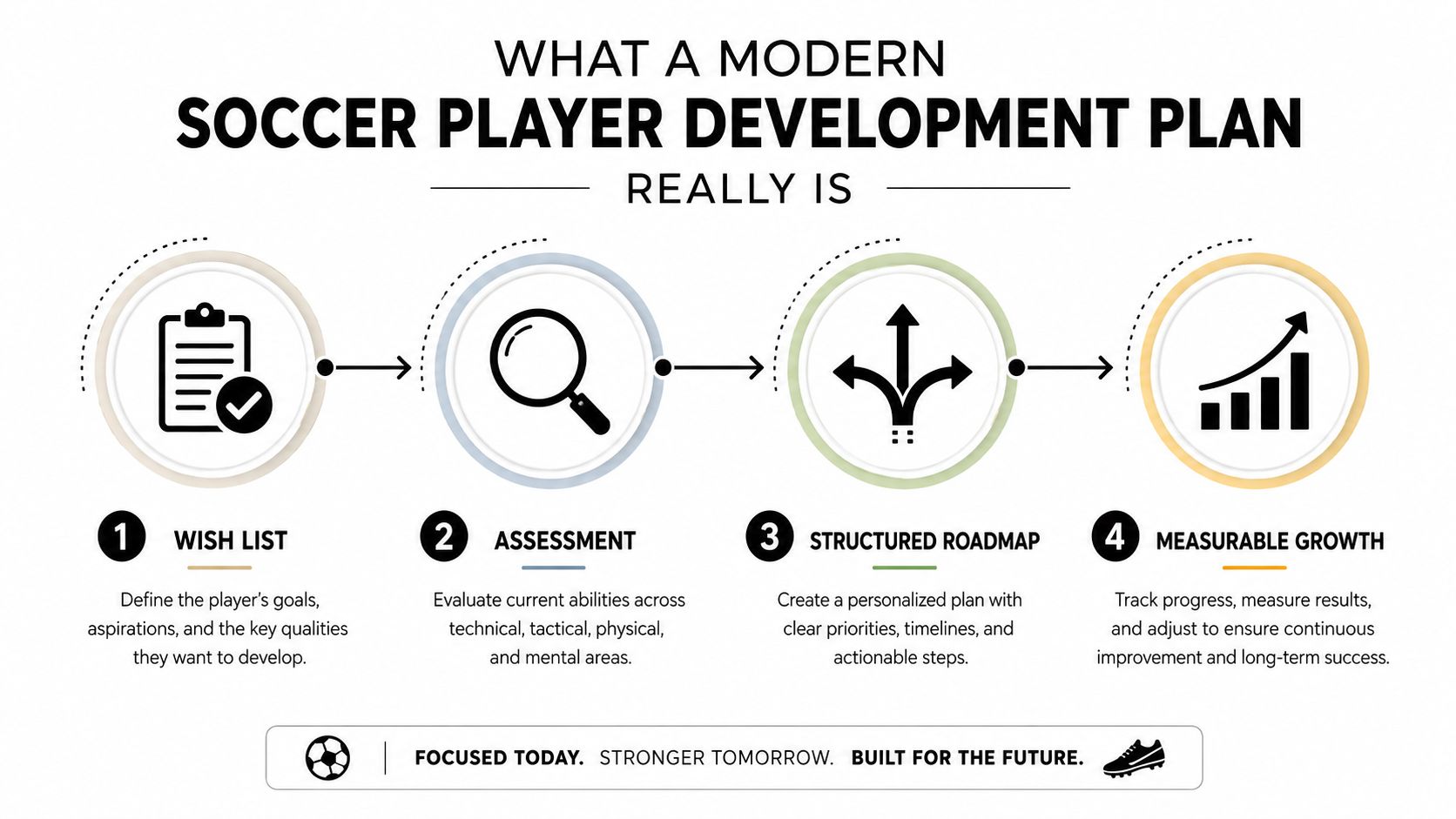
A modern plan isn't a long list of drills. It's a short, repeatable development cycle that answers five practical questions:
Where is the player now?
What should improve next?
What training will address that need?
What will the coach observe?
When will everyone review the evidence?
For most young players, the cycle can run across four to six weeks, then reset. The player might work on receiving across the body, accelerating after a change of direction, recognizing when to play forward, and responding calmly after a mistake. Those priorities are specific enough to coach and limited enough for a child to remember.
What belongs in the cycle
Start with observation. The coach watches training and matches, while the player describes moments that felt difficult or successful. The parent adds useful context, such as whether the player is anxious before games, struggling with recovery, or enjoying a particular type of practice.
Next, choose one goal in each area:
Technical: Receive with the front foot and move the ball away from pressure.
Physical: Improve controlled acceleration and deceleration.
Tactical: Scan before receiving and identify the next pass.
Mental: Reset quickly after losing possession.
The coach then designs sessions that repeatedly expose the player to those actions. A review shouldn't ask only, “Did the team win?” It should ask, “What happened when the player received under pressure, and what choice followed?”
Practical rule: If a goal can't be seen in training or a match, it probably isn't written clearly enough.
A plan is not a season-long syllabus, a collection of favorite online drills, or a tournament calendar. It's also not a promise that a young player will follow a straight path. A soccer academy curriculum can provide structure, but the individual plan still needs to respond to the player in front of the coach.
At the end of each block, the player should see a short summary, hear specific examples, and help choose the next focus. That conversation turns development into a partnership instead of something adults discuss around the player.
Age-by-Age Stages That Shape the Plan
Age changes the question a coach should ask. With younger players, the question is often, “Can this child move confidently and control the ball?” With older players, it becomes, “Can this athlete solve position-specific problems at speed while managing physical and emotional demands?”
The U.S. Youth Soccer development model describes a late-specialization pathway that moves from movement skills to soccer technique, then toward aerobic development, sport-specific performance, and competition preparation. The age bands overlap because children mature at different rates.
Foundation from U6 through U12
At this stage, technical confidence and movement literacy matter more than fixed positions or short-term results. Players need varied touches, changes of direction, balance, coordination, and frequent opportunities to play small-sided games.
The physical priority is broad movement. Running, stopping, turning, jumping, and landing should feel natural. The cognitive demand should stay simple and playful, such as recognizing space, finding a teammate, or deciding whether to dribble or pass.
Development from U13 through U15
The plan can now connect technique to pressure and role. Players may work on receiving between lines, defending in a small group, finishing from position-specific movements, and using strength or mobility work appropriate to their stage.
The physical program should progress carefully because biological maturity varies widely. Coaches should avoid assuming that the biggest or fastest player is the most advanced. Tactically, players begin handling more detailed problems, while mentally they learn to accept feedback, recover from errors, and take ownership of preparation.
Consolidation from U16 through U19
Older players need training that resembles the demands of their position and playing level. Sessions can include individualized speed and conditioning, game-realistic decision-making, video reflection, and routines for focus before and during competition.
The cognitive ask is greater independence. The player should be able to explain what they saw, why they chose an action, and what they'll try next time. The plan should still protect recovery, enjoyment, and long-term health rather than turning every session into a test.
Stage | Technical Focus | Physical Focus | Tactical Focus | Mental Focus |
|---|---|---|---|---|
U6 to U12 | Ball mastery, receiving, passing, dribbling | Coordination, balance, movement variety | Space, simple choices, small-sided play | Enjoyment, courage, curiosity |
U13 to U15 | Technique under pressure and position-related actions | Aerobic development, mobility, strength foundations | Roles, combinations, pressure recognition | Coachability, resilience, self-awareness |
U16 to U19 | Reliable execution at game speed | Individualized fitness and position-specific preparation | Advanced decisions and game management | Focus routines, accountability, emotional control |
Parents can use this age-based soccer development guide as a conversation starter, but the child's maturity and current needs should shape the actual priorities.
Four Pillars of a Complete Development Plan
A strong plan balances technical, physical, tactical, and mental development. The balance shifts with age, maturity, position, and current needs, yet every pillar remains part of the conversation between parent and coach. Review those priorities every four to six weeks instead of treating them as a fixed seasonal checklist.
Technical quality
Technical work covers first touch, receiving angles, passing, dribbling, striking, and finishing. Younger players need frequent, successful contact with the ball and room to try solutions. As they grow, those same actions must remain reliable under pressure, fatigue, and limited time.
Coaching language should point to an action the player can repeat. “Receive across your body so your first touch takes you away from the defender” gives more direction than “Improve your touch.” Parents can use the same cues at home without turning the living room into another training ground. This guide to what makes a good soccer player can help parents and coaches keep that language consistent.
Physical readiness
Youth physical training should build movement quality, speed, coordination, mobility, endurance, and strength in ways that match growth and soccer demands. A younger player may need balance and varied movement, while an older player may need more position-specific preparation.
Coaches should compare progress with age, maturation, and position. That approach reduces the risk of overloading late maturers and prevents early maturers from being treated as finished products. The parent's role is to report changes in energy, soreness, sleep, or enjoyment so the coach can adjust the plan.
Tactical understanding
Tactical development teaches players to read space, recognize pressure, track teammates' movements, and choose an action. Guided questions help connect training to decisions in a match:
What did you see before the ball arrived?
Where was the defender's pressure?
Which teammate could help you?
What changed after your first touch?
The goal is a player who can solve a problem rather than wait for the sideline to provide every answer. During each review cycle, the parent and coach can ask for one example from training or competition.
Mental and psychosocial growth
Confidence, focus, resilience, communication, and emotional control need practice alongside ball work. A player might use a reset breath after an error, set one intention before training, or answer a reflection question after a match.
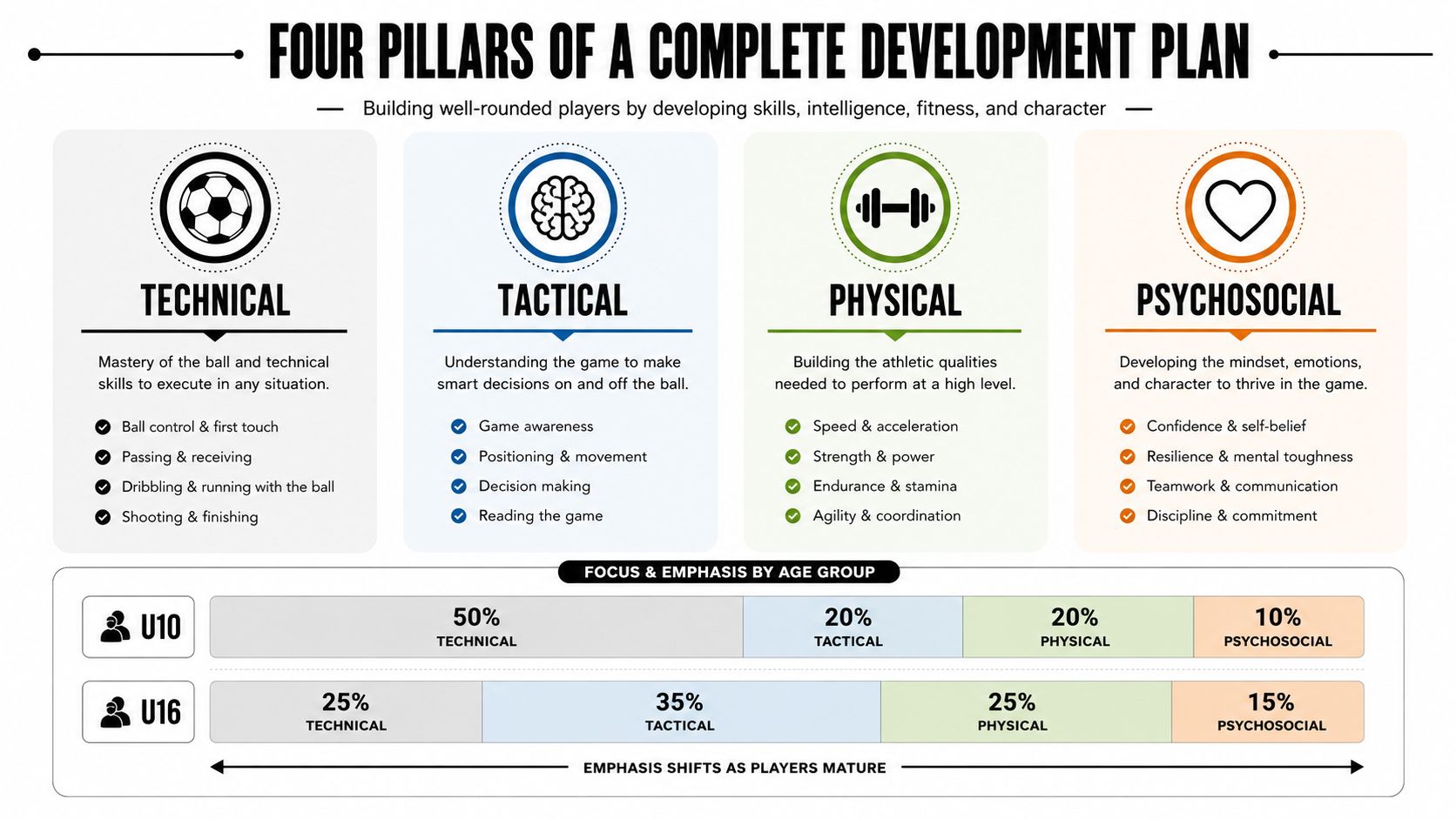
A U10 plan may give more time to technical repetition. An older plan may give greater attention to tactical interpretation and mental performance. The right balance depends on what helps the player become more effective and independent, not on a rigid formula.
The late-bloomer misconception can harm development. A 2024 study of 118 senior international soccer players identified three broadly similar pathways: 40 players, or 34%, followed an early pathway, 39, or 33%, followed a middle pathway, and 39, or 33%, followed a late pathway (PLOS ONE study). Late-pathway players made their senior international debuts about 2.5 years later than early-pathway players. A review cycle should therefore leave room for progress that appears later.
A late developer is not a failed early developer. Persistence, reflection, and willingness to learn can become advantages as physical development catches up.
Sample Weekly and Monthly Training Templates
A schedule should show more than how long a player trains. It should explain the purpose of each block and the coaching cue that gives the work direction.
Consider a younger player whose current goals are directional first touch, balanced movement, scanning before receiving, and a calm response to mistakes. Their week might look like this:
Day | U10-U12 Block | U15-U18 Block |
|---|---|---|
Monday | Technical, moderate: ball mastery and receiving with both feet. Cue, “First touch into space.” | Technical and tactical, moderate: positional rondo and receiving under pressure. Cue, “Scan before the pass arrives.” |
Tuesday | Small-sided games, moderate: 3v3 or 4v4 with a forward-pass target. Cue, “Find space after you pass.” | Physical, high: acceleration, deceleration, and change-of-direction work, followed by finishing. Cue, “Brake under control.” |
Wednesday | Recovery or rest: easy mobility and free play. Cue, “Move well, don't chase fatigue.” | Tactical, moderate: position-specific small-sided game with transition rules. Cue, “Recognize the next action early.” |
Thursday | Technical, moderate: wall passes, turns, and a constrained receiving game. Cue, “Open your body.” | Double-session day: technical repetition earlier, tactical game later. Cue, “Repeat quality under pressure.” |
Friday | Cognitive, light: short video clip and player reflection. Cue, “What options did you see?” | Recovery block: mobility, light aerobic work, and review notes. Cue, “Prepare for the weekend.” |
Weekend | Light match or small-sided game, moderate. Cue, “Try the focus goal.” | Match, high: position-specific objectives and post-match reflection. Cue, “Apply the plan.” |
The younger player doesn't need every session to feel difficult. They need frequent, successful opportunities to make decisions. The older player needs a more deliberate relationship between load, recovery, position, and match demands.
Turning the week into a review block
A four-to-six-week cycle can follow this rhythm:
Opening week: Establish a baseline through normal training and match observation.
Progression weeks: Add one challenge, such as less time, tighter space, or a defender arriving from a different angle.
Final week: Reduce unnecessary load, review examples, and identify the next priority.
Player meeting: Let the player describe what changed before the adults give their assessment.
A goalkeeper can use the same framework with different actions, such as set position, handling decisions, distribution, communication, and recovery after conceding. A defender, midfielder, or forward doesn't need a separate philosophy. Each position needs different examples inside the same review loop.
For coaches who want a broader planning structure, a training plan template guide can help organize objectives, activities, ownership, and review points. The soccer content still has to come from observation and match demands.
Training the Brain Without Overloading It
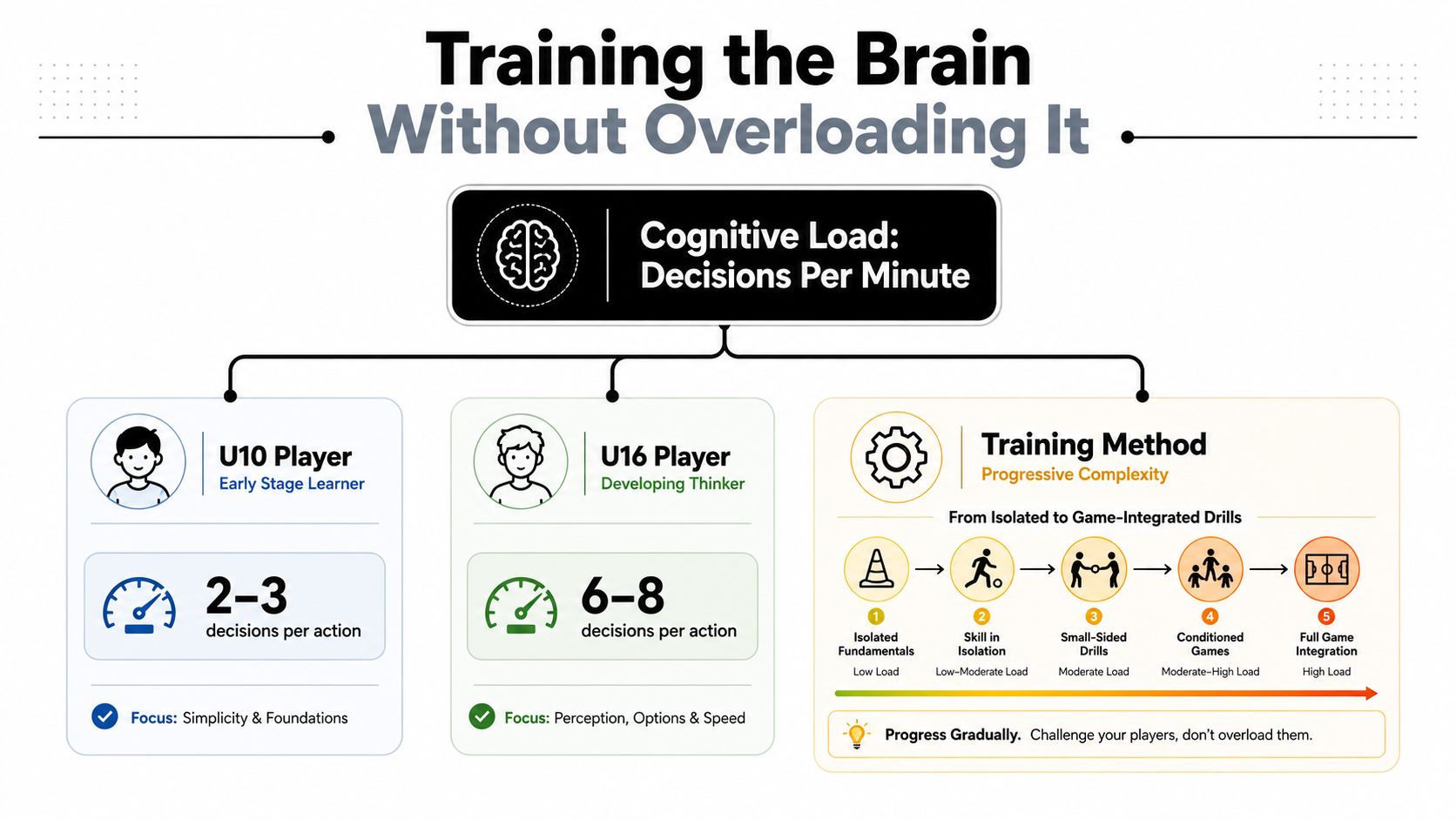
In soccer, cognitive load describes how many decisions a player must process while time, space, opponents, and teammates are changing. A session can look advanced while teaching very little if the player is coping with too many instructions at once.
Younger players need a manageable number of choices connected to one action. Older players can gradually handle more information, but progression should come from the quality of the problem, not from adding complexity for its own sake. Research on cognitive load in youth soccer highlights decision-making as a central part of development (Journal of Sports Research article).
Three practical tools
Manipulated small-sided games change one condition at a time. Adjust the number of players, pitch size, scoring target, or direction of play. A coach might reward a forward pass after a teammate checks away, then remove that rule once players understand the cue.
Short video review keeps reflection concrete. Show a clip under thirty seconds and pause before the decisive moment. Ask the player what they saw, what options existed, and what information arrived too late.
Constrained finishing adds a scan before the shot. A teammate shows a color or number, a defender changes the angle, or the player must identify the goalkeeper's position before receiving. The exercise connects perception to execution.
Coach's adjustment: When the player repeatedly fails a task, simplify one constraint before adding another. Learning needs a challenge the player can interpret.
You don't need a longer practice to train decision-making. Add one cognitive repetition to each block. During passing, ask the receiver to name the next option. During finishing, require a scan. During a game, change one scoring condition and observe whether choices improve.
The parent's role is to ask what the player noticed, not to provide a second set of instructions from the sideline. A calm question after training can reinforce awareness without increasing the player's mental load.
KPIs, Review Cycles, and Parent and Coach Roles
A parent and coach may watch the same match and notice different things. The parent sees a player hesitate before receiving. The coach sees whether the hesitation came from poor scanning, an awkward first touch, or pressure arriving from behind. A useful development plan brings those observations together and turns them into a review cycle that runs for four to six weeks.
The plan should measure behaviors that lead to better play, not only visible outcomes. Goals and wins matter in competition, but they can hide whether a player is learning. A striker may score without improving movement, while a defender may make a valuable choice that never appears in the scoreline.
Research on elite youth development supports repeated assessment across technical, tactical, physical, and psychological areas, rather than relying on one trial or early ranking (longitudinal soccer talent-development research). The same research showed that academy and professional outcomes are selective and difficult to predict early. Players who develop later can still progress, so patient tracking gives families better information than an early label.
What to track
A coach can observe four types of behavior:
Technical execution: First-touch success, passing under pressure, dribbling out of tight spaces, and finishing technique.
Tactical awareness: Scanning before receiving, recognizing pressure, supporting the ball, and selecting an appropriate next action.
Physical development: Speed, change of direction, endurance, mobility, and training tolerance relative to age and maturation.
Character indicators: Coachability, communication, response to mistakes, preparation, and willingness to help teammates.
These categories work like four legs of a table. If one is ignored, the plan may look organized but wobble in games. A player can have clean technique yet struggle to recognize pressure, or show strong speed while losing focus after an error.
Avoid turning every observation into a number. A rating without an example is weak evidence. “First touch improved” means little unless the coach describes the situation, such as receiving with pressure from behind and escaping into the next action.
A useful scorecard
Pillar | KPI | Rating 1-5 | Coach Note |
|---|---|---|---|
Technical | Directional first touch under pressure | Does the touch create a playable next action? | |
Tactical | Scans before receiving | Does the player check information early? | |
Physical | Controlled acceleration and stopping | Can the player change speed without losing balance? | |
Mental | Response after an error | Does the player reset and rejoin the play? |
The rating is a conversation tool, not a permanent label. A 1 can mean the behavior is rarely visible, while a 5 means the player performs it reliably in varied situations. The coach should place one match or training example beside every rating. That note explains what happened and gives the player something specific to repeat.
The four-to-six-week review rhythm
Week one is the baseline. The coach observes normal behavior without forcing the player to perform for a test. The player identifies one moment they want to handle better. The parent can share relevant context, such as a change in confidence, sleep, school demands, or training availability.
The middle of the block checks direction. The coach looks for the target behavior appearing more often or in more difficult situations. If progress stalls, the exercise changes. The player does not receive more criticism. A smaller space, a clearer cue, or a simpler decision can provide the right challenge.
The final review adjusts the plan. The player sees the scorecard, hears specific examples, and helps choose the next goals. A technical target might become a tactical target once the underlying skill is stable. If a player is tired or still growing, the physical goal may need adjustment before more training is added.
As noted earlier, coaching quality, personal mindset, and social support all shape a player's development path. Families see this connection in ordinary weeks. The environment around a player affects whether good training becomes lasting behavior, which is why the parent and coach should review conditions as well as performance.
Parent and coach responsibilities
Parents create the conditions around training. They can manage transportation, support consistent meals and hydration, protect sleep, and ask process questions:
What did you try today?
When did you feel most confident?
What will you repeat next session?
What did you notice before receiving?
The parent's job is to open reflection, not provide a second set of sideline instructions. One calm question after training can strengthen awareness without adding mental pressure.
The coach owns the design and assessment. They should create appropriate constraints, give honest and specific feedback, monitor load, and protect the player from pressure to specialize or prove long-term potential too early. The coach also needs to explain what success looks like in language the player and parent can use.
At the start of a block, both sides can agree to a short responsibility checklist:
The player knows the current goals.
The parent knows how to support practice without coaching every touch.
The coach will provide a review date and examples.
Everyone will discuss development before match results.
The plan can change when the player's needs change.
That agreement turns communication into part of the training environment. A plan works when the adults share useful information instead of competing for control. The parent reports patterns from home and matches, the coach interprets them through training, and the player takes part in choosing the next action.
The pathway is selective and unpredictable, but a thoughtful review cycle gives every player a fairer chance to keep developing. It values evidence over labels, learning over early status, and the player's long-term relationship with the game over a single weekend.
At Villarreal Houston Academy, boys and girls from age 4 upward can follow age-appropriate training that connects technical, tactical, physical, and mental development within a structured pathway. Visit Villarreal Houston Academy to explore teams, camps, clinics, tryouts, and training options across Greater Houston, then ask how the academy can help your family begin a practical four-to-six-week development cycle.
Comments