


10 Soccer Training Exercises That Build Smarter Players

A purposeful warm-up can do more than prepare players to practice. A systematic review in the British Journal of Sports Medicine found that FIFA 11 and FIFA 11+ injury-prevention programs reduced overall soccer injury risk by 25% compared with standard warm-ups. What players practice, and how consistently they practice it, matters more than whether a session looks busy.
The same principle applies to player development. Random cone patterns, shooting queues, and exhausting running sessions don't automatically produce better soccer players. Useful soccer training exercises connect a movement or decision to something players need during a match.
That means developing four pillars together: technical skill to execute, tactical understanding to choose, physical capacity to move effectively, and psychological skills to stay composed, communicate, and respond to mistakes.
Technique includes first touch, passing, dribbling, and striking.
Game intelligence includes scanning, positioning, and recognizing when to attack space.
Athleticism includes balance, acceleration, braking, and controlled changes of direction.
Psychological development includes confidence, patience, concentration, and responsibility.
An intelligence-first approach, consistent with the Spanish academy methodology used by Villarreal CF, connects those pillars rather than teaching skills in isolation indefinitely. Beginners need space, simple rules, and permission to experiment; experienced players need realistic pressure and meaningful choices.
Choose exercises around a match problem, then adjust the space, opposition, and complexity to the player. These activities work best as connected parts of a session, not as a checklist to complete.
1. Rondo (Possession Circle)
A rondo becomes useful when players stop passing to survive and start moving defenders to create an opening. Its main contribution is technique under pressure, supported by scanning, communication, and patience.
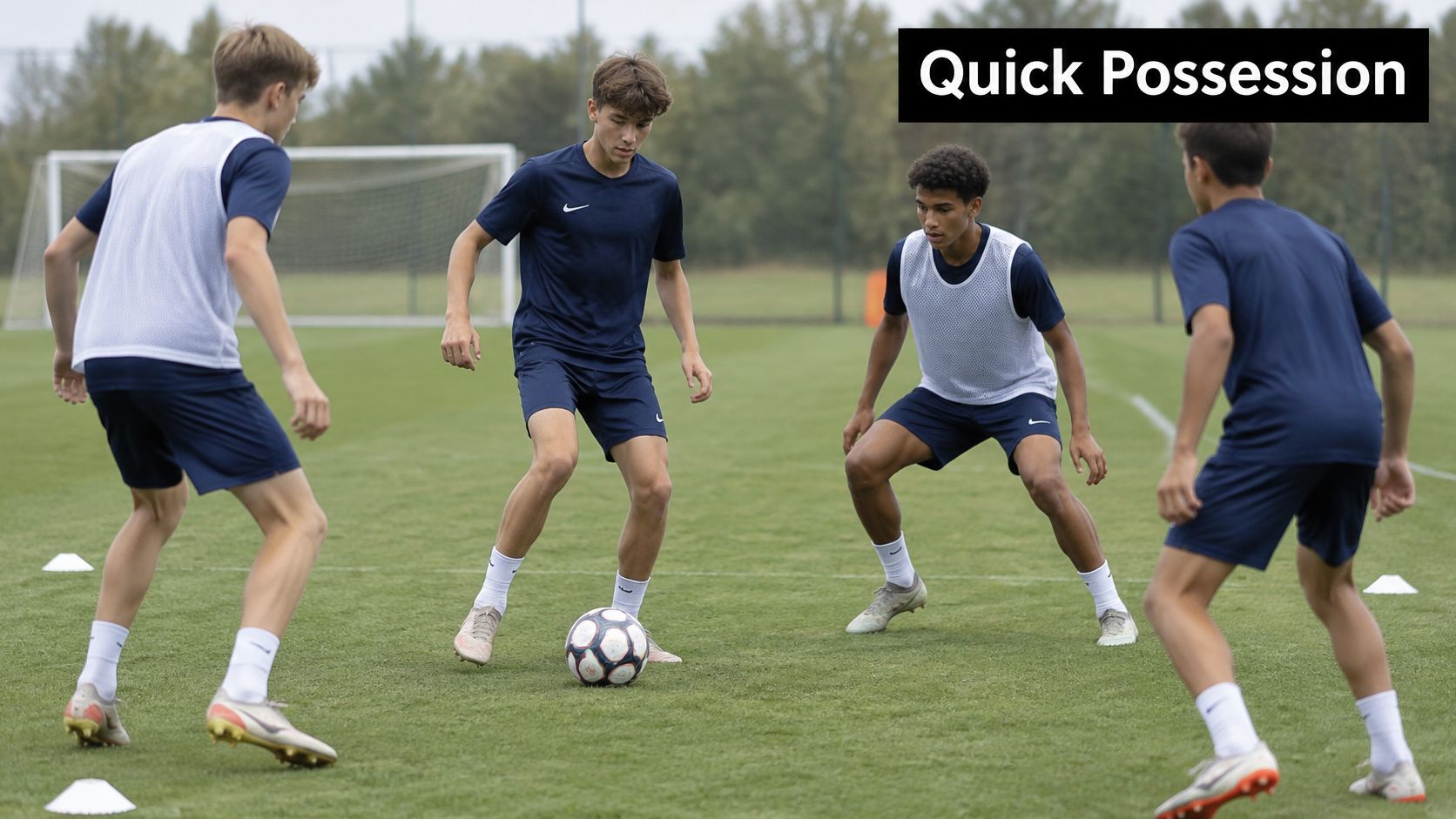
Place attackers around a marked square with defenders inside. Make the space generous enough that a well-weighted pass can reach a teammate, but tight enough that standing still creates a problem.
Coach the Receiver, Not Just the Passer
Ask outside players to adjust along their edge as the ball travels. The receiver should open their body, look beyond the nearest defender, and prepare a first touch that keeps useful passing options available.
For beginners: Allow unrestricted touches and reward receiving without panic.
For developing players: Introduce a touch restriction only when players can maintain clean possession.
For defenders: Reward coordinated pressure rather than chasing the ball independently.
Say a midfielder repeatedly receives facing the sideline. Pause briefly, reposition their hips, and replay the pass so they can feel the difference between being trapped and seeing the next option.
Use this early in a possession-focused session, after movement preparation. Rotate defenders when effort or concentration drops, and keep spare balls nearby.
The setup in rondo training for ball retention provides a useful starting point. Don't confuse a long passing streak with success, though. Look for better receiving positions and passes that move a defender.
2. Positional Play Rondo (Zonal Possession)
A player can complete every pass and still stand in the wrong place. Zonal possession makes that distinction visible by giving players responsibilities within connected areas.
Mark adjoining zones and assign attackers starting positions that provide width, depth, and support behind the ball. Defenders can initially move freely while attackers maintain their team's positional balance.
The challenge isn't to remain rooted to a cone. It's to move enough to become available without occupying the same passing lane as a teammate.
Make Positioning Solve a Problem
For example, a central player may keep drifting toward the ball and bringing a defender with them. Ask them to hold a deeper position, then notice whether the ball carrier gains a forward passing option.
Introduce movement between zones once players understand who replaces the teammate who leaves. Our guide to soccer positioning drills expands on creating useful supporting relationships.
The video below offers a visual reference for positional training.
After a sequence, ask a specific question: Could the player on the ball see you without turning into pressure? That's more useful than telling everyone to find space.
Use zonal possession as the tactical block after a simpler rondo. For younger or less experienced players, enlarge the zones and remove movement restrictions before adding complexity. Too many rules turn the activity into a memory test instead of a soccer problem.
3. Small-Sided Games (SSG)
Start with a match problem: your team wins possession but immediately gives it away. A small-sided game with clear outlets and realistic opposition lets players practice securing the ball, supporting it, and recognizing when to attack.
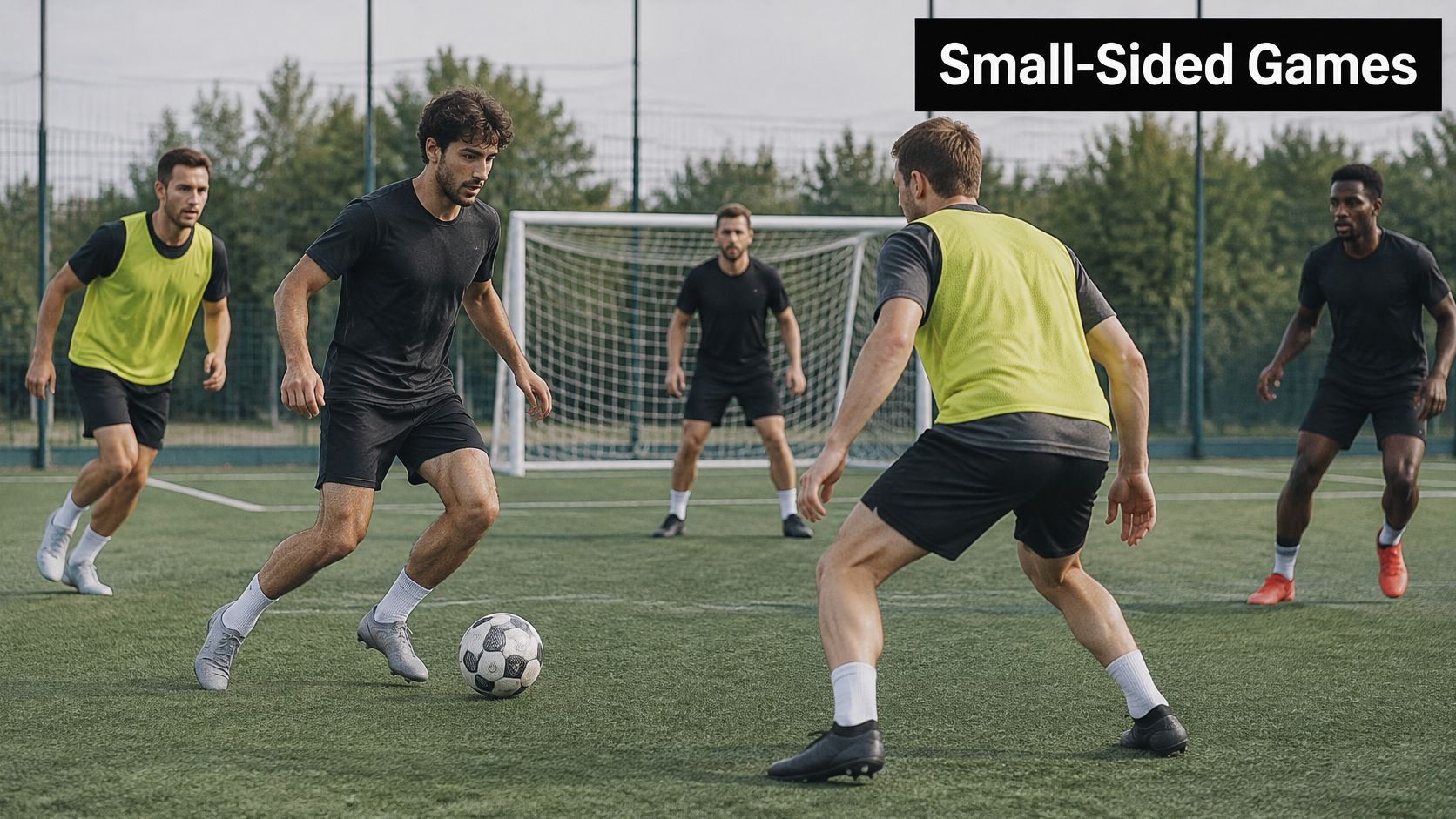
Field size is a coaching tool, not an afterthought. A review of small-sided-game playing-area manipulations reports that increasing area per player generally increases total distance and high-speed running, while tighter formats create different technical and physiological demands.
Change the Space Before Adding Rules
Use a compact pitch when the focus is protecting possession and combining under pressure. Expand it when players need room to recognize forward runs, recover defensively, or play longer passes.
Possession problem: Add an available supporting player outside the main playing area.
Finishing problem: Position targets so players must look forward after winning possession.
Transition problem: Restart quickly and let teams attack immediately after a turnover.
A scoring condition can encourage a behavior, but it shouldn't eliminate good decisions. Requiring extra passes when an attacker has an open goal teaches players to obey the drill rather than read the game.
Use small-sided games as the application phase after technical and tactical work. Record the pitch setup and rules so you can repeat the exercise meaningfully, then finish with fewer restrictions to see whether players apply the lesson independently.
4. 1v1 Attacking and Defending Duels
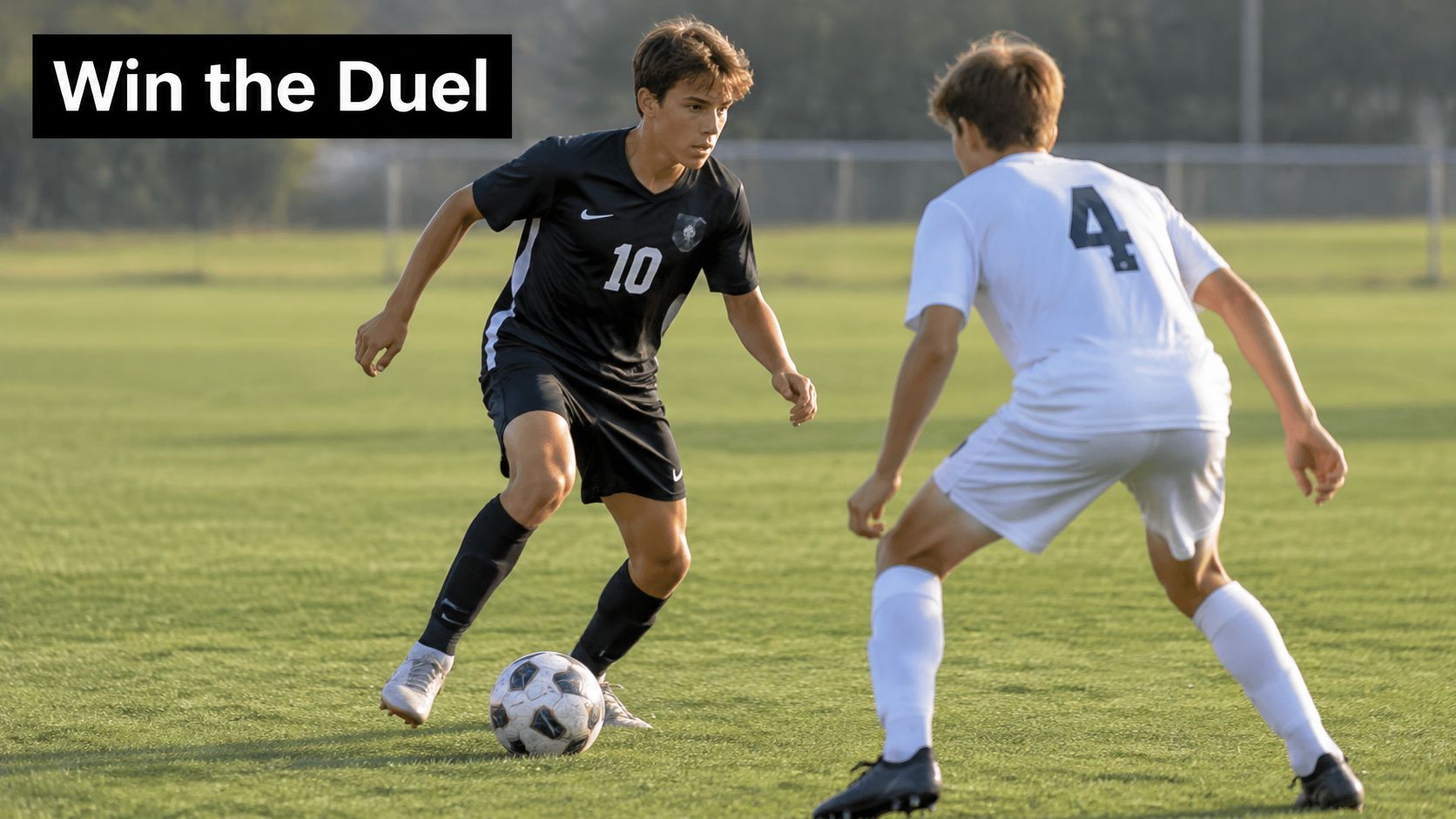
The attacker shifts their body, the defender leans, and a gap appears. Individual duels teach players to recognize that moment, not merely perform a rehearsed trick.
Create a channel with an entry point and an end line or target goal. Serve the ball to the attacker while the defender approaches from a realistic starting position.
Teach Both Sides of the Contest
For attackers, coach a controlled approach, a convincing change of direction, and acceleration once the defender commits. A move that doesn't change the defender's balance or protect the ball serves little purpose.
For defenders, emphasize arriving under control, adopting a balanced side-on stance, and adjusting with small steps. Staying permanently on tiptoes or lunging at every touch makes recovery harder.
Practical rule: Beat the defender's position, not an imaginary cone. Defend the route to goal, not just the ball.
A winger preparing for competitive play might start near the touchline and choose between attacking outside or cutting inside. Give the defender an outlet target after winning possession so both players stay involved through the turnover.
Alternate roles and adjust matchups when differences in speed or size prevent meaningful competition. Place duels after the warm-up while players are fresh enough to accelerate and brake well; reduce the repetitions when footwork becomes uncontrolled.
5. Passing Triangles and Combination Play
Passing triangles are valuable for learning support angles and movement timing, but predictable patterns can become empty choreography. Players should understand which opponent a combination would bypass.
Arrange a triangle with passing lanes wide enough for clean receiving. The passer moves to a new supporting position rather than admiring the pass or following the ball directly into the receiver's space.
Begin with controlled passes to the appropriate foot. Then ask receivers to take their first touch toward the next available lane.
Add a Reason to Combine
Introduce a passive defender who blocks a passing route. Now the group must choose whether to play directly, set the ball back, or use a teammate to reach the next receiver.
Wall pass: The supporting player returns the ball into the runner's path.
Third-player combination: A teammate sets the ball for someone facing forward.
Moving triangle: Players recreate supporting angles as the ball advances.
For example, a midfielder facing their own goal can set the ball to a supporting teammate, who then passes into a forward runner's path. The important detail is that the runner moves when the pass becomes possible, not automatically when the exercise starts.
Use these youth soccer passing drills to develop the technical foundations. Then include opposition or directional targets so the pattern transfers into play.
This fits between ball-focused preparation and possession games. Keep corrections specific: pass weight, receiving foot, supporting angle, or timing, rather than a general demand to move faster.
6. Dribbling Through Gates
For a young player who constantly looks down, a slalom can reinforce the wrong habit. Scattered gates create choices, provided the player must look up and select a route.
Place pairs of cones around an open area at different angles. Each player dribbles through an available gate, changes direction, and searches for another without colliding with teammates.
Start at a pace that allows clean touches. The ball should remain close when space is crowded, with longer touches available when the route opens.
Give the Eyes a Job
Ask players to identify an unoccupied gate before approaching it. A coach can close a gate by standing in it, forcing players to notice the change and choose another route.
Control focus: Use different foot surfaces to turn through gates.
Awareness focus: Avoid gates that another player is approaching.
Game connection: Exit a gate and pass to a moving partner or finish toward a target.
Say a player always uses their stronger foot to turn. Position the next target so the other foot offers a cleaner route, then let them discover the advantage rather than stopping every attempt.
Use gates early in a technical session or as a playful home activity. Competition can help engagement, but counting gates shouldn't encourage reckless speed or skipped touches.
The progression isn't just faster dribbling. It's better control while gathering more information, followed by an action that resembles a match.
7. Finishing Under Pressure
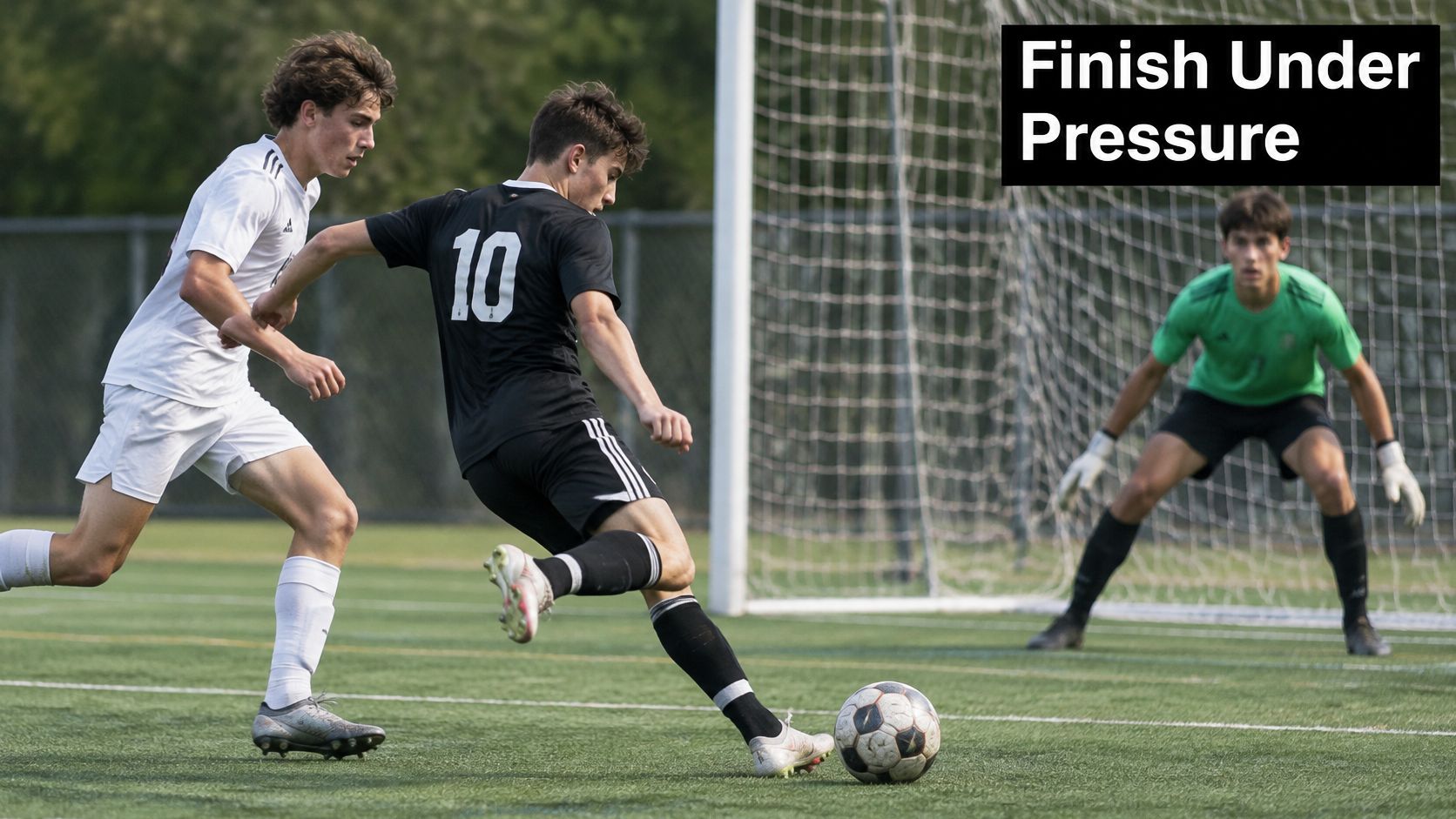
An unopposed shot from a stationary ball trains striking. A moving service with a recovering defender also trains first touch, shot selection, and composure.
Set a serving position outside the shooting lane, a starting point for the attacker, and a recovery route for the defender. Keep waiting players and spare balls away from the goalmouth.
Progress the Pressure, Not Just the Shot Count
Begin with a predictable pass so players can organize their approach. Once contact is controlled, vary the service and allow the defender to recover from an angle.
A cutback asks the attacker to adjust their feet; a through ball asks them to judge the goalkeeper and defender. Don't treat those as identical shooting tasks.
A composed finish isn't always a gentle finish. It's a shot chosen for the space, pressure, and goalkeeper the player actually sees.
For example, an attacker receiving across the penalty area may need to shoot with the nearer foot because an extra setup touch would let the defender block. In another repetition, that extra touch may create the better angle.
Encourage low, placed finishes when they're appropriate, but avoid insisting that every shot stays low regardless of the goalkeeper's position.
Place this before a finishing-focused game, with enough recovery to preserve clean technique. Long queues waste practice time, while continuous shooting under fatigue can reduce the quality of both decisions and ball striking.
8. Scanning and Receive-and-Turn Drill
Checking a shoulder only matters if the player uses the information. A repeated head movement without a decision is just another pattern.
Set up a server, a receiver, and a supporting target beyond the receiver. A defender starts behind or beside the receiver and changes position before the pass.
The receiver must decide whether to turn, protect the ball, or return it. That choice makes the scan meaningful.
Connect the Scan to the First Touch
Initially, let the defender show their position without tackling. Ask the receiver to identify which side is open, then receive toward that space.
Progress to active pressure once the player can read the defender and control the ball. Avoid shouting instructions throughout the pass, because the receiver needs to find information independently.
Before the pass: Check the space and likely pressure.
As the ball travels: Update the picture when possible.
On reception: Use the first touch to carry out the decision.
A midfielder might see pressure tight behind them and set the ball back instead of turning. That's a successful repetition even though the exercise includes turning in its name.
Use this as a focused technical block, then look for the same behavior in rondos and games. A parent serving passes at home can reproduce the basic decision by moving to block a target, rather than asking for shoulder checks with nothing to see.
9. Counter-Press and Transition Game
A turnover doesn't always mean everyone should sprint toward the ball. Counter-pressing requires pressure, cover, and recognition of when the team must recover instead.
Use a directional possession game with targets at opposite ends. After losing the ball, the nearest player pressures while teammates close nearby passing routes and protect the direct route toward goal.
The team that wins possession should look forward, but retain the option to secure the ball when an immediate attack isn't available.
Reward the Reaction and the Organization
A coach might give a bonus for regaining possession immediately after a loss. Keep that incentive secondary to positioning, because frantic chasing can pull the whole team out of shape.
Nearest player: Slow the opponent or challenge when the ball is exposed.
Supporting players: Remove easy passing options and stay connected.
Beaten press: Recover toward a useful defensive position instead of continuing an impossible chase.
For example, a midfielder loses possession near the sideline. Their closest teammate closes the inside route while another protects the forward pass, making the boundary useful without surrounding the opponent aimlessly.
These youth soccer defensive drills support the individual defending skills needed for that collective response.
Run this after players understand the relevant possession and defending principles. Allow regular recovery, and stop to reset spacing when fatigue turns coordinated pressure into disconnected running.
10. Agility and Coordination Ladder Training
A player can fly through a ladder and still struggle to change direction against an opponent. Ladders rehearse foot placement and rhythm; genuine agility also requires reading a cue and choosing a movement.
Lay the ladder flat on a suitable surface. Teach a simple stepping pattern, then have players exit toward a cone, receive a pass, or respond to a partner's movement.
Build an Athletic Preparation Block
Keep posture balanced and foot contacts controlled. Add braking practice so players learn to lower their body and stop without uncontrolled steps.
A complete warm-up needs more than ladder work. A systematic review of FIFA 11+ covering 6,344 soccer players found a 30% lower overall injury risk in teams using the program compared with control groups; those findings concern a structured neuromuscular program, not isolated ladder exercises.
Include age-appropriate balance, strength, landing, and direction-change activities alongside coordination work. For instance, a player can step through the ladder, hold a balanced landing, and then react to a partner moving toward an available gate.
Don't mistake equipment for preparation. A ladder is optional; controlled movement and appropriate progression aren't.
Place this work before demanding technical or game activities, not as punishment afterward. Once players know the pattern, increase the decision challenge rather than endlessly adding complicated foot sequences. If the equipment makes players stare downward throughout, simplify it and reconnect the movement to something happening around them.
The 10 Soccer Training Exercises at a Glance
Choose exercises by the decisions they train, not just by the equipment they require. This comparison groups the drills by their main development focus, with typical group sizes, age guidance, and difficulty to help you select a suitable challenge.
Exercise | Primary Focus | Ideal Group Size | Age Range | Difficulty |
|---|---|---|---|---|
Rondo (Possession Circle) | Passing, first touch, and possession under pressure | 4v1, 5v2, or 6v2 | All ages; adjust pressure to experience | Beginner to advanced |
Positional Play Rondo (Zonal Possession) | Positional awareness, spacing, and tactical understanding | Small groups in zones | U10–U14; adapt rules to experience | Intermediate |
Small-Sided Games (SSG) | Technique, tactics, fitness, and teamwork | 3v3 to 7v7 | U6–U12; adjust rules to experience | Beginner to intermediate |
1v1 Attacking and Defending Duels | Dribbling, defending, and individual decision-making | Pairs | Ages 8–18 | Beginner to advanced |
Passing Triangles and Combination Play | Passing accuracy, support angles, and movement | Groups of 3 | Ages 6–18 | Beginner to intermediate |
Dribbling Through Gates | Close control, ball mastery, and changing direction | Individual players; group size varies | All ages; adjust gate spacing and challenge | Beginner to intermediate |
Finishing Under Pressure | Shooting technique, composure, and decisions in front of goal | Small groups with servers; size varies | Ages 10 and above | Intermediate |
Scanning and Receive-and-Turn Drill | Scanning, awareness, and receiving to play forward | 2–3 passers and a central receiver | Ages 8–18 | Intermediate |
Counter-Press and Transition Game | Pressing, transitions, and team coordination | 6v6 or 7v7 | U12–U18 | Advanced |
Agility and Coordination Ladder Training | Footwork, balance, quickness, and coordination | Individual or pairs | Ages 6–18 | Beginner to intermediate |
These ranges are starting points, not fixed rules. For younger or newer players, simplify the task and give them more time on the ball. Increase pressure, speed, or decision-making demands as their control and understanding improve.
Building Your Weekly Session Plan and Where Structured Training Takes You
A useful weekly plan repeats a learning theme while changing the way players encounter it. If the theme is receiving under pressure, connect scanning practice, rondos, positional possession, and a game where players must find forward options.
Don't attempt every exercise in every session. Choose a technical activity, a related tactical problem, and a game that lets players apply the lesson without constant instruction.
Build Each Session Around a Match Problem
Start with progressive movement preparation that includes balance, controlled landing, mobility, and changes of direction. Add ball work without sacrificing movement quality, then move into the main learning task.
Technical preparation: Use gates, passing triangles, or receive-and-turn work to rehearse the necessary action.
Tactical development: Add defenders through a rondo, zonal possession, or an appropriate duel.
Game application: Finish with a small-sided or transition game, gradually removing special rules.
In a later session, revisit the same problem through finishing or attacking transitions. That creates continuity without making every practice identical.
For younger children, use imaginative gate games, simple targets, and brief explanations. As players develop, introduce more opposition, positional responsibilities, and questions about their decisions rather than merely extending the exercise.
Adjust the Week to the Player
Preventive preparation should also match development. A review of FIFA 11+ Kids reported an association with a 48% reduction in overall injury risk, supporting age-adapted preparation rather than adult conditioning copied into children's sessions.
There isn't a universal weekly workload that suits every child. A six-season study of youth soccer injuries found changing injury patterns with age, reinforcing the need to consider development alongside training exposure.
Account for school soccer, club practices, matches, and informal play together. Reduce demanding work when soreness, poor sleep, unusual fatigue, or declining motivation persist; pain that changes running or kicking warrants stopping and appropriate medical assessment.
Consistency matters more than an impressive exercise list. A systematic review of youth soccer injury-prevention programs found that effectiveness generally increased with better compliance, making a repeatable routine more useful than an elaborate plan players rarely complete.
Structured coaching helps connect these choices over time. At Villarreal Houston Academy, we're the official partner academy of Villarreal CF, with select and competitive programs for boys and girls from age 4 upward across North Houston, plus opportunities to train at Villarreal CF in Spain. Our development approach connects technical skill, tactical understanding, and personal responsibility through age-appropriate coaching.
Villarreal Houston Academy offers teams, camps, clinics, and tryouts that connect soccer training exercises to practical game understanding. Visit Villarreal Houston Academy to explore programs and locations that fit your player's stage of development and find a suitable next step.
Comments