


Soccer Training Drills for 10 Year Olds: Ten Proven Picks

You've got twelve 10-year-olds, one ball each if you're lucky, and a field that's already getting crowded. Practice starts in ten minutes. You don't need twenty new activities. You need a few that give every child touches, keep them moving, and teach one clear idea at a time.
That's how I judge soccer training drills for 10 year olds. How many touches does each player get? How many decisions are you asking them to make? Can they succeed early, then handle more pressure? If a drill fails those tests, it doesn't matter how tidy it looks from the sideline.
The ten drills below were picked for that job. Each one gives you a group size, a grid size, coaching cues, and a progression you can run on Monday without rebuilding it first. Start simple. Add a defender, shrink the space, or cut a touch only when the basic shape holds.
Keep the setup light. Cones, balls, bibs, and small goals cover almost everything here. Families planning a team event can also browse soccer event merchandise for practical extras, but the training value comes from repetition, scanning, and good decisions, not from gear.
1. Rondo (Keep-Away in a Grid)
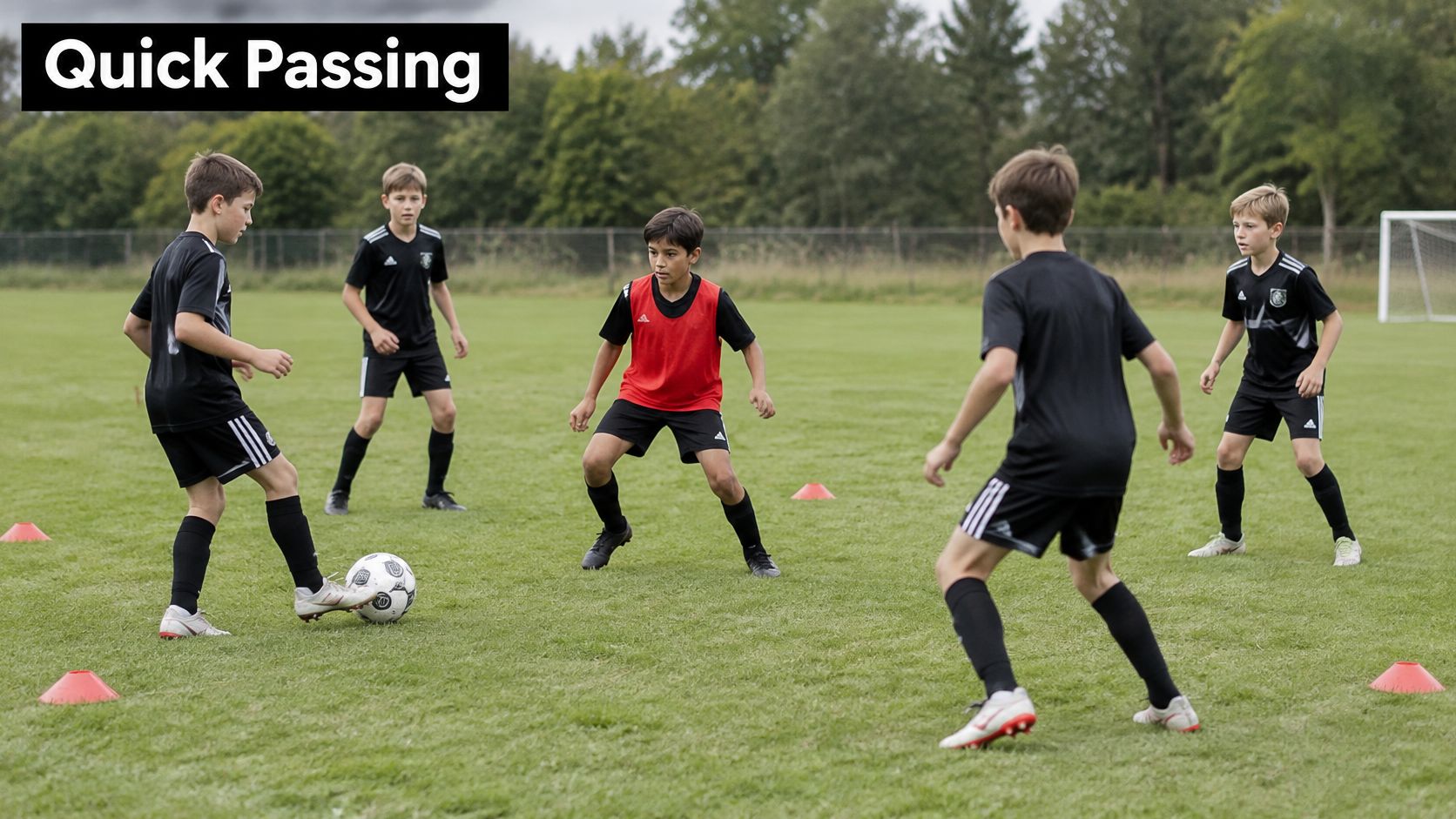
Run this as 4v1 or 5v2 in a 10x10 to 15x15 yard square. Outside players keep the ball. Defenders in the middle try to intercept or force a bad touch. That format keeps decisions manageable for a 10-year-old. They see two or three passing options, not six.
This photo shows the tight spacing you want for quick passing and constant movement.
Run It Cleanly
Two touches maximum: Allow free touches for the first minute, then cap it.
Open body shape: Coach players to receive side-on so they can see the next pass.
Move after passing: A player who stands still kills the next option.
Rotate defenders: Switch every 60 to 90 seconds so effort stays high.
Award a point for a set run of passes and keep score. Rondos are a staple in Dutch and Spanish youth systems that influenced Villarreal CF's methodology, and U.S. clubs use the same formats for a reason. They build first touch, body orientation, and timing together.
It goes wrong when the grid is too big. Defenders can't get close, receivers stop scanning, and the drill turns into casual passing. Shrink it first. Add a second defender later.
2. Cruyff Turn Dribbling Drill
Set five cones in a line with space to accelerate after each one. The player dribbles up, shapes to pass or cross, then drags the ball behind the standing leg with the inside of the foot and bursts away. Johan Cruyff used the turn in the 1974 World Cup, and youth academies still teach it because it works in tight 1v1 moments.
This image captures the cone work and body shape players need before they add speed.
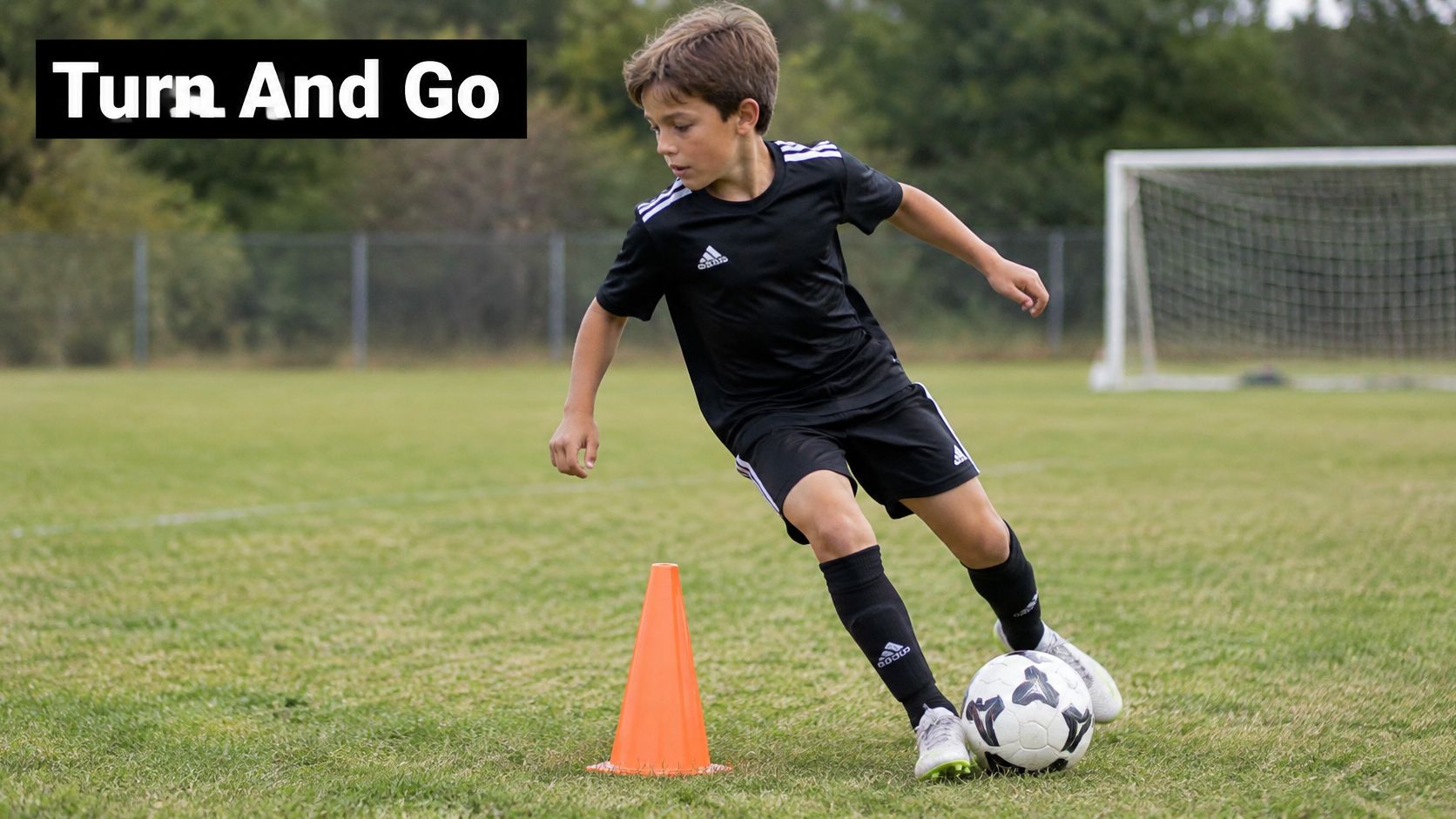
Start slow and exaggerate the feint. The defender, or the cone at first, has to believe the pass is coming. Then coach three details: head up before the turn, ball close during it, sprint after it. Without the sprint, the move just changes direction. It doesn't create space.
Watch the footwork and exit speed in this demonstration before you introduce it to your group.
Make It Game-Ready
Progress to a passive defender who steps one way on your call. Then play live 1v1 to a small gate. I wouldn't add a live defender until players can turn off both feet without looking down for the whole move.
3. Coerver-Style Ball Mastery Circuit
Give every player a ball inside a small square. Work through toe taps, sole rolls, inside-outside touches, and pull-backs in short sets. The Coerver method, developed by Dutch coach Wiel Coerver, gives you a clean framework for this work. Many academies open sessions with it because touches stack up fast.
Keep each set to 30 to 45 seconds, then change the move. Ten-year-olds lose quality when one pattern drags. Require the weaker foot for half the repetitions, even if it looks messy at first. That discomfort is the point.
What to Watch For
Small touches: The ball shouldn't drift outside a short stride.
Knees bent: Straight legs make direction changes slow and clumsy.
Eyes up in bursts: Players can glance down, but they can't stare down.
Practical rule: End ball mastery with a game that uses the same move. Isolated touches help, but transfer happens when a defender forces the choice.
For more progressions you can pair with this circuit, use these youth soccer dribbling drills and keep the same move for a full week. Don't teach six new moves in one session. Teach one well, then test it in play.
4. Passing Triangles
Put three players on cones 10 to 15 yards apart to form a triangle. They pass with the inside of the foot and follow their pass to the next cone. You get constant movement, support angles, and a simple rhythm a 10-year-old can understand without a long explanation.
Start with two touches. First touch sets the ball out of the feet. Second touch passes. Coach weight before power and make players call the receiver's name. If the pass bounces or dies short, the triangle teaches frustration, not combination play.
Progression That Works
Add one-touch passing once the shape is stable. Then require the receiver to take the first touch across the body and play the other way. That small change adds scanning and a real decision.
There's a reason to keep pushing toward game-like versions. A 2024 study in the International Journal of Sports Science & Coaching compared classical passing drills with dynamic, game-like training over 5 weeks in players aged 10 ± 1 years and found stronger retention in the dynamic group (p = 0.001, effect size d = 0.53).
Use these youth soccer passing drills to extend the triangle, but don't leave it unopposed for long. Add a passive defender in the middle. Let players feel pressure before you judge their passing.
5. Small-Sided 4v4 Game
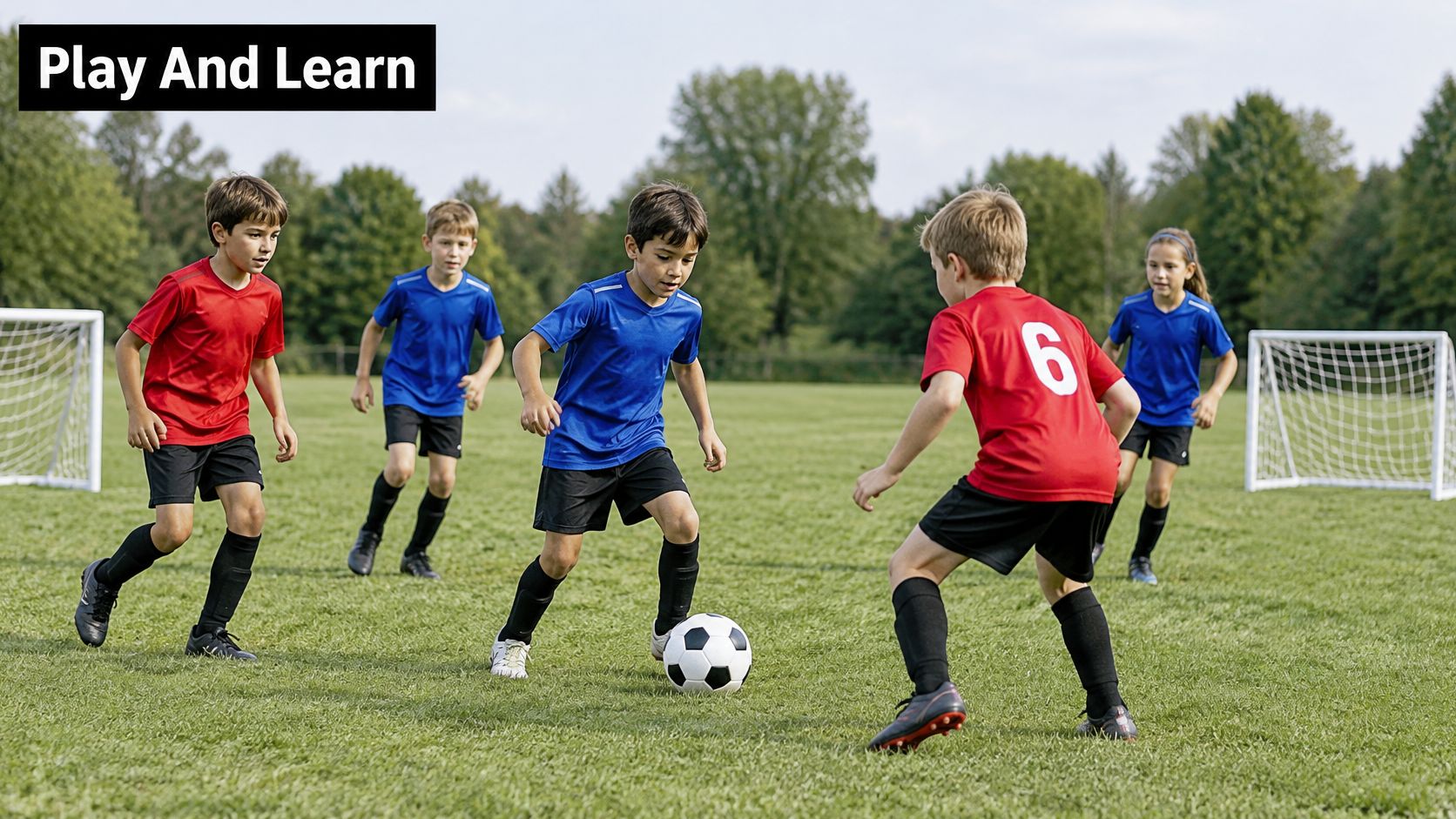
Play 4v4 on roughly 30x40 yards with small goals. Use goalkeepers if you have proper goals. Skip them if you don't. The format matters more than the equipment. Every player stays close to the ball, gets touches, and has to decide whether to dribble, pass, or shoot.
This image shows the density you want, with players close enough to combine and react quickly.
Rotate positions every few minutes. A 10-year-old shouldn't be locked in as a right back for a whole season. Mix teams regularly so players learn to work with different teammates and solve new problems.
Stop the game once to coach one idea, then let them play. Show a support angle or a first touch away from pressure. Don't stop it five times and turn the best part of practice into a lecture.
Small formats give you more than touches. A 2026 study summarized in research on 10 to 12-year-olds found that 3v3, 4v4, and 5v5 supported integrated improvements in physical and technical-tactical performance.
Build your weekly rotation around these small-sided soccer games and you'll see the transfer. A closed drill can look polished while teaching very little game intelligence. The game exposes that quickly.
6. Finishing with a Give-and-Go Combination
Set two attackers against one defender about 20 yards from goal. Attacker one passes to a teammate, sprints past the defender, and receives the return to finish. That's the whole pattern. Timing and communication do the work.
Teach the first pass to be firm and to the correct foot. The wall player should play one touch if they can, two if they need control. The runner shouldn't go too early. If they sprint before the pass is set, the defender just follows them and the return lane closes.
Coaching Points
Pass, then move: Standing and admiring the pass ends the combination.
Run into space: Curve the run slightly so the return pass has an angle.
Finish early: Take the shot before the defender recovers.
Start with a passive defender who only shadows. Then let the defender press after the first pass. Vary the starting angle and distance so players don't memorize one scripted finish.
Praise good movement and a clear call, not only goals. At this age, a player who times the run well and scuffs the shot has still learned the harder part. Finishing gets cleaner with reps. Timing takes coaching.
7. Sharks and Minnows
Mark a grid about 20x25 yards. One or two sharks start in the middle without a ball. The minnows line up on one end, each with a ball, and try to dribble to the other side. If a shark wins the ball and kicks it out, that minnow becomes a shark.
This photo shows the pressure and change of direction that make the game useful for dribbling under stress.
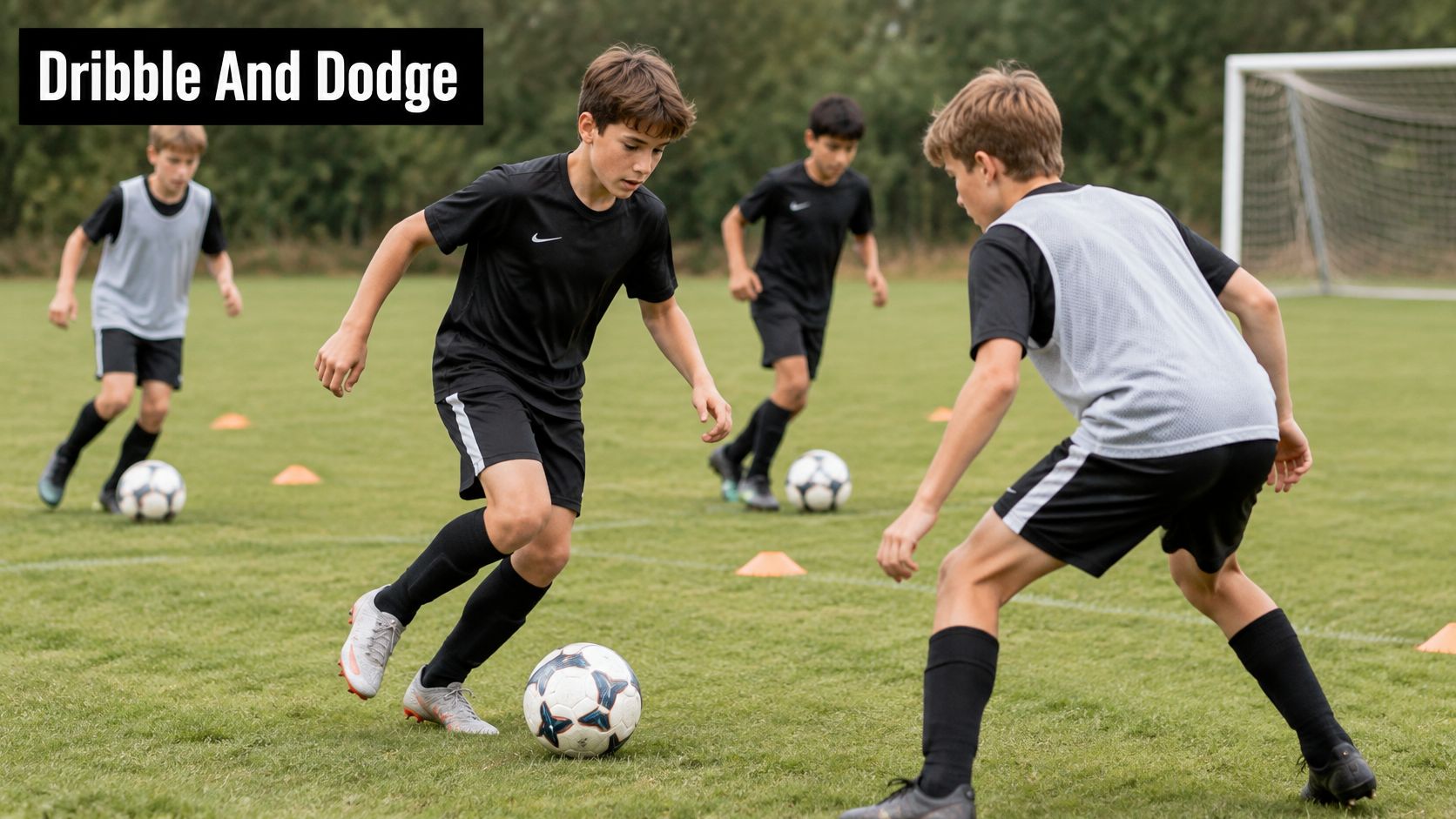
Set the rules before the first round. Sharks win by stealing the ball, not by barging shoulders. Minnows must keep the ball close enough to change direction. Big touches into open space work in round one. They stop working once three sharks are hunting.
Coach players to scan before they start, attack the biggest gap, and use a turn instead of panicking when a shark steps in. That's real spatial awareness, taught without a whiteboard.
Rotate the starting sharks every game. Defending teaches timing and patience, and quieter players often read the game better than you expect.
It goes wrong when the grid is too narrow too early. Weaker dribblers get caught in seconds and stop taking risks. Start wide. Narrow it as confidence grows.
8. Juggling Progression
Start with one bounce between touches. Foot, bounce, other foot, bounce. Then remove the bounce for players who are ready. Add thigh touches once foot control is steady. Keep targets small and personal. Ten in a row is a real achievement for many 10-year-olds.
Juggling builds touch, balance, and the connection between eyes and feet. It also gives you a quiet diagnostic. A player whose touches spray sideways usually locks the ankle poorly or leans back. Coach a flat foot, a locked ankle, and the ball rising to about knee height.
A Simple Ladder
Level one: Alternate feet with a bounce.
Level two: No bounce, feet only.
Level three: Foot, thigh, foot in sequence.
Level four: Partner juggling, one touch each.
Track personal bests and celebrate them. Many clubs keep season records because kids chase their own number without needing to beat a teammate.
Don't use juggling as filler while you set up the next drill and then wonder why players treat it as filler. Give it five focused minutes as a warm-up or cool-down. I prefer it at the start, when legs are fresh and touches are honest.
9. Agility Ladder Footwork Drills
Use a flat ladder or chalk lines. Run two feet in each square, lateral steps, and in-and-out patterns. Keep it short. The goal isn't conditioning. It's coordination, balance, and clean landing before you add a ball and a decision.
Practice is the natural place to slip in injury-prevention work. Add low jumps with a soft landing, single-leg balance, and controlled stops at the end of the ladder. A randomized trial in research on 92 youth teams and 1,409 players aged under 11 to under 14 found high adherence to a neuromuscular warm-up brought a 31% lower risk of acute, noncontact lower-extremity injuries than in control teams.
That evidence points to routine, not intensity. In that trial, injury incidence was 4.77 per 1,000 hours in the high-adherence group and 5.48 per 1,000 hours in controls. Short, consistent work beats an occasional hard session.
Keep It Soccer-Specific
Finish each ladder rep with a ball. Player exits, receives a pass, takes a first touch left or right, and dribbles through a gate. Ladder-only speed doesn't transfer on its own. Pair the feet with a touch and a scan, and it starts to look like soccer.
10. Gate Dribbling Race
Scatter eight to ten cone gates around a 20x20 yard area. Each player has a ball. On your whistle, they dribble through as many gates as they can in 45 seconds. Count a gate only when the player keeps control through it. Blasting the ball through and chasing it doesn't count.
This drill teaches close control, turning, and change of speed with a score kids understand. Round one is always chaotic. Players chase the nearest gate and collide. Coach them to look up after each gate and pick the next one early.
Progressions
Weaker foot only: Slow it down and force better balance.
Turn at every gate: Use a pull-back or Cruyff turn after passing through.
Add a defender: One shark hunts balls while everyone else hunts gates.
Measure it: Record gate counts across a few weeks. Players work harder when they can see their own number climb.
It goes wrong when gates are too close together. Players never get to dribble at speed. Space some gates apart so they can open up, then cluster others so they must slow down and turn. That mix is what games demand.
How the ten drills compare by format, group size, and main benefit
Use this table to match each drill to the decisions it asks of 10-year-olds and the group you have available. Individual work gives each player repeated touches; games and keep-away add pressure and require quicker choices.
Item | Practice Format | Group Size | Main Benefit |
|---|---|---|---|
Rondo (Keep-Away in a Grid) | Passing keep-away in a grid | 4v1 or 5v2 | Quick passing and decision-making |
Cruyff Turn Dribbling Drill | Practice a feint through cones, then accelerate away | Individual or pairs, one ball each | Change of direction and 1v1 confidence |
Coerver-Style Ball Mastery Circuit | Repeated close-control moves with both feet | Individual, one ball per player | Ball control and two-foot confidence |
Passing Triangles | Pass around a triangle and move after each pass | 3 players | Accurate passing and support angles |
Small-Sided 4v4 Game | Reduced-field game with goals | 4v4 | Tactical awareness and player involvement |
Finishing with a Give-and-Go Combination | Combine past defenders and shoot on goal | 2 attackers versus 1 or 2 defenders | Combination play and finishing |
Sharks and Minnows | Dribble across a grid while avoiding defenders | One or two defenders; remaining players dribble | Dribbling under pressure and spatial awareness |
Juggling Progression | Individual or partner juggling challenges | Individual or small groups | Touch, balance, and coordination |
Agility Ladder Footwork Drills | Perform footwork patterns through a ladder | Individual or small groups, taking turns | Foot speed, coordination, and balance |
Gate Dribbling Race | Dribble through cone gates within a time limit | Individual, one ball each | Dribbling speed and close control |
Pair-based and individual drills keep the task simple and give players room to repeat a movement. Use small-sided games and rondos when players are ready to scan, choose, and act under pressure. Move from isolated touches into opposition gradually: add a defender or a game constraint only when players can perform the basic action with control.
Turn These Ten Drills Into a Season Plan
A 10-year-old's session works best when each activity prepares the next. Start with ball mastery or juggling, then use a rondo or passing triangle to add decisions. Finish with a small-sided game that rewards the same skill under pressure. Keep that sequence steady and change one variable at a time, so players spend less time learning new instructions and more time practising.
FIFA's grassroots coaching guidance describes a five-part practice model: about 8 to 10 minutes for an active ball warm-up, 15 to 20 minutes for a technical drill, 25 to 30 minutes for a small-sided game, and 5 minutes for reflection in a 60 to 75 minute practice. Connect the technical work to the game. If players practise receiving on the back foot, reward that choice in the game.
Keep the work active rather than turning practice into conditioning. In a study of 7 to 12-year-old players, the Journal of Human Kinetics reported that its 10-year-old participants completed three weekly 75-minute sessions, while finding no strong training-related influence on aerobic-capacity development in that group. Short, engaging bouts with frequent rotations are a better fit than adult-style endurance work. Watch movement quality and attention. If technique breaks down, shorten the turn or reduce the number of players.
Build balance, landing, and controlled stopping into the warm-up and ladder work. A review of six studies involving 10,565 players aged 7 to 14 on FIFA 11+ Kids reported that one study found twice-weekly work over ten months reduced overall injuries by 48% and severe injuries by 74%. Keep these movements brief and repeat them regularly.
Across the season, look for better decisions as well as cleaner technique. Can players scan before receiving, use the weaker foot, and choose a pass in 4v4 instead of dribbling into traffic? These are practical signs of development at age 10.
Villarreal Houston Academy uses age-appropriate training focused on intelligence, skill, and character. Its qualified coaches are expected to communicate positively and help players find their best on and off the field. The Academy offers competitive teams for ages 10 to 18 at Fall Creek Sports Complex. Families looking for structured training can explore select and competitive programs for boys and girls from age 4 upward at Villarreal Houston Academy, with teams, camps, clinics, and tryouts across North Houston.
Comments