


Youth Premier League Explained: Levels, Costs and Pathway

If the best player on the field never gets selected, was the tryout really about talent, or was it also about who could pay, travel, and clear every weekend for ten months? That question sits underneath most conversations about a Youth Premier League. Parents hear about higher standards, tougher opponents, and a pathway to college or professional soccer. They hear less about how age cutoffs, physical maturity, training load, and family logistics shape who stays in that pathway.
You'll make a better decision if you separate three things from the start. First, you need to understand what level your child is entering. Second, you need the full calendar and the full cost, including the optional extras that can become expected. Third, you need to judge fit by your child's health, motivation, and development, not by a roster announcement alone.
What a Youth Premier League Actually Is
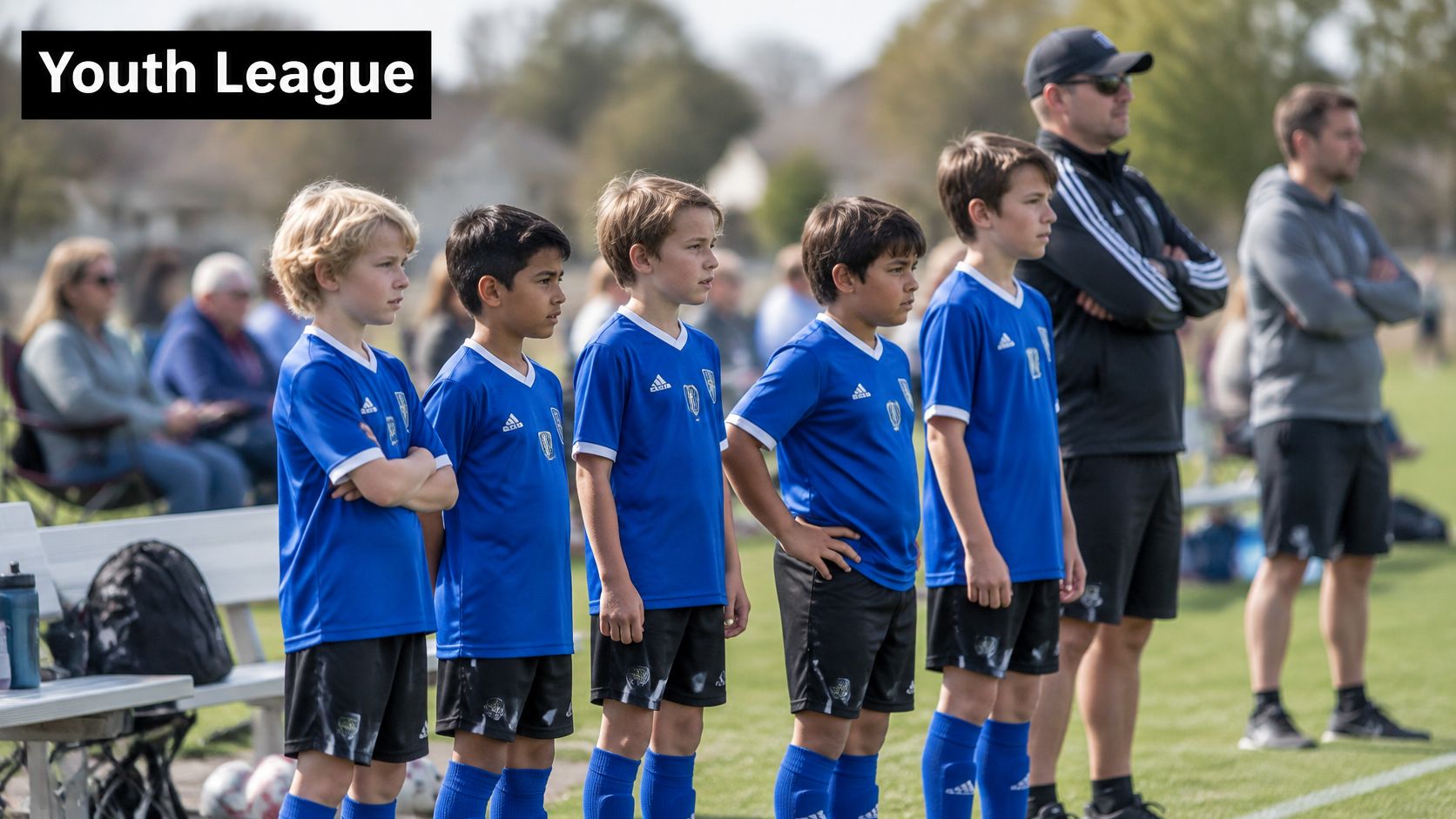
A parent on the sideline usually asks the same direct question. Is this a real league, or is it just a label a club puts on its best team? In simple terms, a Youth Premier League is a competitive, age-grouped tier where clubs field selected squads for league matches, tournaments, and showcases against other strong clubs.
Think of youth soccer as a staircase. Recreational soccer is the playground at the bottom, open to everyone and built around participation. A Youth Premier League is a higher step, where players earn places through tryouts and train several times a week. Further up sit regional and national platforms, then college soccer, professional academies, or other elite routes.
Why the Name Can Confuse Families
No single organization owns the phrase Youth Premier League in the United States. Clubs may use it for the highest competitive tier in their local area, while national and regional competition is commonly organized through leagues such as ECNL, MLS NEXT, and NPL. That's why the league name on the schedule matters more than the word premier on a brochure.
In England, the Premier League's Elite Player Performance Plan, introduced in 2012, divides development into Foundation for Under-9 to Under-11, Youth Development for Under-12 to Under-16, and Professional Development for Under-17 to Under-23. That example is useful because it shows the core idea clearly. Elite youth development is a long, staged pathway, not a single season or one impressive tournament.
Three features usually define the level:
Selection: Players attend tryouts or trial sessions instead of joining through open registration.
Age-group structure: Teams are organized by birth year, with squads moving through progressively harder formats.
Training calendar: League matches sit alongside several practices each week, plus tournaments and occasional showcases.
Before you compare clubs, check three basics. Confirm the exact league name, the age group your child will enter, and the number of weekly training sessions the club requires. Those details tell you more about the commitment than the word premier does.
Age Levels and Team Structure at a Glance
Start by matching your child's birth year to the correct row. Then look across that row to see the training load, match format, and selection pressure before you ask about price or travel.
Age Group | Sessions per Week | Typical Match Format | Selection Style |
|---|---|---|---|
U8–U10 | 2 | 4v4 to 7v7 games and festivals | Open placement, few cuts |
U11–U13 | 2–3 | 9v9 league and tournaments | Annual tryouts, some releases |
U14–U16 | 3–4 | 11v11 league and showcases | Competitive trials, roster cuts |
U17–U19 | 4–5 | 11v11 league, showcases and college scouting | Final selection, highest attrition |
How to Read the Table
The youngest bands use small-sided games so children touch the ball often and learn in tight spaces. As players move into U11 to U13, 9v9 play adds more positions and larger fields. By U14, teams usually play 11v11, and selection becomes sharper because there are more players competing for clearly defined roles.
Training rises for a practical reason. Older players need time for team tactics, position-specific work, fitness, and match preparation. A family that can manage two sessions at U9 may struggle when the schedule reaches four or five sessions, even if the player still loves soccer.
Clubs often run more than one squad in an age group. A first team may carry the heaviest schedule and face the most cuts, while a development side keeps players progressing with slightly less pressure. Ask how many squads the club runs in your child's band and how movement between squads works. You can also review this guide to youth soccer age groups before you speak with a coach, so you're checking the right birth-year category.
Birth Date and Maturity Can Distort Selection
Because teams are grouped by birth year, a player born late in the selection year may compete against teammates who are almost a year older. At young ages, that gap can look like talent when it's partly size, speed, and coordination. A longitudinal study of Category 1 Premier League academy players found birthdate asymmetry in grassroots football and a substantially larger asymmetry in the academy, with early-born players having a higher cumulative probability of retention than late-born players.
Physical maturity creates a related problem. Bio-banding groups players by biological maturity rather than chronological age, and a study of 66 Premier League academy players aged 11–14 found early-maturing players had to emphasize technique and tactics, while later-maturing players had greater opportunities to demonstrate their competencies. Don't judge a late developer's ceiling from one tryout against bigger children.
Ask the club how it records birth quarter, reviews releases by birth date, and reassesses players after growth spurts. A good answer shows the coaches know timing can hide potential.
Your first steps are simple. Find the correct age group, check the weekly session count, ask how many squads exist in that band, then ask how the club handles birth-date and maturity differences.
How a Season Runs from Tryouts to Showcases
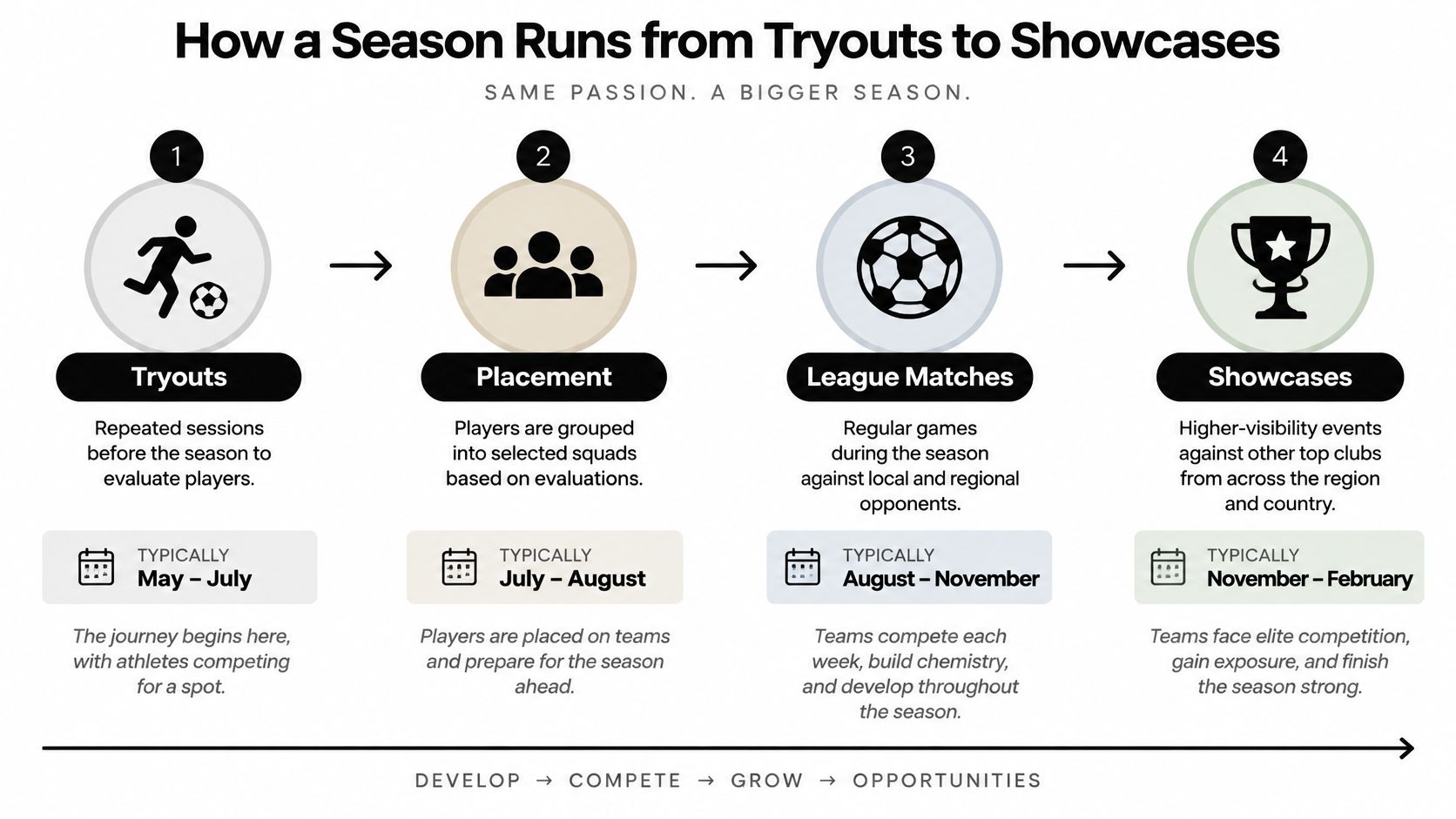
Say your child attends tryouts in late spring. The club doesn't make a final decision from one good drill. Coaches usually watch repeated sessions over several weeks, compare players in small-sided and full games, then place them into squads for pre-season training.
The Four Main Phases
Tryouts come first, often before a fall or spring season. Players may be invited back for additional sessions so coaches can see them with different teammates and in different positions. If your child is new to the club, ask whether placement remains open during the first training block or locks immediately after tryouts.
Placement and pre-season follow. Coaches set rosters, introduce team principles, and use friendly matches to test combinations. This is also when families should receive communication expectations, attendance rules, and safeguarding information. If parent volunteers help with travel, check-ins, or team administration, a guide to youth sports background check costs can help you understand one part of the screening process clubs may need to manage.
League matches form the weekly core of the season. Most games fall on weekends, with occasional midweek fixtures. Training continues around those matches, so a normal week can quickly fill with school, homework, practices, and driving.
Tournaments and showcases sit around the league calendar. Tournaments often involve several matches over a few days. Showcases matter more at older ages because college coaches, scouts, and higher-level clubs may attend selected games rather than ordinary league fixtures.
What to Get in Writing
Playoffs or cup rounds may extend the season, followed by a summer break or reduced schedule. Then the cycle begins again with another tryout window. In practical terms, many families should expect roughly nine to ten months of commitment, with weekends largely booked during the main league block.
Don't accept a place based on a verbal outline. Ask for a written calendar that lists:
League dates: The start, finish, and expected match days.
Tournament dates: Which events are required and which are optional.
Showcase dates: Where they're held and who pays entry and travel costs.
Tryout window: When the next selection cycle begins.
That calendar reveals whether the season fits your family's school schedule, work hours, and budget before emotions take over.
How It Differs From a Recreational League
Parents often compare these options as if one is serious and the other isn't. That framing misses the point. They serve different goals, and the better choice depends on what your child wants from soccer this year.
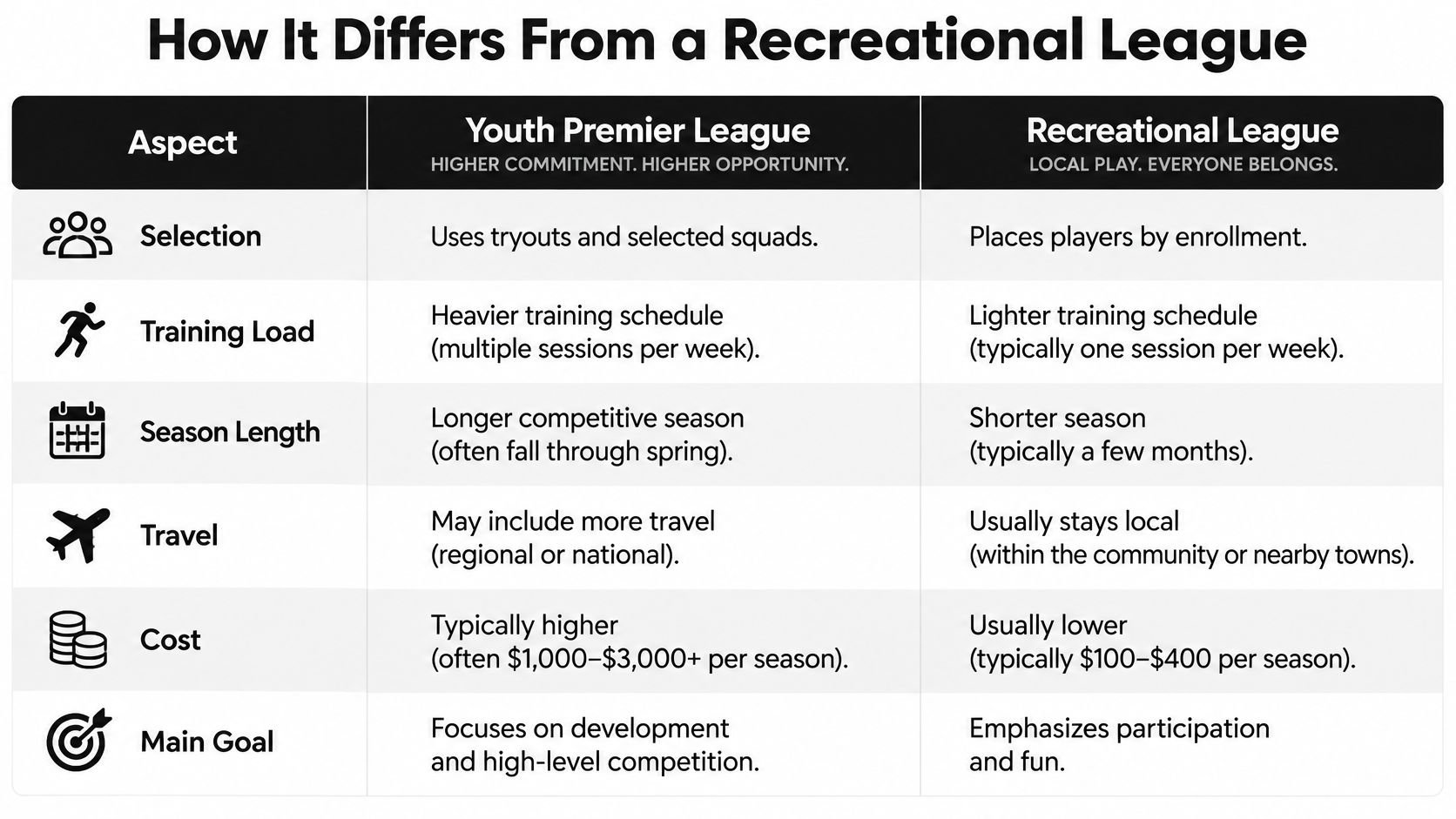
Factor | Youth Premier League | Recreational League |
|---|---|---|
Selection | Tryouts and trial periods | Open registration or neighbourhood placement |
Training | 2–5 sessions weekly | One session weekly or less |
Season | Fall or spring block plus showcases and tournaments | Shorter seasonal block, often local |
Travel | Regional trips and some overnight events | Local fields only |
Cost | Club fees plus optional extras (see the cost table) | Low fixed fee per season |
Main goal | Development, competition and placement | Participation, fitness and fun |
Why Each Difference Matters
Selection changes the whole environment. Recreational leagues spread players across teams, so ability levels are mixed. Selected squads cluster stronger players together, which raises the speed of training but can also reduce minutes for children near the bottom of the roster.
Training load changes because the coaching goal changes. A recreational coach may focus on basic skills, equal involvement, and enjoyment. A competitive coach teaches position-specific skills, pressing, transitions, set pieces, and decision-making under pressure. That extra detail needs more sessions, and it asks more from the player's attention and recovery.
Travel is the difference families underestimate most. Recreational soccer usually stays close to home. Competitive teams travel across a region, sometimes stay overnight, and may ask parents to manage meals, hotels, and changing kickoff times. The soccer can be excellent while the logistics still strain the household.
Cost follows those choices. More coaching time, field use, referees, league entry, tournaments, and travel all add expenses. A lower recreational fee isn't a lower-quality childhood experience. It's a different product with fewer paid services and fewer required commitments.
A Simple Decision Rule
Choose recreational play if your child wants a social, low-pressure season or your family can't absorb the travel. Choose a Youth Premier League if your child seeks daily challenge, detailed coaching, tougher opponents, and visibility to higher-level clubs.
A player can move from recreational soccer into competitive soccer when motivation and fundamentals catch up. Moving down mid-season is usually harder, so don't treat the first decision as permanent.
Watch your child after sessions, not just during selection week. If they leave energized, ask for the ball at home, and want tougher games, the competitive environment may fit. If they mainly want friends, movement, and a free weekend, recreational soccer may serve them better right now.
What the Full Season Costs and Who Gets Left Out
The headline club fee is only the starting point. Use the categories below as a planning checklist, then confirm every amount with the club in writing because local fees and required extras differ.
Cost Item | What It Covers | Typical Range (Estimate) |
|---|---|---|
Club season fees | Coaching, field use, league entry | Set by the club in its season fee schedule |
Kit and equipment | Jerseys, training gear, boots, ball | Priced by the club or kit supplier |
Tournaments | Entry fees for multi-day events | Charged per event by the organizer |
Travel | Fuel, tolls and hotels for away events | $100–$2,000 per season |
Showcases and ID events | Entry and evaluation fees | Charged per event by the organizer |
Private coaching (optional) | Extra one-to-one sessions | $40–$100 per session |
Unavoidable Costs and Optional Extras
Season fees, required kit, and any registration costs are usually unavoidable once you accept a roster place. Tournaments, showcases, private coaching, extra camps, and additional travel may be optional in the contract but feel necessary once teammates attend. That's where budgets break.
A report on youth soccer access and family spending states that average family spending on a child's primary sport reached $1,016 in 2025, nearly 50% higher than five years earlier. It also notes that soccer costs can rise substantially once private fields, coaching, referees, uniforms, tournaments, and travel are added.
Build your estimate in two columns. Put required payments in one column and likely optional spending in the other. If the required column already stretches the household, don't assume you'll skip everything else. Missing repeated team events can affect playing time, social fit, and visibility.
Cost Is Part of Selection
Access barriers begin before tryouts. Aspen Project Play reported that 32% of families identified team fees as a major participation barrier, rising to 41% among low-income families, according to the same report. Transportation adds another barrier when practices and matches require several trips each week.
Selection isn't purely meritocratic if a family must pay fees, drive long distances, and protect a demanding schedule before a coach ever evaluates the player. Some talented children never enter the room. Others enter but can't attend enough optional events to stay visible.
Families comparing youth soccer travel teams should ask direct questions before signing:
Required versus optional: Which tournaments, showcases, and camps must our child attend?
Payment support: Do you offer payment plans, scholarships, or fee assistance?
Lower-travel route: Is there a development squad or local training hub with fewer overnight trips?
Visibility without maximum spend: How can a player be evaluated fairly without attending every extra event?
Don't be embarrassed to ask. A transparent club should explain its full season cost, refund rules, and assistance options clearly. If answers stay vague until after you commit, treat that as useful information.
Staying visible doesn't always require the most expensive route. Consistent attendance, strong fundamentals, good match film at older ages, local ID events, and honest communication with coaches can keep a player developing while the family controls spending.
The Pathway to Elite Play and Its Real Odds
The pathway sounds straightforward when clubs draw it as arrows on a slide. A player joins a local Youth Premier League team, attends regional select or ID events, performs at showcases, enters an academy or development centre, then moves toward college soccer or a professional academy. Each step is real, but none is automatic.
What Each Rung Actually Asks
The first rung asks for consistent performance across a full season. One strong tournament may attract attention, but coaches want to see technical quality, decision-making, work rate, and coachability repeated against good opponents. Attendance and availability matter too because a player can't be evaluated if they're often absent.
Regional ID events and showcases ask a player to stand out in short windows. Coaches watch first touch, scanning, speed of play, defensive reactions, and how quickly a player adapts to unfamiliar teammates. Families researching higher boys' pathways can compare that step with the structure of MLS NEXT youth soccer, but they should still ask what route a specific local club can document.
An academy or development centre asks for a longer commitment. Training becomes more position-specific, feedback becomes more regular, and education and recovery need closer management. College soccer adds academics, recruiting communication, highlight video, and direct contact with college coaches. A league badge doesn't recruit a player by itself.
The Odds Need Plain Language
BBC reporting on the English academy pathway cited an estimate of approximately 1.5 million players in organized youth football in England at any given time, with around 180 expected to become Premier League professionals who play at least one top-flight minute. That's approximately 0.012%, or about 1 player for every 8,333 participants.
That benchmark comes from England, so it isn't a Houston probability. It does give families a realistic sense of scale at the very top. Most players in competitive youth soccer won't turn professional, including many talented and hardworking players.
Practical rule: Judge each season by coaching quality, playing time, education, enjoyment, and continued options. Don't pay for a distant promise that delivers little value this year.
Ask clubs for named examples of players who moved on and the routes they took. Did they reach college programs, higher club platforms, semi-professional teams, or professional academies? How long did those players stay at the club? Specific answers help you separate a documented pathway from general language.
The value can still be substantial. Players can gain discipline, resilience, teamwork, tactical understanding, and strong coaching feedback. They may keep playing in college, join a semi-professional team, or carry the habits into school and work. That's a worthwhile outcome, but it should be described accurately.
Confirm Your Child's Fit Before Committing
For children ages 4 to 12, early roster status isn't the strongest sign of long-term development. Research on early specialization in elite youth soccer reports that early specialization may increase injury risk and can limit broader motor-skill development, while available data are still insufficient to prove it produces superior outcomes. Skill variety, motivation, decision-making, and consistent enjoyment deserve more attention than match volume alone.
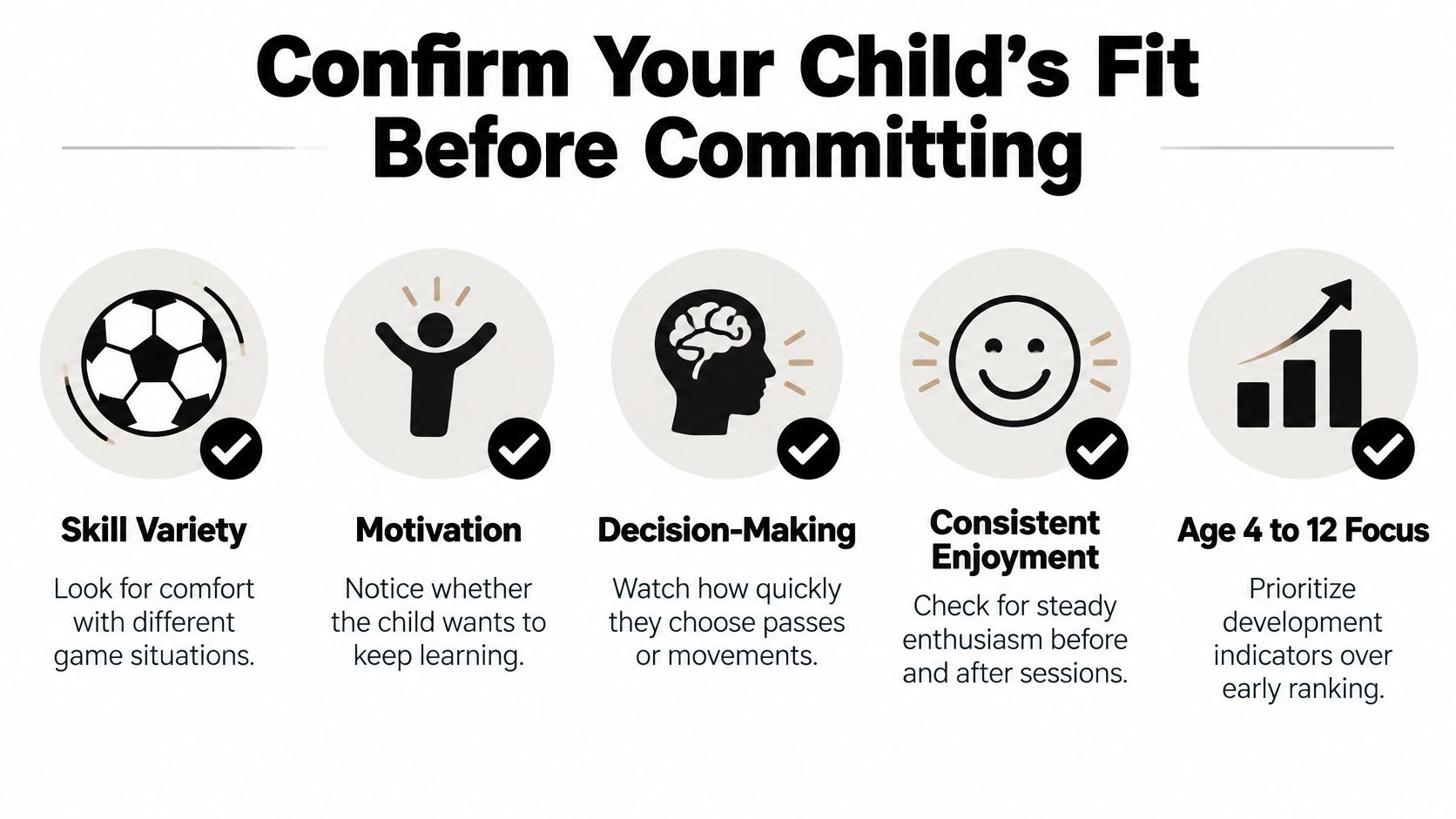
Ask four quick questions. Does your child still enjoy other sports or active play? Do they ask to train without being pushed? Do they recover well after busy weekends? Do they listen to coaching feedback and try again after mistakes? If most answers are yes, use this checklist:
Confirm the age group: Check the birth-year category for the current season.
Request the calendar: Get league, tournament, showcase, and tryout dates in writing.
Compare total cost: Include required fees and likely optional extras.
Plan transport: Test the route for two practices and one match each week.
See the coaching: Attend a tryout, camp, or clinic before signing.
Set a review point: Agree to reassess after one season.
If a coach pressures your child to keep playing through pain, stop activity, report it to the club, and get a medical check before returning. A slower, multisport route can protect long-term development better than a rushed single-sport commitment.
If you're weighing a Youth Premier League commitment in Greater Houston, Villarreal Houston Academy offers age-appropriate teams, camps, clinics, and tryouts for boys and girls from age 4 upward, so you can test the coaching fit before committing to a full season. Visit Villarreal Houston Academy to check current programs, training locations, and tryout details, then bring your calendar, cost, and development questions with you.
Comments