


8 Soccer Positioning Drills for Smarter Play

Positioning changes the game before the ball does. In well-designed soccer positioning drills, young players learn to spot options earlier, defend together, and affect the next pass with their movement, not just their touch. That matters because position games and possession games create clearly different physical demands, and positional constraints can be used to shape rapid changes of direction, scanning, and short explosive actions rather than just running hard (LJMU positional training analysis).
That's why the best soccer positioning drills are not cone routines in disguise. They're decision-rich tasks that teach players where to stand, when to move, and how their choice changes the teammate's options a second later. In a Villarreal-inspired environment, that also means rewarding intelligence, technical quality, and character, the same development priorities parents and coaches look for at Villarreal Houston Academy, which works from Villarreal CF methodology in an age-appropriate way.
The eight drills below move from team-wide defensive organization to role-specific responsibilities. Each one includes a coach-ready setup, the learning objective, a suggested duration, coaching cues, a progression, and an age adjustment so you can fit it to U8, U12, or older players without turning it into empty repetition.
1. Positional Pressing Zones Drill
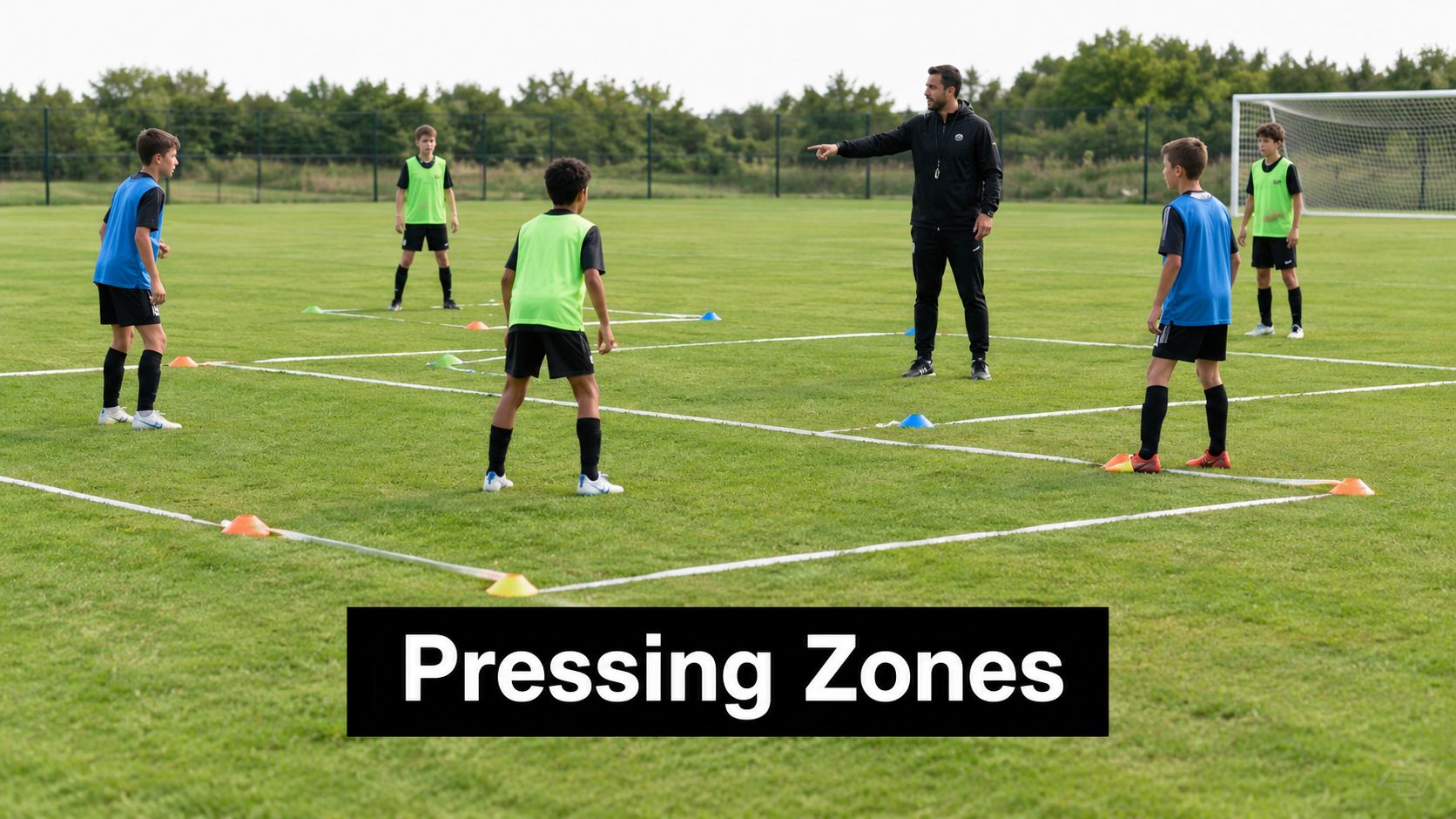
A good pressing team doesn't chase. It closes space with purpose, and that starts with players understanding their zone, their trigger, and their support. Set up a small grid with clear cone boundaries, then run 4v4 or a similar small-sided format so every player can feel the spacing instead of hiding inside a crowd.
Use the drill to teach when to step, when to hold, and who covers behind the first presser. The learning objective is simple, maintain team shape while pressing at the right moment and distance. Keep the first round short, about 8 to 12 minutes, so the team stays sharp and the coach can pause often for quick corrections.
Practical rule: if one player presses and three teammates stay flat-footed, the drill has turned into chasing. Stop it and reset the shape.
A coach can reinforce three cues. First, press on a poor touch or a backwards pass. Second, call for support early. Third, recover into shape as soon as the ball is moved. Rotating players through different positions helps them understand the problem from every angle, not just their favorite role.
For younger players, reduce the field and keep the instructions to two ideas only, “close space” and “help the helper.” For older players, add a second ball once the group understands the first phase, or require the team to win the ball and play forward within a few seconds. That turns the drill from simple pressing into real game recognition.
2. Full-Back Attacking and Defensive Transition Drill
Full-backs live in two worlds. One moment they're protecting the flank, the next they're overlapping into space or recovering at full speed after a turnover. Put them in a 40x60 yard area with clear landmarks for the defensive line, the wide channel, and the overlap lane, then trigger transitions with a whistle or coach call.
Start with defensive recovery, then switch to attacking support. The objective is to help players read the moment when a team needs width, depth, or cover, and to make that choice under pressure. A 10 to 15 minute block works well, especially if you keep the repetitions fast and the feedback specific.
Watch the first touch. A full-back who panics on the ball usually arrived late or opened the body poorly before receiving it. Encourage communication with the center-back, because the overlap only works when someone covers the space behind it. Film a few reps if you can, then show the player how the first pass after recovery changes the entire shape of the attack.
Great full-backs don't just run the line. They solve the next transition faster than the opponent can react.
For U9 to U11 players, keep the pattern simple, defend, recover, support wide. For U12 and older, add a winger who can choose to pass inside, play back, or release the overlap. That gives the full-back a real decision, not just a scripted run.
3. Central Midfield Positioning and Coverage Drill
Central midfielders need to feel where the ball will go before it gets there. In the most effective soccer positioning drills for this role, the midfielder doesn't chase every action, the midfielder balances the team. Use a cone grid to show lanes and pockets, then run a possession task with two-touch maximum play so players must decide quickly and move into the right support angle.
Begin at moderate intensity, then build toward game speed as the group starts to see passing lanes earlier. This drill works best when the coach stops play for short teaching moments, especially after a bad body shape or a missed covering run. A 12 to 15 minute block is enough if the quality stays high.
One useful checkpoint is this: can the midfielder receive, open the body, and connect the next pass without standing in a teammate's lane? If not, the player is too flat or too close to the ball. That matters because better positioning changes the next decision for both the passer and the receiver.
For a related spacing model, Villarreal Houston Academy's youth work on spacing connects naturally with this kind of midfield behavior, especially when players learn to support from different angles rather than stand in lines. Youth soccer drills for spacing
Coaching cue: praise the pass that becomes possible because of movement, not only the pass that ends in a shot.
Younger players should only track one reference point, like “be between the ball and our goal.” Older players can handle more layered ideas such as compactness, switch support, and covering behind the first press. Rotate players through multiple midfield roles so they understand both the defensive and attacking jobs in the same zone.
4. Center-Back Partnership and Communication Drill
A center-back pair needs trust, and trust shows up in the smallest things, one player steps, the other covers, and both talk before the danger becomes obvious. Start with a simplified 2v2 setup, then add a supporting attacker or runner once the pair learns the basic spacing and communication rules. The coach should insist on verbal calls, because silent positioning usually means the pair is reacting too late.
Use cones to mark the defensive line and a recovery line behind it. The objective is to keep the pair connected while deciding who engages, who delays, and who tracks the dangerous runner. A 10 minute session can be enough for younger groups, while older players may need a longer phase of play with multiple entries into the box.
A strong pairing doesn't mean both players do the same thing. One can step aggressively while the other protects depth, but only if they read the cue together. That's where a short stoppage can help, because the coach can freeze the shape and ask which player owns the ball, which player owns the space behind, and which player owns the next cover.
Set-piece moments belong here too. Defending a corner is often the first time young center-backs understand that communication has to begin before the ball is served, not after. Recording the session helps the pair review whether they were compact, connected, and early with their calls.
For older groups, add a recovery race after a clearance so the pair has to reset the line while under light pressure. For younger players, keep the opponent count low and the instruction count even lower. Two voices on the back line are enough to build the habit.
5. Striker Positioning and Movement Off the Ball Drill
Strikers who wait for service make the game easier for defenders. Strikers who move with purpose create a choice for the back line, and that's where the advantage starts. Run this drill first as shadow play, with no ball, so the player can learn timing, checking away, pinning a defender, and curving the run into space.
After the movement pattern is clear, add a midfielder or wide player to supply the pass. The learning objective is to help the striker occupy defenders, create gaps for teammates, and arrive in scoring space at the right time. Keep the block around 8 to 12 minutes, because the work is mentally demanding even before the finishing begins.
A simple coaching rhythm works well. Show the movement once. Let the striker repeat it. Then ask where the space opened and why the defender followed. That question matters because positioning changes the next decision for both teams. A striker who drifts off the shoulder may pull a center-back away and open a lane for the late runner.
“If the defender can predict you, you're too early or too straight.”
Use video of real forwards only if the player can connect the image to the movement. The point isn't to copy a famous striker's style, it's to learn how movement creates advantage without the ball. For younger players, keep the pattern to near-post, far-post, and check-away runs. Older players can work on double movements, third-man runs, and set-piece positioning.
Technical quality still matters here. A striker's first touch, body shape, and finishing choice all depend on the quality of the movement that came before it.
6. Goalkeeper Positioning and Distribution Drill
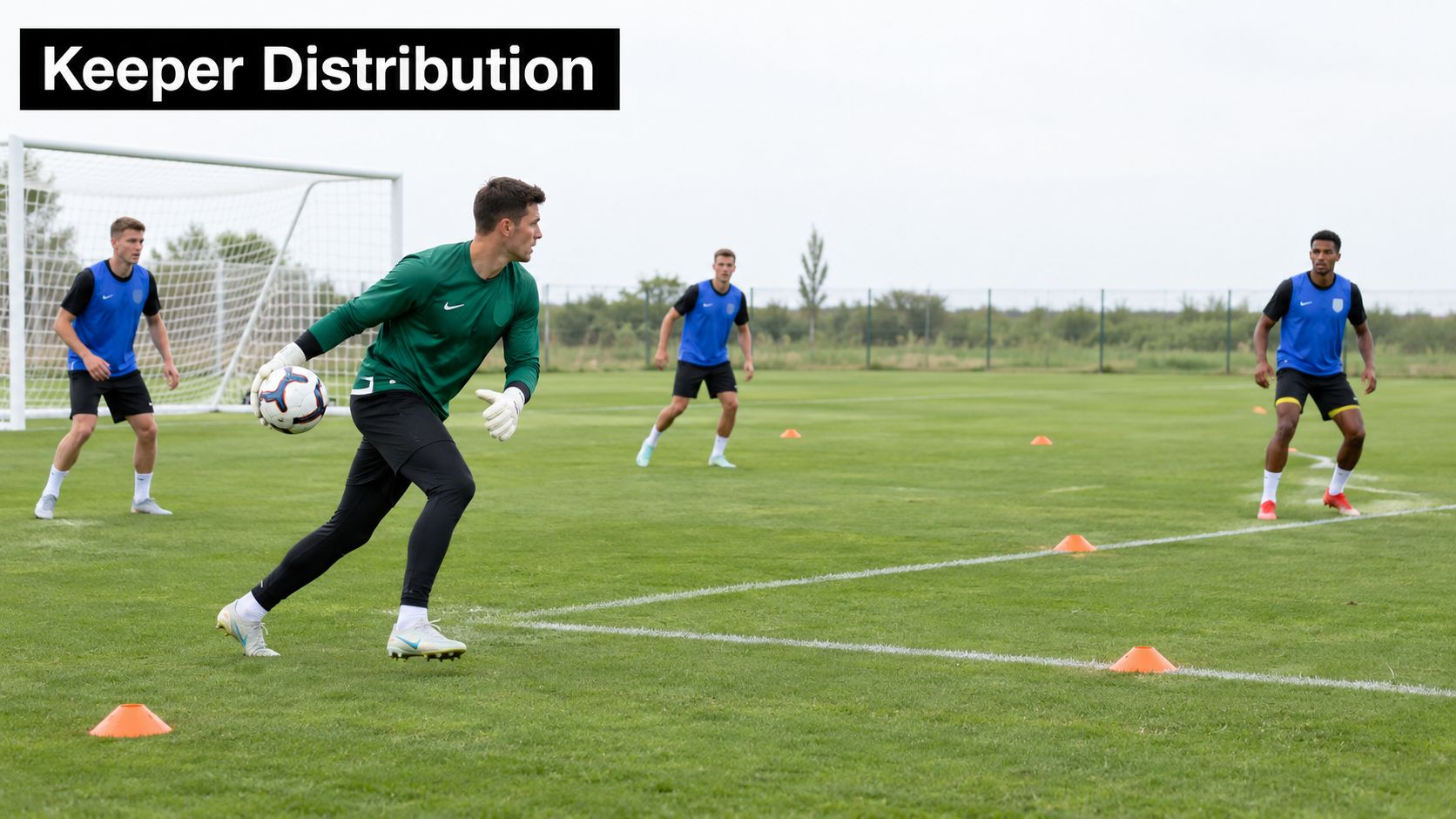
Goalkeepers don't just stop shots, they start attacks. Put the keeper through positioning work inside the penalty area, then connect that to throws, kicks, and short possession play with defenders or wide outlets. The best sessions give the keeper a realistic decision, not just a target to hit.
Start the drill with basic starting positions, near-post coverage, and sweep timing. Then move into distribution with field players so the goalkeeper must choose between a short release, a driven kick, or a safer reset. Keep the work clean and calm, especially for younger goalkeepers who are still learning how far off the line to stand and when to step out of the box.
The objective is to build a goalkeeper who communicates early and distributes with purpose. That means the keeper has to read pressing pressure, scan the field, and choose the correct outlet before the ball becomes stressful. A 12 minute block usually gives enough repetition without overwhelming the player.
For a structured model of keeper development, Villarreal Houston Academy's goalkeeper training guidance fits naturally with this topic, especially its focus on decision-making, communication, and possession participation. Goalkeeper soccer training
A few practical cues help. Keep the body set, not flat. Use the hands quickly when the throw is the better option. Call the defender's name before the pass, not after. If the keeper hesitates, freeze the play and ask what the first safe choice was.
For U8 to U10 players, focus on basic positioning and simple throws. For older keepers, add a sweeper-keeper starting line and pressure from a closing attacker. That forces the keeper to think like an extra defender, which is exactly how modern teams use the role.
7. Wing Player Positioning and Crossing Drill
Wide players have to solve two problems at once. They need to stay in a useful position to stretch the defense, and they need to choose whether to cross, dribble, or recycle the ball. Set up a 30-yard strip with marked crossing zones, then repeat attacks from different angles so the winger learns how body shape and field position change the next action.
Start with controlled service and a target in the box, then add a defender for 1v1 pressure. The objective is to build a winger who can deliver quality from the right space rather than crossing from anywhere. A 10 to 15 minute block works well if each rep gets a quick technical correction.
Crossing quantity means little if the delivery is rushed or the decision is poor. Make the player pause for a second and ask, “Is the striker ready, is the full-back late, and is there a better pass inside?” That habit changes the winger from a runner into a real decision-maker.
For older players, mix in a recovery run after the cross so the winger has to think about both attacking and defending. For younger players, keep the challenge simple, find the line, lift the head, and choose the right foot shape. Video clips of professional wide players help, but only if the coach uses them to point out spacing, not style imitation.
Wingers improve faster when they learn that the best cross is often the one that comes after the best pause.
This is also a good place to reward technical discipline. A clean first touch, a balanced body, and a well-timed entry into the wide channel often matter more than raw pace.
8. Defensive Line Management and Offside Trap Drill
The back line only works when it moves as one unit. That's why defensive line management belongs near the top of any serious list of soccer positioning drills, especially for older players who are ready for organized pressure and compact spacing. Start static, with cones marking the line and adjustment zones, then add movement step by step before introducing the offside trap.
The objective is to teach the entire unit to shift together, step together, and recover together. A 12 to 15 minute block can cover the basic shape, but the best results come when the coach revisits it across multiple sessions. Use short phases of open play and set-piece defending so the line has to hold its responsibility in different game moments.
Communication must be absolute. One center-back calls the line, the full-backs tuck in, and the group reacts as a single block. If one player is late, the line breaks. If the group is early without pressure, space opens behind them. That's why the coach has to teach both timing and patience.
For a Villarreal-inspired tactical frame, Villarreal Houston Academy's tactical training approach fits this kind of collective work, because it connects line organization with decision-making rather than treating defending as isolated movement. Tactical soccer training
You can add a short video review after the drill, especially for U13 and older teams. Show one sequence where the line stayed connected, then one where the timing broke down. The discussion should stay practical, who stepped, who covered, who spoke, and what the next movement should have been.
8-Drill Soccer Positioning Comparison
Drill | Implementation 🔄 | Resources ⚡ | Expected outcomes ⭐📊 | Ideal use cases 💡 | Key advantages |
|---|---|---|---|---|---|
Positional Pressing Zones Drill | Moderate, structured progression (small-sided → full field); needs coach-led triggers | Cones, marked zones, moderate pitch space, 8–18 players | ⭐⭐⭐⭐, improved team shape, pressing timing, anticipation | Academy positional sessions; U10+ tactical introduction | Organizes defense, reduces individual errors, scalable across ages |
Full-Back Attacking and Defensive Transition Drill | High, multi-station, rapid phase changes; specialist coaching recommended | Large area (40x60 yd), cones, support players, high fitness demand | ⭐⭐⭐⭐, better overlaps, crossing, timing, transition speed | Full-back development, U14+, pre-season conditioning | Builds two-way full-backs, improves delivery and timing |
Central Midfield Positioning and Coverage Drill | Moderate, grid progressions with cognitive emphasis; coach feedback essential | 40x40 grid, cones, 6–8 players, video optional | ⭐⭐⭐⭐⭐, enhanced ball retention, distribution, spatial reading | Midfield tactical sessions; U11+ possession work | Develops "brain of the team," reduces turnovers, improves distribution |
Center-Back Partnership and Communication Drill | Moderate, pair-focused progressions (2v2 → 4v4); mandates verbal cues | Small-sided areas, cones, pairing rotations, recording optional | ⭐⭐⭐⭐, stronger partnership chemistry and line management | Defensive unit training; U12+, pairing specialization | Strengthens communication, collective defending, set-piece reliability |
Striker Positioning and Movement Off the Ball Drill | Moderate‑High, shadow play → live scenarios; repetition-focused | Cones, target players, midfield support, video analysis | ⭐⭐⭐⭐, improved timing, space creation, goal opportunities | Striker-specific sessions; U13+ finishing and movement training | Teaches intelligent movement, efficient runs, better link-up play |
Goalkeeper Positioning and Distribution Drill | High, specialist GK coaching and mixed-team drills required | Goal, balls, marked 18‑yd area, field players, dedicated GK coach | ⭐⭐⭐⭐, improved distribution, sweeper actions, defensive command | Goalkeeper development; U10+ modern possession systems | Develops GK as playmaker, enhances communication and decision-making |
Wing Player Positioning and Crossing Drill | Moderate‑High, flank channels, 1v1 and crossing repetitions | Wide strip, cones, cross targets, attackers for finishing | ⭐⭐⭐⭐, improved crossing quality, decision-making, 1v1 effectiveness | Winger development; U11+ flank and transition training | Produces complete flank players with better delivery and choices |
Defensive Line Management and Offside Trap Drill | High, team-wide coordination, precise timing; intensive coaching | Full defensive unit, large space, cones, repeated rehearsals, video | ⭐⭐⭐⭐, cohesive defensive line, compactness, tactical discipline | Advanced team tactics; U14+ collective defensive sessions | Builds organized unit defending, reduces chaos, enables strategic offside use |
Turn Positioning Into Better Decisions
The fastest way to improve positioning is to stop treating every drill like a separate event. Pick one team-shape drill, such as pressing zones or line management, and one position-specific drill, such as full-back transitions or striker movement. Keep the objective narrow, and don't move on until the players can explain what they saw, where they moved, and how their movement changed the next pass, press, or recovery.
The best coaches measure progress with scanning, communication, supporting angles, timing, and recovery decisions. A tackle, pass, or cross still matters, but those actions usually come after the earlier choice to stand in the right place. That's why positional intelligence deserves as much attention as conditioning, especially when the group is young and still learning how space works.
The Villarreal-inspired lesson is clear. Intelligent positioning grows through repetition, guided questions, and age-appropriate game context, not through endless lines or rigid cone patterns. Position games, small-sided games, and tactical awareness tasks help players solve real problems under pressure, which fits the development model many families now look for in a structured academy environment.
If your team needs a clearer pathway from basic awareness to role-specific responsibility, Villarreal Houston Academy is one relevant option in Greater Houston. Its training model centers on technical ability, tactical understanding, and character, which makes it a natural fit for families who want soccer development to go beyond isolated drills and into smarter play.
Villarreal Houston Academy offers age-appropriate training built around Villarreal CF methodology, with coaching that links positioning, technical quality, and tactical understanding. If you want a structured environment for your child to learn smarter movement and better decisions, visit Villarreal Houston Academy to explore teams, camps, clinics, and tryouts.
Comments