


Youth Soccer Coaching Clinics: How to Choose

You're scrolling through weekend soccer flyers while your child's cleats dry by the door. One promises elite training, another advertises a skills clinic, and a third sounds suspiciously like a tryout. Before you rearrange work, find a ride, and pay the fee, you need to know what your child will do.
Around Greater Houston, the right choice isn't necessarily the loudest session or the biggest badge. Good youth soccer coaching clinics give players a useful next step, protect their ability to keep playing, and fit the family's real life, including the drive home.
What Youth Soccer Coaching Clinics Are
A soccer clinic is a focused block of coached learning. Its job might be to sharpen receiving technique, help a beginner feel comfortable with the ball, or teach a volunteer coach how to run a safer warm-up. It isn't a full league season, and it shouldn't be an unstructured camp day with a technical label attached.
The word coaching can cause confusion. Some clinics teach players; others educate coaches. Before comparing staff names, check who's expected to participate and what they should leave knowing.
Clinic formats and family burden
Use these formats as planning examples, not promises about a particular provider's calendar. Confirm the actual duration before registering.
Format | Typical length | Best for | Family burden |
|---|---|---|---|
Single evening | One scheduled evening block | One skill theme or a coach workshop | Low if the site is nearby |
Weekend clinic | A scheduled weekend block | Goalkeepers or a skill burst | Travel and a disrupted weekend |
Multi-week clinic | Recurring sessions across a published calendar | Habit, technique, and safer warm-ups | Repeated weeknight transport |
School or satellite | After school at a local site | Beginners who cannot cross the city | Lowest travel when close to home |
Neighborhood small-sided | A short, game-centered session | Young beginners and first touches | Potentially lighter travel and equipment burden |
Say your child hesitates when receiving a pass. A focused receiving clinic might fit better than a broad holiday camp. If the problem is keeping a new habit between practices, recurring instruction makes more sense than an isolated event.
Short instruction can also have lasting value for coaches. A study reported by Drexel University found that, after a 90-minute preventive-training workshop, coach-led implementation produced movement-quality improvements comparable to athletic-trainer-led sessions; initially high-risk players who received preventive training during both fall and spring were three times more likely to improve their risk classification than comparable peers.
That finding concerns a specific preventive program, not every clinic advertised as developmental. Its practical lesson is that a focused workshop can equip a coach to repeat useful instruction after the event ends.
Choose the format before the brand. Decide whether your family needs an introduction, a targeted correction, or repeated practice. Then check whether the player group fits your child.
Benefits by Age Group and Skill Level
A child who's learning to stop the ball needs a different environment from a teenager learning when to release it. Age fit includes emotional readiness, experience, and current training load, not just the birth year printed on a registration form.
What each age and level should get
The age bands below are illustrative planning categories, not developmental deadlines. The supervision column gives practical selection criteria rather than unsupported numerical staffing standards.
Age or level | Main gain | Group size to look for |
|---|---|---|
Ages 4–6, first experience | Ball comfort and enjoyment | Small enough for the coach to help each child immediately |
Ages 7–9, recreational or junior | Individual bravery and small-sided decisions | Enough supervision to prevent long lines and unnoticed confusion |
Ages 10–14, club or select | Scanning, position habits, and a match theme | A group the coach can observe during opposed play |
Ages 15–18, competitive | Decision speed and managed workload | Position-relevant feedback without crowded stations |
High-level girls or boys | Technical work plus landing, balance, and recovery | Tighter supervision than a large rotating camp station |
For the youngest beginners, success might mean joining a game without holding a parent's hand. Look for imaginative tasks, frequent touches, and permission to try again. A coach who spends most of the session explaining formations has missed the immediate need.
Junior players can begin solving simple problems: protect the ball, beat an opponent, or find a teammate instead of dribbling into traffic. The coach can hide the lesson inside a game. Moving a cone gate or changing the direction of attack often gives children something concrete to solve without a long speech.
Match the challenge to the player
Older club players need a reason for each activity. Say a midfielder receives with their back to pressure. The useful lesson is checking a shoulder, choosing a body position, and deciding whether to turn or return the pass, not merely completing a clean cone pattern.
For teenagers, ask how the clinic connects to their role. A winger may need to recognize when to attack space; a defender may need to judge when stepping forward exposes the space behind. Neither benefits from being exhausted just to make the session look demanding.
Recreational players also deserve thoughtful instruction, without feeling they've entered an audition. Select players need a theme they can recognize in their next match. Competitive girls deserve the same technical ambition as boys, with movement preparation built into the work rather than a lecture that treats them as fragile.
Our guide to soccer development by age can help families think through those changing priorities.
A clinic should be a focused rehearsal, not a smaller version of a professional practice.
Choose the group that matches your child's readiness and weekly commitments, not the oldest group the flyer allows.
How a Clinic Session Is Built
Say a player arrives straight from school, carrying a snack and worrying about joining an unfamiliar group. A named coach greeting them, checking how they feel, and explaining the opening activity does more than organize attendance. It gives the player a clear way into the session.
The following is a hypothetical 75-minute plan, not a published academy schedule. Coaches should adjust the work for readiness, weather, fatigue, and the group's needs.
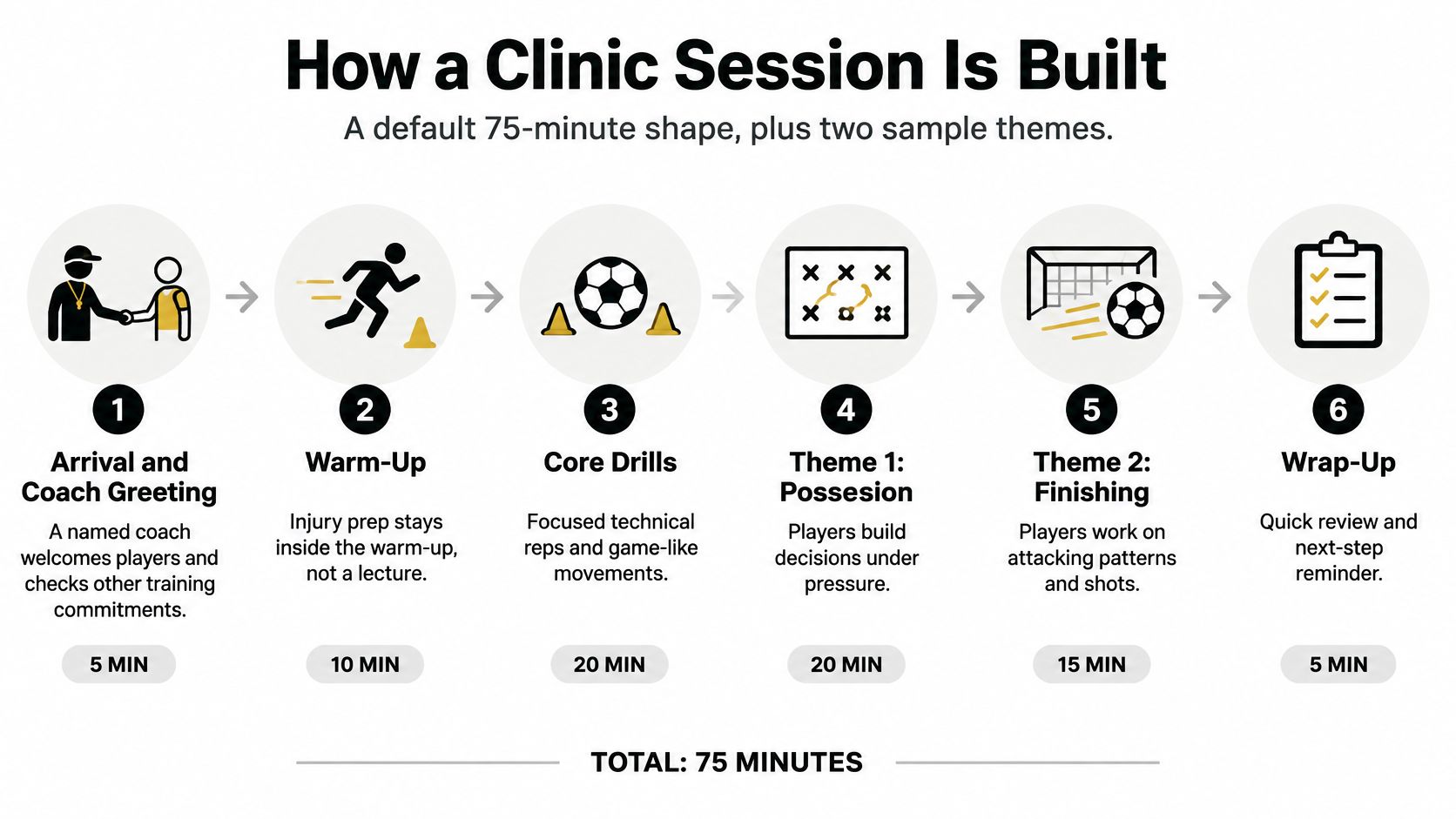
A worked session plan
Arrival and greeting, eight minutes in this example. Check attendance, ask about soreness and other training, and let players settle with the ball. A child shouldn't have to announce an injury in front of the whole group.
Begin a ten-minute ball warm-up with controlled movement, balance, soft landings, and an age-appropriate strength pattern. Demonstrate the movement and watch players perform it rather than assuming they understood.
Build technique for fifteen minutes. Give each player access to a ball where the task allows. For receiving, coach the direction of the first touch and the position of the body, not just whether the ball stopped.
Add opposition for twenty minutes. A defender gives the receiver a reason to look before the pass arrives. Adjust space and pressure so the task challenges players without making success accidental.
Play a small-sided match for twenty minutes. Use a rule that encourages the theme, then reduce interruptions. Players need room to recognize the problem themselves.
Close with two minutes of reflection. Ask what helped and name something to attempt at the next team practice.
These example allocations describe the sequence, not a requirement to continue through unsafe conditions or visible fatigue. Water access and necessary breaks belong throughout the session.
Keep preparation inside the soccer
A Canadian youth-soccer coach survey found that 92.6% of respondents used warm-ups before practices and games, but only 29.8% reported using an injury-prevention program during the previous season; the paper also summarizes earlier evidence linking properly implemented programs with approximately 32% to 65% fewer lower-limb injuries.
A warm-up therefore needs more substance than its name. Coaches should teach movement quality, correct what they see, and repeat a structured progression rather than inventing a novelty exercise every visit.
For a younger-group example, connect first-touch gates, an individual attacking lane, and a small-sided game. Receiving into open space remains the thread throughout. For an older group, connect a shoulder check before receiving, a positional rondo, and a game with a restart that rewards an available passing angle.
Families preparing for outdoor activity can also use HYDAWAY's hydration strategies for better athletic performance as a planning resource. Bring a labeled bottle and confirm how players access refills and breaks rather than relying on a child to interrupt the session.
Safety Checks Before You Enroll
Elite quality includes protecting a player's availability, not just producing a visibly intense session. A child who finishes every activity limping hasn't received better development because the cones carried a professional crest.
Start with questions the staff can answer plainly. A license matters, but so does what the coach does when a player reports pain, struggles with a landing, or arrives tired from another team's tournament.
Parent checklist for a safe clinic
Check | Green flag | Pause if |
|---|---|---|
Coach education | A current coaching course plus recent safety training | Staff cannot explain their preparation or recent education |
Warm-up | Landing, balance, and strength inside the normal start | Jogging and static stretching are the entire preparation |
Ratio | Age-sized groups with an adult supervising each activity | A large station continues beyond the coach's view |
Weekly load | Staff ask about other teams, camps, and tournaments | Extra intensity with no questions |
Girls and ACL risk | The same technical standard, with deceleration coached for everyone | A stereotype lecture or no movement plan |
After an injury | A named contact, concussion awareness, and a return-to-play conversation | Players are told to continue and sort it out later |
The nationwide elite-youth soccer preprint reported 4.4 injuries per 1,000 player-hours for girls versus 3.5 for boys. These findings concern elite youth players and come from a preprint, so they shouldn't be treated as a prediction for your child.
They do support a useful question: how does the coach address movement demands without lowering technical expectations? Look for instruction on controlling a stop, landing with balance, and maintaining technique when the task becomes difficult. Ask whether the staff adapts the activity when fatigue changes how a player moves.
Use this visual checklist when speaking with a clinic organizer.
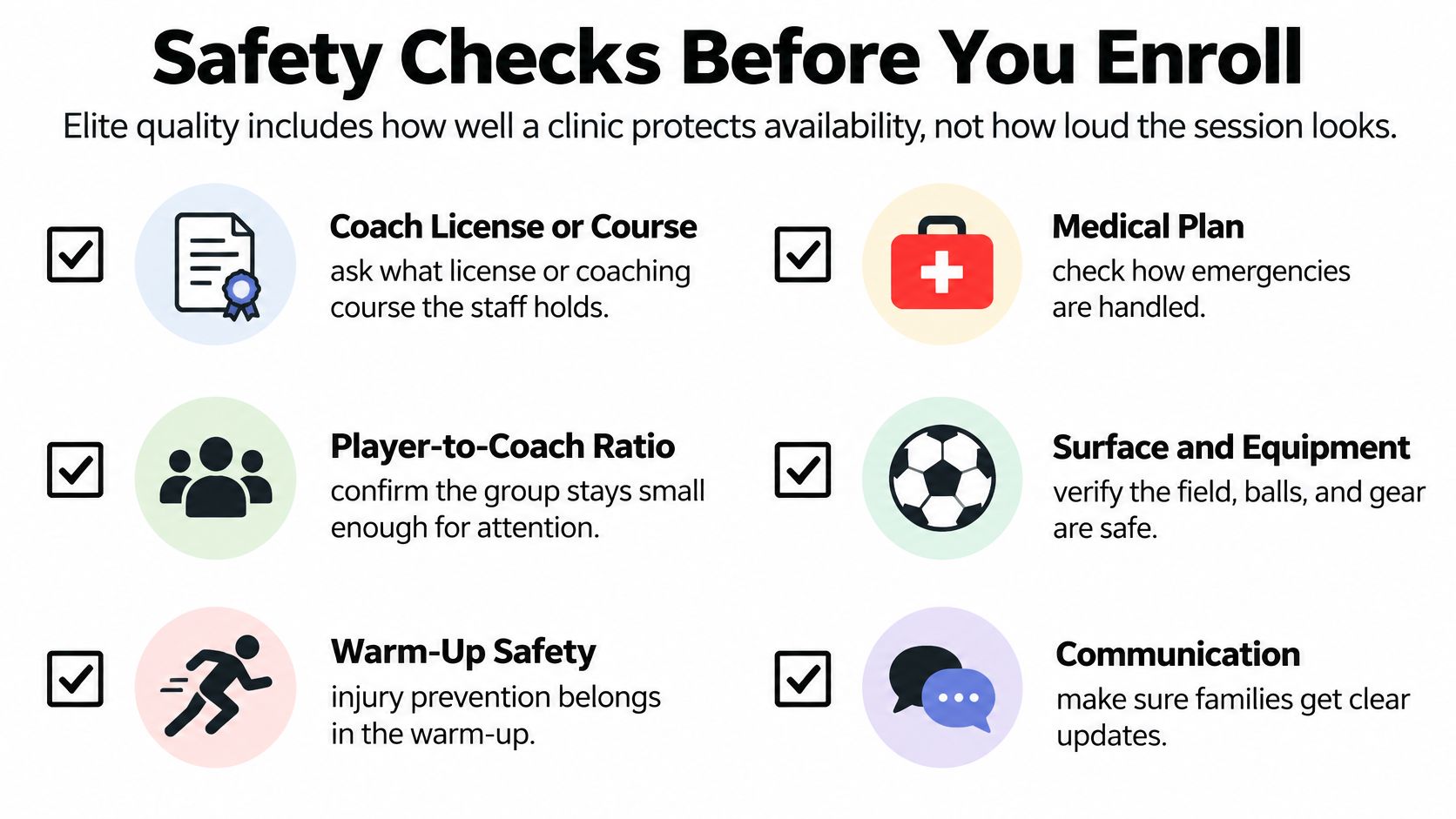
Ask what happens when play stops
A medical plan needs an identified person, an accessible emergency contact, and a clear location for responders. Ask who recognizes a suspected concussion, who removes the player from activity, and how the family receives instructions. A coach shouldn't substitute enthusiasm for an appropriate medical assessment or independently promise that a player is cleared.
Check the surroundings, too. Goals should be secured, the playing area checked for hazards, and equipment appropriate for the activity. For Houston outdoor sessions, ask how staff communicate heat-related changes, lightning interruptions, and pickup arrangements.
Our injury prevention in soccer guide gives families additional context for that conversation. Bring relevant restrictions from a treating clinician and explain what the player is already doing elsewhere.
Registration rule: If staff can't explain the warm-up and the injury call, keep looking.
Real Cost Travel and What to Bring
The registration fee is only the beginning of the calculation. Before paying, make a list of required equipment, clothing, parking, travel, and any optional training offered alongside the event. Don't buy a new kit until you know what's included.
A Boys & Girls Clubs of America summary reports that 32% of youth soccer players identify expensive team fees as a major participation barrier, rising to 41% among low-income families. That describes a broader participation problem, not a price estimate for a Houston clinic.
Compare the whole journey
Say a nearby session costs more to register for than a clinic across the metro. Once you include fuel, parking, missed work, and another child's pickup, the nearby option may place less strain on the family. Test the journey at the actual travel time, not just on an empty-road map.
Our soccer academy fees guide can help you organize cost questions. Confirm the current fee and dated calendar for your chosen clinic, including whether clothing, equipment, tournament entries, or additional private instruction are included, optional, or irrelevant to that format.
Practice sites to compare for travel
These are academy locations to check against the specific event confirmation, not a promise that every clinic runs at each site.
Site | Address | Use for |
|---|---|---|
Fall Creek Sports Complex | 9810 Wyatt Shores Dr, Humble, TX | Academy fields for families on Houston's north side |
United City Church fields | 19901 Townsen Blvd, Humble, TX 77338 | Academy field site in Humble |
JC Sports Houston | Confirm the street address on the event confirmation | Video analysis and performance sessions |
Ask about scholarships, payment plans, equipment lending, and carpool coordination without assuming they're available. Families who need translated communication or disability-related accommodations should describe the practical support their child needs and request a clear answer before paying.
A small, organized bag helps make departure less stressful.
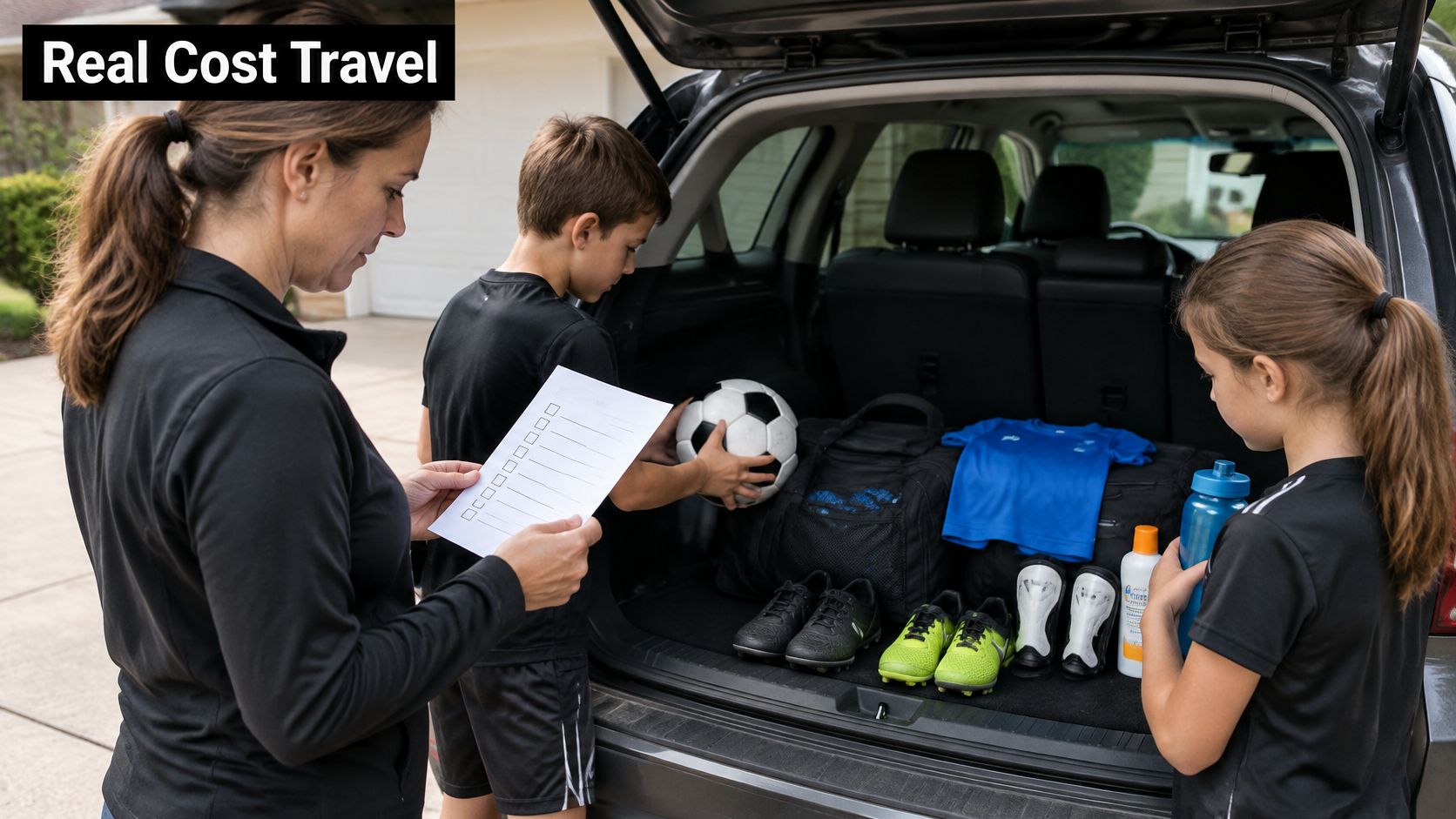
Playing essentials: Pack shin guards, suitable socks, and the footwear confirmed for the surface. Bring both cleats and turf shoes only if the venue instructions call for them.
Weather and comfort: Add labeled water, sunscreen, a light layer, and a backup shirt.
Medical information: Bring any prescribed inhaler and relevant written instructions, and tell the designated staff member where they are.
Access is real when time, money, a ride, and belonging are all solvable. An open registration form alone doesn't answer those questions.
The Villarreal Houston Development Path
Say a local player joins a session and learns to look over a shoulder before receiving. Later, that small action helps them escape pressure in a match. The meaningful development story begins there, not with a promise of a flight to Spain.
At Villarreal Houston Academy, we're the official partner academy of Villarreal CF. Our mission is age-appropriate training with qualified coaches so local youth talent can play at its fullest potential.
The longer journey should follow a player's readiness, not a marketing timetable.
Method before destination
Our coaches learn the Villarreal CF methodology and work side by side with Villarreal CF sports psychologists. They're expected to engage players, communicate positively, and influence how young people approach challenges on and off the field.
In practical terms, a parent should look beyond whether a player can execute a move. Does the player recognize when it's useful? Can they respond to a mistake, listen to feedback, and treat a teammate respectfully? Intelligence, skill, and character belong in the same development conversation.
In the player's next stage, regular team training provides repeated opportunities to apply the clinic lesson. Receiving under pressure becomes part of building an attack. Personal responsibility might mean arriving prepared, discussing discomfort, or accepting a correction without blaming a teammate.
The video offers another way to explore the academy environment.
Keep bigger stages in perspective
Our select and competitive programming serves boys and girls from age 4 upward, with clinics and camps alongside teams across North Houston, including Humble, Fall Creek, Cypress, Tomball, and the Kingwood, Porter, and New Caney area.
Players have opportunities to visit Villarreal CF in Spain, train at the Ciudad Deportiva and Pamesa Training Ground, and play alongside elite academy teams. That possibility shouldn't be confused with an automatic outcome of enrolling in a clinic. Families should discuss the requirements and terms of any opportunity separately.
Watching senior soccer can also become a learning activity rather than a scouting fantasy. Fubo News' Villarreal vs Espanyol live updates provide a match resource families can use to follow play and discuss decisions, without treating professional actions as immediate expectations for children.
Choose the pathway because its teaching approach fits your player. The destination matters less than what the child learns to do, understand, and take responsibility for along the way.
Frequently Asked Questions and Next Steps
Does submitting a form mean my child is accepted?
No. Submitting a registration doesn't guarantee acceptance. The club may accept, deny, suspend, or terminate a player's or family's participation at its sole discretion.
Is there a credit for a missed session?
No. Missed practices, games, training sessions, camps, tournaments, or events don't result in credits or financial adjustments. Check your family calendar before committing.
Is a trip to Spain automatic?
No. International training is a potential development opportunity, not an automatic clinic entitlement. Request the specific selection requirements, arrangements, and costs before making travel assumptions.
How do I register?
Choose the fit. Identify the format and player group that suit your child's experience.
Ask the safety questions and explain existing training commitments or medical restrictions.
Confirm the commitment. Get the current all-in fee, dated schedule, location, and participation policies.
Ask about financial assistance, transport coordination, equipment support, and translated communication.
Submit the registration form through the academy website after reviewing the answers.
Make the conversation specific: give your child's birth year, current team commitments, and the skill they want to improve. Ask which current clinic fits, and confirm acceptance procedures before making plans at 281-962-4920.
Villarreal Houston Academy offers age-appropriate clinics, camps, and team development grounded in Villarreal CF methodology. Visit Villarreal Houston Academy to find a suitable next step, then contact us to confirm the coaching focus, safety arrangements, location, and full family commitment before registering.
Comments