


Soccer Speed Training Program: Age-by-Age Weekly Plan

Your player chases a through ball, gets level with the defender, then loses ground. At the next practice, they fly through an agility ladder but still struggle to create separation on Saturday. Before adding more running, identify what's missing: the start, the longer sprint, the turn, or the decision.
A useful soccer speed training program matches that problem to the player's age, growth stage, position, and existing workload. The schedules below are worked coaching examples, not universal prescriptions. Start conservatively, measure consistently, and change the session when the player's movement or recovery tells you to.
Age-by-Age Speed Sessions at a Glance
Age group | Sessions per week | Acceleration work | Sprint work | Rest between reps | Main focus |
|---|---|---|---|---|---|
U6 to U8 | 1 to 2 | Tag and relay races of 5 to 10 m | No timed sprints | Play-based, no fixed rest | Coordination and play |
U9 to U10 | 2 | 4 to 6 accelerations of 10 m | 2 to 4 sprints of 15 m | About 60 seconds, longer if needed | Wall-drill mechanics and 1v1 races |
U11 to U12 | 2 | 4 to 6 accelerations of 10 to 15 m | 4 to 6 sprints of 20 m | 60 to 90 seconds | Mechanics and sprints with the ball |
U13 to U14 | 2 | 4 to 6 accelerations of 10 to 15 m | 4 to 8 sprints of 20 m and 2 to 4 of 30 m | 90 seconds to 2 minutes | Acceleration, reactive starts, maturation check |
U15 to U16 | 2 | 4 accelerations of 10 m | 6 to 8 sprints of 20 to 30 m | 2 to 3 minutes | Building toward maximum velocity and reactive changes of direction |
U17 to U18 | 2 | 4 accelerations of 10 m | 6 to 10 sprints of 20 to 40 m | 2 to 3 minutes | Repeated-sprint preparation and position-specific runs |
Treat this example table as a menu of starting volumes. The acceleration column includes progressive preparation, not another full block of maximal efforts, and the older groups shouldn't automatically complete every listed option.
A 2025 systematic review and meta-analysis covering 346 soccer players found a moderate positive sprint-speed effect from speed, agility, and quickness training, but substantial variation between programs. That supports structured practice, not promises that every player will improve by the same amount.
Start with movement, then add structure
U6 to U8 players need space to chase, escape, stop, and restart. Change the tag game when attention fades rather than asking children to finish a formal sprint set.
For U9 to U10, wall drills introduce a forward acceleration position without complicated instructions. Follow them with short races between well-matched partners, leaving enough recovery that the next race looks sharp.
At U11 to U12, separate running technique from ball control initially. Then introduce a sprint onto a pass so players learn to arrive quickly without losing their first touch.
Let maturity influence the older groups
For U13 to U14, inspect how the player moves that day. A player who suddenly looks awkward during a growth phase may need simpler starts and fewer demanding turns, not more correction shouted at full speed.
At U15 to U16, longer recoveries allow deliberate exposure to faster running. A short runway won't necessarily let every player reach maximum velocity, so don't label every sprint a top-speed effort.
For U17 to U18, choose runs that fit the role and match calendar. Repeated-sprint preparation belongs in a planned conditioning component, while pure speed work needs enough rest to preserve output.
Session check: Finish with the player still moving quickly and cleanly, not grinding through the final efforts.
Four Kinds of Speed Your Player Needs
Speed quality | Game moment | Training method | Positions to prioritize |
|---|---|---|---|
Linear top speed | Running onto a through ball | Longer straight runs with full recovery | Wingers, strikers, fullbacks |
Acceleration | Winning the opening steps toward a loose ball | Short starts from standing and varied set positions | Midfielders, strikers |
Planned change of direction | Cutting around a known pattern | Timed turning drills, such as the 5-0-5 or T-test | Midfielders, centre-backs |
Braking and curved running | Stopping to receive or bending a recovery run | Controlled decelerations and curved sprints | Centre-backs, wide players |
Reactive agility | Responding to an opponent's movement | Partner-cued or ball-cued starts | All outfield players |
The position column gives priorities, not exclusions. A fullback still needs braking control, and a centre-back still needs longer recovery runs when the defensive line gets exposed.
The first four qualities describe how the player moves. Reactive agility adds an external decision, which makes it different from following a memorized cone pattern.
A youth-soccer study on fixed reactive-skills training found improvements in agility and change-of-direction speed, with limited effects on reaction time and linear sprint speed. Don't assume that improving one drill means every form of match speed has improved.
Diagnose the lost ground
Say a winger starts level with a fullback but falls behind as the chase opens up. Prioritize longer, fully recovered runs, then add starts triggered by a defender's movement.
A centre-back presents a different problem when they arrive quickly but overrun the attacker. Coach braking, body position, and the exit step before adding another straight sprint.
Use these distinctions when choosing agility drills for soccer players. Ladder work can rehearse rhythm and foot placement, but it doesn't automatically teach a player to brake under pressure or recognize a passing cue.
For a practical match review, watch a small sample of clear actions and classify the failure:
At the start: Did the player react late, or react promptly but struggle to accelerate?
At the turn: Did they approach too fast, plant awkwardly, or need extra steps?
In open space: Did they lose ground once both players were running?
At the decision: Did they follow the wrong cue despite moving well?
Choose the training method that addresses the actual problem. Don't prescribe more physical work when the player mainly needs to scan earlier or recognize the opponent's touch.
Test Speed Before You Build the Plan
Test | What it measures | How to run it | Retest interval |
|---|---|---|---|
Short sprint | Initial acceleration | Timing gates, standing start, consistent start mark | At the planned review |
Intermediate sprint | Early acceleration | Same setup, surface, footwear conditions, and recovery | At the planned review |
Longer sprint | Acceleration into faster running | Same start procedure and unobstructed run-out | At the planned review |
Planned change of direction | Pre-planned turn speed | Fixed approach, marked turning line, same plant-leg rules | At the planned review |
Reactive change of direction | Movement response to a signal | Coach gives an unpredictable directional cue using a fixed procedure | At the planned review |
For a worked baseline, use 5 m, 10 m, and 20 m sprints, a 5-0-5 turn, and a coach-cued directional sprint. Record the best of two clean attempts, then schedule the same battery every four to six weeks; these are practical protocol choices, not performance standards.
A 2024 soccer-training study reported 5 m improvements of 9.2% after short-distance training and 10.5% after longer-distance training. Those are results from that intervention, not targets to promise an individual child.
Protect the comparison
Use electronic timing gates where available. Keep the start mark behind the beam and don't allow rocking starts in one session but static starts in another.
Keep the surface, time of day, footwear category, warm-up, and recovery procedure consistent. Use the same tester and cueing procedure, especially for reactive tests, where a different signal can change the task.
For the planned turn, record which leg plants and whether the player reaches the line correctly. For the reactive test, separate a wrong-direction response from a technically valid but slower effort.
A smaller number is useful only when the player completed the same task under comparable conditions.
Don't treat a small hand-timed improvement as proof of adaptation. Stopwatch reaction error, a different start posture, or a firmer surface can make an apparent gain difficult to interpret.
Use a shared sheet with columns for the test, result, conditions, movement notes, and recent workload. Families should see a trend alongside the context, not a ranking based on a single afternoon.
For younger children, keep assessment playful until they can understand and repeat the procedure. A cheerful chase game is more useful than a formal result produced by confusion about when to start.
How to Run a Speed Block Step by Step
Organize the preparation before players arrive so the warm-up leads directly into coached movement.
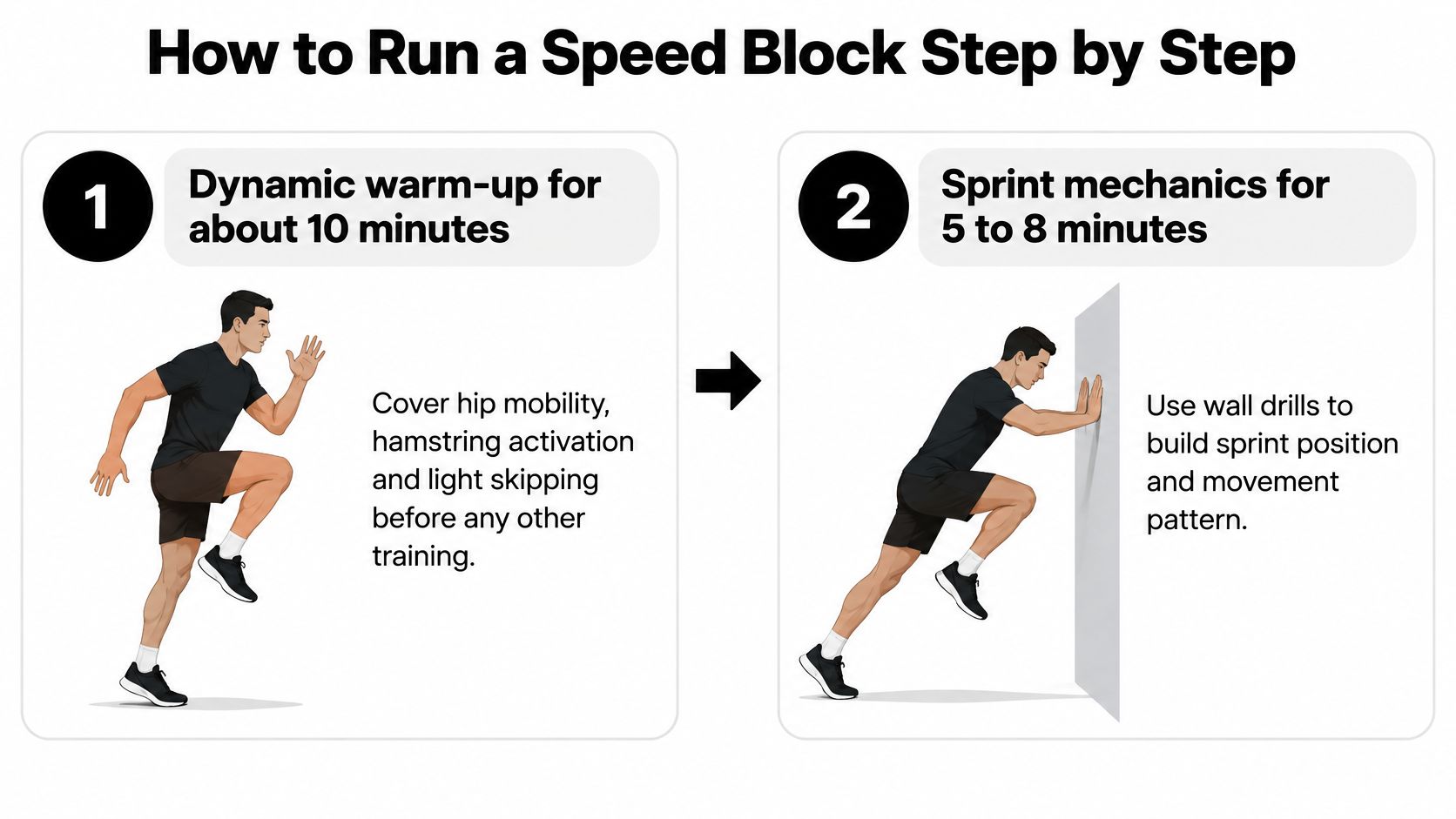
Prepare, accelerate, then protect quality
Begin with a dynamic warm-up. Move from easy locomotion into hip mobility, controlled hamstring activation, skipping, and changes of direction. Don't use exhausting shuttle runs as preparation; the player should become ready to move faster, not tired before starting.
Use wall drills to rehearse acceleration posture, then ankling, A-marching, and A-skipping for rhythm and coordinated arm action. Give one correction at a time rather than turning every repetition into a lecture.
Build speed progressively. Start with controlled accelerations and increase intent only when posture and foot contact remain organized. The common mistake is asking for an all-out race before the player has rehearsed the movement comfortably.
Choose the main runs from the player's age and readiness level. The soccer-specific sprint intervention and practical guidance describes 4 to 10 repetitions over 20 to 40 m, with repeated-sprint protocols using 15 to 30 seconds between repetitions and 1 to 10 minutes between sets; that short recovery structure isn't interchangeable with fully recovered maximum-speed training.
Time the efforts and watch the movement. Stop or extend recovery when a repetition deteriorates materially, using roughly a 3% to 5% slowdown as the practical threshold described in that intervention guidance. Don't push through declining output because unused cones remain on the field.
Finish the block with easy walking and a brief check-in. If the session continues into technical practice, use a calm transition rather than a lengthy cooldown that leaves players standing around.
Use the soccer warm-up exercises to choose preparation movements the group can perform correctly. A simpler warm-up delivered consistently is preferable to an elaborate sequence players can't follow.
The movement demonstration can help coaches explain the preparation before asking players to increase intensity.
Fit the block into team practice
Place the main speed work after preparation and before demanding tactical games or conditioning. Keep a clear run-out area and organize waiting players away from the sprint lane.
For the youngest group, replace the formal main set with tag and relays. Developing players can retain mechanics and short accelerations, while older, prepared players can use longer near-maximal runs with fuller recovery.
When mapping these transitions, coaches can explore session design for coaches from TFA Tactics Board. Plan the equipment, waiting areas, and next activity together so a useful speed block doesn't become a queue of cooling players.
Eight-Week Progression and Volume Cuts
The following is a hypothetical U13 to U14 progression for a player who's healthy, technically ready, and recovering normally. The listed work is the session's main running dose, not an addition to every sprint option in the age table.
Week | Focus | Sprints per session | Distance | Rest between reps |
|---|---|---|---|---|
Weeks 1 to 2 | Mechanics and accelerations | 4 | 10 to 15 m | 45 seconds, extended whenever quality requires |
Weeks 3 to 4 | Acceleration into longer sprints | 6 | 20 m | 90 seconds |
Weeks 5 to 6 | Sprints plus reactive starts | 6 to 8 total | 20 m | 90 seconds |
Week 7 | Exposure to faster running | 4 to 6 | 30 m | 2 minutes |
Week 8 | Retest | Testing battery | Per test | Full recovery |
Progress when the player earns it
During the opening phase, coach a forward projection on acceleration without asking the player to fold at the waist. Use the shorter recovery only while the efforts remain controlled; lengthen it as intent rises.
Before increasing the workload, check whether the player can repeat the movement without reaching forward excessively or losing arm rhythm. If not, keep the current dose and improve execution.
In the next phase, extend the run before making the drill more complicated. The player should have room to accelerate and a safe run-out, rather than needing to brake abruptly at the finish cone.
Introduce the reactive cue within the existing total, not as an extra block afterward. A moving partner or the direction of a pass gives the player something meaningful to read, but the coach should still be able to identify whether an error came from the decision or the movement.
For the longer-running phase, don't force a player to chase top speed while their mechanics are unsettled. Keep the shorter distance if they're struggling with coordination, and avoid assuming that a longer sprint automatically produces the intended stimulus.
Use retesting to decide the next emphasis. Better turning with unchanged straight-line performance calls for a different response than improvement across the sprint tests.
Make a weekly recovery decision
A study of youth-soccer speed profiles and training load supports individualized planning around sprint exposure and development rather than assuming that more running always produces better speed. Treat accumulated distance as something to monitor, not a quota to fill regardless of readiness.
Keep a weekly log covering:
Growth and coordination: Note recent changes in movement, balance, and comfort in familiar drills.
Soreness: Record location, whether it changes running, and whether it persists between sessions.
School and sleep: Include exams, late nights, travel, and unusual fatigue.
Heat exposure: Note how the player feels and recovers, not merely whether practice went ahead.
Match demands: Record minutes, demanding recovery runs, and tournament congestion.
Attendance: Don't jump to the current progression after missed training.
For this worked example, if several recovery concerns appear together, remove roughly a third of the planned main efforts and retain low-fatigue skill work. That's a conservative coaching adjustment, not a validated medical cutoff.
A tournament-heavy weekend should change the following week's plan before the player arrives exhausted. Keep a full recovery day between hard speed exposures in this example, and don't use the calendar as permission to train hard when the player still isn't ready.
Reduce the demand, not the communication. Explain what changed and what the player can still practice successfully.
Know when speed work should stop
Pain, limping, a sudden pulling sensation, dizziness, or unusual distress means stopping the activity, not substituting another demanding drill. Persistent or recurring symptoms warrant assessment by an appropriate healthcare professional.
For a pain-free player who's moving awkwardly, use low-intensity mechanics or technical ball work. Cue tall posture during upright running, a firm ankle at contact, controlled hips over the support foot when braking, and eyes up before the signal.
At Villarreal Houston Academy, our coaches are meant to engage players, communicate positively, and help them find their best on and off the field. That includes explaining a reduced session without making a young player feel that reporting fatigue is a failure.
Plan Your Player's Speed Block This Week
For a hypothetical U13 player with school, club practice, and a Saturday match, use this calendar. Coordinate it with the team's weekly soccer training schedule rather than adding private sprint work on top.
Day | Example plan |
|---|---|
Monday | Light mechanics; move baseline testing to a fresh session |
Tuesday | Speed block after the warm-up, then technical and tactical work |
Wednesday | Recovery or ordinary low-demand activity |
Thursday | Technical session with brief reactive starts, no extra straight-sprint block |
Friday | Rest or the team's light match preparation |
Saturday | Match |
Sunday | Full rest |
Don't schedule a demanding baseline battery immediately before the main hard session just to tick both boxes. Testing is a physical exposure too, so replace training with it when necessary.
Put the plan on one calendar
Choose the starting dose. Select the age band, then reduce it if growth, soreness, or team workload makes the full example inappropriate.
Establish the baseline. Run the sprint and turning tests when the player is fresh, with consistent equipment and procedures.
Book the review. Put the next assessment on the same calendar as training, matches, school demands, and recovery.
For a younger player, substitute short accelerations and partner races for the longer Tuesday runs. For an older player, use the longer-running options only when preparation and recovery support them.
If the week already contains demanding matches, retain a brief quality exposure and make the other session mechanics-focused. Bring the baseline sheet to the coach so the plan supports team training instead of creating another hard day.
Our development path emphasizes competing at full potential with respect, integrity, and personal responsibility. Reporting soreness truthfully and following the agreed workload are part of that responsibility.
Villarreal Houston Academy offers select and competitive youth soccer programs for boys and girls as young as 4 years old, with age-appropriate development rather than a single routine for everyone. Visit Villarreal Houston Academy to explore the programs and discuss how your player's speed goals can fit their broader soccer development.
Comments