


8 Agility Drills for Soccer Players

A winger receives the ball near the touchline. Pressure arrives from behind, the player brakes, checks the defender's position, cuts into open space, and accelerates away before choosing a pass. That sequence demands much more than fast feet. Useful soccer agility combines balance, deceleration, coordination, reaction, ball control, and decision-making.
The best agility drills for soccer players follow that same progression. Players first learn to control their feet and body, then change direction efficiently, respond to a cue, move with the ball, and solve a live game problem. The eight drills below build those qualities step by step, with adjustments for players from ages 4–18, practical safety guidance, simple ways to measure progress, and examples of how Villarreal Houston Academy can place agility inside a broader technical and tactical pathway.
Before intense movement, use a progressive warm-up with dynamic mobility and gradual acceleration. The warm-up tips from MEDISTIK can help families and coaches prepare players for training without treating stretching as a substitute for movement quality.
1. Ladder Drills
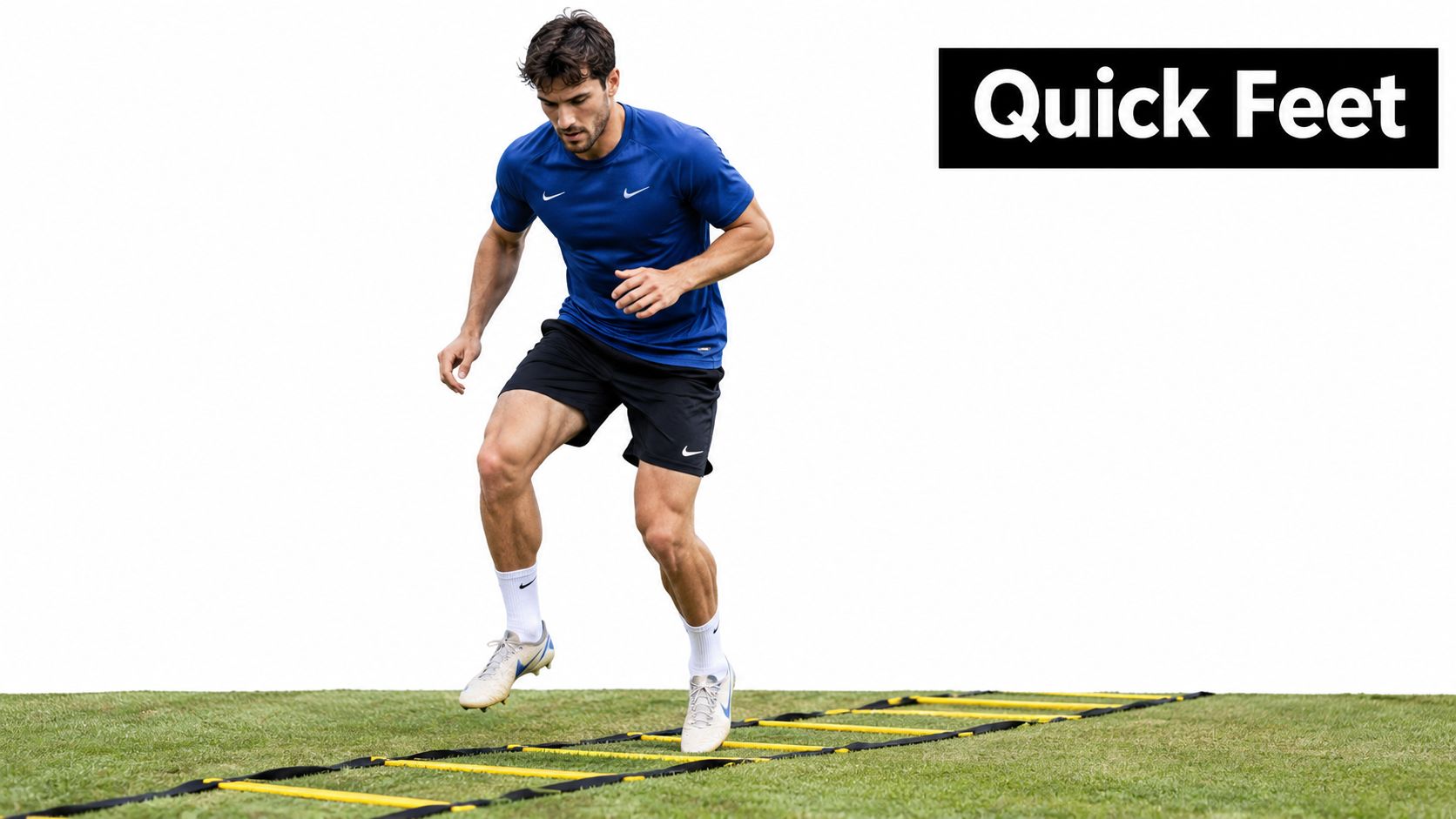
An agility ladder gives young players a clear movement map. They learn to place each foot accurately, keep their balance while stepping quickly, and control their body in a confined space. Those qualities matter when a midfielder receives the ball in traffic or a defender adjusts position without crossing their feet.
Start with a single-step pattern, placing one foot in each square. Progress to two feet per square, lateral steps, in-and-out movements, and controlled crossover steps. The player should stay tall through the trunk, bend slightly at the knees, and look up whenever possible. Speed comes after accuracy.
Build the pattern before adding pressure
A player who rushes and clips the ladder hasn't developed useful quickness. Begin slowly, then increase rhythm while keeping the feet quiet and the steps consistent. Perform the drill early in practice, when players can concentrate on coordination rather than trying to correct tired movement.
A short ladder block can work as part of a warm-up or as one station in a larger circuit. The SoccerWares agility equipment guide offers context on equipment selection, but the ladder itself doesn't create agility. The coach must connect the footwork to soccer actions.
Ages 4–6: Use walking patterns, colors, and simple challenges such as “one foot in every square.”
Ages 7–11: Add lateral patterns and a short dribble immediately after the ladder.
Ages 12–15: Use more complex patterns, then require a pass or directional turn.
Ages 16–18: Reduce instruction time and add a visual cue, opponent, or ball action after the final step.
2. Cone Weaving and Figure-8 Drills
Cone weaving teaches players to enter a turn under control, shift their center of gravity, and leave the turn with purpose. A straight weave is useful for learning repeated cuts. A figure-8 adds a different challenge because the player must alternate the direction of the turn and adjust the body angle continuously.
Set up a short line of cones for beginners, leaving enough space for the player to slow down before each change of direction. The player can run through the pattern first, then repeat it while dribbling. That separation matters. Coaches can see whether a movement problem comes from poor agility mechanics, poor ball control, or both.
Coach the brake, not just the turn
Players often focus on reaching the next cone as quickly as possible. Ask them to lower their hips before the cut, shorten the final steps, plant under control, and push away from the outside leg. The goal isn't to make every turn dramatic. Soccer players frequently make smaller, sharper adjustments while preserving balance.
Use forward, lateral, and backward variations when the player has mastered the basic pattern. A simple competitive format can keep younger players engaged, but don't turn every repetition into a race. A rushed player may win a drill while reinforcing poor posture or a wide, unstable plant.
Practical rule: If a player can't control the deceleration, the pattern is too fast or too difficult.
For ages 4–6, use large gates and playful routes. Ages 7–11 can add the ball and both-footed turns. Ages 12–15 can respond to a coach's direction at selected cones. Older players should finish with a pass, shot, or escape action so the cut has a football purpose.
3. T-Drill
The T-drill gives a player a simple four-direction route. From the starting point, the player moves forward to the top of the T, shuffles across one side, returns through the center, shuffles to the other side, comes back to the middle, and moves backward to the start.
That sequence exposes common weaknesses. Some players sprint well but lose alignment during lateral movement. Others can shuffle smoothly but struggle to brake before changing direction. A coach can use the drill as a teaching exercise first, then as a repeatable assessment when the player understands the route.
Make body position the priority
Players should keep their hips low, chest controlled, and feet active during the shuffle. They shouldn't turn the drill into a series of crossed steps unless the coach deliberately wants to teach a crossover variation. On the backward movement, encourage short, controlled steps and frequent visual awareness rather than reckless speed.
For younger children, remove the timing element and use the T as a movement story. Run forward to the “top,” travel to a colored cone, return to the “middle,” and finish with a backpedal. Ages 10 and older can learn the complete sequence, but the coach should still teach deceleration before asking for maximum effort.
A practical progression looks like this:
First stage: Walk the route and name each direction.
Second stage: Move at moderate speed while preserving posture.
Third stage: Add a ball at the finish, such as a pass or first touch.
Advanced stage: Have a coach call the finishing action after the final movement.
The T-drill isn't a match by itself. It becomes more relevant when the player must recognize a cue, receive the ball, or defend a target immediately after completing the movement.
4. 5-10-5 Shuttle Run
The 5-10-5 shuttle run concentrates on the moment many players mishandle, the plant and cut. The player starts at the middle, moves to one side, crosses beyond the start to the opposite side, and returns to the center. The route rewards efficient braking, a stable plant, and a forceful first step away from the turn.
Use a thorough dynamic warm-up before this drill. Players should practice progressive accelerations, low-speed cuts, and the complete pattern without racing. The coach can then observe whether the player reaches the line with control or arrives too upright and has to take extra steps.
Keep testing separate from conditioning
This is a high-intensity assessment-style drill, not a movement pattern to repeat without thought. Give the player enough recovery to preserve technical quality, and stop the set if fatigue changes the plant, knee position, or trunk control. A coach should record the result only when the route and starting position are consistent.
For ages 4–8, replace the full shuttle with short races between colored gates. Ages 9–12 can learn the route with broad turning zones. Older players can use the full pattern as an occasional benchmark, then connect it to a soccer action such as closing down a receiver or escaping pressure.
The soccer conditioning programs at Villarreal Houston Academy show how conditioning can include movement circuits, short accelerations, and change-of-direction work. That connection matters because agility shouldn't sit apart from the player's technical and physical development.
Track more than the final time. Note whether the player lowers the body before the cut, plants securely, keeps the steps economical, and accelerates in the intended direction.
5. Reactive Agility Drills
A planned route tells the player where to go. A match rarely does. Reactive agility adds a coach's point, a colored signal, a whistle pattern, a pass, or an opponent's movement so the player must perceive information and choose a response.
Start with a simple setup. The player stands in a balanced defensive position while the coach points left or right. The player reacts, moves through a gate, and returns to the starting area. Once the player can respond without losing body control, add a ball, a second possible direction, or a decision to press, contain, or recover.
Teach the first decision
The quickest player can still make a poor defensive choice. Ask the player to identify what triggered the movement, keep the head available for information, and avoid committing before the cue appears. In attacking situations, the cue might be the defender's weight shift. In defending, it might be the ball carrier's touch or the movement of a supporting runner.
For younger players, use colors, names, or playful commands. Players ages 7–11 can react to a coach's point and then dribble through the chosen gate. Ages 12–15 can respond to a live passer or teammate. Older players can begin in realistic positions and finish with a tackle action, pass, shot, or transition run.
Keep reactive blocks short enough that concentration stays high. Give feedback on both decision quality and movement execution. A player who reacts slightly later but chooses the correct option may be learning more than a player who sprints instantly in the wrong direction.
The following video can help coaches visualize a reaction-based movement format:
6. Zigzag Dribbling and Ball Mastery Courses
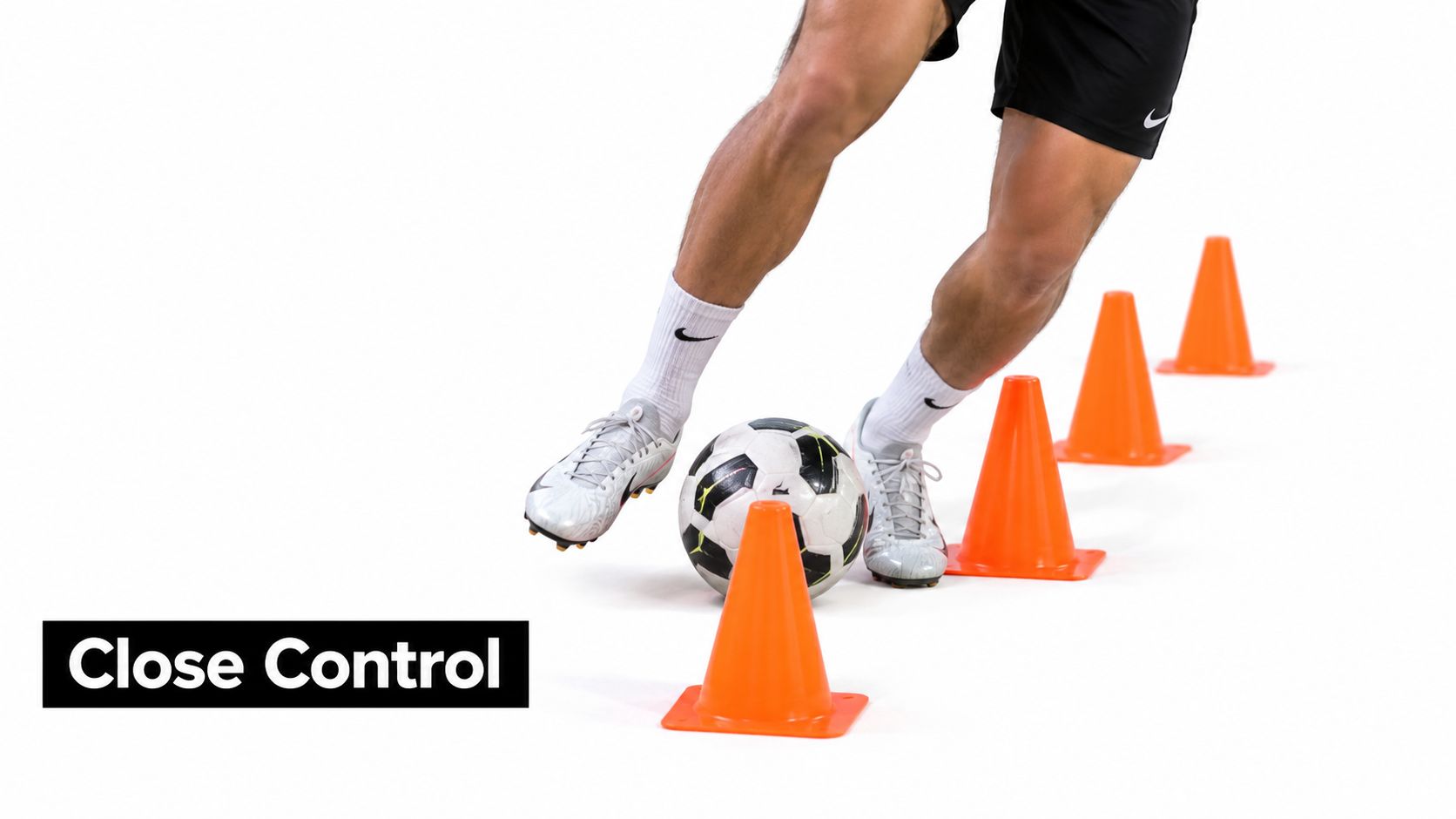
Zigzag dribbling turns a change of direction into a technical problem. The player must approach a cone, protect the ball, select a surface of the foot, turn away from the imagined defender, and accelerate into the next space. The drill develops agility only when the ball stays connected to the player's movement.
Begin with wide routes and a controlled pace. Ask the player to use the inside of one foot, the outside of the other, the sole, and changes of direction with both feet. A younger player may need to stop the ball and reset. That's acceptable during the learning stage. Control should come before speed.
Add pressure without losing technique
As players improve, narrow the route or add a time challenge. Don't force a faster pace if the ball rolls several steps away after every turn. The player should keep the final touch before the cut close enough to allow a balanced plant, then take the next touch into space rather than directly toward the cone.
A useful progression includes:
Ball-free rehearsal: Run the route and practice the body angle.
Controlled dribble: Use small touches and complete each turn cleanly.
Speed dribble: Increase the approach speed while preserving the final setup touch.
Decision finish: Add a defender, a passing target, or a shot after the last cone.
For ages 4–6, use large targets and let players explore different surfaces. Ages 7–11 can work on both feet and simple feints. Ages 12–15 can combine the course with a passive defender. Ages 16–18 should perform the movement under realistic pressure and choose the exit based on the defender's position.
The soccer dribbling techniques from Villarreal Houston Academy fit this principle, because close control becomes more valuable when it helps a player escape pressure or create the next action.
7. Lateral Bound and Hop Series
Lateral hops and bounds develop the ability to produce and absorb force from side to side. That quality supports a defender's adjustment steps, a midfielder's transition movement, and an attacker's explosive cut. Unlike a ladder, this drill asks the player to manage landing stability before producing the next movement.
Start with small two-foot hops over a line. Progress to single-leg hops only when the player can land with control, with the knee aligned over the foot. A lateral bound should finish with a controlled landing, not a collapse or an uncontrolled extra step.
Use plyometrics at the right stage
Young children can develop balance through low-level hopping games, skipping, and landing shapes. More demanding plyometric work requires a suitable strength and coordination foundation. For adolescent players, a coach can introduce lateral hops, then bounds, while monitoring surface, footwear, landing quality, and fatigue.
A 2024 systematic review of plyometric training in male football players concluded that a focused program using two sessions per week over a 6–9 week period, with maximum-intensity multidirectional exercises, was sufficient to improve change-of-direction speed. The review also found that adding another training method wasn't necessarily better when total load stayed unchanged, as reported in the PLOS ONE review. The practical lesson is clear: quality and progression matter more than stacking exercises.
Keep the volume modest and place this work early in training, after the warm-up. Stop when landings become noisy, the knee collapses inward, or the player loses control. Strength work, balance exercises, and gradual exposure should support the movement rather than compete with it.
8. Game-Based Agility Circuits and Small-Sided Games
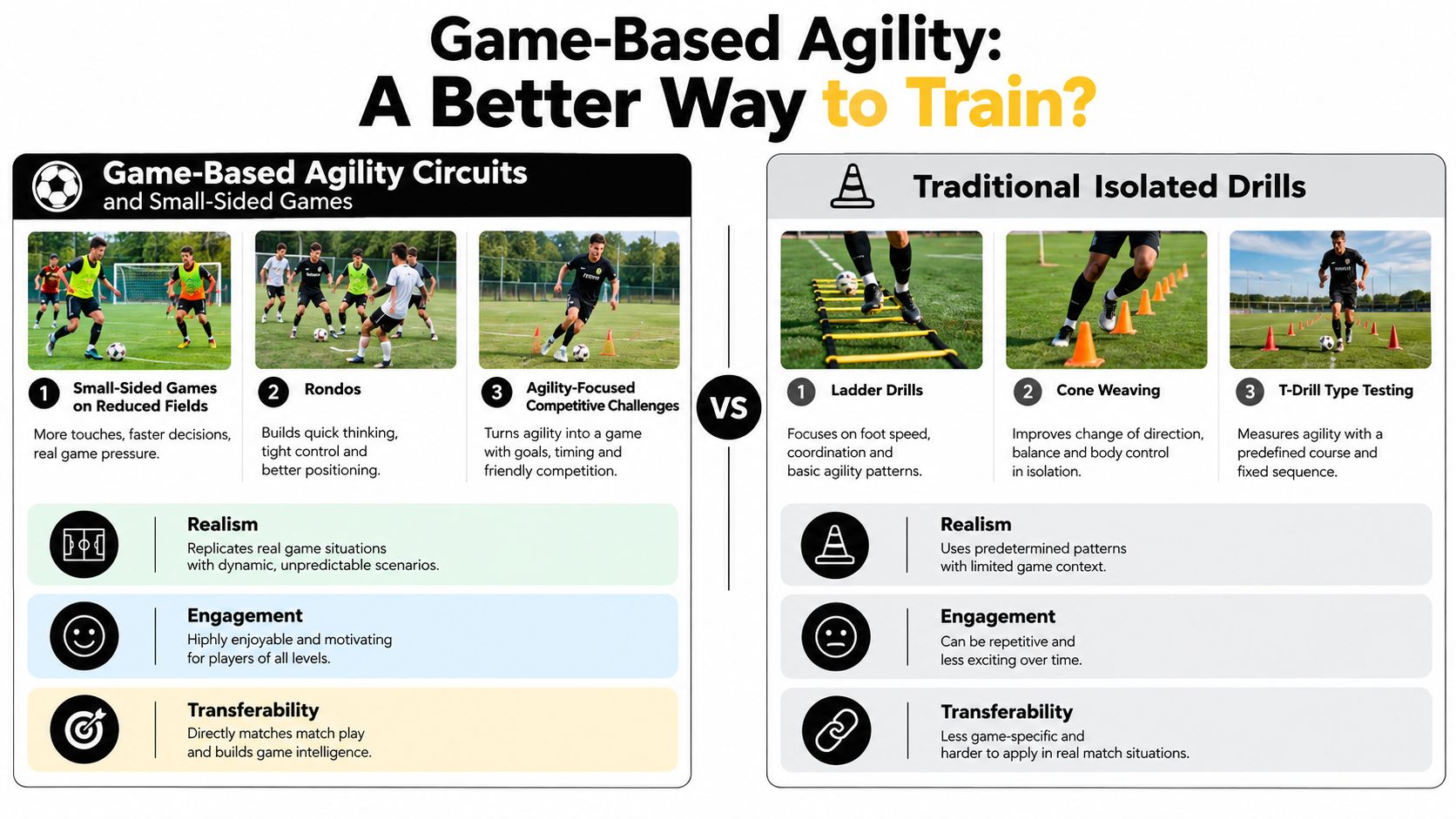
The final step places agility inside soccer. A small-sided game forces the player to scan, react, change direction, protect the ball, close space, and make a decision while teammates and opponents move. That combination is closer to match demands than a route where the next cone is always predictable.
Use a reduced playing area and a small group so every player gets frequent involvement. A coach might award a point for receiving across the body and escaping pressure, reward a defensive recovery after losing possession, or require a quick transition after a turnover. The rule should encourage the desired behavior without turning the game into a mechanical test.
Change the problem, not just the pace
For ages 4–6, use directional games with large spaces, simple targets, and playful chasing. Ages 7–11 can play small possession games with clear boundaries. Ages 12–15 can work on pressing, support angles, and transition decisions. Ages 16–18 can handle more tactical constraints, position-specific responsibilities, and competitive scenarios.
A 2025 youth-soccer study found that fixed-role small-sided games improved agility and change-of-direction speed with and without the ball, but had limited impact on reaction time and linear sprint speed. That finding supports a balanced program. Game-based work can improve movement in context, but coaches should still include targeted reaction and acceleration exercises when those qualities need attention. The small-sided soccer games guidance from Villarreal Houston Academy provides a relevant framework for connecting technical actions with tactical decisions.
Finish with a short reflection. Ask players what cue they saw, why they changed direction, and how their movement helped the next pass or defensive action.
8 Soccer Agility Drills, Side-by-Side Comparison
Drill | 🔄 Implementation Complexity | Resources | 📊 Expected Outcomes | ⚡ Ideal Use Cases | ⭐💡 Key Advantages & Tips |
|---|---|---|---|---|---|
Ladder Drills (Agility Ladder Training) | Low, simple setup, easy progressions | Minimal: ladder, small space, short prep | Improves foot speed, coordination, measurable timing gains | Warm-ups, agility circuits, youth skill sessions | ⭐ Effective for rapid foot placement; 💡 start slow, combine with ball work |
Cone Weaving & Figure‑8 Drills | Low–Medium, layout planning, variation design | Cones, moderate space, coach oversight | Enhances change-of-direction, deceleration, dribbling transfer | Dribbling practice, evasion drills, technique+agility sessions | ⭐ High game transferability; 💡 emphasize controlled deceleration & body position |
T‑Drill (Four‑Direction) | Medium, standardized sequence, needs instruction | Few cones, timing device, clear spacing | Quantifiable multi-directional quickness; good for assessment | Player evaluations, defensive movement training, testing | ⭐ Objective benchmarking; 💡 teach sequence slowly before timed runs |
5‑10‑5 Shuttle Run (Pro Agility) | Medium, high intensity, precise execution | Minimal cones/lines, timer, rest periods | Develops explosive first-step, deceleration control, benchmarkable power | Talent ID, explosive training, short assessments | ⭐ Builds game-relevant explosiveness; 💡 ensure thorough warm-up and limit reps |
Reactive Agility Drills (Light‑Triggered) | Medium–High, needs stimuli & coached variability | Light systems or coach cues, skilled coach, variable setup | Improves decision-making, reactive speed; highly game-realistic | Match-realistic training, tactical decision-making, advanced sessions | ⭐ Very transferable to games; 💡 start with simple cues, keep short blocks |
Zigzag Dribbling & Ball Mastery | Low–Medium, integrates technical patterns with movement | Balls, cones, moderate space | Enhances close control under direction changes; attacking skill development | Attacking drills, individual technical sessions, winger training | ⭐ Combines technical + agility; 💡 progress spacing and add time constraints |
Lateral Bound & Hop Series | Medium, requires progression and strength foundation | Hurdles/cones, quality surface, strength prep | Increases lateral power, stability, single‑leg control | Strength & conditioning, U12+ advanced players, injury-prevention work | ⭐ Builds explosive lateral power; 💡 prioritize soft landings and low volume initially |
Game‑Based Agility Circuits & Small‑Sided Games | Medium, coaching skill required to control quality | Pitch/space, players, optional cones/balls | Most transferable to match performance; develops decision-making under pressure | Team training, tactical sessions, integrated development | ⭐ Highest match transferability; 💡 use small teams, adjust rules to target desired agility outcomes |
Turn Quick Feet Into Better Soccer
Agility training works best as a pathway, not a daily checklist. Start with ladder patterns, simple hops, and cone movements so the player learns foot placement, posture, braking, and balanced cuts. Add the ball once the movement is stable, then introduce visual cues, opponents, and small-sided games that require the player to perceive information and make a choice.
The match-play demands behind this progression are substantial. Research on elite youth soccer found an average of 305 ± 50 changes of direction per match, with approximately 19.2 ± 3.9 seconds of recovery between efforts. The same study reported that 77% of those actions occurred at angles of 90 degrees or less, and that demanding 15-minute and 5-minute periods produced repeated bursts of directional change. Those findings, available in the PubMed study of youth soccer change-of-direction demands, support training that develops repeated, controlled movement rather than only one spectacular cut.
Program length matters, but more work isn't automatically better. A 12-week SAQ program in young elite soccer players improved agility with and without the ball, according to the Journal of Sports Science and Medicine research. A separate systematic review and meta-analysis reported a small-to-moderate positive effect on change-of-direction ability, with an effect size of 0.35, showing that improvement is meaningful but generally incremental, as detailed in the SAQ training meta-analysis.
Track repeatable signs of progress instead of relying on effort or appearance:
Timed movement: Use the same route, surface, start, and instructions.
Deceleration quality: Watch the final steps, body angle, plant, and ability to leave the turn.
Reactive success: Record whether the player selected the correct response, not just how quickly they moved.
Ball control: Check whether the first touch creates space and whether the player exits under control.
Game decisions: Note whether agility helps the player receive, escape, press, recover, or support a teammate.
Villarreal Houston Academy's methodology gives families a way to connect these physical skills with intelligence, technical ability, and character. Players from age 4 upward can progress through age-appropriate teams, camps, clinics, and tryouts in a structured environment led by qualified coaches. Older players may also pursue competitive pathways and opportunities to train and play in Spain alongside Villarreal CF's elite academy.
The right program respects growth, ability, recovery, and confidence. It doesn't rush young players into maximal testing or advanced plyometrics before they can land, stop, turn, and think well. For families in Greater Houston, Humble, Atascocita, Cypress, Tomball, Kingwood, Porter, and New Caney, that combination of safe physical development, soccer intelligence, technical detail, and positive coaching can help agility become a lasting part of the player's game.
Villarreal Houston Academy offers age-appropriate teams, camps, clinics, tryouts, and year-round youth soccer development guided by the Yellow Submarine methodology. Visit Villarreal Houston Academy to explore training options that connect agility, ball mastery, tactical understanding, and long-term player development.

Comments