


Weekly Soccer Training Schedule: A Coach's Guide

Your Tuesday already looks like a training plan written by three different people. One child has club practice in Humble, another has a private session across town, and the weekend brings a travel match or tournament. By Thursday, you're asking whether the missed homework, sore legs, and short temper are normal, or whether the weekly soccer training schedule has become too much.
The answer rarely comes from counting team practices alone. A useful plan accounts for age, biological maturity, match demands, school, travel, other sports, private coaching, and recovery. The right week gives a player enough repetition to improve without turning every day into another test of toughness.
What a Good Weekly Soccer Training Schedule Looks Like
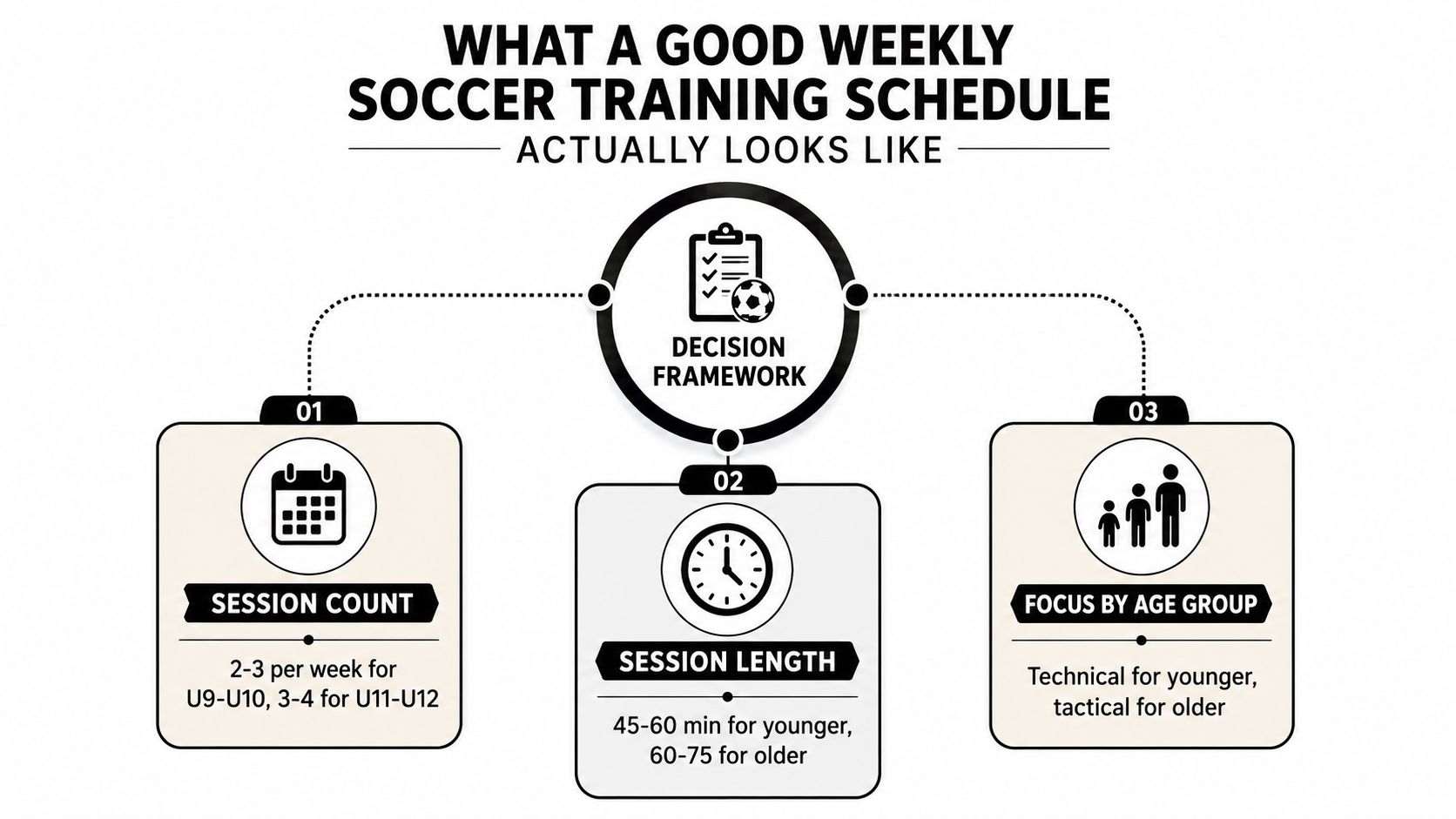
A good weekly soccer training schedule is not a fixed seven-day grid. It is a load-balanced microcycle, a short training block organized around the next match and the player's ability to absorb work. Set four decisions first: how many sessions the player needs, how long they should last, what each session should improve, and where the full recovery day belongs.
For many youth players, a practical starting range is two to four sessions per week, with each session lasting roughly 45 to 90 minutes. Age and development change the answer. Younger children need playful ball contact and variety. Older players can handle more tactical structure, provided the full week includes matches, tournament travel, other sports, and private coaching. A commonly used youth benchmark places ages 6–8 at two training sessions weekly, ages 9–12 at two to three, and ages 13–16 at three to five, with progression linked to coordination, stamina, and tactical understanding (youth soccer training schedule guidance).
Set the week before you choose the drills
Put the match on the calendar first. Add team practices, school demands, private training, tournament travel, and other sports. Then give every soccer session one primary purpose, such as first touch, passing under pressure, finishing, tactical decisions, or physical preparation. Several activities can serve one session, but the coaching point should remain clear.
Houston schedules often hide the problem. A player may have two club practices, a weekend tournament, a private lesson, and another sport before anyone counts the total load. U13–U16 players also need an adjustment during growth spurts. Soreness, coordination changes, sleep, mood, willingness to play, and movement quality can matter more than the team calendar.
A useful parent check is soreness. If a child remains noticeably sore more than 48 hours after training, the week may be overloaded, even when the drills were well designed.
Practical rule: A schedule works when the player reaches the next important session ready to learn, not merely able to survive it.
Research from elite youth environments reinforces the value of structure. A study of French academy players describes weekly training ranging from 3 to 7 sessions, while a controlled intervention used 18 sessions of 90 minutes across 6 weeks, equal to 3 organized sessions per week (peer-reviewed academy training research). Those settings are not templates for every Houston family. They show that frequency should match ambition, maturity, and readiness, rather than parental anxiety.
Age-Group Templates from U5 to U18
Age bands provide a starting point, not a finished schedule. A U14 player in a growth spurt may need a different week from a physically mature teammate, even if they attend the same team sessions. Use the table below to set a starting range, then adjust it for school, travel, tournaments, other sports, soreness, sleep, and biological maturity.
Age Group | Sessions/Week | Session Length | Weekly Hours | Primary Focus | Rest Rule |
|---|---|---|---|---|---|
U5–U6 | 1–2 | 45–60 minutes | Keep within age-hours guidance | Play, coordination, ball familiarity | Protect a full day away from organized sport |
U7–U8 | 1–2 | 45–60 minutes | Keep within age-hours guidance | Ball mastery, movement, small games | Avoid stacking hard days |
U9–U10 | 2–3 | 60–75 minutes | Keep within age-hours guidance | Technique, receiving, passing, small-sided decisions | Place recovery before or after the match |
U11–U12 | 2–3 | 60–75 minutes | Keep within age-hours guidance | First touch under pressure, scanning, combination play | Keep one full recovery day |
U13–U14 | 3–4 | 75–90 minutes | Keep within age-hours guidance | Tactical principles, speed of play, age-aware physical work | Reduce load during growth-related discomfort |
U15–U16 | 3–4 | 75–90 minutes | Keep within age-hours guidance | Tactical periodization, position demands, strength foundations | Don't add volume automatically during puberty |
U17–U18 | 4–5 | About 90 minutes | Keep within age-hours guidance | Position-specific preparation, performance, recovery planning | Balance match exposure with training quality |
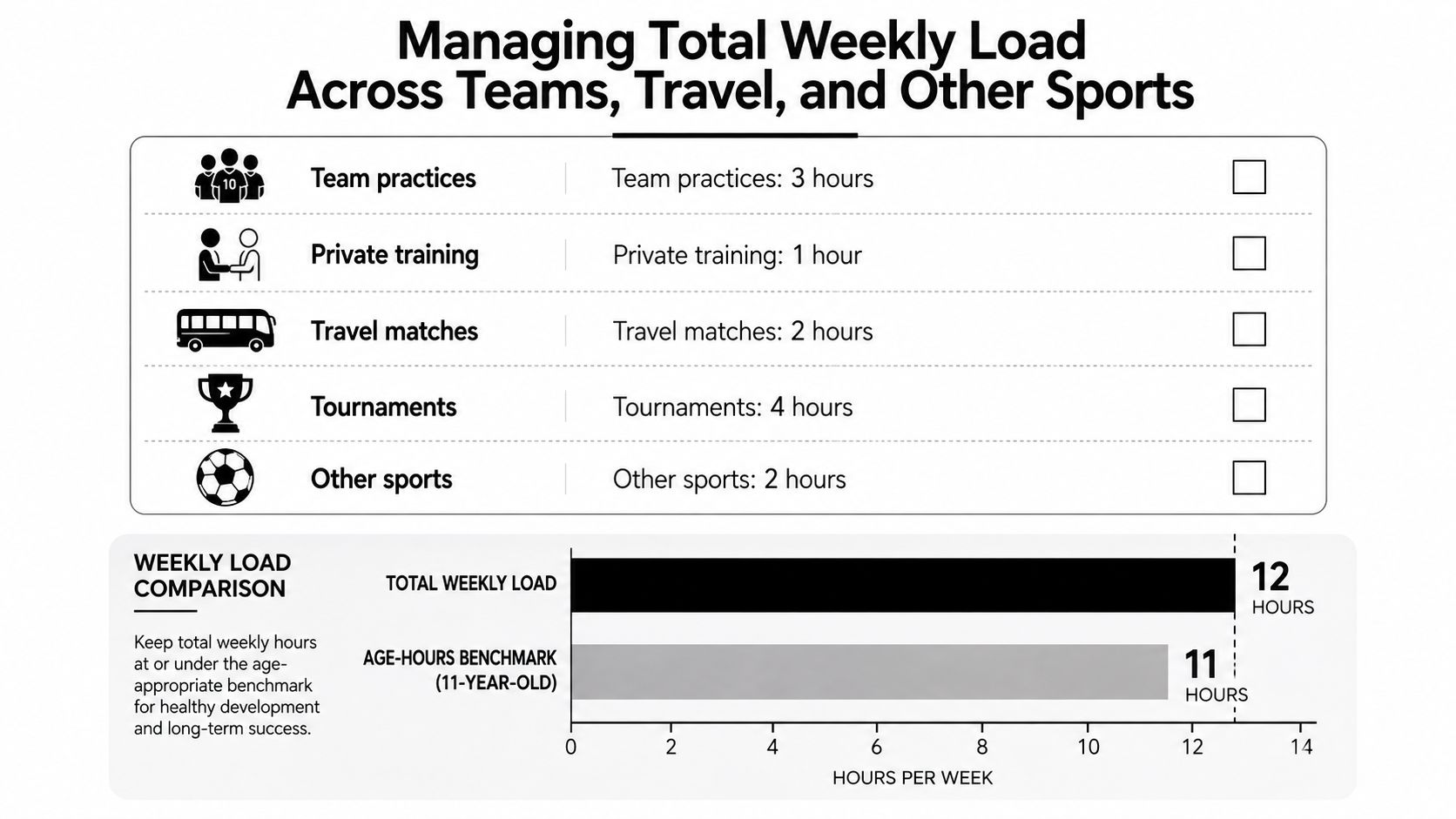
Treat the weekly hours as a planning ceiling, especially after adding school teams, travel soccer, tournaments, or another organized sport. Count the whole week, not only sessions carrying a club logo. A player who has practice, a private lesson, and tournament matches may already have a demanding schedule before extra conditioning is considered.
The table also needs a parent's judgment. Persistent soreness, disrupted sleep, mood changes, reduced willingness to play, or declining movement quality can signal that the plan needs adjustment. A child who remains noticeably sore more than 48 hours after training may be carrying too much load, even when every individual session looks reasonable.
Why U13 to U16 needs judgment
Generic templates break down during puberty. Growth can change coordination, sprint tolerance, jumping, collision tolerance, and the ability to repeat high-speed actions. A review of youth soccer development connects training load, injury risk, and physical performance with peak height velocity, and states that “one size does not fit all” during this period (review of maturity and youth soccer training).
Late maturers may need less collision exposure while continuing technical work. Players moving through rapid growth may respond better to shorter high-intensity blocks, closer monitoring, and more recovery between demanding sessions. Those adjustments matter in Houston, where a travel team, tournament weekend, and another sport can fill the same calendar.
For families comparing soccer with boxing, the teen boxing class program blueprint offers a useful prompt: how does the second sport change the total load, contact exposure, and recovery time?
The soccer development by age guide helps frame changing expectations across age groups. Calendar age starts the conversation. Biological maturity, current stress, and the player's response to training determine the final week.
A Sample Week With Drills, Durations, and Objectives
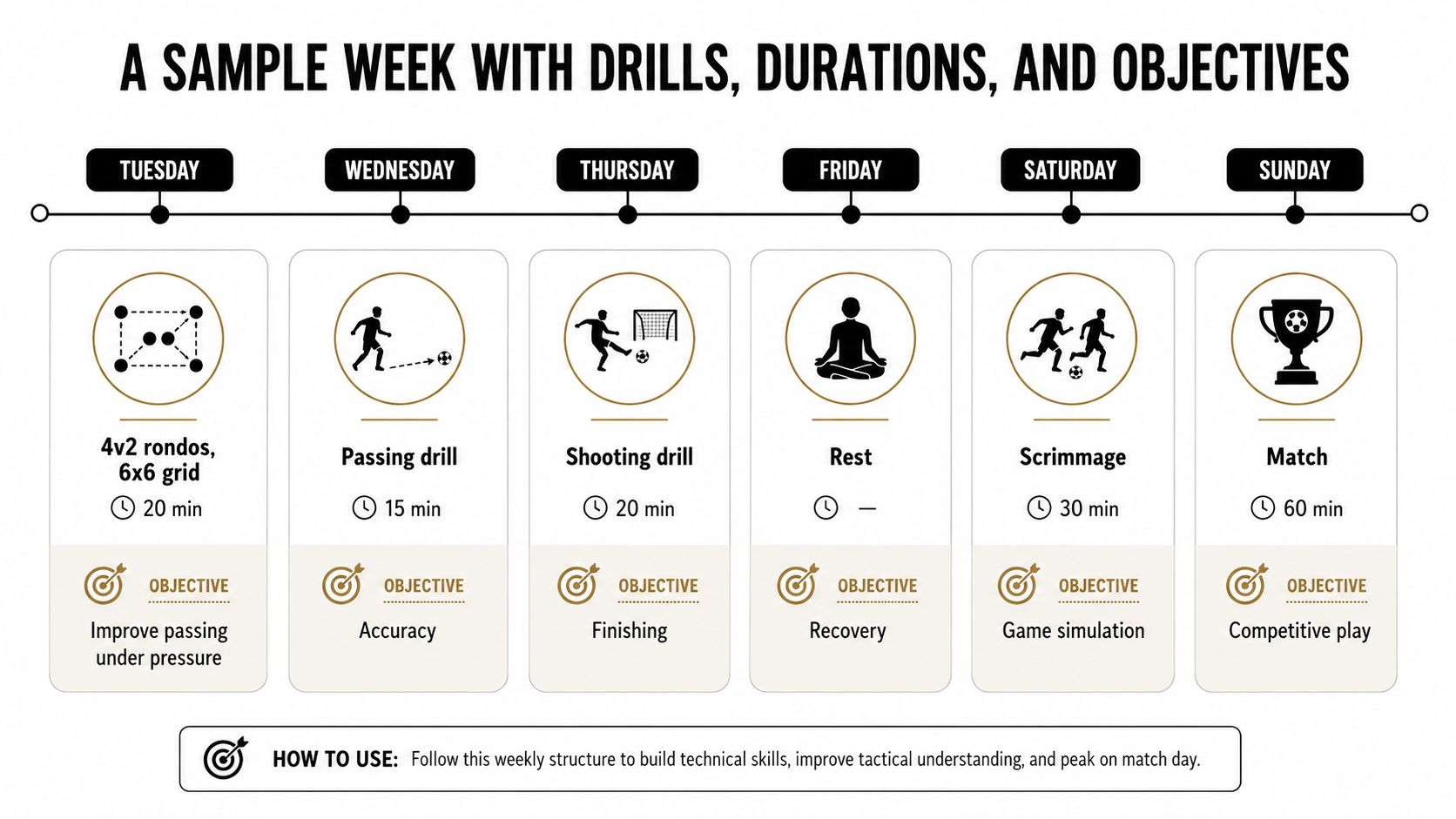
For a U11 or U12 player with one weekend match, a Tuesday-to-Sunday structure can work well when the player has no major tournament or second sport competing for recovery. The week starts with technical learning, moves into tactical application, then gives the match the highest competitive demand.
Tuesday, technical quality
Use a 60-minute session focused on receiving and passing under pressure.
Ball mastery ladders, 10 minutes: Use inside-outside touches, sole rolls, pull-push actions, and changes of direction. Keep the ball close and ask the player to look up between repetitions.
4v2 rondos in a 6x6 grid, 20 minutes: Start with clean support angles, then add a one-touch restriction only when the player can keep the ball moving. The point isn't to punish mistakes. It's to teach the player to scan before receiving.
Directional possession, 20 minutes: Create two scoring gates and require the team to recognize when to keep the ball and when to play forward.
Cool-down and recap, 10 minutes: Ask, “What did you see before you received?” That question is more valuable than another tired sprint.
A reasonable touch target for this age is around 2,000 weekly touches, treated as an approximate planning target rather than a score to chase. Quality, perception, and decision-making matter more than forcing extra contacts after technique has deteriorated.
Thursday, tactical transfer
Keep the session around 60 minutes. Use positional small-sided games, progressing from 7v7 to 9v9 for 30 minutes, then finish with a 20-minute finishing circuit. The objective is to connect the Tuesday skill to game choices.
Coach cues should stay short: “Open your body.” “Can you play forward?” “Where is the next pass?” During finishing, vary the service so the player must finish from a cutback, a loose ball, and a pass across the defender. Parents running a home session should avoid turning this into a fitness test. Give the player a clear decision and stop while the movement remains sharp.
For additional technical ideas, use these technical soccer drills as a menu, not as a demand to complete everything.
Saturday and Sunday, compete and recover
On Saturday, use a 20-minute activation block before the match. Include passing sequences, controlled mobility, and set-piece rehearsal. Don't add conditioning before kickoff. Match day already supplies the most competitive stress in the microcycle.
Sunday can be an optional 45-minute recovery session with light juggling, easy mobility or yoga flow, and a short video debrief. If the player is tired, Sunday becomes rest. A private session fits best on Tuesday or Thursday only if it replaces part of the planned work. Adding it on top of both team practices and the match can push total organized hours beyond the age-hours ceiling.
Managing Total Weekly Load Across Teams, Travel, and Other Sports
A Houston family calendar needs to show the player's full load, not just soccer practices. Record team training, private coaching, match minutes, tournaments, travel games, driving, time spent waiting at fields, school sports, strength work, and informal play. Driving and waiting do not create the same physical demand as sprinting, yet they still take time from meals, homework, sleep, and recovery.
Use a simple traffic-light review
Review the week with three colors:
Green: The player moves well, joins in willingly, and recovers between sessions. Keep the planned technical work.
Amber: Soreness, poor sleep, school pressure, or slower decisions is appearing. Shorten or simplify the next session.
Red: Persistent pain, unusual fatigue, illness, or a clear decline in movement quality means pausing and contacting the coach or an appropriate health professional.
Track changes in training volume gradually. A sudden jump from a second team, tournament, travel weekend, or another sport deserves attention, even when each individual session looks reasonable. The figures often used in youth load-management guidance, including keeping week-to-week increases under 10% and treating changes above 15% as a warning, are coaching guardrails rather than targets. They do not override symptoms or a player's maturity stage (youth soccer load-management guidance).
Count the invisible stress
Tournament weekends can combine several matches, long drives, irregular meals, and little downtime. Replace the private session with recovery instead of squeezing it into an already crowded schedule. If another sport adds practices, protect a genuine soccer-free day rather than leaving rest to whatever time remains.
For U13 to U16 players, puberty changes how much load they tolerate and how quickly they recover. Adjust the week for biological age and current fatigue, not only the birth-year label. A technically excellent plan still fails if the player cannot recover from it. Put rest on the calendar before every commitment fills the week.
Periodizing the Season Around Match Day
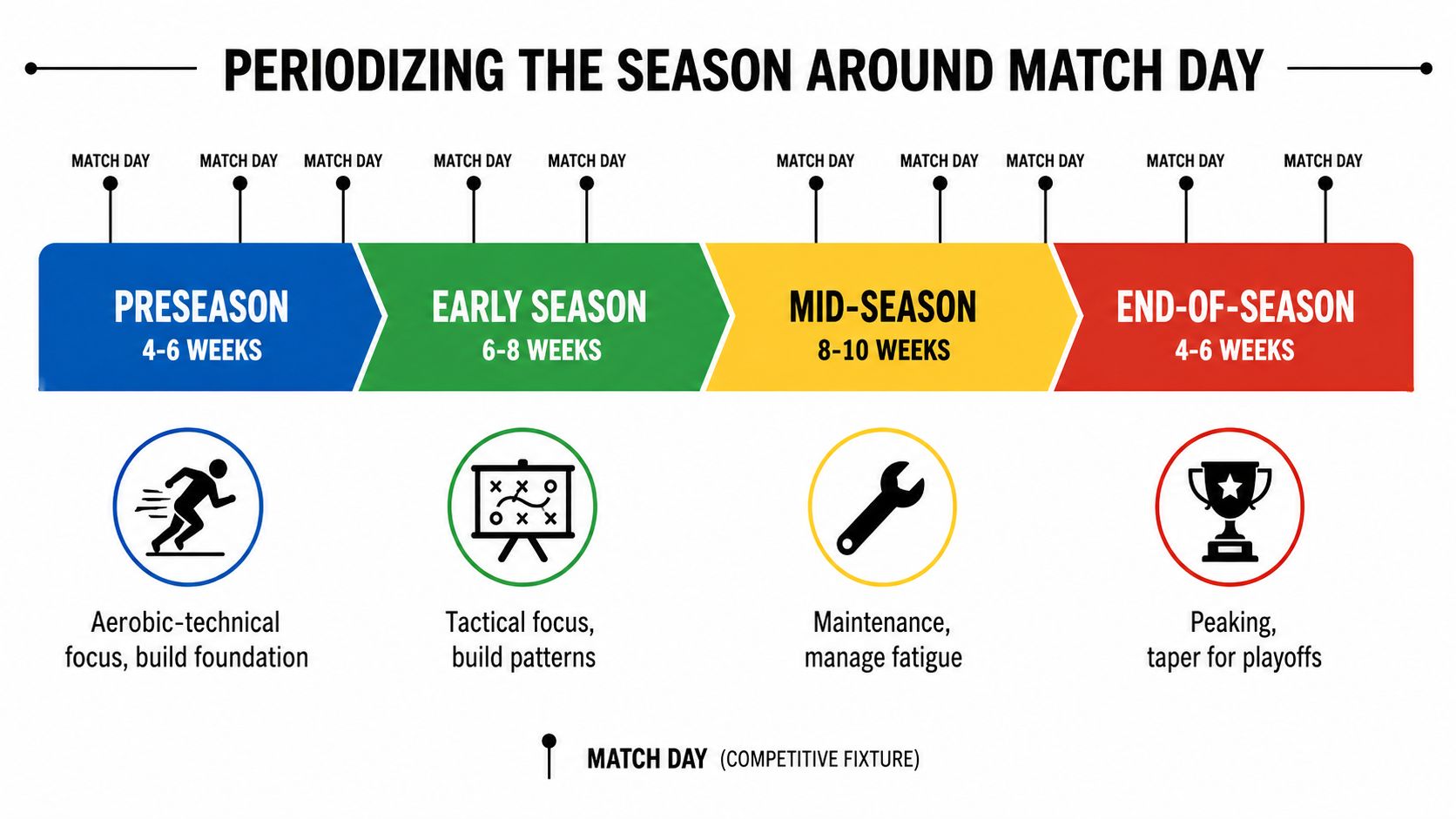
The strongest season plan works backward from the match calendar. Coaches need to know whether the coming week is a normal development week, a tournament week, a three-game week, or a recovery period before choosing the volume.
Preseason builds the base
Use the opening block for aerobic and technical preparation. With a Villarreal-style intelligence-first lens, that means teaching players to receive, scan, support, and make decisions while gradually preparing them to repeat actions. Keep possession work central, but don't turn every session into a long conditioning circuit.
A preseason block can last 4–6 weeks in a common periodization model, but the exact calendar depends on the competition schedule. Early in the season, keep development work on non-match days and protect the day before competition from unnecessary fatigue.
In-season training serves the match
During a normal in-season week, place the most demanding learning earlier, then reduce the load as kickoff approaches. Elite youth microcycles commonly use harder sessions early in the week and reduce training load near match day. A youth-academy analysis found that U15 players had lower session-RPE load by MD-3/MD-4, and that age groups reduced load during the final two days, mainly by cutting session duration (youth academy microcycle analysis).
That pattern gives parents a simple test. If the player is doing the hardest conditioning session the day before a match, the week probably isn't organized around performance.
Tournaments and breaks require subtraction
During tournament peaks, keep short tactical sessions, set pieces, and position-specific reminders. Drop extra conditioning and optional private work. After a demanding competition period, use an off-season deload to restore enthusiasm and movement quality, especially for players in the U11–U15 range.
Three-game weeks should be treated as competition-heavy weeks, not as normal weeks with extra matches. Winter break shouldn't become an excuse to replace every team session with maximal private training. The week matches its phase when the training load prepares the player for the next meaningful demand, rather than trying to win every day.
Adding Mental Skills and Recovery to the Weekly Plan
A player's brain needs a place in the weekly soccer training schedule. Tactical intelligence doesn't appear only during a match. Players develop it through deliberate attention, reflection, and calm repetition.
Add a short visualization routine before key training or competition. The player can rehearse receiving on the back foot, checking the shoulder, making the next pass, or recovering after a mistake. A mid-week breathing routine can help the player reset attention, while a brief post-match journal can answer three questions: What did I notice? What decision helped me? What will I try next time?
Recovery needs a protected slot
Recovery isn't an empty space between activities. It's a planned part of the program.
Full rest: Keep at least one complete day away from organized soccer and other demanding training when the schedule allows.
Gentle mobility: On a rest day, easy mobility is preferable to adding another running session.
Sleep protection: Younger players need consistent, adequate sleep. For U12 and younger, a practical target often used by youth programs is 9–10 hours across two sleep windows, so late travel and early training deserve attention.
Match-day nutrition: Plan familiar meals, fluids, and snacks around competition rather than experimenting on game day.
These habits support the player who can read the game, stay composed, and make a useful decision late in a match. Extra fitness may make a tired child more tired. Quiet preparation can make the player more attentive.
A fuller discussion of this approach appears in mental training for young athletes. The main point is practical: a complete plan trains the body and the brain in the same week, with rest acting as the third pillar.
The calm player who sees the next pass isn't built through extra running alone. That player is built through attention, recovery, and purposeful repetition.
Putting It Into Practice With Villarreal Houston Academy
A schedule works only when it fits the family's actual week. Start with the player's age, biological maturity, development stage, current team commitments, school demands, travel, and other sports. Then select the smallest training load that supports the next development goal.
Ask the club coach three direct questions:
What principle is this session reinforcing? The answer should identify a technical or tactical idea, not “fitness.”
How does the match change this week? A tournament or congested weekend should alter the sessions around it.
What should we remove if the total load is already high? A good coach can tell you which optional work has the lowest priority.
At Villarreal Houston Academy, tryouts can help establish technical level, decision-making habits, and appropriate group placement. Camps can provide focused development blocks, but they shouldn't automatically fill every school break with extra volume. Before adding private coaching, identify the problem first. Repeated errors around the same technical or tactical idea may justify a targeted session. More training without correction may only create more fatigue.
Keep a simple weekly log with sleep, soreness, mood, minutes played, and session quality. Coaches should adjust the plan when school pressure, illness, growth-related discomfort, or tournament congestion rises. Review the schedule every four weeks using attendance, confidence, movement quality, and match observations, not results alone.
Villarreal Houston Academy offers age-based team training, competitive programming, camps, clinics, tryouts, and a pathway connected to Villarreal CF methodology in the Greater Houston area. To build a weekly plan around your child's maturity, commitments, and development needs, visit Villarreal Houston Academy and ask which program fits the week you can realistically sustain.
Comments