


Soccer in Houston Texas: Clubs, Tryouts and How to Choose

You're in Humble or Cypress, your child wants to play soccer, and every search brings another registration form, academy badge, or tryout announcement. You need to know which program fits your child, what the commitment really costs, and whether you can make the drive after school without turning every evening into a rush.
Choosing soccer in Houston, Texas, starts with separating introductory play from competitive development. A child who wants to kick a ball with friends needs something different from a player asking for tougher opponents. The right choice matches that goal with a workable schedule, clear coaching, and sensible safeguards.
Houston Soccer Programs at a Glance
Houston families can start with free city programming, YMCA activities, community events, recreational leagues, or academy teams. Each option asks for a different level of time and commitment. A free introduction may suit a beginner, while an academy team typically involves regular practices, matches, and possible travel.
Use this comparison to identify a suitable program type, then confirm current availability and terms with the provider before paying. Published age and fee details are included where available; other rows focus on commitment and fit.
Houston Soccer Program Types by Age, Commitment and Cost
Program | Ages | Commitment | Cost | Best for |
|---|---|---|---|---|
City of Houston Soccer for Success | Varies by participating site | Recurring practices and game days during scheduled seasons | Free | Low-cost first exposure |
YMCA soccer programs | Varies by branch and season | Branch and season schedule | Varies by branch and season | Introductory play and teen leagues |
Soccer Celebration Community Tour | Varies by event session | Short community sessions at participating parks | Free | Trying soccer before committing |
North Houston academy teams | Varies by team and birth-year group | Team practices, matches, and possible travel | Varies by team | Select and competitive development |
Recreational leagues and clinics | Varies by division or clinic | League season or short skill-focused block | Varies by provider and program | Casual play and skill focus |
A free program removes the registration charge, but families still need to account for transportation, footwear, and an adult's time. A nearby field your child can attend consistently may be more practical than a program that regularly conflicts with work.
YMCA and recreational options can work well for children who want organized play without an intensive team commitment. Ask whether beginners start in an instructional group or join games right away. A hesitant newcomer may benefit from guided ball work before playing matches, while a child ready for games may prefer a quicker route onto the field.
Read the Commitment Behind the Label
An academy team should offer purposeful technical work, small-sided games, and feedback players can understand, alongside its regular schedule. Before committing, ask about practice frequency, match expectations, travel, and the full season cost. The label alone does not tell you whether the workload fits your family.
A clinic serves a narrower purpose. Look for a specific skill focus or a manageable introduction to organized play; a clinic does not guarantee team placement.
Practical rule: Choose a level of commitment your family can sustain during an ordinary school week, not only during an enthusiastic registration weekend.
Start with the option that matches your child's goal. Then compare the weekly demands and likely expenses, and confirm the details that vary by branch, team, season, or division before registering.
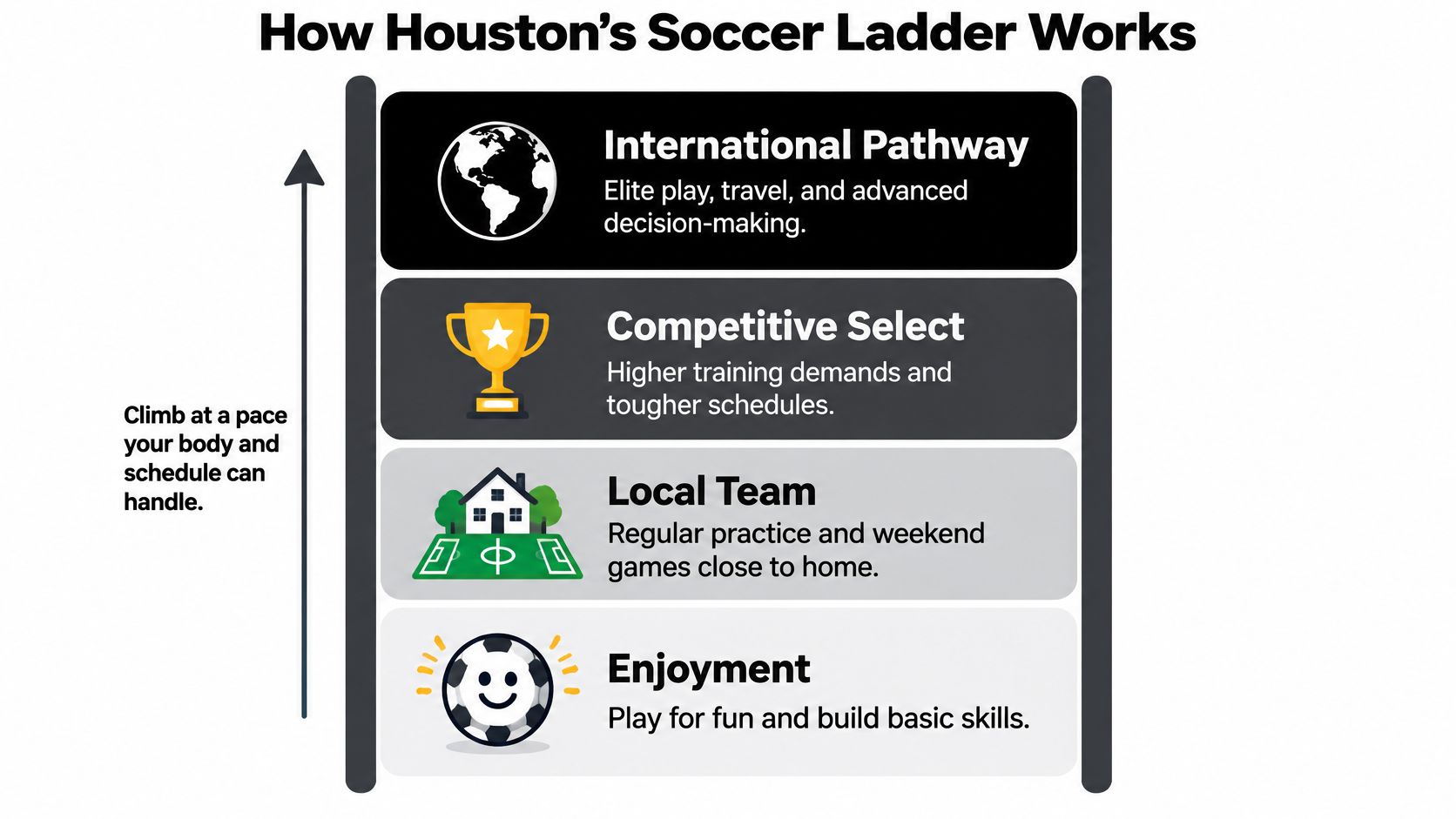
How Houston's Soccer Ladder Works
Think of a child who loves dribbling in the yard but freezes when another player challenges for the ball. That child doesn't necessarily need a more selective team. They may need an environment where pressure increases gradually and mistakes don't end their involvement.
Houston has a professional backdrop for those ambitions. The Houston Dynamo's inaugural-match account records the club's first MLS match on April 2, 2006, when Houston defeated Colorado at Robertson Stadium. A visible professional team can inspire a young player, but watching professionals and being ready for competitive selection are different things.
This ladder illustrates increasing demands, not an automatic route to professional soccer.
Build Readiness Before Raising the Stakes
For early beginners, prioritize enjoyment and comfort with the ball. Chasing, stopping, turning, and trying again matter more than holding a position. A useful readiness signal is that the child wants to participate without constant parental encouragement.
For developing elementary-school players, add technique under light pressure. Receiving across the body, changing direction, and looking up before passing become useful coaching targets. A player who can keep possession in a small game is ready for more demanding technical challenges, even if their execution remains inconsistent.
For players approaching select soccer, the new demand is making decisions with teammates. Notice whether the player moves into space without prompting, responds after losing possession, and accepts feedback without withdrawing. Speed or a powerful shot alone doesn't establish readiness.
For older competitive players, evaluate whether training supports match understanding and the rest of life. Club soccer, school soccer, advanced evaluations, and travel opportunities can compete for the same time. The player should help own the calendar rather than relying on a parent to manage every obligation.
A Higher Rung Isn't Always the Next Move
A technically capable player may still need a less pressured setting after changing schools or returning from injury. Another child may be ready for tougher opposition before they look physically dominant.
Use this explanation of soccer levels of competition to distinguish labels, then judge the actual training environment.
Progress means handling the next challenge with growing independence. It doesn't mean collecting a more impressive team name.
Ask which demand your child handles comfortably today and which challenge would stretch them without overwhelming them. That's a more useful placement question than asking for the highest available team.
Register, Try Out and Verify Before You Pay
Registration should establish what you're buying. A completed form doesn't necessarily secure a roster position, and a successful evaluation doesn't tell you the full season cost.
For a concrete community benchmark, the Houston Parks and Recreation Department reports that free Soccer for Success programming serves approximately 1,500 young people at eight sites, with two 12-week seasons annually and three weekly sessions lasting 60–90 minutes. That's a substantial recurring commitment, even without a registration fee.
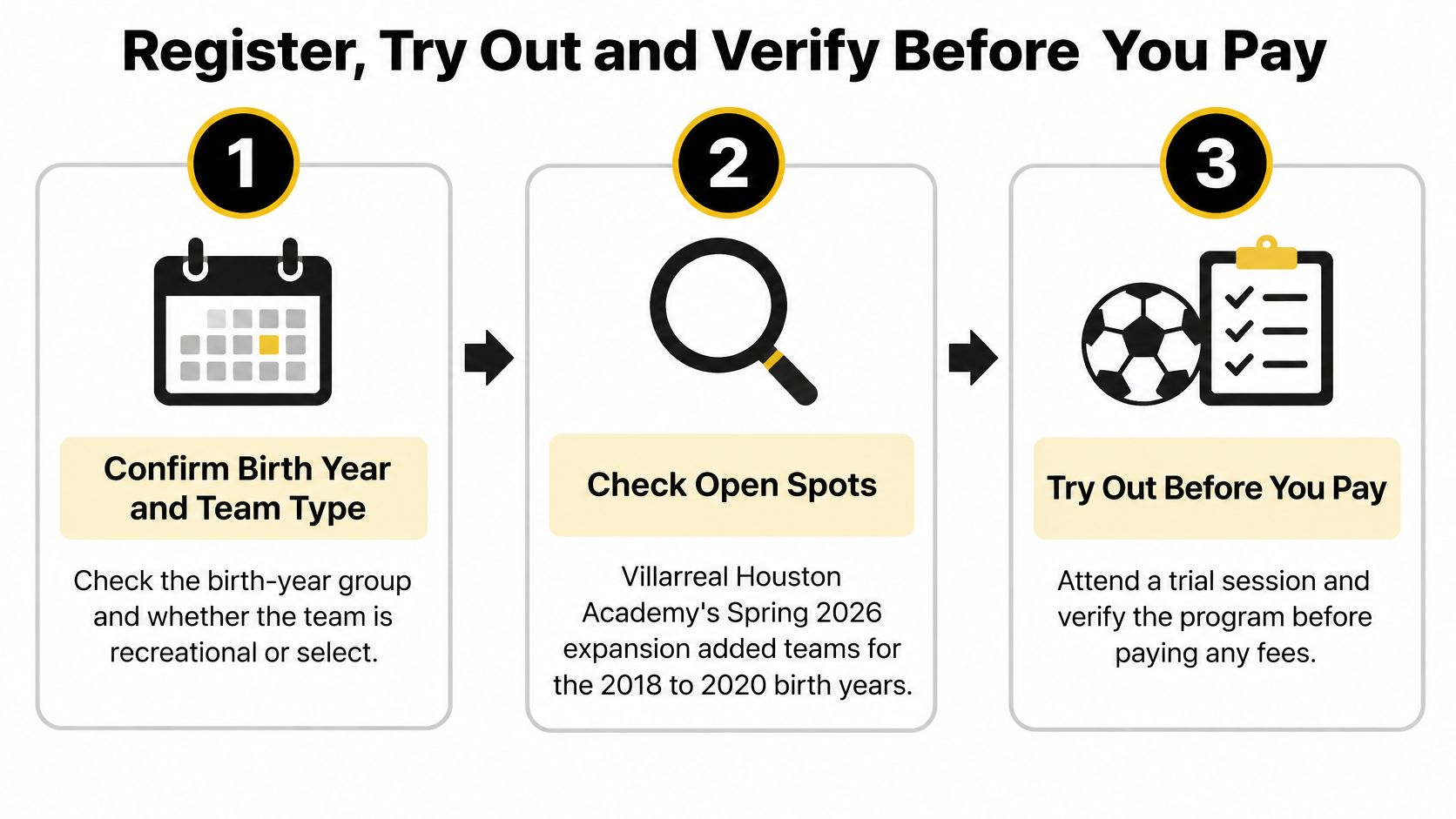
The registration process should move from eligibility to evaluation to a verified offer.
Follow a Verification-First Procedure
Confirm the team's eligibility rules. Give the registrar your child's birth date and ask which group they would actually join. Establish whether the opportunity is recreational enrollment, an academy training group, or selection for a competitive roster. Don't assume the same label means the same arrangement across providers.
Get the current calendar. Request the season opening and closing dates, practice days, match expectations, and known breaks. Check the schedule against school events, custody arrangements, and other sports. For an expansion announcement, confirm that the advertised group has a coach, a training location, and enough players to operate.
Check space and prepare the paperwork. Ask whether registration secures a place or only enters an evaluation pool. Obtain the required consent forms, identification instructions, medical disclosures, and emergency-contact requirements. Use the youth soccer registration guide to organize the process, then follow the selected provider's current instructions.
Prepare without cramming. Use brief, familiar work on receiving, dribbling through turns, passing against a safe surface, and looking up before releasing the ball. Finish while the player still feels sharp. Don't copy a full team-session workload at home or add exhausting conditioning immediately before a tryout.
Make arrival straightforward. Confirm the exact field entrance, check-in procedure, footwear, ball requirements, and weather-contact method. Arrive with enough time to check in and settle. Bring water, shin guards, and a clearly labeled bag, and note who is leading the evaluation.
Observe the coaching and request useful feedback. Watch how coaches respond when a child makes a mistake. Notice whether players spend most of the session participating or waiting in lines. Afterward, ask what the player did effectively, what needs work, and how the next evaluation will happen.
Verify the placement before paying. Obtain the proposed team, coach, training site, practice schedule, game expectations, full cost, and cancellation policy. Ask how bad weather, extreme heat, coach changes, and missed sessions are handled. Attend a normal training session if possible, not just a specially arranged recruitment event.
Compare the Offer, Not the Sales Pitch
Put shortlisted programs beside each other using the same categories. One may offer a convenient practice site but distant weekend fixtures; another may provide stronger feedback but a commitment your child doesn't want.
Treat vague answers as unfinished information, not reassurance. You should know who will coach your child, where they'll train, and what you're agreeing to before a deposit makes changing direction expensive.
Heat, Humidity and Safe Training Load
Houston heat affects both safety and performance. Before practice, families should know how staff will adjust training as conditions change and who has authority to stop it.
A peer-reviewed Texas climate study projects that heat indices will exceed healthy or safe limits for outdoor sports by the mid-to-late twenty-first century. It identifies practice timing, duration, intensity, and location as adaptations. This is a long-term projection, not a rule for deciding whether a session can proceed today.
Humidity reduces how effectively sweat cools the body. A familiar drill can feel much harder even when the air temperature does not seem dramatically different.
Session Changes by Heat-Index Band
Ask the club to provide its written heat-index thresholds and explain what staff do at each one. The thresholds should guide three practical responses:
At the club's caution threshold: Reduce exertion, add shaded recovery, and monitor players closely, especially those new to hot-weather training.
At its modification threshold: Shorten practice or move it indoors. Replace sustained conditioning with lower-load technical work.
At its stop threshold: Suspend outdoor activity and follow the cancellation or indoor-backup plan.
A heat-index reading does not capture every field condition. Direct sun, the playing surface, available shade, equipment, and each player's response also matter. Ask whether staff check conditions at the field and account for those factors.
What a Sound Protocol Includes
Gradual acclimatization: Increase workload progressively for players entering hot-weather training. A child returning from a break should not immediately take on the workload of teammates who have trained regularly.
Clear escalation rules: Staff should know when to reduce intensity, shorten practice, move indoors, or stop. Parents should not have to negotiate a break for a child who is struggling.
Prepared adults: Coaches need to recognize exertional heat illness and follow an emergency action plan. Confusion, collapse, or altered behavior calls for urgent action, not encouragement to finish a drill.
Safety first: If a child seems unwell, remove them from activity and assess the situation. Do not use toughness as a test of whether they can continue.
Heat can affect technical execution and decision-making before obvious illness appears. Repeated loss of ball control or slow reactions can signal that the workload should be reduced, not that a player needs more conditioning.
For a separate overview of injury-related concerns, Thermo Recovery Wear's sports injury guide offers additional reading. It does not replace medical assessment or the club's emergency procedures.
Ask the coach who checks conditions, who can cancel, and how families receive updates. A useful answer names the responsible people and the actions they will take, not just a promise to provide water.
Filling the Gaps Between Seasons
The last match ends, the next registration window hasn't opened, and your child still wants to play. You don't need to fill every empty evening with paid coaching.
The Houston Dynamo and Dash Charities community-tour announcement describes free programming for ages 6–17 across five parks in 2026, including age-specific morning technical sessions and evening pick-up matches for older players. Check the event calendar and enrollment status before making plans, since an announcement doesn't establish that a session is still upcoming or has space.
Match the Gap to the Player
Free community play for beginners: Use a school break to try soccer without purchasing a full season. The objective is participation and confidence, not proving readiness for selection.
Short clinics for developing players: Choose a clearly defined skill, such as receiving under pressure or finishing after a turn. A focused clinic makes more sense than repeating general training the child already receives.
Camps for players who enjoy longer group activity: Check the daily structure, shade, supervision, and balance between instruction and play. A camp can solve a calendar need, but a demanding day shouldn't automatically be followed by evening team practice.
Formal team training for committed competitors: Use it when the player needs coordinated tactical work and an organized return to competition. Confirm that the workload accounts for other training rather than assuming the club is the child's only activity.
Individual practice for self-directed players: Keep the objective narrow and observable, such as controlling a pass into space. Older players can pair technical work with appropriate strength training, tactical learning, and recovery.
YMCA programming is another option worth checking locally. Ask the branch about current age groups, season availability, and open places rather than assuming every location runs the same soccer schedule.
Build a Flexible Break
More training isn't automatically better. Younger players need enjoyable touches and freedom to experiment; older competitors need a reason for each added session. This guide to off-season soccer can help families choose activities around an actual development goal.
For a hypothetical month-long gap, alternate brief technical practice with informal games and leave genuine rest days unfilled. Scale back if the child becomes unusually tired, sore, or reluctant to participate.
Have a weather backup before leaving home. An indoor facility may preserve active play, while safe indoor ball work or a short match-video discussion can replace a canceled outdoor session without pretending every missed practice must be recovered.
Choosing the Right Program for Your Child
Start with what your child wants now: enjoyment, a dependable local team, stronger competition, or an advanced pathway. Parents can support ambition without turning a tentative interest into a commitment the player never requested.
The conversation belongs with the child as well as the coach.

Goal-to-Track Decision Table
Goal | Track to consider | What to verify |
|---|---|---|
First experience for a young beginner | Free city or YMCA programs | Age eligibility, season dates, site distance, class size |
Weekly fun and basic skills | Recreational league or clinic | Practice length, coaching coverage, cost |
Select and competitive team | Academy or club select team | Birth-year placement, tryout dates, coach credentials |
International or elite pathway | Academy with a documented international connection | Evaluation criteria, opportunity eligibility, Spain trip costs, school conflicts |
Gap between seasons | Camps, clinics, and pick-up play | Weather backup, session length, enrollment deadlines |
For a first-time player, prioritize fun, manageable sessions, and location over pedigree. A coach who explains a task clearly and brings a hesitant child back into the game provides something useful immediately. An impressive badge doesn't compensate for a child spending practice confused or uninvolved.
For a player actively seeking select soccer, prioritize evaluation access, coaching quality, and an appropriate playing challenge. Ask how coaches teach scanning, receiving, movement off the ball, and decisions under pressure. Match results alone won't tell you whether the player is learning those skills.
Test Pathway Claims Against Everyday Delivery
An academy associated with an overseas professional club may offer a distinctive methodology and international training opportunities. Still, verify who delivers the local sessions, how coaches are supported, and whether travel experiences involve evaluation, training, competition, or a combination. An international experience isn't a promise of professional placement.
If sports psychology support is advertised, ask how players access it and what it includes. Likewise, confirm the assigned training site rather than judging convenience from a list of locations across Humble, Fall Creek, Cypress, Tomball, and the Kingwood, Porter, and New Caney area.
Use introductory video material to prepare questions, then compare it with the session your child would attend.
A pathway program makes sense when the player wants the challenge and the family can support the attendance and travel. A free community program makes sense when enjoyment and access are the immediate priorities. Neither choice needs to become permanent.
Before signing, ask your child what they enjoyed, what felt difficult, and whether they want to return. Combine that answer with the written offer and your observation of the coach. That's a firmer basis for choosing than pressure to accept before your questions are answered.
Villarreal Houston Academy offers youth teams, camps, clinics, and tryouts in Greater Houston as an official partner academy of Spain's Villarreal CF. Visit to explore current opportunities, then ask about your child's eligible group, assigned training location, evaluation process, and complete season cost before committing.
Comments