


Soccer Levels of Competition Explained for Youth Players

A parent can start Saturday morning feeling perfectly comfortable, then watch a team from another town arrive in matching kits and wonder whether their child is falling behind. The questions come quickly: Is recreational soccer enough? Does “select” mean the same thing as “travel”? Is an academy automatically better, even if the player spends more time on the bench?
Those questions are difficult because soccer levels of competition aren't one universal ladder in the United States. Names overlap, clubs organize teams differently, and a program that fits one player may be a poor match for another. The useful question isn't, “What's the highest level available?” It's, “Which environment gives this child the right challenge, playing time, coaching, and family routine right now?”
Why Competition Levels Feel So Confusing for Parents
American youth soccer uses several overlapping systems. A local club may offer recreational teams, select teams, competitive travel teams, and academy programs under the same name. Another club in the same area may use “premier” for a team that functions like a regional travel side, while a different organization uses the word for its most demanding group.
Parents also hear names such as classic, select, premier, ECNL, MLS NEXT, academy, and ODP. These labels can describe a league, a club philosophy, a team within one age group, or a pathway connected to scouting. They don't always tell you how often your child trains, how far the team travels, how much playing time is realistic, or what the coach teaches.
The English football pyramid offers a useful contrast. In England, the structure has at least 11 levels, with the Premier League containing 20 clubs, the Championship 24 clubs, League One 24 clubs, and League Two 24 clubs. The National League sits at Tier 5, followed by regional divisions. Promotion and relegation can change a club's competitive status from one season to the next, which gives the pyramid a clearer formal structure than many American youth systems. This overview of the English football pyramid explains how movement between levels affects competition and club operations.
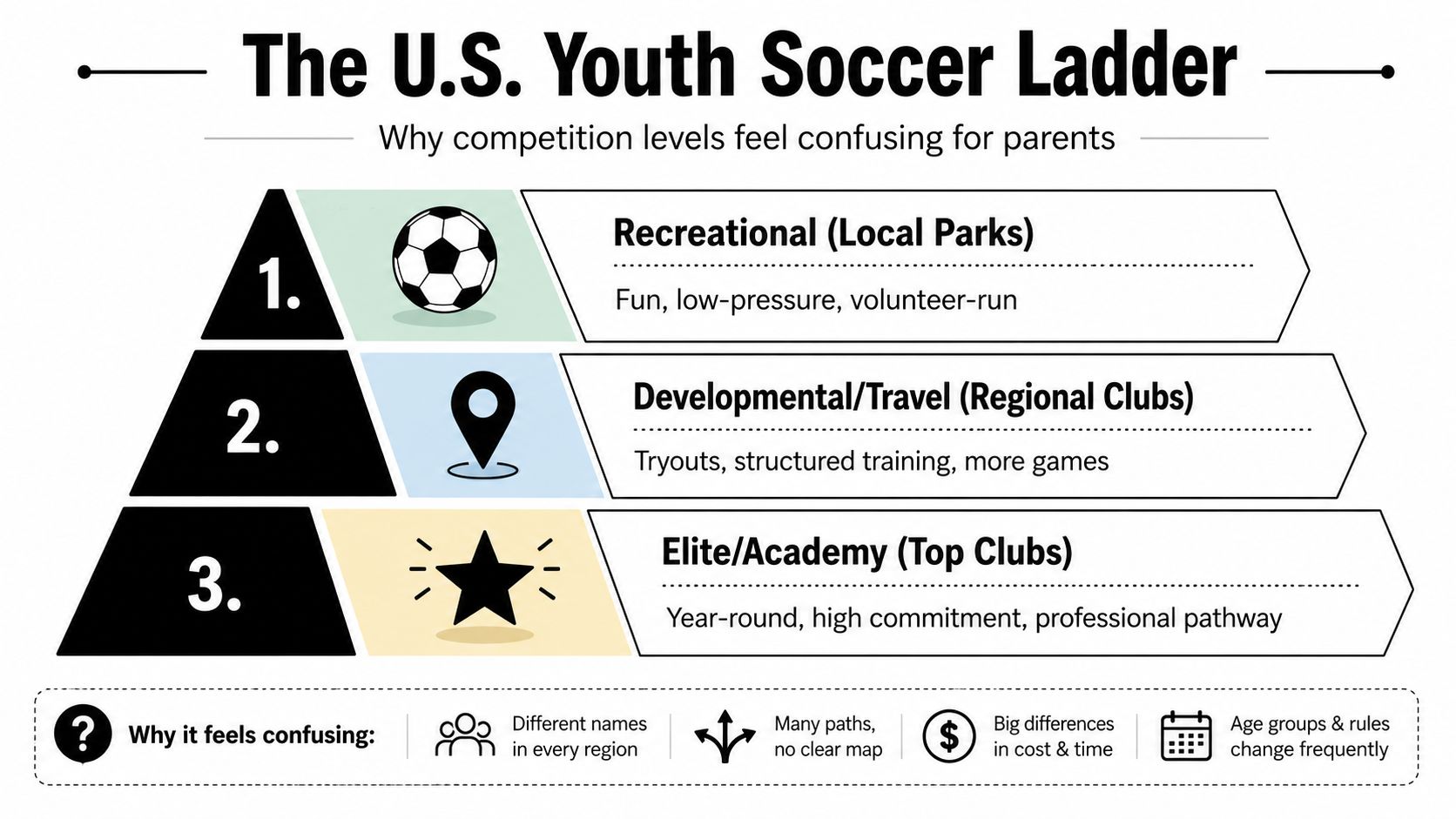
Read the pyramid as a map
For youth players, the broad pathway usually runs from recreational soccer to local competitive play, regional or national elite competition, and professional academy pathways. The levels help you understand the environment, but they don't guarantee that every step upward will improve development.
A friend's recommendation may be sincere and still not apply to your family. Their child may have had an excellent coach, a short commute, and a deep roster. Your child might enter the same label in a different birth year, train with a different coach, or receive fewer meaningful minutes.
The right tier is the one that matches your child's goals, your family's capacity, and the quality of the daily training environment.
That framework keeps parents from treating a team badge as a verdict on a child's ability. A higher label can bring stronger opponents and better resources, but it can also bring more travel, expense, pressure, and competition for roster space. The decision deserves more care than a simple ranking.
What Recreational and Developmental Soccer Looks Like
A Saturday under eight game at a small-town recreation field often begins with a volunteer coach carrying cones from a car. Players warm up together, rotate through positions, and spend much of the morning trying to control the ball, dribble around an opponent, or find a teammate. The adults may care about the score, but the coach's main job is to keep children involved and comfortable making decisions.
In a rec-plus program, the same player might add one weekday practice. The coach may use more small-sided games, introduce basic team shape, and create a little more competitive pressure without turning every match into a selection test. The child still gets frequent touches, and the schedule remains manageable for a family with school, siblings, or other sports.
A community developmental academy sits another step along that spectrum. Tryouts or evaluations may influence team placement, training may be more consistent, and matches may involve nearby clubs. Yet the staff can still emphasize learning over standings, especially with younger players.
What parents actually notice
The difference isn't just the word on the registration page. Families usually feel the change through the weekly routine:
Playing time: Recreational programs often emphasize broad participation, while competitive teams may make minutes more dependent on training and match needs.
Travel: Local soccer may stay close to home. Developmental and travel teams can require regular drives to neighboring communities.
Training: Rec may center on a weekend session. Rec-plus adds another practice, while developmental programs may use a more deliberate curriculum.
Coaching: Volunteers remain important, but paid or licensed coaches often take greater responsibility as competition becomes more selective.
Skill focus: Good early environments teach dribbling, striking, receiving, turning, and small-group decisions rather than locking children into rigid positions.
Recreational soccer isn't automatically unstructured or low quality. Many clubs build development pathways for children from U6 through U12, using age-appropriate Grassroots principles. The level may stop fitting when a child repeatedly dominates matches, asks for more demanding training, and no longer faces enough problems to solve.
At that point, moving up can make sense, but the test is the environment, not the title. Ask whether the next team will give the player more useful decisions, better coaching feedback, and enough involvement to keep learning.
Travel and Select Soccer Compared
“Travel” and “select” often describe similar parts of the youth soccer environment, but clubs don't use the terms consistently. Travel usually means a tryout-based club team that plays opponents outside the immediate neighborhood. Select often describes a club's second competitive tier, although some organizations use it as their main name for competitive soccer.
The label matters less than the answers below.
Travel vs. Select Soccer: What Actually Changes
Factor | Select Soccer | Travel Soccer |
|---|---|---|
Team purpose | Competitive development, often below a club's premier group | Regional competition against more selective opponents |
Entry | Usually tryouts or evaluations | Tryouts with stronger roster competition |
Training | Structured practices, commonly more than recreational soccer | Structured, frequent training with greater tactical demands |
Travel | Often shorter regional trips | Regular regional travel and possible tournaments |
Playing time | May be competitive but can remain developmental | More directly tied to performance, position, and match plan |
Family role | Team communication and occasional event help | Team manager, treasurer, tournament planning, and lodging coordination may be expected |
Some clubs publish a travel fee of $1,200 to $3,500 and a select fee of $700 to $1,800, but those figures are included here only as examples from the program description, not as universal market rates. Families should request a complete fee sheet that separates registration, uniforms, tournaments, travel, coaching, and optional training.
A cheaper team can become the more expensive choice if its travel schedule is harder for your family to sustain.
The practical difference often appears in the calendar. A select player may train regularly and play a local or regional league schedule. A travel player may face longer drives, more tournament weekends, and a roster built around stronger week-to-week competition. Neither arrangement is automatically better for a child who needs confidence, technical repetition, or a stable routine.
Ask the coach where the child is likely to fit. Will they play up against older or stronger opponents, sit behind established players, or become a central contributor? A player receiving meaningful minutes and specific feedback can develop faster than a player carrying an elite label but rarely entering games.
Families comparing programs can also review a club's explanation of what select soccer means. Then ask direct questions: How many players are on the roster? How does the club handle absences? What does a normal week look like? Which league does this specific team play in, not just which league the club advertises?
Academy and Elite Pathways in Practice
An academy pathway becomes easier to understand when you follow one player rather than stare at a list of league names. Consider a player entering a structured academy environment around U10, attending evaluations, and joining the group that matches their current technical and tactical readiness. The first season isn't a guarantee of a straight climb. Coaches may reassess roster placement each year according to training habits, match performance, decision-making, physical development, and the player's response to coaching.
At a program such as Villarreal Houston Academy, the pathway can connect local competitive teams with environments associated with MLS NEXT, ECNL, and international showcases, while its stated methodology draws from Villarreal CF in Spain. Families should ask exactly which team and competition their child is being considered for, because an academy's overall pathway doesn't mean every player enters the same league or receives the same exposure.
What changes inside an elite environment
The most noticeable differences are usually practical:
Training design: Sessions may place more emphasis on execution under pressure, positional understanding, and decisions across multiple phases of play.
Staff expertise: Families may encounter licensed coaches and a more formal curriculum rather than a team plan built week by week.
Player review: Coaches may use match observation, training behavior, video, and technical assessments when making roster decisions.
Development support: Strength and conditioning, video analysis, and sports psychology may be integrated depending on the program and age group.
External opportunities: Showcases, identification events, and international experiences can provide additional visibility, but participation isn't the same as selection.
A sample week might include several team training sessions, one match, individual technical work, recovery, and school responsibilities. The exact schedule varies by team, age, league, and season, so parents should get the calendar in writing before accepting a place.
A player portfolio may include match clips, position information, coach evaluations, academic details for older players, and records of training or showcase participation. That material can help organize communication with coaches, but it doesn't replace performance, character, or consistent preparation.

An academy can provide a clearer route, stronger training demands, and access to higher-level competition. It can't guarantee a professional contract, a college place, a national team selection, or a trip to Spain. Before comparing academy promises, read what academy soccer involves, then ask what your child's actual team receives.
The player's motivation still matters most. A well-designed pathway won't work if the child feels managed by adults rather than engaged in the game.
How to Choose the Right Level for Your Child
Moving up isn't automatically progress. A stronger opponent can expose weaknesses, but a player who rarely plays may get fewer chances to solve problems, take risks, or recover from mistakes. Development depends on the fit between challenge and participation.
Start with four questions.
Who wants to move up
If your child asks for tougher practices, watches soccer independently, or keeps working on a skill after training ends, the desire may be genuine. If the only enthusiasm comes from adults comparing uniforms and league names, slow down.
A parent can open a door, but the player has to want to walk through it. Motivation may change by season, and that's normal.
Is the player still challenged
Watch the game, not just the result. Does your child receive the ball under pressure? Do they need to scan, combine, defend, and make decisions quickly? Or do they spend most of the match untested?
A player doesn't need to dominate before moving. They need a reasonable chance to learn in the next environment. A conversation with the current coach can reveal whether the child needs stronger opponents, a different position, more technical work, or time.
Can the family handle the commitment
Consider school nights, siblings, work schedules, travel, uniforms, tournaments, and the emotional cost of constant selection. A program that strains the household may reduce the quality of every practice, even if its competition is strong.
Build the decision around what your family can sustain for a full season, not what you can force through the first month.
Is the environment positive
Ask how coaches correct mistakes, how they communicate playing time, and whether players are encouraged to make decisions. Look for evidence of individual development, not only trophies or a prominent league name.
The “talent” label can create pressure, especially when children are sorted early and families fear losing access. Relative age can also affect selection and confidence. A child born near a cutoff may appear more physically ready than a younger teammate in the same group, even when the difference reflects timing rather than long-term potential.
US Youth Soccer says the 2026–27 season will move from calendar-year grouping to a school-year format running August 1 through July 31, with the stated aim of improving competitive balance over time. The organization's competition platform update also says team size, field size, and age-appropriate rules remain the same.
If a move doesn't fit, re-entry is possible. A child can return to a local team, change clubs, train with an older group, or try again at the next evaluation. Treat the choice as a season-by-season experiment, not a permanent verdict.
What Is Changing in U.S. Youth Soccer in 2026
The age-grouping transition can make an already confusing situation harder to read. US Youth Soccer says the 2026–27 season will use school-year grouping, from August 1 through July 31, instead of the calendar-year system. That shift can affect team composition, tryout conversations, and how parents compare a child's current group with the next available roster.
Families shouldn't assume every club will handle the transition identically. Some programs may need bridge arrangements, revised evaluations, or different roster conversations. The practical question is simple: “Which players will be evaluated together for the upcoming season, and how will the club place children whose birth dates fall near the cutoff?”
U.S. Youth Soccer 2026–27 Changes at a Glance
Area | Current 2025–26 | Starting 2026–27 | Family Action |
|---|---|---|---|
Age grouping | Calendar-year structure | School-year grouping, August 1 through July 31 | Ask which birth dates form the new team |
Selection | Existing roster and tryout process | Clubs must explain placement under the new grouping | Request the evaluation timeline |
Team rules | Existing age-appropriate formats | Team size, field size, and age-appropriate rules remain unchanged | Focus on role and environment, not only the label |
Planning | Families compare familiar age groups | Rosters may feel less settled during transition | Treat tryouts as a planning point and ask about alternatives |
The change doesn't answer whether a child should play up or down. Coaches still need to consider technical skill, tactical understanding, physical maturity, confidence, social fit, and playing opportunities. A birth-date adjustment can change who appears on a roster, but it shouldn't replace an individual development conversation.
U.S. Youth Soccer has also described a planned integration of the National Premier Leagues and parts of the National League into a new National 1 League for 2026–27, framed as a merit-based connection between local, regional, and national play. Families can read more about the broader boys' elite environment in this guide to MLS NEXT youth soccer.
Ask every club how the transition affects evaluations, fees, schedules, and roster movement. A clear answer is more valuable than a polished label.
A Simple Decision Guide for Families
Use this checklist before registering for tryouts or accepting a roster place:
Coach quality: Can the coach explain what your child is learning, not just how the team is winning?
Player motivation: Is the child asking for more challenge, or are adults pushing the move?
Family schedule: Can everyone manage practices, matches, travel, school, and rest?
Financial comfort: Can the household cover the full commitment without ongoing strain?
Enjoyment: Does the child still look forward to training and playing?
Two or more answers pointing toward fun, access, and flexibility usually support staying recreational or choosing a rec-plus environment. A child who wants more challenge, receives honest encouragement from a coach, and has a family able to absorb the routine may be ready for select or travel soccer.
Academy is a different decision. Give the player a full season of feedback from a qualified trainer before treating an elite pathway as necessary. Watch whether the training environment improves technical execution, decision-making, confidence, and responsibility. Don't choose solely because another parent says the program is prestigious.
Take three practical steps
Watch two games: Observe the level above without judging only the score. Notice the speed of decisions, player involvement, coaching behavior, and roster rotation.
Talk with one parent: Ask what the weekly schedule, travel, communication, and playing-time experience feel like in ordinary weeks.
Ask the current coach: Request a direct assessment of your child's present stage and the specific skills that would help them succeed in a new environment.
The broad participation base helps explain why youth soccer has so many pathways. Global estimates describe about 2.68 billion people engaged with football annually, while other summaries estimate roughly 265 million active players worldwide. This global participation overview also describes the professional and semi-professional funnel as a small fraction of that enormous base. Those figures explain the scale of the sport, not a requirement that every child pursue its most selective tier.
Moving between levels is normal and reversible. The right team is the one where your child is challenged, coached, involved, and still asking when the next practice starts.
Villarreal Houston Academy offers select and competitive programming for boys and girls from age 4 upward, with structured training, competitive teams, and a development pathway connected to Villarreal CF methodology. If you're comparing soccer levels of competition in the Greater Houston area, visit Villarreal Houston Academy to explore programs, camps, clinics, and tryout information.
Comments