


Off Season Soccer Training Guide for Houston Youth Players

By late May, Houston families usually fall into one of two camps. One child disappears from soccer until tryouts, while another moves from camp to camp, showcase to showcase, and 7v7 league to 7v7 league until the player is tired before preseason begins. Neither approach prepares a young athlete well for the next competitive cycle.
A productive off season soccer plan keeps the ball close, lowers unnecessary load, rebuilds athletic qualities gradually, and leaves room for sleep, family time, and genuine recovery. Houston's heat and humidity make that balance even more important. The right plan should help a player arrive at late-summer tryouts sharper, healthier, and more confident, not just more exhausted.
What a Productive Off Season Soccer Period Looks Like in Houston
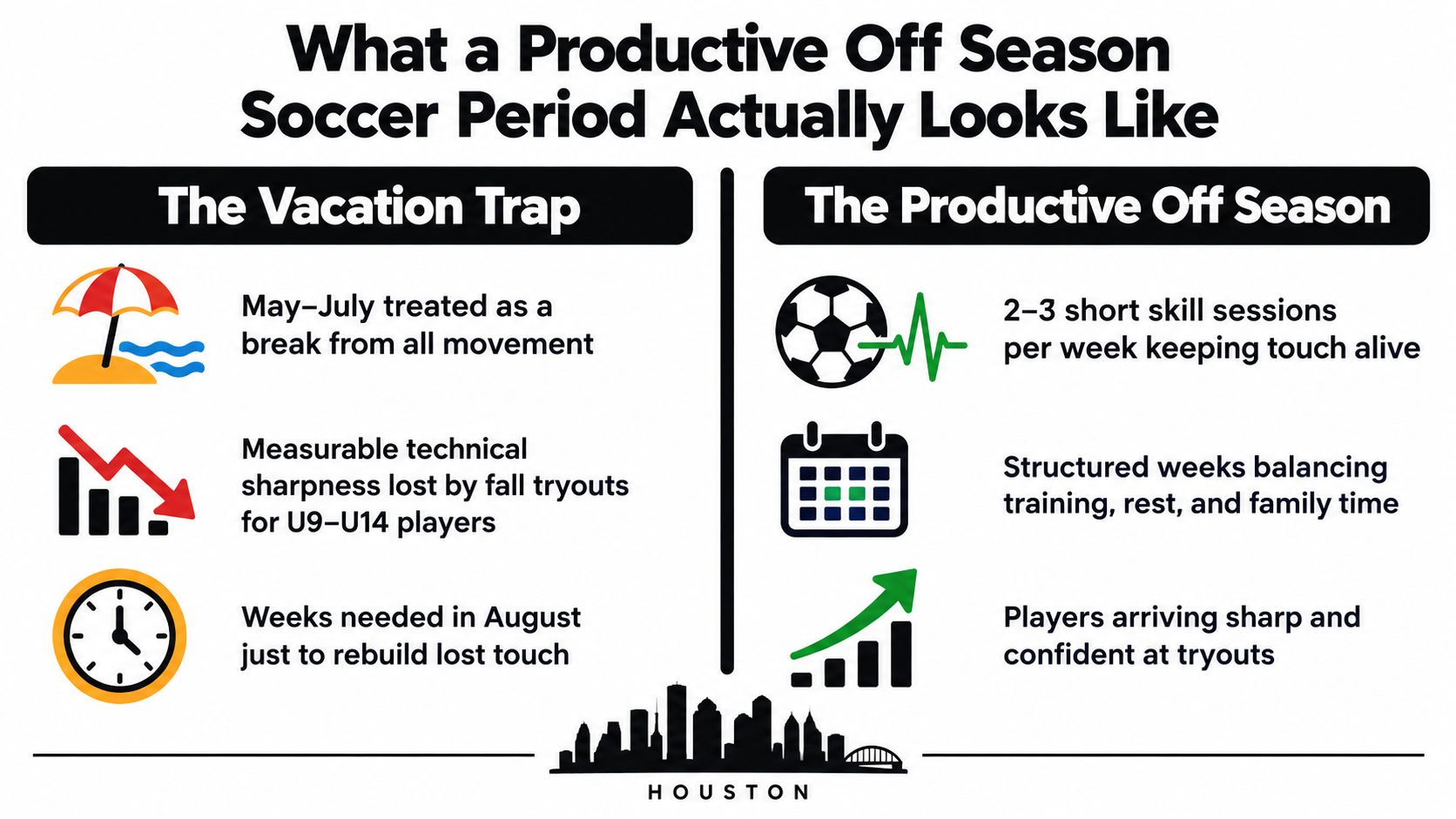
By early summer, a Houston player may be carrying spring fatigue while facing weeks of heat, humidity, and no regular team rhythm. Removing all activity until tryouts can leave U9 to U14 players rusty with first touch, coordination, and decisions. Filling the break with camps, showcases, private sessions, and leagues creates a different problem: the player reaches preseason mentally and physically spent.
A productive off season soccer period gives each part of the break a clear job. Elite programs often separate recovery, strength and power development, and soccer-specific conditioning across 6 to 12 weeks in youth soccer research. For Houston families, that can cover much of the summer, but training should stay intentional and lower-volume than the competitive season.
Start with the right objective
The goal is not to win every summer fitness test. It is to enter preseason faster, more durable, technically cleaner, and more coachable than when the spring calendar ended.
Set three priorities:
Keep touch alive: Short technical sessions preserve comfort with the ball without recreating a full team-training week.
Build the athletic base: Strength, balance, mobility, and controlled speed work can address weaknesses that regular practices may overlook.
Protect recovery: A player who sleeps well and enjoys the summer can absorb training better than one who stays sore throughout the break.
Research involving under-19 players found that a short, structured schedule can limit declines in jumping and sprint performance compared with doing nothing, while high-intensity interval training can help maintain aerobic fitness. The study's findings on under-19 players should guide expectations, not prescribe hard intervals for every child. Complete inactivity and an overloaded camp calendar are not the only choices.
Adjust for Houston conditions
Heat and humidity change when and where training should happen. Schedule outdoor work early in the morning, use shade or indoor turf, and move lighter technical work into a garage or other small indoor space. Sprinting and small-sided games demand closer supervision, reliable hydration, and permission to stop when heat stress or poor movement appears.
A workable week might include two short ball sessions, one or two supervised athletic sessions, one enjoyable game-based activity, and at least one fully free day. Adjust that mix for the player's age, fatigue, injury history, family schedule, and tryout timing. A camp earns its place when it solves a clear need, such as coaching feedback or organized competition. Otherwise, a simple home plan may provide enough work with less travel and pressure.
Structuring the 8 to 12 Week Off Season Soccer Calendar
A calendar works best when each phase has a clear job. Starting with hard conditioning in the first week ignores the fatigue accumulated during the competitive season. Doing the same light session for the entire break misses the opportunity to build toward preseason.
A practical three-phase model begins with recovery, moves through technical and physical development, then sharpens the player before team activity resumes. The broader youth periodization guidance from U.S. Soccer also supports beginning with rest or non-soccer activity, then using limited structured sessions before increasing demand.
Phase | Weeks | Focus | Sessions per Week | Intensity |
|---|---|---|---|---|
Recovery and reintroduction | 1–3 | Active rest, mobility, easy ball work, relaxed aerobic movement | 2–3 | Low |
Technical and physical build | 4–8 | Ball mastery, strength, controlled speed, small-sided decisions | 4–6, including recovery work | Moderate |
Sharpening and preseason ramp | 9–12 | Position-specific work, transitions, repeated high-quality efforts | 4–6 | Moderate to high, with freshness protected |
Phase one
During the first phase, the player should feel better at the end of the week than at the beginning. Use walks, swimming, mobility, playful ball work, and light coordination games. A sample week could include a short technical session, a mobility and balance session, and an optional recreational activity.
Don't turn every recovery session into disguised conditioning. A child who just finished a demanding spring schedule may need genuine distance from organized soccer.
Phase two
The middle block is where families can build consistency. A workable template includes two or three on-field sessions, two short strength sessions, and one recovery day. Keep the hardest outdoor work early in the morning or move it indoors during the hottest part of the day.
Parents looking for a fixed weekly structure can use this weekly soccer training schedule as a planning reference, then adjust the workload to the child's age and current team commitments.
Phase three
The final phase should look more like soccer, but it shouldn't become a preseason punishment. Add small-sided games, position-specific actions, controlled repeated sprints, and transition decisions. Reduce extra volume as tryouts approach so the player arrives responsive rather than flat.
Practical rule: Increase complexity and intensity gradually, but don't increase every training variable in the same week.
On Field Drills That Build Skill Without Burning Players Out
Off-season field work should create more quality touches, not just more minutes. A player can improve technique through short, focused blocks that leave enough energy for concentration. The drill should match the player's age and the phase of the calendar.
U9 to U11
Younger players need variety and repetition without feeling trapped in a conditioning session.
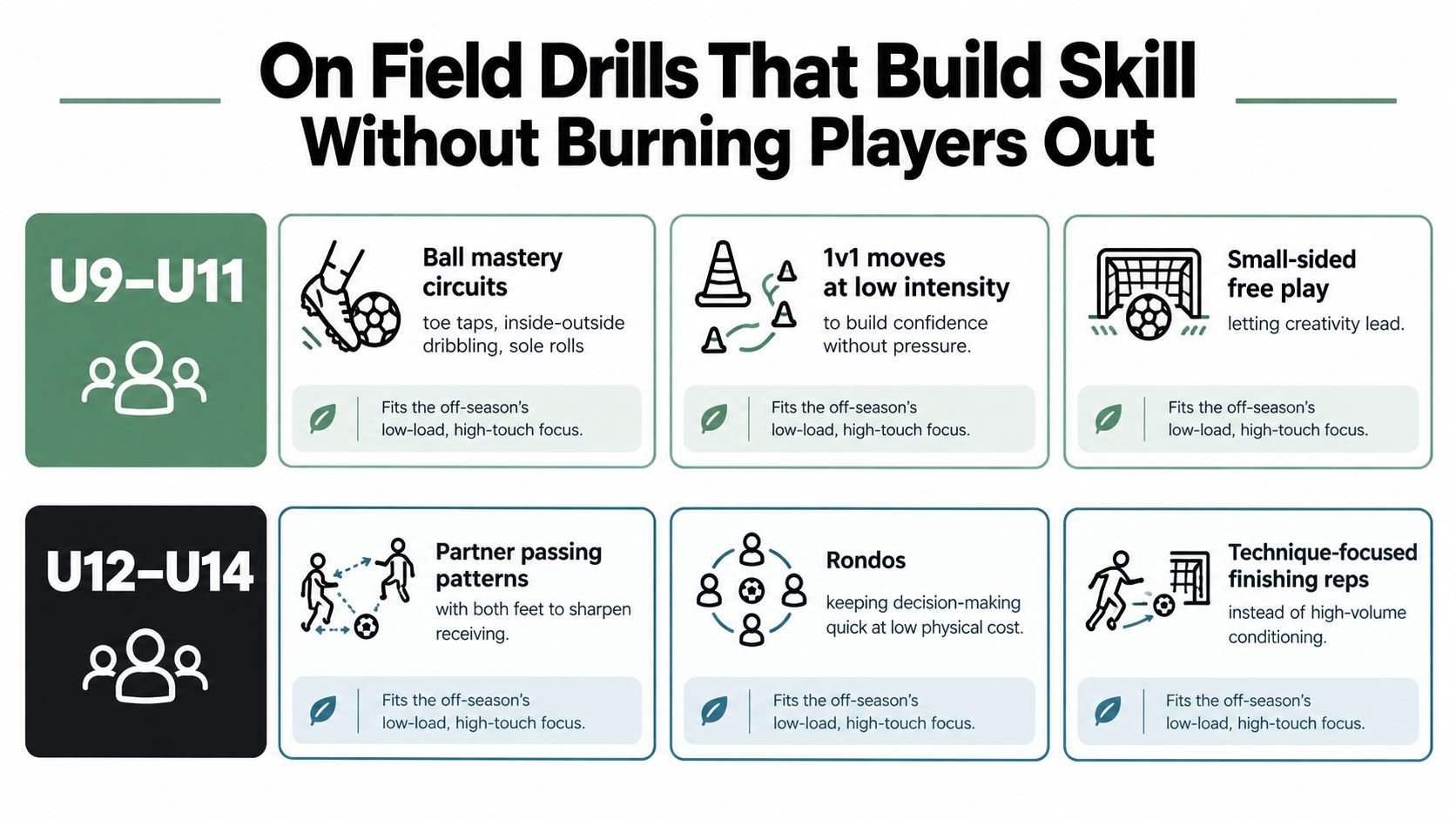
Ball mastery circuit: Use toe taps, inside-outside touches, sole rolls, and changes of direction for short intervals. The aim is comfort and coordination, not fatigue.
1v1 to two goals: Give the attacker a chance to face, deceive, accelerate, and finish. Keep the space compact enough for frequent decisions.
Rondo in a 12-by-12 grid: Use simple numbers and generous encouragement. The player should learn to scan before receiving, protect the ball, and find a teammate.
These drills fit the technical-building phase because they create frequent contacts with the ball while keeping running demands controlled. During the recovery phase, remove pressure and let the player explore moves. During the sharpening phase, add direction, scoring, or a time limit.
U12 to U14
This age group can handle more structure, but technical quality still comes first.
Wall-pass combinations: Work both feet, receive across the body, and move after the pass. Use a partner or rebounder when possible.
3v3 plus a neutral player: Add directional gates so players must recognize when to combine forward instead of circulating aimlessly.
Finishing from realistic service: Include cutbacks, first-time finishes, and controlled touches before shooting. Keep the number of high-quality repetitions manageable.
Individual ball work can run in a garage, driveway, or small indoor turf space when Houston afternoons become uncomfortable. For families creating training materials or organizing coaches, resources such as team member training for creators can also help standardize how sessions are explained and delivered.
A useful session sequence is simple: technical preparation, one decision-making game, then a short finishing or position-specific block. Players should leave with a clear learning point, not just tired legs.
Strength and Conditioning Work for Youth Players
A Houston off-season session can fail in two ways: a young player may spend the break inactive, or a family may stack training until every session becomes another source of fatigue. Strength work should match the player's age, training history, and the heat and humidity outside. A nine-year-old needs coordination, landing control, and body awareness. A teenager may be ready for supervised resistance training once technique and progression are established.
Use a garage, driveway, park, or quiet field. Keep sessions short, place them away from the heaviest soccer days, and stop when movement quality declines. On hot days, train earlier, choose shade or indoor space, and build in water breaks rather than forcing the planned workload.
U8 to U11
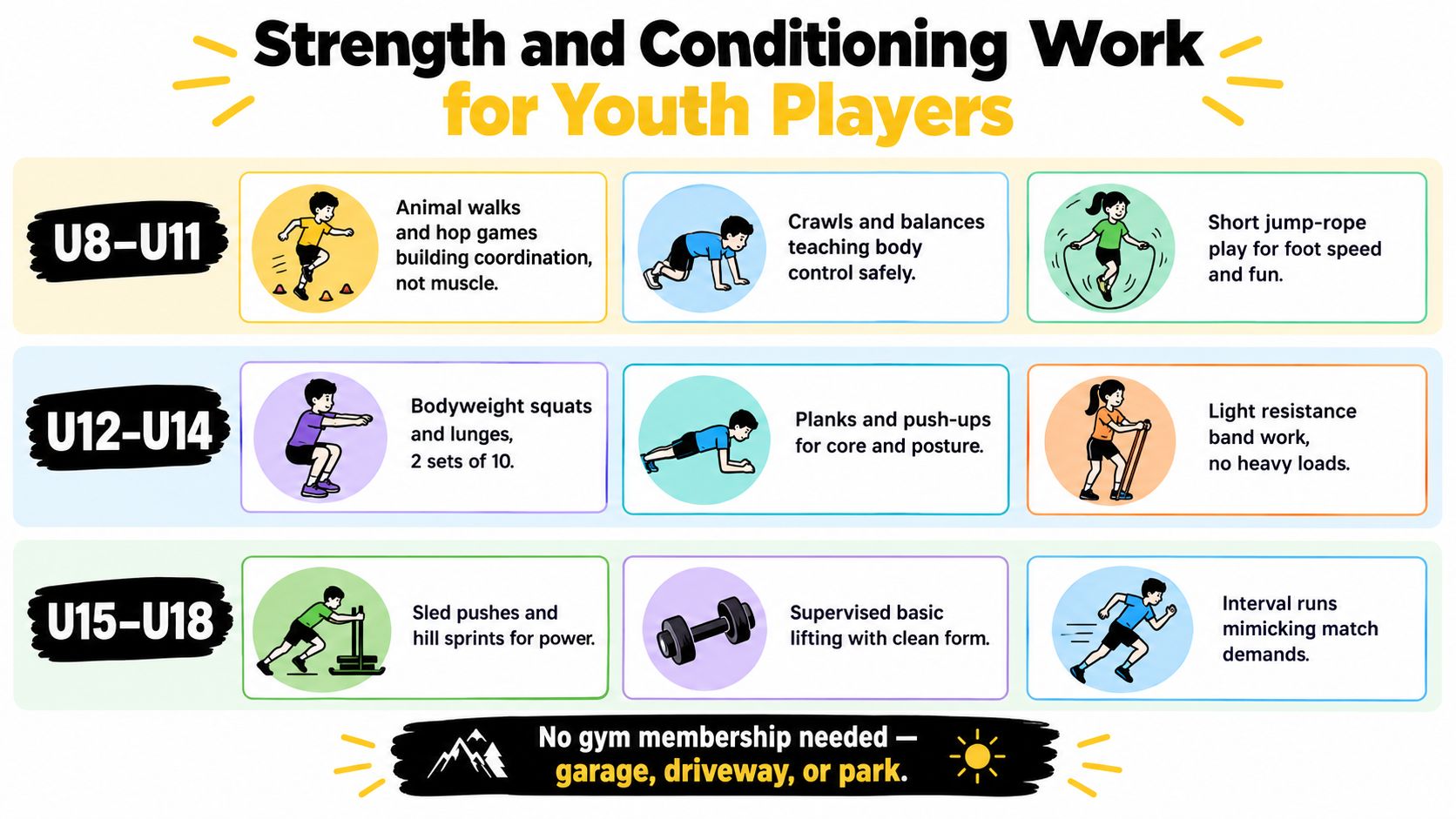
Use two playful sessions each week. Animal walks, bear crawls, single-leg balances, hopping games, and brief jump-rope activities develop coordination without turning training into bodybuilding. Add gentle hip mobility and controlled landing practice.
Avoid heavy external loading and complicated lifting patterns. The child should learn to stop, land, balance, and change direction under control. Keep each session around 25 to 30 minutes, with frequent breaks in Houston weather.
U12 to U14
Use two sessions built around bodyweight basics and light resistance. Squats, reverse lunges, push-ups, planks, band rows, and calf raises work well in a controlled circuit. Teach the knee to stay aligned over the foot during single-leg movements, and stop before technique breaks down.
A second session can focus on hip mobility, balance, low-level jumps, and short acceleration starts. Avoid maximal loading and forced repetitions. If the player cannot maintain clean movement, reduce the difficulty.
U15 to U18
Teen players can progress toward supervised dumbbell or barbell work when a qualified adult teaches each movement. Prioritize the posterior chain, single-leg strength, trunk control, and acceleration. Introduce Copenhagen adductor progressions and Nordic hamstring curls gradually.
Research reviews report declines in body fat, aerobic fitness, jumping, and sprint measures after training stops in off-season soccer research. Keep short hill sprints and posterior-chain work in the plan, while avoiding long mileage that does not match soccer demands. Schedule around 25 to 35 minutes, with at least 48 hours between strength work and the heaviest field load.
Families can use this soccer conditioning exercises guide to organize sessions. Pain, swelling, limping, or persistent soreness calls for professional assessment, not another exercise.
Recovery, Sleep, and Nutrition During the Houston Off Season
Recovery belongs on the calendar before the first training session is planned. Players who eat poorly, sleep inconsistently, and train through warning signs often mistake accumulated fatigue for a lack of fitness.
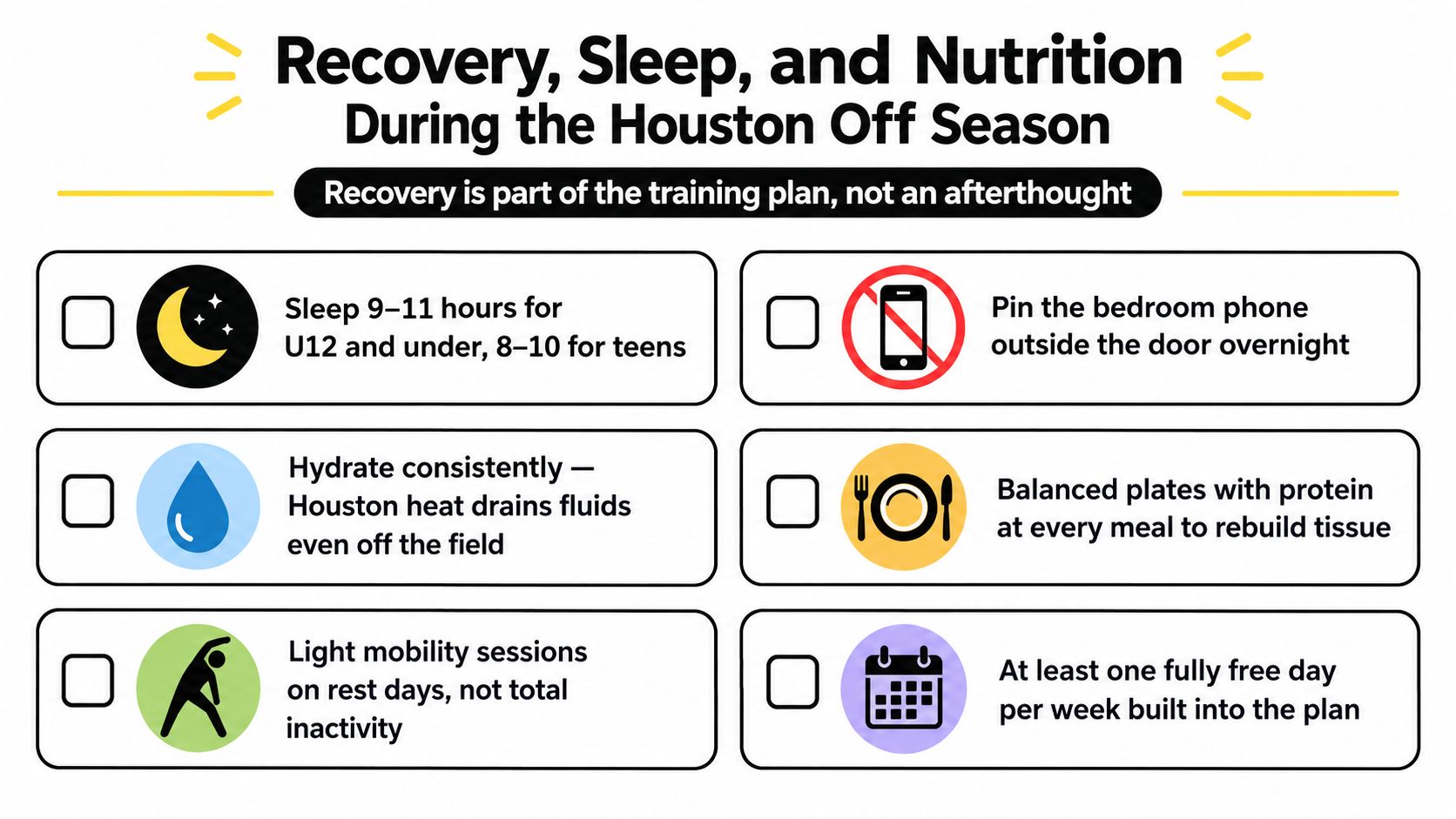
Sleep is the first checkpoint. Younger players generally need 9 to 11 hours, while teenagers commonly need 8 to 10 hours. Keep the bedroom cool, place the phone outside the room overnight, and protect a regular sleep schedule even when school is out.
Hydration in Houston
Heat and humidity make fluid planning part of player safety. Offer electrolyte-containing fluids before and during longer outdoor sessions, especially when a player is sweating heavily. Plain water still has a role, but families shouldn't wait for thirst to become the only signal.
Weighing a player before and after a demanding session can help parents notice substantial fluid loss. A body-weight drop of 2% or more should be treated as a warning sign that the session, hydration plan, or recovery period needs adjustment. Younger children shouldn't manage this process alone, and parents should seek medical guidance when symptoms are severe.
Food should follow the workload
Don't force the same meal plan on a rest day and a two-a-day training day. Increase carbohydrate portions when the schedule demands more running, include protein at meals, and offer a recovery snack after training. A simple plate might combine rice or potatoes, fruit or vegetables, and a protein source such as eggs, yogurt, beans, chicken, or fish.
Families who need a practical planning model can use this 7-day meal prep for runners as a starting point, then adapt portions and food choices to the player's age, appetite, allergies, and training load.
Pool play, relaxed swimming, easy walking, and gentle mobility can provide active recovery without adding another competitive demand. A player who reports unusual fatigue, dizziness, pain, poor sleep, irritability, or a change in movement quality needs a rest day and, when symptoms persist, appropriate medical advice.
Choosing Camps, Clinics, and Academy Programs Wisely
A camp can be useful, but a camp shirt isn't proof of development. Before paying for a week of soccer, ask how much time the player will spend with the ball, how coaches teach decisions, and whether the environment matches the child's age and current needs.
Six criteria make the decision more objective:
Coach-to-player ratio: A ratio under 1 to 12 gives coaches more opportunity to observe and correct players.
Curriculum transparency: Ask for the weekly themes, not just a list of activities.
Coach qualifications and communication: Coaches should understand the age group and communicate clearly with children and parents.
Session length: Younger players usually benefit from shorter, focused sessions rather than long blocks with declining attention.
Contact policy: The program should align with U.S. Soccer guidance and prioritize safe, age-appropriate coaching.
Defined outcomes: Look for technical, tactical, and personal-development goals beyond a highlight video.
Compare the pathway, not just the price
Criterion | Week-Long Camp | Weekly Clinic | Year-Round Academy |
|---|---|---|---|
Cost per touch | Can be low when the player receives frequent ball work, but varies widely | Often consistent when sessions stay focused | Stronger continuity when training, games, and feedback connect |
Scheduling fit | Easy to place in a school-break week | Requires a recurring family commitment | Requires the most planning around school, travel, and competition |
Long-term development | Useful exposure, limited continuity | Builds a repeatable technical habit | Provides a pathway with ongoing coaching and competitive application |
Best use | Reintroduction, evaluation, or a focused summer experience | Maintenance and targeted improvement | Players seeking structured progression over the full cycle |
A structured academy option may combine teams, camps, clinics, tryouts, and recurring training across Greater Houston. Villarreal Houston Academy describes programming for boys and girls from age four upward, with training locations across areas including Humble, Fall Creek, Cypress, Tomball, and the Kingwood, Porter, and New Caney region.
Families considering a camp can also review this youth soccer camps guide before comparing dates, format, coaching, and player fit. The right choice may be a clinic, a DIY plan, a camp, or a year-round program. The answer depends on whether the player needs exposure, consistency, technical correction, or a complete competitive pathway.
Tracking Progress and Building a Repeatable Off Season Plan
Parents don't need a sports science degree to monitor whether the plan is working. They need consistent observations, the same testing conditions, and enough discipline to avoid changing the program every time a child has one poor session.
Use three checkpoints during the break: the first week, the middle of the plan, and the final build toward preseason. Test a 5-10-5 shuttle for change of direction, a 30-meter sprint for linear speed, and a juggling or wall-pass target for first touch. Record the surface, footwear, weather, and whether the player was rested so the comparisons remain useful.
Keep the weekly journal simple
A notebook or shared phone document should capture:
Session effort: Ask the player to rate how hard the session felt.
Sleep: Record the previous night's sleep rather than guessing about recovery.
Soreness: Note location, severity, and whether movement changed.
Enjoyment: A sharp drop in enthusiasm can signal that the schedule is too dense.
Training completed: Mark the session type, not just the total time.
The trend matters more than one result. If sprint times worsen repeatedly, touch becomes less precise, or soreness continues into the next session, reduce volume and restore recovery. If performance is stable and the player feels fresh, progress one variable at a time, such as decision speed, movement complexity, or intensity.
Neuromuscular training may help reduce selected lower-limb injuries in youth soccer, with the clearest protective signal reported for ankle injuries, while pooled results for overall and knee injuries were not conclusive in the cited meta-analysis. That makes the off season a useful time to practice balance, landing, cutting, and strength without rushing back into full competitive loads.
Finish with a written review
At the end of the break, answer three questions:
What improved? Note technical, physical, and confidence changes.
What stagnated? Identify skills that need more coaching rather than more random repetitions.
What changes next cycle? Remove sessions that created fatigue without a clear benefit.
This week, print the family schedule, complete a baseline testing session, check cleats and equipment, prepare a hydration plan, and book an end-of-summer reassessment. Then choose the first week's training load conservatively. A repeatable plan that a player can follow is more valuable than an ambitious plan that collapses after the first hot weekend.
Villarreal Houston Academy offers age-appropriate teams, camps, clinics, tryouts, and year-round training built around technical skill, tactical understanding, character, and competitive development. If your Houston player needs structured support between seasons, visit Villarreal Houston Academy to review current programs and find an option that fits your family's schedule.
Comments