


Player Development Plan for Youth Soccer

More training isn't automatically better development. A young player can attend every practice, play every weekend, and still lack a clear route toward better decisions, healthier workload, and senior football. The difference is a player development plan, a living framework that connects coaching, competition, maturation, education, confidence, and family support.
For parents, the important question isn't only whether a child is getting enough touches. It's whether each activity serves a purpose, whether coaches track change over time, and whether the pathway can adapt when growth, motivation, school, or selection status changes.
Rethinking the Traditional Soccer Pathway
Many youth programs still measure progress through weekend results, team standings, and the amount of training on the calendar. Those signals matter, but they can distract adults from the central question: What is this player learning, and what should come next?
A winning team may rely on early physical developers, direct play, or a small group of confident players. That can produce short-term success without teaching every athlete how to solve problems, communicate, recover, and adjust. Conversely, a player may be developing excellent habits in scanning, movement, and decision-making even when the team's results remain uneven.
From attendance to purposeful progression
Team practice gives players shared experiences. It doesn't automatically provide an individualized pathway. A useful plan identifies technical, tactical, physical, psychological, and social objectives, then connects those objectives to training tasks, match roles, feedback, and review points.
FIFA's global talent-development study examined youth-football systems across 205 member associations, with research conducted over 14 months beginning in January 2020. The research team completed 1,143 interviews and 2,140 surveys, while Double Pass analyzed 864 football academies. The study evaluated identification, training, playing opportunities, and the transition from youth to senior football. FIFA's global talent-development report found that talented players can remain undiscovered when planning, education, infrastructure, and financial resources are inadequate.
The pathway problem is especially clear at the transition to senior football. FIFA reported that only 43 of the world's top 100 football associations had a specific strategy for moving players from youth football into senior football. That figure gives families a useful evaluation question: does an academy explain how players progress from introductory football to competitive and high-performance environments?
Practical rule: A season schedule tells you when training happens. A development plan explains why it happens and how coaches will know whether it worked.
What a living plan contains
A strong plan changes as the player changes. It might begin with ball control and coordination, then move toward scanning before receiving, protecting the ball under pressure, or choosing when to break a line. It should also record the player's response to mistakes, communication with teammates, availability, fatigue, and school demands.
Parents should ask to see the logic behind progression, not demand a promise of elite selection. The best pathway is rarely a straight line. Players may move between recreational, competitive, school, academy, and international opportunities as their needs develop.
The Five Pillars of Holistic Athlete Growth
Ball mastery is visible, so adults often give it most of their attention. A complete player development plan treats technical ability as one part of a connected system. A player needs the skill to execute, the awareness to choose, the physical capacity to repeat the action, and the mental and social qualities to remain engaged when the game becomes difficult.
Technical and tactical learning
Technical development includes receiving, passing, dribbling, finishing, turning, tackling, and striking with both feet. The objective changes with age and experience. A younger player may need coordination, comfort with the ball, and freedom to experiment. An older player should connect technique to pressure, space, tempo, body orientation, and the next action.
Tactical development asks different questions. Can the player scan before receiving? Does the player recognize when to pass forward, switch play, protect possession, or press? A ten-year-old might work on creating passing angles and understanding basic team shape. A sixteen-year-old may need to manage space between lines, recognize pressing triggers, and adjust positioning according to teammates and opponents.
Physical preparation
Physical work should support football rather than become a separate contest about size or speed. Coaches can observe acceleration, deceleration, balance, coordination, change of direction, repeated effort, and movement quality. During rapid growth, the plan may need to reduce complexity, modify volume, and place greater emphasis on control and recovery.
FIFA reports that an average 14-year-old male player at an academy in one of the world's top 20 football markets plays 44 matches per season, including friendlies. FIFA's analysis of playing opportunities shows why match volume needs context. Games are useful when they connect to coaching feedback and progressive objectives, not when they only fill the calendar.
Mental and character growth
Confidence isn't the same as constant success. Coaches can define mental and character objectives through observable behaviors:
Response to mistakes: The player uses a reset routine and re-enters the action instead of withdrawing.
Communication: The player gives useful information, listens, and accepts correction.
Preparation: The player arrives ready, understands the session objective, and manages equipment responsibly.
Problem-solving: The player attempts a solution before waiting for an adult to provide one.
Reflection: The player can identify what worked and name a practical next step.
A parent can observe these qualities without turning every car ride into a performance review. Ask what decision the player noticed, how they helped a teammate, or what they would try differently. Those questions value learning rather than placing the entire emotional weight on the result.
Age-appropriate priorities
Age Group | Technical Focus | Tactical Focus | Mental/Character Focus |
|---|---|---|---|
Early development | Coordination, ball familiarity, both-foot exploration | Understanding space, direction, and basic support | Enjoyment, curiosity, sharing, and trying again |
Preteen years | Receiving under pressure, combination play, finishing | Scanning, passing options, transition decisions | Communication, independence, and response to mistakes |
Teenage years | Position-specific execution at speed | Positional play, pressing, game management, and adaptation | Accountability, resilience, reflection, and leadership |
These pillars overlap. A player who scans earlier can receive more cleanly. A player who communicates can organize defensive pressure. A player who handles mistakes can keep attempting difficult actions, which creates more opportunities for technical learning.
Structuring Weekly and Yearly Training Cycles
A productive calendar alternates stress and recovery. Repeating the same high-intensity session throughout the year can make training predictable, while abrupt increases in workload can raise the risk of fatigue and injury. Coaches should periodize the year into development blocks and give each block a small number of clear outcomes.
Start with the annual view:
Pre-season: Build movement habits, technical consistency, fitness foundations, and team principles.
Competition phase: Maintain sharpness, connect training to match problems, and manage playing demands.
Mid-season reset: Review objectives, restore energy, refine tactical details, and address neglected skills.
Off-season: Recover physically and mentally while maintaining enjoyable ball contact and developing individual weaknesses.
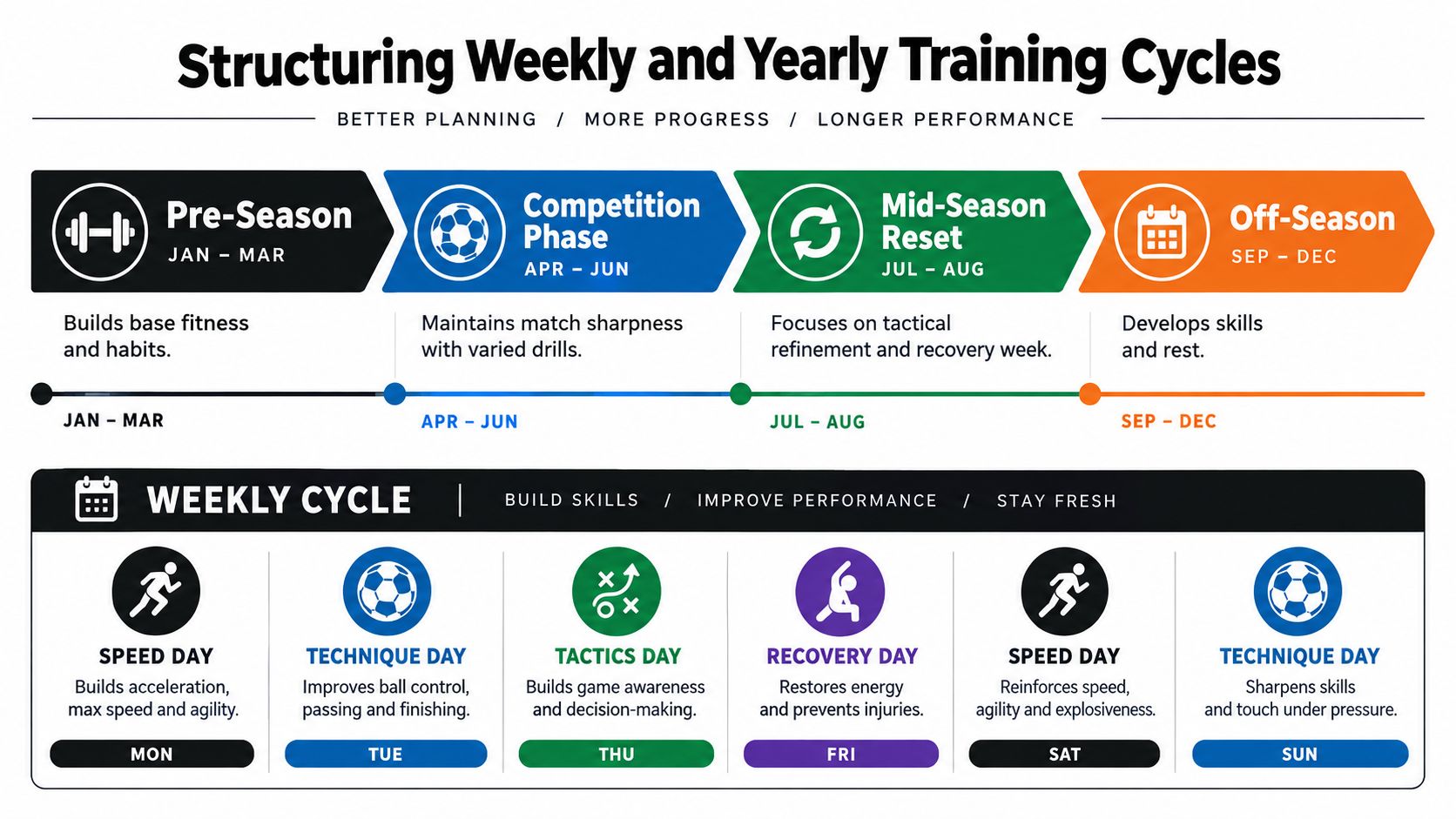
A workable weekly rhythm
The exact schedule depends on age, school, match commitments, travel, and the player's current condition. A useful template might include a team session built around principles, a second session focused on tactical problems, an individual technical activity, competition, and genuine recovery. Unstructured play can also help younger players develop creativity without constant adult direction.
Each block should name one or two observable technical-tactical behaviors, a physical objective, a workload range, and a reassessment date. For example, a player might work on checking the shoulder before receiving, supporting the ball carrier after passing, and recovering calmly after a turnover. Coaches can then adjust the task rather than just adding more repetitions.
Families can use a simple weekly record with session type, perceived exertion, sleep quality, soreness, mood, and school pressure. Parents who want a broader explanation of practical monitoring can review this guide to track training load effectively, then adapt the principle to a youth-soccer context.
Adjusting the plan
A growth spurt, exam period, illness, travel weekend, or change in team role should trigger a review. Reduce exposure when the player shows persistent fatigue, declining movement quality, unusual soreness, or a sharp change in motivation. Progress when the player handles the current demand with good technique, stable energy, and consistent engagement.
For families building a repeatable routine, this weekly soccer training schedule can provide a useful reference point. The schedule should serve the player, not control the player's entire life. School, sleep, friendships, family time, and healthy enjoyment are part of sustainable preparation.
Tracking Progress Beyond the Scoreboard
A player's current size, speed, or match dominance can create a misleading impression of future potential. Biological maturation doesn't follow the same timetable for every child, so age-only selection can reward temporary physical advantages and overlook late developers.
A technically defensible monitoring cycle begins with an individual baseline. Record technical execution, tactical behaviors, movement quality, growth indicators, training availability, perceived exertion, and match involvement. Reassess growth and maturity approximately every two to three months, then compare the player primarily with their own trend and with benchmarks appropriate to age, position, and maturity. These recommendations are supported by guidance on maturation-informed longitudinal monitoring.
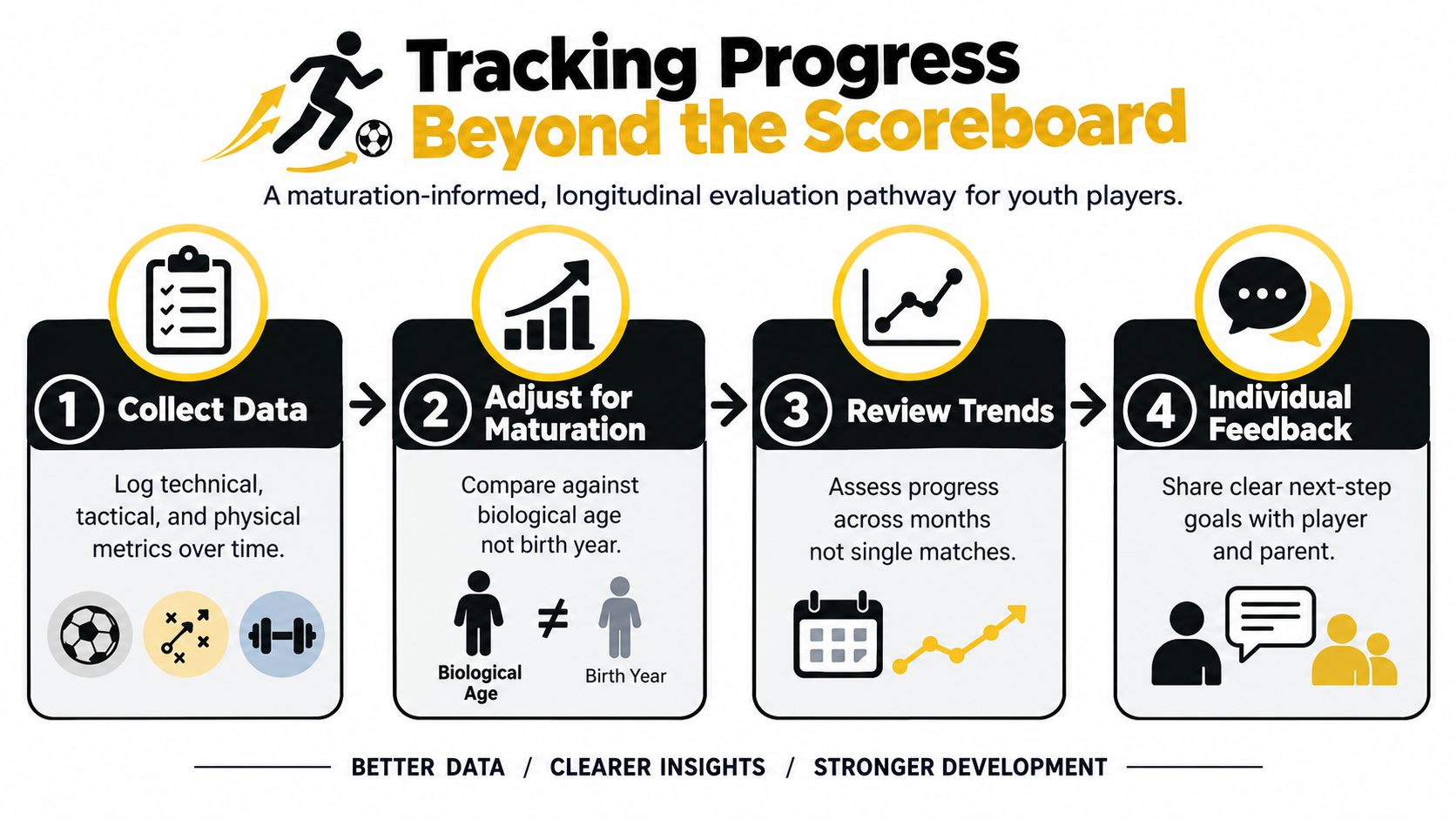
Four questions for every review
What was the starting point? A baseline might include stature, sitting height, body mass, sprint and change-of-direction tests, technical actions, coach-rated behaviors, training attendance, and perceived effort. The record doesn't need to become an obsession. Its value comes from consistency.
What has changed? A coach should look for trends across months, not react to one match. Has the player improved body orientation before receiving? Does the player make better decisions when pressed? Has fatigue affected effort or movement?
What might maturation explain? Biologically advanced players may temporarily benefit from greater strength, power, sprint speed, and aerobic or anaerobic capacity. Late maturers can be undervalued when evaluators mistake current physical advantage for a permanent difference.
What should change next? Reviews should lead to practical adjustments in training exposure, recovery, role, and objectives. The player and family should understand the next target and how coaches will observe it.
A longitudinal study of 42 high-level players aged 11 to 16 found that, even after two to four years of high-level training, longer follow-up reduced the ability to predict future running performance. Less-fit players only partially closed the gap during adolescence. The lesson is not to ignore performance. It's to interpret performance carefully and avoid releasing or labeling a player because of one testing window.
The fairest comparison is often the player's previous version, not the biggest or fastest player in the group.
Applying the Villarreal CF Methodology Locally
The Villarreal approach begins with a simple football problem: how can a player see the game earlier and make a better decision under pressure? The answer isn't limited to running faster or striking harder. It involves close control, intelligent movement, positional understanding, quick support, and the confidence to keep the ball when a safer solution is available.
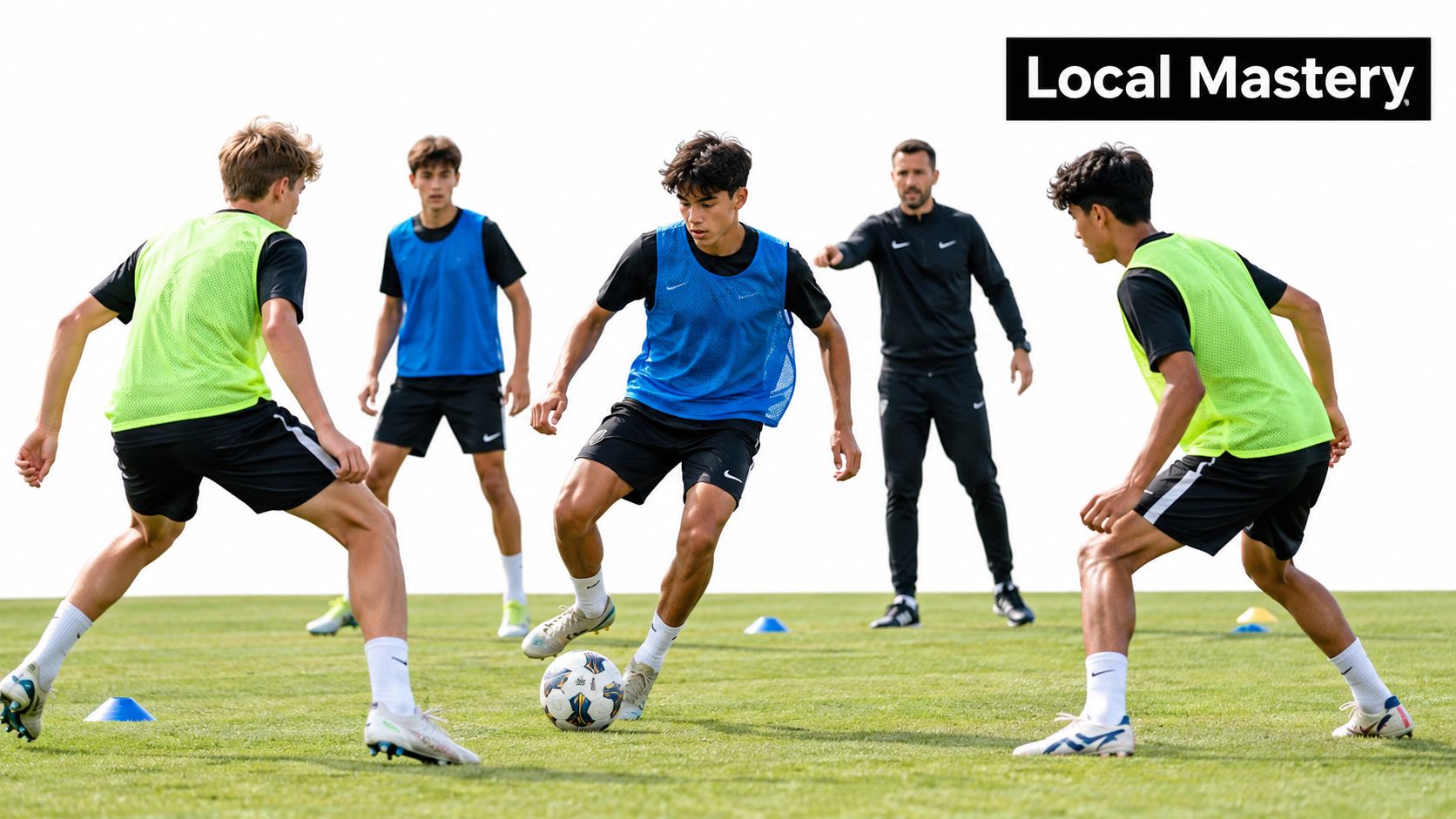
Turning principles into training
A coach might create a small-sided game where a team earns value by finding a free player after a controlled possession sequence. The condition encourages scanning, spacing, support angles, and movement away from the ball. A rondo can develop quick decisions, but the coach should connect it to match behavior: opening the body, recognizing the next pass, and reacting immediately after losing possession.
The methodology also asks players to understand their role without becoming trapped by a position too early. A defender should learn to pass through pressure. An attacker should learn to press and recover. A midfielder should understand how teammates create passing lanes. This broader education helps players read the whole game rather than memorize isolated movements.
The Villarreal CF youth academy pathway illustrates how an official partner environment can translate an international methodology into local programming. In Greater Houston, that translation needs to respect the player's age, experience, school schedule, physical development, and family circumstances.
A training example
Consider a young player who receives near the sideline with an opponent closing quickly. A drill-only session might ask for repeated turns. A methodology-led session can add information:
Can the player scan before the pass arrives?
Is the first touch away from pressure?
Does a teammate create a second option?
Should the player combine, carry, or protect the ball?
What happens immediately after losing possession?
The coach can vary the space, number of players, direction, and time available, then ask the player to explain the decision. That conversation builds tactical awareness without turning training into a lecture.
The cultural side matters too. Respect, integrity, and personal responsibility should appear in daily behaviors: arriving prepared, listening to teammates, accepting feedback, caring for equipment, and responding constructively to mistakes. Technical quality and character aren't competing priorities. They reinforce the trust required for intelligent, creative football.
The following video offers additional visual context for families and players exploring the training environment:
Safeguarding Mental Health and Preventing Burnout
A development plan that ignores emotional health eventually undermines its own technical goals. Players need challenge, but they also need belonging, recovery, voice, and permission to remain interested in the game.
Recent evidence identifies coaching quality, personal mindset, and social support as important perceived contributors to youth development, while scholarship continues to examine how academies can assess confidence, resilience, self-regulation, communication, and decision-making. A practical plan can include these qualities without reducing a child to a vague label such as “mentally weak.”
Build decision rules before problems appear
Agree in advance on what happens when the player shows warning signs:
Persistent fatigue: Reduce intensity or volume, check recovery, and involve the appropriate health professional when needed.
Motivation decline: Ask what has changed before adding pressure or assuming poor commitment.
Rapid growth: Review movement quality, soreness, coordination, and training demands.
Selection disappointment: Provide a clear development target and a scheduled review rather than treating non-selection as a final judgment.
Schedule overload: Protect school, sleep, family stability, and unstructured activity.
Research on youth athletes links burnout to social and psychological conditions as well as training demands. One recent study found that single-sport specialization was associated with significantly greater emotional and physical exhaustion, while other burnout dimensions were higher among some non-specialized athletes. The message is nuanced: specialization isn't automatically harmful or automatically beneficial. Coaches must consider the individual, workload, support system, and stage of development.
Parents can help by separating support from control. Ask what the player enjoyed, what decision felt difficult, and what support would help next week. Avoid making every match a referendum on talent. Families seeking accessible guidance on how to beat burnout naturally can use it as a starting point, while recognizing that persistent physical or psychological symptoms deserve qualified professional attention.
A plan should also give the player a voice in reviews. Sports psychology for youth players can support conversations about confidence, pressure, routines, and healthy responses to setbacks. The aim is sustained participation that keeps learning possible across multiple seasons.
Villarreal Houston Academy provides age-appropriate teams, camps, clinics, tryouts, and competitive programming for boys and girls, using a structured pathway influenced by Villarreal CF's methodology and supported by qualified coaches and sports psychology resources. If your family wants to evaluate a player development plan built around technical skill, tactical intelligence, character, and sustainable progression, visit Villarreal Houston Academy to explore local programs and next steps.
Comments