


Sports Psychology Youth: Building Mental Strength

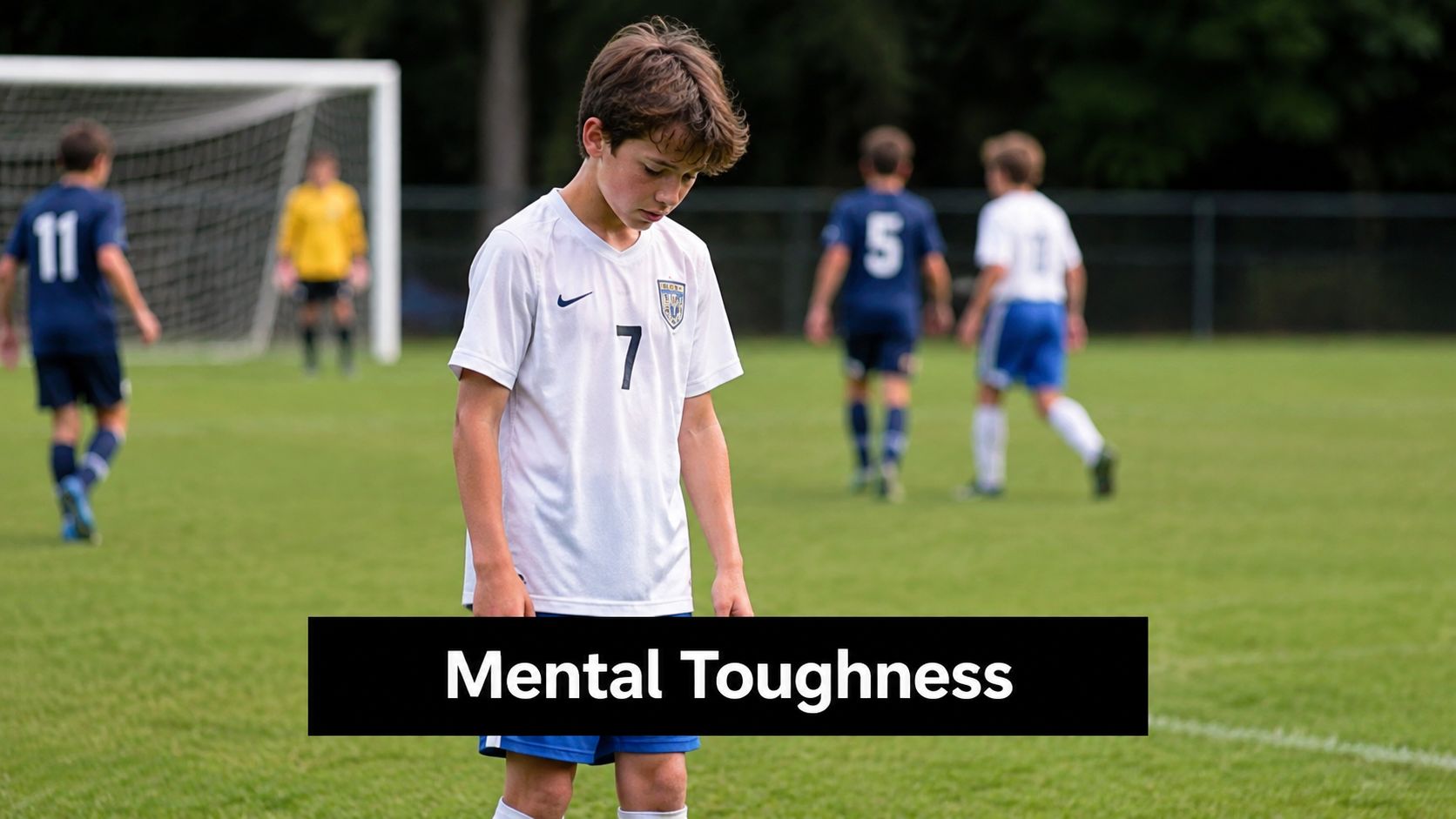
The pass is simple. The reaction isn't. A 12-year-old midfielder misplaces a key ball, drops their shoulders, stops calling for possession, and spends the rest of the match trying not to make another mistake. From the sideline, an adult may see poor concentration or a lack of confidence. The player may be experiencing something more basic: they haven't yet learned how to recover emotionally while the game continues.
That moment captures why sports psychology for youth belongs in everyday soccer development. Young players face selection pressure, parental expectations, peer comparison, injury concerns, and constant evaluation while their thinking, emotional regulation, and identity are still developing. Mental training shouldn't wait until an athlete is struggling. It should grow alongside technical skill, tactical understanding, physical coordination, and character.
The Mental Game Behind Youth Soccer Development
A missed pass can become a five-minute collapse when a player interprets it as proof that they aren't good enough. The body tightens, attention shifts from the field to the error, and the player begins avoiding the decisions that soccer requires. A coach who only corrects the technical mistake may miss the more important lesson: the athlete needs a reliable way to reset.
Pressure appears before adulthood
Competitive youth soccer can reward commitment, but the environment can also magnify every result. Early specialization may narrow a child's sense of identity. Tryouts can make selection feel like a judgment of personal worth. Social media adds another layer of comparison, while adults sometimes bring their own frustration to training and match days.
A recent review describes a “paradox of participation”, in which performance pressure, social media surveillance, and adult dysregulation can undermine psychological safety. The same review connects early specialization and pay-to-play structures with identity foreclosure and psychological harm. That evidence supports a practical conclusion: adding more competition doesn't automatically create healthier or better-developed players. Structural choices matter. The review on psychological safety in youth sport offers useful context for parents and club leaders.
Practical rule: A player must feel safe enough to make a difficult decision before they can consistently play bravely.
Mental training is part of development
Youth sport participation is associated with better physical activity, healthier body composition, improved well-being, and less mental ill-being over time than nonparticipation, according to a contemporary review of youth sport research. The same review notes that more than half of children ages 6 to 17 participated in youth sport in 2020, showing how important sport environments are in children's lives. Research on elite youth athletes has also expanded substantially, with one scoping review synthesizing 33 studies covering 5,826 athletes and identifying disordered eating, anxiety, and depression among the most frequently examined concerns. The review of youth athlete mental health research places mental development within the broader purpose of youth sport.
Technical coaching teaches a player how to receive under pressure. Tactical coaching teaches where to move next. Sports psychology teaches the player how to notice pressure, respond to a mistake, communicate with teammates, and remain connected to the game. Those skills aren't a luxury reserved for elite prospects. They're part of preparing a young person to learn, compete, and grow.
What Youth Sports Psychology Actually Means
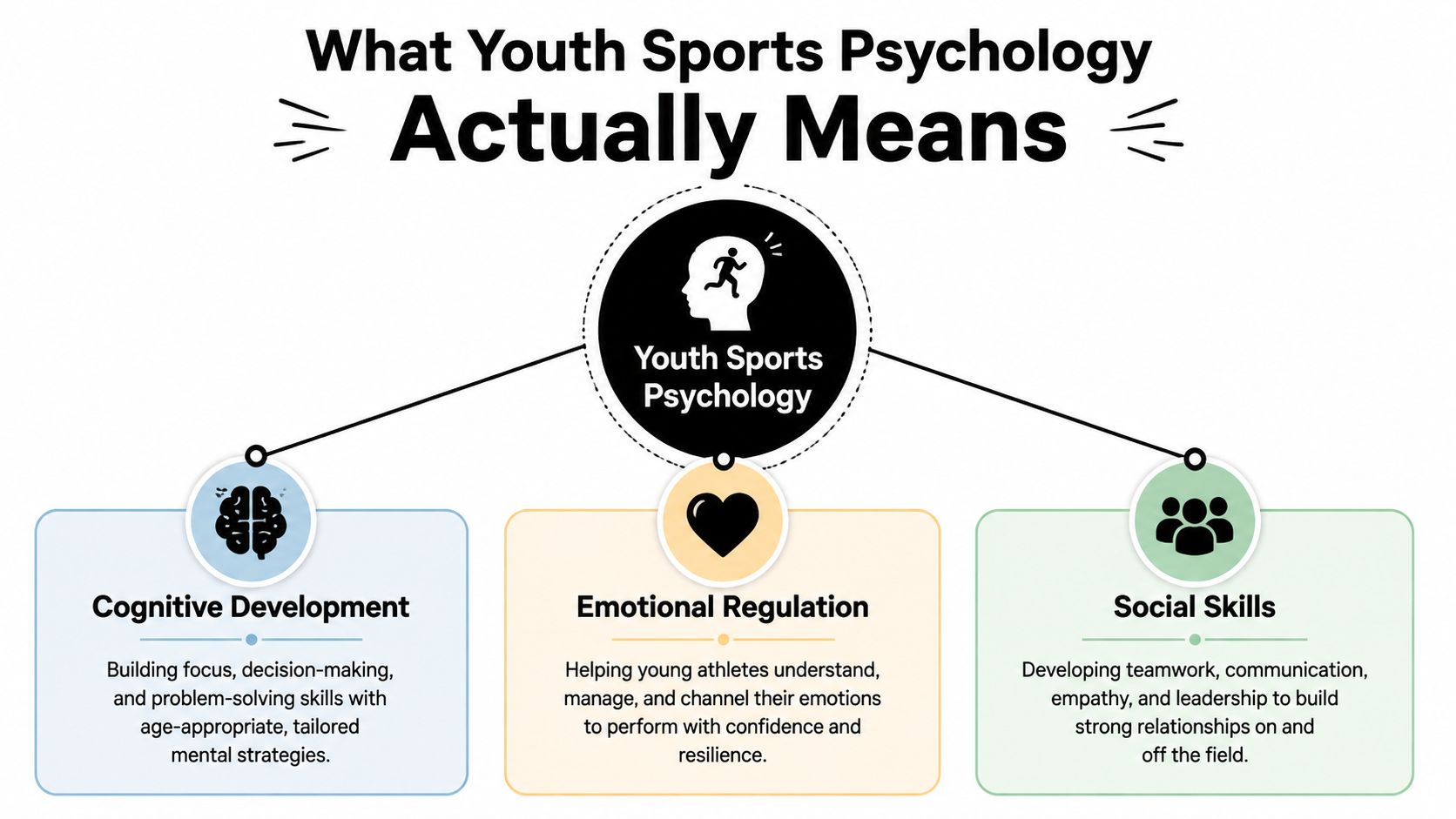
Youth sports psychology applies psychological principles to sport while accounting for a child's cognitive, emotional, and social development. It isn't adult performance psychology delivered in simpler language. A young athlete's ability to understand abstract ideas, regulate strong emotions, interpret feedback, and separate self-worth from performance changes over time.
A seven-year-old may need help naming frustration and returning attention to play. A sixteen-year-old may need to examine perfectionism, identity, social comparison, or persistent performance anxiety. Both athletes need mental support, but the language, exercises, and level of independence should differ.
Five connected areas
Emotional regulation: Recognizing feelings such as anger, fear, disappointment, and excitement, then using an age-appropriate response.
Self-talk: Replacing harsh or inaccurate internal statements with useful cues such as “scan,” “next play,” or “find space.”
Goal-setting: Turning a broad ambition into behaviors the athlete can practice, observe, and review.
Attention control: Returning focus to relevant information after a distraction, mistake, crowd reaction, or coaching instruction.
Identity development: Helping athletes understand that soccer can be important without becoming the only source of value or belonging.
Performance anxiety also needs careful definition. Research with 1,038 athletes aged 9 to 14 supports a three-factor structure involving somatic anxiety, worry, and concentration disruption. In practical terms, “nerves” may include physical activation, fearful thinking, or difficulty directing attention. The research on performance anxiety in young athletes explains why one generic confidence speech rarely solves every problem.
Sports psychology is also proactive. A player doesn't need a diagnosis to learn breathing, constructive self-talk, or reflection. Coaches can use these tools as educational parts of practice, while licensed professionals address clinical needs. Parents looking for broader mental performance ideas can also review these mental performance coach tips, then adapt them to the child's age and personality rather than copying adult-oriented exercises.
How Mental Skills Develop Across Different Ages
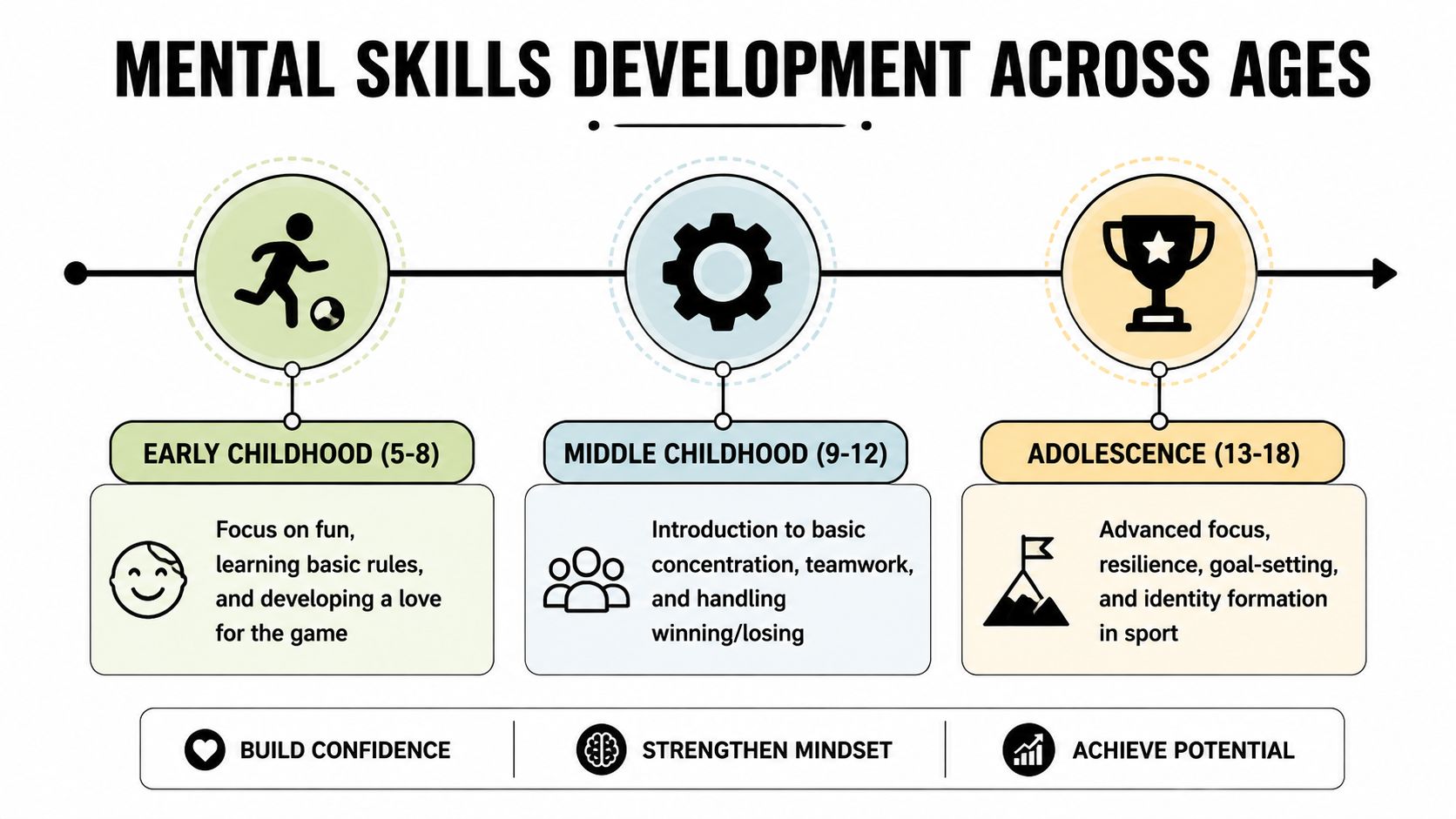
Mental training works best when adults match the tool to the child's development. Asking a young player to visualize a complex tactical sequence may sound advanced, but the exercise can feel confusing if the child doesn't yet think comfortably in abstract images. At the other end, giving an older athlete only simple praise can leave them without the deeper tools needed to manage pressure and identity.
Early childhood from ages 5 to 8
The first task is building a positive relationship with the game. Young children learn through movement, imitation, play, and short cues. They benefit from adults who help them identify emotions without turning every feeling into a problem.
A six-year-old might use a reset word such as “next” after losing the ball. The coach can pair the word with a physical action, like touching the jersey or clapping once, then direct the child toward the next simple task. The objective isn't deep introspection. It's learning that disappointment can be noticed and followed by action.
Keep instructions concrete:
Name the feeling: “Your face looks frustrated.”
Offer one action: “Take a breath and find your teammate.”
Reward re-engagement: Praise returning to play, not just a successful outcome.
Middle childhood from ages 9 to 12
Players in this stage can begin connecting choices with consequences. They can understand that a routine may help them prepare, that breathing can settle an overactive body, and that a mistake doesn't determine the next play.
An 11-year-old taking a free kick might create a short routine: place the ball, look at the target, take one steady breath, and choose the striking action. The routine should be practiced during normal training so it feels familiar under pressure. Goal-setting can also become more structured, with process goals such as checking over the shoulder before receiving or communicating earlier during defensive transitions.
At this age, coaches can ask, “What did you notice?” before giving an answer. That question develops reflection without demanding adult-level analysis.
Adolescence from ages 13 to 18
Teenagers can work with imagery, mindfulness, journaling, values, and identity questions. A 15-year-old might write about tournament pressure, identify the thoughts that appear before a match, and decide which behaviors remain controllable. Guided autonomy becomes important because adolescents need ownership, not constant correction.
The risks also change. Social comparison, selection decisions, year-round competition, and pressure to define a future through sport can intensify anxiety or burnout. A young athlete may look disciplined while losing sleep, withdrawing socially, or tying every aspect of self-worth to selection.
Advanced tools should be introduced when the athlete can understand and use them, not because they sound impressive.
The soccer development guidance by age can help families think about technical development in age-related terms. Mental development deserves the same progression. Start with emotional co-regulation, build toward independent routines, and eventually support reflective decision-making.
Evidence-Based Techniques for Building Mental Strength
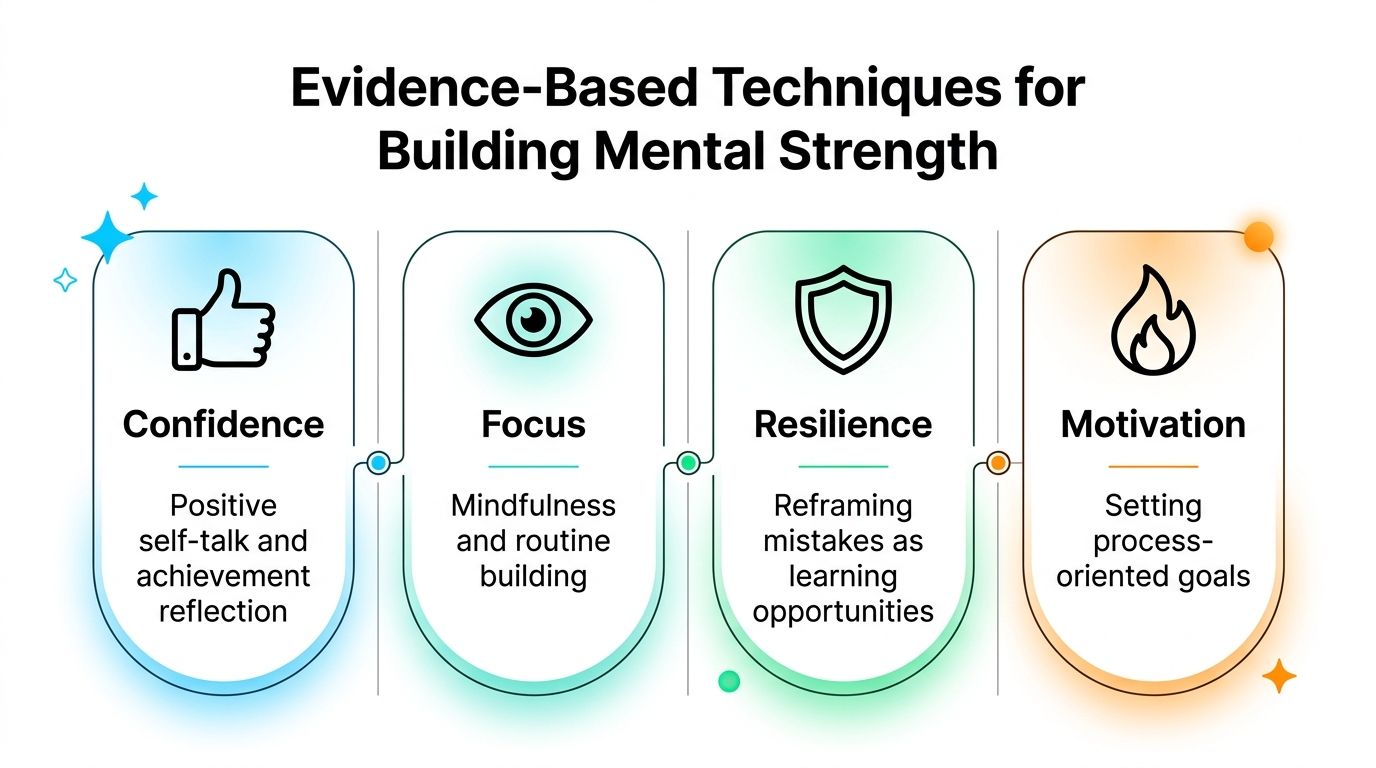
Mental strength isn't a personality trait that some children possess and others lack. Coaches can teach specific responses, repeat them in realistic situations, and help athletes discover which tools work for them. The strongest routines are brief enough to use during practice and clear enough to remember during a difficult match.
Confidence through controllable actions
Confidence grows when players recognize preparation and effective behavior, not only successful outcomes. After training, ask a player to identify one action they controlled, such as checking their shoulder, making a recovery run, or communicating with a teammate. Older players can write these observations in a training journal. Younger players can share them aloud.
Self-talk reframing should stay believable. “I never make mistakes” is too fragile. “I can recover and make the next decision” gives the athlete a useful response without denying difficulty. A short pre-performance routine can combine one breath, one cue word, and one controllable action.
Focus with cue words and grounding
Attention control means noticing distraction and returning to the task. Choose a cue that matches the position or moment. “Scan” may help a midfielder. “Set” may help a goalkeeper prepare for a shot. “Move” may help a player re-engage after losing possession.
A sensory grounding exercise can be brief. Ask the player to notice the feel of the boots, the position of the ball, the sound of a teammate's call, and the next passing option. Younger athletes can focus on one sensory detail. Older athletes can practice this before a corner, free kick, or substitution.
The visualization in sports guide can support older players who are ready to use imagery. Coaches should introduce visualization as a complement to physical practice, not as a replacement for learning the skill.
Resilience after mistakes
Create an error-recovery protocol before an error happens:
Release: Use a small “flush it” gesture to mark the end of the mistake.
Reset: Exhale slowly and relax the shoulders.
Reconnect: Find the ball, teammate, opponent, or space relevant to the next action.
Respond: Choose one clear behavior, such as tracking back or showing for the pass.
For a young player, the coach may model the sequence. An adolescent can practice it during small-sided games where mistakes happen often. Families seeking general workplace resilience ideas may find actionable resilience advice for professionals useful, but youth athletes need shorter language and sport-specific practice.
Motivation through process goals
Outcome goals depend on selection, score lines, and other people's decisions. Process goals focus on actions the player can repeat. A weekly target might involve earlier communication, recovery effort, or receiving with an open body shape. Review the goal at the next training session and ask what helped or got in the way.
The evidence for psychological intervention is especially relevant when anxiety affects performance. The clinical review linked above identifies psychological interventions as the primary treatment for performance anxiety, particularly state anxiety. That supports skills-based coaching, while persistent or severe symptoms require professional assessment.
Practical Guidance for Parents and Coaches
Adults shape the emotional climate around a young athlete. A player may forget a tactical instruction, but they often remember whether the car ride home felt like a safe place to process the match or another test they could fail.
Use questions that create reflection
After a game, replace an immediate verdict with an open question:
“What did you notice about your positioning today?”
“When did you feel most comfortable receiving the ball?”
“What would you like to try in the next training session?”
A car-ride-home protocol can help. Give the player emotional space first, offer water and food, and avoid a detailed review until they appear ready. If they want to talk, listen before explaining. If they don't, agree on a later time to revisit the match.
For coaches, language changes can reduce threat without lowering standards. “Don't miss” directs attention toward failure. “Find the target” directs attention toward the task. “Why did you do that?” can sound accusatory. “What options did you see?” invites decision-making.
Compare the response, not only the result
Scenario | Supportive Approach | Counterproductive Approach |
|---|---|---|
A player misses a penalty | Acknowledge the disappointment, allow a breath, then ask what the player noticed about the routine. | Replay the miss repeatedly or suggest the player let everyone down. |
A player loses possession | Direct attention to the next defensive action and praise immediate re-engagement. | Shout several instructions at once from the sideline. |
A player isn't selected | Validate the feeling, ask what support would help, and identify development actions with the coach. | Compare the player with a sibling, teammate, or earlier version of themselves. |
A player makes repeated errors | Pause, simplify the task, and offer one clear cue. | Tie approval, playing time, or affection to flawless performance. |
U10 players often need more emotional co-regulation. An adult may need to help name the feeling, slow the moment, and provide a simple next action. U16 players can handle more guided autonomy, including reviewing video, identifying patterns, and proposing their own adjustment.
Coach autonomy support matters because it predicts more self-determined regulation and protects against amotivation. In a study of 269 athletes aged 11 to 17, perceived coach autonomy support predicted autonomous behavioral regulation, ranking ahead of parental and peer support, and served as a protective factor against amotivation. The study of coach autonomy support in youth soccer supports choices within structure, such as offering role-specific options, explaining the purpose of a drill, and using guided problem-solving.
When to Seek Professional Sports Psychology Support
Sports psychology isn't only for an athlete who has lost confidence. A coach can teach a reset routine, help a player set process goals, and create a supportive practice environment. A licensed professional is needed when symptoms persist, intensify, or interfere with health, relationships, school, or participation.
Parents and coaches should pay attention to patterns such as:
Persistent performance anxiety: The athlete remains overwhelmed despite ordinary coaching support and practiced mental skills.
Sudden withdrawal: The player stops engaging with teammates, avoids training, or no longer wants to compete.
Sport-related sleep disruption: Worry about matches, selection, or training repeatedly affects sleep.
Identity foreclosure: The athlete treats selection or performance as the only evidence of personal worth.
Clinical concerns: Eating disorders, depression, trauma responses, or other mental health symptoms require qualified clinical care.
Recent evidence identifies gaps in support for elite youth athletes ages 12 to 18, particularly around identity formation, social media, and performance pressure. It also notes that many training programs lack access to sports psychologists. Emerging research is examining selection pressure, parental support, self-compassion, deselection, and premature withdrawal, while a Japanese study reported worsening mental health indicators over time among youth athletes, with female and older athletes at higher risk. The review of mental health support for youth elite athletes reinforces the need to notice more than visible performance.
Start the conversation without stigma. A parent might say, “Mental coaching is one way athletes learn to handle pressure and understand what they need.” Ask whether the player would prefer a practitioner who understands soccer, youth development, or a specific concern. Check licensing, experience with children and adolescents, communication policies, and whether the professional can coordinate appropriately with parents and coaches. Families seeking youth-focused counselling information can also explore Interactive Counselling Kelowna youth services as an example of how youth mental health support may be presented outside a team setting.
How Villarreal Houston Academy Integrates Mental Training
Villarreal Houston Academy treats mental development as part of its broader youth soccer pathway rather than as a separate response to failure. As the official partner academy of Villarreal CF in Spain in the Greater Houston area, it provides competitive programming for boys and girls from age four upward, with age-appropriate coaching focused on intelligence, skill, and character.
That model connects mental skills to ordinary soccer moments. Coaches can reinforce emotional regulation after a mistake, attention during technical work, communication during small-sided games, and reflection after competition. Sports psychologists support youth player development, while the academy's structure emphasizes a safe, fun environment in which players can take risks and learn without fear of punitive reactions.
The approach also recognizes that a player at an early developmental stage shouldn't receive the same mental demands as an adolescent preparing for higher-level competition. Younger athletes need simple cues, emotional support, and enjoyment. Older players can take more responsibility for routines, goal-setting, self-reflection, and decisions about their development. Families can learn more about this approach through mental training for young athletes.
A healthy competitive program doesn't lower standards to protect confidence. It teaches players how to meet standards while preserving curiosity, belonging, and a life beyond results. That balance gives coaches a practical blueprint for developing complete athletes, not just more efficient performers.
Villarreal Houston Academy offers age-appropriate competitive soccer training, camps, clinics, tryouts, and player development supported by sports psychology across the Greater Houston area. If you want your child to build technical ability, tactical intelligence, resilience, and confidence in a structured environment, visit Villarreal Houston Academy to explore available programs.
Comments