


Year Round Soccer Training: How to Balance Growth and Rest

Most advice about year round soccer training treats the calendar like a loyalty card. Stay in a club every month, add a camp, book the private lesson, and never let the ball go cold. More stamps, the story goes, means more progress.
That story skips the bill. Kids can stay connected to soccer across the whole year, the way students stay in school across terms, while the subjects, the pace, and the breaks all change. Nonstop organized soccer is a different choice, and it is a riskier one.
Parents around Humble, Atascocita, and the rest of Greater Houston often stack club, school ball, futsal, lessons, and weekend tournaments because each piece looks reasonable alone. Knees, sleep, and motivation feel the sum, not the brochure. A managed pathway keeps development going and builds rest into the year. It also asks a question most performance guides skip. What does this plan cost in money, drive time, and hours the child no longer has?
What Year Round Soccer Training Really Means
Year round soccer training is a continuous development pathway, not twelve months at match intensity. The job of each block changes. One stretch is technical repetition. Another is strength and movement preparation. Another is deliberately lighter. One stretch is genuine rest, with the boots left in the bag.
A school year is the cleanest analogy. September is not the week before winter break, and a teacher doesn't assign the same load before a unit test and before a holiday. The student is still a student in every term. The work is not identical. A soccer year should work the same way. The player stays in touch with the game while the purpose of the month shifts.
How this differs from specialization
Single-sport specialization with no off-season is a different pattern. One sport, organized teams, almost no other movement, and no real time away after the last game. Youth soccer research ties long, unbroken seasons to more overuse problems, especially at the knee. That research does not say organized soccer should vanish for half the year. It says the year needs a plan, including lower-load periods.
School teams, futsal, camps, private lessons, matches, and pickup games can all live in one plan. They should not all run at full volume in the same week. Futsal can be the technical block when fields are crowded. A camp can replace a week of regular training instead of sitting on top of it. Free play counts as development, and it often costs nothing.
Practical rule: If you can't name what this month is for, and what it is not for, the calendar is collecting sessions rather than building a player.
Continuity versus cumulative load
Productive continuity keeps the ball in a player's life at a dose the body can absorb. Excessive cumulative load keeps adding organized hours because each coach only sees their own session. The rest of this article uses that split. Every new commitment has to improve the week, not just fill it.
Weighing the Benefits and Risks for Young Players
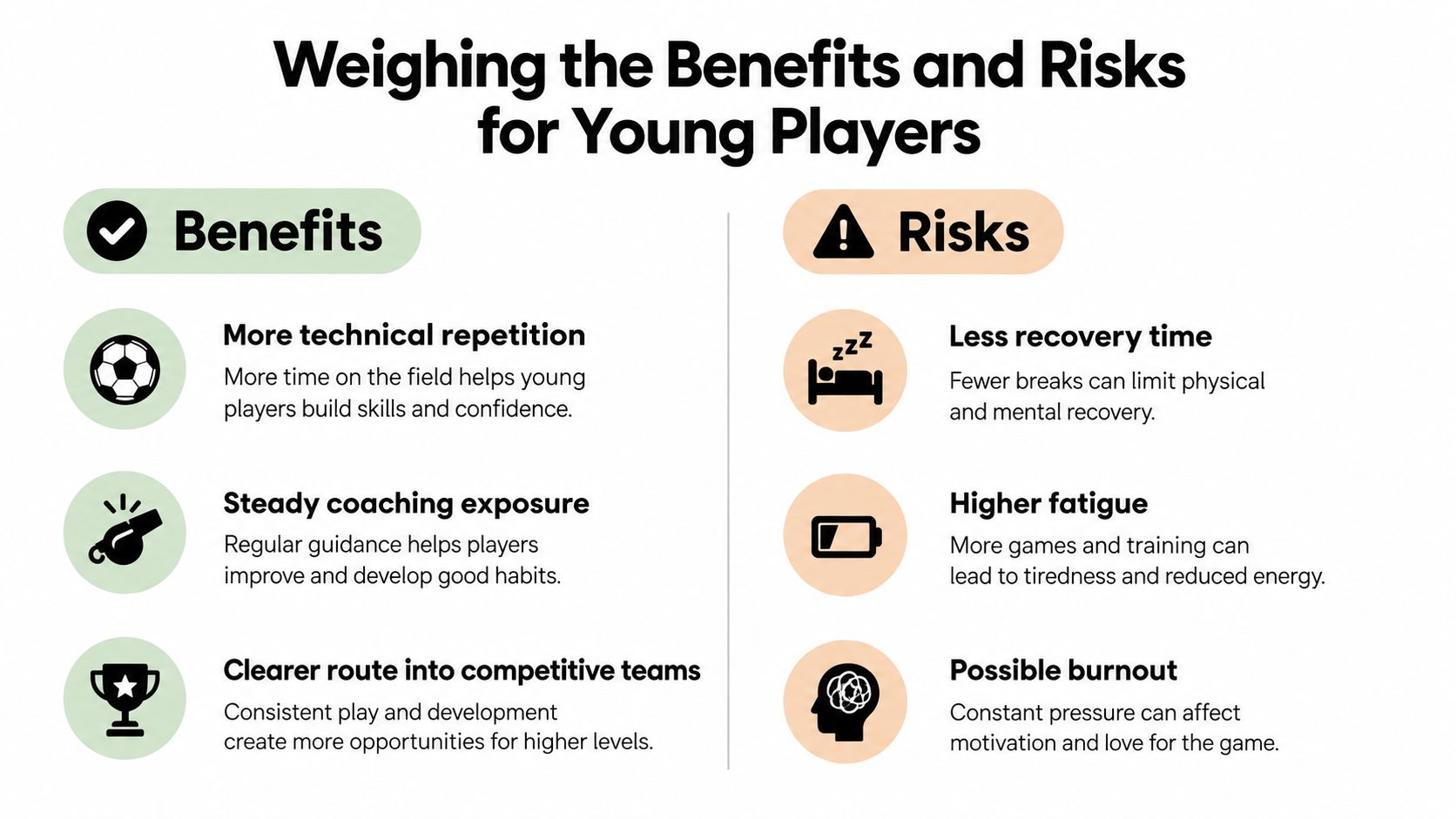
More sessions can mean cleaner touches, a coach who already knows the player, and a clearer route onto a competitive roster. Those gains are real. Technical quality comes from repeated, coached actions over time. A player who vanishes for months often spends the next season rebuilding habits that could have been kept with a lighter dose.
The other side of the ledger is just as real, and it is where families get surprised.
A systematic review of youth soccer injury research reported that playing or training for more than 8 months per year was associated with a higher risk of overuse injuries, particularly at the knee. In a separate study of 761 soccer athletes ages 12 to 18, athletes who played one sport for more than 8 months annually had nearly twice the odds of an overuse knee injury (odds ratio 1.97; 95% confidence interval 1.01 to 3.86), as reported in this review of youth soccer injury research.
That same study found highly specialized athletes were more likely to report previous overuse injuries (odds ratio 2.05) and acute injuries (odds ratio 1.68). Among highly specialized players, soccer-specific overuse knee injuries carried an odds ratio of 5.49.
What those figures do not say
They do not say your child should quit in March. An odds ratio describes an association in the group that was studied. It is not a personal forecast. A player can train across most of the year and stay healthy when the load changes and the rest is real. The narrower reading is the useful one. Unbroken high-volume specialization raises the chance of problems that show up as nagging knees, not only as a dramatic collision.
A test for any added program
Ask what the new session removes, not only what it adds. A clinic that replaces a hard team practice may be worth it. A clinic on the only free evening mostly adds fatigue.
Less recovery time: Two hard days in a row become the normal week.
Higher fatigue: The player needs the opening minutes just to look like themselves.
Possible burnout: Irritability, dread before practice, or a shrug when you mention the game.
These findings support a planned year with lighter blocks. They do not support shutting the sport down, and they do not support never letting up.
Matching Training Cycles to Age and Growth
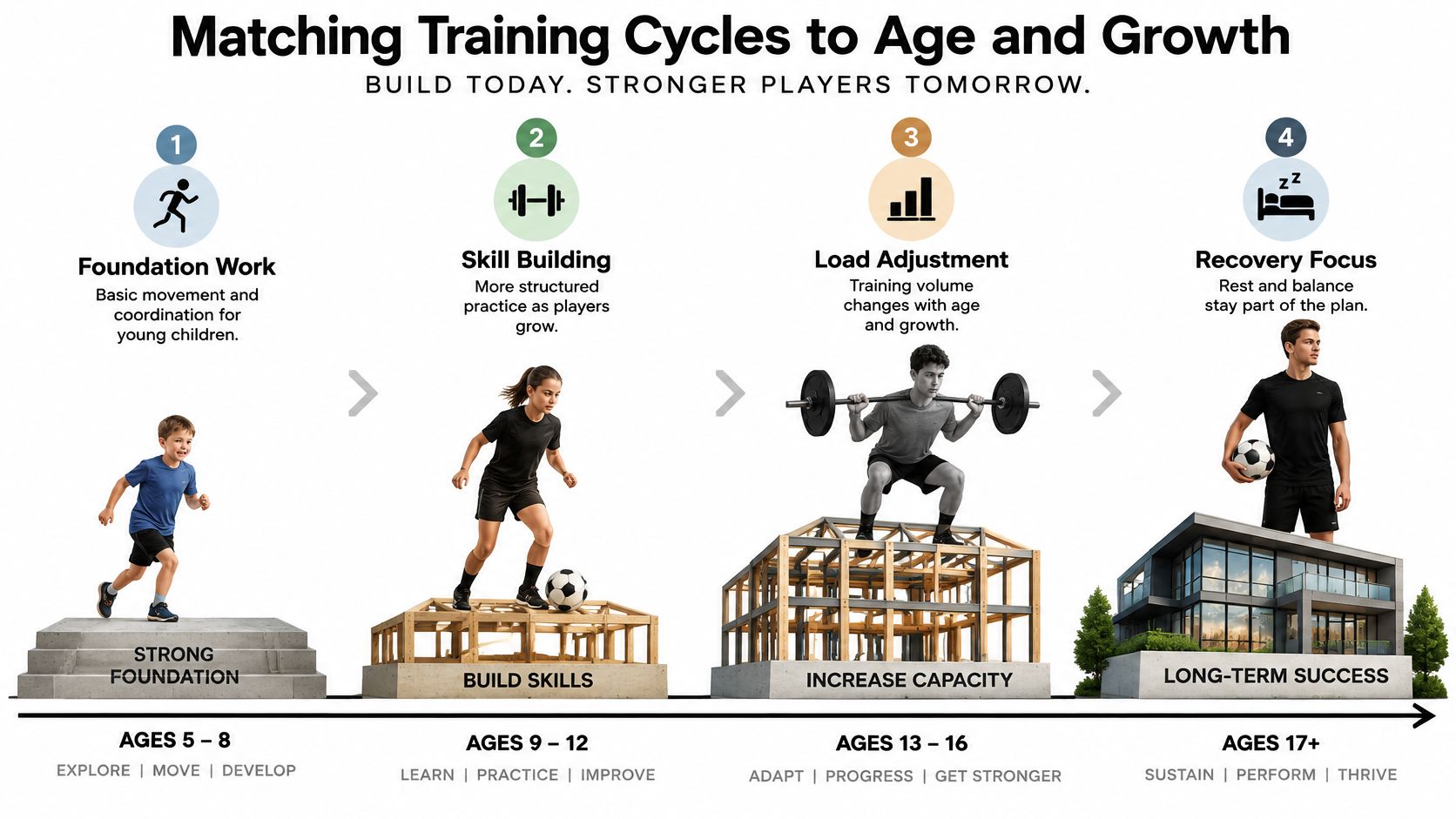
The same calendar will not fit a 7-year-old and a 15-year-old, and it may not fit two 13-year-olds on the same roster. Birthdate is a team label. Biology is the workload label.
Think of a building. Foundation work for a young child is coordination, balance, and comfort on the ball. You don't pour the upper floors first. A teenager heading toward tougher competition needs reinforcement, meaning strength, recovery, and a ceiling on hours. Adding sessions because "they're older now" is like adding floors without checking the frame.
Why the growth spurt changes the plan
Training across the year should follow biological maturation, not age on a birth certificate alone. Peak height velocity, the adolescent growth spurt, can differ by about 5 to 6 years between athletes, and injury incidence tends to rise during rapid growth, especially in the lower limbs. Coaches should check growth and maturity about every 3 to 4 months, with closer checks near and during that spurt, as outlined in research on maturity and youth injury risk. A recent review places that window near 11.5 years for girls and 13.5 years for boys.
A 2025 study of 841 Japanese male youth soccer players, averaging 13.7 years old, found that 11% had a serious overuse injury in the preceding year, and that 64% had played other sports before age 12. Players who trained more weekly hours than their age in fifth and sixth grade had greater odds of serious overuse injury (odds ratio 1.70; 95% confidence interval 1.07 to 2.72). A separate six-season study of 811 academy players ages 8 to 15 found injury incidence rising with age, highest among under-15 players, with traumatic and overuse injuries roughly even. Those milestones are summarized in the 2025 study of Japanese youth players.
Three stages, not one ladder
Younger players: Varied movement, technical repetition, and enjoyment. The session should still feel like play.
Adolescents: Growth, recovery, weekly hours, and physical preparation need a closer look. A sudden jump in height or leg length, new soreness, clumsier touches, or unusual fatigue calls for a temporary cut in volume and complexity. That player should not be held to a biologically stable teammate's workload.
Older competitive players: Individual load planning. More sessions are not the automatic upgrade.
Age-banded expectations are sketched in this guide to soccer development by age. Use the bands as a checkpoint, then adjust for the child in front of you.
Sample Annual and Weekly Training Plans
Build the year before you build the week. Families get stuck when every Tuesday is full and nobody has decided what June is for.
Four blocks, not one endless season
High-focus technical block. Fewer matches, more ball mastery, receiving, and both-foot repetition. Intensity can stay moderate. The point is clean habits.
Competition period. Team sessions plus matches. Keep some technical work, but shorten it. The match is already a high load.
Transition window. After the last league game, drop organized volume. A little ball work at home or in free play keeps touches alive without starting another season the next Monday.
Genuine rest. Days with no organized soccer. Sleep, friends, another sport, or an empty afternoon. This is the block ambitious calendars delete first.
The National Athletic Trainers' Association recommends limiting organized sport to no more hours per week than the athlete's age, taking at least two days off weekly, and scheduling time away at the end of a competitive season.
A mid-age week you can edit
Treat the age-hours figure as a ceiling, not a target. A 12-year-old does not need 12 organized hours. This sketch assumes school plus one club.
Day | Focus | Load |
|---|---|---|
Monday | Off, or easy mobility at home | Rest |
Tuesday | Team session, technique into small-sided games | Moderate |
Wednesday | Strength, movement, and a short ball block | Low to moderate |
Thursday | Team session | Moderate |
Friday | Off | Rest |
Saturday | Match, or free play if there is no game | High if a match, low if pickup |
Sunday | Optional light touches, or fully off | Low or rest |
Two offs are already on the grid. If Saturday is a tournament, Wednesday becomes the second rest day and Sunday stays quiet. Don't paste another team session onto Friday to "make up" the minutes.
The template is a budget. If Saturday overspends, another day has to pay.
For another way to spread the week, see this weekly soccer training schedule. When school ball, travel, and a tournament collide, cut before you add. Drop the optional clinic. Shorten the technical block. The grid is a starting point, not a contract.
Injury Prevention, Recovery, and Cross-Training
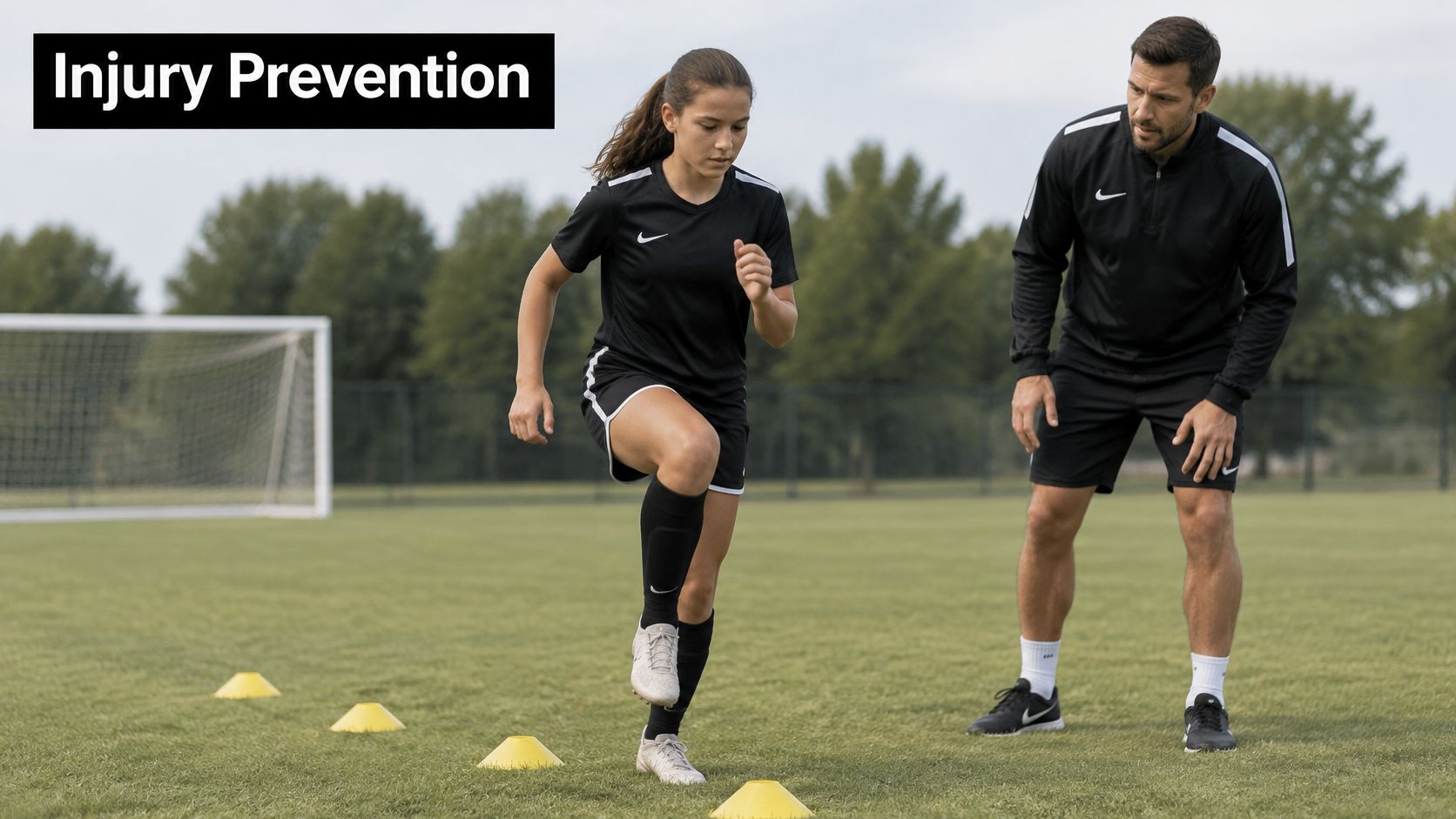
Two practices can look identical from the parking lot. The difference shows up in the first twelve minutes, before a ball is even touched.
A structured neuromuscular warm-up works like a pilot's pre-flight walk around the plane. It is short, it runs the same way every time, and it catches small problems before takeoff. Programs built this way, the FIFA 11+ being the best known, have been linked to meaningfully lower injury rates when teams use them session after session. One youth-football review counted 3.23 injuries per 1,000 hours in players using an intervention warm-up, versus 4.73 per 1,000 hours in control groups, about a 32% reduction, according to research on neuromuscular warm-up programs.
The catch is that the benefit was tied to repeated exposure. A warm-up that only appears in September does nothing in March. The routine belongs in preseason, competition weeks, camps, and even the lighter blocks, scaled down to match the day's load.
Ten to fifteen minutes before the ball
Coaches can run age-appropriate movement prep for 10 to 15 minutes, then progress from controlled technique into faster small-sided games.
Running and deceleration: Easy runs, then planned stops, so braking is practiced before a game demands it.
Balance and landings: Single-leg balance and simple landings, scaled so a younger player can still smile through them.
Strength in motion: Squats, lunges, or calf raises matched to age. This stays well short of a weight-room session.
Change of direction: Cone cuts at a speed the player can still steer.
More on turning that opening into a habit sits in this piece on injury prevention in soccer.
During a growth spurt, skip back-to-back high-load days and leave more space between sessions and matches. A player mid-spurt can float in a possession game rather than contest every duel. Mobility and landing mechanics earn the minutes that used to go to extra sprints.
Cross-training earns its place in the yearly plan, and it does not require a second club registration. A pickup basketball game, a bike ride, or an hour at the public pool trains different movement patterns and gives soccer-specific tissues a break from the same repetitive stress. Many of the players in the research discussed earlier had sampled other sports before age 12. That does not prove sampling prevents injury, though it does show a soccer pathway can share a childhood with other movement.
Recovery works like a car's service schedule. You book it before the warning light comes on. Persistent soreness, a drop in performance, irritability, and broken sleep are the warning lights, and if several appear together the answer is less organized soccer, rather than a pep talk. A rest day is also the cheapest line item in the whole plan, which matters for families already weighing fees and travel. For a fuller checklist, see these overtraining recovery strategies for athletes.
The clip below shows how movement prep can stay specific without swallowing the whole practice.
Questions to Ask and How Villarreal Houston Academy Compares
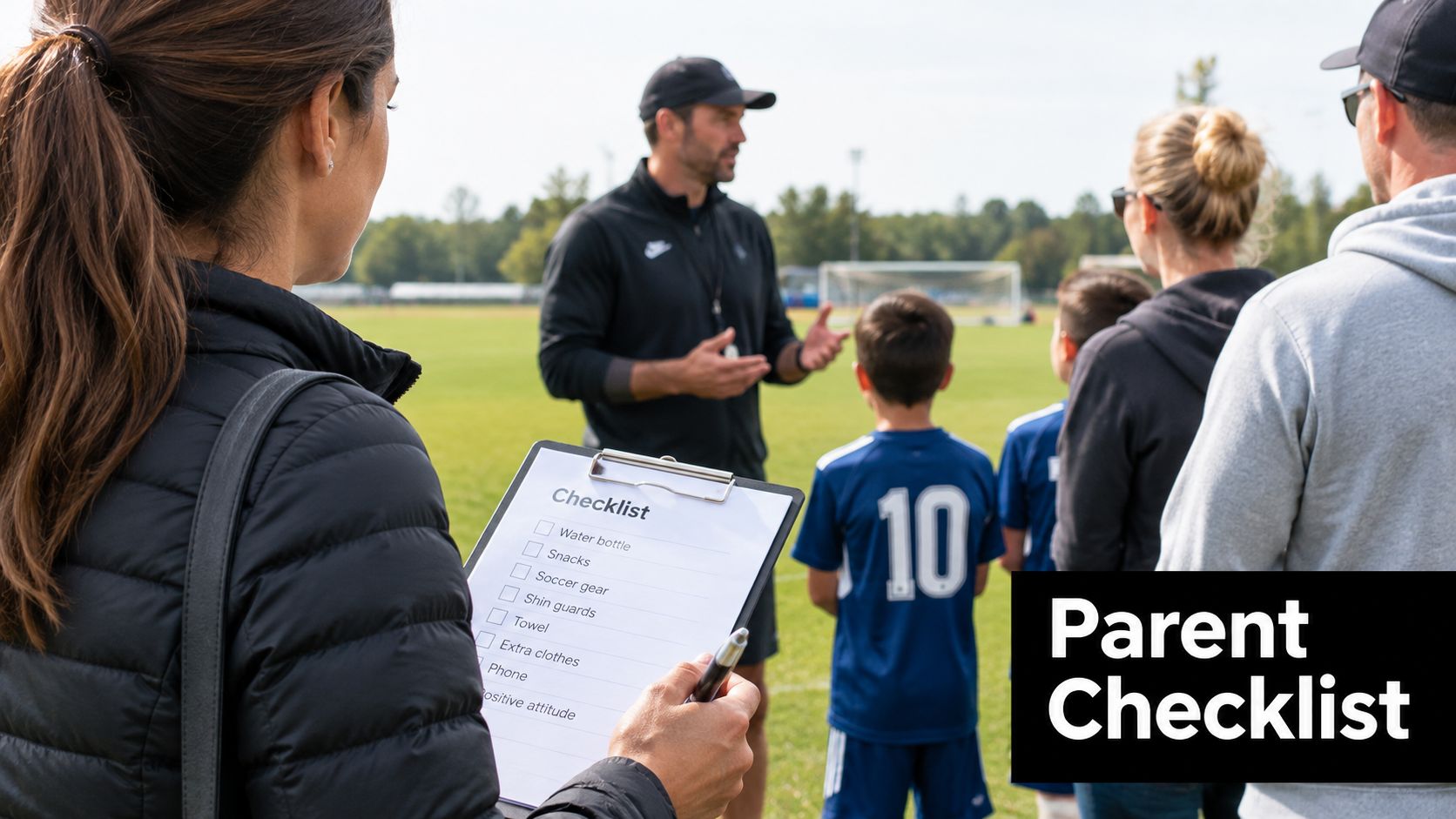
A polished session can still be a bad fit if the week has no ceiling. Write the questions down before you compare clubs, and ask them out loud.
What to put on the checklist
Weekly volume: Is organized time capped with age in mind, or does the answer stay vague?
Rest and transitions: Are days off and a postseason block written down?
Growth: Does anyone notice a sudden spurt and change the work?
Warm-up: Is movement prep structured, or is it a few minutes of jogging?
Coaches: Who is on the field, and who helps when a player is anxious or flat?
Full cost: What sits past tuition, including tournaments, kits, and travel?
Drive time: How many evenings cross town, and what does that do to homework and a work shift?
Cost is part of the training plan, not a footnote. The Aspen Institute's Project Play survey reported that the average U.S. sports family spent $1,016 on a child's primary sport in 2024, 46% more than in 2019, and that soccer-family spending was $910 in 2024, up from $537 in 2019. The same reporting notes participation gaps by income, and that 98% of park-and-recreation agencies charge fees for youth sports, as detailed in the Project Play family spending survey.
Split essentials from extras. Team training and a basic ball are essential. Another camp, a weekly private lesson, and an out-of-town tournament stay optional until the week still has rest. Home technical work and a ball passed between siblings carry a lot of development when money is tight. A low fee that needs three cross-region drives can cost more than a nearer club once missed work and gas are counted.
A cheap-looking schedule can still be impractical if the car is doing as much work as the coach.
Villarreal Houston Academy, the Greater Houston partner of Spain's Villarreal CF, runs teams, camps, clinics, and tryouts for boys and girls from age 4 up. The Yellow Submarine methodology centers on intelligence, skill, and character, with qualified coaches and support from sports psychologists. Sites include Humble, Fall Creek, Cypress, Tomball, and the Kingwood, Porter, and New Caney area, which matters when drive time is part of the load. Ask any club, this one included, for the written calendar, weekly hours by age, fees outside tuition, and how growth or soreness changes a player's week. A program that can't answer in writing is selling sessions, not a pathway.
Answers to Common Questions and Your Next Steps
School soccer and club in the same year
Yes, if both calendars share one budget. When the school season starts, club should give something back, usually a session or a tournament weekend. Running both at full volume is how a reasonable week becomes too much without anyone deciding that on purpose.
Camps, clinics, and the weekly total
They count. A long camp morning is organized time, not a bonus that sits outside the week. In a camp week, drop the regular sessions so the total stays near the plan. A clinic that replaces Thursday team training is easier to absorb than a clinic stacked after a Saturday match.
When a child wants more than the plan
Wanting more is a good sign. It isn't clearance to ignore fatigue. Offer a low-load option first, such as a short ball-mastery block at home, a pickup game, or a quiet look at a match with a parent. If sleep is solid, soreness fades within a day, and school is fine, test a small addition for two weeks. If mood or legs slide, take the extra back off.
When a break is the right call
Use the warning signs already named, and add one check. If play is worse and the child no longer wants to go, you're looking at load, not laziness. A planned week off, or a shift to free play only, beats waiting for a complaint that ends the season.
One action for this week
Put the current week on a single page. List every organized soccer hour, including school, club, camp, and lessons. Mark the rest days. If the total breaks the weekly cap described earlier, cut the optional piece first.
Then look for an age-group path instead of one endless season. Review teams, camps, clinics, and tryouts for your player's age. Watch the warm-up before you watch the scrimmage. Ask the coach to walk the calendar, including the weeks after the last match. Do the hour count at the kitchen table before you register for anything.
Villarreal Houston Academy offers year-round teams, camps, clinics, and tryouts built around age-appropriate work, rest inside the calendar, and coaching that treats growth as part of the plan. If you're sorting how to keep your child developing without stacking every extra session, compare your week with a pathway that already uses several North Houston training sites. Visit Villarreal Houston Academy to see current programs and register your interest.
Comments