


Youth Soccer Coaching Player Development Podcast: Top Picks

You're driving to Tuesday practice, thinking about the player who stopped asking for the ball after a mistake last weekend. Instead of another match recap, you listen to a conversation about confidence and arrive with a better response than telling that player to be brave. That's what the right youth soccer coaching player development podcast can offer: an idea you can use, not just something you agree with.
For parents, the payoff might be a calmer drive home. For coaches, it might be a clearer demonstration, a better question, or a training game that gives players more decisions to make.
These seven podcasts and audio-friendly resources serve different purposes. Some are suited to the commute; others need a screen, a notebook, or time on the field. None replaces coach education or knowing the child in front of you. Use them to make a specific adjustment, then judge whether players understand it and can apply it within an academy-style pathway like ours at Villarreal Houston Academy.
1. Finding Mastery with Michael Gervais
Best for coaches and parents working on confidence, focus, and responses to mistakes. Finding Mastery offers long-form conversations about performance and the human habits behind it. It's a useful choice when a player's difficulty isn't understanding the technique, but staying engaged after something goes wrong.
Don't turn an elite performer's routine into another requirement children can fail. Translate the principle into something simple: settle your breathing, look up, and choose your next action.
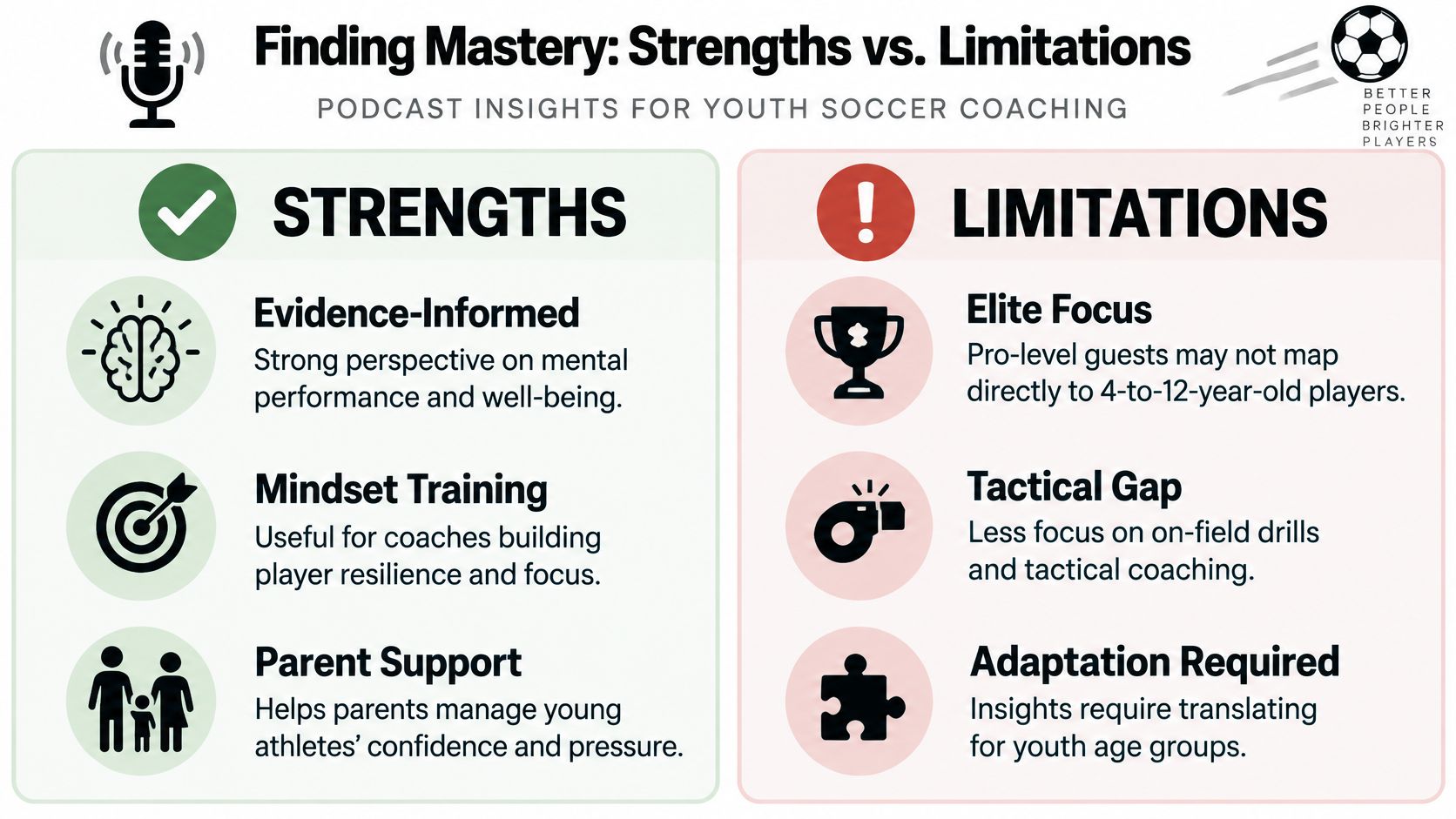
Put a Reset Routine Into Practice
Say a young midfielder loses possession and spends the next passage apologizing rather than defending. During training, introduce a reset: a comfortable breath, eyes toward play, then an immediate recovery action. Rehearse it during ordinary games, not only before an important match.
For a parent, the equivalent is resisting an instant technical review. Ask whether the player wants to talk, then let them explain what happened before offering advice.
Practical rule: A mental skill should help a child return to the game, not make the child monitor every feeling during it.
A peer-reviewed study of youth-to-professional pathways identified coaching, personal mindset, and social support as leading development factors and recommended regular, structured training feedback. The practical implication is to connect mental routines with observable actions rather than vague demands for confidence.
Our coaches work alongside Villarreal CF sports psychologists. Use our sports psychology examples to connect listening with that wider approach. The limitation: a general performance interview isn't individualized psychological care.
2. Positive Coaching Alliance Audio and Resource Content
A player attempts the right pass, misjudges its weight, and hears only that they gave the ball away. Another player avoids the risk entirely and receives no correction. The coach has unintentionally made caution look like the safer route to approval.
Positive Coaching Alliance's audio, video, and resource content is most useful for adults who want their feedback to match their development priorities. Parents and assistant coaches can use it together, particularly when sideline messages contradict what players hear at training.
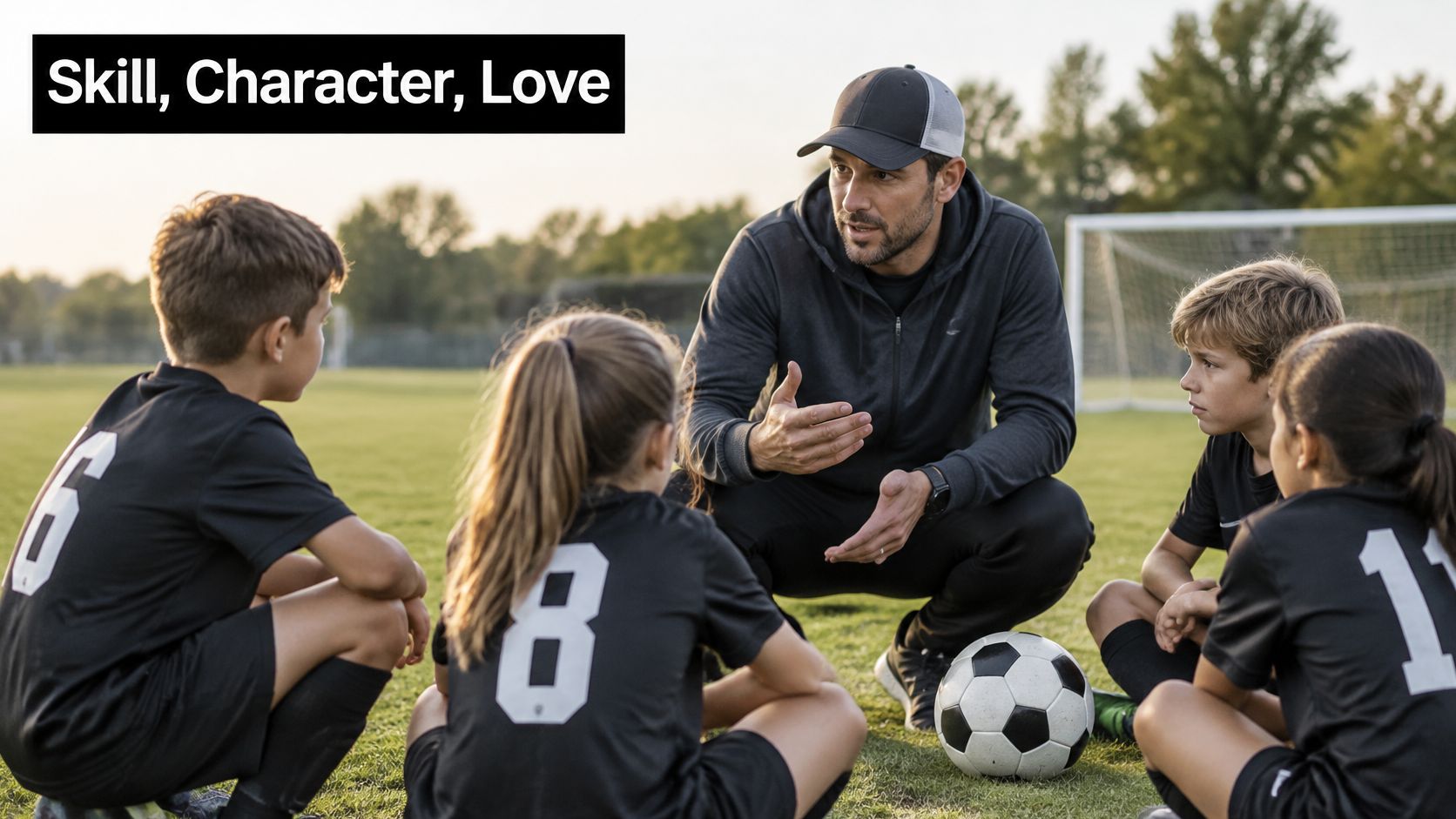
Make Praise Informative
Choose a discussion about feedback or sportsmanship, then examine your language during the next practice. Don't replace criticism with enthusiasm. Tell the player what they did that mattered.
Recognize the decision. Acknowledge that the player saw an available teammate before correcting the pass.
Give a usable adjustment. Demonstrate the contact or body position you want rather than demanding better quality.
Reinforce responsibility. Notice the recovery run after the mistake, not just the original error.
The trade-off is important: positive coaching isn't constant praise, and it doesn't mean avoiding difficult conversations. Empty encouragement can be as unclear as criticism.
A qualitative study of community youth coaches examined coaches' concerns about safe technique, injury recognition, burnout, competitiveness, and parent pressure. That broader responsibility makes communication part of the training environment, not an optional extra.
Our positive coaching techniques connect with our expectation that coaches communicate constructively. This week, agree on a shared response to mistakes so players don't receive encouragement from the coach and blame from the touchline.
3. Changing the Game Project Content
Choose Changing the Game Project when the family calendar is getting fuller but the child's enjoyment is getting harder to see. Its child-centered development themes are especially useful for parents weighing competition, organized training, and room for informal play.
The useful question isn't whether ambition is good or bad. It's whether the current environment gives the player appropriate challenge, ownership, and enough willingness to return.

Protect Play Without Abandoning Structure
After listening to a discussion about development priorities, look at a typical training session. Where can players choose teams, invent a rule, try a move, or solve a disagreement without an adult taking over?
Say a foundation group has been practicing turning. Finish with a small-sided game that allows different ways to escape pressure rather than requiring the same turn every time. Coach the principle, protecting the ball and finding space, while allowing players to choose the solution.
A peer-reviewed study of youth soccer players in the CONCACAF region found that informal activities accounted for a larger share of accumulated soccer engagement than formal training, and skilled players completed more individual practice during childhood and early adolescence. That supports treating self-directed activity as a complement to coaching, not leftover time.
Give players a clear problem, then resist solving every attempt for them.
The limitation: player-centered coaching can be misread as coaching without standards. Children still need safe boundaries, suitable challenges, and useful instruction.
Within our age-appropriate development approach, the application is straightforward: keep the learning objective, but leave room for initiative. For families, invite informal play without turning it into another supervised assignment.
4. NSCAA Coaching Education Audio and Webinars
This is the strongest fit for coaches who need help designing sessions rather than another motivational message. When searching for NSCAA material, also use the United Soccer Coaches name so you can distinguish legacy resources from newer education offerings.
Webinars and recorded presentations require a different listening habit. You can absorb a coaching philosophy while driving, but you shouldn't try to understand field diagrams or exercise progressions without seeing them.
Take a Session Problem to the Recording
Start with something your players are struggling to do. Suppose defenders can pass comfortably without opposition but lose their options as soon as an opponent presses. Look for material about support angles, receiving positions, or small-sided game design.
Then build a progression around the problem:
Establish the action. Let players rehearse receiving with an open body position and a visible passing option.
Introduce opposition. Add a defender so the receiver must recognize where pressure comes from.
Test transfer. Use a game in which players can choose whether to combine, turn, or carry the ball.
Coach education has a broader youth-development role, too: the Aspen Institute's Project Play reports that Million Coaches Challenge partners trained 1,000,000 youth coaches in evidence-based youth-development practices in 2025.
The trade-off: collecting exercises can create a disconnected training week. A polished activity isn't useful merely because an accomplished coach demonstrated it.
Our coaches learn the Villarreal CF methodology, so outside education should clarify the learning problem without replacing shared coaching language. After watching, write down the behavior you want to see and the adjustment you'll make if players aren't finding it. That's more useful than copying every cone position.
5. US Youth Soccer Coaching Education Content
Parents don't need to become tactical analysts to evaluate a development environment. They do need to understand why training looks different for a beginner and an experienced competitive player.
US Youth Soccer's education content is a practical starting point for parents and volunteer coaches seeking that context. Treat it as a reference library rather than assuming every useful resource will arrive as a conventional podcast episode.
The organization's historical Soccer as a Lifetime Sport report described over 300,000 coaches, most of them volunteers. That historical scale helps explain why clear, accessible coaching guidance matters beyond elite development environments.
Use Guidance to Ask Better Questions
Choose age-appropriate development material before reviewing a team's training approach. Instead of asking only whether the group wins, ask what players are learning, how they practice decisions, and how the coach adjusts difficulty.
Say a younger player can dribble through cones but struggles in matches. A useful next question is whether training includes opponents and opportunities to recognize space, not whether the child needs a more complicated cone pattern.
For coaches, our guide on how to become a soccer coach provides a related starting point for thinking about preparation and responsibility.
The limitation: national guidance can't diagnose an individual player or determine team placement. Use it to improve conversations, not to challenge every exercise from the sideline.
In our pathway, qualified coaches provide age-appropriate training. Parents can support that process by discussing a clear development objective with the coach and helping the player recognize progress beyond the weekend score.
6. Coerver Coaching Technique Content
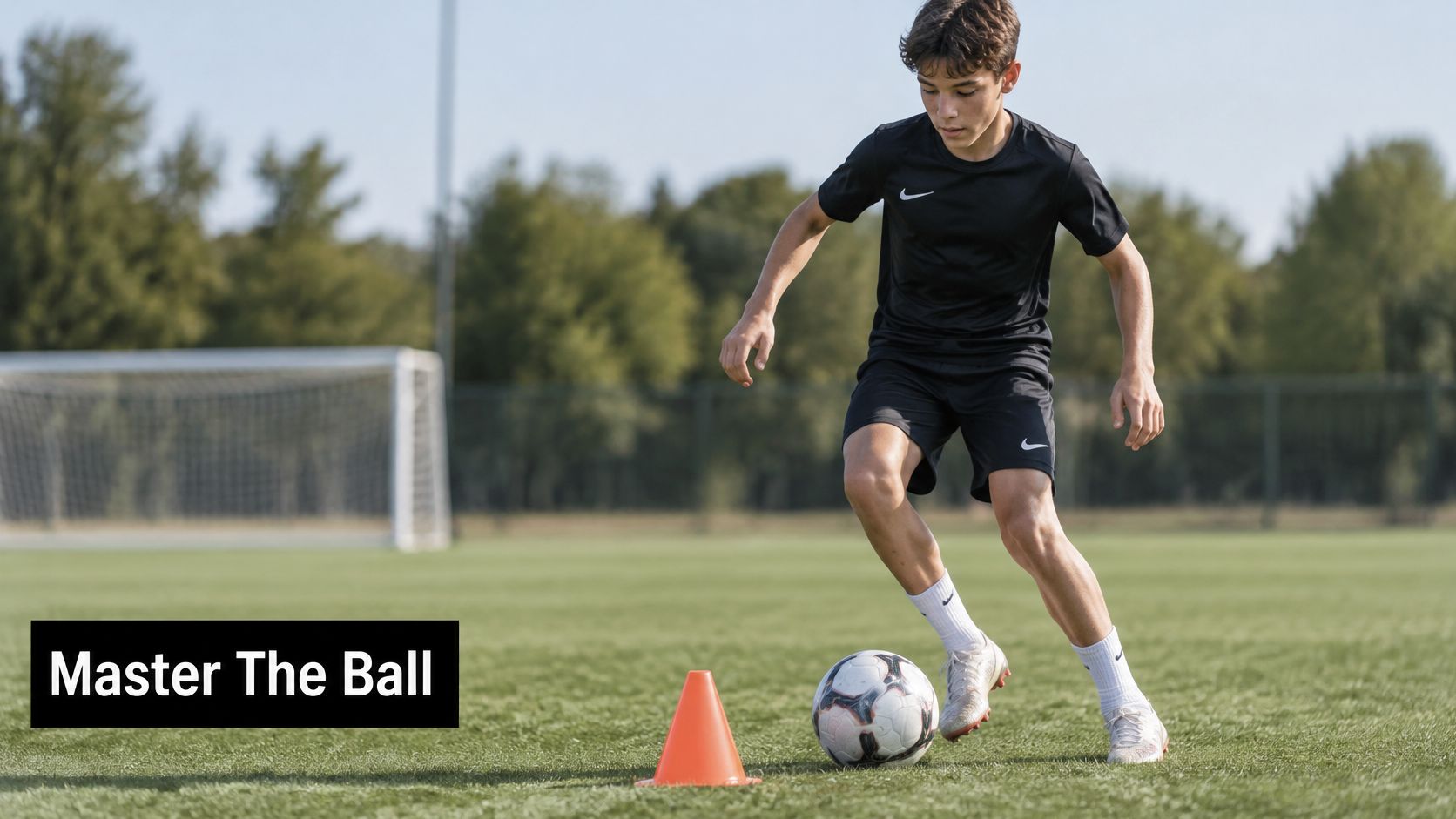
Coerver belongs on this list as a watch-and-practice resource, not a commute-only recommendation. Close control, turning, and first-touch demonstrations depend on seeing the movement. An audio explanation can direct your attention, but it can't replace the visual detail.
It's best suited to players and coaches who want a specific technical action to rehearse. Watch the demonstration before taking the idea onto the field.
Move From Repetition to a Decision
Suppose a player is learning to turn away from pressure. Start with a clear demonstration, allow comfortable repetitions, then introduce an opponent approaching from different directions.
The final task should require a choice. Let the attacker decide whether to turn, protect, pass, or accelerate into space.
Observe control. Can the player keep the ball within a useful playing distance?
Observe awareness. Does the player look beyond the ball before choosing an action?
Observe transfer. Does the movement help against an opponent, or appear only during rehearsal?
Keep the distinction clear: mastering a movement and knowing when to use it are related skills, not identical achievements.
The trade-off: isolated practice makes details easier to teach, but long sequences without opposition can hide decision-making problems. Conversely, placing a struggling beginner straight into pressure can prevent useful repetition.
For an academy-style pathway, technical practice should connect to a recognizable match problem. Use the same coaching language when the movement appears in a game, and don't demand a particular trick when a simple pass would work.
This week, select a movement the player needs. Judge progress by whether it helps them play, not by how impressive the rehearsal looks.
7. Coach Ed Podcast
A coach gives a detailed explanation, asks whether everyone understands, and receives a group of nods. The game restarts, and the same confusion remains. Coach Ed is useful for coaches who want to examine communication and leadership rather than copy soccer-specific tactics.
Use its cross-sport coaching conversations selectively. Check the host, guest, and subject before saving an episode, since similarly named coaching resources can appear in search results.
Turn a Conversation Into an Observable Change
Choose an interview about feedback, questioning, or athlete ownership. During the next session, replace a long explanation with a short demonstration and a question that requires players to show their understanding.
For example, ask a defender to demonstrate where they would stand to protect the goal while still seeing an opponent. Their movement tells you more than agreement does.
This approach is particularly useful when discussing selection and playing time. The Soccer by 3four3 discussion of playing time and player development offers a soccer-specific companion topic for examining how adults explain opportunities and expectations.
The limitation: a principle from another sport needs translation. A conversation about individual performance may not account for soccer's continuous decisions and interdependent roles.
For our development approach, connect feedback with respect and personal responsibility. Explain what the player can work on without implying that completing a task guarantees selection or minutes.
Use an episode with an assistant coach, then compare the instructions you give during practice. If you're using different words for the same action, agree on simpler language before asking players to understand it.
Youth Soccer Coaching & Development Podcasts at a Glance
Podcast / Resource | Primary Focus | Best For | Soccer-Specific | Content Format |
|---|---|---|---|---|
Finding Mastery with Michael Gervais | Performance psychology and mental skills | Coaches and parents supporting mindset and confidence | No; insights need adapting for youth soccer | Long-form interviews |
Positive Coaching Alliance Audio and Resource Content | Character, sportsmanship, and positive coaching | Youth coaches, parents, and sports leaders | Broad youth sports; limited soccer tactics | Audio and video content, workshops, and resources |
Changing the Game Project Content | Child-centered development and reducing early specialization | Coaches and parents prioritizing long-term development | Broad youth sports; not soccer-specific | Articles and written resources |
NSCAA Coaching Education Audio and Webinars | Soccer coaching education and player development | Coaches seeking structured learning and practical guidance | Yes | Courses, webinars, and digital content; not always podcast format |
US Youth Soccer Coaching Education Content | Age-appropriate development, safety, and the youth soccer pathway | Coaches and parents seeking national guidance | Yes | Written guides and coaching education resources |
Coerver Coaching Technique Content | Ball mastery and individual technical skills | Coaches and players developing fundamental technique | Yes | Progressive drills and instructional materials, often video-based |
Coach Ed Podcast | Coaching communication, leadership, and athlete development | Youth coaches seeking transferable coaching principles | No; applicable across sports | Podcast-style interviews and discussions |
From Listening to Coaching Put These Lessons on the Field
Choose a podcast or resource that matches the problem in front of you. A confidence conversation won't fix an unclear receiving demonstration, and a technique video won't resolve conflicting messages from adults. The best choice is the one that helps you change a specific interaction or training task.
Keep the experiment manageable. Try a reset routine before a practice game, make your feedback more precise, or follow a technical rehearsal with opposition. Give players enough consistency to understand what you're asking before replacing the idea with something else.
Notice What Players Actually Do
Assess the change through behavior, not your enthusiasm after listening. Does the player rejoin play after an error? Can they explain the task, recognize an option, or use the practiced movement under pressure?
For coaches: Note the learning objective, your adjustment, and what players did in response.
For parents: Ask the player what they're working on without adding a competing set of instructions.
For players: Choose an action you can practice and discuss with your coach.
Listening itself also requires patience. The habits used in deeper conversations in research interviews, including giving someone room to explain before responding, offer a useful parallel for player conversations. Don't ask a reflective question and immediately supply the answer.
At Villarreal Houston Academy, our coaches learn the Villarreal CF methodology and work alongside Villarreal CF sports psychologists. Positive communication, age-appropriate expectations, and personal responsibility belong within the same development process as technical and tactical learning.
You don't need to finish every episode or adopt every recommendation. Keep what fits the player, adapt what needs translation, and leave aside what conflicts with a coherent development plan. Listening becomes coaching education when you test an idea thoughtfully and pay attention to the child's response.
Villarreal Houston Academy offers youth soccer teams, camps, clinics, and tryouts across North Houston, with age-appropriate coaching guided by the Villarreal CF methodology. Visit Villarreal Houston Academy to explore a development setting where technical learning, positive communication, and player responsibility are practiced together.
Comments