


Youth Soccer Travel Teams: What Parents Need to Know

The average U.S. family spent $1,016 on a child's primary sport in 2024, while soccer-family spending increased 69% over five years. Texas ranked second nationally with approximately 246,863 registered youth players.
That's the situation many parents face on a Saturday morning. Your child has enjoyed a local recreational league, a coach mentions a travel opportunity, and suddenly you're weighing tournaments, training demands, hotel rooms, missed work, and tryout pressure. The question isn't whether your child is talented enough. It's whether the program fits your child's goals and your family's real capacity.
The spending figures come from the Aspen Institute's youth-sports family spending survey, while the Texas registration context appears in youth soccer market data. Use those facts as a warning against judging a club by its advertised registration fee alone.
What Makes Travel Soccer Different
A strong performance in a recreational game does not, by itself, justify joining a travel team. Youth soccer travel teams operate under a different agreement with families. Players train more consistently, face stronger opponents, attend tournaments, and follow a calendar that can control weekends for much of the season.
The change is practical, not just competitive. A local match can become a full weekend away. Training may require a long drive, and regular attendance may be expected because one absent player affects the quality of the session. Parents handle transportation, hotel choices, tournament meals, equipment, and club communication. Ask who pays for what, how far the team usually travels, and what happens when a family cannot attend.
Access also depends on more than registration. Work schedules, fuel, lodging, sibling care, and reliable transportation can determine whether a player can remain involved. A club that offers a low entry fee may still create high costs through distant practices and frequent overnight events.
Soccer's popularity makes the choice more consequential. It was identified as the second most popular youth sport in the United States, involving approximately 26.5% of children, behind basketball at 36.8%, and Texas had approximately 246,863 registered youth players, ranking second nationally behind California, according to the American Pro League market overview. A large player pool creates opportunity, but a travel label says little about coaching quality, playing time, or the support available to families.
The travel spectrum
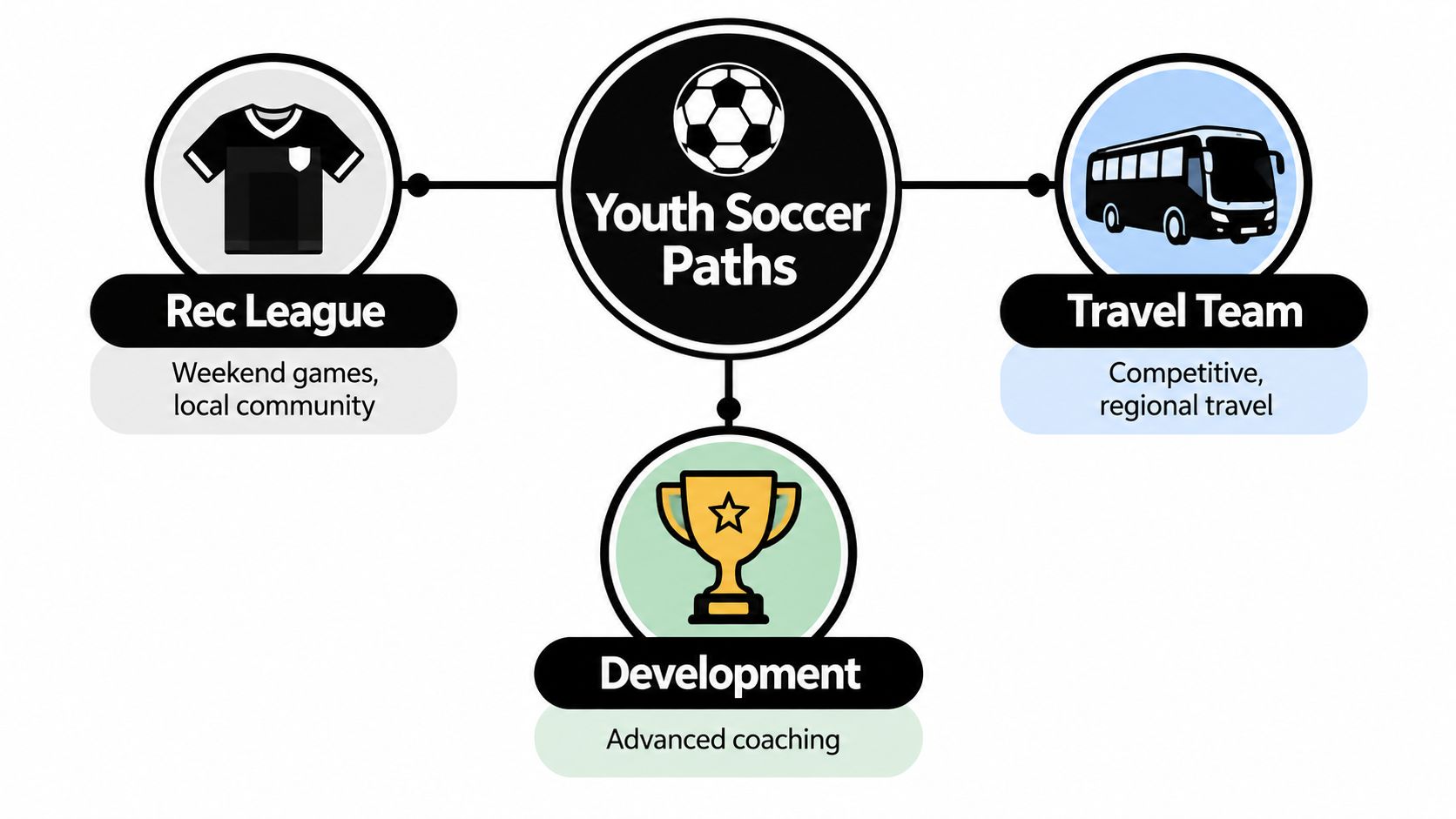
Travel soccer covers a wide range. One regional team may stay within driving distance, while an elite academy may schedule destination tournaments or international training experiences. Some clubs prioritize league results. Others focus on individual technique, tactical understanding, and long-term progression.
Before treating “travel” as a development credential, ask the club to define it. Where does the team play? How often are overnight trips scheduled? How much training occurs between tournaments? What is each event intended to develop? Also ask about roster size, expected playing time, coach qualifications, refund policies, and financial assistance.
Practical rule: Don't buy the label. Buy the schedule, coaching plan, safety standards, and cost structure you can verify.
Travel Soccer Versus Recreational Soccer
Travel soccer isn't automatically better. It's more demanding, and that can be useful for a motivated player who wants stronger competition and organized development. It can also turn a child's favorite activity into a source of anxiety when the family can't sustain the schedule or the club confuses winning with development.
Recreational soccer makes sense when the primary goals are enjoyment, movement, friendship, and a positive introduction to the sport. A child can build confidence and basic skills without committing every weekend to tournaments. Travel soccer makes more sense when the player asks for additional challenge, enjoys structured training, and accepts that attendance and preparation matter.
Factor | Recreational Soccer | Travel Soccer |
|---|---|---|
Training | Usually limited and community-based | More structured and development-focused |
Competition | Local, mixed ability levels | Selective rosters and stronger opponents |
Schedule | Easier to combine with other activities | Practices, league play, and tournaments shape family weekends |
Travel | Usually local | Regional, overnight, or international depending on the program |
Cost | Generally easier to predict | Includes fees, equipment, tournament expenses, and family travel |
Player selection | Often broad participation | Tryouts, roster decisions, and position competition |
Best fit | Children exploring the game or prioritizing flexibility | Players seeking a serious competitive environment |
Families should also distinguish a development program from a tournament-heavy team. More games don't automatically create better players. A strong program explains how training, match selection, feedback, and rest work together. Parents who want a clearer explanation of competitive levels can review this breakdown of soccer competition levels, then ask a club where its teams fit in practice.
Use this decision test
Choose recreational soccer for now if your child mainly wants to play with friends, your family needs schedule flexibility, or travel expenses would create ongoing stress. Choose travel soccer when your child is personally motivated, the training environment is demonstrably stronger, and the family can meet the attendance and financial expectations without constant conflict.
Don't make the decision because another parent says travel is the only serious pathway. A player who loves soccer in a sustainable environment can develop more effectively than one who joins an impressive-sounding team and quits after an exhausting season.
What Youth Travel Soccer Actually Costs
A club may quote an affordable registration fee, then add expenses that never appear on the enrollment form. A realistic budget includes team registration, uniforms, equipment, tournament entry, hotels, fuel or flights, meals, missed work, private instruction, and sibling-care costs. Some charges go to the club. Others come from the family budget later, creating access barriers for households that cannot absorb unpredictable costs.
The Aspen Institute's 2024 nationally representative survey included 1,848 youth-sports parents and found that the average U.S. family spent $1,016 on a child's primary sport. That amount was 46% higher than in 2019, and soccer-family spending increased 69% over the same period. Families earning at least $100,000 spent $1,471 more annually than families earning under $50,000.
Those figures cover family spending broadly, not a universal travel-team price. They show why parents should reject vague promises such as “reasonable fees” or “a small investment.” Ask for the full financial commitment before your child accepts a roster spot.
Build the budget in layers
Start with mandatory club charges. Request registration, coaching, league, insurance, uniform, and tournament costs in writing. Then create a separate travel budget for transportation, lodging, meals, parking, and incidental purchases. Add the expenses families often miss, including time away from work, sibling care, private training, replacement equipment, and trips that require a parent to stay overnight.
A practical worksheet should mark every line as mandatory, optional, refundable, or variable. Record whether each cost applies to the player alone or to the whole family. A tournament fee may be fixed, while hotel and meal costs change sharply based on who travels and how long the team stays.
Ask the club these questions before paying:
Payment options: Are payment plans available, and when are installments due?
Financial assistance: Does the club offer scholarships, aid, or reduced-cost participation?
Travel obligations: Must every player attend every tournament?
Family logistics: Can a player attend when a parent cannot travel?
Refunds: What happens if the player leaves, is injured, or the club changes the schedule?
Extra training: Is private instruction encouraged, required, or completely optional?
Use this published explanation of soccer academy fees to understand common fee categories, not to replace a written, team-specific budget. If an administrator cannot explain the total commitment before the signing deadline, do not assume the missing details will become clearer afterward. Choose a club whose costs and access policies your family can sustain for the full season.
Tryouts and the Selection Process Explained
Tryouts test more than shooting power. Coaches watch how players receive the ball, scan before possession, make decisions under pressure, recover after mistakes, respond to instruction, and work when they aren't directly involved in the play. A technically gifted player who ignores teammates may be less useful than a player who sees the field, follows the game plan, and learns quickly.

Prepare without manufacturing a different player
Before the session, make sure your child arrives rested, fed, hydrated, and properly equipped. Bring the requested footwear, water, shin guards, and any medical information the staff needs. A short technical session can help with confidence, but cramming intense training into the days before a tryout is a poor choice.
Tell your child what success looks like. It isn't scoring every time or winning every duel. It's communicating, making the next sensible decision, recovering after an error, and showing the coach that feedback changes behavior.
A typical evaluation may include a warm-up, technical exercises, small-sided games, positional work, and a larger scrimmage. Each format reveals something different. Is the player comfortable with the ball? Can they find space? Do they defend after losing possession? Do they make teammates better?
The guide to travel soccer team tryouts can help families prepare, but no online checklist can guarantee selection. Rosters are limited, coaches may need a specific position, and a player's age, physical development, or timing can affect the decision.
Ask for useful feedback
A responsible club should explain when decisions will be made, whether players may receive feedback, and whether another team or training group is available. Ask whether the offer is for a defined roster, a developmental group, or an evaluation period. Those are different commitments and should not be presented as interchangeable.
Use this video as a conversation starter with your child. Watch for the coach's language about decision-making, effort, and team behavior, then compare it with what you observed at the tryout.
If your child isn't selected, don't turn the result into a verdict on their potential. Ask what skills need attention, whether the club offers a realistic development route, and when the next evaluation opportunity arrives. The right response protects confidence while creating a specific plan.
Development Benefits and Physical Risks
Structured competition can accelerate development when the environment is well coached. Players encounter faster decisions, stronger pressure, more demanding tactical situations, and teammates who expose weaknesses. Consistent training can improve technical habits because the player receives repeated opportunities to solve similar problems at increasing speed.
The benefit depends on the quality of the work. A crowded calendar filled with matches may create activity without teaching. A thoughtful program uses games to identify learning needs, then uses training to address them.
Tournament density changes the risk
An elite U15 tournament study followed players through three 70-minute matches over three consecutive days. Eight athletes sustained injuries during the tournament or in the following two weeks. Among the injured players, 87.5% exceeded their previous maximum tournament rolling workload for total distance, 75% exceeded it for high-speed running, and 50% exceeded it for combined acceleration and deceleration load, according to the peer-reviewed tournament workload study.
That evidence doesn't mean tournaments are unsafe by nature. It means coaches must treat tournament scheduling as load management. Match minutes, high-speed running, acceleration and deceleration, soreness, sleep, and recovery all matter. Equal playing time doesn't create equal physical stress because positions, movement patterns, and individual conditioning differ.
Coach's standard: A club should know who is accumulating load, not just who is available for the next game.
The risks become more visible late in congested events. Coaches should rotate players before fatigue changes movement quality, provide recovery time after demanding weekends, and adjust participation when a player reports worsening soreness. Parents should expect clear concussion recognition and referral procedures, not casual reassurance from the sideline.
Evaluate the recovery culture
Ask who tracks minutes and whether the coach can reduce a player's workload without treating that decision as punishment. Find out how the program handles pain, suspected concussion, heat, illness, and return to play. A club that talks constantly about exposure but never discusses recovery is showing you its priorities.
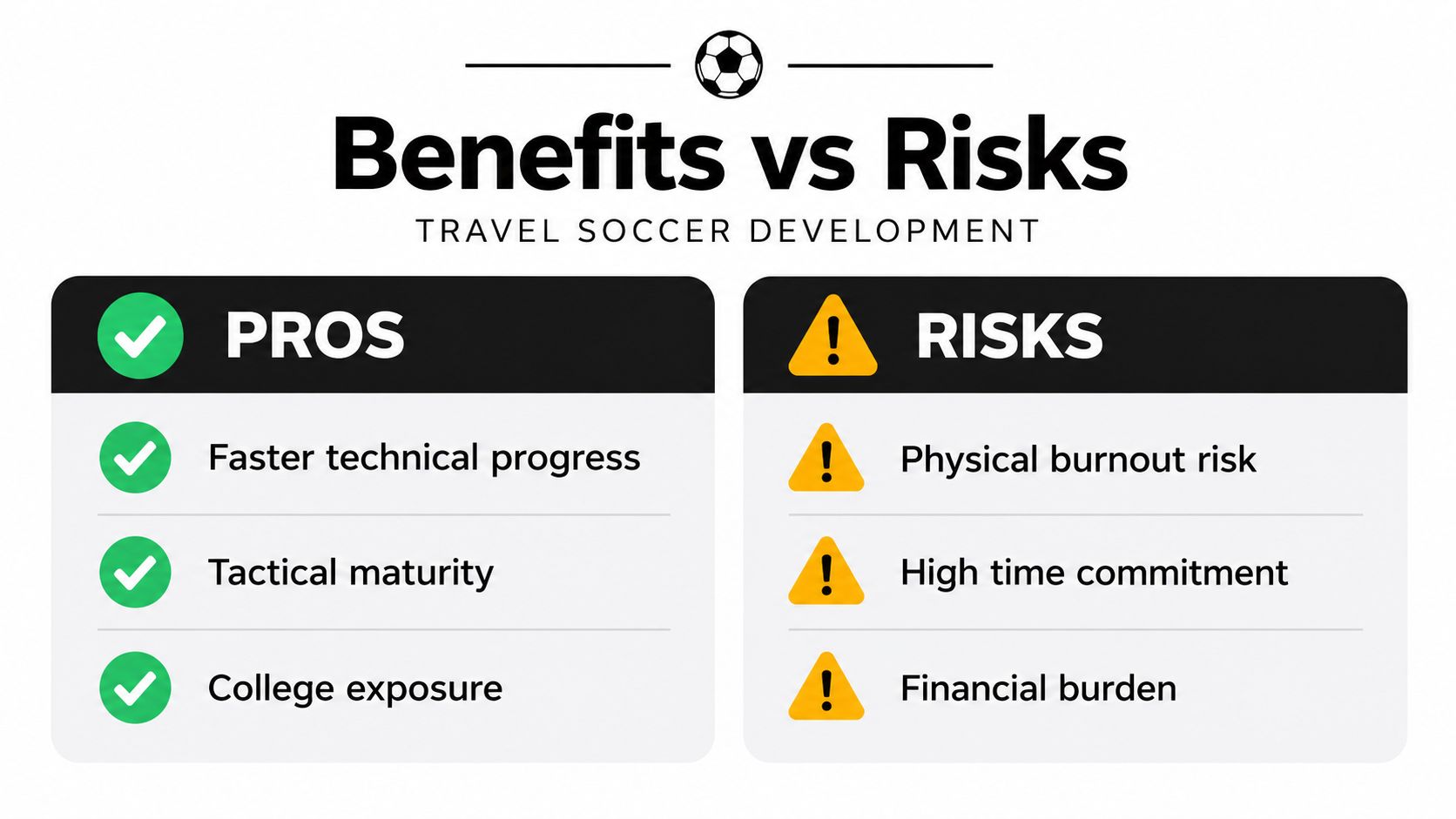
Travel soccer can build skill, tactical maturity, and confidence. It can also create burnout when adults use every available weekend and every player as if the body has no limits. Development requires challenge, but it also requires enough sleep, school stability, unstructured time, and a reason for the child to keep enjoying the game.
How to Evaluate a Travel Soccer Program
Interview the club as if you're hiring a coach to work with your child, because that's what you're doing. A polished website and a recognizable badge don't answer the practical questions. The answers come from the director, coach, administrator, and your own observations at training.
Start with the coaching environment
Ask who will coach the team every week, what qualifications and age-group experience that person has, and how many players share the field with each coach. Ask how coaches deliver feedback after mistakes and how they respond when a player struggles. Watch a session. Players should receive instruction, make decisions, and interact with the coach, not spend most of the time waiting in lines.
Then ask how playing time works. The answer may change by age, competition, and team goals, but it shouldn't be evasive. Ask how the club balances results with development and how it communicates a player's progress to families.
Test the development claim
Request examples of what a player works on during a normal training cycle. Ask whether the team has individual development objectives, how positions are assigned, and whether players can receive feedback outside tournament weekends. A club that promises exposure should explain what exposure means and how it serves the player's development.
Education and family stability also belong in this conversation. Ask how the club schedules travel, whether it publishes dates early, and what happens when school, religious observance, work, or another child's activity creates a conflict.
Put safety and access in writing
A large six-day youth football tournament reported 1,184 injuries, equal to 15.4 injuries per 1,000 player-hours, with incidence rising across the event and peaking on the final day. Lower-extremity injuries were most common, head injuries represented 7% of all injuries, and 11-year-olds recorded the highest reported rate at 27.7 injuries per 1,000 player-hours, according to the tournament injury research.
Ask who makes return-to-play decisions, where medical support is available, how the club handles suspected concussion, and whether coaches track match density. Also ask for realistic travel expectations, carpool policies, late-arrival rules, and alternatives when a family can't reach a distant practice or event.
Watch for financial pressure
Request a complete annual cost sheet before accepting a roster place. Ask which fees can change, which expenses are optional, and whether tournament entry is included. Be cautious when a club guarantees a roster spot, refuses to explain playing time, pressures you to pay immediately, or treats questions about injury and affordability as disloyalty.
A good program welcomes informed parents. You're not asking for special treatment. You're checking whether the club can provide the environment it expects your family to support.
A Houston-Area Development Pathway in Practice
A useful Houston-area example is an academy operating as the official partner academy of Spain's Villarreal CF in Greater Houston. Its pathway serves boys and girls from age 4 upward, with select and competitive programming built around age-appropriate training, technical skill, tactical understanding, intelligence, and character.
That model gives parents several points to examine. Qualified coaches lead the training, sports psychologists support the environment, and the stated mission includes long-term love of the game rather than short-term results alone. Competitive teams can also access international opportunities, including travel to Spain for training and matches alongside the Spanish club's elite academy.
The important question isn't whether international travel sounds impressive. It's whether the program can explain why that experience fits the player's stage, what the family must pay, how the schedule affects school and recovery, and what development happens before and after the trip.
Accessibility is part of development
Training takes place across facilities in Humble, Fall Creek, Cypress, Tomball, and the Kingwood, Porter, and New Caney area. A multi-site network can reduce driving for some families, but parents still need to identify the actual location and schedule for their child's team. Convenient geography matters because an excellent plan that a family can't reach consistently won't produce consistent training.
Use this example as an evaluation lens for every academy. Look for a clear pathway, qualified staff, age-appropriate training, safety procedures, transparent travel expectations, and a practical answer for families managing work, siblings, and transportation. The badge matters less than whether daily operations match the stated philosophy.
Making the Right Decision for Your Family
Travel soccer is a good choice when the child wants the challenge, the family can afford the full commitment, and the club offers real development rather than an expensive schedule of games. It's a poor choice when adults are chasing status, the budget depends on debt, or the player is already showing consistent anxiety and exhaustion.
Before signing, answer five questions:
Motivation: Does the child want more training and stronger competition?
Sustainability: Can the family manage practices, tournaments, school, work, and recovery?
Affordability: Have you budgeted the complete season rather than the registration fee?
Access: Can you reliably reach training and travel events, or does the schedule create a transportation barrier?
Quality: Has the club answered questions about coaching, playing time, safety, feedback, and refunds?
If the answer is no, stay with recreational soccer, choose a local development option, or wait. Waiting isn't falling behind. A child can move into competitive soccer when motivation, maturity, access, and family capacity align.
If the answers are yes, compare clubs on evidence. Attend training, speak with the coach, get the costs in writing, and ask what happens when the player is injured, overwhelmed, or unable to travel. Choose the program your family can sustain, not the one that sounds most impressive at tryout night.
Villarreal Houston Academy offers select and competitive soccer teams, camps, clinics, tryouts, and a development pathway for boys and girls from age 4 upward, with training across North Houston and opportunities for international experiences in Spain. Review the program details, ask the difficult questions about cost and access, and visit Villarreal Houston Academy to explore whether its approach fits your child and family.
Comments