


Soccer Programs for 6 Year Olds: What to Look For

The most common advice about starting soccer is to find the strongest team and get as much training as possible. For a six-year-old, that can be the wrong starting point. A busy schedule and an impressive club badge don't tell you whether your child will get to play, feel comfortable making mistakes, or want to return.
When comparing soccer programs for 6 year olds, start with the child's experience and the family's capacity. Look for patient instruction, plenty of contact with the ball, and a commitment you can sustain without turning dinner, bedtime, and weekends into a scramble.
Soccer Program Options for Six-Year-Olds Compared
The label on a program tells you very little. Two classes both called a "developmental academy" can look nothing alike: one runs 45 minutes of guided games with a ball for every child, the other runs 90 minutes of lines and instructions. What matters for a six-year-old is the format underneath the name, and how much of your week it asks for.
Five formats are common at this age: community recreational leagues, developmental academy classes, indoor technical training, holiday camps, and select teams. Each one buys something different, and each one costs your family something different in time and driving.
Six-year-old soccer program formats at a glance
Program type | Typical weekly load | Session length | Main focus | Best fit |
|---|---|---|---|---|
Community recreational league | 1 practice plus 1 game per week | 45–60 minutes per session | Fun, shared involvement, basic ball handling | Families wanting a local team experience |
Developmental academy class | 1–2 classes per week | 45–60 minutes | Technical foundation through guided play | Children with steady interest |
Indoor technical training | 1 class per week, often supplementary | 45–60 minutes | Ball control in smaller spaces | Weather interruptions or optional extra practice |
Holiday camp or clinic | Concentrated activity during a school break | 2–3 hours per day, often half-day | Sampling skills and trying the game | Families wanting a bounded introduction |
Select or competitive team | 2–3 trainings plus weekend matches | 60–75 minutes | Individual development within team competition | Children already asking for more |
Treat those figures as typical ranges to check against a real schedule, not as fixed rules. A developmental class can demand less family time than a recreational league with distant games, while a camp can be a heavy daily commitment despite lasting only one week.
What each format offers
A community recreational league makes sense when neighborhood participation matters most. Look for a policy that shares playing opportunities rather than assuming the recreational label guarantees equal minutes.
A developmental class adds guided practice with stopping, turning, dribbling, and passing. Indoor training can supplement outdoor play, but ask whether the space feels comfortably active or crowded, since a smaller gym with a large group means more waiting and fewer touches.
A holiday clinic lets a child sample instruction without committing to a season. Check how much of the day involves active play versus breaks and standing in line. Select soccer deserves closer scrutiny because the calendar, the selection process, and match expectations add demands beyond practice itself.
Participation patterns shouldn't make parents feel rushed. FRANdata's small-sided soccer industry analysis identifies children ages 6–12 as the largest youth-soccer participant segment, which places a six-year-old squarely in soccer's main introductory market rather than behind it.
For local context, Villarreal Houston Academy offers select and competitive programs for boys and girls as young as 4. Fall Creek Sports Complex offers MLS Go recreational soccer for ages 4–13. United City Church hosts Future Stars for ages 4–5 and the Junior Academy for ages 5–9. Between them, a family here can compare recreational, developmental, and competitive formats without driving across the city to do it.
Our guide to soccer teams for beginners walks through entry routes in more detail. Pick the environment first. The competitive label can wait until the child's own interest asks for it.
Developmental Goals That Matter More Than Winning
Soccer at six is like learning letters before writing essays. You wouldn't judge a beginning reader by the complexity of their writing, so don't judge a beginning player by formations, assists, or match results.
Use the following foundations as observation points, not end-of-season tests. Children won't develop each skill at the same pace.
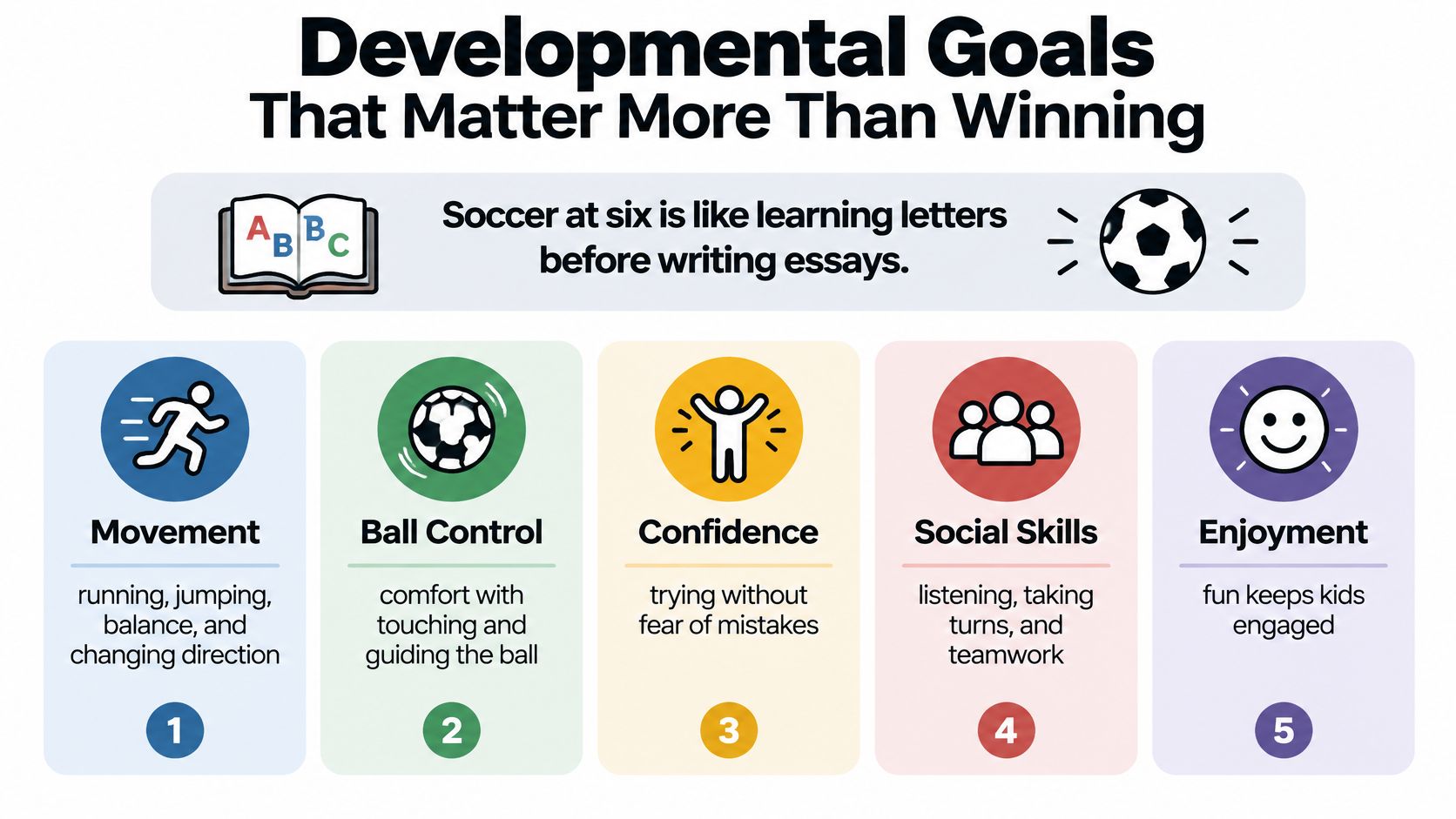
Notice what the child can do
Movement: Look for more comfortable running, stopping, jumping, balancing, and changing direction. A child who can turn without repeatedly losing balance is making useful progress.
Ball control: Notice whether the child can stop a rolling ball, guide it toward open space, or protect it from a gentle challenge. Clean execution isn't required.
Confidence and understanding: Trying again after losing possession matters. So does beginning to notice a nearby teammate or an empty patch of field instead of following the crowd automatically.
Social skills: Joining an activity, listening to a brief instruction, taking turns, and encouraging a teammate all belong in the learning process.
Enjoyment: Pay attention when the child invents a ball game at home or eagerly describes something from practice. Voluntary engagement tells you something a scoreline can't.
A child might finish a season without scoring and still become more willing to receive the ball. Another might score often because they run quickly but still need help coping with mistakes. Both need teaching, not a ranking of their future potential.
Practical rule: Compare your child's comfort and willingness with their own starting point, not with the most experienced player.
Early exposure isn't early specialization
A peer-reviewed review of youth soccer specialization reports that participation commonly begins between ages 5 and 14, while evidence confirming the effectiveness of early specialization remains limited.
That distinction answers a common worry. Starting young can mean enjoyable exposure; it doesn't have to mean treating soccer as an exclusive, intensive commitment.
Technical instruction isn't the problem. The concern is allowing adult ambitions to replace the child's curiosity, recovery, and freedom to enjoy other activities. Build confidence and motivation first, then adjust competitive demands as the child matures.
How to Judge Coaching, Safety and Program Design
A polished website and attractive field won't tell you how a coach responds when a child misses the ball or becomes overwhelmed. Watch an actual session before paying for a longer commitment, preferably with the coach who would teach your child.
Observe ordinary moments rather than only the opening welcome. Notice what happens when someone arrives late, misunderstands an instruction, or needs help.
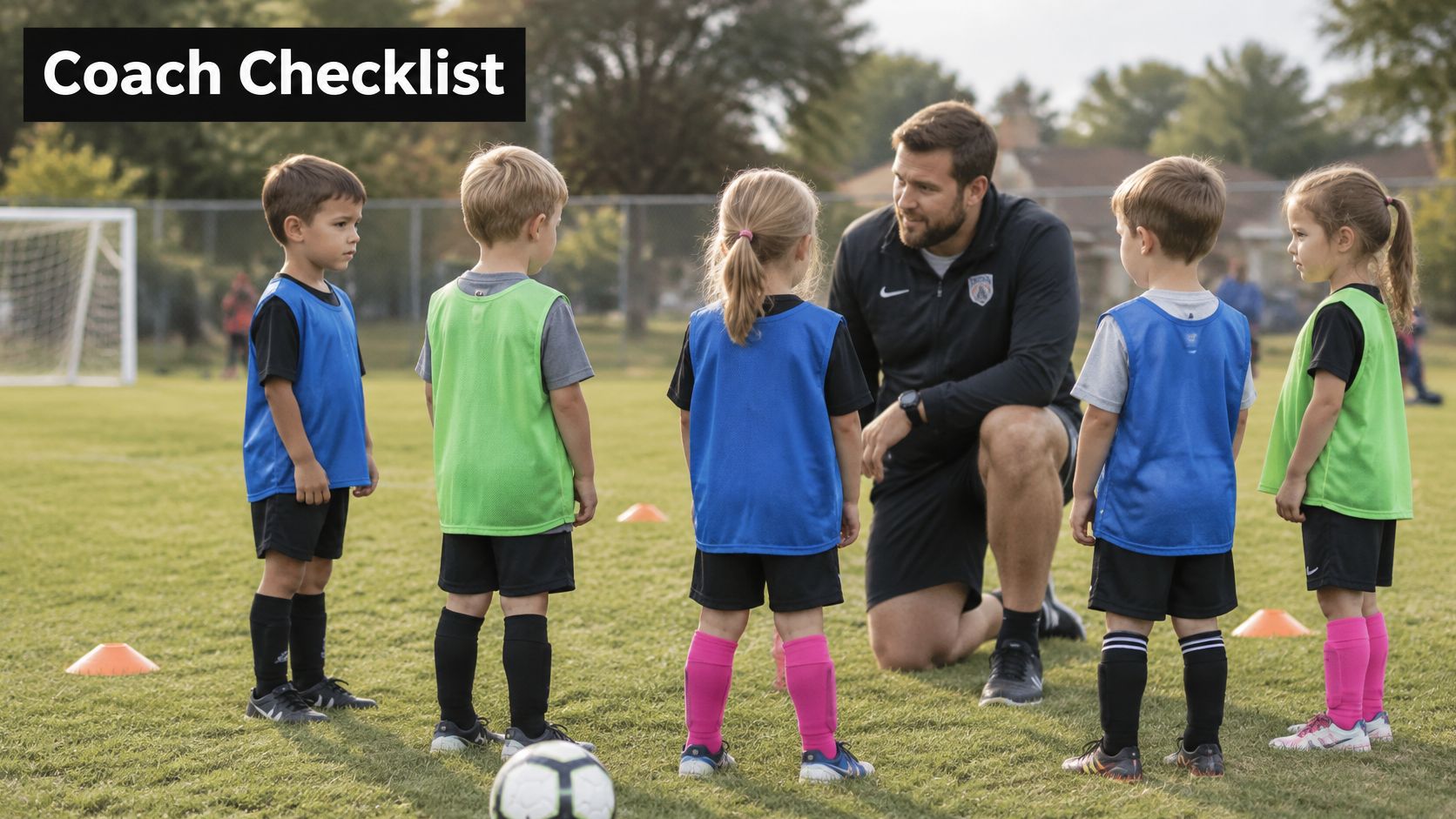
Coach standards and session design
Relevant preparation: Ask which coaching course or license the coach has completed, whether first-aid training is current, and how the organization handles background screening. A confident answer should identify a process, not merely describe the coach as experienced.
Manageable supervision: Watch whether the coach notices children who drift away, struggle, or rarely receive the ball. Headcount matters less than whether the adults can supervise and teach the group effectively.
Active participation: Look for small games, accessible goals, suitable balls, and equipment arranged before activities begin. Long queues leave children practicing waiting rather than soccer.
Fair involvement: Ask how the coach distributes match opportunities and supports less-confident players. Don't mistake a welcoming introduction for a clear playing-time policy.
Our coaching standard is to engage, communicate positively, and help young players find their best on and off the field. Parents can use those behaviors as practical tests, alongside the considerations in our guide to what makes a good soccer coach.
Communication and safety
Specific feedback gives a child something useful to try. Encouraging a player to take a softer touch is more helpful than repeatedly demanding better play. Watch whether the coach demonstrates, allows another attempt, and avoids comparing children publicly.
Safety should also be visible. Check for controlled arrival and collection, accessible drinking water, shin guards, secure goals, and a playing surface free of obvious hazards. Ask who manages an injury, how families are contacted, and what happens during dangerous weather.
Use these questions during a trial:
Teaching: How would you help a child who keeps losing the ball and becomes frustrated?
Participation: What happens when a child needs a break or isn't ready to join?
Emergency response: Who takes responsibility if a player is injured?
You should be able to explain who is supervising your child, how you collect them, and what happens if something goes wrong.
Walk away from yelling directed at children, public shaming, unsupervised drop-off, or unavailable water. A session dominated by lectures is also a poor fit, even if the coach's explanations sound polished.
What a Good Six-Year-Old Session Looks Like
A good session keeps children moving without demanding continuous exertion. Coaches alternate activity, explanation, recovery, and play rather than trying to fill every moment with a drill.
The CDC's physical activity guidance recommends at least 60 minutes of moderate-to-vigorous activity daily for children ages 6–17, with varied activities and gradual progression. That's a daily movement recommendation, not a requirement for a soccer practice to last that long.
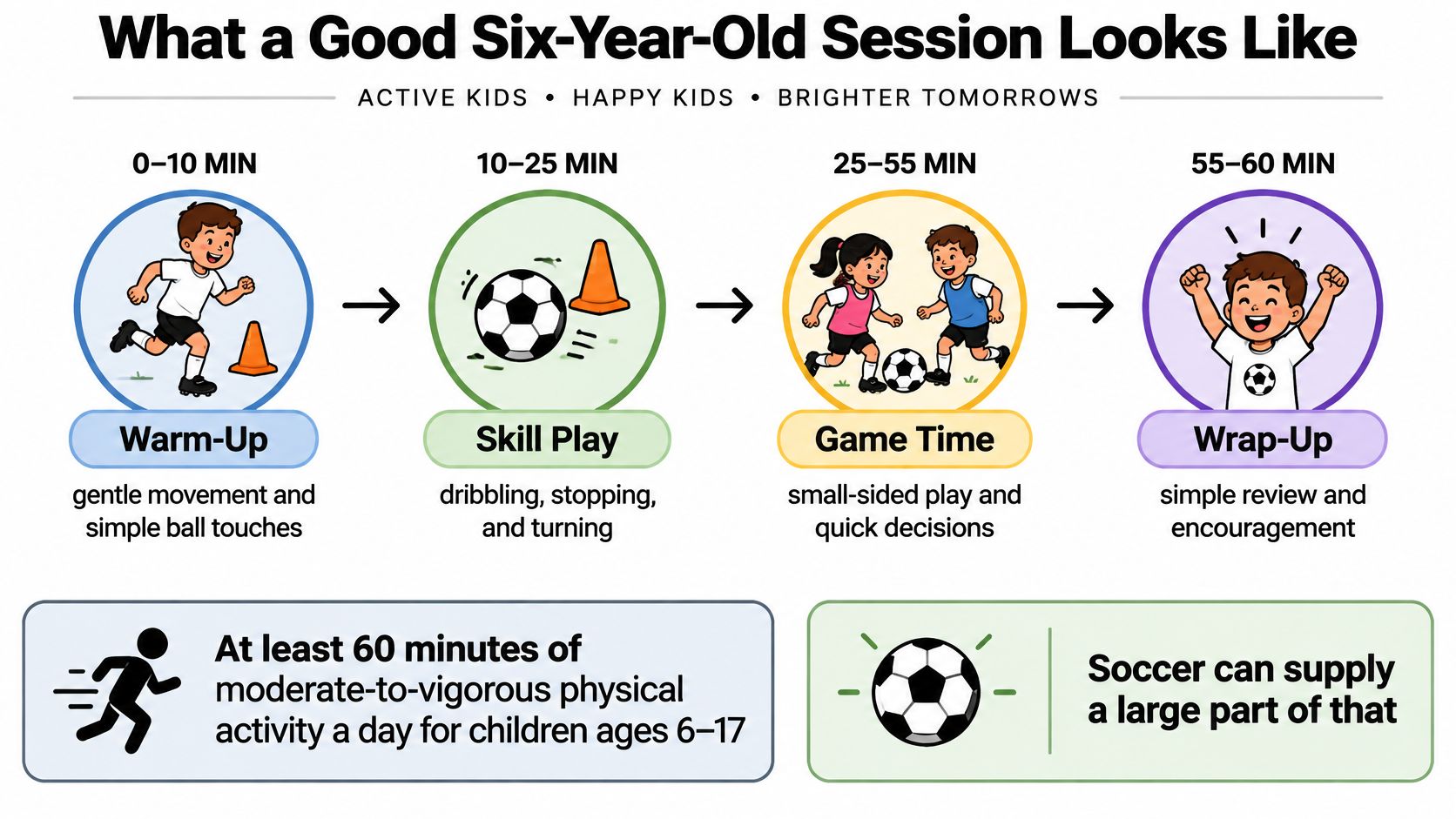
An illustrative practice timeline
The following hypothetical 45-minute session shows how a coach might organize the time. It's an example, not a prescribed timetable, and water should be available throughout.
Example timeframe | Activity | Purpose |
|---|---|---|
0–4 minutes | Arrival and free dribbling, with a ball available for each child | Allows an easy entry while the coach observes |
4–10 minutes | Gentle tag games involving the ball | Introduces stopping, starting, and awareness |
10–18 minutes | Dribbling gates and short passing stations | Gives children manageable technical challenges |
18–30 minutes | A small-sided game, such as 4v4, with rotating groups | Lets players make decisions against opposition |
30–37 minutes | Balance walks, animal movements, and playful relays | Adds movement variety rather than repeating footwork |
37–42 minutes | Water, recovery, and a brief reflection | Helps children recognize something they attempted |
42–45 minutes | Calm finish and supervised collection | Makes the transition back to the family predictable |
The coach should adapt the plan when children need more recovery or an activity isn't working. Passing against a wall, for example, only belongs in the session if the surface and surrounding space are suitable.
Keep the load varied
Repeating only soccer movements isn't necessary. Running games, jumping, balance, and coordination challenges give children different ways to move and succeed.
Persistent dread, unusual fatigue, lingering soreness, or losing interest in ordinary play are reasons to reduce demands rather than add training. If pain persists or changes how your child moves, seek medical advice instead of trying to coach through it.
Preparation can also prevent avoidable stress. Pack shin guards, suitable shoes, and a filled bottle together, and identify belongings clearly. InchBug's guide to choosing a durable soccer bag tag offers practical considerations for keeping a child's equipment identifiable.
Keep the post-practice conversation light. Ask what the child enjoyed or tried, rather than conducting a technical review on the drive home.
Real Time, Money and Travel Commitment
Registration is only the beginning of the commitment. Uniforms, footwear, shin guards, a ball, a bottle, transportation, and replacement equipment can all affect what a family spends.
Time deserves the same scrutiny. A nearby session that fits between school and dinner may be more sustainable than a longer journey to a program with a stronger competitive reputation.
Count the whole outing
Use this hypothetical weekly calculation, replacing every entry with your own schedule.
Weekly family time for one six-year-old
Item | Minutes per week | Notes |
|---|---|---|
Practice session | 45 | One weekday session |
Drive to field, round trip | 60 | An assumed 30 minutes each way for practice |
Saturday game | 60 | Allow separately for any additional warm-up |
Arrival and waiting | 30 | Assumed time before and after activities |
Total family time | 195 | 3 hours 15 minutes, before game travel or sibling logistics |
The example isn't a complete travel estimate. If Saturday's game requires another journey, add that round trip too. Also consider whether an adult must remain on site and whether siblings need supervision elsewhere.
A manageable calendar is part of program quality. Choose a commitment your family can sustain during an ordinary busy week.
Ask for the full cost before registering
FOX Sports reporting citing the Aspen Institute's Project Play puts average family spending on a child's primary sport at $1,016 and reports that 32% of respondents identified team fees as a major barrier. Those are broader youth-sport figures, not a quote for a local soccer program.
Request an itemized total rather than asking only for the registration fee. Our guide to soccer academy fees offers context for evaluating the financial commitment.
Before paying, get clear answers about:
Assistance and equipment: Is financial help available, and can families use exchanged uniforms or suitable secondhand equipment?
Disruptions: What happens after weather cancellations, missed sessions, or a change in family circumstances?
Transport: Where do families park, and can training or game locations change?
Accessibility: Can caregivers obtain information in a language they understand?
Commitment: Can a child participate without immediately entering a year-round competitive schedule?
Don't treat uncertainty as a minor administrative issue. Unclear costs or collection arrangements can make an otherwise appealing program difficult to use.
Common Parent Questions About Six-Year-Old Soccer
Is my child too late to start at six?
No, six is a reasonable age to begin. Some teammates may already know the routines, but familiarity isn't a prediction of long-term ability.
Tell the coach your child is new and ask how beginners join activities. A useful first experience lets the child participate without needing to catch up before arriving.
Should my child play only soccer?
No, soccer doesn't need to replace other enjoyable movement. Swimming, climbing, playground games, and casual outdoor play can remain part of family life.
You don't need to turn those activities into another training plan. Let your child choose some movement because it's enjoyable.
Will early soccer lead to a scholarship or professional career?
Participation doesn't guarantee a future playing opportunity. At our academy, participation does not guarantee playing time, starting positions, team selection, advancement opportunities, college recruitment opportunities, or professional opportunities.
Judge the current experience rather than buying a distant promise. Ask whether your child is learning, treated respectfully, and receiving appropriate instruction now.
What if my child cries or refuses to go?
Find out what feels difficult before deciding whether to continue. New-setting nerves differ from repeated distress, fear of a coach, physical discomfort, or feeling excluded.
Ask calmly whether the problem is the activity, the people, or the transition from home. A supported introduction or different format may help, but persistent refusal deserves a change rather than escalating pressure.
What gear should we buy first?
Start with comfortable basics and confirm the venue's requirements before buying extras. Shin guards, socks that hold them securely, a water bottle, weather-appropriate clothing, and suitable trainers cover a practical trial-session kit.
Ask which ball the group uses before purchasing one. Hand-me-down cleats can work if they fit well and suit the surface, but don't buy expensive footwear to solve a problem your child hasn't encountered.
Before the trial: Confirm what the provider supplies and what your child must bring.
After the trial: Buy only the additional equipment required for the format you've chosen.
Choose Your Six-Year-Old's Program and Take the First Step
Use a modest starting commitment, then let the child's response guide the next decision. The U.S. Youth Soccer Player Development Model recommends approximately one weekly session lasting no longer than 45 minutes for U6 players.
Check how the provider groups children, because an age-group label isn't always identical to a child's current age. Prioritize enjoyment, willingness to attend, movement confidence, and comfortable recovery.
Competition can be appropriate when children can experiment, remain involved, and make mistakes without humiliation. Increase demands only when your child consistently wants more and remains enthusiastic.
Set your limits. Write down the weekly time and total spending your family can sustain.
Shortlist contrasting formats. Compare a local team experience with a class or short clinic.
Arrange a trial. Watch coaching behavior, supervision, and actual participation.
Resolve practical questions. Confirm costs, equipment, cancellations, travel, and collection arrangements.
Confirm local suitability. Call us at 281-962-4920 to discuss ages and locations, including our United City Church fields at 19901 Townsen Blvd, Humble, TX 77338.
You don't need to choose your child's entire soccer future today. Choose a safe, manageable place they want to attend next week.
Villarreal Houston Academy offers select and competitive youth soccer programming with age-appropriate training focused on skill, intelligence, and character. Visit Villarreal Houston Academy to explore local options and discuss which setting fits your six-year-old's readiness and your family's schedule.
Comments