


8 Youth Soccer Tryouts Drills for Better Evaluations

A tryout field can fill quickly with players who have different ages, experience, confidence levels, and physical development. One player may dominate a sprint, another may need time to settle before showing an excellent first touch, while a younger player may understand space without yet having the coordination to execute every idea.
A fair evaluation can't depend on goals, speed, or one impressive scrimmage. The strongest youth soccer tryouts drills combine frequent touches, pressure-based decisions, realistic small-sided games, and age-appropriate observation. Coaches should look for technical security, awareness, adaptability, coachability, communication, and the response to mistakes.
The eight drills below create a complete pathway, from first touch and possession to 1v1 duels, transitions, positional responsibilities, game intelligence, and fatigue. Each activity includes adjustments for players from age 4 through 18, along with practical signs to record. That approach fits the development focus of Villarreal Houston Academy, the official partner academy of Villarreal CF in the Greater Houston area, where intelligence, skill, character, positive coaching, and a safe, enjoyable environment sit alongside competitive development.
Coaches should evaluate how players perceive, decide, execute, respond, and support teammates, not only whether the final action succeeds.
1. The Rondo Possession Circle Drill
Rondo gives a coach a fast view of how players behave when time and space disappear. Players on the outside pass and move while defenders inside attempt to win the ball. The activity rewards a good first touch, scanning before receiving, accurate passing, support angles, and the courage to show for the ball after a mistake.
Use a compact area with enough players to create frequent decisions. Begin with unrestricted touches for younger or less experienced players, then introduce touch limits or an additional defender for older groups. The point isn't to punish a player who loses possession. Watch what happens immediately afterward. Does the player recover mentally, offer a new passing angle, or disengage?
A coach can vary the rondo without changing its purpose:
For ages 4–7: Use a larger space, fewer defenders, simple movement instructions, and frequent encouragement. Allow players to stop the ball, turn, or carry it before passing.
For ages 8–12: Encourage receiving across the body, checking away before showing, and moving after every pass. Add gentle touch restrictions only when players understand the task.
For ages 13–18: Increase tempo, narrow the area, add directional targets, or require players to connect a certain number of passes before switching play.
Villarreal CF-aligned coaching places value on intelligent possession rather than empty circulation. The principles behind this activity also connect naturally with small-sided soccer games for developing players, where players repeatedly solve problems with teammates.
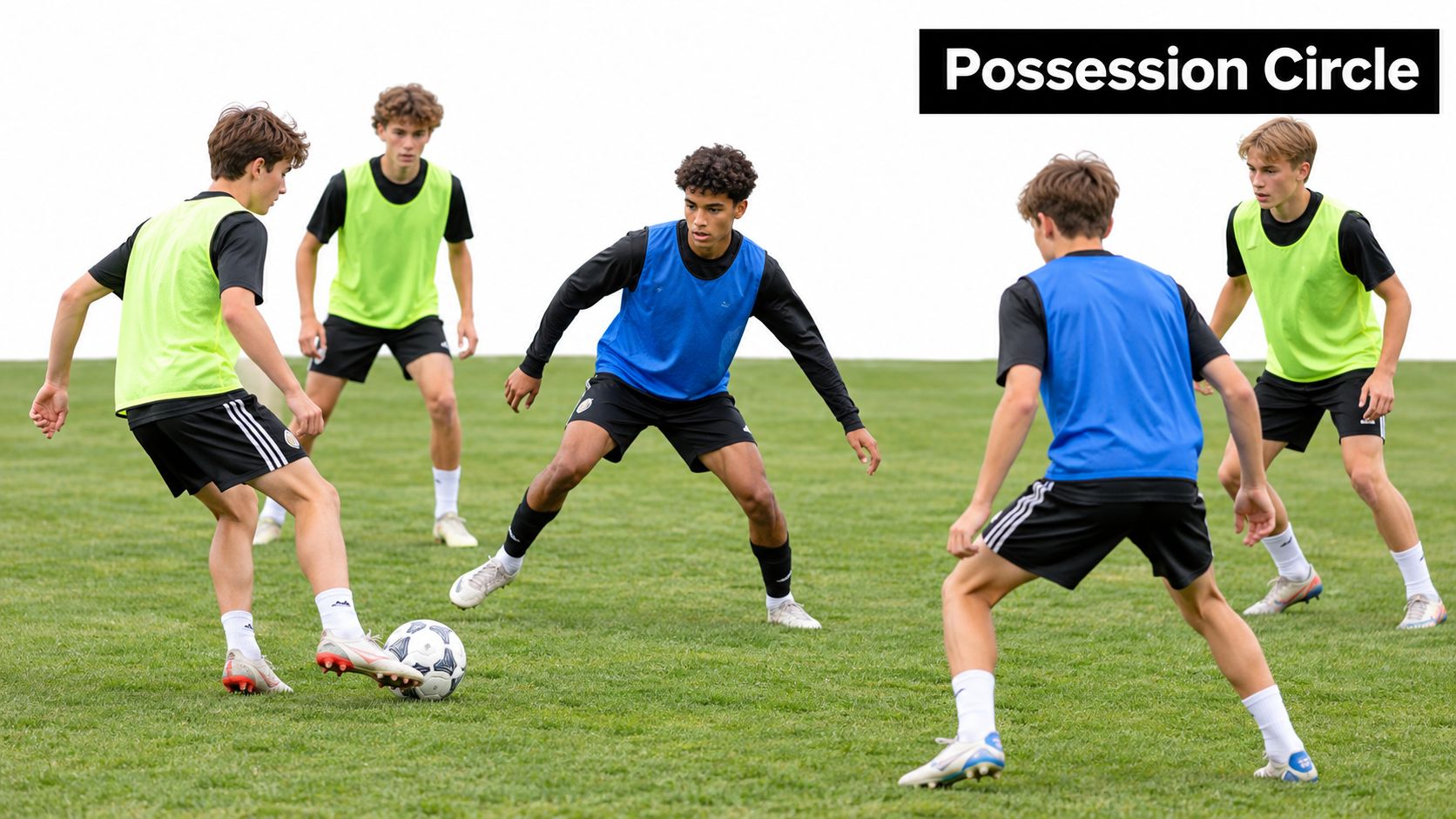
Record first-touch direction, scanning, passing weight, support movement, communication, and reactions to pressure. Historical reviews of youth talent identification describe a shift from mainly physical testing toward broader assessment, including technical, tactical, psychological, and social qualities. The review of physical characteristics and talent identification in male youth soccer%20-%20Accepted%20Version%20-%20Review%20of%20Physical%20Characteristics%20in%20Male%20Youth%20Soccer.pdf) provides useful context for why a rondo should be one part of a wider pathway, not a standalone selection test.
2. 1v1 Isolated Skill Assessment
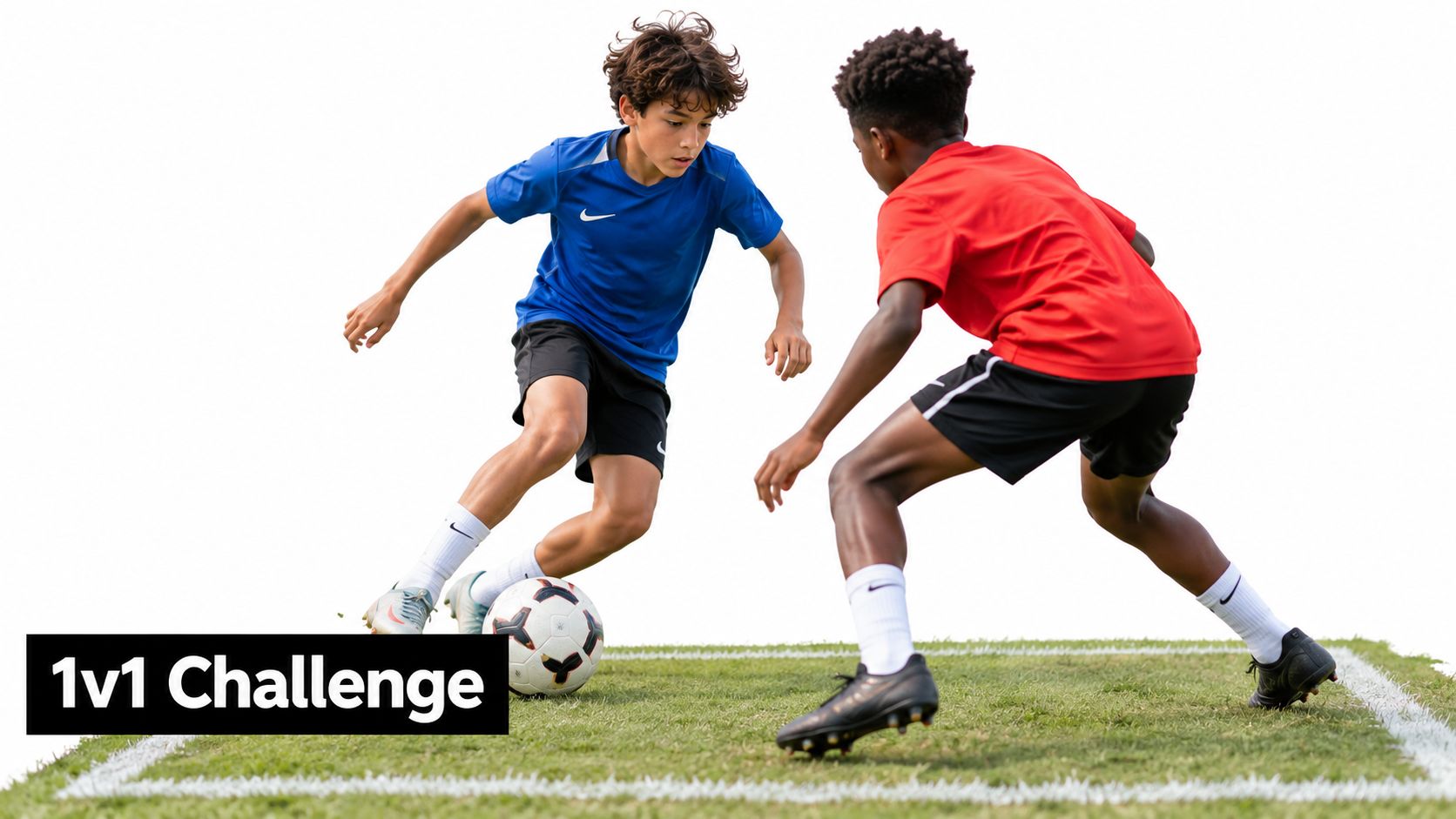
A 1v1 duel reveals details that team play can hide. Mark a defined channel or square, give the attacker a target line or mini-goal, and let the defender score by winning the ball and dribbling out. Rotate attackers and defenders so every player experiences both roles against different opponents.
Don't judge only whether the attacker beats the defender. Look at the setup touch, changes of speed, body feints, use of the weaker foot, shielding, and timing. Defenders should be assessed on approach speed, body shape, patience, ability to delay the attacker, and reaction after the first move.
The drill should feel competitive without becoming a test of size. For younger players, make the space generous and allow the attacker to restart after an accidental loss of balance. Players in the middle age groups can work with directional gates, end zones, or a bonus for recognizing when to protect the ball instead of forcing a dribble. Older players should face varied starting positions, tighter channels, and realistic transitions after the duel.
A useful sequence is:
First round: Let players solve the duel without many instructions.
Second round: Change the width or starting angle and observe adaptability.
Third round: Add a supporting attacker or recovering defender to connect the duel to the game.
A coach can distinguish creativity from reckless repetition. A player who attempts the same move every time may look exciting but still need guidance. A player who changes the action based on the defender's position is showing stronger game intelligence.
Use ideas from youth soccer defensive drills when evaluating the defender's stance, pressure, and recovery. Keep the feedback positive and specific. “You waited until the attacker showed the ball, then stepped in” teaches more than “good defending.”
3. Directional Passing and First Touch Assessment
Set up a server, a receiving player, and several target gates placed at different angles. The server passes along the ground, and the receiver must identify the next action, take the first touch into useful space, and pass through the correct target. The drill looks simple, but it exposes whether a player receives the ball with a plan.
Start without opposition so the coach can see basic technique. Then add a passive defender, a closing defender, or a visual cue that changes the target at the last moment. The receiver should check the shoulder before the pass arrives, adjust the feet, open the body when appropriate, and choose a touch that protects the next action.
The best first touch isn't always the softest one. A touch away from pressure may need to travel farther than a touch used to secure the ball in a crowded area. Ask coaches to record whether the player recognizes that difference.
Age-based progressions
For ages 4–7, use larger gates, slower passes, and clear verbal prompts. Let players catch or stop a difficult ball before restarting if the purpose is coordination and confidence. Ages 8–12 can receive with either foot, pass through gates in both directions, and begin responding to a defender's movement. Ages 13–18 should work at match speed, receive from varied angles, and select between a safe pass, a forward pass, and a turn.
Useful observations include:
Body orientation: Can the player see the field before receiving?
First-touch purpose: Does the touch create time, protect the ball, or move away from pressure?
Passing detail: Does the player choose the correct foot, weight, and angle?
Decision speed: Does the player act quickly without rushing?
Technical security gives a player more options, but coaches should also reward the player who recognizes when not to force a difficult pass. The progression should reflect the principles in these youth soccer passing drills, especially receiving with awareness and connecting the next action to the wider game.
Don't turn the exercise into a queue. Use multiple servers, spare balls, and parallel stations so players receive enough repetitions to show a pattern rather than one isolated touch.
4. Small-Sided Game Assessment
Small-sided games are the closest test in this pathway to natural football. Use a balanced 4v4 or 5v5 format, with goals and clear restart rules. Rotate teammates and opponents so a player isn't judged only within one comfortable combination.
A small game reveals whether a player can apply technique while reading teammates, opponents, space, and the score. Watch what happens away from the ball. Does a winger create width? Does a defender move to provide cover? Does a midfielder check away before receiving? Does a player recognize a moment to slow down after winning possession?
Balance matters more than keeping a strict win-loss record. If one team overwhelms the other, some players will spend the activity defending deep or chasing the ball, and the evaluation becomes distorted. Adjust teams between rounds and give every player opportunities to start attacks, defend, and respond to turnovers.
What to record in the game
Availability: Does the player create passing options without being prompted?
Tactical response: Does the player recognize when to support, switch, press, or recover?
Technical application: Does the player protect and move the ball under realistic pressure?
Social contribution: Does the player communicate, encourage teammates, and accept responsibility?
For ages 4–7, use very small spaces, simple targets, and frequent restarts. Keep the emphasis on ball involvement and joy. Ages 8–12 can play with directional goals and basic team principles such as spreading out and recovering. Ages 13–18 can handle more complex constraints, including pressing triggers, buildup roles, and transition responsibilities.
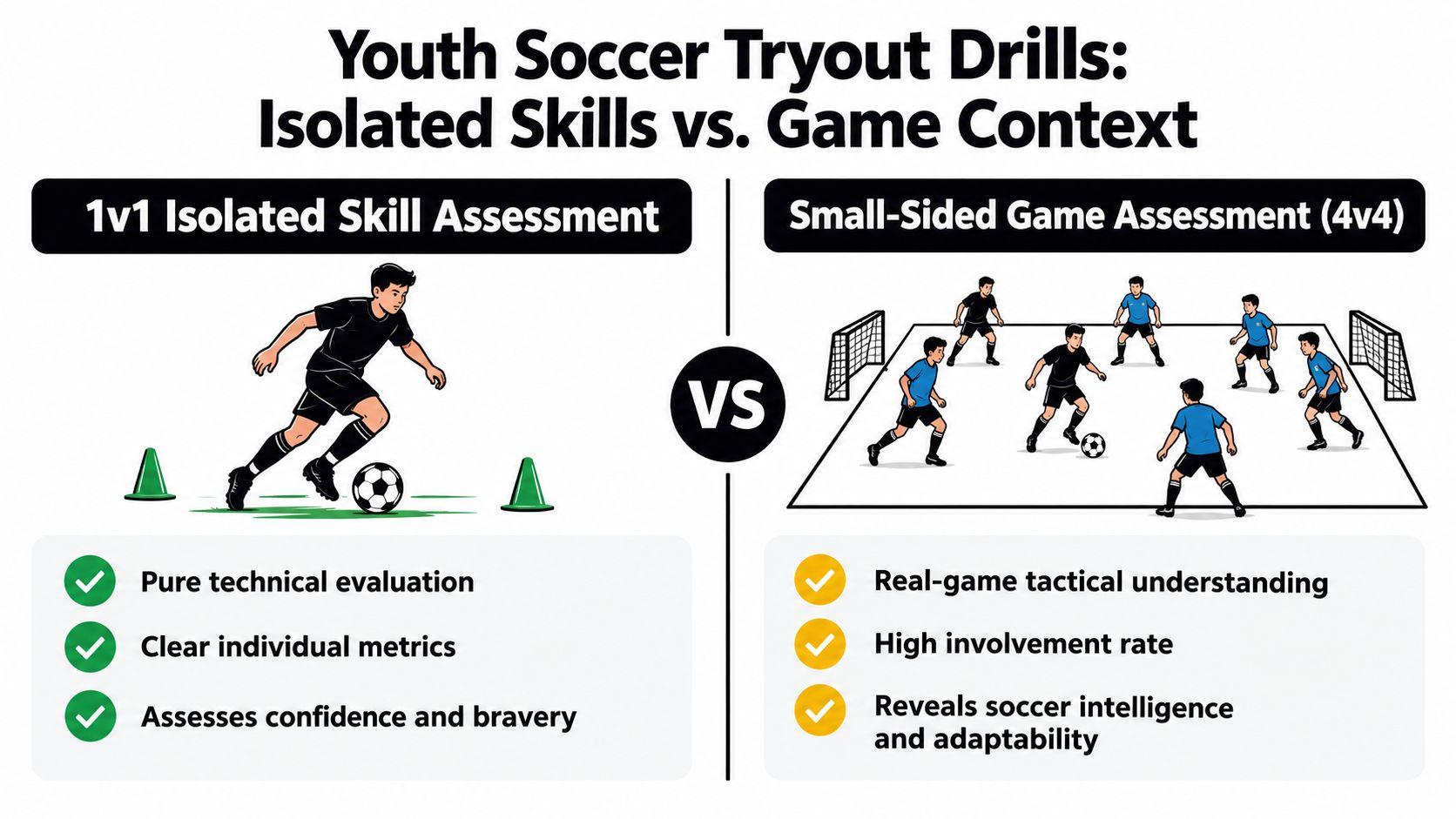
A practical tryout guide recommends technical blocks in an 8x8 space, a 1v1 activity, and 4v4 plus jokers, with 15-minute blocks followed by a short scrimmage. This youth football tryout format is useful because it combines repeated technical actions with realistic decisions instead of asking one drill to answer every selection question.
5. Transition and Counter-Attack Drill
Transitions expose a player's reaction to changing information. Begin with a small attacking group trying to score against defenders. When the ball goes out, a coach serves a new ball to the opposite team or signals a change of direction. Players must move immediately from attacking to defending, or from defending to supporting the counter.
Keep the first version clear. A coach can call “change” or use a visual signal, then watch whether players understand the new phase. Later, allow the turnover itself to become the trigger. This reveals who reacts to the game and who waits for instructions.
Use numerical variations such as 3v2, 3v3, or a recovering defender joining late. The exact format matters less than the decisions it creates. In attack, look for the first forward action, support underneath, width, and recognition of when to keep the ball. In defense, assess the first pressure, cover position, recovery speed, and communication.
The first action after losing the ball often tells you more about a player's game understanding than the previous attacking move.
Adapt the activity carefully by age. For ages 4–7, use a simple chase-and-score game with obvious targets and short rounds. Ages 8–12 can learn the ideas of immediate pressure, recovery, and support through clear team roles. Ages 13–18 should handle varied triggers, numerical disadvantages, and choices between a direct counter and controlled possession.
Record decisions rather than only outcomes. A counterattack may fail because a teammate made a poor run, while a technically clean pass may still be the wrong choice if a safer forward option was available. A Villarreal CF-aligned assessment should reward intelligent solutions, responsibility after mistakes, and effort to help the team in both phases.
6. Positional Specific Skill Stations
Position-specific stations help coaches understand where a player may contribute today, but they shouldn't lock a young athlete into one role. A goalkeeper, center-back, fullback, midfielder, winger, or striker needs different technical actions, yet younger players also need opportunities to develop versatility.
Create short stations with one technical task and one decision component. A goalkeeper might handle basic footwork, catching, distribution, and choosing a passing option. A defender could receive under pressure, defend an attacker in a channel, and recognize when to step or cover. A midfielder might play forward from a checking movement, while a winger or striker combines receiving, running, crossing, and finishing.
For ages 4–7, avoid rigid positional labels. Let players rotate through attacking and defending roles, and focus on coordination, ball control, bravery, and enjoyment. Ages 8–12 can explore several positions while learning simple responsibilities such as creating width, supporting the ball, and protecting the goal. Ages 13–18 can complete more specialized stations that include realistic positioning and tactical choices.
Build a fair station
Use clear criteria: Define what the station tests before players begin.
Include a decision: Require the player to react to a teammate, defender, or changing target.
Test transfer: Follow the isolated action with a small game or phase-of-play activity.
Record development needs: Note whether a weakness reflects technique, awareness, confidence, or unfamiliarity with the role.
A striker who finishes well but doesn't scan for the next pass may need a different development plan from a striker who consistently finds good spaces but needs technical refinement. Similarly, a defender's value isn't measured only by tackles. Body shape, communication, anticipation, and the ability to play out can matter just as much.
This station should inform placement, not determine a player's identity. Coaches should communicate that positional observations are part of a development conversation, especially for children whose physical growth or confidence may change their current performance.
7. Decision-Making Under Pressure
Decision-making activities should progress from clear choices to situations with competing solutions. Start with a receiver choosing between a pass and a shot. Add a recovering defender, a supporting teammate, a second goal, or a requirement to protect a lead. The coach is testing perception before execution, not just asking players to act quickly.
A useful scenario begins with a realistic picture. For example, an attacking player receives near the edge of the area with one defender closing, a teammate making a supporting run, and a target behind the defender. The correct choice might be a dribble, a pass, a turn, or a shot, depending on the information available. Don't announce the answer beforehand.
Younger players need short instructions and visible targets. Ages 4–7 can choose between two colors or two goals, learning to lift the head and recognize options. Ages 8–12 can deal with a passive or semi-active defender and begin explaining why they chose a particular action. Ages 13–18 should face game-speed pressure, changing runs, numerical differences, and situations where more than one decision can be effective.
Evaluate the process
Watch whether the player:
Scans early: Checks the field before the ball arrives.
Recognizes pressure: Understands whether to play forward, protect possession, or turn.
Chooses proportionately: Matches risk to the situation.
Executes under stress: Keeps technique functional while processing information.
Learns quickly: Adjusts after feedback or a changed constraint.
Coaches should avoid treating every unsuccessful decision as a poor decision. A well-read forward pass may fail because of execution, while a successful pass backward may reflect fear rather than good game management. Record the quality of the thought, the technical action, and the response to feedback separately.
This is also a strong place to observe character. Players who listen, ask constructive questions, and try a new solution after failure often show development potential that a single successful action can't capture.
8. Fitness and Intensity Assessment
Fitness belongs in the pathway, but it shouldn't become a shortcut for selecting the strongest or fastest player. Physical maturity varies, and a high sprint result doesn't show whether a player can read the game, maintain technique, or contribute to teammates.
Run physical testing after the technical and decision activities when players are fresh, then observe how they maintain skill during later game play. A coach may use repeated sprints, short high-intensity intervals, or a shuttle test, but the interpretation should include movement quality, recovery behavior, and technical consistency.
Youth coaching resources cite these age-banded benchmarks as one reference point: a 5-10-15m shuttle under 14 seconds for ages 10–12 and under 12 seconds for U14+, a 40-yard sprint under 6.5 seconds for ages 10–12 and under 5.8 seconds for U14+, and a beep test target of Level 6+ versus Level 8+. This youth soccer tryout preparation guide presents those thresholds as useful for distinguishing general participation readiness from a more competitive select level, but coaches still need context.
For ages 4–7, replace formal testing with enjoyable races, movement games, and repeated ball actions. Ages 8–12 can complete simple, well-explained tests with generous recovery and no public ranking. Ages 13–18 can use more structured protocols, provided the coach records conditions and avoids presenting one result as a complete player profile.
The most revealing fatigue observation may come in a technical task after the running. Does the player still scan? Can they control the ball away from pressure? Do they keep communicating and tracking runners? Physical capacity matters, but its value increases when it supports intelligent, technically reliable play.
Youth Soccer Tryouts: 8-Drill Comparison
Drill / Assessment | Implementation Complexity 🔄 | Resource & Space ⚡ | Expected Outcomes 📊 | Ideal Use Cases 💡 | Key Advantages ⭐ |
|---|---|---|---|---|---|
The Rondo (Possession Circle Drill) | Low–Moderate 🔄, scalable, simple rules | Low ⚡, small area, few balls, 1 coach | High technical + decision-making ⭐⭐⭐⭐ 📊, high ball contact, composure under pressure | Warm-ups, tryouts for possession-style players | Reflects Spanish methodology; easily modifiable; high repetition |
1v1 Isolated Skill Assessment | Low 🔄, simple setup, needs standard rubric | Very Low ⚡, small zone, cones, optional video | Clear individual technical/mental metrics ⭐⭐⭐ 📊, dribbling, bravery, defensive response | Identifying attackers/defenders, quick individual comparisons | Easy to score/compare; reveals confidence and one-on-one quality |
Directional Passing & First Touch Assessment | Moderate 🔄, requires servers/structured reps | Low–Moderate ⚡, cones, targets, servers, coach supervision | High technical fidelity ⭐⭐⭐⭐ 📊, first touch, weighted passing accuracy | Technical baseline testing; fit for possession-focused systems | Quantifiable metrics; directly assesses fundamentals valued by La Liga academies |
Small-Sided Game Assessment (4v4 or 5v5) | Moderate–High 🔄, rotations, balanced teams needed | Moderate–High ⚡, full small-sided pitch, multiple coaches, time | Comprehensive game-readiness ⭐⭐⭐⭐ 📊, tactical intelligence, positioning | Final selection, assessing team fit and game application | Most realistic context; shows decision-making in play and versatility |
Transition & Counter-Attack Drill | High 🔄, complex triggers and phase design | Moderate ⚡, space, coaches, video for analysis | Strong transitional ability & fitness ⭐⭐⭐ 📊, quick decisions, recovery | Assessing players for pressing/quick-transition roles | Reveals tactical speed, adaptability, and stamina under pressure |
Positional Specific Skill Stations | High 🔄, multiple stations, specialized rubrics | High ⚡, many coaches, varied equipment per station | Clear position-fit metrics ⭐⭐⭐⭐ 📊, role-specific technical/tactical indicators | Assigning positions, targeted development planning | Objective, comparable station scores; tailored feedback per role |
Decision-Making Under Pressure (Game-Speed Scenarios) | High 🔄, scenario design, expert evaluation required | Moderate ⚡, live defenders, video, experienced coaches | Elite tactical intelligence identification ⭐⭐⭐⭐ 📊, decision speed and appropriateness | Selecting players for possession systems needing high IQ | Most realistic cognitive assessment; exposes nuance in choices |
Fitness & Intensity Assessment (RSA / HIIT) | Moderate 🔄, standardized protocols, timing control | Moderate ⚡, timing devices, measured space, recovery monitoring | Objective physical metrics ⭐⭐⭐ 📊, sprint recovery, fatigue effect on skills | Evaluating work-rate, conditioning, readiness for intense systems | Provides objective data to inform conditioning and role suitability |
Turn Eight Drills Into a Fair Player Pathway
A strong tryout feels organized to players and families, but it shouldn't feel mechanical. Begin with registration, a brief movement explanation, and an age-appropriate technical warm-up. Give younger players time to understand the space and coaches, while older players can move more quickly into purposeful ball work.
A practical sequence starts with directional first touch and passing, then moves into the rondo. These activities show whether players can secure the ball, scan, support teammates, and make a useful next action. Add 1v1 work after players are comfortable, because individual duels reveal creativity, defensive patience, courage, and response to pressure.
Next, use transition scenarios and positional stations. Those activities show how players handle changes in possession, whether they understand different responsibilities, and where their current strengths may fit. For younger groups, keep positions flexible. For older players, give them enough role-specific work to assess their current contribution without treating today's position as a permanent label.
Small-sided games should provide the main game-context check. A player needs opportunities to apply technique, decisions, communication, and character in a changing environment. Rotate opponents and teammates, balance the teams, and observe players in more than one role. Research on youth selection describes how short tryouts can be highly pressurized, while longitudinal and multidisciplinary assessment offers a fuller picture of potential. This review of youth soccer selection and talent identification supports repeated observation rather than relying on one brief performance.
A sample timeline can look like this:
Registration and briefing: Welcome players, explain movement between stations, and establish safety expectations.
Technical warm-up: Use ball mastery, receiving, and simple passing games matched to the age group.
First-touch and possession stations: Combine directional receiving with a rondo or another high-repetition activity.
Pressure activities: Add 1v1 duels and decision-making scenarios with realistic defenders.
Transitions and positional stations: Observe reactions to turnovers, role awareness, and tactical adaptability.
Small-sided games: Use balanced 4v4 or 5v5 formats, then finish with a longer game-context observation.
Recovery and communication: Allow players to recover, thank them for their effort, and explain when and how next steps will be shared.
The precise duration should match the age group, facility, weather, and number of coaches. The important principle is progression. Players should move from technical security to pressure, then from individual actions to team decisions and game understanding.
Standardize field dimensions, rules, station instructions, and scoring categories. Record technical execution, perception, decisions, effort, coachability, communication, respect, responsibility, and response to mistakes. Don't compare a younger player with an older player's physical output, and don't treat a late-maturing athlete as less promising because they currently lack strength.
Fitness should be interpreted alongside technical maintenance and development stage. A player who slows physically but continues to make good decisions may offer more long-term potential than a faster player who loses awareness under fatigue. Coaches should also document what can be developed. Tryouts aren't only a search for finished players. They're an opportunity to identify who can learn, compete positively, support others, and grow within a clear pathway.
That philosophy aligns with Villarreal CF principles of intelligent play, technical quality, respect, personal responsibility, and long-term development. Families comparing programs can also use this guide to soccer team building to think beyond isolated talent and consider how players function within a group.
Send every family a clear next step. Explain whether the player is invited to a team, another evaluation, a camp, or a development opportunity, and provide practical feedback where possible. Clear communication protects trust and helps players understand that selection is one moment in a longer journey.
Villarreal Houston Academy offers select and competitive youth soccer programming for boys and girls from age 4 upward, with training guided by Villarreal CF methodology and an emphasis on intelligence, skill, character, and positive coaching. Visit Villarreal Houston Academy to explore tryouts, teams, camps, clinics, and development opportunities across Greater Houston.
Comments