


8 Youth Soccer Drills U6 Coaches Can Use Today

The best youth soccer drills U6 coaches can use balance ball mastery, simple decisions, and joyful competition in 1v1, 2v1, and 2v2 games, not constant scrimmaging or long lines. A strong 30 to 45 minute session moves through individual touches, partner work, team awareness, and a small-sided game in short rounds.
That balance surprises many new coaches. Six-year-olds don't need a full game to learn soccer, and they don't need extended tactical talks either. They need frequent, simple involvement with the ball, a clear picture of one job, and another turn almost immediately.
Think of the session as a sequence of small challenges. A child stops and starts, escapes a shark, finds a gate, calls a partner's name, then tries those same actions against real opponents. Each drill below adds one layer, so technique connects to decision-making, communication, and character instead of sitting in isolation.
Keep instructions to one sentence, show the action once, and let them play. If you're talking while balls are still, you've probably explained too much. Praise the specific thing you saw, adjust the space or target, and restart quickly.
1. Red Light, Green Light Dribbling
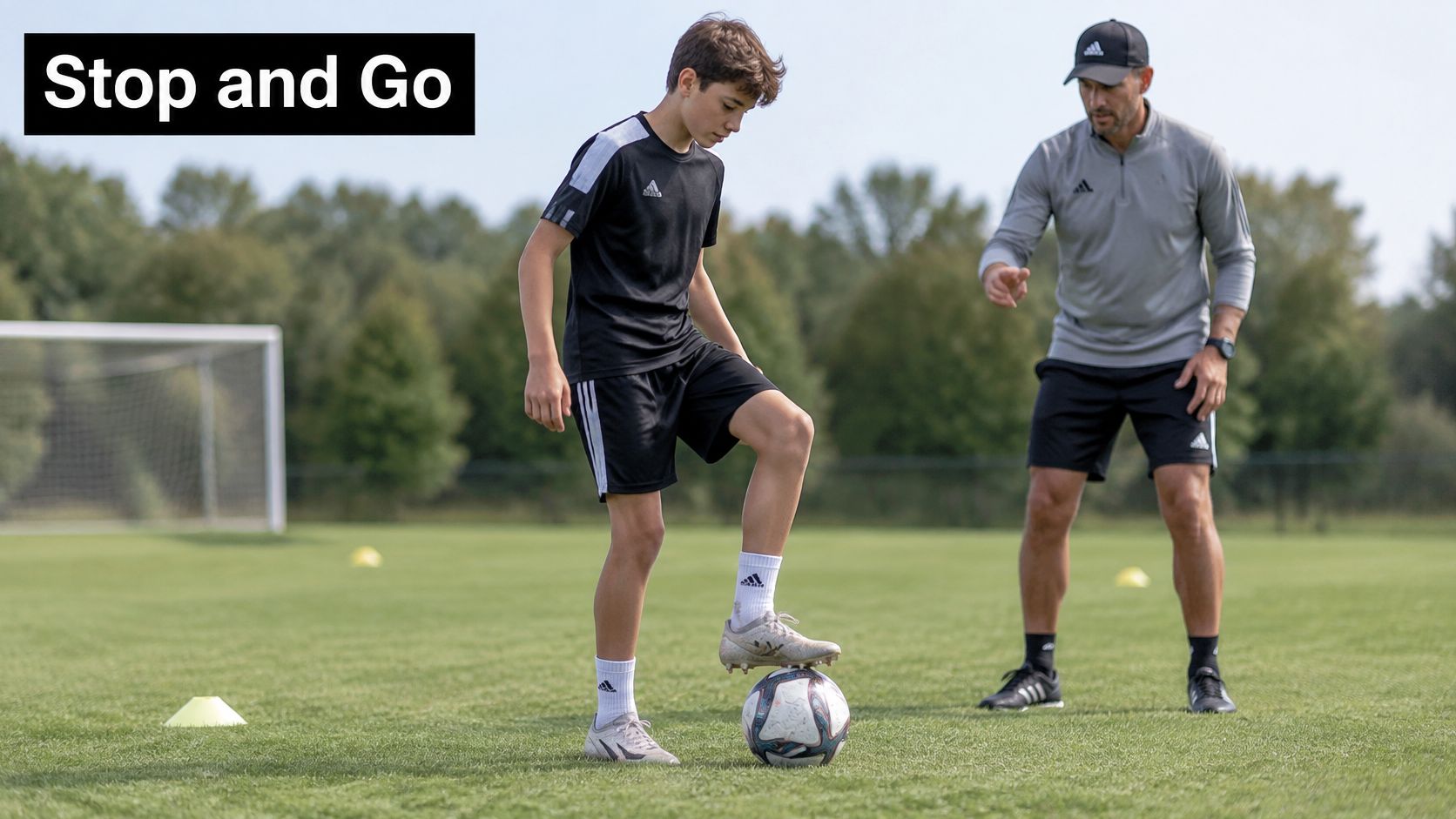
Give every player a ball inside a marked area. On green light, they dribble freely. On red light, they stop the ball with the sole of the foot and freeze like statues.
Use a random call order so children listen instead of guessing. Add yellow light for tiny touches once stopping looks easy. Anyone who rolls on after red doesn't sit out. They do three quick toe taps and rejoin, because elimination steals the touches this age group needs most.
What You're Really Teaching
This is a listening game disguised as dribbling. Players learn to keep the ball close enough to stop, lift their heads between touches, and restart without panic. That's the foundation for every turn and escape they'll attempt later in the session.
U.S. Soccer's U6 guidance on dribbling, receiving, and running with the ball supports this kind of realistic, repeated ball involvement over extended instruction, and it also advises no heading at this age. Keep the focus on feet, balance, and confidence.
Safe zone: Mark a cone corner where a tired or overwhelmed child can pause with the ball.
Praise the stop: Celebrate quick, controlled stops and restarts, not only who reaches the end first.
Build the library: Connect this control work to youth soccer dribbling drills for close control and turns as players grow ready.
In recreational clubs across the United States, this works best as a five minute opener. It's familiar, it settles nervous first-timers, and it tells you immediately who needs a bigger space and who needs a harder challenge.
2. Sharks and Minnows
One or two sharks stand in the middle of a grid without a ball. The minnows line up on one side, each with a ball, and try to dribble safely to the other side. Sharks tap a ball away below the knee, and a caught minnow becomes a helper shark for the next crossing.
Start with a wide grid. Beginners need obvious escape routes, not a wall of defenders. Shrink the space only when most minnows are crossing with their heads up and changing direction on purpose.
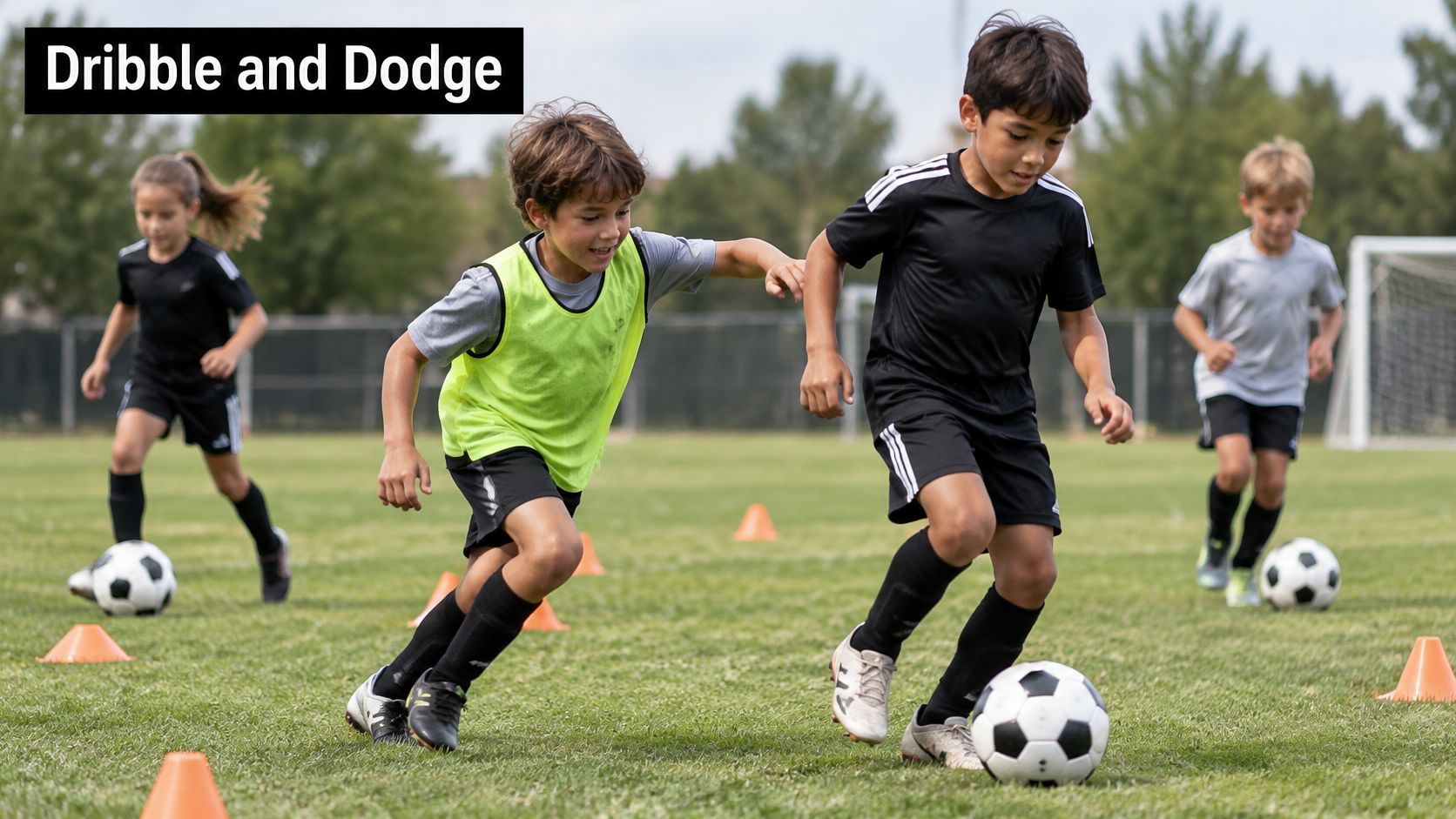
The trade-off is excitement versus control. Children love the chase, but the game turns chaotic if sharks lunge or hacked balls fly everywhere. Freeze play for ten seconds when you see a good body shield, with the minnow's side between shark and ball, and name it out loud.
Practical rule: If a child hasn't crossed successfully in two rounds, the game is too hard. Widen the grid or give that player a head start.
Rotate sharks often, or use a simple lives system so nobody spends the whole game defending. Community and academy programs for children under seven use this tag format because it teaches spatial awareness without a lecture. A minnow who scans early finds the quiet lane. A minnow who stares at the ball runs straight into trouble.
End each round with everyone back on a line, ball stopped, eyes on you. That tiny reset habit makes the next drill start faster and calmer.
3. Cone Dribbling Gates
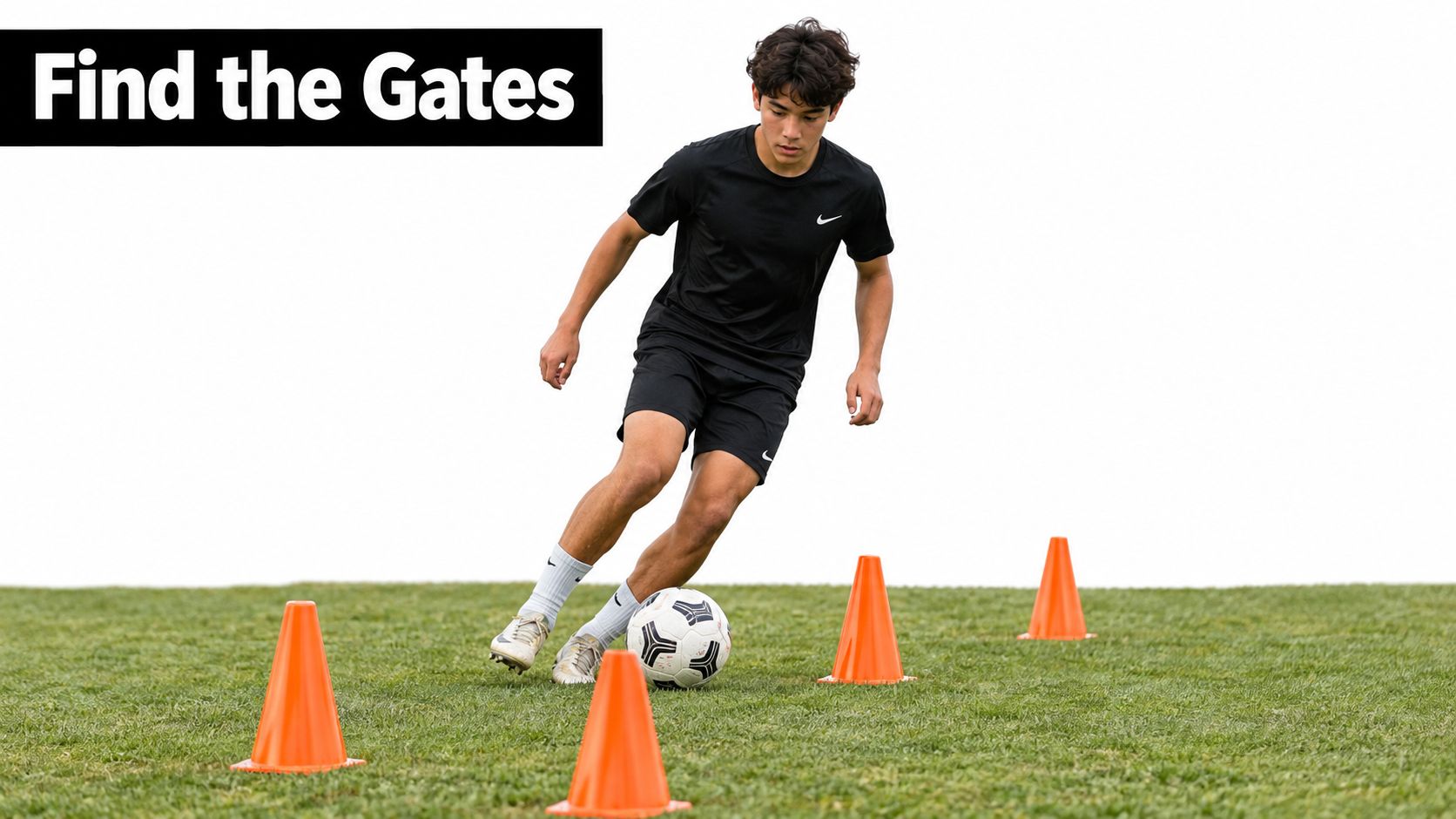
Scatter pairs of cones around the area to make small gates, each wide enough for a ball and a child to pass through comfortably. Players dribble through as many different gates as they can before you call time. There's no line, no fixed route, and no waiting for a turn.
That freedom is the point. A set slalom course looks tidy, but children spend half of it standing behind someone else. Scattered gates let every player choose a route, turn when a gate is busy, and keep moving at their own speed.
Progress It One Step at a Time
Start with wide gates and any part of the foot. Then call a simple instruction for one round only, such as inside of the foot through the gate, or a turn immediately after passing through. Let confident players count their gates and try to beat their own total next round.
For a hesitant player, do the opposite. Make two gates extra wide, place them away from traffic, and let that child succeed before joining the busier middle. Same game, different difficulty, nobody singled out.
Short rounds: Stop while energy is high and reset with a new challenge.
Own score: Players track personal improvement instead of racing one winner.
Change direction: On your whistle, everyone turns and finds a gate behind them.
Academy sessions in Europe and North America use gate work as a standard technical station because progress is easy to see. Tighter touches, cleaner turns, and fewer collisions tell you more than a stopwatch does.
4. Partner Passing Through Gates
Pairs face each other at a short, comfortable distance with a small gate between them. One player passes through the gate using the inside of the foot, the partner stops the ball, then passes it back. Say your partner's name before you pass. That one habit turns a technique drill into early communication.
Demonstrate once with the cue toe up, ankle locked. Don't lecture about body shape for two minutes. Show it, let them try, and correct one thing at a time while the ball is moving.
Making Passing Mean Something
At U6, passing competes with a strong and healthy instinct to dribble. Children pass more willingly when a real person is waiting and calling back. Praise the decision, saying you saw your partner, even when the ball misses the gate.
Narrow the gate or add one step of distance only after a pair strings together several accurate passes. Rotate partners every couple of minutes so children learn names, adjust to different passing speeds, and build social confidence. Pairs who finish early can try passing with the other foot rather than standing still.
This activity is the bridge between individual skill and team play in the best youth soccer drills U6 sessions can offer, and it leads naturally into youth soccer passing drills that build accuracy and first touch. Grassroots clubs commonly place it right before small-sided play for exactly that reason.
Keep one honest expectation. Receiving will look messy, balls will bounce away, and that's normal. A partner who moves toward a loose ball instead of waiting for it is already learning the game.
5. Rondo (2v1 or 3v1 Keep-Away)
Three attackers spread around a large square and keep the ball from one defender in the middle. Attackers pass, receive, and shuffle to a new angle so the player on the ball always has somewhere to play it. At U6, large grid, few defenders must stay the priority. Success first, pressure second.
Watch this short rondo example before you set yours up, then make your version bigger and slower than what older players use.
Rotate the defender after a short time limit or after the group completes an agreed string of passes. Award a point for consecutive passes and let children count out loud together. The counting does real work. It keeps everyone engaged and teaches players to value helping a teammate keep the ball.
An umbrella review of soccer small-sided games covering 172 youth team-sport players reported a statistically significant technical-development advantage for 1v1 to 3v3 formats over control training, with an effect size of 0.59 (p < 0.001). That evidence comes mostly from older youth players, so treat it as design guidance, not a promise about six-year-olds.
Rondos are central to the Barcelona and Ajax youth tradition, adapted here far down in scale. If passes keep getting intercepted, don't coach harder. Enlarge the square. You can explore more formats in small-sided soccer games for young players once this version flows.
6. Shooting at Targets (Hit the Target)
Set small goals or cone targets at one end of the area. A player dribbles a few steps or receives a gentle pass from you, then shoots at a target worth points. Bigger targets earn fewer points, smaller targets earn more, and everyone retrieves their own ball and rejoins quickly.
Shooting is the easiest sell in youth soccer. Children will sprint back for another turn without any motivational speech. Use that energy carefully by starting close, encouraging a short approach, and repeating one message often. Accuracy beats power at this age.
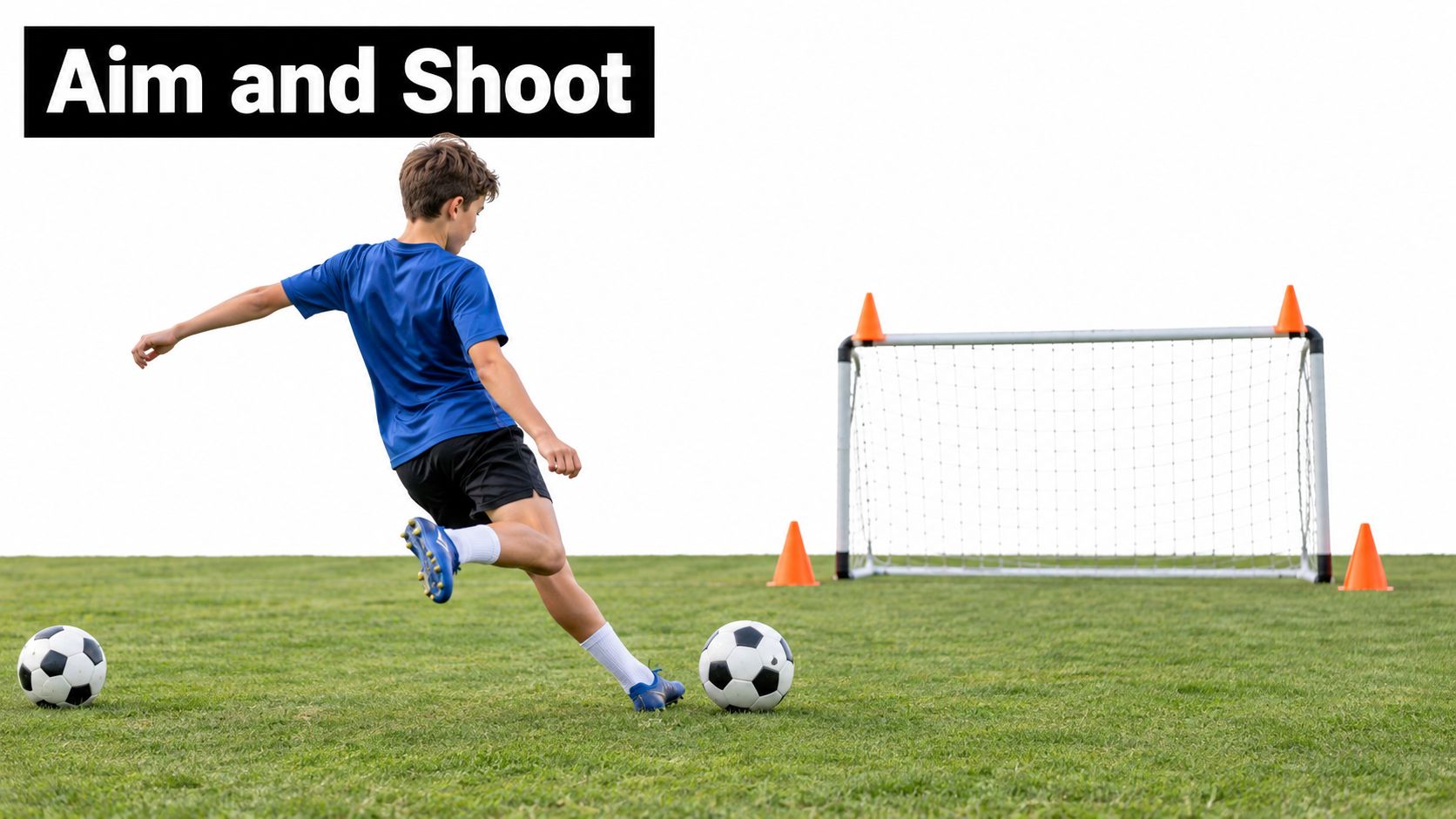
Run two or three shooting spots at once if you have help. One long line to one goal is where sessions die. Players who are waiting can do toe taps on their own ball behind a cone, so nobody is standing empty-footed.
A Simple Technique Picture
Ask for a balanced body, eyes on the target, and a strike through the middle of the ball with the inside of the foot or instep. If you want background on how different strikes work, Fair Play Feed soccer kicks explains the main types for older readers. For your players, keep it to one cue per turn.
Grassroots programs use point-based target games as a finishing station because the score creates focus without needing a goalkeeper. Celebrate a well-struck miss that went where the child aimed. They're learning to choose a spot, which matters more than this week's point total.
7. Follow the Leader Dribbling
You lead the group on a winding route with your own ball, and every player copies what you do. Hop like a frog between touches, stomp like an elephant with slow, heavy steps, tiptoe with tiny touches, then freeze and balance. The silliness is deliberate. It holds attention that a plain dribbling course loses in a minute.
Sneak real technique into the story. A pull-back becomes the bus reversing. Toe taps become raindrops on the ball. A gentle stepover becomes stepping over a puddle. Children repeat these movements many times because they're playing a character, not performing a drill.
Give every child one turn as leader, even for twenty seconds. A quiet player who leads the group once often dribbles more boldly for the rest of the session.
Managing Mixed Confidence
Soccer coaching for young players often falters under one-size instruction. U.S. Soccer's player development framework for all age groups emphasizes player-centered, activity-based learning, exploration, and experimentation rather than long technical lines. In practice, that means advanced players can lead faster moves while beginners follow at walking pace on the same route.
Change the theme often: Animals, weather, and vehicles each reset attention.
Keep the route short: Loop back before the tail of the line loses sight of you.
Let them invent: A player-created move gets copied with far more enthusiasm.
Camps and clinics rely on themed games like this for children under seven. It won't look like serious training in a photo. Count the touches and turns, though, and it's doing serious work.
8. 3v3 Small-Sided Game (No Goalkeepers)
Finish with teams of three on a small field with two small goals and no goalkeepers. Players score by passing or dribbling the ball into the goal. Everyone attacks, everyone defends, and nobody is parked in a position they don't understand yet.
FIFA's grassroots coaching guidance on inclusive, game-based sessions supports actively engaging formats like this, and a sound session can give the free-play game 15 to 20 minutes with minimal stoppages. Coach from the edge with quick restarts. Roll a new ball in instead of stopping play to fetch the old one.
What to Watch Instead of the Score
Track things you can see. Is every child getting repeated chances to attack and defend? Are players attempting to beat an opponent, changing direction, and spreading out a little instead of swarming one spot? Those observations tell you what next week's drills should revisit.
U.S. Soccer's player initiative framework for small-sided game progression begins with 4v4 at U6 and reaches 11v11 at U13, which confirms the principle behind this game. Fewer players means more involvement for each child.
Use free substitutions so children rotate before fatigue turns into tears. Stop only for safety or one quick, positive point. Celebrate a brave dribble, a helpful pass, and a player who runs back to defend. Goals are fun, but they're the least useful thing to praise if you want those other behaviors to repeat.
8 U6 Soccer Drills Compared
Drill | 🔄 Implementation complexity | ⚡ Resources and time | 📊 Expected outcomes | ⭐ Key advantages | 💡 Ideal use |
|---|---|---|---|---|---|
Red Light, Green Light Dribbling | Low; explain stop-and-go cues and mark boundaries | One ball per player, cones, 15–25 yards of space; 8–12 min | Builds close control, stopping, listening, and reaction skills | Keeps all players active; easy to run with large groups | U6 warm-ups and introductory dribbling practice |
Sharks and Minnows | Low–moderate; set clear boundaries and safe tagging rules | One ball per minnow, cones, 1–2 bibbed sharks; about 20 × 20 yards; 10–15 min | Develops shielding, scanning, and changes of direction under pressure | Energetic, playful introduction to defending | U6 groups practicing dribbling and ball protection |
Cone Dribbling Gates | Low; arrange gates and adjust spacing to ability | One ball per player, pairs of cones; 8–10 min | Improves close control, accuracy, and directional changes | Simple to scale and progress; provides measurable challenges | Individual technical stations or focused dribbling practice |
Partner Passing Through Gates | Low; demonstrate passing and pair players | One ball per pair, two cones per gate; 5–10 yards between players; 8–12 min | Introduces passing accuracy, basic technique, and cooperation | Repetition builds confidence; minimal equipment required | Early passing practice and transition from individual to partner skills |
Rondo (2v1 or 3v1 Keep-Away) | Moderate; define grid, roles, and defender rotation | One ball, cones, 3 attackers and 1 defender; about 10 × 10 yards; 8–12 min | Develops passing, first touch, support movement, and awareness | Many touches and game-like teamwork | Players who are beginning to pass and recognize space |
Shooting at Targets (Hit the Target) | Low–moderate; organize safe shooting turns and retrieve balls | Small goal or cone targets, multiple balls, coach/server; 8–10 min | Builds basic striking technique and shooting accuracy | Motivating, adaptable, and easy to score | U6 finishing practice focused on accuracy over power |
Follow the Leader Dribbling | Low; leader demonstrates actions along a simple route | One ball per player, cones, open space; 8–12 min | Develops dribbling, coordination, balance, and creativity | Highly engaging and adaptable to group size | Playful warm-ups and groups with short attention spans |
3v3 Small-Sided Game (No Goalkeepers) | Moderate; mark a small field, form teams, and explain simple rules | Small field, two small goals, bibs, ball; 12–20 min | Encourages frequent touches, teamwork, decision-making, and attacking and defending | High involvement with little downtime; game-based learning | Applying skills in U6 play and developing basic game awareness |
Build the Session Around How U6 Players Learn
A successful U6 session isn't measured by how many drills you complete. It's measured by whether children get meaningful touches, make their own decisions, communicate with teammates, and leave feeling successful enough to come back. The eight activities above form a pathway for exactly that. Control comes first, then escaping pressure, then sharing the ball, then solving the full game together.
For a 30 to 45 minute plan, keep it simple. Use a short activation game like Red Light, Green Light, pick two technical or partner activities, add the rondo or target shooting, and finish with the small-sided game. You don't need all eight drills every week. Rotating three or four well-run games beats rushing through eight poorly explained ones.
Progress one variable at a time. Make the grid smaller, or add a defender, or narrow the gate, but never all three at once. When a drill breaks down, that's information, not misbehavior. Regress it, let players succeed, and try the harder version next week. The same logic protects children physically.
Safety deserves the same practical attention as technique. A 2025 systematic review of injury prevention in 28,200 youth soccer players found prevention programs reduced injury likelihood overall, with stronger effects linked to better adherence, though most research involves older children. For U6 players, the sensible version is playful movement preparation, short rounds, varied movement, and flexible rest built into normal games. Stop for pain, a limp, or unusual fatigue and follow up with a parent. Don't treat tiredness as poor effort.
Planning on paper helps you stay that disciplined when twelve excited six-year-olds arrive at once. Many coaches sketch their weekly plan with whatever tool they already use, and an AI lesson planning assistant can help organize session notes and progressions between practices. What matters is arriving with setups ready, spare balls at your feet, and one clear objective per activity.
That philosophy runs through Villarreal Houston Academy, the official Villarreal CF partner academy in Greater Houston, where training for players from age four upward is built around intelligence, skill, and character. At U6, intelligence looks like scanning for space. Skill looks like a controlled stop. Character looks like encouraging a teammate who just lost the ball. Name those moments and children start repeating them.
Run your next session with fewer stoppages, more decisions, and praise that tells a child exactly what they did well. You'll see the difference within one practice, not because the drills are magic, but because every child spent the session playing soccer.
If your child is ready for age-appropriate training that builds ball mastery, decision-making, and character through small-sided games like these, Villarreal Houston Academy offers programs for boys and girls from age four across North Houston. Visit Villarreal Houston Academy to explore teams, camps, and clinics and find the right starting point for your player.
Comments