


How to Start a Soccer Academy in Houston

A parent finishes work, collects a child from school, then drives across North Houston for training. The child loves soccer, but the current club offers no clear next step, and the trip home makes the family wonder how long they can keep it up. If you're considering how to start a soccer academy, that kind of problem is a useful place to begin: identify the families you want to serve, then build a program that gives them a practical reason to stay.
A new academy doesn't survive on a logo and a field booking alone. It needs a clear place in the local market, a viable financial model, consistent safeguarding, and a development pathway families can understand.
Why Houston Is a Strong Market for a New Soccer Academy
A parent on a North Houston sideline may be asking two questions at once: “Where can my child develop?” and “Why does every promising option require another long drive?” That's a market signal, not proof that another academy will succeed. A founder still needs to find out which families are underserved and what the proposed program will do better or differently.
Start by mapping nearby clubs and programs by location, age group, level, and format. Look at whether they offer an accessible entry point for young players, skills training for developing athletes, or selective competitive teams. Then check where families have to travel from neighborhoods such as Kingwood, Porter, and New Caney. The aim isn't to declare a neighborhood empty based on a quick online search. It's to speak with parents, schools, coaches, and community organizations, and verify what options are available.

Choose a position families can understand
A useful positioning statement names the player, the offer, and the reason to choose it. For example: “We provide accessible introductory soccer and a visible development route for families in the Kingwood–Porter–New Caney area.” That statement is only a starting point. Validate it with families, then sharpen it around the actual gap you can serve, whether that's convenience, a transition from introductory sessions to competitive play, or a consistent coaching method across sites.
The broader participation picture supports a segmented approach, not a one-size-fits-all launch. In 2024, U.S. soccer participation was approximately 20.5 million, including 14.1 million outdoor participants ages 6 and older. Outdoor participation grew 8.1% year over year and 23% compared with 2018, while soccer accounted for 26.5% of children's sport participation, behind basketball at 36.8%. Yet regular participation among children ages 6–17 was 3% lower in 2024 than in 2019. These figures describe the national market, not guaranteed demand at a particular Houston field, and the participation figures vary by definition. The 2024 youth soccer participation reporting gives founders a reason to test more than one program format.
Build a small, coherent offer: welcoming sessions for beginners, development training for players ready for structured practice, and selective teams for athletes seeking a more competitive commitment. Camps and clinics can introduce families to the program, but retention depends on giving players a credible next step after the first session.
Legal, Financial, and Affordability Setup
Before collecting registration fees, separate the academy's finances from your personal finances and choose an appropriate legal structure. An LLC, nonprofit, or other entity can suit different missions and operating models, but the right choice depends on your circumstances. Discuss it with a qualified attorney or accountant, then establish clear contracts, bookkeeping, and payment procedures.
Insurance and operating costs need attention before you commit to a schedule. Ask an insurance professional about coverage for the activities you plan to run, and confirm what facility owners, leagues, and partners require. Choose registration and payment software that can handle waivers, player information, attendance, invoices, and parent communication without forcing staff to patch together disconnected spreadsheets.
Budget the real cost of each place
Founders often price by looking at nearby programs and guessing what families will accept. That's risky if the comparison programs have different staffing, facilities, or sources of support. Start with the full cost of delivering a place, including coaching, field access, equipment replacement, insurance, administration, and any competition or travel costs included in the offer.
Cost category | Typical nature | Planning note |
|---|---|---|
Field access | Rental, deposits, and schedule constraints | Confirm cancellation terms and usable hours before setting prices. |
Coaching | Pay, onboarding, and development | Budget for consistent staffing, not just the first practice. |
Equipment | Balls, cones, goals, bibs, and first-aid supplies | Track replacement needs and keep loaner items available. |
Insurance and administration | Coverage, registration, and payment systems | Confirm requirements before collecting enrollment. |
Competition and travel | League, event, or trip expenses | State clearly what tuition includes and what families pay separately. |
Affordability needs its own plan. Independent research indicates private youth soccer academies commonly cost families more than $1,000 annually for membership, equipment, registration, and travel. A separate 2025 Project Play report found families spent an average of $1,016 on a child's primary sport, nearly 50% more than five years earlier. The research on youth soccer costs and family spending underscores why access shouldn't be an afterthought.
Set a defined share of subsidized places that the budget can sustain. Use transparent aid criteria, installment options, sponsor-funded spots, and equipment reuse. Keep aid decisions confidential and make clear that financial hardship isn't evidence of weak commitment.
Before signing a lease: Estimate fixed costs, then divide them by the number of paid places you can realistically fill. Add variable costs per player and decide how many supported places your finances can carry. If the break-even enrollment depends on filling every roster immediately, the plan is too fragile.
For a broader checklist of startup expenses and cash reserves, this guide to budget for launch and survival capital can help you think beyond the initial purchase list.
Facilities, Equipment, and Safeguarding Foundations
A facility should work for players and families, not just look good in a tour. Inspect the playing surface, markings, drainage, lighting, parking, restroom access, storage, and the route from the parking area to the field. In a spread-out metro, compare drive times for families coming from Humble, Fall Creek, Cypress, Tomball, and the Kingwood–Porter–New Caney corridor. One convenient site may be better than several scattered locations if it lets coaches deliver a consistent schedule.
Before committing, ask how cancellations work and what happens when weather makes the field unusable. Review the actual turf field pricing and planning considerations as part of comparing facility options, but don't treat field cost as the only deciding factor. A lower rental rate won't help if access, parking, or scheduling makes the program difficult for families to attend.
Equip the sessions you plan to deliver
Start with equipment matched to the age groups and activities: appropriately sized balls, cones, bibs, portable goals where needed, first-aid supplies, and accessible water. Keep inventory simple and check it before sessions. In Houston's heat, hydration and weather decisions belong in the operating plan, not in a coach's memory.
Safeguarding is equally foundational. FIFA's framework applies across 211 member associations and is intended to help prevent harm to children and guide responses when risks arise. FIFA launched its Safeguarding in Sport Diploma with The Open University in January 2021; 204 learners were enrolled by December 2021. FIFA also recognizes children under 18 as needing specific protection under the 1989 United Nations Convention on the Rights of the Child. FIFA's safeguarding framework and training pathway offer a useful reference for treating child protection as an operating responsibility.
Appoint a safeguarding lead and define what coaches, volunteers, and families should do when they have a concern. Set written procedures for reporting and escalation, screening and training requirements, supervision during practices and travel, changing-area rules, and one-to-one communication. For every facility, document emergency contacts, response steps, weather decisions, and who has authority to stop activity.
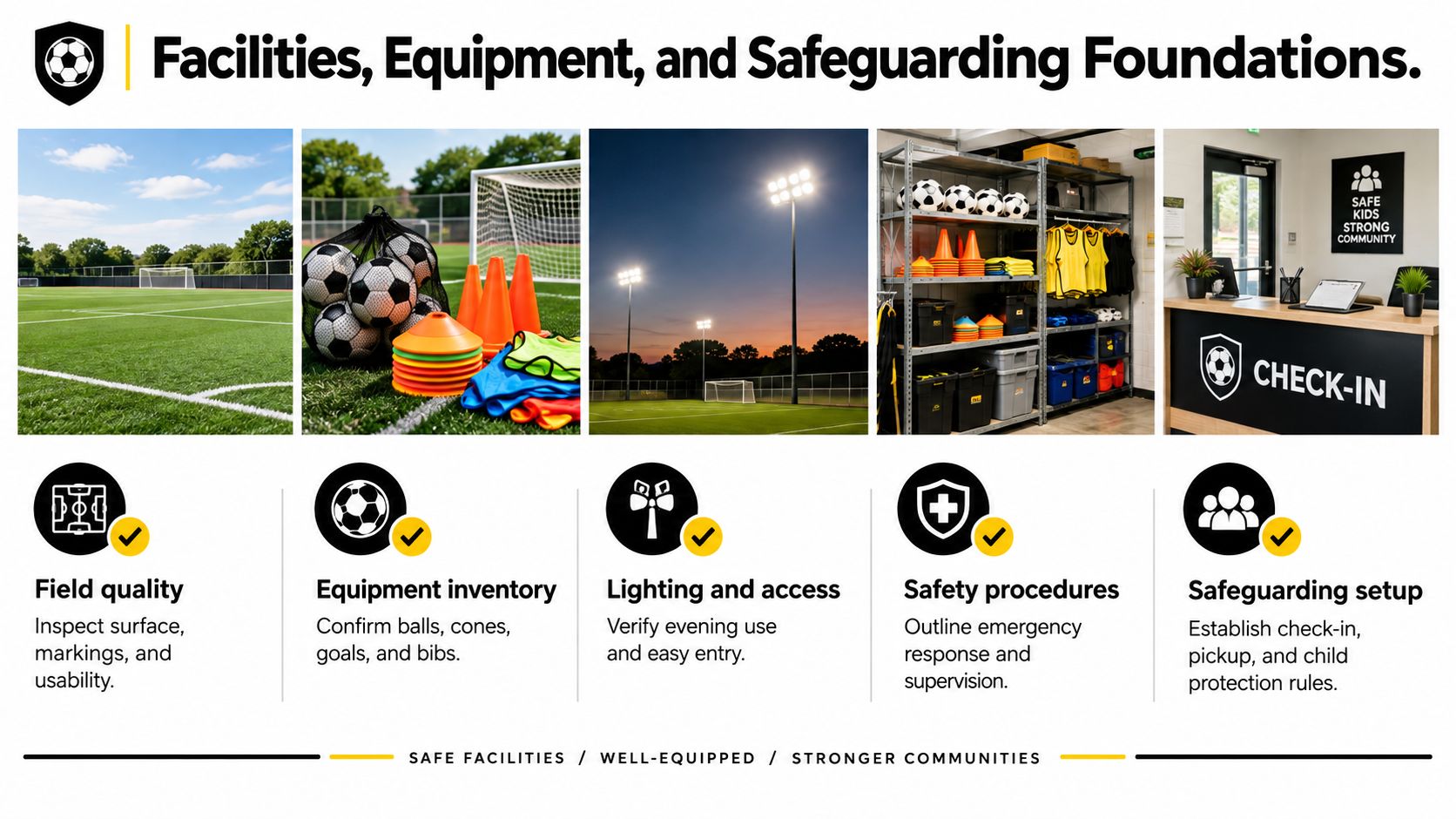
Use the same procedures at every site. Train substitutes and seasonal staff, document incidents, and record return-to-play decisions when a player has been injured. A policy binder matters only if staff can apply it on the field.
The video below can also help frame facility and program planning:
Choosing Between Independent, Affiliated, and Partner Models
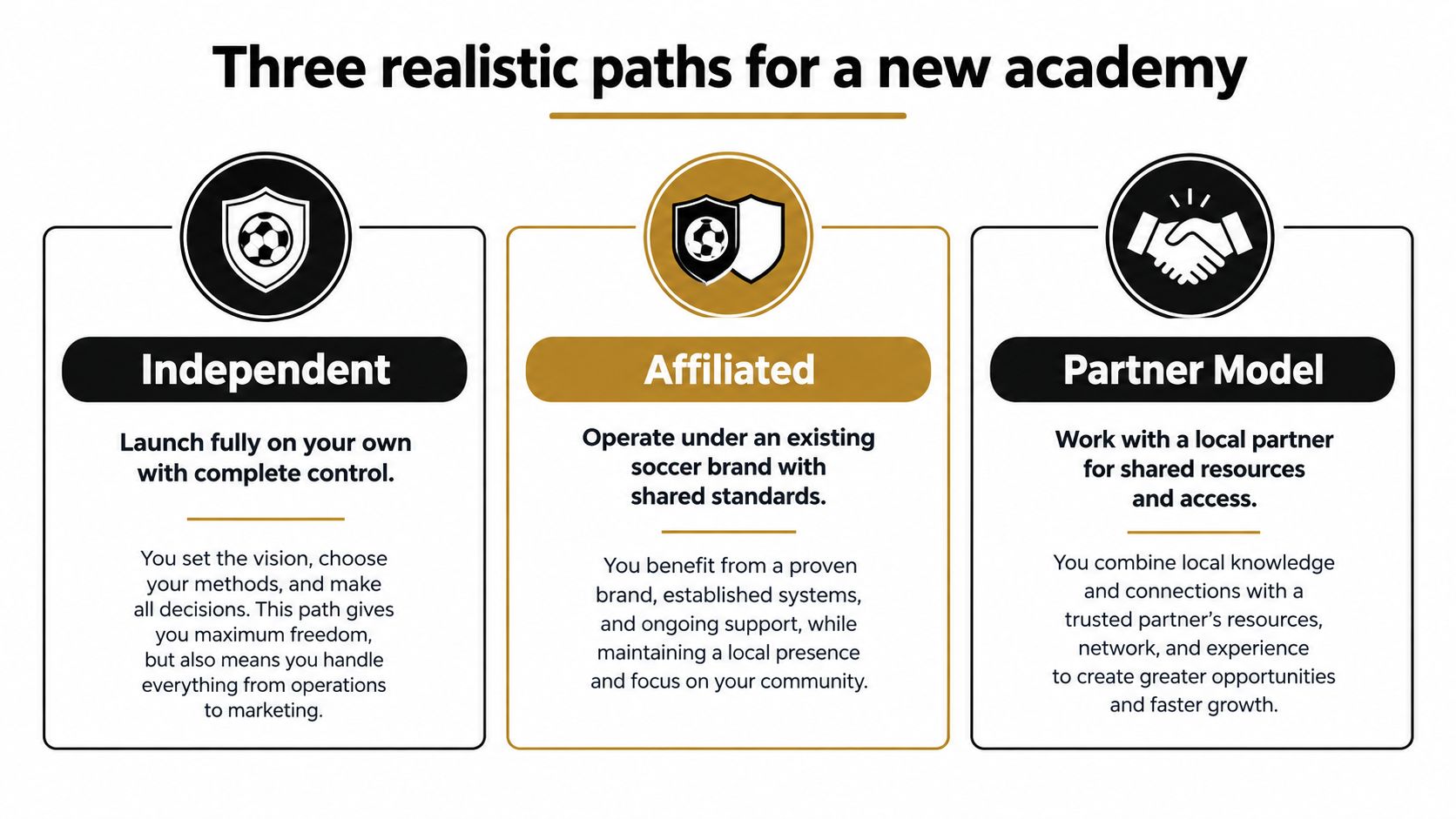
There isn't one best structure for every founder. The right choice depends on how much control you need, what resources you already have, and whether families need an established pathway from the outset.
Compare the trade-offs
Model | What you control | What you may gain | Main trade-off |
|---|---|---|---|
Independent | Brand, curriculum, and operating decisions | Freedom to shape the program around local needs | You must build recognition, systems, and a credible pathway yourself. |
Affiliated | Your local delivery within shared standards | A recognizable methodology and an established development framework | Affiliation can limit flexibility and comes with obligations to understand before signing. |
Partner | Shared facility access or operational resources | A local base and potential support with delivery | Responsibilities, scheduling, and decision-making must be clear between partners. |
An independent academy suits a founder with a well-defined curriculum, strong local relationships, and the capacity to build operational systems from scratch. It gives maximum flexibility, but the founder owns the work of earning trust and connecting players to appropriate competition.
Affiliation can help when the academy needs a defined methodology and recognizable identity. Before signing, review fees, brand rules, coach education, player progression, travel expectations, and how disagreements are handled. A familiar name is not a substitute for consistent coaching or careful safeguarding.
A partner model may be the practical option when facility access is the primary obstacle. Put the arrangement in writing: who controls the schedule, who communicates with families, how revenue and costs are handled, and who carries responsibility for safety and incidents. A friendly handshake isn't an operating agreement.
Villarreal Houston Academy illustrates the affiliation route as the official partner academy of Spain's Villarreal CF in the Greater Houston area. Its select and competitive programs serve boys and girls from age four upward, with training across facilities in Humble, Fall Creek, Cypress, Tomball, and the Kingwood–Porter–New Caney area. Its player pathway includes opportunities to travel to Spain to train and play alongside Villarreal CF's elite academy. For an overview of Houston youth soccer association pathways, compare how local competition and development options fit your own model.
Choose the path you can fund and operate reliably, not the one that sounds most impressive in a launch announcement.
Building Programming, Coaching, and Recruitment
A family doesn't experience your business plan. They experience the training session, the coach's communication, and whether their child knows what comes next. Build programming around clear transitions rather than launching every possible offer at once.
For ages 4–6, prioritize a welcoming introduction: movement, ball familiarity, simple games, and a positive first experience. Development groups can add structured technical work and age-appropriate decision-making. Selective competitive teams need defined expectations for attendance, coaching, competition, and family commitment. Camps and clinics can complement those core programs, but shouldn't distract from delivering them well.
Make progression visible
Write down what players are working toward at each stage. Coaches should know how a session connects to the curriculum, and families should be able to understand the purpose of the program without being promised a specific outcome. Sequence technical and tactical learning over time, and adjust session plans to local conditions, especially heat and field availability.
Hire coaches for both soccer knowledge and their ability to work within shared standards. Verify relevant qualifications, screen and train staff as required by your safeguarding procedures, and observe sessions so the academy doesn't become several unrelated programs operating under one name. Coach education should include practical discussion of age-appropriate instruction, feedback, behavior expectations, and how to raise concerns. The guide to becoming a soccer coach can help prospective staff understand the profession and pathways into coaching.
Recruitment works best when families can try the experience before making a larger commitment. Offer a clear evaluation process, explain what coaches assess, and follow up promptly with the next step. Reach families through schools and community organizations as well as digital channels, and make fees, schedule, location, and expectations easy to find.
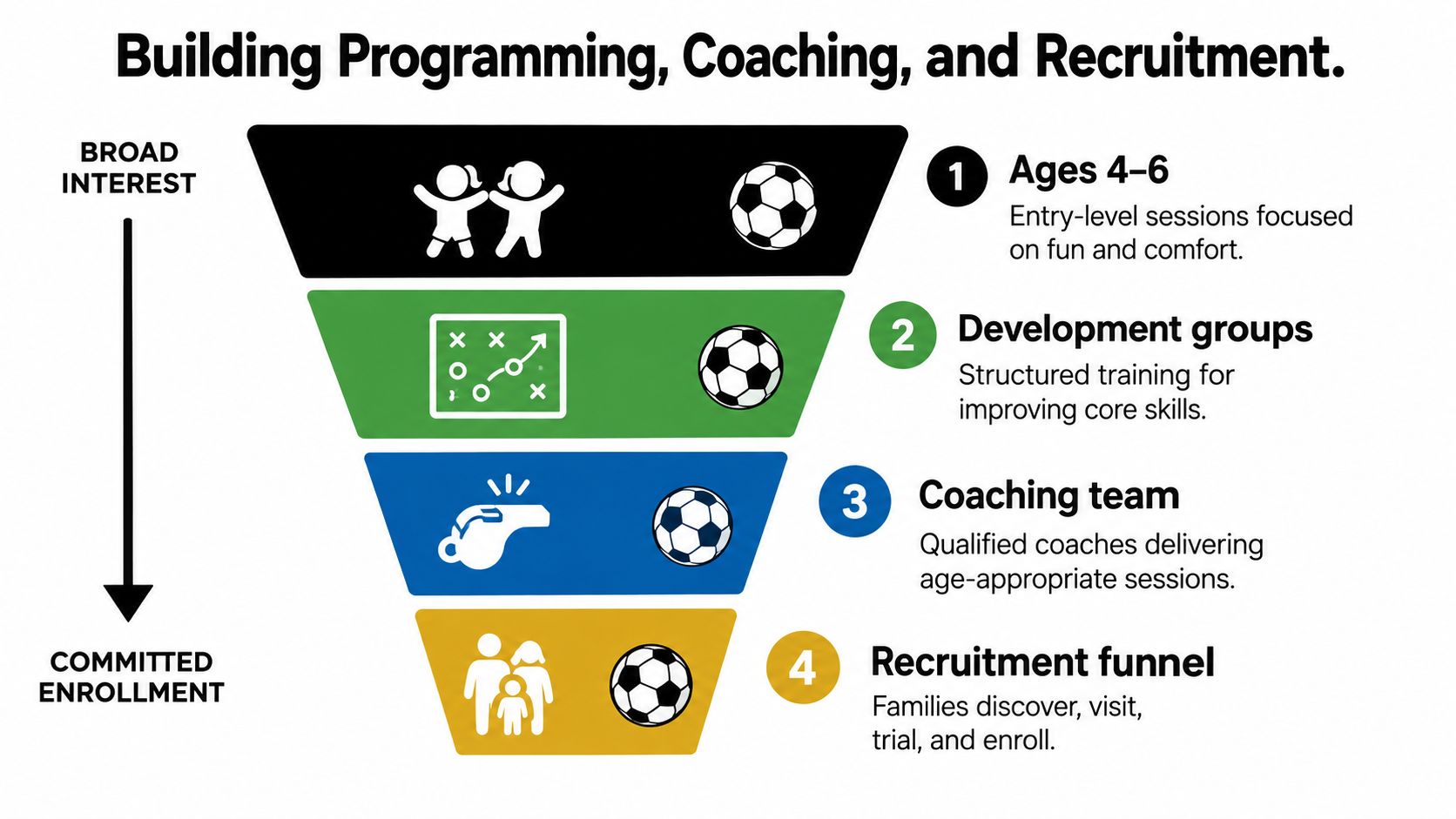
Think of enrollment as a sequence: families discover the program, attend a session, try the training, then decide whether to enroll. The message at each step should be useful, not pushy. If you're refining how to explain the value of a service, this resource on confident service selling with AmaJova offers ideas for communicating an offer clearly. The academy still has to earn trust on the field.
Operations, Risk Management, and Growth Metrics
Once players enroll, the director's job shifts from launching sessions to making sure the experience holds together. Registration, schedules, payments, attendance, parent messages, and incident reports should follow predictable workflows. Use one reliable system or a small set of tools with clear ownership. If families receive schedule changes in one channel and emergency updates in another without knowing which to check, the process will fail when it matters.
Track the measures that reveal operational health. Look at retention by age group, roster fill, attendance, tryout-to-enrollment conversion, coach-to-player ratios, and participation in optional travel. These indicators help explain what's happening, but they aren't universal benchmarks. A low roster fill might signal weak awareness, a poor schedule, or a program that doesn't meet local needs. Strong enrollment paired with declining retention may point to inconsistent coaching, unclear progression, or a mismatch between the promise and the experience.
Review the reasons behind the numbers
Keep a regular review with coaches and administrators. Compare retention across programs, ask departing families why they left, and check whether staff are documenting incidents and following site procedures. Don't wait for a complaint to discover that one location handles pickup differently or that a coach is using a separate version of the curriculum.
Travel opportunities can motivate players and families, but they also add cost, planning, and safeguarding responsibilities. Treat an international exchange as part of the pathway only if the purpose, selection process, supervision, family costs, and travel procedures are clear. Training and playing alongside an established academy can be meaningful, but a trip shouldn't be sold as a guaranteed outcome or a substitute for strong local development.
Growth test: Add a team only when you can staff it well, explain its place in the pathway, and deliver the same safety and coaching standards at its location. More registrations aren't a win if the academy can't support the players already enrolled.
Add locations cautiously. Before expanding, confirm that the current operation has dependable staffing, consistent communication, a workable budget, and clear accountability. If those foundations are uneven, pause growth and fix the delivery system first.
Your First 90 Days and Next Steps in Houston
Treat the launch as a sequence of decisions with proof points, not a race to announce a full academy. The best first step is often a focused program that lets you learn from real families before taking on larger commitments.
A practical launch sequence
First month: Map nearby options, talk with families and community groups, and write a positioning statement. Move forward when you can name the audience, the local need, and the program you'll test.
Second month: Choose a legal and financial structure, build a full-cost budget, compare facilities, and document safeguarding responsibilities. Move forward when you understand the operating costs and the conditions of your facility access.
Third month: Recruit and prepare coaches, complete the registration and parent communication setup, and run a camp or clinic as a trial. Move forward when staff can deliver the session consistently and families know how to enroll or give feedback.
Avoid underpricing by calculating delivery costs first. Don't skip safeguarding documents because the first group is small, launch more age groups than your staff can support, or treat financial aid as a future concern. Each shortcut creates an operating problem that becomes harder to correct after families have enrolled.
A short trial gives you a chance to test scheduling, coaching, demand, and parent communication before you commit to full teams. That principle applies across youth programs: even guides to starting your own electrical contracting business emphasize planning the operating details before taking on work. For a soccer academy, those details include safe supervision, a realistic budget, and a program families can reach.
If you're planning a launch in Greater Houston, attend a local tryout, camp, or clinic and observe how check-in, coaching, communication, and progression work in practice. Use what you learn to pressure-test your own plan before you sign a long-term facility commitment.
Villarreal Houston Academy offers select and competitive programs, camps, clinics, tryouts, and a development pathway for boys and girls from age four upward across North Houston. Visit Villarreal Houston Academy to explore its training options and see how an established academy structures player development.
Comments