


7 Youth Soccer Drills U12 Players Can Master

Effective U12 training can look less like a traditional drill session and more like a sequence of carefully designed game problems. Research across 16 academies in four European countries found that coaches devoted 62% of session time to active decision-making activities, compared with 20% for non-active drills and 17% for transitions between activities (U12 coaching research from St Mary's University). That balance matters because players need frequent touches, but they also need to scan, choose, move, compete, and respond to changing pressure.
The seven youth soccer drills U12 players can master below form one connected pathway. The sequence moves from ball familiarity and individual technique into rondos, combination play, 1v1s, possession, positional shape, pressing, transitions, and directional games. Each activity includes its purpose, setup guidance, progressions, coaching points, and a practical place in the session.
The approach reflects the principles associated with Villarreal Houston Academy, including intelligence, skill, character, enjoyment, and age-appropriate development. Coaches can adjust the spaces, player numbers, touch limits, and defensive pressure for a small training group, a full team, or facilities across Humble, Fall Creek, Cypress, Tomball, and the Kingwood, Porter, and New Caney area.
1. Rondo Possession Circle
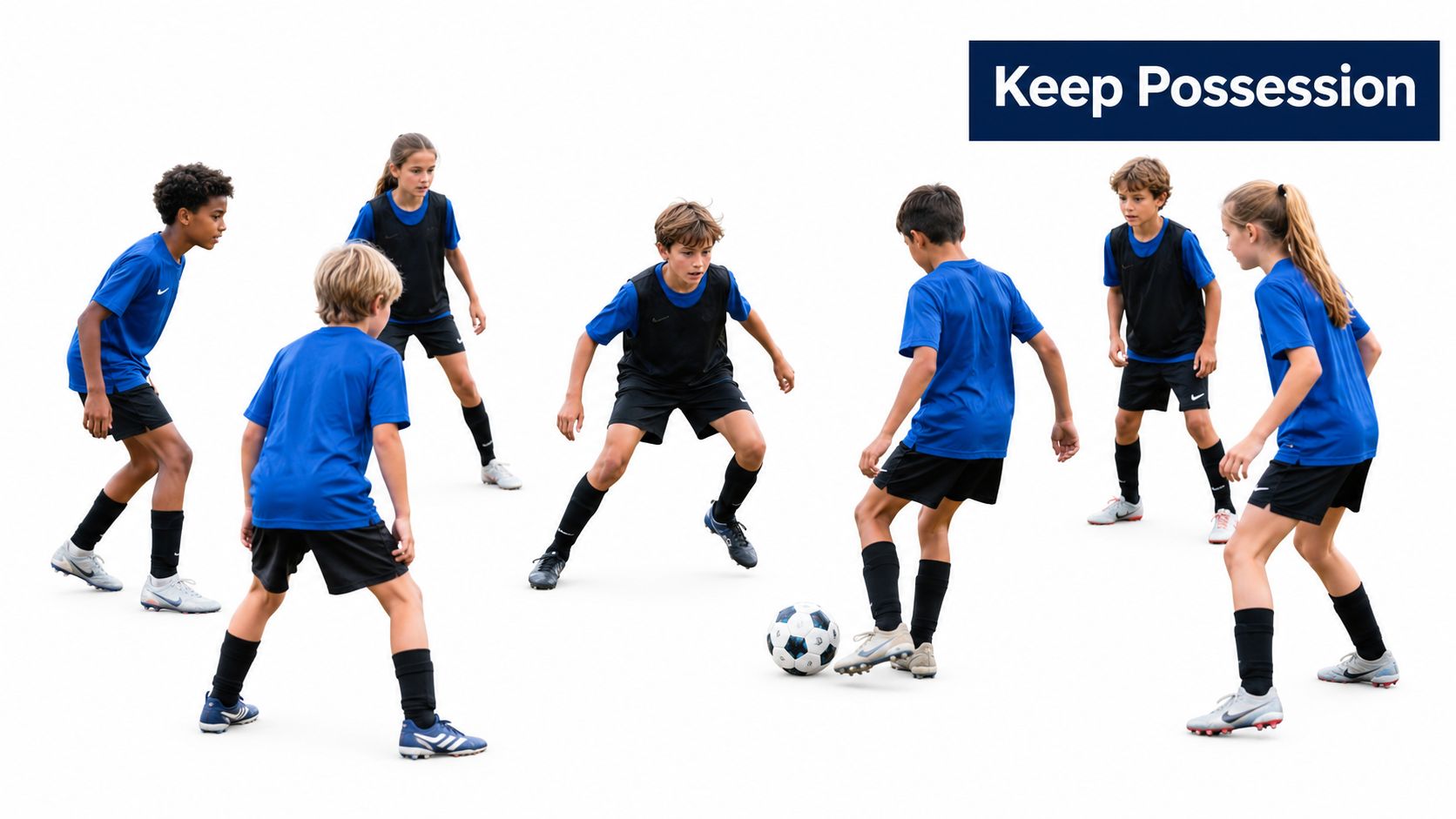
A rondo gives U12 players a simple problem with no simple solution. The outside players must create passing angles, recognize pressure, and move before the defender can close the next option. The defender must read body shape, anticipate the next pass, and react quickly after every change of possession.
Start with a 4v1 in a square or circle large enough for players to receive comfortably. Progress to 5v2 once the group can keep the ball while checking shoulders and supporting at useful angles. The shape matters less than the spacing. Players should be close enough to connect but far enough apart that one defender can't cover multiple passing lanes.
Setup guidance
Starting shape: Place the outside players around the marked area and put one defender inside. Keep spare balls beside the coach for immediate restarts.
Defender rotation: The player who loses possession, misplaces a pass, or allows an interception can enter the middle. Rotate defenders frequently so every player learns both possession and pressure.
Progression path: Begin with free touches, then use two-touch play, shorter defender rounds, directional support, or a requirement to change the point of attack before scoring a success.
The first coaching message should be awareness, not speed. Ask players to check both shoulders before the ball arrives, receive across the body, and move immediately after passing. Their next position should help the next pass, not just take them away from pressure.
Practical rule: A fast pass to a poor angle is still a poor decision. Reward players for seeing the next action early.
Use verbal cues such as “man on,” “turn,” “set,” and “time,” but don't let communication replace scanning. In a real match, a player may not hear a teammate, so the receiving player must learn to collect information independently.
A useful session placement is immediately after a dynamic warm-up. Keep the tempo high without turning the rondo into a frantic passing contest. The Villarreal Houston Academy passing drills resource can support further work on first touch, passing weight, and movement after the pass.
2. 4v4 Small-Sided Games With Directional Play
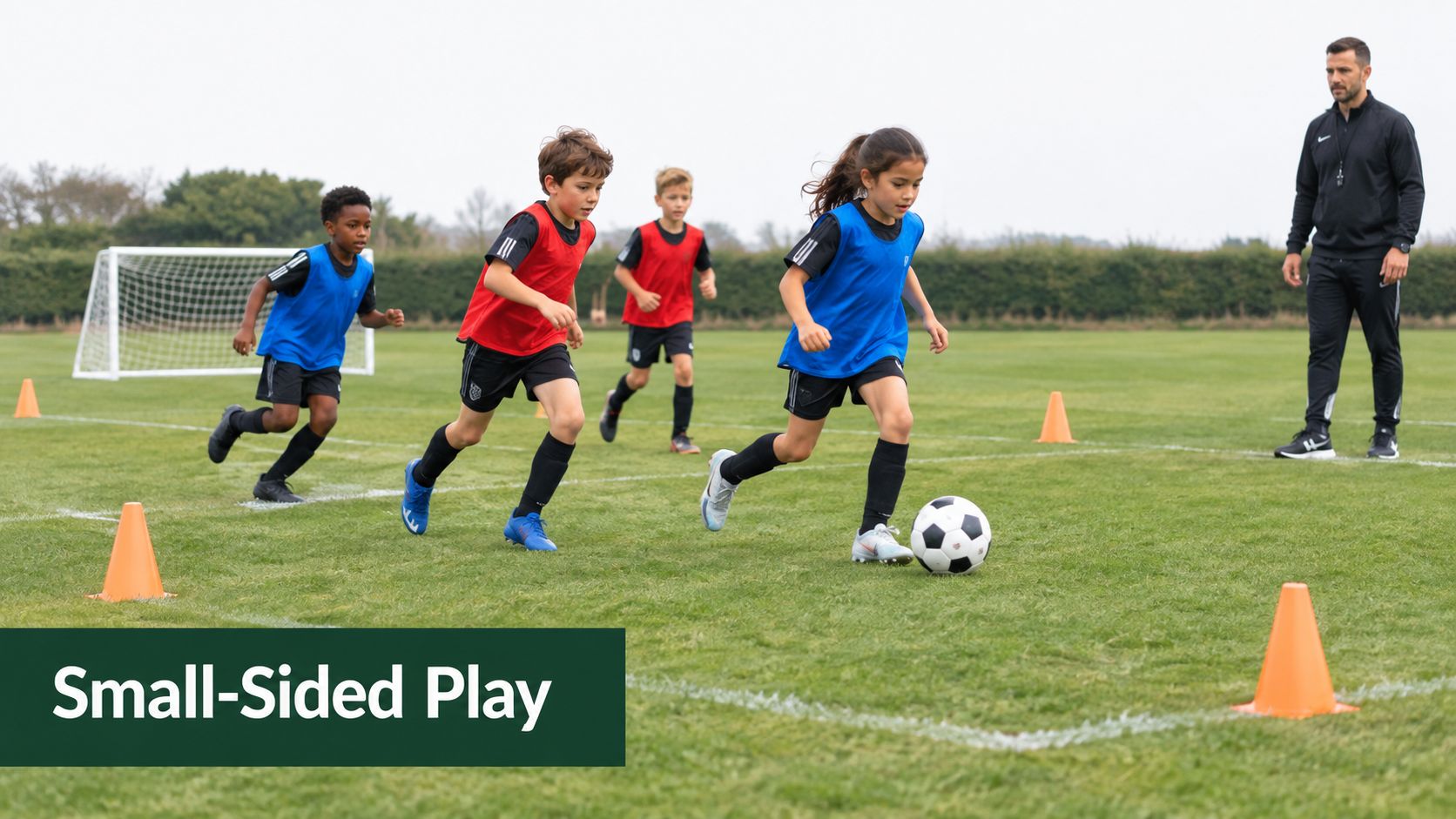
A 4v4 directional game is the first real test of whether technique supports intelligent play. Players must recognize pressure, choose a forward option, protect possession, support the ball, and react when the team changes from attack to defense. This moves the U12 framework beyond isolated execution and into decisions that resemble the match.
Mark a reduced rectangular field with two end zones, two small goals, or target players behind each end line. Give each team a clear direction of attack. The format can remain 4v4, or neutral players can be added to create overloads and new passing options. Adjust the numbers when the group needs more time on the ball or greater pressure.
A simple field picture
Blue team attacks the north goalTarget zone | playing area | target zoneRed team attacks the south goalSpare balls beside each goal for quick restarts
Start with free play and observe before adding rules. Watch whether players create width, offer depth, support at useful angles, and recognize the first action after a turnover. The coach should identify one behavior to improve, then use the next game to test it rather than stopping play after every mistake.
Add one constraint at a time. A bonus for finding a target player can encourage forward play. A wall-pass condition can develop support around the ball. A switch requirement can teach players to move the attack away from a crowded side. Remove the condition when players begin forcing the action instead of reading the situation.
Keep the game competitive and readable
Use colored bibs, rotate teams, and balance the groups so the game stays competitive. Short games with quick restarts keep players involved. Water breaks and brief coaching pauses allow recovery and reflection. Stand where the entire field is visible, stepping in only when a focused intervention can improve the next repetition.
Ask questions that connect each decision to match play:
Before receiving: Where is the next forward option, and what might close it?
When the ball is wide: Who gives depth, and who can stretch the opponent?
After losing possession: Can the nearest player delay the attack while teammates recover?
After winning possession: Is the best first action forward, away from pressure, or toward support?
U12 coaching research supports making active decision-making part of the session rather than saving it for the final scrimmage. This game links the passing awareness developed in the rondo to the positional understanding and transition work that follow. Coaches using a Villarreal Houston Academy-inspired methodology can also review small-sided soccer games for youth development when shaping constraints around game understanding.
3. Technical Combination Play With Three-Pass Sequences
Combination play works best when players understand the reason behind the movement. A memorized passing pattern may look clean without teaching players when to check away, when to come toward the ball, or how to use a third player to break pressure.
Set up groups of three or four with a starting player, a supporting player, a receiver, and an optional finishing player. Begin with a simple pass and follow movement. Then add a wall pass, an overlapping run, or a third-player action that finishes with a shot or cross.
Sequence diagram guidance
Player A passes into Player B.Player A checks away, then supports.Player B sets the ball to Player C.Player C plays forward for the final run.The sequence ends with a shot, cross, or pass into a target zone.
Start unopposed so players can learn the timing and body shape. Add a passive defender once the movement is coordinated, then allow the defender to win the ball. The pattern should become a prompt for perception, not a script that players follow regardless of what the opponent does.
A player receiving between lines may need to open the body and play forward. A player receiving with pressure behind may need to set the ball back. The same three players should experience each role, because a U12 player develops better awareness when they understand what teammates need from different positions.
“Don't ask players to memorize the picture. Ask them to recognize the problem.”
Coach the details that make the combination transferable:
Receiving body shape: Open the hips when the next action is forward.
Pass weight: Give the next player enough speed to play quickly but enough control to keep the ball secure.
Movement timing: Check away before coming toward the ball so the defender can't track the movement easily.
Communication: Use an early cue, but keep looking at the ball, defender, and space.
Final action: Make the shot, cross, or forward pass purposeful rather than automatic.
Place this activity after the rondo and before a larger game. It provides technical repetition while gradually adding direction, timing, and opposition. If a player can complete the sequence only when the defender is passive, reduce the complexity and rebuild the timing rather than demanding more speed.
4. Pressing and Transition Training in Thirds
A lost ball creates the next coaching moment. U12 players should learn that defending doesn't begin only after the team has settled into a defensive shape. The nearest player can pressure, teammates can cover and balance, and the whole group can decide whether to recover or try to win the ball immediately.
Divide the field into a defensive third, middle third, and attacking third. Play 5v5 with goals, target players, or a coach serving balls into different zones. Give the defending team a clear starting rule, such as pressing immediately after losing possession in the defensive third. Once players understand that trigger, allow the same reaction in other zones.
Setup guidance
Defensive third: The team protects the goal and recognizes when the nearest player can pressure safely.
Middle third: Players decide whether to delay, trap the ball near a line, or recover compactly.
Attacking third: Players coordinate the first press while protecting the central passing lane.
Transition direction: After winning the ball, the team should make a purposeful first action toward a goal, target, or forward zone.
The first defender should arrive under control. Running straight at the ball often allows the attacker to play around the pressure. A curved approach can block one passing lane while directing the ball toward a teammate or sideline.
Coach the four-second moment without timing the children
The exact length of a transition matters less than the quality of the response. Ask the nearest player to apply immediate pressure, the second defender to provide cover, and the remaining players to regain balance. When possession returns, the player who wins the ball must take a controlled first touch and look forward before playing a rushed pass.
Avoid turning this into a running test. U12 players need recovery periods and clear work-to-rest changes, particularly when the practice includes repeated sprints, duels, and rapid changes of direction. Reduce the field or number of players if the group loses technical quality through fatigue.
The following visual can help coaches explain the sequence before play begins.
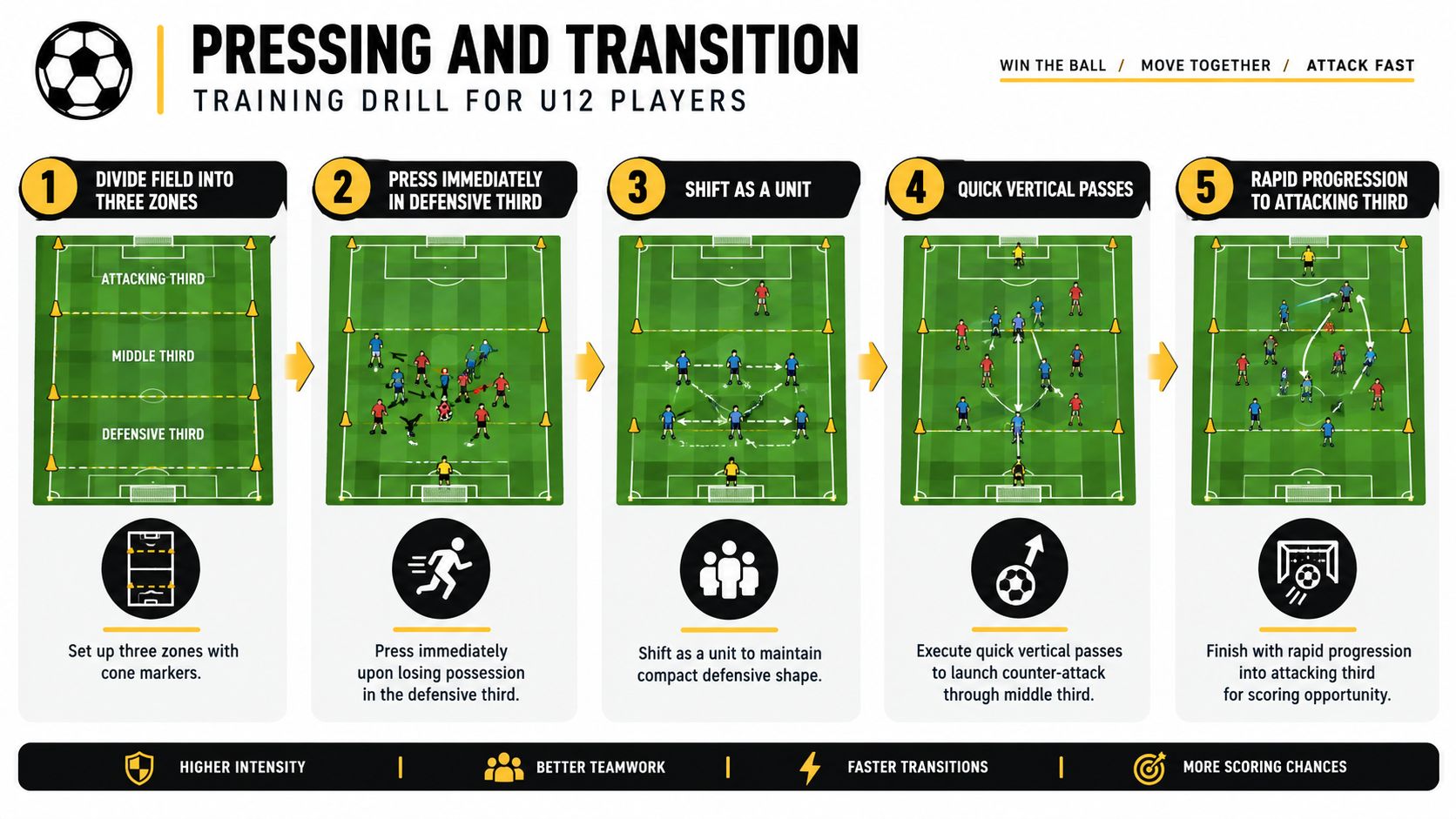
Show the video only after players understand the rules, then return to the field and ask them to identify the pressing trigger, cover position, and first forward action.
5. Dribbling Through Gates and Changing Pace
Close control is useful only when it helps a player escape pressure or attack space. Gates make the technical demand visible, but the coach should avoid rewarding players for completing a course with their head down. Every repetition should include a reason to scan, change direction, or accelerate.
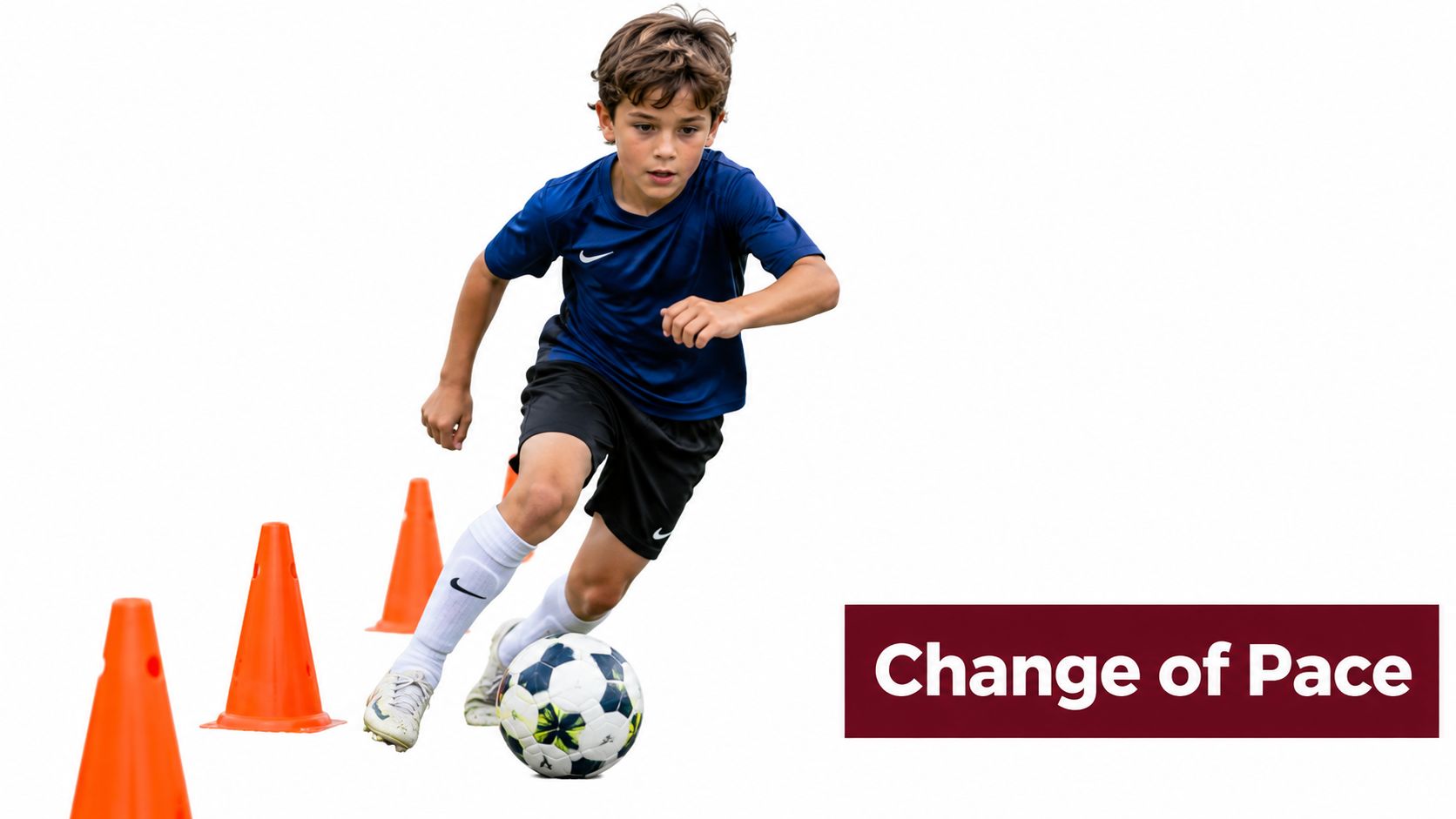
Set up several cone gates in lanes, with an acceleration zone beyond the final gate. Players begin with the ball, dribble through the gates, and take a larger touch into the open space. Add a finishing target, a passing option, or a defender at the end so the final action resembles a match decision.
Diagram guidance
Start line | narrow gates | change-of-direction gate | acceleration zone | goal or targetOptional defender begins near the final gate.A support player can receive the pass after the acceleration zone.
Begin with both-foot control and different surfaces of the foot. Ask players to use small touches when navigating traffic and a larger touch when the next space is open. A sole roll, inside cut, outside cut, scissors, or stop-and-go action should serve a purpose. The move isn't valuable because it looks elaborate. It's valuable when it changes the defender's balance or creates a route forward.
Once players are comfortable, vary the task:
Receiving variation: A teammate passes into the first gate, and the player controls before dribbling.
Scanning variation: The coach calls a color or number that determines the next gate.
Pressure variation: A defender can chase after the first touch.
End-product variation: The player must choose between a shot, a cross, or a pass to support.
The technical detail: Keep the ball close before the decision, then release it into space when acceleration is the right answer.
Don't use timing as the only measure of improvement. The fastest player who misses a gate, loses the ball, or chooses the wrong direction hasn't completed the actual task. Use competition to raise energy, but praise head-up scanning, controlled changes of speed, and smart choices as much as pace.
This drill fits early in the session, either after movement activation or before rondo work. The Villarreal Houston Academy guide to youth soccer dribbling drills can help coaches build further variations around close control, turns, and attacking movement.
6. Positional Play and Shape Maintenance in a 6v6 Game
Players can't support one another if they all occupy the same space. A positional game teaches U12 players to spread out when attacking, become compact when defending, and recognize how their location changes the options available to the player on the ball.
Mark defensive, midfield, and attacking zones across the field. Assign players to starting zones and begin with strict movement restrictions. The aim isn't to trap players in positions. It's to make spacing and passing lanes visible before gradually giving them more freedom to rotate.
A simple starting shape might include defenders building from the back, midfielders offering angles between lines, and attackers providing depth. The opposing team follows the same principles in the other direction. Use goals, target players, or end zones to give the game a clear direction.
Release the restrictions in stages
At first, a player may leave their zone only after a teammate fills the space. Later, allow rotations when players can explain the reason for them. A wide player might move inside to connect, but someone else must provide width. A midfielder might support the ball, but another player should remain available behind the action.
Coach the principles rather than naming positions constantly:
Width: Stretch the defending team and open passing lanes.
Depth: Give the ball carrier a forward option and a safe option behind.
Compactness: Reduce space between teammates when defending.
Cover: Protect the space behind the player applying pressure.
Balance: Keep enough players connected to the ball without abandoning the opposite side.
Rotation: Move to improve the team's options, not just to chase the ball.
Pause the game when the shape has a clear teaching moment, then restart quickly. A long explanation can turn a positional activity into a lecture. Ask one question, reset the players, and let them solve the next repetition.
Rotate players through different zones. A defender who experiences the game from midfield better understands the value of support behind the ball. An attacker who has to defend a wide area learns why compactness and recovery matter. This movement supports the character and responsibility expected in a development environment, while still preserving creativity and enjoyment.
Place the game after combination work and before the final free play. The earlier passing and receiving actions now have a team structure around them, and the final game reveals whether players can apply that structure without constant instruction.
7. 1v1 Attacking and Defending With Support Play
A 1v1 is an individual contest, but it rarely stays individual in a match. The attacker may beat the defender, combine with a teammate, protect the ball, or finish before help arrives. The defender must decide whether to engage, delay, force play away from goal, or recover after being beaten.
Create a channel with an attacker, defender, support players, and a goal or end line. The coach starts the ball with a pass or dribble. The attacker chooses the route, while the support players provide realistic passing options without solving the problem for them.
Setup diagram guidance
Coach or serverAttacker receives facing goalDefender starts at a controlled distanceSupport player behind or beside the attackerGoal or scoring end line beyond the duelRestart balls near the coach
Begin with passive defending so the attacker can practice the first touch and recognize the space. Progress to live defending, then add a condition that forces a choice. The attacker might score by beating the defender, combining with support, or finishing quickly. The defender can earn a point for winning the ball, forcing a mistake, or completing a recovery run.
The attacker should use disguise, changes of pace, and a positive first touch. Encourage patience when the defender is balanced, but don't punish a player for trying to create an advantage. A failed move can still be a useful decision if the player chose the right moment and executed with courage.
The defender's distance and body angle matter. Too much distance gives the attacker time to build speed. Too little distance allows a quick touch past the front foot. Teach the defender to slow down, stay side-on, protect the most dangerous route, and recover with determination when the attacker gets past.
Confidence grows when players are allowed to make brave decisions and learn from the result.
Match players thoughtfully, but don't keep the same pairings all session. Different opponents create different questions. Move the support player from a wide position to a central one, change the starting angle, or place the duel closer to goal to alter the decision without adding unnecessary rules.
Use this activity before the final small-sided game. The game then becomes the test of transfer. Can the winger recognize a 1v1? Can the defender delay the attack? Can the attacker combine when the direct route is closed? Those answers matter more than how many isolated moves a player completes.
U12 Youth Soccer Drills, 7-Point Comparison
Drill | 🔄 Implementation Complexity | ⚡ Resource Requirements | 📊 Expected Outcomes | 💡 Ideal Use Cases | ⭐ Key Advantages |
|---|---|---|---|---|---|
Rondo (Possession Circle) | Low, simple setup, moderate coaching attention | Minimal, 6–8 players, few cones, small area | Improved possession, quick passing, spatial awareness | Early technical activity after warm-up; build tactical intelligence | Enhances retention and decision-making; low equipment |
4v4 Small‑Sided Games with Directional Play | Medium, multiple small fields and group rotation | Moderate, 30x40 yd fields, several balls, coaches per grid | High touch volume, quicker decisions, better fitness | Central game-based block; replicate match scenarios | High engagement; realistic tactical pressure and frequent touches |
Technical Combination Play (3‑Pass Sequences) | Low–Medium, clear demonstration required | Minimal, small groups, cones, optional goals | Better timing, pass weight, coordinated movement | Technical→attacking phase after rondo; teach movement principles | Builds repeatable technical patterns and tactical understanding |
Pressing and Transition Training (5v5 in Thirds) | High, structured rules and zone management | High, full pitch divided into zones, clear markers, good supervision | Improved pressing, coordinated defense, faster transitions | Tactical block after technical prep; teaching team pressing | Trains defensive shape and rapid counter-attacks; game-realistic |
Dribbling Through Gates & Change of Pace | Low, simple stations, easy to vary | Low, many cones/gates, small lanes | Better close control, change of pace, head‑up play | Warm-up or early technical block to raise ball familiarity | Direct improvement in 1v1 control; measurable skill gains |
Positional Play & Shape Maintenance (6v6 with Zones) | High, complex concepts, strict coaching needed | Moderate–High, marked zones, experienced coach, space | Positional discipline, compactness, smarter spacing | After combination work; develop team shape and role awareness | Teaches positional responsibilities that transfer to matches |
1v1 Attacking & Defending Drill (with Support) | Low–Medium, needs player matching and progression | Minimal, small grids, support players, cones/goals | Individual creativity, defensive timing, decision-making | Focused duel/finishing block before final small‑sided game | Develops attacker vs. defender skills; highly engaging and competitive |
Turn Seven Drills Into One Development Pathway
Seven activities become much more effective when the coach connects them through one theme. The session shouldn't feel like a collection of unrelated exercises. A player might begin by scanning before receiving in a rondo, then use the same habit in a combination sequence, recognize the next pass in a positional game, and finally apply that awareness in a directional match.
A technical-possession practice can follow this pathway:
Dribbling gates: Introduce ball familiarity, scanning, turns, and changes of pace.
Rondo: Add receiving angles, support, communication, and pressure.
Combination play: Connect first touch and passing to movement, timing, and a final action.
1v1 with support: Give players a choice between dribbling, combining, and finishing.
Directional game: Test whether those choices appear when teammates, opponents, goals, and transitions all matter.
The coach can use the early activities to identify a small number of behaviors for the rest of practice. If players receive square, focus on body orientation. If they stand after passing, focus on immediate support. If they all chase the ball, focus on width and depth. Don't try to correct everything in one session.
A tactical-transition practice can use a different order:
Rondo: Prepare technical speed and awareness before pressure work.
Positional game: Establish spacing, support, compactness, and balance.
Pressing in thirds: Add defensive triggers and reactions after losing the ball.
1v1 with support: Develop individual defending and attacking inside the team context.
Final small-sided game: Remove most conditions and observe whether players recognize when to press, recover, combine, or attack space.
Both practices can fit within a 60 to 90 minute window, but the coach should select the duration based on the group, the training day, the match schedule, and the quality of decision-making. The time range is a session design option, not a target that should override player welfare. Use lighter activities, pauses, and water breaks when players show declining technique, reduced concentration, or poor movement control.
Adjust the task before abandoning the objective
A small group may need a neutral player to create passing options. A larger group may benefit from two fields running at the same time. If players rarely touch the ball, reduce the space or change the numbers. If the game becomes crowded and frantic, enlarge the area or give the team a clear width rule.
Touch limits can sharpen speed of play, but they shouldn't become a punishment. Give players unlimited touches while they learn the picture, then add a limit when the restriction makes the intended decision more visible. The same principle applies to defenders. Start with passive pressure, increase intensity gradually, and allow players to experience both success and failure.
Age-appropriate development also includes managing the total load. Youth players may attend team sessions, camps, clinics, games, and extra training, so a coach should consider what the player has already done before adding repeated high-intensity work. The best U12 session isn't the one with the most drills. It's the one in which players remain engaged, technically capable, mentally present, and eager to play again.
Home practice can support that continuity when families receive short, structured assignments rather than vague instructions. A survey-based youth soccer report linked regular practice at home with lower likelihood of giving up soccer. Its U.S. findings reported that 61% of players who didn't practice regularly at home were likely to quit soon, while 0% of regular home practicers were likely to give up, and the comparable UK figure for non-practicers was 35.7% (the SoccerWire report on home practice and retention). The practical lesson is to send players home with a manageable touch, dribbling, or scanning task that complements team training without creating another exhausting obligation.
Finish every practice with a clear message. Choose one or two coaching behaviors, preserve competition and joy, and connect every exercise to an intelligent action in the game. Villarreal Houston Academy is a relevant local pathway for Greater Houston families seeking structured, age-appropriate training, competitive teams, camps, clinics, tryouts, and a development environment shaped by the Villarreal CF methodology.
Villarreal Houston Academy offers age-appropriate youth soccer programs for boys and girls, including teams, camps, clinics, and tryouts across the Greater Houston area. Families looking for structured U12 training built around technical skill, tactical understanding, character, and enjoyment can visit Villarreal Houston Academy to explore available programs.
Comments