


Youth Soccer Skills Training by Age: Plans and Drills

“Add more sessions” is popular advice for youth soccer skills training. It's also incomplete. A child can become excellent at a rehearsed cone routine without getting better at recognizing pressure, finding a teammate, or controlling the ball when a defender arrives.
Judge training by what changes in games, whether the workload is manageable, and whether the challenge fits the child. Repetition has a place, but it needs a purpose. On Monday, the useful question isn't how many touches your child can accumulate. It's which game problem those touches will help them solve.
Age-by-Age Training Focus at a Glance
Age band | Main training focus | Sessions per week | Session length | Game format |
|---|---|---|---|---|
4–6 | Play, balance, running, basic ball familiarity | 1–2 | Short, flexible, finish while engaged | Free play and 1v1 in tiny zones |
7–9 | Fundamental movement skills and first touch | 2 | Adjust to attention and recovery | 2v2 to 3v3 |
10–12 | Dribbling under light pressure, two-footed passing, scanning | 2–3 | Enough for technique and game application | 3v3 to 5v5 |
13–15 | Technique at speed, receiving under pressure, positional roles | 3 | Adjust around matches and growth | 7v7 to 9v9 |
16–18 | Match problem solving, tactical roles, conditioning | 3–4 | Up to 90 minutes in the example plan | 11v11 with tactical block work |
Treat these as suggested planning bands, not research-established prescriptions. The session counts describe an example organized schedule, not extra lessons to add automatically on top of club training. A busy match week calls for a different plan from a quiet development week.
For the youngest players, avoid fixed positions. Let children chase, stop, turn, balance, and discover what happens when they move the ball with different parts of the foot. Older players can handle more tactical detail, but don't confuse understanding a coach's explanation with applying it under pressure.
Why movement belongs beside technique
A 2024 study of fundamental movement skills and soccer technique, involving 70 boys aged 7–12, found that movement skills, scored from 0 to 50, were the strongest predictor of technical ability, ahead of coach ratings, playing experience, and maturity status; its model reached up to 99% accuracy within the study sample, not as a guarantee of future performance.
The practical interpretation is broader than “do more coordination drills.” Build running, changes of direction, jumping, landing, and balance into activities that children enjoy. Don't remove those experiences to squeeze in another passing line.
Age-fit rule: Use the birth year to choose a starting point, then adjust the task according to how the child moves and handles the ball in games.
Adjusting the task doesn't necessarily mean changing teams. Give an uncertain receiver more space; give a comfortable receiver less time. Size, a prestigious team name, and early physical advantage shouldn't decide the difficulty of every exercise.
Weekly Session Template Minute by Minute
The following is a worked coaching template, not a tested dosage or a minimum children must complete. Its totals are ceilings for the example session; shorten them when engagement, movement quality, or recovery calls for less.
Session block | Ages 4–6 | Ages 7–9 | Ages 10–12 | Ages 13–15 | Ages 16–18 |
|---|---|---|---|---|---|
Arrival and free play | 10 min | 5 min | 5 min | 5 min | 5 min |
Movement warm-up, FMS and dynamic | 10 min | 10 min | 10 min | 15 min | 15 min |
Technical block, ball mastery and first touch | 15 min | 20 min | 20 min | 20 min | 20 min |
Decision game, small-sided | 15 min | 20 min | 20 min | 30 min | 40 min |
Cool-down and reflection | 5 min | 5 min | 5 min | 10 min | 10 min |
Total | 55 min | 60 min | 60 min | 80 min | 90 min |
Use this visual as an ordering guide rather than a separate timetable.
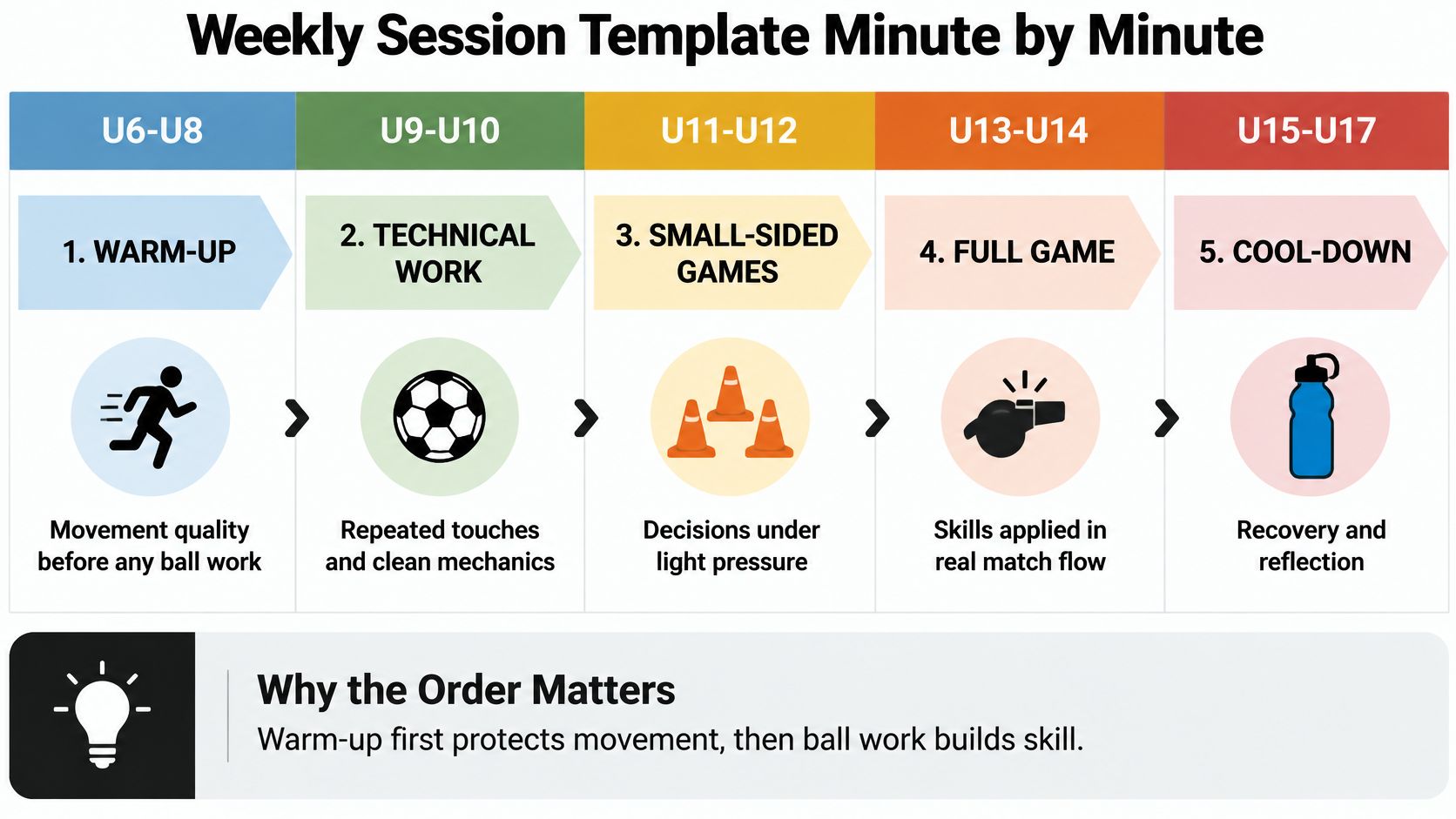
Run the session with a clear purpose
Arrival is optional play, not a hidden conditioning test. The movement warm-up comes before demanding technical work so the coach can see how players are moving and prepare them for the session's actions.
Then teach the technique and put it into a decision game. Finish that game with fewer restrictions so players must recognize when the skill is useful, rather than perform it because a rule demands it.
Here are practical ways to fill the example blocks:
Ages 4–6: Try the technical block as dribbling tag in an example 10-metre grid, with a ball for every child. Follow it with free attacker-versus-defender play in tiny zones. Make the area larger if collisions or frustration replace exploration.
Ages 7–9: An example 20-minute technical block could contain two 6-minute keep-away stations and an 8-minute gate game. Encourage a look before receiving, then award a point for a pass through a cone gate.
Ages 10–12: Keep the technical block focused, then use the decision game to test receiving and passing against active defenders. Apply a touch restriction to only one team if both teams struggle under it.
Older groups: Use directional goals and realistic support positions. Extend the decision game only while players continue making purposeful choices.
Shorten without losing the point
Cut the arrival block first when time is tight, not the movement preparation. If a longer session is appropriate, add another game problem rather than extending repetitive drilling.
End with a reflection question such as, “Where did you find space today?” Accept a short answer. You're checking what the player noticed, not delivering a lecture after they've stopped listening.
Skill Progressions From 1v1 to Full Game
Polished drills don't guarantee better decisions in a match. Judge each progression by whether players recognize pressure, use teammates, and keep making useful choices as the game becomes more demanding. Change the problem, not just the number of cones.
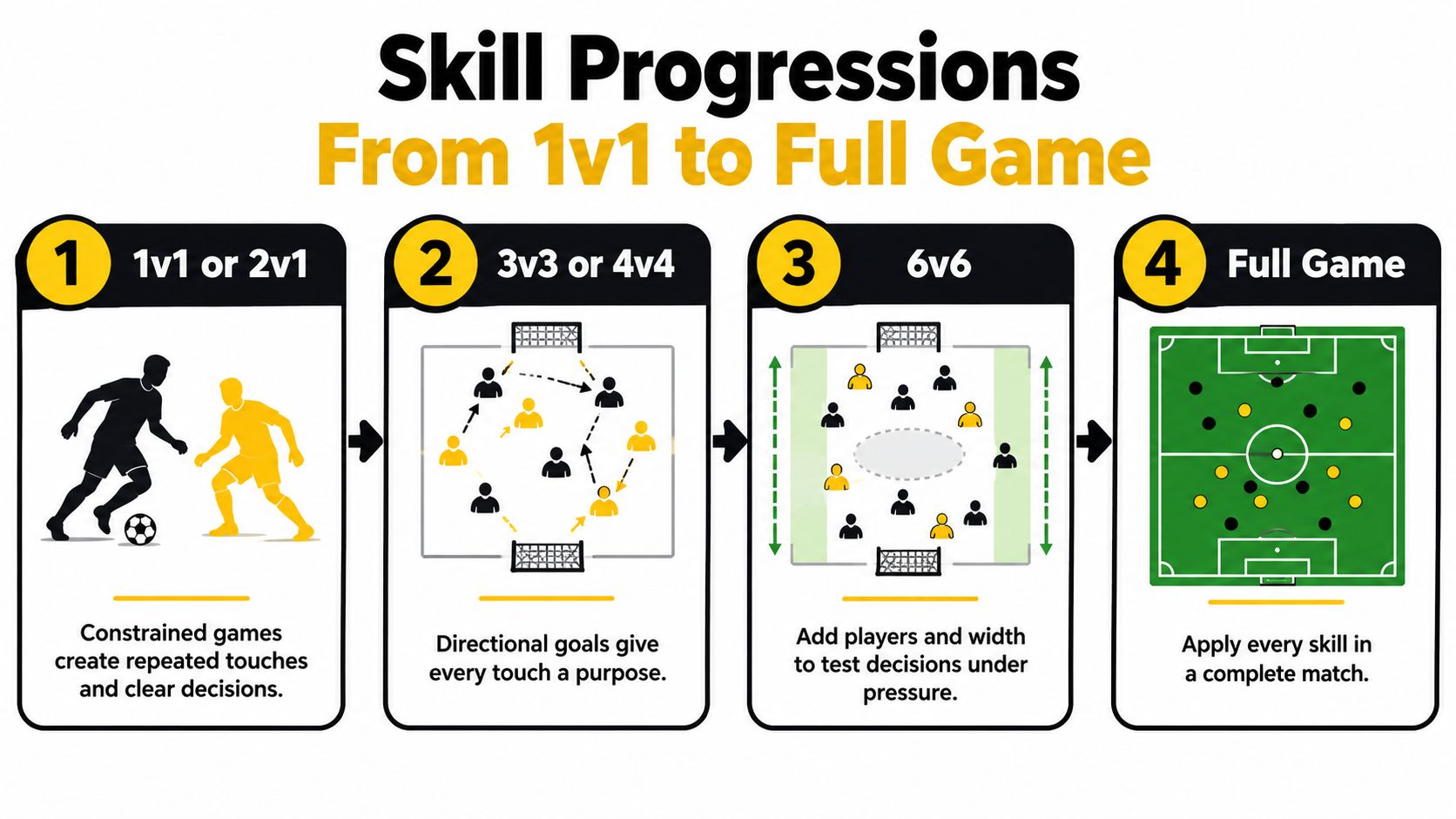
Start with constrained 1v1 or 2v1. Give the attacker a clear destination and let the defender genuinely try to win the ball. Players must decide whether to carry it, protect it, or use support. For ages 4–6, start with generous space and simple boundaries.
Add teammates and directional goals. For ages 7–9, begin with 2v2 in a small area, using end lines or target gates to show the direction of attack. For ages 10–12, progress from 2v2 to 3v3 or 4v4 with directional goals, so players must find teammates while moving toward a target. Keep the game simple until players understand where to attack; add conditions only when they can play with purpose.
Use a condition to address a specific problem. A touch limit, weaker-foot challenge, or bonus for scoring through a target zone can focus attention. For older players, positional conditions can create realistic receiving angles. Remove a rule if it makes every possession follow the same passing sequence.
Finish with an unconstrained game. Stop rewarding a practice behavior artificially and see whether players choose it when it helps. For older, more advanced groups, use full-sided play with normal tactical responsibilities.
Why small-sided games earn their place
The small-sided-game research summarized in Scientific Reports reports that 3v3 and 4v4 appeared in 21% and 29% of reviewed studies, respectively. Protocols averaged 3.5 sets of about 8 minutes 52 seconds. The review also describes 17-year-old academy players who completed six weeks of two additional weekly small-sided sessions and improved more than players doing dribbling circuits in sprinting, agility, passing accuracy, and interceptions.
These study formats are examples, not a stopwatch prescription for every child. Use repeatable game bouts with a clear purpose, and give feedback between them. The result with older academy players does not show that the same schedule suits beginners.
More completed passes aren't automatically better practice if the coach has already made every decision.
Track execution and judgment separately. Note successful passes, first-touch errors, and recoveries, then consider whether each action suited the pressure, space, and teammate positions. A technically imperfect pass may follow a good decision; a clean pass can still miss a better option.
Use the video as an additional on-field reference, alongside what you observe in your own players.
Coaching Cues for Core Techniques
Skill | Cue to use | Common error | Fix that works |
|---|---|---|---|
Inside-foot pass | Plant beside it, firm ankle | Unintended toe-poke or pass sliding wide | Partner passing through a cone gate, alternating feet |
Dribbling | Look up, touch into space | Eyes down, ball trapped beneath feet | Dribble through a live game zone and notice looks before touches |
First touch | Cushion into your next space | Ball rebounds beyond control | Receive while moving, including with the weaker foot |
Shooting | Plant beside it, strike through | Leaning back and lifting the shot | Receive, then finish toward a clear target |
Turning | See pressure, turn away | Turning directly into the defender | Receive against a defender who starts by jockeying |
1v1 defending | Stay ready, slow the attacker | Lunging and getting beaten | Jockey and guide the attacker away from the dangerous route |
These are starting cues, not universal laws. A toe-poke can be useful in a match, and a first touch shouldn't always go forward. Correct the action that prevented the player from solving the situation, not every departure from a textbook picture.
Give a cue while the repetition continues, then check understanding during a natural pause. Ask the player to explain the action briefly or demonstrate it. If they can repeat the words but can't perform the task, change the exercise before adding another explanation.
Match the language to the learner
For younger children, show the movement and use a familiar image. “Plant your foot beside the ball like a lamp post” is easier to demonstrate than a lecture about the supporting leg. Praise the action you wanted: the player looked before receiving or placed the supporting foot beside the ball.
For developing players, pair a technical intention with a decision intention. For example, ask for a controlled first touch and awareness of the defender. Don't add shooting mechanics, body shape, passing weight, and tactical positioning to the same correction.
With teenagers, ask what they saw. “What did the defender do?” can reveal whether the difficulty was execution or a misreading of pressure.
Sideline agreement: Reinforce the coach's cue rather than giving your child a competing version during play.
Constant correction can turn practice into an attempt to avoid mistakes. Let the activity teach, allow another attempt, and intervene when the same obstacle persists. Parents can help most by asking what the player is working on and leaving the technical instructions consistent.
Keeping Young Players Healthy and Motivated
Before adding training, ask what the child is already doing across every team. In a 2025 injury-prevention systematic review and meta-analysis covering 28,200 youth players, prevention programs were associated with a relative injury risk of 0.615, with stronger effects among players who followed their programs more consistently. That supports consistent prevention work, not a promise that any warm-up makes extra training safe.
Workload decisions shouldn't depend only on whether a child wants another session. Parents and coaches need a shared picture of practices, matches, camps, school soccer, and recovery. Otherwise, each adult can approve a reasonable-looking activity without seeing an unreasonable overall schedule.
Have the weekly load conversation
List every exposure: Put club practice, matches, school teams, camps, and private lessons on the same calendar.
Flag sudden increases: Compare the coming week with the child's recent routine, especially around tournaments or overlapping teams.
Protect recovery: Leave a full recovery day in the example weekly plan rather than filling every open space.
Adjust during growth or fatigue: Reduce intensity when movement becomes uncomfortable or coordination looks unusually difficult.
Keep preparation consistent: Use running, controlled landing, balance, and progressive changes of direction rather than skipping straight into hard competition.
A practical soccer injury-prevention guide can help families prepare questions for the coach. Ask who modifies the session when a player arrives sore and how coaches communicate with other teams sharing that player.
Recovery also belongs in the training environment.
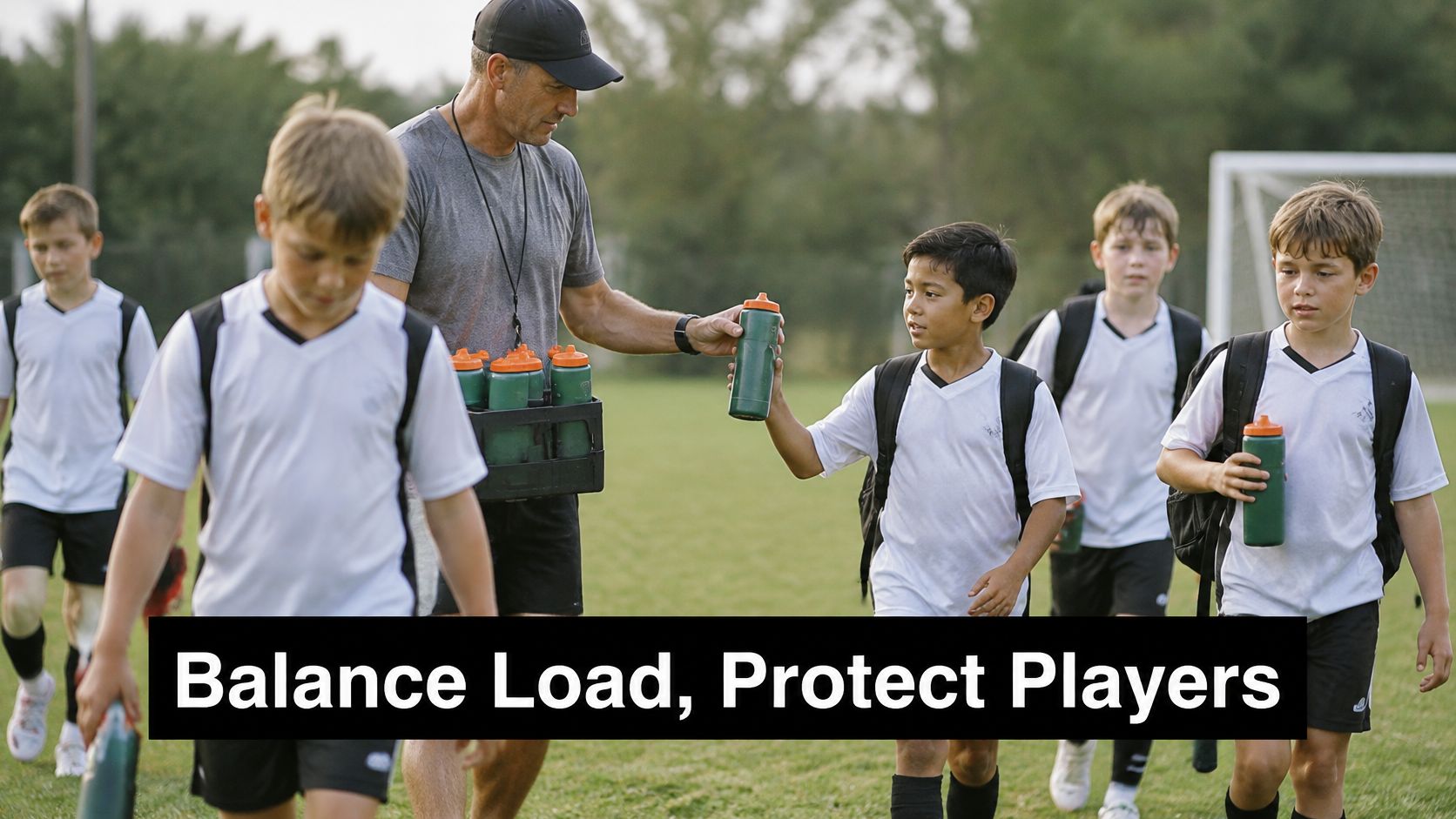
Protect the desire to return
Leave room for soccer that children organize themselves. Research concerning skilled youth players in the CONCACAF region associates deliberate play with intrinsic motivation and longer engagement. That doesn't mean abandoning coaching; it means resisting the urge to supervise every touch.
Avoid public rankings for younger players. Give feedback privately, recognize purposeful effort, and allow children to describe what they enjoyed as well as what they found difficult.
Persistent pain after rest or limping warrants pausing participation and seeking medical advice. Sudden dread of practice also deserves attention: speak privately with the child, investigate pressure or conflict, and seek appropriate professional support when needed. Don't treat reluctance as a character flaw to train out of them.
Measuring Progress Without Chasing Goals
A polished drill can hide a gap between practice and match play. Track whether a skill holds up against opponents, and whether the child's workload and age fit the training. Use a small set of measures rather than turning every session into a test.
Metric | How to test it | Suggested starting age | Sign of progress |
|---|---|---|---|
Skill course time | Repeat the same cone-and-passing course | 9 | Faster across a training block, not just on one attempt |
Cone touches and passing errors | Count contacts and misplaced passes on that course | 9 | Fewer errors without simply slowing down |
Successful passes under pressure | Observe a keep-away or small-sided box game | 10 | More appropriate completions with defenders close |
First-touch control | Note receptions kept within a playable step | 8 | Ball arrives where the next action is possible |
Scanning and decision speed | Observe looks before receiving and the resulting choice | 10 | Useful information followed by a suitable decision |
Off-ball movement | Record supporting angles during games | 12 | Offers an available option on the open side |
These ages are suggested coaching entry points, not validated developmental thresholds. Introduce a measure when the child understands the task, and keep it low-pressure. Younger children do not need a formal performance dashboard.
Read improvement cautiously
A 2024 study of 90 players aged 9–12 reported larger course-time gains for the intervention group than for controls, but the difference between groups was not statistically significant. The result does not prove that training caused the gains; repeated testing and normal development may also affect performance.
A faster score alone cannot show that extra training improved match decisions. Familiarity with a course can improve a time without changing how a player reads the game.
Keep a notebook with the course setup, conditions, execution, and relevant observations from play. Retest after a meaningful training block, using the same course and instructions. Periodic checks are more useful than assessing every practice.
Pair the score with the situation
A player might complete more passes by choosing only safe options, while missing chances to play forward. Another may spot the right pass but need better weight or timing. Record both the outcome and whether the decision made sense.
Apply the same judgment to scanning. Counting head movements is only a starting point. Note whether the player used what they saw to choose an action. A glance that does not inform the next decision is not the goal.
Use a structured soccer player evaluation to organize feedback around the individual, rather than ranking teammates after one session. Compare the child's performances under similar conditions and look for repeated behavior in practices and matches. One poor test is information, not a verdict.
Choosing a Program That Keeps Development Going
Before enrolling, ask the coach to show how the program handles the following:
Age fit: Activities change with the player's readiness rather than repeating an older team's session.
Game application: Players spend meaningful practice time making choices against opponents.
Transparent workload: Coaches discuss the full schedule, including outside teams and recovery.
Useful feedback: Evaluations include technique, decisions, and movement rather than goals alone.
Positive, qualified coaching: Staff explain corrections without humiliation and welcome reasonable parent questions.
Psychological support: Families know how confidence, pressure, and wellbeing concerns are handled.
A private technical trainer, a community program, and a competitive academy can serve different needs. Private work can isolate a stubborn mechanical issue; team training can expose whether that improvement survives unpredictable pressure. Don't buy another training format until you can name the problem it needs to solve.
Apply the checklist to a Houston option
The publisher's soccer development programs offer a local option to evaluate against those criteria. As the official Villarreal CF partner academy in Greater Houston, it serves boys and girls through age-appropriate programming guided by the Yellow Submarine methodology, emphasizing intelligence, skill, and character, with sports psychologists involved.
Programs include teams, camps, clinics, and tryouts. Training locations span Humble, Fall Creek, Cypress, Tomball, and the Kingwood–Porter–New Caney area, while the development pathway includes opportunities to train and play in Spain alongside Villarreal CF's academy.
The academy's website provides a starting point for comparing programs and asking about current availability.
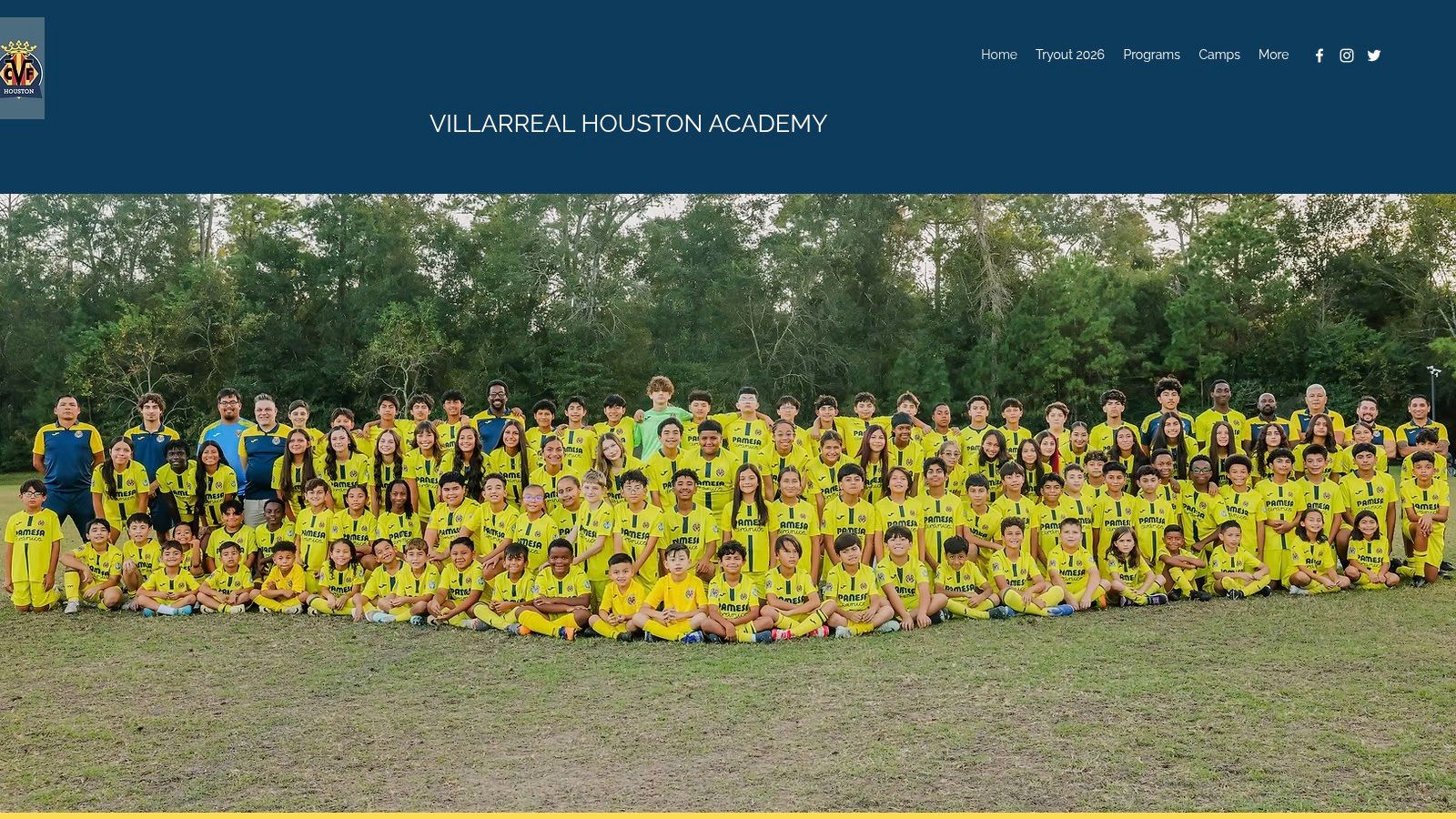
Those features describe an offering, not proof of fit for your child. Ask how a coach would help an anxious receiver, a confident dribbler who rarely passes, or a player already carrying a crowded schedule. Specific answers tell you more than a polished list of drills.
Request the session plan for your child's age band and the workload policy before committing. Compare how programs answer those questions, then choose the environment where the child can learn, recover, and keep wanting to play.
Villarreal Houston Academy offers teams, camps, clinics, and tryouts that connect technical development with tactical understanding and game application. Visit Villarreal Houston Academy to explore an age-appropriate program, then ask a coach how the session plan and weekly workload would fit your child.
Comments