


10 Sports Psychology Examples for Youth Soccer Coaches

A young player places the ball on the penalty spot. The score is tied, teammates are watching, and parents behind the goal have gone quiet. The player knows how to strike the ball in training, but the moment feels different. Similar pressure appears at tryouts, set pieces, late-game decisions, and any situation where one action seems to define the player.
That pressure doesn't mean a child lacks talent. It means the player needs mental skills, just as they need to train passing, scanning, balance, and first touch. A 2022 review of 30 sport-psychology meta-analyses found a moderate beneficial effect across performance-related psychological variables, including confidence, cohesion, mindfulness, and mental practice, with an average standardized effect size of d = 0.51 (review of sport-psychology meta-analyses). A separate 2023 review found that psychological skills training outperformed control conditions with a moderate effect of g = 0.83 (systematic review of psychological interventions in sport).
Villarreal Houston Academy supports youth players with sports psychologists alongside qualified coaches. The following sports psychology examples turn mental training into actions coaches and parents can use at the next session and at home.
1. Goal Setting
A player improves faster when the next action is clear. “Play better” gives a child nothing to measure. “Scan before receiving the ball and make three forward passes” gives the player a behavior to practice.
Use outcome goals sparingly. Winning, earning a starting role, or scoring a goal can motivate a player, but the player can't control every part of those outcomes. Process goals keep attention on actions within the player's control.
Use two types of goals
A U10 defender might choose one training goal, such as holding a balanced 1v1 stance during defensive practice, and one enjoyment goal, such as trying a new feint. A U16 player hoping to earn a starting role might support that ambition with weekly goals for weak-foot passing, communication, and recovery runs.
Keep active goals limited so they don't become another source of pressure. Review them during the season and recognize progress even when match results lag.
Coach's script: “What's one action you can repeat today that will help you become the player you want to be?”
For ages 4 to 7, avoid formal worksheets. Use visible phrases such as “keep the ball close,” “look up,” or “try a new move.” Parents should praise effort and follow-through, not only goals or wins. Ask, “Did you work on your goal?” rather than, “Did you score?”
A team can also set a collective process goal, such as improving communication when pressing or maintaining defensive shape after losing possession. The coach then observes those behaviors instead of making the scoreboard the only measure of development.
2. Mental Imagery and Visualization
A winger has a tryout tomorrow and keeps thinking about making a mistake. Instead of repeating “Don't mess up,” the player can rehearse the first action: receive on the back foot, scan inside, carry the ball, and choose a cross or pass.
Mental imagery works best when it resembles the actual task. The player should picture the ball's movement, the position of teammates, the sound of the field, and the next decision. The 2022 review identified mental practice as especially relevant, with one included meta-analysis covering 21 studies reporting a standardized mean difference of 0.68 (sport-psychology meta-analysis review).
Make the rehearsal active
A goalkeeper can visualize reading a striker's body shape and moving into the save. A player recovering from an ankle injury can mentally rehearse a passing pattern while following the medical plan. A striker can see the ball arrive, choose the target, and finish with control rather than imagining a celebration.
Use imagery before physical practice, then perform the skill immediately. This connects the mental rehearsal to movement. Keep the language concrete:
See the situation: “The defender closes from my right.”
Choose the action: “I take my first touch across the defender.”
Finish the sequence: “I pass into the forward's path.”
For ages 4 to 8, use storytelling instead of demanding formal visualization. Ask the child to pretend they're a submarine navigating around cones or a goalkeeper protecting a castle. Older players can write a short tryout script and rehearse how they'll respond to an imperfect first touch.
Imagery isn't a replacement for physical training. It's a way to prepare attention and decisions before the body performs.
3. Positive Self-Talk
A midfielder receives the ball with an opponent closing quickly. The useful thought isn't a long speech about confidence. It's a short instruction the player can act on immediately: “Scan, then play.”
Self-talk can guide technique, manage emotion, or restore focus after an error. Instructional cues describe the next action, such as “open body,” “first touch away,” or “hit through.” Motivational cues support effort and commitment, such as “stay with it” or “win the next action.”
Build a shared vocabulary
Choose two to four words that players can remember under pressure. Practice them during normal drills, not only before an important match. A striker might use “shoot early” during finishing work. A defender who gets beaten can replace “I always lose that duel” with “next play, stay compact.”
Coaches and parents should use consistent language. A child who hears one cue from the coach and a completely different message from the sideline has more information to process at the moment concentration matters.
A useful reset sounds like this: “That play is finished. What's your next job?”
Parents can reinforce the same approach after matches by asking which cue helped and when the player used it. They shouldn't turn self-talk into forced positivity. Telling a frustrated child to “be positive” can dismiss the emotion. A specific action cue gives the player somewhere to place attention.
For more guidance on applying mental routines with young athletes, coaches and families can read mental training for young athletes. The practical standard is simple: the words should help the player do something, not merely sound encouraging.
4. Pre-Performance Routines
A penalty taker doesn't need to invent a new response each time pressure rises. A consistent routine gives the player a familiar sequence before the kick.
For example, the player places the ball, takes two steady breaths, looks at the chosen target, and says, “Calm, strike.” The routine ends with the same physical action used in training. It doesn't guarantee a goal. It gives the player a reliable way to return attention to the task.
Rehearse the sequence under realistic conditions
A goalkeeper can use a short routine before a goal kick: check the field, breathe, choose a target, and commit to the pass. A corner taker can set the ball, pick the delivery area, take one breath, and begin the approach. A young player can use the simpler version, “Look, breathe, kick.”
Keep an in-game routine brief. Players need to complete it without delaying play or becoming distracted by whether it feels perfect. Practice it during ordinary sessions, training penalties, and set-piece games. Add mild pressure later, such as a scoreline or teammates watching.
The routine should contain:
A breath: one controlled exhale to reduce rushing.
A visual target: a corner, teammate, or space.
A cue word: “calm,” “commit,” or “strike.”
A physical trigger: placing the ball, setting the feet, or beginning the approach.
Use the same sequence after a mistake. A player who misses a penalty won't benefit from a completely new ritual created in frustration. The next routine should return attention to the next controllable action.
5. Arousal Regulation
A goalkeeper's heart may race before a penalty. A midfielder may return after halftime tense and unfocused. Give both players a short way to regulate that energy before it affects the next decision.
Teach younger players belly breathing with “Smell the flower, blow out the candle.” For older players, use a measured pattern with a longer exhale than inhale. The cue should lower rushing without making the player drowsy.
Match the tool to the moment
A full progressive muscle relaxation exercise works best at home or in a quiet team setting. The player gently tightens and releases each muscle group, learning how tension feels. Before a match, shorten it to shoulders, hands, and jaw. During a stoppage, one slow exhale and relaxed shoulders may be enough.
Use a simple progression:
Before training: practice slow breathing while standing or sitting.
During a stoppage: exhale once, drop the shoulders, and find the next task.
At halftime: take several steady breaths while listening to tactical instructions.
At home: complete guided relaxation during recovery or before sleep.
The coach's script should stay concrete: “Breathe out, soften your shoulders, scan the field.” For ages 4 to 8, pair the words with a visible action, such as blowing gently toward a hand. Ages 9 to 12 can count the exhale. Older players can choose a breathing pattern and rehearse it before pressure sessions.
A 2023 systematic review reported beneficial effects for mindfulness- and acceptance-based interventions, with g = 0.67, and imagery, with g = 0.75. The findings support regular practice, not a promise that one breathing exercise will solve every performance problem.
Parents can explore gentle movement and recovery ideas through yoga and mindfulness posts. Persistent exhaustion, disrupted sleep, loss of enjoyment, or worsening emotional distress needs more than a breathing cue. Discuss those concerns with an appropriately qualified health professional.
6. External Attentional Focus Cues
A coach says, “Lock your ankle, keep your knee over the ball, and swing through.” The player now has several body parts to monitor. A clearer instruction may be, “Pass the ball through the gate.”
External focus cues direct attention toward the effect of the movement, such as the target, ball path, teammate, or space. They often help players move more naturally because the athlete responds to the task rather than consciously controlling every joint position.
Turn mechanics into outcomes
Instead of telling a player to swing the leg faster, point to the result: “Drive the ball into the far corner.” Instead of saying, “Bend your knees and keep your hips low,” tell a defender, “Keep the attacker on your left side.” The second instruction still influences body position, but it gives the player a tactical outcome to solve.
Use cones, goals, gates, and teammates as visual anchors. Ask, “Where do you want the ball to go?” or “What space are you protecting?” This reveals whether the player understands the action and creates language that transfers to a match.
For ages 4 to 8, keep cues visual and playful. “Kick it to the rainbow cone” is easier to use than a technical explanation about ankle stability. Internal cues still have a place when introducing a new movement, but they shouldn't dominate every repetition.
A coach can test the difference in the next passing drill. Give one group a body-focused instruction and another an outcome-focused instruction, then ask players which cue helped them find the target. The aim isn't to ban technical detail. It's to use the smallest instruction that helps the player solve the problem.
7. Mindfulness Acceptance and Commitment
A player misses a penalty and feels anger, embarrassment, and fear about the next match. A mindfulness-acceptance-commitment approach doesn't require the player to erase those reactions. It teaches the player to notice them without allowing them to control the next action.
The script can be short: “I notice I'm nervous. I can still choose my next job.” The player then looks for the next task, such as tracking a runner, communicating with a teammate, or preparing for a restart.
Connect feelings to values
Ask players to choose a value they want to show on the field. It might be courage, respect, responsibility, or effort. Then connect it to behavior:
Courage: ask for the ball after a mistake.
Respect: speak constructively to a teammate.
Responsibility: recover quickly after losing possession.
Effort: keep moving when the game becomes difficult.
A short mindful breathing or body-scan exercise can fit into a warm-up or cool-down. Players notice their feet, breathing, and surrounding sounds, then return attention when the mind wanders. The coach should avoid presenting mindfulness as a demand to feel calm. The player may still feel nervous and can act with purpose anyway.
For younger children, use names such as “Superhero Focus” or “Quiet Body.” Keep the exercise playful and brief. Older players can write one difficult feeling they expect at tryouts and one value-based action they'll take when it appears.
Families can learn more about the underlying therapeutic approach through this explanation of ACT therapy for anxiety and OCD. A youth coach should stay within a coaching role and refer clinical concerns to qualified professionals.
8. Growth Mindset Coaching
A child says, “I'm bad at heading.” The coach's answer shouldn't be empty praise. It should identify the next development step: “You're not consistent with it yet. We'll work on your timing and contact point.”
Growth mindset coaching treats ability as developable through practice, strategy, feedback, and persistence. It doesn't mean every player will reach every target, and it doesn't excuse poor instruction. The coach still needs to provide a clear method and an appropriate progression.
Praise the behavior, not the label
“Your hard work on your weak foot is paying off” tells the player what produced improvement. “You're a natural” may feel positive, but it can make future difficulty seem like evidence that the player isn't talented after all.
After a loss, ask questions that create learning:
“Which decision would you repeat?”
“What became difficult when we lost the ball?”
“What will you try differently at the next session?”
Parents can use “What did you learn today?” instead of making the first question about winning. They can also praise recovery after mistakes, communication, and willingness to attempt a difficult skill.
Coaches should model the language themselves. If a drill fails, say, “That setup didn't give you enough realistic decisions. I'll change it,” rather than blaming the players. Young athletes learn mindset partly by watching how adults respond to errors.
For a clearer explanation of fixed and growth-oriented thinking, see what is a fixed mindset. The practical test is whether feedback leaves the player with a specific action to repeat.
9. Stress Inoculation Training
Comfortable drills don't prepare players for every match problem. A four-week controlled intervention involving 51 elite male youth soccer players compared structured training with stressful constraints against standard training. The constrained group developed stronger resilience-related skills, while preoccupation and concentration disruption decreased significantly, with several reported effects at p < 0.001 (controlled youth soccer intervention).
The lesson isn't to make every session chaotic. It's to add pressure deliberately, then teach players how to respond.
Increase challenge in stages
Begin with a normal small-sided game. Add a limited-touch rule. Then introduce a time restriction, an uneven-number situation, a scoreline disadvantage, or a restart with the opponent pressing. Afterward, ask what the player noticed in the body and which action helped.
Use this response plan:
Recognize: “My breathing is rushed.”
Regulate: take one controlled breath.
Cue: say “scan” or “next play.”
Commit: choose the next football action.
A coach can run penalty practice with teammates creating noise, but only after players have learned their routines in calmer conditions. For younger children, turn pressure into a game rather than an evaluation. Keep the experience challenging without making the child feel trapped or humiliated.
Staff should monitor whether pressure is productive. Look at concentration errors, recovery after mistakes, communication, and the player's reported stress. If a player becomes persistently distressed, reduce the load and involve the appropriate support professional.
For more guidance on pressure responses, coaches and families can read how to handle pressure in sports. Pressure training works when players learn skills inside the challenge, not when adults just add fear.
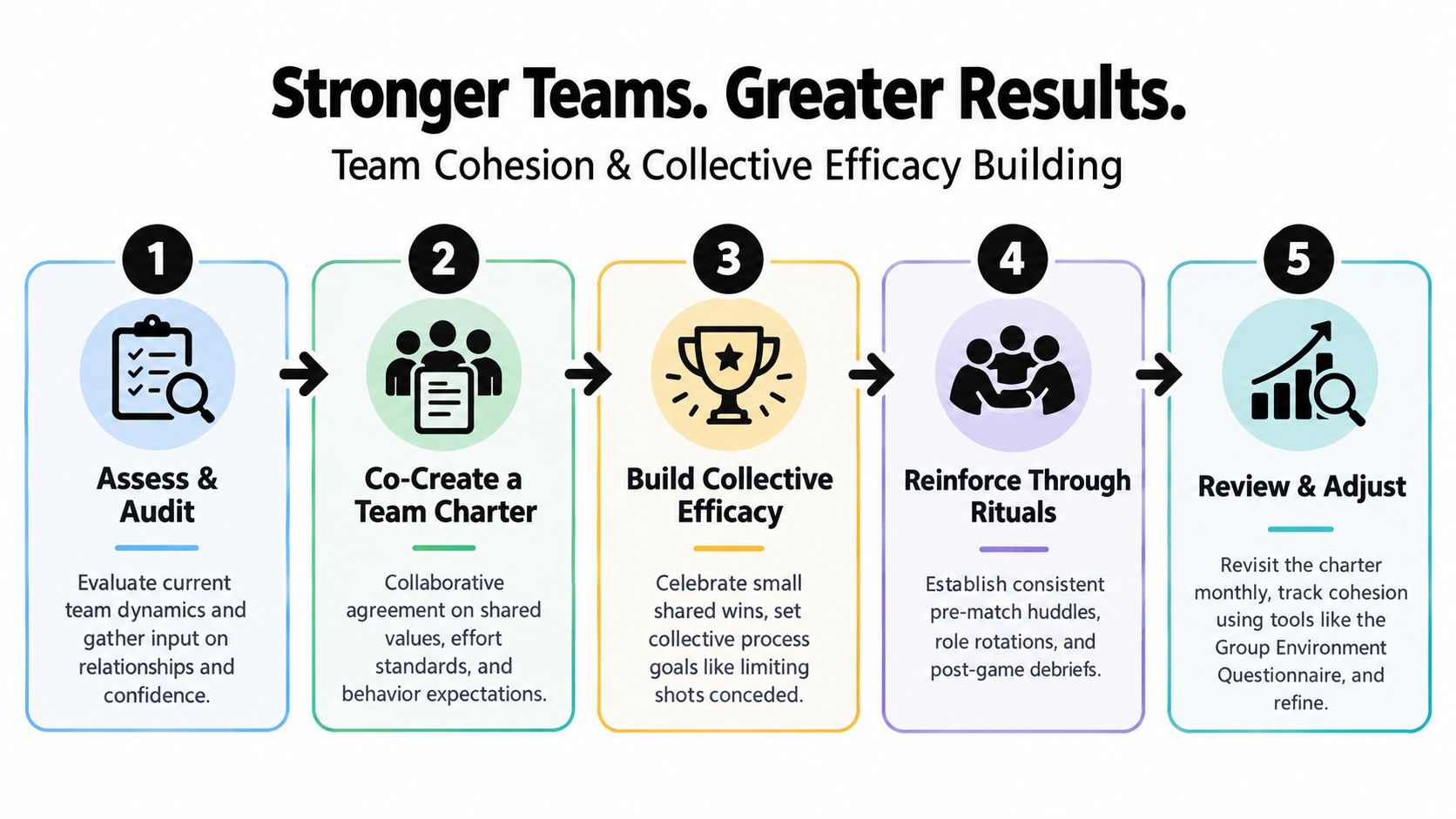
10. Team Cohesion and Collective Efficacy Building
A team concedes early and begins blaming one another. One defender stops communicating, midfielders hide from the ball, and the group loses its shape. A cohesion exercise won't fix a tactical problem by itself, but a team that trusts its roles is more likely to communicate and recover together.
Team cohesion combines connection among players with commitment to shared tasks. Collective efficacy is the group's belief that it can execute those tasks. Coaches build both by giving players meaningful responsibilities and drawing attention to improvements the team created together.
Make teamwork visible
Create a team charter with the players. Keep it practical:
Communication: use names and helpful information.
Response: recover immediately after losing possession.
Respect: support teammates without sarcasm.
Responsibility: arrive prepared and care for shared equipment.
Revisit the charter during the season. Rotate leadership roles so different players lead warm-ups, organize a team activity, or speak during a reflection. Highlight collective progress, such as better defensive spacing or faster support around the ball, instead of discussing only goals and individual awards.
Parents contribute from the sideline. Positive support, respect for officials, and encouragement after errors reinforce the environment coaches are trying to create. Parents can ask, “How did the team help one another?” rather than evaluating every player's individual performance.
A 2025 qualitative study emphasized collaboration among coaches, parents, teachers, sport psychologists, and athletes, along with institutional support and athlete ownership, as important parts of mental-skill development (qualitative study of mental skills in youth sport). That matters because mental toughness isn't something adults install in a child. The surrounding culture shapes how the child experiences challenge.
10 Sports Psychology Techniques Compared
Technique | 🔄 Implementation Complexity | ⚡ Resource & Time Requirements | ⭐ Expected Effectiveness | 📊 Typical Results / Impact | 💡 Ideal Use Cases / Key Tips |
|---|---|---|---|---|---|
Goal Setting (SMART & Process Goals) | Medium, structured setup, needs regular review | Low, written goals, weekly check-ins | ⭐⭐⭐⭐, strong research support | Increased motivation, measurable skill progression, sustained practice | Season planning & development; limit to 2–3 active goals; combine outcome + process goals |
Mental Imagery & Visualization | Medium, requires scripts and guided practice | Very low, can be done anywhere, short daily sessions | ⭐⭐⭐, effective when paired with physical practice | Improved technical execution, confidence, rehab support | Use for injury rehab, pre-game prep; include multisensory detail and short scripts |
Positive Self-Talk | Low, simple to teach and cue | Very low, immediate, practiced in drills | ⭐⭐⭐⭐, solid meta-analytic support | Faster recovery from errors, improved focus under pressure | Use short (2–4 word) instructional/motivational cues; rehearse in training |
Pre-Performance Routines | Medium, design brief sequence and automate | Low, short (5–10s) routines practiced in training | ⭐⭐⭐⭐, reduces anxiety and improves consistency | More consistent set pieces and penalties, better readiness | Keep routines ≤10s, include 1 breath + visual + cue; practice in drills |
Arousal Regulation (Breathing & PMR) | Low, teach protocols and cues | Low, minutes per session; practice required | ⭐⭐⭐⭐, effective for lowering tension/anxiety | Reduced heart rate, improved sleep/recovery, calmer performance | Practice in training so use under pressure is automatic; pair with cue words |
External Attentional Focus Cues | Low, rephrase instructions to targets/effects | Very low, cones/targets; integrated into drills | ⭐⭐⭐⭐⭐, strong motor learning evidence | More automatic, efficient movement and skill transfer | Use visual anchors (cones/targets); avoid prolonged internal cues for skill execution |
Mindfulness‑Acceptance‑Commitment (MAC) | Medium–High, needs trained facilitation & continuity | Medium, short regular exercises, reflection time | ⭐⭐⭐, strong for resilience; slower performance change | Increased psychological flexibility, reduced self-criticism | Start with 2–3 minute practices; tie exercises to team values and language |
Growth Mindset Coaching | Low–Medium, consistent language and feedback shifts | Low, coach/parent education, consistent practice | ⭐⭐⭐, supports long-term motivation and persistence | Greater willingness to try challenges, better learning from mistakes | Praise process/strategy, add "yet" to setbacks; align coach/parent messages |
Stress Inoculation Training (SIT) | High, phased program (education → skills → application) | Medium–High, planned simulations, coach training | ⭐⭐⭐⭐, effective for pressure preparation | Improved coping under pressure, confidence in high-stakes situations | Gradually increase stressors (noise, timers); debrief after scenarios |
Team Cohesion & Collective Efficacy | Medium, facilitation, rituals, role clarity needed | Medium, team meetings, activities, shared rituals | ⭐⭐⭐⭐, benefits team performance and retention | Stronger communication, commitment, sustained team performance | Create team charter, rotate leadership, celebrate collective wins |
Start With One Skill This Week
Don't introduce all ten techniques at once. Choose the age-appropriate tool that matches the situation causing the most trouble. For a young player rushing set pieces, start with “Look, breathe, kick.” For a team that loses focus after mistakes, use “Next play, stay compact.” For a player overwhelmed at tryouts, combine one breath, one target, and one process goal.
Practice the skill in training for two weeks before expecting it to appear reliably in a match. Keep the cue words identical across coaches and parents. A player shouldn't hear “relax” from one adult, “be aggressive” from another, and a long technical lecture from a third person during the same moment.
Review the response, not only the result. Did the player return attention faster after an error? Did the player follow the routine? Did communication improve? These observations give coaches useful information without turning every session into a test.
Age and maturity should guide the method. Younger children need stories, games, short cues, and visible targets. Older players can keep a written goal, rehearse a tryout scenario, or reflect on how pressure changed their decisions. The same principle applies at every age: mental skills should be simple enough to use under pressure and specific enough to practice.
Adults also need to watch for signs that ordinary nerves or fatigue may have become a broader concern. Persistent sleep disruption, emotional exhaustion, loss of enjoyment, or declining day-to-day functioning shouldn't be treated as a mindset failure. Recent youth-athlete research describes burnout as an interaction between physical load and psychological resources, including sleep and training fatigue (research on burnout and youth athletes). Adjust training when appropriate and seek qualified medical or psychological support when concerns persist.
Villarreal Houston Academy's coaches and sports psychologists can help families decide where to begin. The academy's player-development approach includes emotional regulation after mistakes, attention, communication, reflection, confidence, resilience, and coping with pressure alongside technical and tactical training. That combination gives players a practical pathway from a mental skill in training to a response they can trust in competition.
Villarreal Houston Academy offers competitive youth soccer teams, camps, clinics, tryouts, and age-appropriate training for boys and girls from age 4 upward, supported by qualified coaches and sports psychologists. Visit Villarreal Houston Academy to explore programs in the Greater Houston area and find a structured next step for your player's technical, tactical, and mental development.
Comments