


Soccer Teams for Beginners: How to Choose and Join

The most popular advice for first-season families is also the most misleading. Parents hear that they should find the best team, get in early, and not fall behind, as if a six-year-old who starts in recreation has already missed a door. In Houston, that advice pushes good families into the wrong team for the right reasons. They want their child coached well, included, and challenged, so they choose the most selective option they can find.
A better first question is simpler. Will your child touch the ball often, understand what's asked, and want to come back next week? More competitive is not automatically better for a beginner. Start with recreation, a short clinic, or a developmental group, and add travel only when your child asks for more and your budget and calendar can handle it without strain. Enjoyment comes before any pathway, including any future chance to train in Spain.
Which Beginner Pathway Fits This Season
A bigger commitment can look like a faster start, but for a beginner it may mean fewer chances to learn at a comfortable pace. A child needs regular playing time, clear teaching, and teammates learning similar skills. If games move too quickly for them to join in, the select label on a uniform will not make the experience more useful.
Recreation gives a new player room to try, make mistakes, and try again without every touch feeling like a test. It also lets a family find out whether a child enjoys team soccer, which is different from enjoying a ball in the yard. Many children in the U.S. play team sports, but that alone does not tell you which soccer format suits your child.
Four Pathways You Can Choose This Month
Recreational soccer includes city leagues and MLS GO programs. Registration is generally open, and games are often local. Fall Creek Sports Complex offers Recreational Soccer for ages 4-13 in partnership with MLS Go. For a beginner, recreation can be a straightforward first team: the focus is participation, and the lower-pressure setting can make it easier to learn the basic rhythm of practices and games.
A developmental or junior academy group adds planned instruction and coaching while keeping the emphasis on learning. Villarreal Houston Academy offers select and competitive youth programs for boys and girls as young as 4. At United City Church, the Villarreal Developmental Program “Future Stars” serves ages 4-5, and the Villarreal Junior Academy serves ages 5-9. Fall Creek Sports Complex also offers the Villarreal Junior Academy for ages 5-9, along with Villarreal Competitive Teams for ages 10-18. These options differ in age and level, so ask which group fits your child rather than choosing by the academy name alone.
A clinic, camp, or indoor technical block is a shorter way to try coached soccer before committing to a season. It can suit a child who is curious but has not yet played on a team. A short block is not the same as a season roster: it offers practice with a defined focus, without requiring the family to treat the child's first sessions as a long-term decision.
Select or competitive teams involve a greater commitment and may include tryouts, league games, and tournaments. Playing time is not guaranteed. That format may fit a child who already wants more structured competition and whose family can manage the calendar and cost. It can be a poor first step when a child is still figuring out where to run or whether they enjoy organized games.
Beginner soccer pathways compared
Pathway | Typical ages | How you join | Playing time | Travel | Choose it when |
|---|---|---|---|---|---|
Recreational or MLS GO | About 4-13 | Open registration | Often shared among players | Usually local | It is a first team or interest is still uncertain |
Developmental or junior academy | About 4-9 | Ask about eligibility and placement | Focus on learning | Limited or program-dependent | Your child wants coaching without a tournament-first commitment |
Select or competitive | Age range varies by program | Tryout or team placement | Not guaranteed | May include weekends and tournaments | Your child is asking for more competition |
Clinic, camp, or indoor block | Age range varies by program | Register for the specific program | Practice rather than season games | Usually limited | Your child wants to try coached soccer first |
Read the table as a family calendar, not a ranking. Consider the weeknights and weekends you can realistically keep for a full season. If two pathways seem suitable, start with the one that offers a gentler introduction and plenty of chances to participate. A child can ask for more challenge later; first, let enjoyment take root.
Practical rule: if your child has not yet enjoyed a full season, avoid committing to a pathway built around a heavy competition schedule.
How to Register for a First Soccer Team
Registration looks administrative, but the order matters. Parents who pay first and ask questions later often discover the age group, drive, or practice night doesn't work. Work through the steps below and treat the form as the middle of the process, not the start.
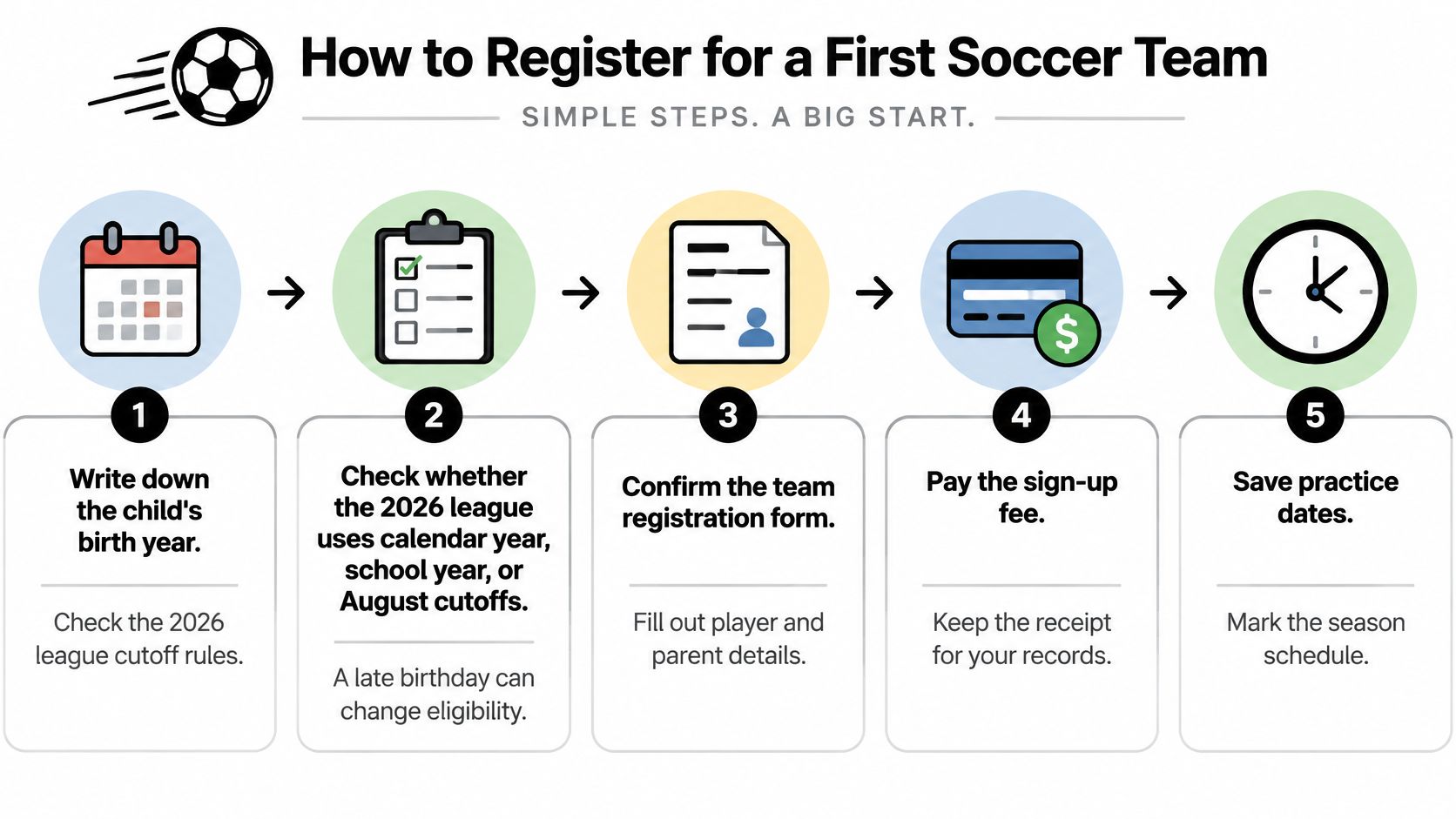
Register In This Order
Write down the birth year first. Check whether the 2026 league uses calendar year, school year, or August cutoffs, because a late birthday can change the team your child joins. Don't assume last year's grouping still applies. Ask the registrar to confirm the exact group before you pay.
Search close to home. Look within about a 20-minute drive at city recreation, YMCA or church leagues, school play, and club developmental programs. Ignore national rankings. A good local practice you can reach on a wet Tuesday beats a famous program you resent driving to by week three.
Visit one practice before paying. Stand where you can watch a new player, not the best player. Count how often that child touches the ball in ten minutes. If beginners spend long stretches in lines or watching, the session isn't built for them, whatever the brochure says.
Ask five direct questions. What's the game format? How big is the roster? How do substitutions work? Are coaches trained? What happens if your child wants to stop midseason? Write the answers down, because you'll forget the details once schedules and fees start arriving.
Complete the form and save proof. Register the player and a parent contact, then save the receipt and practice dates. You can use a clear overview of youth soccer registration steps and requirements to check what information a club may request. Treat competitive acceptance as a separate decision from submitting a form. A signed form doesn't promise a roster spot or playing time.
Buy only the starter kit. Your child needs molded cleats or turf shoes, shin guards, a size-appropriate ball, and a labeled water bottle. Delay extra kits, matching bags, and premium balls. If the first month goes badly, you haven't turned a short trial into an expensive commitment.
Make week one calm. Arrive 15 minutes early, help your child meet one teammate, and keep the ride home short and easy. Ask what was fun. Don't run a performance review in the car while your child is still deciding whether soccer feels safe.
Say a seven-year-old cries at drop-off on day one. A good coach doesn't deliver a speech about toughness. She gives that child one simple job, such as starting the first pass, and a buddy to stand beside. The tears often stop once the child knows exactly what to do in the first minute. That small, specific welcome tells you more about a beginner program than any trophy photo.
Small-Sided Formats and Safe Ages
A more competitive team is not automatically a better first team. Beginners need a format that gives them room to touch the ball, make choices, and enjoy playing. A small game can still overwhelm a new player if the field is too large, rests are too short, or an experienced child controls every attack. Judge the activity by what children are doing, not by the format name on a schedule.
Research on small-sided game formats and player load found that changing player numbers, field area, goalkeepers, rules, and work-to-rest ratios can materially alter mechanical and metabolic load. The practical point is simple: changing one feature can change how demanding a game feels. If you are new to soccer, you do not need to interpret formation charts. Watch how often each child gets involved and whether the pace leaves time to learn.
Build The Game In Three Steps
Begin with unrestricted 2v2 or 3v3. Every child has chances to receive, dribble, shield, and shoot, and it is harder to disappear from play. Tiny goals and no fixed positions let beginners explore the ball without waiting for permission to move.
Progress to 4v4 or 5v5 when basic actions happen without constant turnovers. Players can then practice finding support, using width, covering defensively, and reacting when possession changes. Larger formats make more sense once children can notice open space and work with teammates instead of crowding around the ball.
A review of small-sided formats and conditioned games recommends 3v3 or smaller when the primary objective is individual skill execution, while larger areas and more players better develop team organization. Keep the game small to work on a touch; expand it to introduce team shape.
First-season format and workload by age
Age | Format | Session length | Focus | Reduce load when |
|---|---|---|---|---|
4-5 | 3v3, no goalkeeper, tiny goals | 30-40 minutes | Fun and ball contacts | Tears, heat, or fatigue that does not pass |
6-8 | 4v4 or 5v5 | 45-60 minutes | Receiving, dribbling, simple passes | Limping or one child never touching the ball |
9-11 | 7v7 | 60 minutes | Space, support, light roles | Next-day pain or dread of practice |
12-14 late starter | 7v7 or 9v9, separate group if the gap is large | 60-75 minutes | Decisions without embarrassment | Overload or public comparison with veterans |
Use this guide to youth soccer age groups and format progression to compare age groups and formats before choosing a team. Age is only one part of the decision. A confident eight-year-old and a nervous eight-year-old may need different starting groups.
Balance, Constraints, And Warning Signs
A balanced game gives newcomers meaningful turns. Coaches can pair them with steady teammates and avoid correcting mistakes in front of the group. For a 12- to 14-year-old late starter, a separate beginner group or recreational 7v7 or 9v9 may be a better fit than an experienced 11v11 roster, where mistakes can feel more exposed.
Change one constraint at a time, such as the pitch size, a touch limit, the direction of attack, or a bonus point for switching play. Mandatory passing and fixed positions can rush decisions before beginners have enough control to try a dribble. Let players learn the action before adding a rule that restricts it.
Watch for successful first touches, forward passes, recoveries within five seconds, and whether a child looks up before the ball arrives. You do not need a scoresheet. These signs help you see whether beginners have repeated chances to make decisions.
Reduce the load or sit a child out for limping, heat distress, next-day pain, tears that don't settle, or dread before practice. Take those signs seriously rather than treating them as weakness. At the eight-week reassessment, ask whether your child is still smiling, sleeping normally, and asking to return. If the answer is yes, keep enjoyment at the center; consider a more demanding pathway only when the child wants it and the family is ready for the cost and commitment.
Warm Ups That Cut Beginner Injuries
You should be able to recognize a good warm-up from the sideline. It isn't children standing in a circle yanking a foot toward a hip while the coach sets up cones. It's movement that gets gradually quicker, with balance and landing practice built in before the game speeds up.
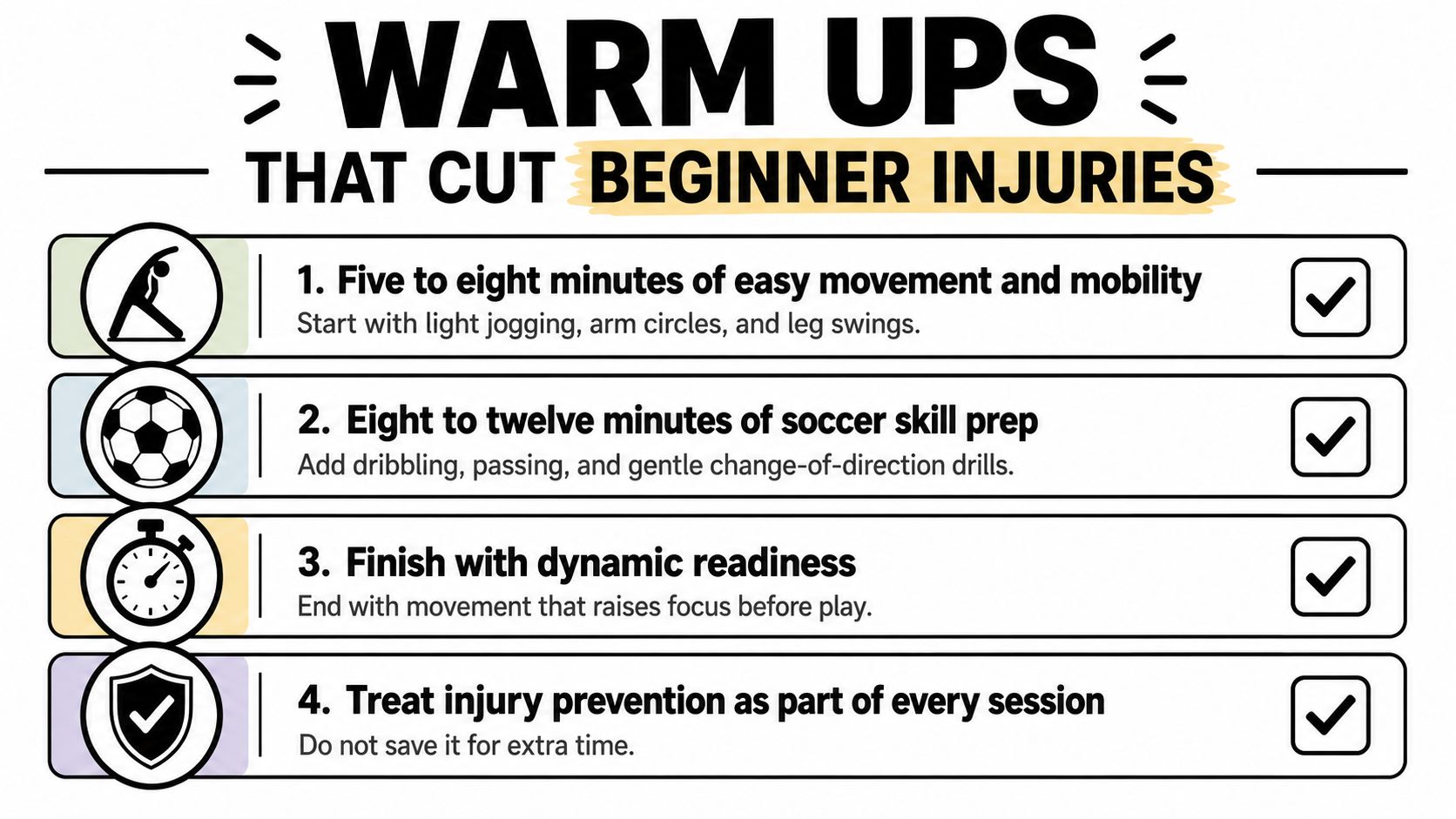
The First 15 Minutes To Look For
Easy movement for 5 to 8 minutes. Children jog lightly, move through mobility work, and raise their temperature without sprinting cold. For a plain-language primer on how to stretch before exercise, use it as background for movement preparation, not as a reason to make static holds the whole routine.
Neuromuscular work for 8 to 12 minutes. Look for single-leg balance, soft landings, deceleration, skipping, and controlled changes of direction. Coaches cue it concisely. Land with knees tracking over the feet, lower the hips before a cut, and slow down over several steps instead of stopping stiff and upright.
Ball work that speeds up last. Passing, dribbling, and small games get faster only after bodies are warm. A detailed set of warm-up exercises for soccer players shows the kinds of movements that belong in this part of a session.
Build minutes before intensity. Don't jump a new player from one short practice to a full weekend of matches because a roster is short. Watch pain, heavy legs, poor sleep, and how hard the session felt to your child. A beginner who is still sore and tired two days later has told you the load rose too fast.
The reason to insist on this routine is concrete. A meta-analysis summarized in a review of youth soccer injury prevention programs covered 28,200 youth soccer players aged 7-19 and found structured programs reduced injury likelihood by roughly 35-39%, with a relative risk of 0.615. That doesn't make any warm-up a guarantee. It does make skipping it hard to defend.
Consistency beats drama. A steady 10 to 15 minute routine for at least 12 weeks is more useful than one occasional hard fitness day that leaves beginners sore. The pitfalls are easy to spot: static stretching as the entire warm-up, dropping prevention work when the team arrives late, and treating ongoing pain as normal soreness.
Before you commit, ask the coach one question. What do the first 15 minutes look like when you're short on time? The answer should protect the routine and shorten something else.
Injury prevention isn't the part you add if practice starts on time. It's part of practice.
Beginner Drills for the First Practices
On a practice visit, you don't need to judge a coach's whole curriculum. Look for short, ball-based activities where every child moves often and understands the job in seconds. Each drill below should take under ten minutes and lead into a real game, not replace it.
Four Drills You Can Recognize
Gate passing: pairs pass through two cones set two steps apart and swap roles after ten successful passes. The gate gives beginners a target without stopping play for a lecture. Good coaches widen or narrow the gate instead of shouting for perfection.
Shield and turn: in a small grid, one attacker protects the ball while a defender applies light pressure. The attacker tries to turn toward an end line and cross it under control. This teaches body position and courage on the ball in a space small enough for quick repetitions.
Follow the pass: three players pass in a triangle, and each passer runs to the next cone to receive again. Children learn to move after passing instead of admiring the ball. Keep the triangle small at first so passes succeed.
Dribble and finish: a child dribbles through a cone gate and shoots into a small goal with no keeper. The finish gives the dribble a purpose. Send the next player quickly so nobody stands in a long line cooling down.
Cones-only work should stay short. A drill can clean up one action, but children learn timing, scanning, and recovery when an opponent can win the ball. If a full session is lines and lectures, beginners may look tidy and still freeze in a game.
Praise the brave touch, the look over the shoulder before receiving, or the quick sprint back after losing the ball. Don't make the score the headline on the ride home. For parents trying to protect family downtime around the season, practical ideas for staying active while switching off are a useful reminder that recovery and unstructured time support the sport rather than compete with it.
Costs That Should Stay Optional
Let's name the money problem before a club names it for you. A Fox Sports report on youth sports costs and participation barriers states that U.S. youth-sports costs rose 46% from 2019, while team fees alone were identified as a major participation barrier by 32% of parents and 41% of low-income parents. If the price makes you pause, you're not being difficult. You're reading the market correctly.
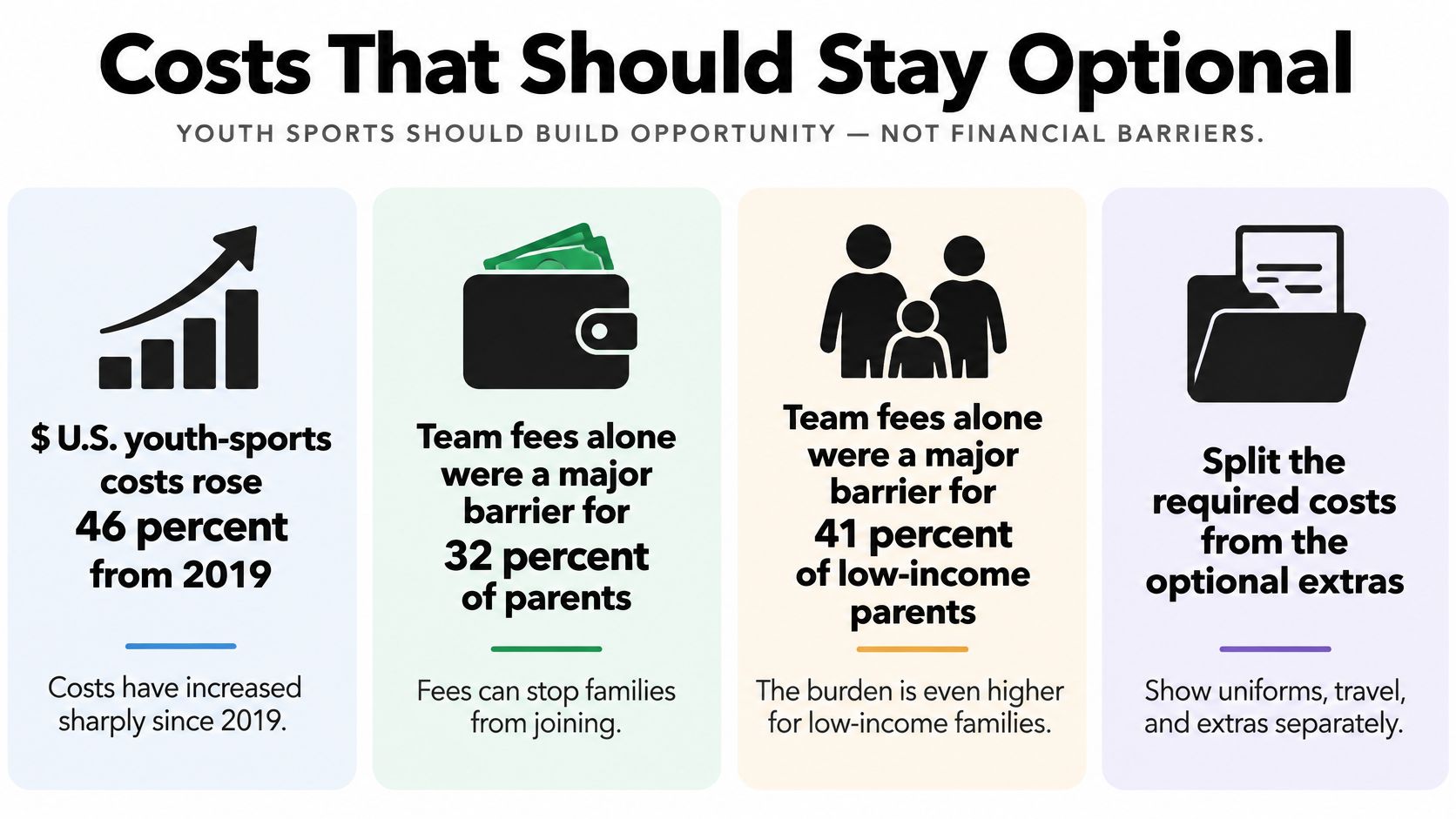
Split The Bill Into Two Lists
For a first team, the unavoidable list is short: registration or league fee, shin guards, proper shoes, a ball, and water. That's enough for a child to learn the rules, join a team, and find out if soccer is fun. Anything beyond that should earn its place.
Often optional in year one are extra uniforms, tournament hotels, out-of-town weekends, private lessons, showcase events, and a second paid training program. If a team requires a full apparel package, ask what's needed for games and what can wait. Guidance that helps you compare custom apparel options for teams is useful when a required kit starts growing into warm-ups, bags, and fan gear.
Before any tryout, a beginner needs only three things: basic comfort with a ball, the ability to follow a coach for a short session, and a family that can make the stated practices. A clinic or a few recreational weeks can answer readiness better than a private-trainer package sold as insurance. Don't pay to prove a child is ready for a level he hasn't tried yet.
Set a reassessment at 8 to 10 weeks. If your child wants more challenge, still enjoys practice, and your weekend calendar and budget are honest, look at select soccer then. If enjoyment is slipping, stay recreational or developmental and protect the habit. Soccer participation is strongest among younger children and tends to decline as children age, with affordability and access contributing to dropout. Keeping the first season affordable isn't lowering standards. It's keeping the door open.
Choose the Pathway and Take One Step This Week
Make the decision for this season, not for your child's whole sporting life. If your child is new, enroll in a recreational or developmental group and skip the tournament calendar. If interest is still a guess, book one clinic before paying any season fee.
Move toward select or competitive soccer only when three conditions line up. Your child asks for more games, your family can handle weekends without strain, and the budget still holds at the 8 to 10 week reassessment. If one condition is missing, waiting isn't falling behind. It's choosing a level your child can enjoy and repeat.
Do Three Things This Week
Visit one local practice. Count how often a new player touches the ball and whether beginners are included or parked at the edge.
Ask about the first 15 minutes. Ask what the warm-up includes and how the format changes by age group, then listen for specific answers rather than general promises.
Check the true total. Put the weekend calendar beside registration, required kit, travel, and any extra training. Cross off everything that should stay optional in year one.
We are the official partner academy of Villarreal CF, and we offer select and competitive youth soccer programs for boys and girls as young as 4 years old. Our mission is to provide age appropriate training with qualified coaches so local youth talent can play at their fullest potential. Roster spots and playing time are earned over time and are never promised by a signed form, so judge any program by a fair test: does your child want to come back next week?
If you're choosing soccer teams for beginners in the Greater Houston area and want a first step that keeps coaching serious without making childhood feel like a tryout, explore the beginner and competitive pathways at Villarreal Houston Academy. Look for the age group that fits your child this season, visit a session, and ask the questions above before you commit. Start with the level your child can enjoy now, then add challenge when he's the one asking for it.
Comments