


8 Youth Soccer Attacking Drills for Every Age and Level

You're planning Tuesday's session, and the group in front of you includes an energetic U8 player, a technically confident U12, and an older player who already understands how to create space. They all need attacking work, but a single drill won't challenge them in the same way. A scripted passing pattern may overwhelm the youngest player, while a cone circuit may leave the older player rehearsing movements without solving a real problem.
That's why effective youth soccer attacking drills begin with the player, not the exercise. Villarreal CF's methodology places value on technical quality, tactical understanding, intelligent decisions, and character. Villarreal Houston Academy applies that development approach through age-appropriate programming across North Houston, including Humble, Fall Creek, Cypress, Tomball, and the Kingwood, Porter, and New Caney area.
The list below moves from foundational movement and possession to progressive attacks, transitions, finishing, and pressing. Each drill includes a suitable age and ability range, a practical session role, strengths, and trade-offs. Coaches should also reinforce respectful conduct, responsibility, and the kind of attitude covered in these tips for sportsman behavior.
1. Attacking Movements and Combinations
Best for: U8 to U14, beginner through advancedSession role: Technical activation and attacking supportSuggested duration: A short technical block, then a longer game-based progression
Start with three players in a triangle, one ball, and a clear passing sequence. Player A passes to Player B, follows the pass, and receives a return ball into space. Once the group understands the one-two, add a third player so the ball can move through a triangle with a wall pass, supporting run, and forward movement.
For younger or less experienced players, keep the pattern unopposed. Use clear verbal cues such as “pass,” “turn,” “wall,” and “go.” Demonstrate the timing of the run rather than asking players to sprint immediately after every pass. The key behavior is moving as the ball travels, not standing to admire the pass.
Older players should receive with their body open, scan before the ball arrives, and choose whether to play back, turn, or combine with the third player. Add a passive defender first, then allow active pressure. Finish the sequence with a pass into a mini-goal or a shot when the combination breaks the line.
What coaches should emphasize
Timing over choreography: The runner should move when the defender is occupied, not merely because the pattern says to run.
First-touch direction: The receiving touch should help the next action and move away from pressure.
Different solutions: Use one-twos, overlaps, third-player runs, and diagonal support rather than one memorized route.
Progressive pressure: If the defender removes every passing lane, enlarge the area or reduce the defensive intensity.
Practical rule: A combination only matters if it helps the attacker create time, space, or a better angle.
This work reflects the passing and movement principles discussed in Villarreal Houston Academy's offensive soccer strategies. The trade-off is clear. Structure gives young players a reliable starting point, but too much structure produces players who can repeat a pattern without recognizing when the game demands a different action.
2. Small-Sided Possession with Target Players
Best for: U9 to U16, developing through select playersSession role: Possession warm-up and decision-making blockSuggested duration: Several brief rounds with frequent position changes
Create a central area with three attackers and two defenders. Place two neutral target players on the outside, one on each side. The attacking team keeps the ball by using the outside players as support, then looks for opportunities to play through, around, or away from pressure.
This format gives players a reason to create width while still offering close support. Rotate the outside targets into central roles so every player learns how positioning changes the available passing lanes. For younger groups, allow free touches and make the area large enough for players to receive without panic. For advanced groups, use a touch limit only after players can control the ball and scan effectively.
The coach should praise useful movement even when the player doesn't receive the ball. A forward checking away before coming short, a teammate creating a diagonal angle, or an outside player moving to open a passing lane can improve the attack before anyone plays a pass.
Make the possession problem realistic
Start with stability: Give the attacking team a clear numerical advantage and enough space to find success.
Add urgency carefully: Introduce a short counterattack window after a defender wins the ball.
Reward penetration: Give the group a target for playing through the central area, not just completing safe passes.
Rotate quickly: Players learn more when they experience central, wide, and defensive responsibilities.
The value of small-sided games is supported by a peer-reviewed study of Spanish U9 and U14 players. In 5v5 games, U9 players averaged 62 touches per outfield player, while U14 players averaged 56. Across the formats examined, the lowest figure was 29 touches per player in 9v9. The study also recorded 263 total touches for U9 and 253 for U14 in 5v5 games, with 5v5 and 7v7 producing more attacking actions than 9v9. These findings come from the study of small-sided games and youth soccer actions.
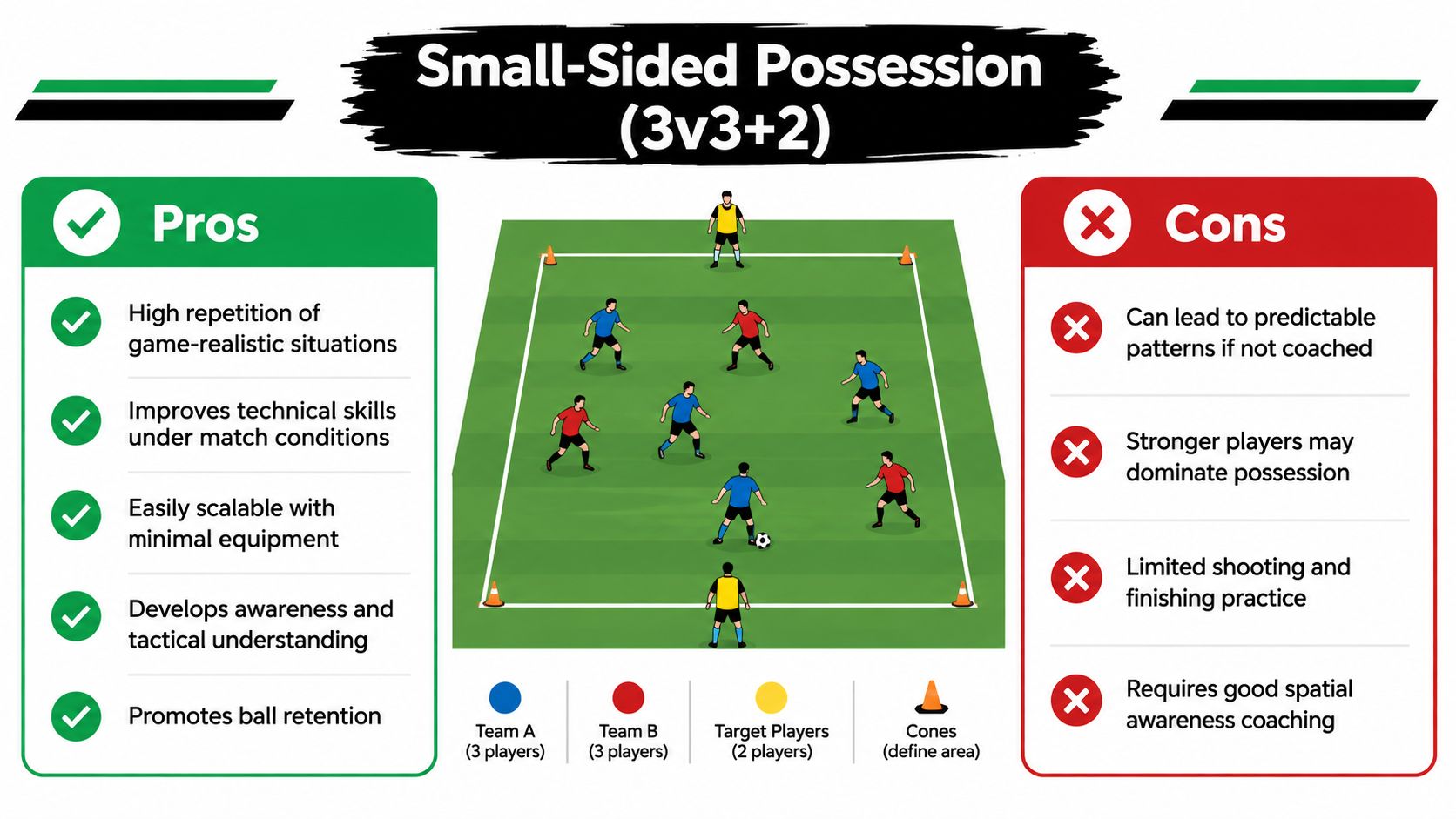
Use this activity when you want players involved often, then adapt the principles through Villarreal Houston Academy's small-sided soccer games. The trade-off is that high involvement doesn't automatically mean good decisions. Coaches still need to assess scanning, support, first touch, and forward intent.
3. Progressive Passing Attack
Best for: U10 to U18, intermediate through advancedSession role: Progression from possession into penetrationSuggested duration: A central tactical block before finishing or transition play
A basic rondo becomes more useful for attacking development when the ball has somewhere meaningful to go. Set up a starting zone, a middle zone, and an attacking target zone. The attacking team keeps possession against defenders, but it must recognize when to advance the ball into the next area.
Begin with a numerical advantage, such as six attackers against three defenders, so players can understand the problem without being rushed into poor passes. Ask the group to maintain width, create diagonal support, and move away from the ball to open a forward lane. A player should sometimes carry the ball forward if space is available, rather than passing just to preserve possession.
For younger players, use a target player or mini-goal at the end of the attack. Older players can progress into a larger directional game with defenders recovering from behind. Change the starting position so players must solve the problem from the center, a channel, or a wide area.
Coach the moment of progression
The most important question isn't “How many passes did you make?” It's “What made the forward action possible?” Players should learn to recognize a defender stepping out, a teammate checking between lines, or a wide player creating room for a diagonal pass.
A 2013 study involving U15 boys compared 3v3 plus goalkeepers with 6v6 plus goalkeepers. The players averaged about 12.9 years of age, and the experienced group had approximately 3.93 years of organized soccer experience. The results support choosing the format according to the learning objective, rather than assuming that one game size suits every player. The findings are available in this research on offensive sequences in small-sided matches.
The strength of this drill is its connection between patient circulation and purposeful penetration. Its weakness appears when coaches reward every forward pass, even when the pass is forced. Preserve the ball when the lane is closed, then accelerate when the defense gives you a reason.
4. Creative Play and Improvisation
Best for: U8 to U16, especially players who need confidence in 1v1 situationsSession role: Creativity block and individual problem solvingSuggested duration: A short, high-quality block before a conditioned game
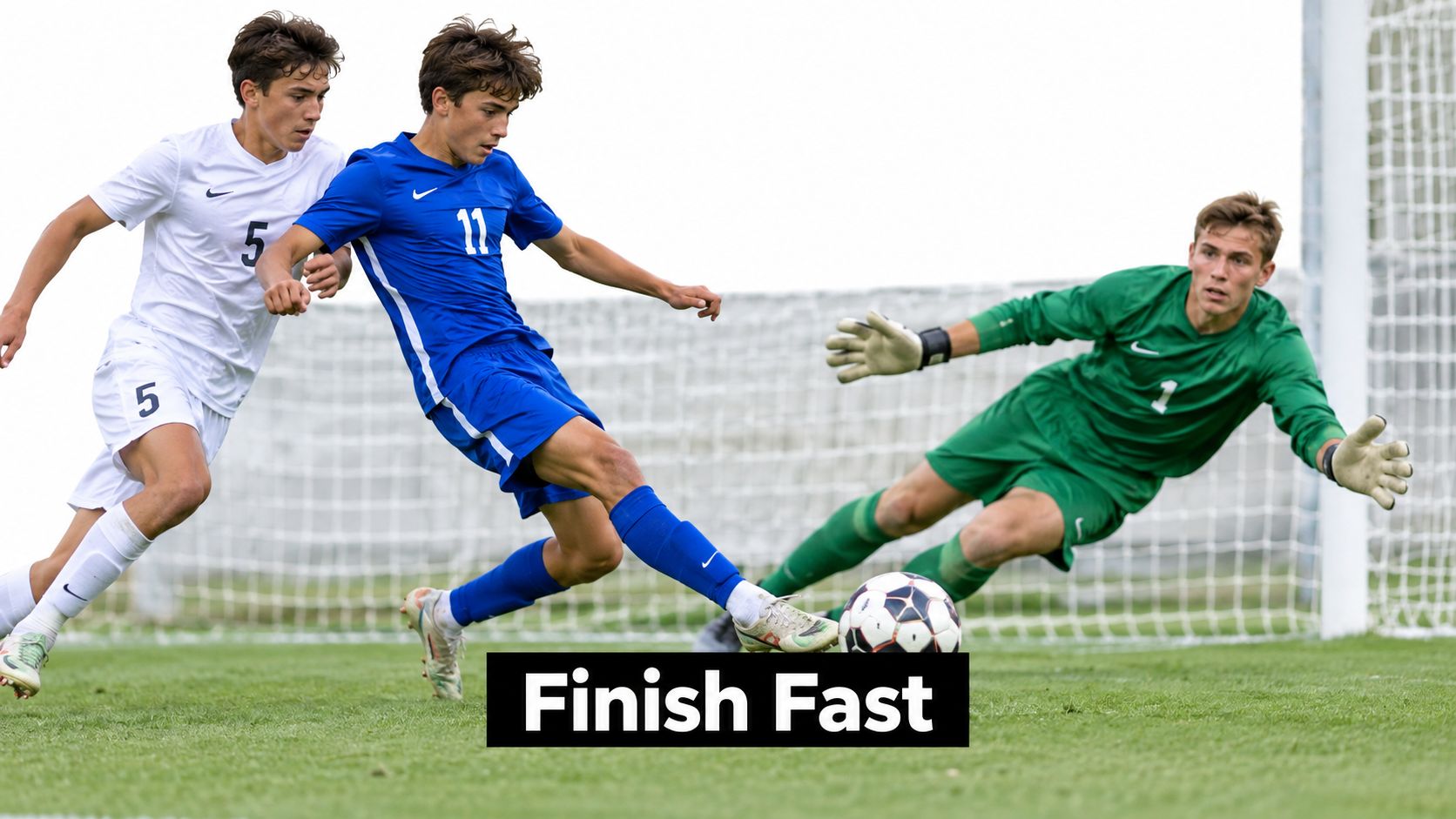
Give attackers a defined space, a goal, and a simple challenge such as creating a shot. Use 1v1, 2v2, or 3v3 formats so players face real defenders without hiding behind a large group. The coach can serve the ball from different angles, start attacks with a pass, or allow the attacker to begin with possession.
The boundaries should be clear, but the solution shouldn't be. A U8 player might use a change of direction, stop-start movement, or a simple pass. A U14 player may disguise a pass, combine with a third player, or attack the defender's blind side. Praise the decision and the courage to try, not only the successful outcome.
Keep freedom connected to the game
Technical creativity: Change direction, manipulate the ball, or use a feint.
Passing creativity: Draw a defender in before releasing the ball to a teammate.
Movement creativity: Make a decoy run or switch positions to disturb defensive organization.
Finishing creativity: Use placement, a first-time finish, or a disguised attempt when the situation allows.
A 2025 study of players aged 12 to 15 found that explicit coach instruction was associated with more cooperative team behavior, while free play and constraint manipulation without instruction produced more individual actions. The practical lesson is not to choose between total freedom and constant stoppages. Use a representative game problem, allow exploration, then give a short cue that clarifies the tactical purpose. The study is discussed in this research on coach instruction, free play, and constraints.
For Villarreal-style development, creativity should serve intelligent attacking. A risky action can be appropriate when it creates a clear advantage. Repeating a trick into a crowded area is not the same thing.
5. Switch Play and Width Creation
Best for: U10 to U18, intermediate through advancedSession role: Breaking a compact defenseSuggested duration: A tactical possession block with directional targets
Divide the field into wide channels and a central area. Play five attackers against three defenders, with the attacking team trying to move the ball from one side to the other before entering a scoring zone. The wide players should hold the field's width, while central players create passing angles and decide whether to circulate, combine, or play forward.
Start without goals if the group needs to learn the spacing. Place a target player in each wide channel and require the ball to travel through one target before the attack can switch. Once players understand the idea, add a goal and allow the attack to finish after a switch, a cutback, or a pass into the box.
The first touch matters. A player receiving on the right side should often take the ball away from pressure and face the next action. The central player must scan before receiving so the switch doesn't become a blind pass into a waiting defender.
Use the switch for a reason
A switch is valuable when the defense has crowded one side, when the far-side player has room, or when the next pass can create a forward entry. It isn't automatically the best choice every time the ball reaches the center.
Older players can work with a tighter touch limit and active defenders. Younger players need more room and more time to recognize the far-side option. Rotate positions so wingers learn central support, central players learn to open the field, and defenders understand how attackers create overloads.
The drill's major strength is its tactical connection to organized attacks. The trade-off is that players can become obsessed with moving the ball side to side. Stop the activity when the team has a clear chance to progress and ask why it didn't take it.
6. Attacking Third Transition Drill
Best for: U11 to U18, intermediate through select playersSession role: Transition attack, wing play, and final passSuggested duration: A demanding block after the technical work is complete
Set up a midfield zone, two wide channels, and an attacking third with a goal and goalkeeper. Begin with a possession team building from the middle. When the defending team wins the ball, it immediately attacks in the opposite direction, using width, an overlapping run, or a quick pass into the final third.
The first touch after the transition sets the tone. Players should look forward before automatically passing sideways. A winger can receive in space, a midfielder can support underneath, and the opposite winger can attack the far post or arrive for a cutback.
For younger players, freeze the activity briefly after a transition and ask where the wide players should be. For older groups, allow the defense to recover fully and require the attack to recognize whether it can counter quickly or must circulate the ball.
Build the final action
Give the attacking team a clear objective, such as finishing after a limited number of passes or creating a shot through a wide entry. Don't turn the drill into a crossing competition. The best final action may be a cutback, a pass across the box, a combination at the top of the area, or a direct finish.
Use goalkeeper involvement once players can deliver under control. Rotate roles so every player experiences the decisions of the ball carrier, supporting midfielder, wide attacker, and recovering defender.
Watch the video below for a visual reference before adapting the activity to your group.
The strength is realism. Players attack with limited time and changing defensive pressure. The trade-off is workload. Repeated sprints, crosses, and recovery runs can reduce technical quality, especially for players in growth stages or those arriving after school sport and club sessions. A recent youth-soccer review highlights how maturation affects neuromuscular responses, perceived exertion, adaptation, and injury susceptibility, particularly around peak height velocity. Read the review on youth soccer maturation and workload management before increasing intensity for an entire age group.
7. Finishing Under Pressure
Best for: U10 to U18, developing through competitive playersSession role: Chance creation, decision-making, and finishingSuggested duration: A focused finishing block with short rotations
Place two attackers against two defenders, starting outside or around the penalty area. Serve the first ball from a central or wide position, then let the attackers combine, run beyond the ball, and finish against a goalkeeper. Vary the service so players face through balls, cutbacks, crosses, and passes from the side.
Younger players can begin with a passive defender and a larger starting area. Older players should face active pressure from the first touch. The attacker with the ball must decide whether to shoot, dribble, combine, or protect the ball. The supporting attacker should create a clear angle rather than standing beside the ball.
The best finish is the one the situation allows. Don't ask every player to hit the ball hard when a calm placement or a quick pass is the better choice.
Coach the details that survive match pressure. Players should take the first touch away from the defender, keep the head up before receiving, and finish with composure. Rotate goalkeepers so the activity stays engaging, but avoid turning the drill into nonstop shots with no recovery or feedback.
Measure the action before the goal
A goal is an important outcome, but it doesn't explain the decision that created the chance. Note whether the player scanned, recognized pressure, selected a sensible finish, and helped the team create a good shooting angle.
A 2022 scoping review of technical-tactical assessments found that complex measures, including decision-making, total performance, and collective attacking behavior, distinguished skill levels more consistently than simple counts of passes, touches, or shots. A useful coaching rubric can score perception, decision, execution, and outcome from 0 to 2, as described in this review of technical-tactical assessment in youth soccer.
For extra guidance on the technical side of finishing, use Villarreal Houston Academy's shooting accuracy resource. The trade-off is volume versus quality. More repetitions help only when players still have enough time to recognize the situation and execute the right action.
8. Pressing Triggers and Counter-Attacking
Best for: U13 to U18, advanced and competitive playersSession role: Organized pressing and immediate attack after recoverySuggested duration: A late-session tactical block for mature groups
Set up a directional game with two goals and clear pressing zones. Before play begins, name the triggers. These might include a poor first touch, a backward pass, a slow pass across the field, a receiver facing their own goal, or a ball trapped near the sideline.
The nearest player presses with speed, but the rest of the team must support the action. One teammate covers the forward pass, another closes the inside lane, and the far side becomes compact enough to prevent an easy escape. If the team wins the ball, the first attacking decision should be forward when the space is available.
Younger players can work with one obvious trigger, such as a backward pass. Older groups should identify triggers during live play and coordinate without waiting for the coach to stop the game.
Press together or don't press
First defender: Arrive under control and show the ball toward the intended side.
Second defender: Close the nearest forward option rather than chasing the ball.
Cover players: Protect the space behind the press and stay connected.
Attacking transition: Look for the first forward pass, dribble, or finish after recovery.
Use verbal communication throughout. Players should call the trigger, cover, and next action. Add a transition finish so pressing has an attacking purpose, not just a defensive one.
The main strength is tactical intelligence. Players learn that pressing isn't running at the ball whenever possession changes. It's a coordinated decision based on field position, pressure, and support. The trade-off is physical and cognitive demand. Don't use this as the main activity for a young group that hasn't developed basic spacing or recovery habits, and don't keep increasing speed when fatigue causes poor technique.
Youth Attacking Drills: 8-Point Comparison
Drill | Implementation Complexity (🔄) | Resource Requirements (⚡) | Expected Outcomes (📊 / ⭐) | Ideal Use Cases (💡) | Key Advantages (⭐) |
|---|---|---|---|---|---|
Attacking Movements & Combinations (One‑Two and Triangles) | Moderate 🔄🔄, needs active coaching | Low ⚡, cones, balls | Timing of off‑ball runs; one‑touch combos 📊 ⭐⭐ | Technical sessions, pattern play, youth progression 💡 | Scalable, match‑applicable, minimal equipment ⭐⭐ |
Small‑Sided Possession with Target Players (3v3+2) | Low 🔄, simple rules and rotations | Low ⚡, small area, few players | Ball retention; tight‑space decisions 📊 ⭐⭐ | Warm‑ups, possession themes, progressive training 💡 | High repetition, realistic pressure, scalable ⭐⭐ |
Progressive Passing Attack (Rondo Progression) | Moderate 🔄🔄, requires structure and coaching | Low ⚡, cones, balls | Patient buildup; progressive penetration 📊 ⭐⭐ | Directional possession, tactical build‑up drills 💡 | Develops strategy, passing range, spatial awareness ⭐⭐ |
Creative Play & Improvisation (Sideshow/Creativity Zone) | Moderate 🔄🔄, needs guided freedom | Minimal ⚡, flexible setup | Creativity, individual problem‑solving 📊 ⭐ | Talent development, motivation sessions, small games 💡 | Encourages invention, confidence, unpredictability ⭐ |
Switch Play & Width Creation (Overload Drill) | Moderate‑High 🔄🔄🔄, tactical timing required | Medium ⚡⚡, space and numbers recommended | Width creation; effective switches and crosses 📊 ⭐⭐ | Flank play, team shape work, tactical sessions 💡 | Teaches switching decisions; varied passing distances ⭐⭐ |
Attacking Third Transition Drill (Wing Play Focus) | High 🔄🔄🔄, complex sequencing | Medium‑High ⚡⚡⚡, players, GK, space | Quick transitions; crossing and finishing under pressure 📊 ⭐⭐ | Match simulation, winger/FB development, finishing practice 💡 | Game‑realistic; multiple scoring opportunities ⭐⭐ |
Finishing Under Pressure (2v2 to Goal) | Low‑Moderate 🔄🔄, simple structure, high intensity | Medium ⚡⚡, goals, GK rotation | Composure and finishing in tight areas 📊 ⭐⭐ | Finishing practice, tryout prep, competitive scenarios 💡 | Direct scoring improvement; high engagement ⭐⭐ |
Pressing Triggers & Counter‑Attacking (Organized Pressing) | High 🔄🔄🔄, tactical nuance and timing | Medium ⚡⚡, good player numbers, conditioning | Pressing intelligence; efficient transitions 📊 ⭐⭐ | High‑intensity tactical sessions, senior youth, match prep 💡 | Builds coordination, transition efficiency, fitness ⭐⭐ |
Building a Season Plan Around These Attacking Drills
A good attacking curriculum doesn't use all eight drills every week. It gives players repeated exposure to the same principles while changing the problem, the space, the pressure, and the expected decision. The session should feel familiar enough for players to improve, but variable enough that they can't rely on memorized movements.
For U8 to U10, begin with movement, simple combinations, and small-sided possession. Use one-two patterns, triangles, target-player games, and creative 1v1 situations. Keep instructions short and demonstrate the action. At this stage, a player may need help seeing a teammate or recognizing space, but the practice should still include choices rather than turning every attack into a scripted route.
U10 to U12 players can handle more directional work. Add progressive passing, width creation, and small transition games once they can receive and pass under moderate pressure. Finishing should follow the attack, not sit apart from it. Ask players to create the shot through a run, pass, dribble, or switch before they finish.
U13 to U16 players can begin solving more complex problems. Use active defenders, recovering opponents, pressing triggers, and varied final-third scenarios. A 3v3 format can increase responsibility, while a 6v6 format can introduce more complex positional and combination problems. The best choice depends on whether the session needs individual involvement or collective organization.
For U16 to U18 players, connect every activity to match demands. A pressing drill should lead into a counterattack. A switch should create a final-third entry. A finishing exercise should begin with a realistic decision, not a stationary shot. Older players should also learn to manage tempo, recognize when to attack quickly, and understand when possession must stabilize the team.
Track decisions across several sessions
Coaches shouldn't use one session's totals as a player development verdict. In a controlled study of players averaging 10.1 years old, 3v3 produced more individual technical actions than 6v6, but session-to-session variation was high. The study reported variation of 52.2% for received balls, 133.8% for conquered balls, 80.1% for lost balls, and 90.1% for attacking balls and shots. The study of technical actions and variability in small-sided games supports comparing players under consistent rules and field dimensions across multiple sessions.
Use a simple observation record:
Perception: Did the player scan before receiving?
Decision: Did the player choose a sensible pass, dribble, or finish?
Execution: Did the first touch and technique support the decision?
Advantage: Did the action create a numerical or positional benefit?
Sequence: Did the player continue supporting the attack after the first action?
Keep the physical plan just as individual. Players mature at different rates, and a growing player may need reduced sprinting or contact volume without being removed from meaningful attacking work. Structured neuromuscular warm-ups, strength-focused prevention, recovery, and communication about pain or unusual fatigue belong inside the season plan.
For the next training block, choose two or three drills, not all eight. Pair one foundation activity with one directional game and one end-product exercise. For example, use combinations, progressive passing, and 2v2 finishing for an older group, or possession, creative 1v1s, and a small-sided game for younger players. Then review whether players are making better attacking choices, not only whether they're scoring more goals.
Families in Humble, Fall Creek, Cypress, Tomball, and the Kingwood, Porter, and New Caney area can also review the current teams, clinics, camps, and training options offered by Villarreal Houston Academy at villarrealhouston.com.
Villarreal Houston Academy offers age-appropriate youth soccer programming for boys and girls from age 4 upward, including teams, camps, clinics, and tryouts across North Houston. Visit Villarreal Houston Academy to explore training that connects technical skill, attacking decisions, tactical understanding, and character development through the Villarreal CF methodology.
Comments