


Youth Soccer Academy Teams: A Complete Guide for Parents

A Saturday morning in Greater Houston can make every parent question the next move. Your 7-year-old is drifting across the field, chasing the ball instead of holding shape, while another parent talks about academy tryouts and professional pathways. You may be wondering whether the drills are building useful habits or just filling another weekend.
The right youth soccer academy team isn't defined by a polished logo or an expensive kit. It should give your child a structured development environment, qualified coaching, honest feedback, safe training loads, and a pathway that respects both ambition and family reality. The best decision isn't automatically the most competitive option. It's the program that fits your child's stage, your household's capacity, and the kind of soccer experience you want to sustain.
What Youth Soccer Academy Teams Actually Are
A youth soccer academy team is a long-term player development environment. It isn't just a select team with a professional-looking badge, and it isn't a collection of extra practices added to a normal club schedule. A genuine academy uses a deliberate methodology to develop technical ability, tactical understanding, physical literacy, character, and decision-making over time.
European academy systems offer a useful reference point. UEFA's Elite Youth Player Development Programme began in the 2014–15 season and initially used pilot projects to support players' technical, educational, and personal development. In participating countries, approximately 40–50 young footballers per year completed apprenticeships in youth academies, and UEFA reported that an estimated 60–75% later represented national Under-15, Under-16, or Under-17 teams, with some receiving professional contracts. The programme eventually expanded to all 55 UEFA national associations. UEFA's programme overview shows the central lesson: academy development is a connected pathway, not a promise of professional employment.
Three features parents should verify
A written curriculum should explain what players work on at each development phase. A young player might begin with ball familiarity and movement, then progress toward receiving under pressure, scanning, combination play, and tactical decisions. Ask to see the curriculum rather than accepting broad language about “elite training.”
Qualified coaches should understand both the club methodology and the needs of growing athletes. Coaching quality matters more than the language used in marketing materials. Ask who designs sessions, who observes coaches, and how the academy supports continuing education.
A player feedback loop turns training into development. The academy should maintain a player profile or equivalent record covering strengths, priorities, attendance, wellbeing, and progression goals. Families should know how often feedback is shared and who answers questions when a player's role changes.
Academy rosters are usually formed through evaluation rather than open sign-up. Training follows a seasonal plan, and families commit to a development arc that may extend across several seasons. That makes the kit secondary. If your family wants distinctive team apparel for tournaments or global merchandise projects, a resource such as this pinstripe jersey for global merch teams may help with design inspiration, but clothing doesn't create an academy environment.
Practical rule: Ask what your child will learn next, how coaches will measure it, and what happens when progress slows.
Academy Teams vs Club and Rec Programs
No program type wins for every child. Recreational soccer may be exactly right for a child who wants movement, friends, and basic ball skills. Select club soccer suits a player who wants regular competition but still needs a flexible family schedule. Academy teams make sense when the player wants a more deliberate pathway and the household can support the commitment.
Factor | Recreational | Select Club | Academy Team |
|---|---|---|---|
Coaching qualifications | Varies widely, often volunteer-led | Mixed, with paid and volunteer structures | Defined coaching standards tied to a methodology |
Selection process | Usually registration-based | Evaluation or open assessment | Formal evaluation and roster selection |
Training pattern | Flexible and seasonal | Regular competitive schedule | Planned development across training and competition cycles |
Season length | Usually limited to a season | Often extends across multiple parts of the year | Designed around a longer development pathway |
Travel expectations | Usually local | Local and regional, depending on level | May include regional, national, or international opportunities |
Cost structure | Lower and easier to predict | Higher, with competition-related expenses | Varies widely and can include extensive travel costs |
Development goal | Enjoyment, movement, and fundamentals | Competitive growth and stronger match experience | Long-term technical, tactical, and personal development |
Choose by fit, not status
A recreational program is the sensible starting point for many younger children, especially if they're still deciding whether soccer belongs in their weekly routine. Parents should resist treating a casual beginning as a missed opportunity. Early enjoyment, coordination, and freedom to experiment create useful foundations.
Select club teams offer a middle path. They can provide more demanding practices, stronger opponents, and a clearer competitive rhythm without requiring the full structure of an academy. The quality gap between clubs can be large, so evaluate the actual coach and schedule rather than relying on the label.
Academy teams should earn their higher commitment. Look for age-specific planning, consistent technical language across teams, meaningful player reviews, and a clear policy for playing time, movement between groups, injuries, and family communication.
The U.S. player pool is enormous. U.S. Youth Soccer cites approximately 3.9 million soccer participants, nearly 1 million high-school students playing soccer in grades 9–12, and about 2,600 collegiate soccer programmes. It also states that fewer than one-half of 1% of children who play soccer ultimately play professionally. The U.S. Youth Soccer participation summary supports a parent-side conclusion: professional ambition can be welcome, but a healthy program must define success more broadly.
The Development Pathway from First Touch to Elite
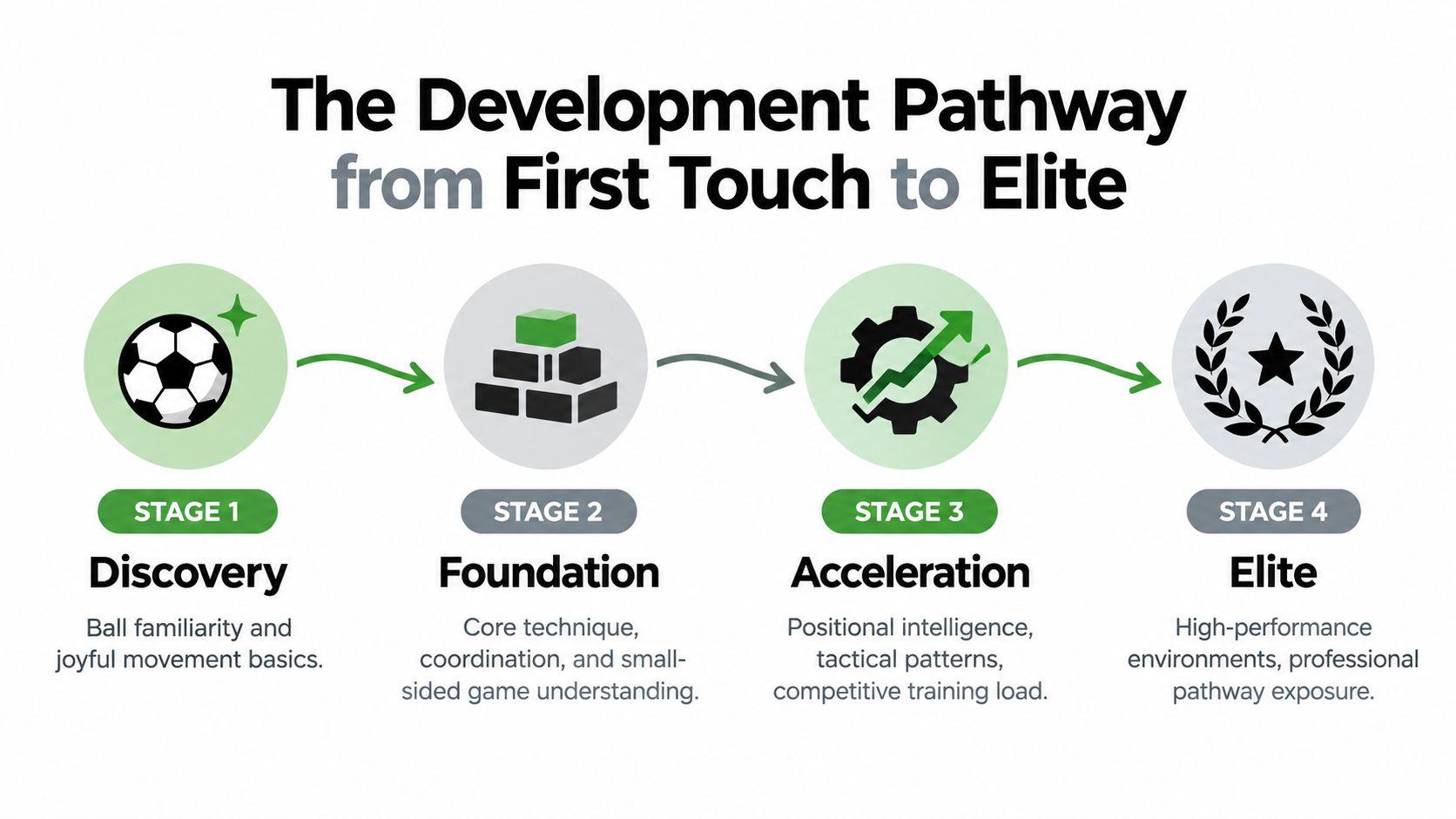
A strong academy doesn't force every child through the same age checklist. It moves players through stages according to demonstrated competence, learning needs, confidence, and biological development. Two children born in the same year may need very different training priorities.
Discovery
The discovery phase is about ball familiarity, movement, and enjoyment. Players learn how the ball reacts, how to change direction, how to stop and start, and how to use space. Coaches should create frequent contact with the ball and small games that invite curiosity. At this stage, a child who wanders, experiments, or makes unexpected choices may be learning more than a child who follows instructions perfectly.
Parents should judge this phase by engagement and growing comfort, not by position or match statistics. A young player doesn't need a permanent role before learning the game.
Foundation
The foundation phase introduces core technique in game-like situations. Players develop first touch, passing, dribbling, turning, shielding, coordination, and basic defensive habits. Coaches begin to notice preferences and strengths, but they shouldn't lock a child into one position just because the player is physically advanced or unusually fast.
Here an academy's curriculum becomes visible. A session should connect technique to decisions, not isolate ball exercises from the realities of a match.
Acceleration
Acceleration brings more tactical responsibility. Players learn to scan before receiving, recognize pressing cues, support teammates, manage space, and adjust their intensity. Positional intelligence starts to matter, but flexibility still matters more than early specialization.
Growth can temporarily change how a player moves. The academy must adjust expectations rather than treating a temporary coordination problem as a permanent decline. The research on academy players shows why: injury patterns differ across growth phases, and fixed age-group assumptions can overlook individual maturation. The academy maturation study supports tracking growth and adapting workloads instead of selecting players only by chronological age.
Elite
The elite phase connects high-performance training with stronger competition, showcase opportunities, collegiate environments, and, for a small group, professional pathways. It should still include education, recovery, communication, and personal responsibility. A player isn't ready for this phase merely because a parent wants a more prestigious roster.
Late development isn't failure. A responsible academy keeps evaluating players whose physical growth and confidence arrive later.
Parents should ask how players move between stages, how coaches identify late bloomers, and whether a player can receive additional support without being pushed into excessive competition. A useful resource on age-appropriate progression is this guide to soccer development by age.
How Tryouts Work and How to Prepare
Tryouts reveal more than a player's highlight skills. Coaches want to see how a child behaves when the ball isn't at their feet, whether they can process information quickly, and how they respond after a mistake.
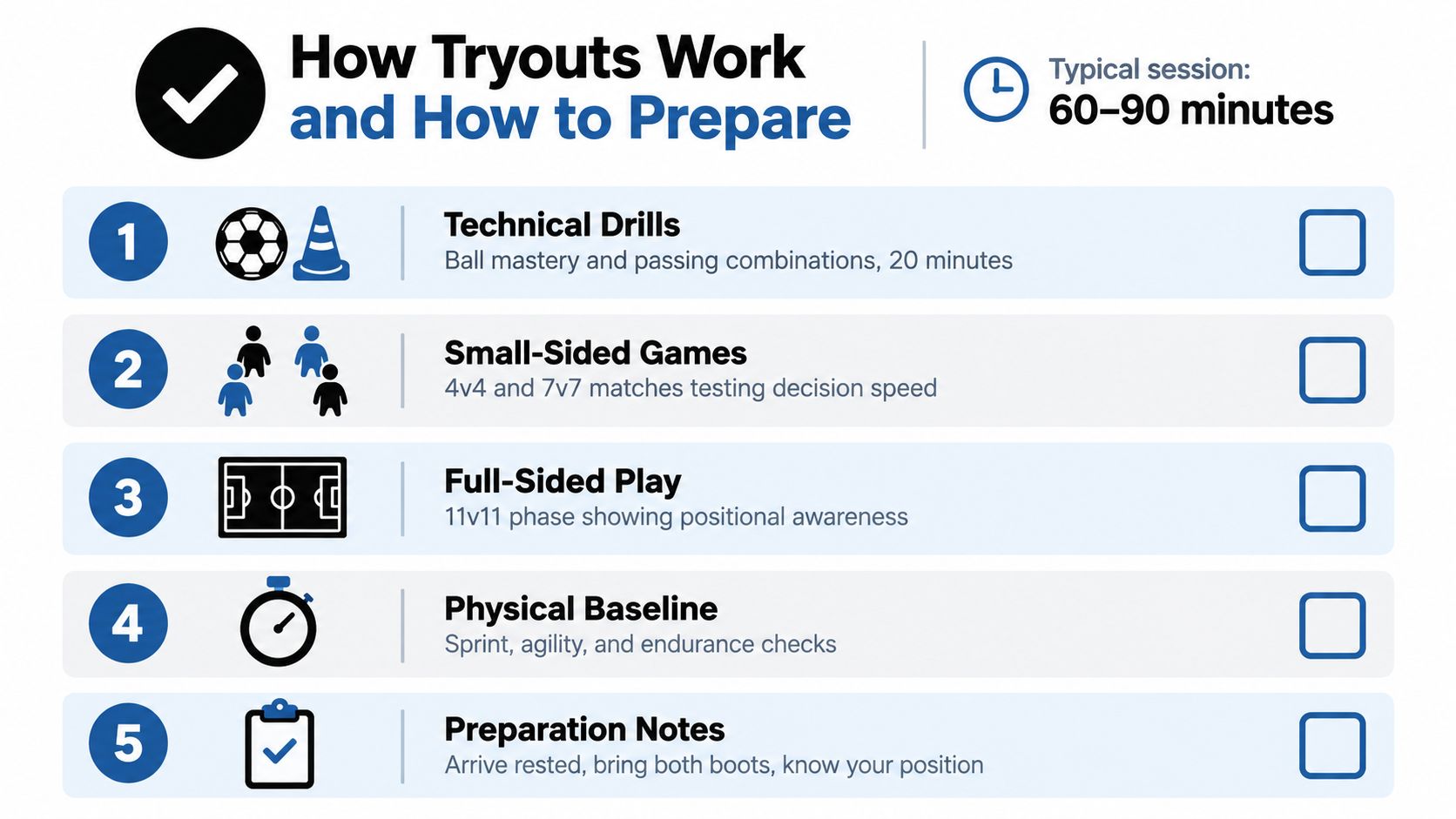
A typical academy assessment combines technical work, small-sided games, and larger match play. The technical portion may include ball mastery, passing, receiving, turning, and finishing. Small-sided play exposes decision speed and involvement. Larger games show positioning, awareness, work rate, and whether the player can transfer technique into a more complex environment.
Prepare the player, not a performance
During the weeks before an evaluation, prioritize consistency over dramatic extra training. Let the player practice receiving with both feet, passing against a wall or with a partner, dribbling under control, changing direction, and looking up before making a decision. Short, focused work is more useful than exhausting sessions that create soreness or anxiety.
Nutrition should stay familiar. A normal meal with enough time to digest, regular hydration, and a good night's sleep are more sensible than an unfamiliar supplement or a last-minute conditioning challenge. Parents should also avoid turning every practice into a trial. The child needs freedom to play.
Use a simple tryout-day checklist
Equipment: Bring shin guards, suitable boots, a properly inflated ball if requested, and water.
Arrival: Build in enough travel time to check in calmly and hear the coach's instructions.
Communication: Tell the player to ask questions, acknowledge teammates, and respond positively to correction.
Effort: Sprint to recover, move after passing, and stay engaged when the ball is on the other side of the field.
Composure: A mistake followed by a useful action often tells evaluators more than a successful trick.
Evaluators commonly assess technical competence, tactical understanding, physical readiness, coachability, resilience, and positional suitability. They don't need a child to dominate every moment. They need evidence that the player can learn, compete, and contribute.
The academy's own process matters too. Before attending, ask whether players receive feedback, how roster decisions are communicated, whether a second evaluation is possible, and what the family is committing to if an offer arrives. This youth soccer academy tryouts guide can help parents prepare questions before the session.
The Year Round Training Question
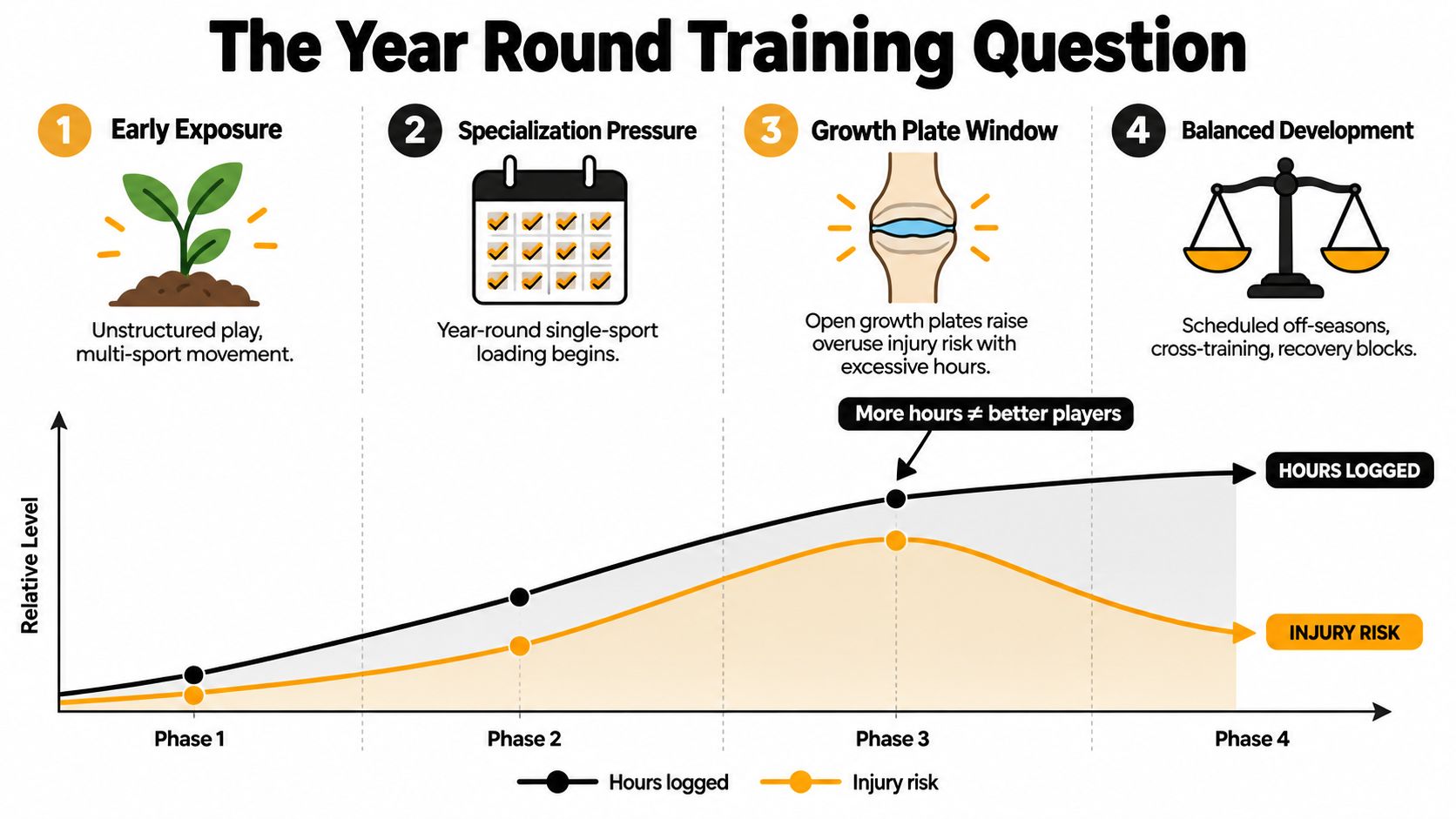
More soccer isn't automatically better soccer. A child can accumulate hours while losing creativity, sleep, motivation, and physical freshness. The serious question is whether the training load matches the player's age, growth, school demands, other sports, and recovery capacity.
Sports-medicine evidence links higher specialization with overuse and lower-extremity injury risk, while professional organizations generally support multisport participation for young athletes. Soccer-specific evidence adds an important qualification. A prospective study of 80 youth players found no injury-incidence difference between specialized and multisport athletes after accounting for training load. The practical conclusion is clear: coaches should monitor the total workload instead of treating “specialized” as the only risk factor. The specialization and injury evidence supports a balanced policy.
What a responsible academy monitors
Coaches should record training and match exposure, soreness, missed sessions, mood, and changes in movement. They should know when a player is growing rapidly and adjust sprint volume, high-speed running, strength work, recovery, and match exposure accordingly.
A structured injury-prevention routine should include landing mechanics, deceleration, balance, dynamic strength, and change-of-direction control. A 2025 systematic review and meta-analysis associated structured prevention programs with an estimated 35–39% reduction in injury risk among youth players. The systematic review on youth soccer injury prevention gives academies a strong reason to make this work routine rather than optional.
Questions that expose a weak schedule
Ask whether the calendar includes genuine recovery periods. Ask how the coach handles a player who also participates in another sport. Ask who makes return-to-play decisions after an injury and how the academy supports emotional wellbeing.
A schedule that runs continuously for most of the year without meaningful breaks deserves scrutiny. The best academies protect training quality, not just attendance. They create enough challenge to improve players while preserving the desire to return tomorrow.
What Playing on an Academy Team Actually Costs
A Houston family can accept an academy roster spot and still underestimate the commitment. The registration fee is only one line in the budget. Plan for uniforms, training clothing, tournament expenses, travel, private sessions, transportation, replacement gear, and the time required to reach practice fields across the metro area.
Recent U.S. data found that families spent an average of $910 on youth soccer in 2024, compared with $537 in 2019, while participation among children ages 6–12 fell 5.5% between 2013 and 2023. The report on rising youth soccer costs shows why parents should request an all-in budget instead of comparing team fees alone. Competition-related expenses can push annual soccer spending far above the registration charge, particularly for families managing travel and extra training.
Expense Category | Low Estimate | High Estimate |
|---|---|---|
Broad U.S. family spending reference | $537 in 2019 | $910 in 2024 |
Competitive soccer budget reference | $6,000 annually | $12,000 annually |
Academy-specific total | Request a written estimate | Request a written estimate |
These figures are reference points, not a quote for a Houston academy. Your cost will depend on age group, roster level, tournament calendar, travel distance, and what the club includes. For a detailed breakdown of typical inclusions, review this guide to soccer academy fees.
Build the budget line by line
Request separate figures for registration, uniforms, training kits, league fees, tournament fees, coach travel, video services, goalkeeper training, private instruction, and transportation. Ask whether a warm-up jacket, team photos, video access, or skills sessions are required or just optional.
Travel needs its own discussion. A family may handle local league play comfortably, then face flights, hotels, meals, and missed work when showcases enter the schedule. A lower registration fee does not guarantee a lower family cost.
Before committing, ask for:
A written fee schedule: Confirm due dates, deposits, refunds, and late-payment rules.
Financial assistance: Ask about scholarships, payment plans, sibling discounts, and documentation.
Travel expectations: Request likely destinations and the notice families receive.
Optional spending: Separate recommended extras from mandatory expenses.
Exit terms: Clarify what happens after an injury, relocation, or financial change.
An academy that will not explain the full cost clearly is showing a communication problem, not merely an accounting problem.
How the North Houston Academy Model Works
Families evaluating a European-style academy in North Houston should translate methodology into daily reality. The model described by the local partner academy connects its programming to Spain's Villarreal CF, serves boys and girls from age 4 upward, and provides competitive team opportunities for players in the 10–18 range. It also offers age-group programming, camps, clinics, assessments, and pathways that can include training and playing opportunities in Spain.
The useful question isn't whether a European club name appears on a website. Ask how the methodology changes a Tuesday session in Humble, Fall Creek, Cypress, Tomball, Kingwood, Porter, or New Caney. Parents should look for consistent coaching language, age-appropriate objectives, positive engagement, and clear communication about what happens between assessment, training, and roster selection.
Translate the offer into family logistics
The academy's development groups serve younger players, while performance teams support older competitive players. Exact training frequency should be confirmed for the individual roster because schedules change by age, facility availability, competition level, and season phase.
Age Group | Training Frequency | Session Focus | League Play |
|---|---|---|---|
U6–U8 | Confirm the current age-group schedule | Ball familiarity, movement, confidence, and small-sided play | Developmental games and local opportunities |
U9–U12 | Confirm the current team calendar | Technical foundation, coordination, decision-making, and game understanding | Competitive local and regional play |
U13–U18 | Confirm the performance-team schedule | Tactical intelligence, position-specific growth, competition preparation, and recovery | Competitive league play, showcases, and selected travel |
The published model includes qualified coaching, structured development, goalkeeper-specific work, video review, and parent communication. Parents should verify which services are included in the team fee and which require an additional charge. They should also ask how often coaches share player feedback, whether sports-psychology support is available, and how injuries affect training and match selection.
Ask for the calendar before the sales conversation ends. A family can evaluate a fee only after seeing the practice locations, match commitments, travel pattern, and communication rhythm.
A trial or assessment should be transparent and pressure-free. Ask whether the player can train before committing, how the staff evaluates fit, and what happens if the academy recommends a different group. You can also use an AFC Champions shirts design guide for general football apparel ideas, but team clothing should never distract from the substantive questions about coaching, cost, safety, and progression.
Choosing the Right Academy Team for Your Family
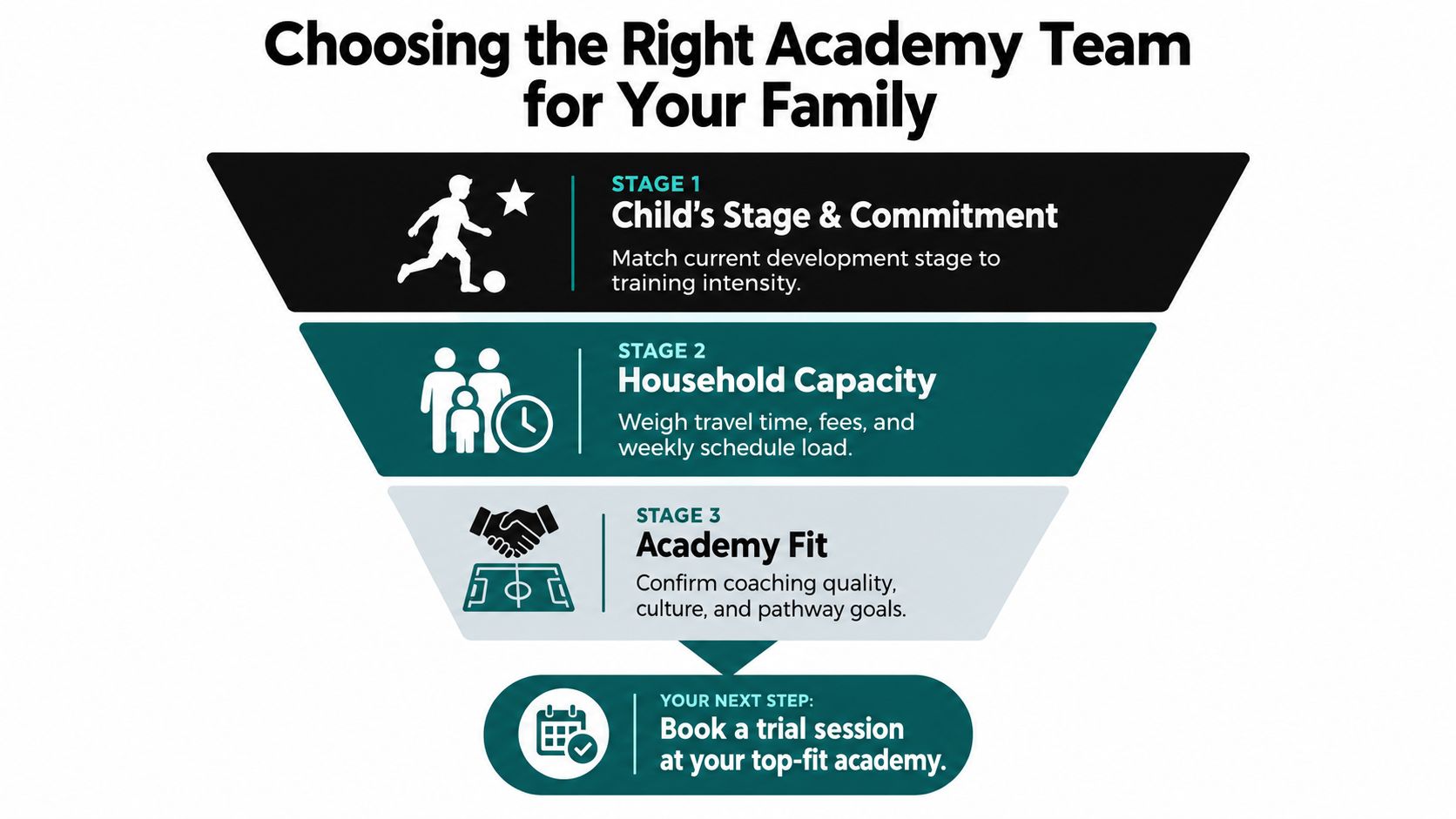
Use three filters, in order.
First, assess the child. A curious 5-to-7-year-old who still needs joyful ball time may be better served by a developmental environment than a high-pressure competitive roster. A player already seeking stronger opponents, regular feedback, and more demanding training may be ready for select club soccer. An older athlete pursuing collegiate or professional opportunities needs a documented performance plan, not promises.
Second, assess household capacity. Add every cost, including travel, equipment, private sessions, transportation, and missed work. Then review the weekly calendar. A program that looks ideal on paper becomes a poor choice if the drive creates constant lateness, family conflict, or skipped recovery.
Third, assess academy fit. Ask to see the curriculum, coach qualifications, player feedback process, injury-prevention policy, maturation policy, financial-assistance options, and full competition calendar. Watch a session. Notice whether coaches teach decisions or just shout instructions, and whether players look engaged when they aren't winning.
A good decision tree is simple:
Rec-first: Choose a flexible developmental program if your child is exploring the sport.
Club-ready: Choose select club soccer if your player wants stronger competition and your family needs moderate flexibility.
Academy-bound: Choose an academy if the player wants a long-term pathway and the program can explain its methodology, costs, workload, and progression standards.
Don't choose based on the badge alone. Choose the environment your child can sustain and your family can understand.
Villarreal Houston Academy offers age-group programming, competitive teams, camps, clinics, assessments, qualified coaching, and access to North Houston training locations, with pathways that can include international training opportunities. Visit Villarreal Houston Academy to review the current trial options and ask the questions that will determine whether the program fits your player's stage and your family's schedule.
Comments