


Sports Psychology in Soccer: A Youth Player's Guide

Your player comes off the pitch after a training shootout, pulls the hood of their jacket up, and says nothing for the first ten minutes of the drive home. They missed the last penalty. Nobody is injured, nobody shouted, and the afternoon still feels ruined.
That gap between what happened and how it lands is where sports psychology in soccer does its work. Not in a speech about attitude, and not in a poster of a lion. In the ordinary business of helping a young player understand what their nerves are doing and what to do about it next Tuesday at training.
Sports psychology in soccer studies how a player's thoughts, emotions and relationships shape what happens on the pitch, then trains those skills the way a coach trains a first touch: little and often, inside normal practice. It's a teaching job, not a rescue job.
What Sports Psychology Covers in Soccer
The field has a measurable shape, and it's wider than most parents expect. A 2022 systematic review of 66 studies on soccer and futsal players found that soccer accounted for 47 of the reviewed articles, or 71.2% of the total evidence base, with futsal contributing 19 and a single study covering both sports. Inside those soccer studies, anxiety was the most investigated construct with 12 studies, ahead of stress with 9, coping with 7 and motivation with 6.
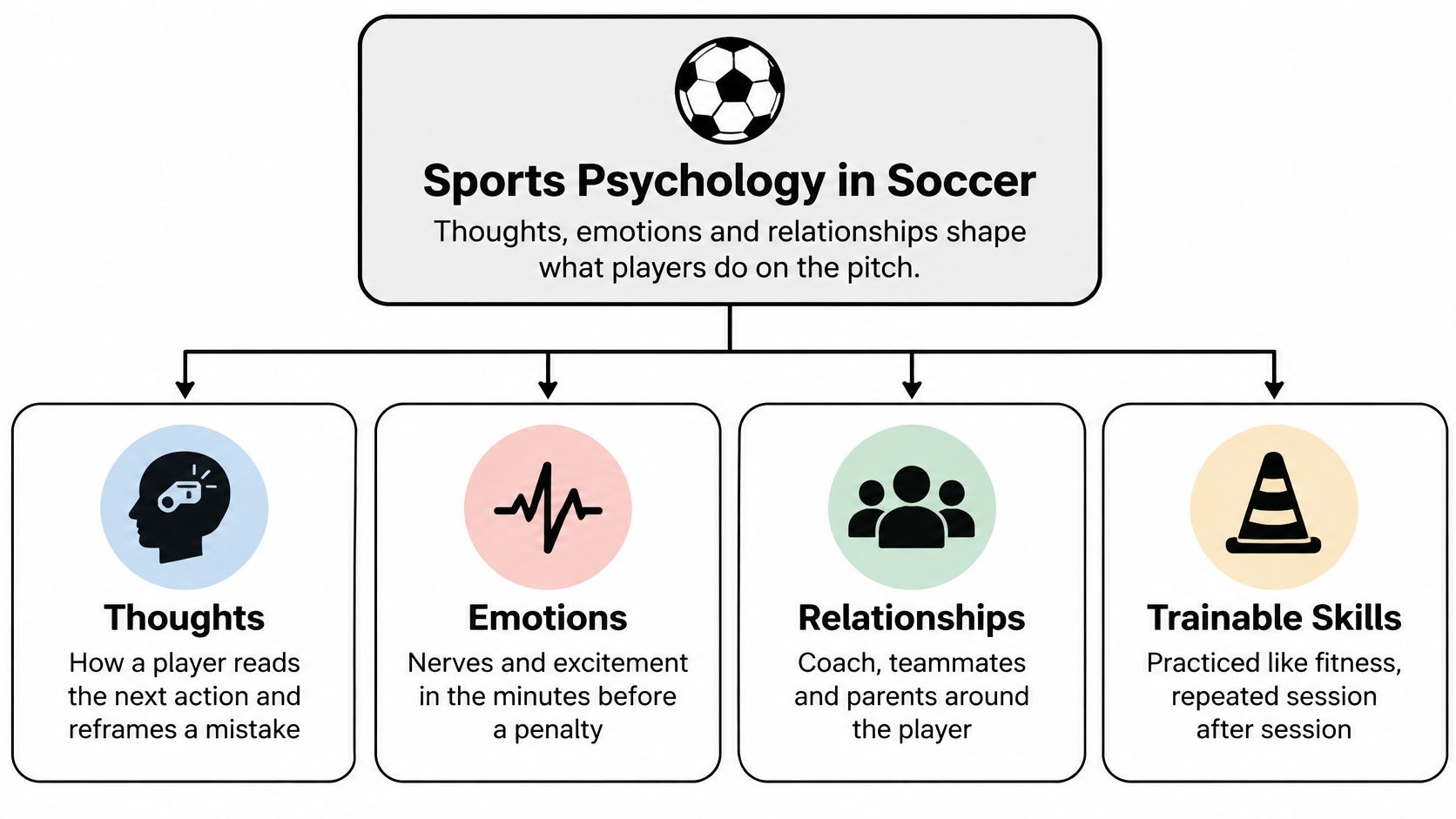
The list continues past anxiety and stress, and that's the part worth reading twice. Group cohesion appeared in 5 soccer studies, motivational climate in 4, depression in 4 and mood in 4. This isn't a wardrobe of pre-match pep talks. It studies how players carry evaluation pressure, setbacks, teammates and their own changing emotions across a whole season.
Here's the map, with a youth example you'd recognise in each row. Every count comes from the same 2022 review.
Construct | Soccer studies (2022 review) | Youth example |
|---|---|---|
Anxiety | 12 | Freezing on a penalty in a training shootout |
Stress | 9 | Worry after being dropped from the starting line-up |
Coping | 7 | Recovering quickly after a lost ball leads to a goal |
Motivation | 6 | Wanting to keep training after a disappointing tryout |
Group cohesion | 5 | Trusting teammates to cover during a high press |
Motivational climate | 4 | Team focusing on effort and learning rather than only the scoreline |
Depression | 4 | Persistent low mood after repeated losses |
Mood | 4 | Day-to-day emotional state around matches and school |
Why anxiety and stress dominate the research
A player's mind runs like a dashboard with many gauges going at once. Confidence, arousal, focus, mood and belonging all move independently, and one needle in the red doesn't tell you what's wrong with the engine. Anxiety and stress lead the count because they're the gauges that move fastest in competitive youth soccer, where selection, playing time and tryouts are decided by adults watching.
The working rule: a nervous player isn't a broken player. They're a player whose dashboard needs a reading, and reading it is a skill you can teach.
The review's own conclusion points the same way for youth development. Psychological skills belong in everyday coaching rather than being held back as an emergency intervention. Age-appropriate work on confidence, emotional regulation, concentration and coping sits alongside technical and tactical training, not instead of it.
How to Build a Pre-Kick Routine for Pressure
What happens in the brain when a penalty goes wrong
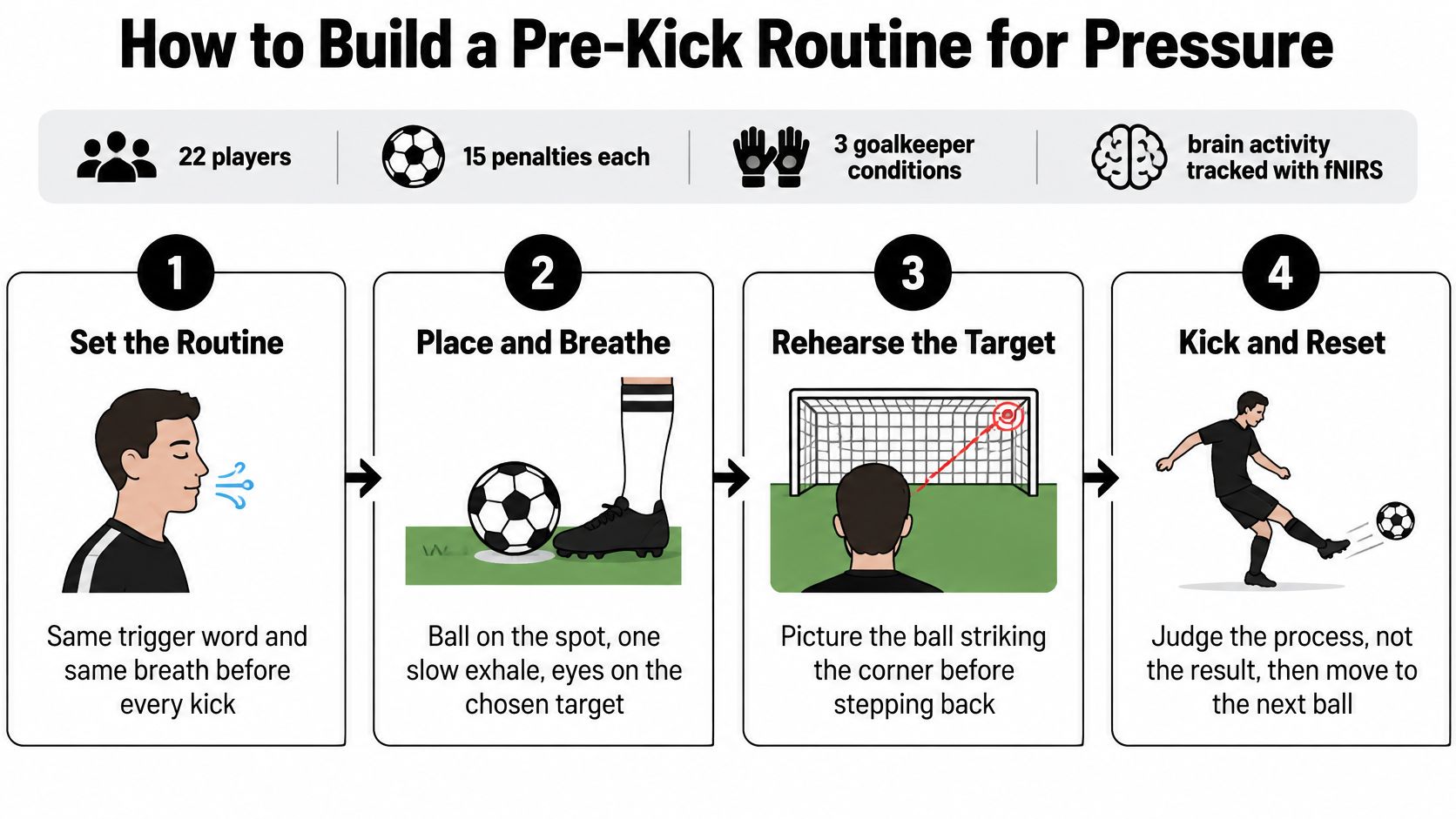
In an in-situ fNIRS study of penalty taking, 22 soccer players each took 15 penalties under three conditions: no goalkeeper, an amiable goalkeeper and a competitive goalkeeper. Anxiety and missed kicks were associated with greater activation of task-irrelevant prefrontal regions, while successful, non-anxious execution showed stronger activation in the motor cortex. Among experienced players, anxiety-related increases in the left temporal cortex suggested excessive self-instruction, an internal voice narrating a movement that should be automatic.
Translation for the parent standing behind the goal: the harder your child tries to supervise their own leg at the moment of contact, the less leg they have. The fix isn't a calmer personality. It's a routine that fills the mind with the right cues, so the wrong ones have nowhere to sit.
The six-step routine
Choose it in training, not in the shootout. Build the sequence during an ordinary session, then run the identical version in every small-sided game and simulated shootout. Novelty is the enemy under stress.
Take two slow breaths after the signal. Controlled, unhurried, nose in and mouth out. This is the only part of the sequence that buys you time to think.
Pick the target before the approach. One specific zone, chosen while you're still walking to the ball. Decide early and stop shopping.
Say one action cue out loud or in your head. Something like "through the middle of the ball" or "low to the keeper's left." One cue, never three.
Commit and strike without rechecking your technique. The run-up is a decision already made. Changing your mind at the last step is the miss.
Reset before the next kick. Walk away, breathe once, find the target again. Carry nothing forward.
Building pressure in stages is what makes this stick. Start with scored small-sided games, move to simulated shootouts, add time constraints, then add supportive evaluation with a coach watching. A ten-year-old in a training shootout with a teammate counting down from five will rush the first attempt every time. The routine gives their hands and their breath somewhere to go.
Starting it over the next four weeks
Rehearse the sequence three times a week for four to six weeks. One breathing cue before tryouts is enough to begin with. Consistency matters more than volume.
Begin where nothing is at stake. A free-kick drill with no scoreboard, then a scored drill, then a simulated shootout. Each step up in pressure should feel small.
Log two numbers after every session. Preparation time from signal to strike, and your child's own 0-to-10 anxiety rating. Two numbers, thirty seconds.
Tell the coach the cue. If the words in training differ from the words in matches, the player is learning two routines and keeping neither.
If your child needs help finding a breath pattern they'll use, this breathing guide for parents from Children Psych walks through simple exercises you can rehearse at home before practice. Pair that with visualization work so the target-selection step becomes a picture rather than a thought, and the routine carries a clear image into the run-up.
The objective was never to remove nerves. It's to stop attention drifting toward consequences and mechanics at the exact moment of contact.
Tracking Pressure Control Across Training
Timing is the cheapest pressure marker a coach can record. An analysis of international shootouts from the University of Groningen research repository examined 366 penalty kicks taken by 296 players in World Cup, European Championship and UEFA Champions League shootouts. Longer intervals between the referee's ready signal and the kick were associated with more goals. Shorter self-imposed response times were associated with more misses, and the researchers read rushed execution as a possible attempt to escape emotional distress.
That reframes the rushed kick. It usually isn't impatience or a lack of focus. It's a player trying to get an uncomfortable feeling over with, which is exactly what a routine is designed to interrupt.
The coachable piece is the preparation window: breath control, visual target selection, approach alignment, commitment to the chosen technique, in that order. Resist standardising it to a fixed number of seconds. Excessive delay breaks rhythm as surely as a sprint does, so the window should be built around the individual player, then held steady.
What to praise: the routine showing up under pressure, not the goal that follows it.
Reading the trend, not the single session
Film each pressure trial, then log four things: seconds from signal to strike, shot location, outcome and the player's own anxiety rating before the kick. Do this across four to six weeks rather than one good afternoon. You're looking for steadier timing and fewer rushed attempts, which is a different question from whether the ball went in.
Marker | How to record it | Sign of progress |
|---|---|---|
Preparation time | Seconds from the referee signal to the strike, timed on video | Steady timing across trials, not simply faster |
Shot outcome | Goal, save or miss for each trial | Conversion under pressure closer to unpressured conversion |
Self-rated anxiety | Score from 0 to 10 before each trial | Lower or steadier scores over four to six weeks |
Routine completion | Yes or no for each pre-kick step | Routine completed on nearly every attempt |
Shot location | Target zone chosen before the approach | Deliberate, varied target choices |
The benchmark is consistency under stress, not the fastest kick or the best unpressured conversion rate. For younger players the same logic transfers to free kicks, one-on-ones and late-game decisions, where a deliberate sequence keeps avoidance-driven rushing out of the picture without flattening natural technique.
How Confidence, Focus and Resilience Work on the Pitch
Confidence works like a bridge, which is rated for a known load because someone calculated and tested it. A player believes they can receive on the half-turn under pressure because they have done it three hundred times. That is a structure built from evidence, rep by rep, and it holds up on match day for the same reason a bridge holds up under traffic.
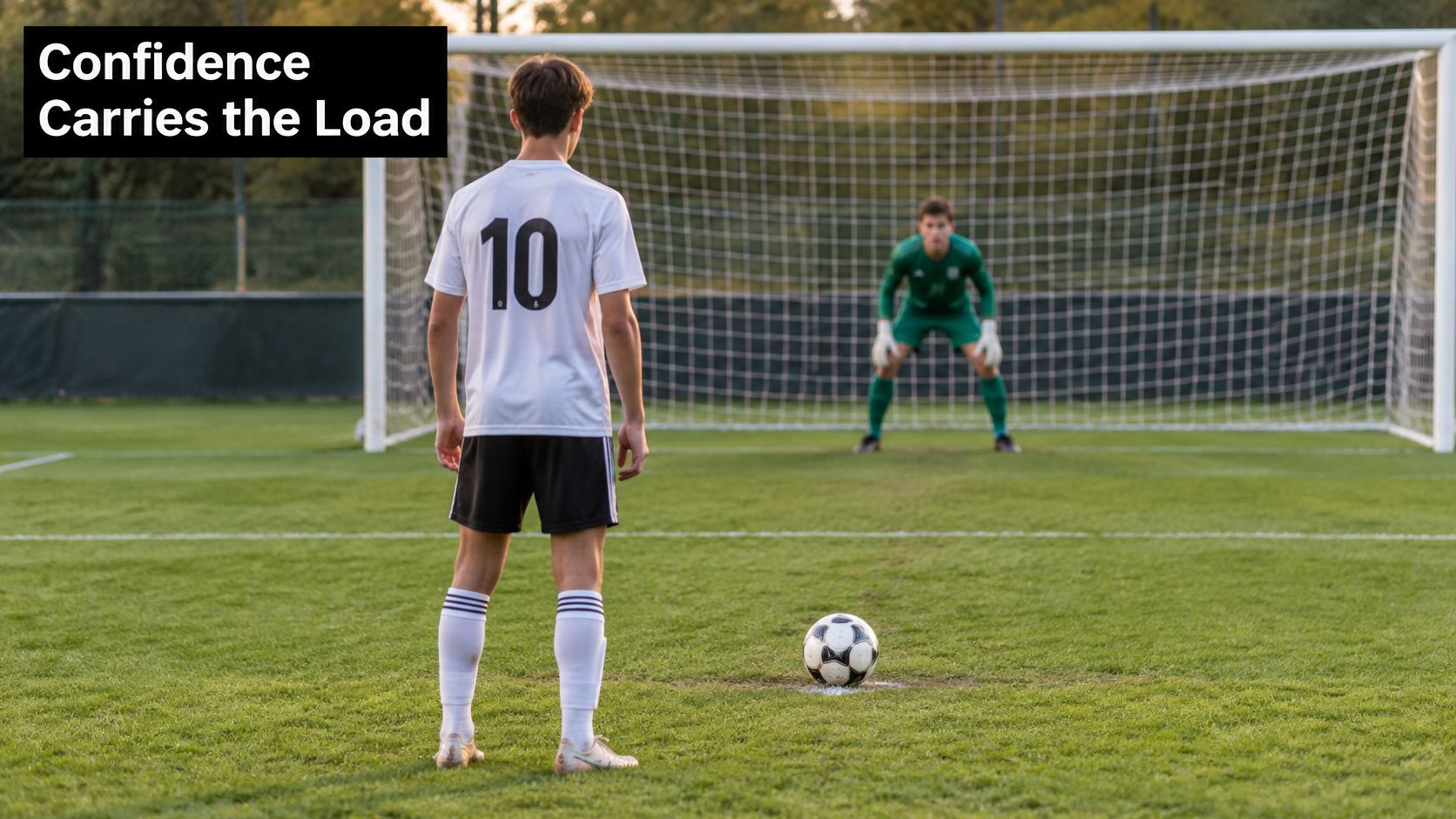
Focus behaves like a torch beam. Pointed well, it lights the runner's shoulder, the space behind the full-back, the goalkeeper's planted foot. Swing it toward the scoreboard, the sideline or last week's mistake and everything useful goes dark. Resilience is a spring. The player takes a hit, loses shape briefly, then recovers it, and that recovery is what teammates feel.
What the training studies measured
These are more than metaphors. In a 2016 psychological-skills intervention study, athletes who completed a 12-week psychological-skills-training program improved on psychological skills and psychological well-being, and follow-up testing found those gains held for as long as 6 months. The program was also associated with improved team cohesion, greater self-confidence and reduced anxiety.
Youth-focused mental-skills programmes have been linked to better handling of performance evaluation, which is the everyday stress load of competitive youth soccer: tryouts, selection, playing time and mistakes made in front of watching adults. That load sits on a child across a whole season, so these skills function as an availability issue as much as a match-day one. A player who can reset after an error stays engaged in training. A player who cannot starts avoiding the ball and going quiet.
Here is a short walkthrough of how those mental skills look in practice:
The skills themselves are unglamorous: goal setting, imagery, self-talk, breathing and arousal control, attentional routines and a rehearsed response to mistakes. Twelve weeks is roughly one season block, so a club can run this inside a normal calendar without inventing a new one. Trained cues and repeated exposure are what build the confidence described above.
One practical addition: how a coach delivers correction changes whether a player hears information or hears a verdict. This guide to handling criticism with young athletes pairs well with the skills above, because a constructive response to mistakes is a coached behaviour before it becomes a player habit.
Teamwork and the Adults Who Protect Players
Most soccer psychology advice hands the job to the child. Visualise the kick, breathe, talk positively, be resilient. All of that helps, and none of it changes the fact that a nine-year-old's sense of safety on a pitch is built or eroded by the adults in the car and on the touchline.
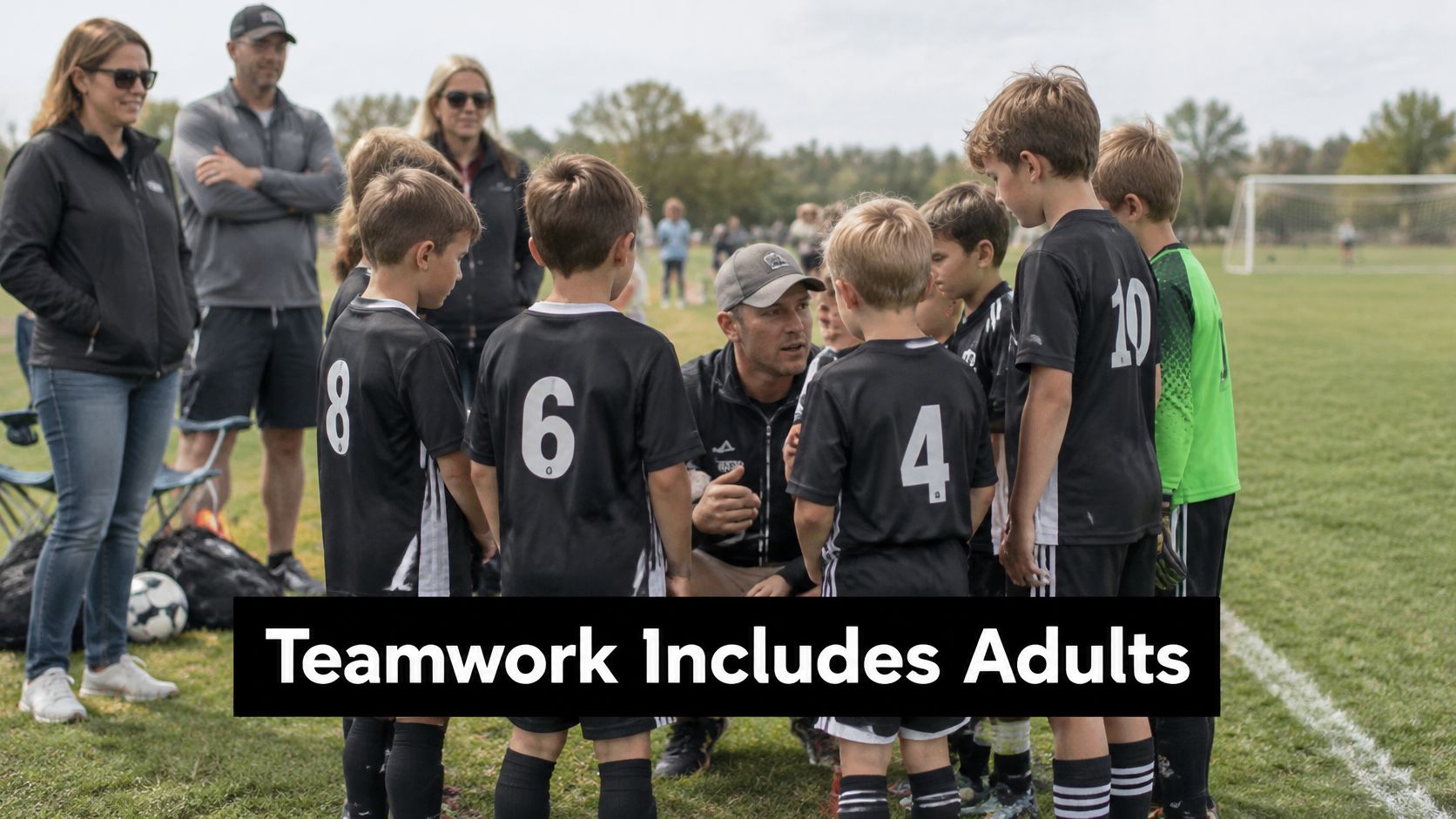
Teamwork on the pitch looks like trusting a teammate to cover the back post during a high press, speaking again two minutes after the mistake that cost a goal, and praising the run that created space rather than only the finish. None of that is personality. All of it is climate, and climate is set by coaches.
What the adults survey found
A survey of coaches and administrators reported in the journal Apunts found that 82.19% of respondents had supported an athlete or staff member facing a mental-health challenge, yet 56.65% had no prior training in recognising or managing such issues. 98.71% believed mental-health training would be valuable for their coaching or administrative role, and 60.16% worked with youth athletes.
Read those figures together and the gap appears plainly. The adults most likely to be in the room when a player discloses distress are among the least likely to have been trained for that moment. Good intentions are not a protocol.
"Mentally tough" coaching turns harmful when it rewards concealment or treats distress as a commitment problem. A player who learns to hide pain to keep their place has learned the opposite of resilience.
Three scripts and the lines not to cross
After a panic episode. Sit the player down, breathe with them, and don't ask for an explanation while their heart rate is still climbing. Ten minutes later: "That looked frightening. It happens to good players. Let's get you some water and talk about what would help before the next one."
After a player withdraws from teammates. Name what you saw without diagnosing it. "You've been quiet with the group since Saturday" opens a conversation. "What's wrong with you?" closes one.
After a disclosure of low mood. Say thank you, promise confidentiality within the limits you state clearly, and move toward qualified help rather than trying to counsel the child yourself. Keep sport-performance support and clinical treatment in separate lanes.
Our coaches at Villarreal Houston learn the Villarreal CF methodology and work side by side with Villarreal CF sports psychologists, and they're expected to engage, communicate positively and influence young players to find their best in and off the field. That standard is worth asking about at any club you're considering. The wider work on positive coaching techniques is a useful next read for the adults in the system.
The one-week checklist
Ask one open question after a match that has nothing to do with the result.
Set one shared team cue for the week, such as "first voice after a mistake," and use it yourself.
Note withdrawal in writing. Two weeks of a player going quiet is a pattern, not a mood.
Don't punish honest pain reports, whether the pain is in a knee or in a head.
Name the referral contact so every parent knows who to call before a crisis arrives.
Anxiety, Injury Risk and When to Refer
A defender can be fit, brave and technically sharp, then have one anxious week: poor sleep, a sore ankle hidden from staff, rushed decisions in simple drills. Anxiety belongs in everyday coaching for that reason. A prospective study of 122 footballers aged 14 to 17 linked each increase in competitive-anxiety score with a 13% higher probability of sports injury and each additional stress point with a 22% higher probability.
Youth findings also point to different patterns across age groups: the anxiety-injury link appears clearer in older youth players than in younger ones. Read that as an availability signal rather than a diagnosis. A worried eight-year-old is not automatically a physical risk case. As players move into the older youth years, worry, sleep loss, distraction and pain concealment can decide whether they train, play and recover.
Normal activation or a signal to act on
Signal | Usually normal | Consider referral when |
|---|---|---|
Pre-match nerves | Build before kickoff and fade once play starts | Panic attacks or avoiding training for weeks |
Stress after injury | Frustration that eases as recovery progresses | Low mood or withdrawal from teammates that persists |
Distraction | Brief lapses in focus during a demanding week | Repeated lapses affecting safety or decisions on the pitch |
Pain reporting | Player reports pain promptly to staff | Player hides pain to avoid being removed from play |
Sleep and appetite | Short disruption around tournaments | Lasting change or concern about disordered eating |
Psychological screening sits beside medical evaluation. It should never drive rehabilitation changes on its own, and no coach should turn a questionnaire into a return-to-play plan. Its value is context: whether a player is sleeping, whether they are avoiding contact, whether they tell staff the truth about pain, and whether confidence after injury is returning at the same pace as movement.
Adults set the concealment risk. A player who hears “stop being soft” learns to hide symptoms, and hidden symptoms are hardest to see during exactly the window when early support works best. Separate ordinary pre-game activation, which fades once the first challenge goes in, from persistent distress that follows a player into school, sleep and appetite. Families facing that second pattern, in Houston or elsewhere, can look at youth counselling services such as this support for struggling teens in Kelowna to see what a proper referral pathway looks like.
When signals persist past a few weeks, the right step is a conversation with the club's medical staff or a licensed mental-health professional. Early is easier than late.
Villarreal Houston Academy builds mental skills into the same sessions that teach first touch and pressing, with age-appropriate training for boys and girls from age 4 upward and coaches who work alongside Villarreal CF sports psychologists. If you want a development environment where a nervous player is coached rather than labelled, come see a session and meet the staff at Villarreal Houston Academy. Tryouts, camps and clinics across Humble, Fall Creek, Cypress, Tomball and the Kingwood-Porter-New Caney area are the easiest place to start.
Comments