


How to Handle Criticism in Youth Soccer the Right Way

Saturday morning, an U12 striker gets through on goal and puts the chance wide. The coach calls from the technical area, a dad in the stand winces, and the player's shoulders sink before the restart. The miss lasts a moment. The criticism, if nobody manages it well, can occupy the rest of the half.
Most youth-soccer families live inside an unspoken agreement. The coach teaches, the player listens, and the parent watches. That agreement works when everyone understands where feedback belongs, what it should sound like, and how the player can use it. It cracks when an adult vents publicly, a parent adds instructions from the sideline, or a young player mistakes one poor decision for proof that they aren't good enough.
This isn't a sermon about being nicer. Learning how to handle criticism means having a practical response ready for the next misplaced pass, tactical correction, post-game rant, or heated team-chat comment. It also means knowing when feedback is useful, when it needs adjusting, and when a player should calmly push back.
The player, parent, coach, and wider team culture all shape that moment. A healthy football environment reflects the same respect explored in resources on fair play in football history, while clear expectations can be reinforced through a youth soccer code of conduct.
The Sideline Moment Every Family Knows Too Well
A player who hears “next play” after a mistake has somewhere to go mentally. A player who hears “you're costing us the game” has to solve two problems at once, the football problem and the emotional threat. Young athletes rarely improve by pretending the second problem isn't there.
The difficult part is that criticism often arrives with mixed signals. A coach may be trying to correct pressing distance but shout in frustration. A parent may be trying to encourage effort but deliver a long analysis before the player has even left the field. A teammate may be frightened after conceding and blame the nearest person. The message can contain a useful football point, but the delivery can still damage attention and confidence.
I've seen players respond to a sharp comment in three common ways. Some rush the next action and make another mistake. Some stop asking for the ball. Others become defensive and spend more energy proving the adult wrong than reading the game. None of those reactions means the player is weak. They mean the player needs a rehearsed process for staying connected to the next decision.
Sideline rule: A correction should help the player make the next action better, not make the player feel smaller.
Parents have an important job here. During the match, support usually means protecting attention, not adding a second coaching voice. Afterward, it means allowing the initial emotion to settle before asking what the player heard, what they think was fair, and what they'll try next.
Telling Constructive Criticism Apart From the Destructive Kind
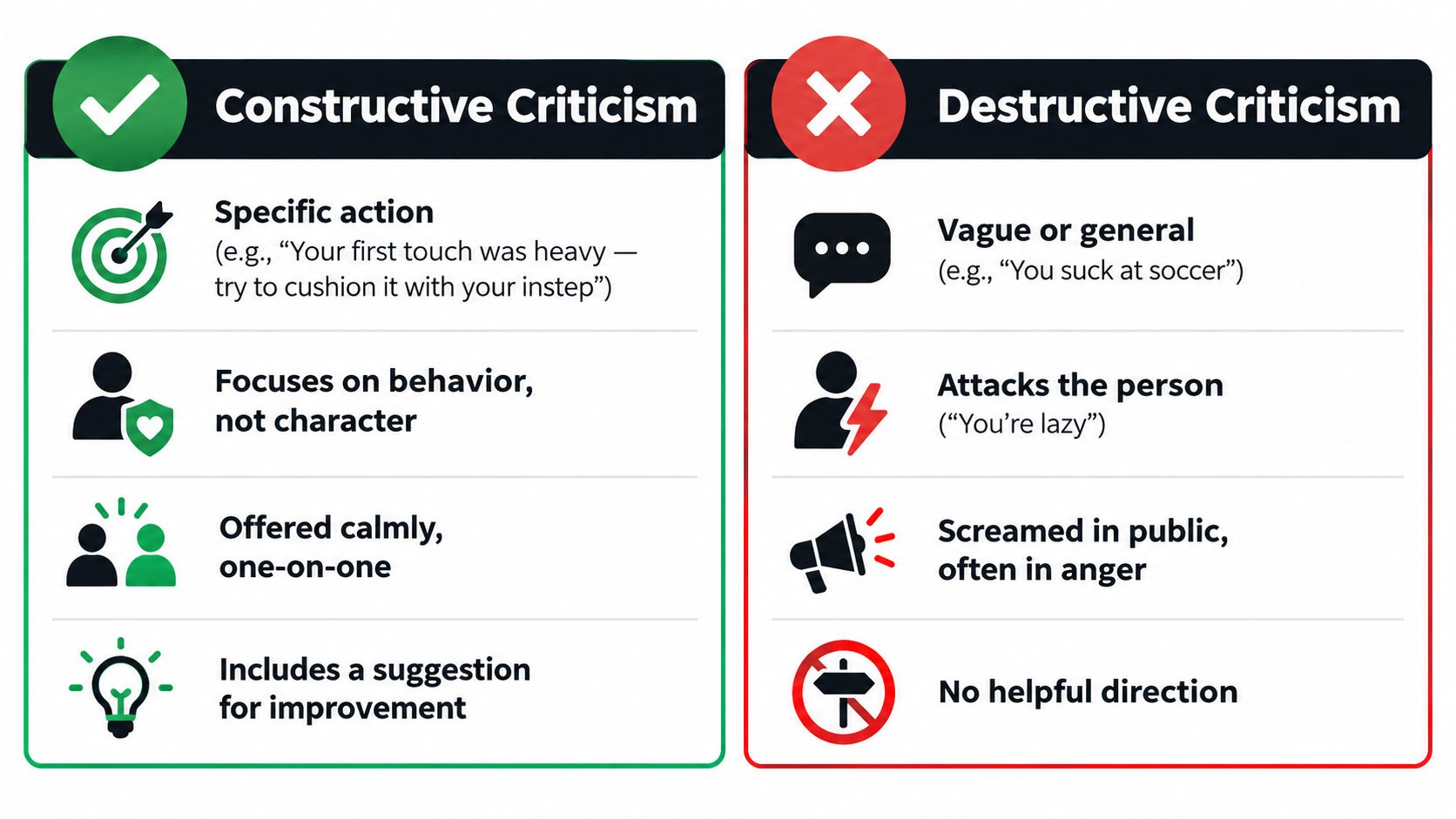
Constructive criticism identifies a behavior, explains the effect, and gives the player a usable correction. Destructive criticism attacks identity, releases frustration, or leaves the player guessing what to change. The difference isn't whether the feedback feels comfortable. A specific correction can sting. The difference is whether the player can turn it into action.
The American Psychological Association's guidance on constructive criticism emphasizes recording feedback, keeping it specific and relevant, and avoiding vague or personality-based language. It also notes that people may remember evaluative feedback about completed work more readily than directive feedback about future improvement, which is one reason players should write down the actionable point rather than trust memory after an emotional match.
Use the three-question sideline filter
Ask these questions quickly:
Does it name the behavior? “Your first touch was heavy, cushion it with the instep” gives the player a technical target. “You're hopeless” attacks the person.
Does it offer a fix? “Check your shoulder before receiving” creates a next action. “Wake up” expresses urgency without teaching anything.
Can the player use it now? A short cue before the next restart may help. A public lecture during a chaotic match usually overloads the player.
At U10, constructive feedback might sound like, “You're too tight on the ball. Give yourself a little more space before the defender arrives.” Destructive feedback sounds like, “You never listen.” At U12, “Track the runner when we lose it, then recover inside” is useful, while “You're costing us this game” is not. At U18, “Our press starts when their center back takes a poor touch. Hold your position until that trigger” teaches a tactical decision. “You don't understand the game” closes the conversation.
Harsh feedback can also produce a short-term reaction, which is why adults sometimes repeat it. That reaction isn't the same as learning. Performance-feedback research summarized by this review of feedback effects indicates that delivery, timing, and recipient control influence whether criticism helps or harms performance.
Even caring coaches slip under match pressure. Families need the filter so they can separate the useful football information from the adult's emotional spillover.
The Four-Step Reset Right After the Whistle
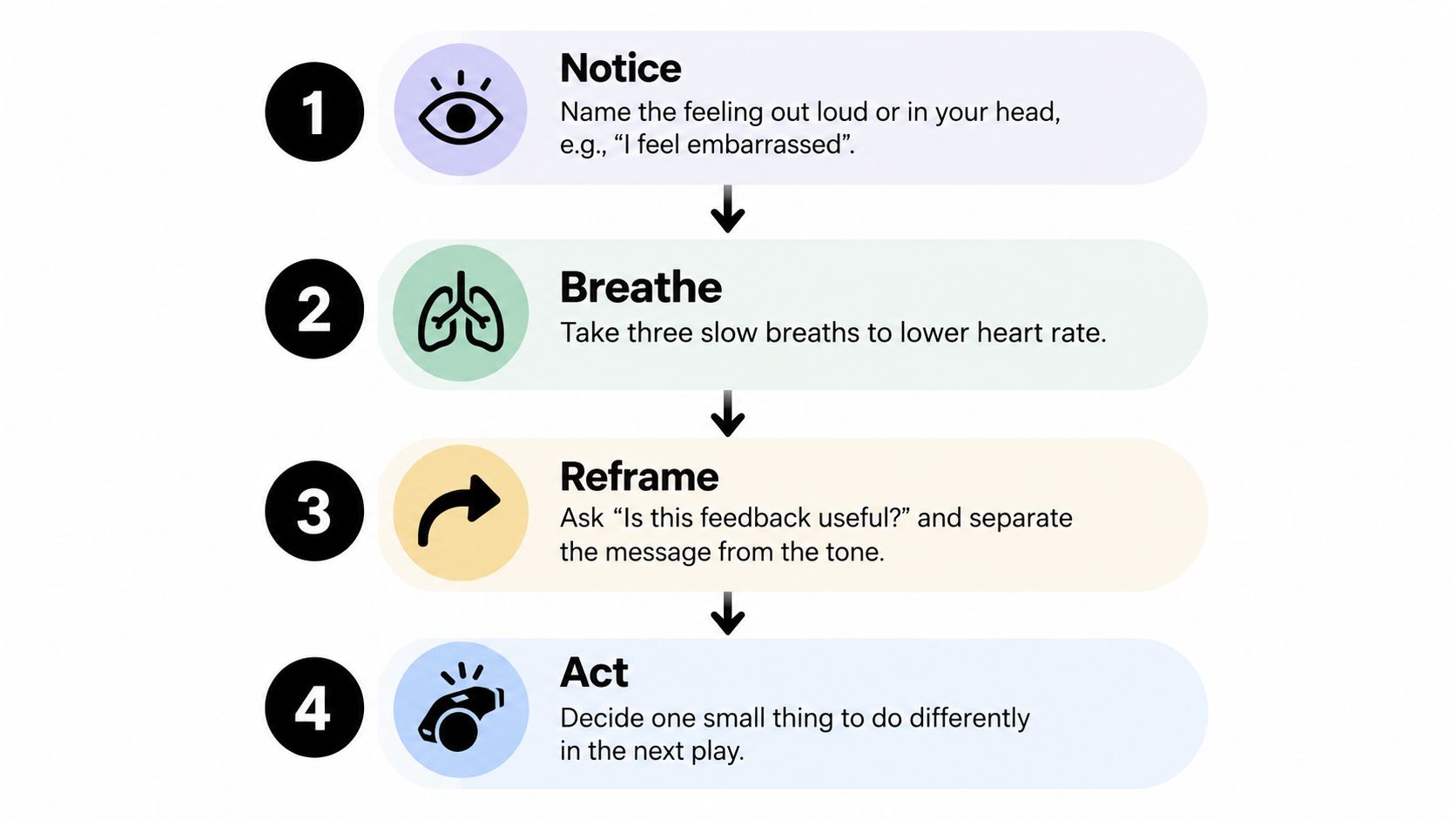
The best reset takes less than a minute and works because it gives the player a sequence to follow before emotion chooses the response. Practice it away from matches, then use it after a bad touch, a public correction, or a teammate's accusation.
Notice
Name the feeling without judging it. “I'm embarrassed.” “I'm angry.” “I'm worried the coach thinks I'm useless.” Naming the reaction creates distance from it. The player doesn't need to solve the emotion immediately.
Breathe
Take two slow cycles, breathing in for four counts and out for six. Keep the exhale longer than the inhale, drop the shoulders, and look at one fixed point. Parents can mirror this in the stand instead of reacting to the adult who delivered the criticism.
Reframe
Ask, “Is this about my game, or about the adult's nerves?” Then separate the content from the tone. A coach might have delivered a valid positioning correction badly. The player can keep the positioning point without carrying the insult.
Choose
Select one small action for the next play: “Clean first touch.” “Scan before I receive.” “Recover inside.” “Next play only.” A narrow target restores control because the player no longer has to repair the entire match at once.
This is a skill, not a personality trait. A player can rehearse the reset in training, while watching match footage, or during the drive home. Families looking for more performance tools can also use this practical guide to handling pressure in sports, especially when criticism and anxiety arrive together.
Scripts and Role-Play Drills Players Can Rehearse
A young player doesn't need a perfect speech. They need a short line that prevents arguing, protects attention, and keeps the next action available. The following scripts should sound natural in a child's voice, not like something copied from a leadership seminar.
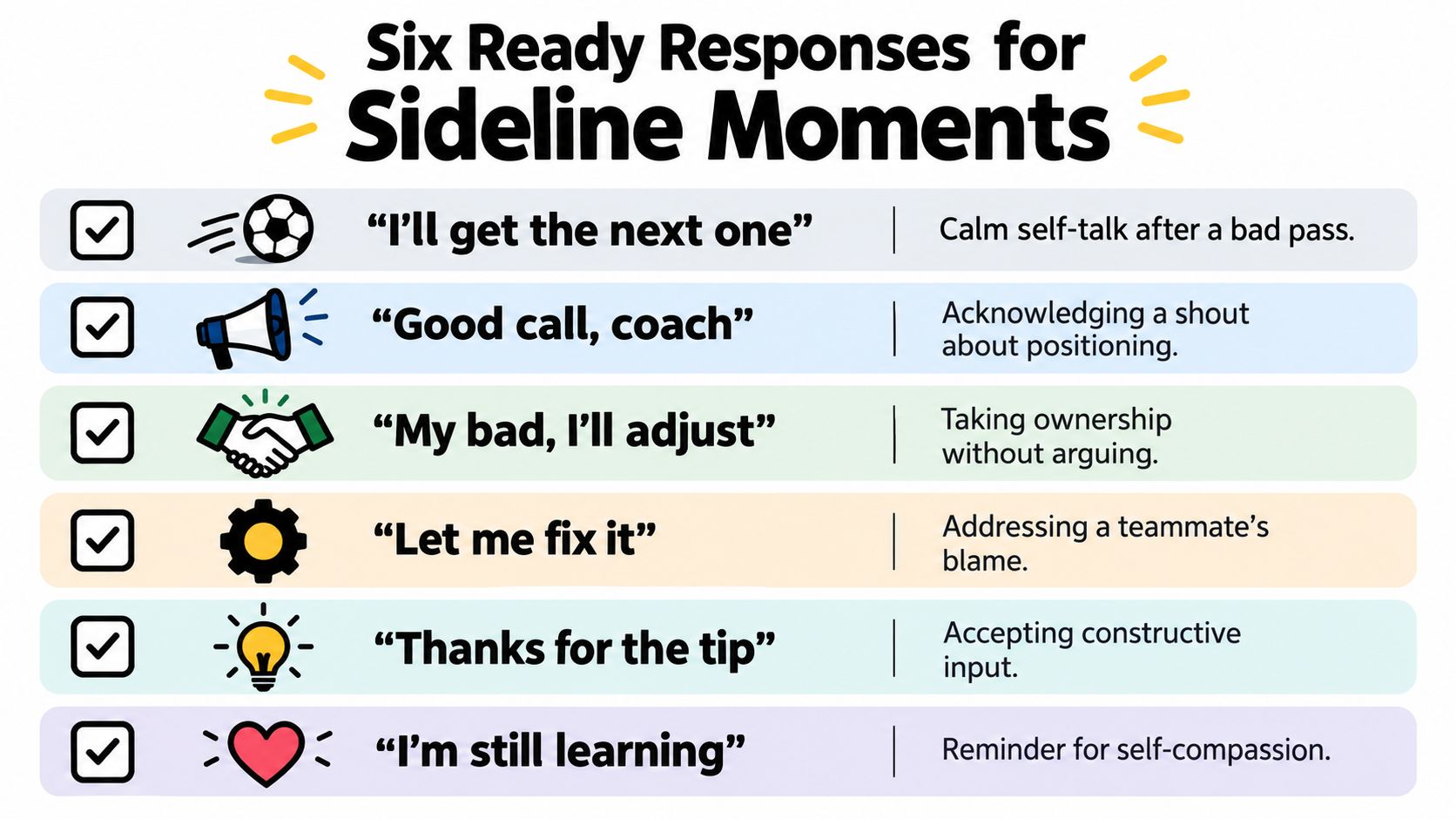
Six lines for common moments
After a misplaced pass: “I'll get the next one.”
After a positioning shout: “Good call, coach.”
After a teammate points out a mistake: “My bad, I'll adjust.”
After unfair blame: “Let me fix my part.”
After useful technical input: “Thanks for the tip.”
After a difficult mistake: “I'm still learning.”
The player doesn't have to agree with every comment. These lines buy time and keep the response short. If the issue needs discussion, the player can ask later, “Can we speak about that after the game?”
Three home drills
Car-ride replay: The parent plays coach and gives one realistic correction. The player looks up, answers with one line, and names the next action. Keep the tone firm but never cruel.
Freeze frame: Pause match footage just before a mistake. Ask, “What did you hear, and what could you say?” The player practices the reply, then identifies the football decision without replaying the shame.
Buddy tag: Two siblings or friends trade the roles of critic and player. Each round lasts five minutes. The critic must name a behavior, and the player must answer without arguing.
Use a simple score after each round:
Skill | Developing | Consistent |
|---|---|---|
Eye contact | Looks away or stares aggressively | Brief, relaxed eye contact |
Tone | Defensive, sarcastic, or too quiet | Steady and respectful |
Reply | Long explanation or argument | Short line followed by action |
Scripts only become automatic through repetition. Practice them often enough that the player can access them while tired, embarrassed, or frustrated.
Matching the Response to the Age Group
Feedback must match the player's ability to understand, regulate, and apply it. A young child may need a demonstration and one cue. An older midfielder can discuss tactical triggers, question an interpretation, and help build the correction plan.
Age Group | What They Can Handle | Player's Expected Response | Parent/Coach Role |
|---|---|---|---|
U6/U8 | One simple action at a time | Repeat the cue and try it | Demonstrate, encourage, and avoid long explanations |
U10/U12 | A cue plus a reason | Give a short reply and attempt the change | Use brief questions and track reset habits with a simple sticker chart |
U14 | Technical and tactical detail with reflection | Summarize the feedback in their own words | Use film review and ask the player to identify the next step |
U16/U18 | Collaborative discussion and evidence | Ask clarifying questions and request examples | Treat the player as a developing decision-maker, not a passive recipient |
U6 and U8
“Too tight on the ball” means very little to a child unless the adult shows the alternative. Demonstrate receiving with a little space, then ask for one repeat. The correction should be connected to the next action, not a lecture about the entire game.
U10 and U12
This is a useful stage for two-part feedback: “Your first touch took you toward pressure. Take it across your body next time.” The player can answer, “Across my body, got it,” then try it in the next drill. A small chart can track whether they noticed, breathed, and returned to play, rather than whether every decision was perfect.
U14
Players can begin reviewing clips and writing a short reflection. Ask them to state what happened, what they heard, whether the feedback was useful, and what they'll try. If a defender is criticized for stepping too early, the player should be able to explain the trigger they missed.
U16 and U18
Older players should participate in the analysis. A midfielder might respond to a pressing critique with, “Do you want me to jump when the center back receives facing forward, or only after the poor touch?” That question shows engagement, not defiance. Coaches can expect accountability while still making room for context and disagreement.
When to Accept, Adjust, or Push Back
“Be open to feedback” is incomplete advice. Openness without judgment teaches players to accept personal attacks, inaccurate claims, and unfair treatment as if all criticism carries equal value. The better approach is to filter, decide, and respond.
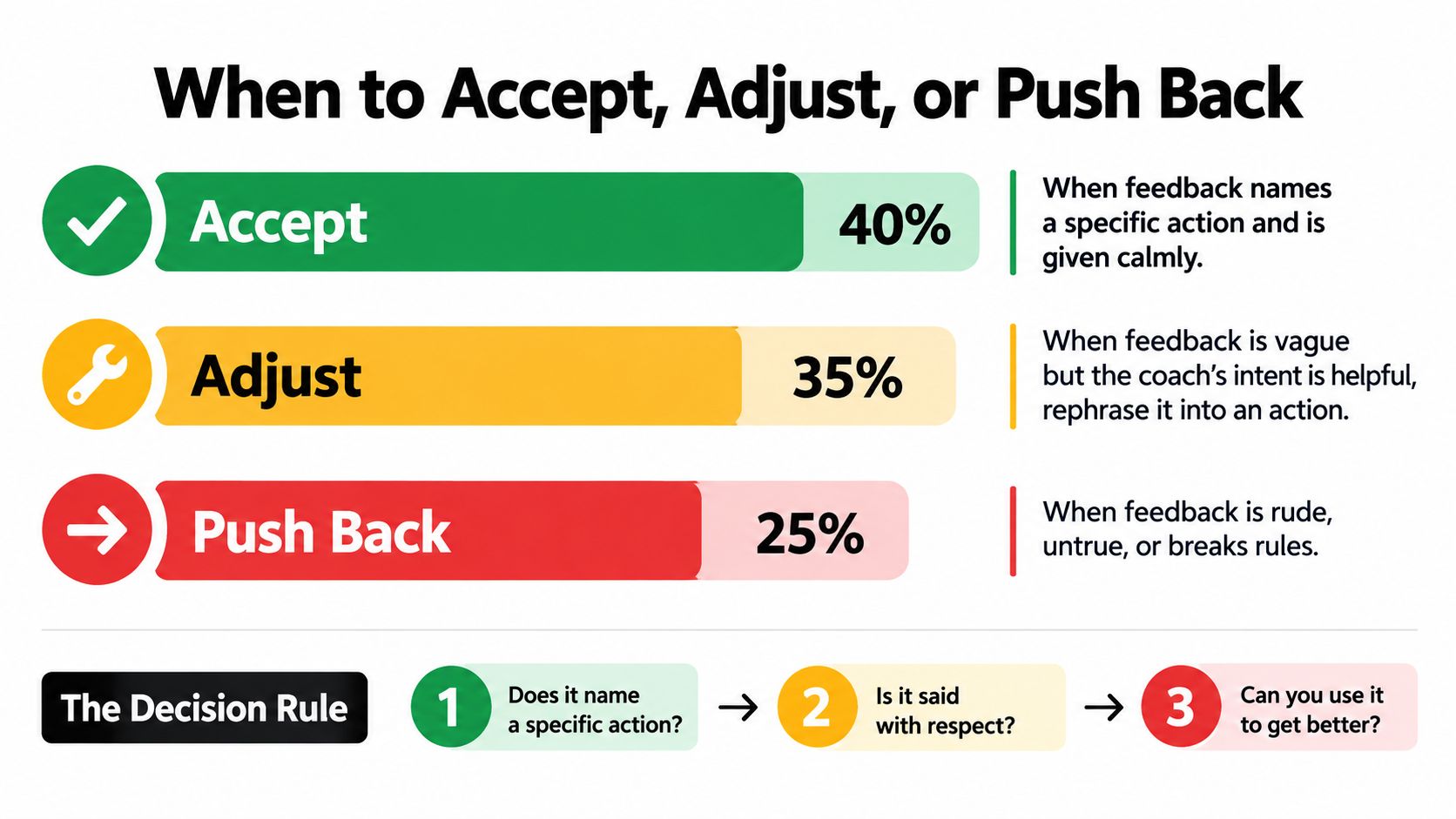
Accept
If the feedback names a specific action and the player can test it, accept it. A coach says, “You're pressing from too far away. Start closer so you can arrive under control.” The player answers, “Got it. I'll start closer,” then tries the adjustment.
Adjust
Sometimes the message is partly right but poorly delivered. A parent says, “You didn't work hard enough today,” after the player made repeated recovery runs but missed a defensive assignment. The player can extract the useful piece: “I did recover, but I missed that runner. I'll check over my shoulder earlier.” The tone can be discussed later.
Push back
If criticism attacks character, is factually wrong, or violates team standards, the player should respond calmly and move the conversation to a private setting. After a conceded goal, a teammate says, “That was all your fault.” A suitable response is, “I'll own my part, but we both need to review the play. Let's talk after the match.”
Research on criticism and interpersonal fairness, summarized in this analysis of accepting criticism, supports the importance of fair treatment in whether people accept feedback. Push-back isn't rebellion. It's a communication skill, and it works best when players rehearse factual phrases at home rather than inventing them in the heat of competition.
How Coaches and Parents Should Frame the Feedback
Adults set the emotional temperature. The most useful sideline feedback follows three pillars: specific observation, immediate context, and a forward-looking next step. This structure keeps the conversation about football behavior instead of personality.
Start with what happened
Name the observable action without exaggeration. “Your first touch traveled away from you” is stronger than “You blew it.” Avoid labels such as lazy, careless, soft, or selfish. A player can change a touch or a recovery run. They can't productively respond to a verdict about who they are.
Then explain the impact in football language. “That gave the defender time to close the space” connects the action to the team's problem. The player now understands why the detail matters.
Finish with one correction. “In the next rondo, cushion the ball across your body and scan before it arrives.” The player has a target that can be tested immediately.
This is cleaner than a praise sandwich, where adults bury criticism between compliments. Players often leave unsure which part matters. A feedback stack is more direct:
Observation: “You received square to pressure.”
Impact: “The defender could close you before you turned.”
Action: “Open your body and take the first touch away.”
Practical rule: One correction, one reason, one next action. Save the second correction for another moment.
Replace familiar sideline phrases
Common Sideline Criticism | What the Player Hears | Reframed Feedback, Observation → Impact → Action |
|---|---|---|
“Stop being lazy.” | “My character is the problem.” | “When you jog back into position, our shape breaks. Recover at speed and protect the inside lane.” |
“You blew it.” | “One mistake defines me.” | “That turnover started with a heavy first touch. Take the next touch under control in the rondo.” |
“Wake up.” | “I'm failing, but I don't know how.” | “Scan before the pass arrives so you can see the next option.” |
“Why are you always out of position?” | “The coach has given up on me.” | “You're starting too high when we lose possession. Drop beside the midfielder before pressing.” |
Parents should avoid becoming assistant coaches during the match. Agree before kickoff on what support sounds like, such as “Keep going,” “Next play,” or silence. Afterward, ask, “What feedback did you get?” before offering an opinion. The positive coaching techniques used in youth soccer are most effective when adults reinforce the same behavior-focused language across training, matches, and home conversations.
Two things matter. Don't criticize effort when the player clearly tried hard, even if execution was poor. Correct the decision or technique instead. Don't compare players publicly during a match window. Comparison creates embarrassment and rarely teaches the specific behavior that needs changing.
A short weekly routine keeps criticism from becoming a crisis. On Sunday evening, hold a 10-minute family huddle and ask:
“What's one thing you heard this week?”
“What's one thing you agreed with?”
“What's one thing you want to try?”
Coaches can run a shorter end-of-week player check-in using the same prompts. At home, add a 10-minute role-play: the parent gives one tough but fair correction, the player completes the four-step reset, and then says, “Got it, here's my plan.” The purpose isn't to create players who never feel upset. It's to help them recover, decide, and act.
Criticism handled well becomes a weekly habit rather than a crisis event. That habit gives players a way to keep improving through the teenage years, even when the feedback is uncomfortable.
Villarreal Houston Academy offers age-appropriate youth soccer programs, competitive pathways, camps, clinics, tryouts, and training shaped by Villarreal CF methodology across the Greater Houston area. Families can visit Villarreal Houston Academy to explore a development environment where feedback, technical growth, tactical understanding, and character are practiced together.
Comments