


Soccer Training Routine for Youth Players That Works

A Tuesday evening can tell you whether a young player's week is designed or improvised. School pickup runs late, a snack is eaten in the car, boots and shin guards are thrown into the trunk, and the family drives forty minutes to an extra session added because someone worries the player is falling behind. The weekend match is still ahead, and the child already looks flat during the first passing drill.
That situation isn't usually a motivation problem. It's a training-design problem. A useful soccer training routine gives every session a job, places hard work where the player can absorb it, and protects recovery when school, matches, travel, or growth make the planned workload too much.
Academy pathways such as Villarreal CF's Yellow Submarine model point toward that structure. Players develop through consistent technical and tactical work, game-realistic practices, age-appropriate progression, and individual adjustments, not through random volume. The practical templates below use minutes, frequency, intensity, and recovery so parents can stop guessing whether “more” is helpful.
Why a Soccer Training Routine Matters More Than Extra Sessions
The extra-session instinct is understandable. A parent sees a missed first touch, a slow decision, or a player who hasn't made the next team, then looks for another training hour. The problem is that an added session doesn't exist in isolation. It sits beside school stress, team practice, match minutes, car travel, sleep, and the physical demands of growing.
A routine makes those demands visible. It separates a technical day from a high-intensity game day, identifies when the player should recover, and prevents every practice from becoming a test of fitness. Development improves when the player can repeat quality actions consistently, not when fatigue forces them through low-quality repetitions.
Coach's rule: If the player can't bring attention, coordination, and intent to the session, adding another session may reduce the value of the sessions already on the calendar.
Elite academy evidence supports the idea that training volume changes with development stage. In a five-year analysis of an elite academy, overall weekly volume was about 330 minutes for U12 to U14 groups and about 400 to 420 minutes for U15 to U18 groups, while younger players typically trained four times weekly and late-stage groups such as U17 and U19 trained five times weekly (academy training-load analysis). Those figures describe a progression, not a universal prescription.
The cost of random volume
Random extra work often creates three problems:
Poor spacing: A hard private session follows a demanding team practice, leaving no room for the player to recover.
Repetition without transfer: A player performs isolated touches but doesn't learn when to use them under pressure.
Fatigue disguised as effort: The session feels demanding, yet technical execution and decision-making deteriorate.
A well-built routine also gives coaches better information. If a player struggles after a tournament, the answer may be reduced load, not a new drill. If a player is fresh but lacks scanning habits, the solution may be more representative games, not longer conditioning.
The Yellow Submarine pathway is useful as a reference because it connects technique, tactical understanding, positional responsibilities, and character development inside a planned week. Local families should apply the principle rather than copy an academy schedule blindly. The right question is not, “How many sessions can we fit?” It's, “What does this player need next, and when can the player train it well?”
What an Elite Youth Soccer Training Routine Actually Looks Like
A strong routine has architecture. It includes on-field work, match exposure, strength or injury-prevention work when appropriate, recovery, and at least one genuine reduction in demand. The exact arrangement changes with age, maturity, position, school obligations, and match minutes.
Weekly volume should rise gradually along the pathway. The academy analysis cited earlier found a progression from roughly 330 weekly minutes in younger groups to 400 to 420 minutes in older groups, with training frequency also increasing (five-year academy load research). That progression doesn't justify adding adult-style conditioning to a young player's week. It shows why a U10 and a U17 need different routines.
Routine architecture by age group
Component | U10–U12 | U15+ |
|---|---|---|
On-field work | Short, varied sessions focused on ball mastery, movement, and games | Longer sessions combining technical, tactical, and physical demands |
Weekly frequency | Usually three to four organized exposures, adjusted around matches | Often four to five training exposures in a late-stage pathway |
Strength work | Play-based strength, landing mechanics, mobility, and body control | Structured strength and injury-prevention work supervised by qualified staff |
Recovery | Free play, mobility, easy movement, and protected family time | Dedicated recovery day, monitoring, sleep, fueling, and active recovery |
Load progression | Add complexity before adding large amounts of volume | Progress volume and intensity while managing match and growth demands |
A U12 week might use three or four on-field sessions of roughly 60 to 75 minutes, but those minutes shouldn't all be hard. One day can isolate first touch and passing, another can use small-sided games, and another can emphasize free movement and creativity. Formal gym work isn't necessary for every child in this band. Basic strength can come through jumping, balancing, accelerating, decelerating, and controlling the body.
A U15 or older player may handle four or five sessions of 75 to 90 minutes, with structured strength work and a dedicated recovery day. That still doesn't mean every session should be intense. A player who starts a match may need a different training load from a non-starter. One academy study reported that non-starters covered roughly 5,534 meters in weekly training compared with about 5,106 meters for starters, illustrating why match minutes must influence the following sessions (microcycle and academy load study).
The best weeks also breathe. Coaches use lighter periods after congested competition, reduce volume before tournaments, and return progressively after illness or injury. A flat line of hard sessions may look ambitious on paper, but it rarely produces the cleanest technical work.
Weekly Soccer Training Routines by Age Group
The right template depends on the player's developmental band, not just the birth year. A late-maturing U14 athlete may need less high-speed volume than a physically advanced teammate, while a U9 player who also plays multiple matches may need more rest than the calendar suggests.
The following grids are starting points. Match minutes replace some training, and a tournament week requires a different arrangement.
Day | U8–U10 | U11–U14 | U15–U18 |
|---|---|---|---|
Monday | Free play or rest, 30 to 45 minutes of relaxed ball work | Technical session, 60 minutes, first touch and passing | Recovery or mobility, with load based on weekend minutes |
Tuesday | Team practice, 45 to 60 minutes | Team practice, 60 to 75 minutes, small-sided games | Technical and tactical session, 75 to 90 minutes |
Wednesday | Free-play day, no structured gym | Technical-only session, 60 minutes, lower physical demand | Strength and injury-prevention work plus field training |
Thursday | Team practice, 45 to 60 minutes | Game-day-impersonating practice, 60 to 75 minutes | High-quality tactical and game-realistic session, 75 to 90 minutes |
Friday | Rest or light movement | Rest, mobility, or easy ball work | Active recovery and set-piece or positional review |
Saturday | Match or informal play | Match | Match, with controlled training for non-starters |
Sunday | Family activity and recovery | Recovery or match, depending on schedule | True off day when competition allows |
Reading the bands correctly
U8 to U10: Use two or three organized sessions of 45 to 60 minutes, centered on ball mastery, movement games, and enjoyment. A free-play day matters because children need to solve problems without constant instruction. Structured gym training isn't needed in this routine.
U11 to U14: Use three or four sessions of 60 to 75 minutes. Include one technical-only day and one practice that resembles match demands through small-sided games, transitions, and role changes. Introduce strength through supervised body-control exercises, mobility, landing, and deceleration rather than chasing heavy loads.
U15 to U18: Use four or five sessions of 75 to 90 minutes when the player's match schedule and recovery support it. Blend technical, tactical, and physical work, add structured strength sessions, include active recovery, and protect a true off day. The busiest session belongs far enough from the match to allow adaptation and freshness.
For families balancing endurance goals, the same planning principle applies outside soccer. A practical marathon preparation guide can help explain why training blocks need recovery rather than constant intensity. Soccer families can also compare the weekly structure with this weekly soccer training schedule when organizing recurring practices.
Don't treat the table as a prescription. Track how the player responds, then adjust the next week.
Anatomy of a Strong Session and a Tryout-Ready Week
A 75-minute session should have a clear purpose from the first minute. At an academy level, the coach isn't filling time with unrelated drills. Each block prepares the next one, moving from control and activation toward decisions under pressure.
The normal 75-minute session
The opening 12 minutes use a ball. Start with a rondo-to-shuttle progression, add hip mobility, and finish with short neural-activation actions. The player should feel alert, not exhausted. Use controlled accelerations and clean changes of direction rather than repeated maximal sprints.
The next 20 minutes isolate one technical theme. For example, receive on the back foot, open the body, and play a directional pass. Give players enough repetitions to recognize the cue, then add a passive defender or a time limit. Quality falls when coaches introduce five unrelated techniques in one block.
The 15-minute tactical block uses a conditioned small-sided game. Constrain space or scoring so players must make the intended decision. A rule that rewards finding the third player can teach support angles more effectively than a long verbal explanation.
Finish with 20 minutes of game-realistic play at larger pitch size. Assign role-specific tasks, such as a fullback receiving behind pressure or a midfielder scanning before the ball arrives. Use the final 8 minutes for a gradual cool-down, light mobility, and a coach-led reflection prompt.
The exact block durations are a coaching model, not verified academy-wide statistics. The value comes from progression and relevance.
The tryout adjustment
A tryout-prep week changes intensity and decision speed, not the player's identity. Add reactive plyometrics only when the athlete already lands and decelerates well. Raise the technical block toward game-tempo passing, use 9v9 high-press scenarios in the tactical phase, and include 11v11 transition work when the player's age and environment make that realistic.
Session block | Normal week focus | Tryout-prep week focus |
|---|---|---|
Warm-up | Ball work, mobility, activation | Ball work plus brief reactive movement |
Technical | One clean receiving or passing theme | Faster execution and pressure |
Tactical | Conditioned small-sided decision-making | Pressing, scanning, and transition choices |
Game block | Role-specific match behavior | 9v9 or 11v11 actions relevant to evaluation |
Cool-down | Mobility and reflection | Mobility, confidence, and calm review |
In the final 72 hours, remove extra conditioning and unfamiliar drills. Keep touches sharp, shorten the total work, and leave the player confident rather than sore. Families looking for a structured start can use these soccer warm-up exercises as a reference, while coaches should still tailor the warm-up to the athlete's age and readiness.
Periodization, Growth Spurts, and Adjusting Around Tournaments
A useful macrocycle sets the season direction. A mesocycle breaks that direction into a shorter training block. The microcycle organizes each week around matches, recovery, and the player's current readiness. This structure gives the Yellow Submarine academy pathway a practical rhythm: build capacity early, sharpen decisions before competition, then reduce fatigue before match day.
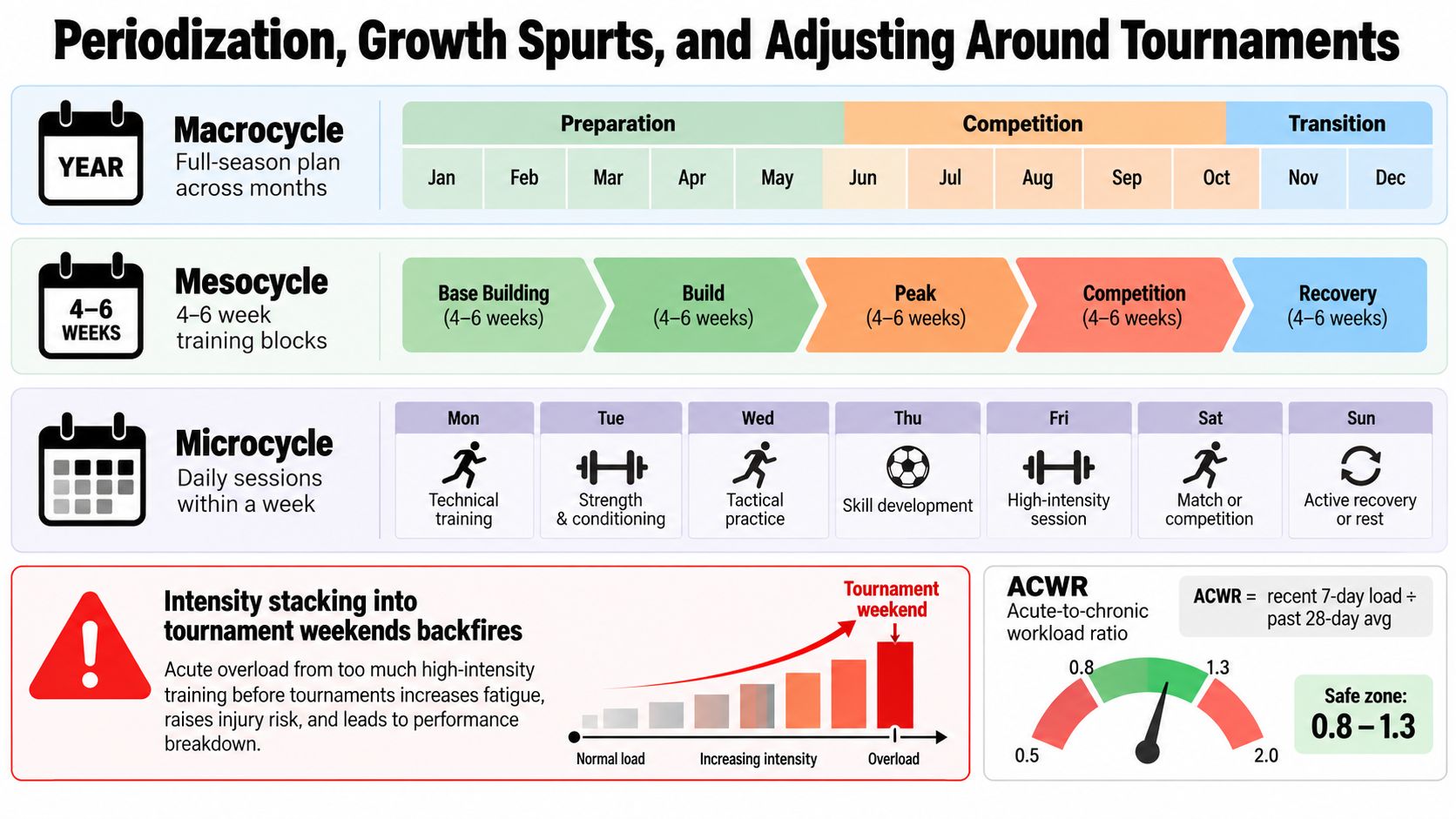
Place the hardest work several days before competition. Reduce training demand as the match approaches. Players in academy settings lowered load during the two days before matches, largely through shorter sessions and lower session-RPE load, while match day created the highest weekly load (academy microcycle research). The coaching point is straightforward: players should reach competition fresh enough to execute, not carrying the week's hardest session in their legs.
Growth changes the plan
Schedule maturation checks at least three times per year. During the adolescent growth spurt, monthly checks are ideal when possible. Estimates become more reliable when they draw on two or more years of data (growth and maturation review).
Watch for practical signs that the plan needs adjustment:
Repeated coordination errors in familiar movements.
New soreness around joints or growth-sensitive areas.
A sudden drop in sprint quality or enthusiasm.
Difficulty recovering from a normal session.
Changes in posture, balance, or running mechanics.
During a tournament week, front-load tactical preparation on Monday and Tuesday. Lower volume on Wednesday, then rest or use very light movement on Thursday. Manage match minutes rather than asking every player to play every available minute. A player showing growth-related fatigue needs less volume and clearer technical work, not punishment conditioning.
Use the same caution with weekly load. A youth injury review reports practice injury rates ranging from 1.4 to 5.8 injuries per 1,000 hours and links week-to-week load increases above 15% with a 21% to 49% higher injury risk (youth soccer injury and load review). Avoid abrupt spikes after holidays, illness, or tournaments. Growth status, match congestion, and training response should shape the next microcycle more than an age-only template.
Recovery, Sleep, and the Day Most Routines Get Wrong
The day after a match is where many youth routines fail. The player is stiff, the parent sees an open field, and another hard session gets scheduled. That choice may satisfy the desire to keep improving, but it often ignores the work the match already supplied.
Recovery is part of training because the player needs time to absorb the stimulus. U.S. Soccer medicine coverage emphasizes flexible regimens, variation in activity and competition level, and scheduled short breaks to reduce burnout in youth soccer (U.S. Soccer medicine guidance).
Make the post-match day useful
A post-match recovery session can last about 20 minutes when the player is comfortable moving. Keep the work easy: light ball touches, relaxed passing, mobility, walking, and gentle range-of-motion exercises. A player with pain, unusual fatigue, or a suspected injury shouldn't use a recovery routine to train through symptoms.
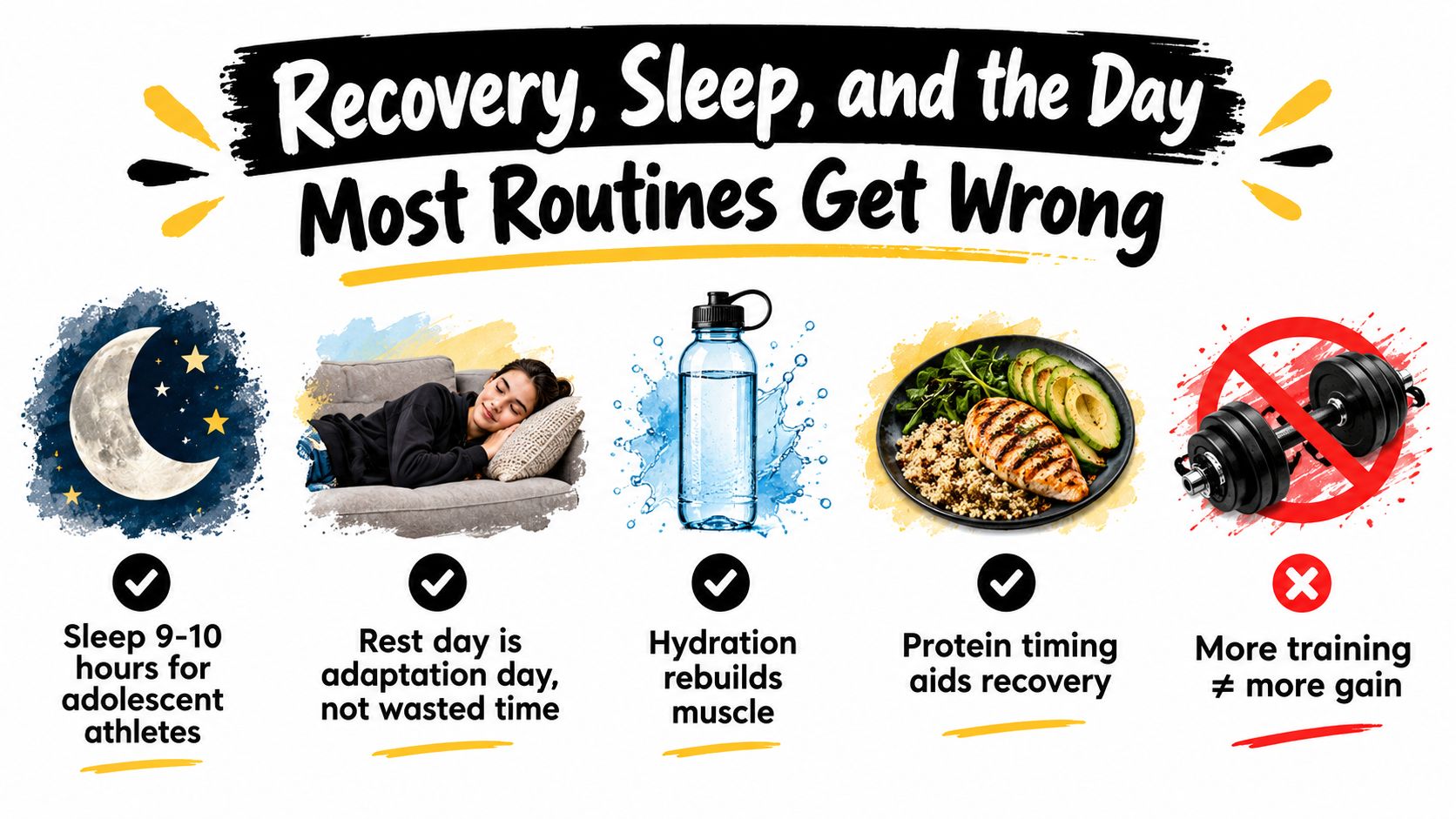
Fuel and sleep deserve the same attention as the field. The guidance above recommends an easy day with light movement, adequate sleep, and balanced fueling rather than another hard session. Parents can make the routine concrete:
Movement: Can the player walk and move without increasing pain?
Hydration: Has the player replaced fluids regularly since the match?
Food: Has the player eaten balanced meals with a useful protein source?
Sleep: Is the evening protected from unnecessary late commitments?
Mood: Does the player feel emotionally fresh enough to enjoy the next session?
More training isn't automatically more development. A player who recovers well can learn more from the next quality practice.
Massage, foam rolling, and contrast bathing may feel helpful, but they shouldn't replace sleep, food, hydration, or sensible load management. Active recovery can be a low-intensity technical session, mobility circuit, or easy pool walking. Passive rest is appropriate when the player is ill, injured, unusually fatigued, or coming through a dense competition period.
Tryout Preparation and Putting the Villarreal CF Method to Work Locally
Tryout preparation should sharpen recognizable soccer actions, not create a new athlete in two weeks. The player needs clean first touch, faster scanning, reliable passing under pressure, and enough freshness to show those qualities repeatedly.
The two-week checklist
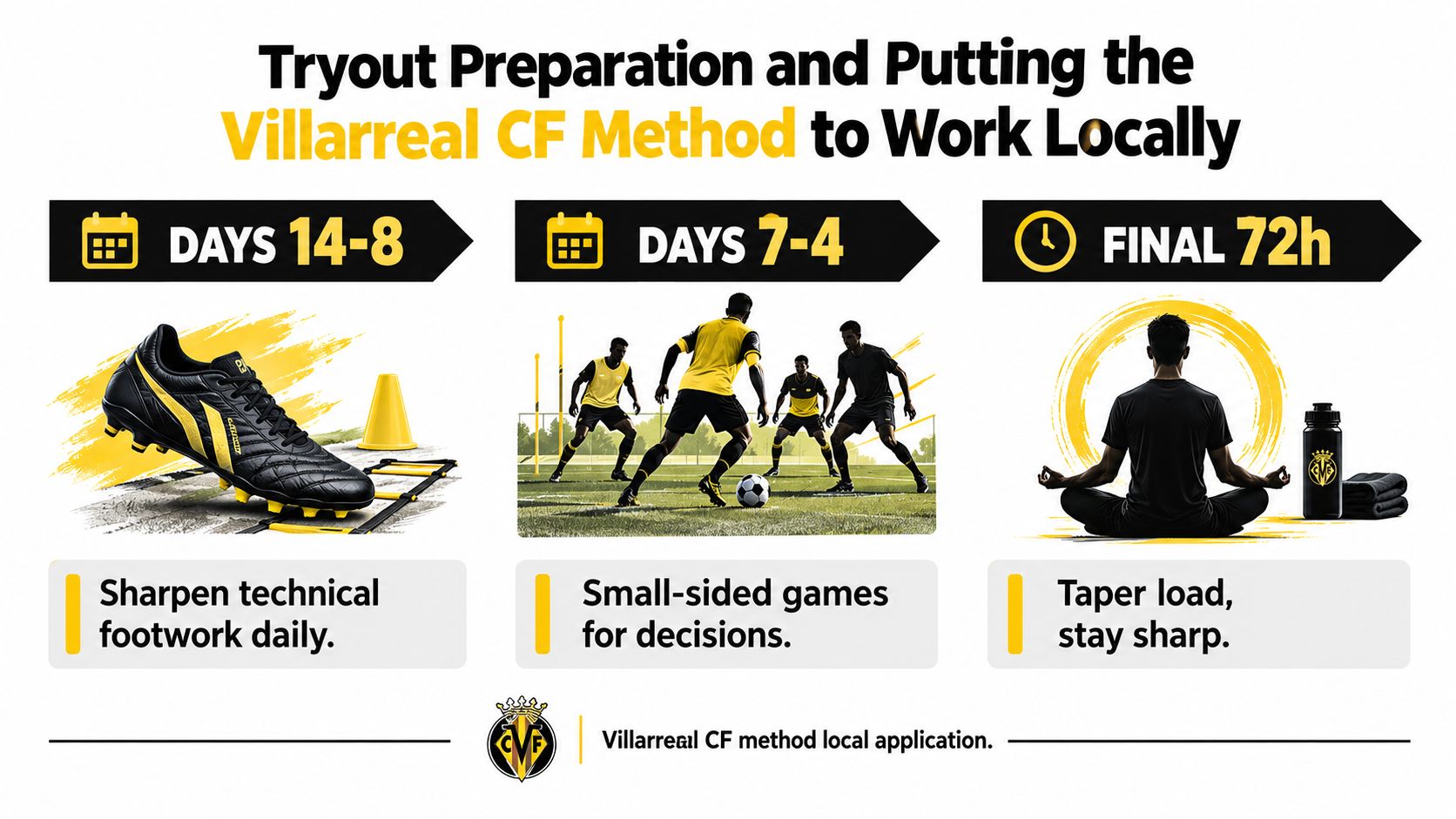
Days 14 to 8 are for technical sharpness. Use first-touch circuits, receiving across the body, passing on the move, ball protection, and finishing waves. Keep the coaching theme narrow. One session might emphasize checking away before receiving, while another focuses on the first action after winning the ball.
Days 7 to 4 add decision-making. Use 4v4 possession grids, transition games, directional rondos, and role-specific exercises. The player should practice recognizing pressure and choosing quickly, because tryouts evaluate behavior in a game context rather than isolated foot speed.
The final 72 hours are for freshness. Reduce volume, keep a few crisp accelerations and technical actions, avoid exhausting conditioning, and protect sleep, hydration, and normal meals. Don't test a new boot, new supplement, or unfamiliar workout at this stage.
A simple daily check can prevent overreach:
Technical: Did the player complete the intended theme with clean execution?
Decision-making: Did the player scan, support, and react under realistic pressure?
Readiness: Is the player alert, coordinated, and free of concerning pain?
Recovery: Is the next day lighter if today's work was demanding?
Villarreal Houston Academy applies the Yellow Submarine methodology through age-appropriate programming for boys and girls from age four upward, with technical, tactical, character, and psychological development included in the wider pathway. Families across North Houston can explore recurring teams, camps, clinics, and evaluation opportunities across facilities in Humble, Fall Creek, Cypress, Tomball, and the Kingwood, Porter, and New Caney area. The academy also provides a route for players seeking competitive teams and potential training experiences in Spain, while the practical starting point for a family remains the player's current needs, readiness, and fit. Details about the evaluation process are available through the soccer academy tryouts information page.
The routine works locally when coaches use the method as a framework rather than a rigid script. A U8 player needs freedom and repetition through play. A U13 player needs increasing tactical clarity while growth is monitored. A U17 player needs higher training demands, but also precise recovery, match-load adjustment, and honest communication about fatigue.
Villarreal Houston Academy offers age-appropriate teams, camps, clinics, recurring training, and tryout pathways shaped by the Villarreal CF methodology. Visit Villarreal Houston Academy to explore a structured soccer training routine for your player and find the next suitable step in the North Houston area.
Comments