


Soccer Training for 14 Year Olds: The Guide

A 14-year-old arrives at practice frustrated. Yesterday, they could turn cleanly, accelerate past a defender, and strike the ball with confidence. Today, their legs feel unfamiliar, their first touch is inconsistent, and simple movements look awkward. Parents often assume motivation has dropped. Coaches may wonder whether the player is falling behind.
Rapid growth can explain much of this change. Effective soccer training for 14 year olds must account for more than technical ability and match results. It should help players improve their touch and decision-making while adapting sprinting, jumping, recovery, and expectations to the physical and emotional realities of adolescence.
Understanding the 14-Year-Old Soccer Player
A 14-year-old who suddenly looks uncoordinated isn't necessarily losing skill. During a growth spurt, the body changes faster than the player's movement habits can adjust. A longer stride alters balance, a changing center of gravity affects dribbling, and new strength levels can make familiar actions feel poorly timed.
One player might need several weeks of patient repetition before their first touch becomes reliable again. Another might gain height without the same temporary disruption. Comparing those players directly can lead to poor decisions, especially when adults mistake early physical development for superior soccer potential.
The bridge between technique and game understanding
At this age, players still need extensive technical practice, but they must learn to use those skills in more complex situations. A clean pass is useful only when the player recognizes the right option, checks their shoulder, adjusts their body, and plays before pressure arrives.
U.S. Soccer recommends that players in this age group develop through small-sided games, position rotation, overload attack-and-defense scenarios, and a game model that prepares them for 11v11 soccer. That approach moves learning away from isolated movements and toward decisions that resemble the match. U.S. Soccer's U13-U14 age-group guide also sets explicit heading limits, with no more than 30 minutes of heading practice per week and no more than 15 to 20 headers per player per week.
Those limits illustrate an important principle. A 14-year-old needs greater tactical challenge, but greater challenge doesn't mean unlimited intensity. The coach must increase the quality of decisions while controlling avoidable physical stress.
What adults should expect
Historical guidance from U.S. Youth Soccer places 13- and 14-year-olds in an intermediate stage, where puberty can limit physical consistency and safety should remain the first priority. Its development model describes “training to train” as spanning ages 11 to 16, while recommending that U-14 teams train three days per week for 75 to 90 minutes per session, with an approximate coach-to-player ratio of 3:1. These figures come from the U.S. Youth Soccer Player Development Model.
The practical goal isn't to make every player look polished every week. It's to build adaptable players who can solve problems, handle physical change, and keep learning when performance fluctuates.
Practical rule: Judge a 14-year-old by the quality of their decisions, effort, adaptability, and progress over time, not by a temporary dip in coordination during a growth spurt.
Structuring Effective Weekly Training Sessions
A productive week gives the player repeated contact with the ball, meaningful game problems, and enough recovery to absorb the work. Long sessions built around lines, lectures, and disconnected cone patterns rarely provide that balance.
For a standard 90-minute team session, a useful structure is:
Session element | Approximate time | Primary purpose |
|---|---|---|
Technical work | 25 to 30 minutes | First touch, passing, receiving, dribbling, and finishing |
Game-realistic soccer | 50 to 60 minutes | Decision-making, transition, pressure, and tactical understanding |
Arrival, mobility, and review | Remaining time | Preparation, recovery, and concise coaching feedback |
The technical allocation reflects a youth-development framework that recommends 25 to 30 minutes of technical drills within a session, combined with 50 to 60 minutes of regular soccer work. The same framework emphasizes technique progression during the first 14 years of a player's career rather than premature specialization in advanced tactics. These recommendations are discussed in the youth soccer development framework from SCIRP.
Build the session around contact and decisions
Start technical work with a ball for every player when possible, or one ball for two players. The point isn't to keep athletes busy. It's to increase the number of purposeful touches while adding a decision.
For example, a passing exercise can require the receiver to check away, scan, receive across the body, and play into a new angle. A dribbling activity can add a defender, a color cue, or a target gate. A finishing drill can ask the player to choose between a first-time finish and a touch around pressure.
Then move quickly into game forms. A 3v3 or 4v4 game can teach support angles, pressing, transition, and scanning more effectively than a long explanation. Larger practices can use overloads, such as attackers having an extra player, so the team learns how to recognize and exploit space.
For coaches building a repeatable week, this weekly soccer training schedule resource can help organize the relationship between team sessions, individual work, match play, and recovery.
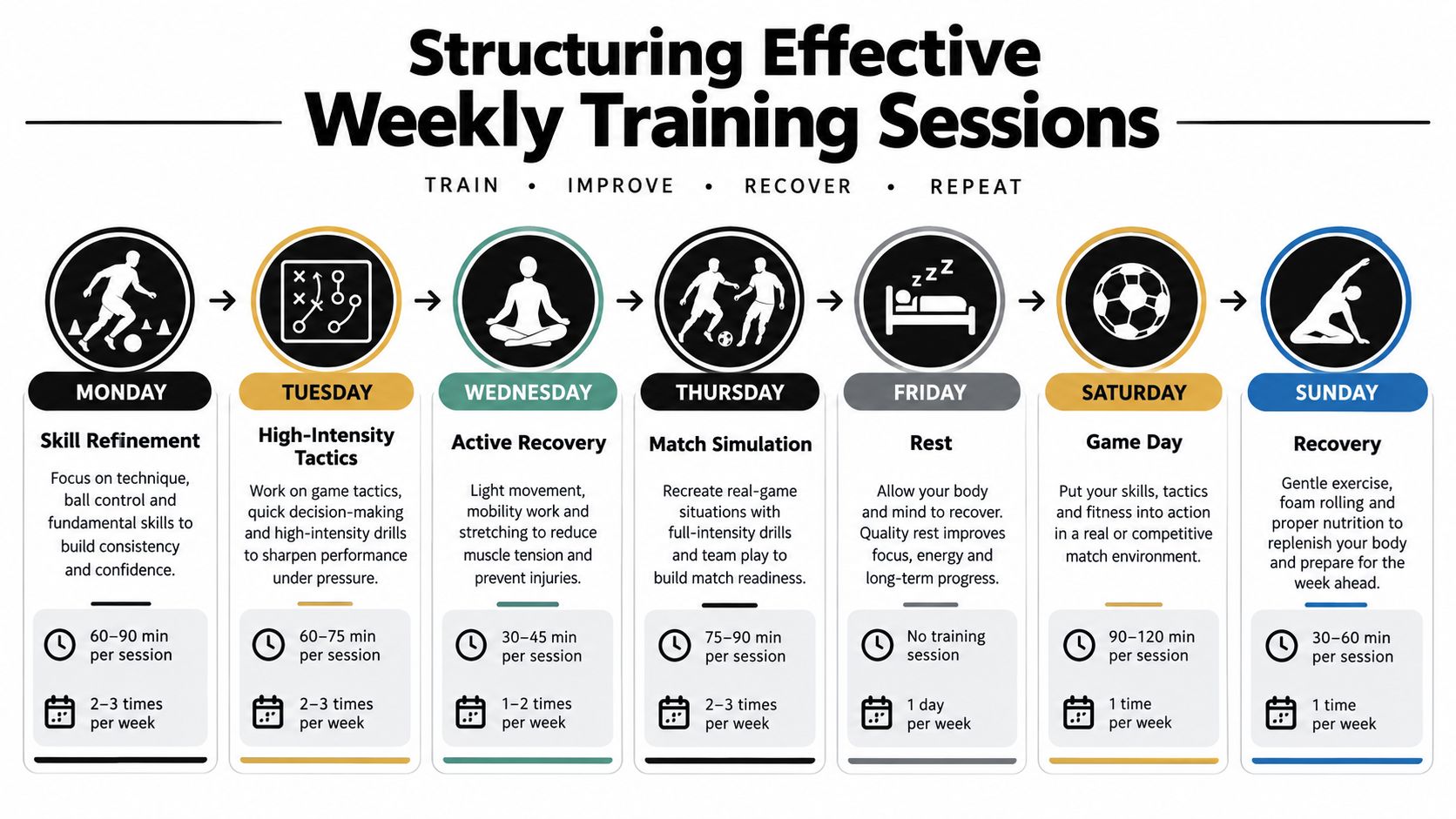
A practical seven-day rhythm
The exact schedule must respond to matches, travel, school, and the player's maturity status. A useful model might look like this:
Monday, skill refinement: Use a focused technical session with passing, receiving, turning, and weak-foot work. Keep the emphasis on quality and rhythm after the weekend.
Tuesday, high-intensity tactics: Use small-sided games, pressing cues, transition moments, and overload scenarios. This is a suitable day for demanding decision-making if the player is recovered.
Wednesday, active recovery: Reduce intensity. Include mobility, light ball work, and discussion of match decisions rather than adding another hard session.
Thursday, match simulation: Rehearse the team's game model through larger game forms and position rotation. Connect individual actions to the team's attacking and defending principles.
Friday, rest or short reset: Avoid adding volume just because a player feels guilty about resting. A short, easy ball session may be appropriate for some athletes, while complete rest may be better for others.
Saturday, game day: Evaluate choices, communication, and response to changing situations, not only goals, assists, or playing time.
Sunday, recovery: Use easy movement, family activity, or rest according to fatigue and the demands of the match.
Players also benefit from setting process goals, such as scanning before receiving or communicating during defensive transitions. Parents who want help making those goals age-appropriate can use this goal-setting guide for children as a practical starting point.
A session should finish with a short review. Ask the player what they noticed, which decision they would change, and what action they want to repeat. That conversation turns practice into learning rather than simple exertion.
Managing Growth Spurts and Injury Prevention
The most important adjustment during adolescence is often not a new drill. It's a change in load.
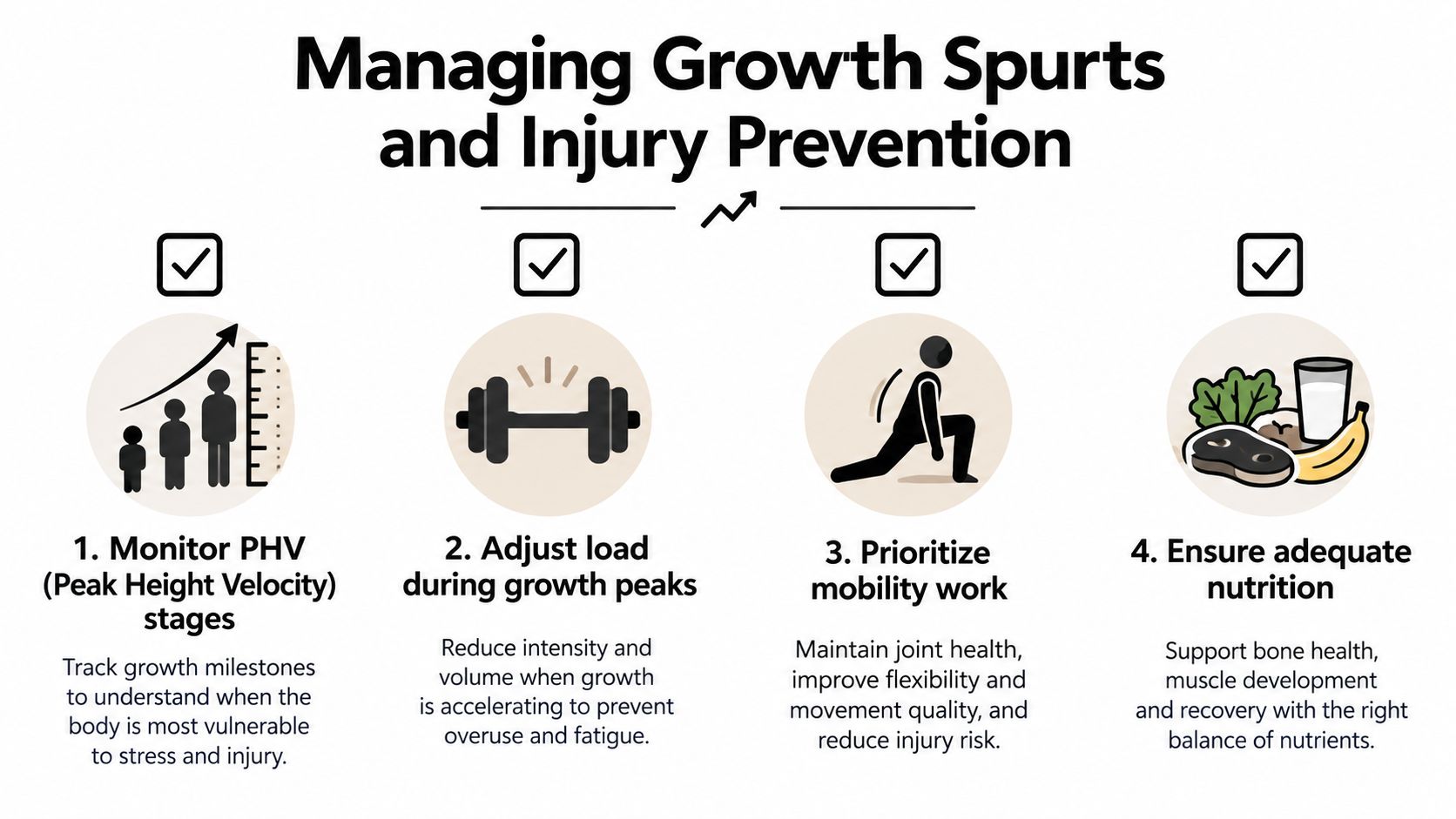
Peak height velocity, commonly called PHV, is the period when a young person's height increases most rapidly. Reviews of adolescent soccer identify this window as a consistently high-risk period for overuse injuries, particularly when rapid growth combines with high internal training loads. The review of injury prevention and monitoring in adolescent soccer recommends tracking training volume, intensity, frequency, and subjective readiness, while checking maturity status every three to four months.
A player may look fine during warm-up and still be accumulating excessive stress. Knee pain, heel pain, unusual stiffness, repeated complaints about soreness, a sudden decline in coordination, or reluctance to accelerate deserve attention. These signs don't automatically indicate a serious injury, but they do require an adult to investigate rather than telling the player to push through.
Use decision rules instead of guesswork
A coach doesn't need to remove all challenge during a growth spurt. The better approach is to alter the type, density, and timing of the challenge.
If coordination suddenly declines, reduce the complexity of the movement before reducing all soccer activity. Use larger spaces, slower demonstrations, and more controlled receiving patterns. Give the player time to rebuild timing without public criticism.
If knee or heel pain appears, stop treating it as normal training soreness. Remove painful jumping, repeated hard decelerations, and maximal acceleration until a qualified medical professional has assessed the problem. A player can often work on pain-free passing, scanning, and tactical understanding, but the exact modification must follow professional guidance.
If the player reports heavy fatigue or poor readiness, avoid consecutive hard days when possible. The adolescent soccer research review specifically advises limiting rapid load spikes and consecutive demanding sessions because reduced recovery can increase injury and illness risk.
If jumping and landing quality deteriorates, lower the volume and focus on landing mechanics, balance, and controlled strength. Don't use fatigue as a test of commitment.
Plyometrics can have a place in a well-supervised program. One review found that programs performed two days per week for eight to 10 weeks, with 72 hours of rest, were the most effective preventive format among the programs examined. That finding doesn't mean every 14-year-old should follow the same plan. It means recovery spacing and progression matter as much as exercise selection.
Keep growth monitoring practical
Parents don't need to turn the home into a laboratory. They can keep a simple record of height changes, soreness, energy, sleep quality, and the player's response to recent training. Coaches can compare the player's current movement quality with their own recent baseline rather than with a physically earlier-developing teammate.
Recent evidence also recommends monitoring growth status across the season and paying attention to training hours, not only training days. During vulnerable phases, coaches should be more cautious with jumping, acceleration, and deceleration. Hydration and food intake should support both training and growth, while persistent pain should receive qualified medical attention.
Families looking for general information about managing discomfort around the lower leg can consult this Achilles tendon support guide, but educational material can't replace assessment by a sports physician or physiotherapist. A broader soccer injury-prevention resource can also help parents prepare questions for the coaching and medical team.
Warning sign: A player who repeatedly changes how they run, lands, or strikes the ball to avoid pain needs a load review, not a motivational speech.
Balancing Soccer Demands with Sleep and Recovery
A player can complete every planned session and still be under-recovered. School deadlines, exams, travel, team selection, family commitments, and match pressure all contribute to total stress. A training calendar that counts only field time gives parents an incomplete picture.
Recent youth-athlete research found that more sleep is associated with lower anxiety and depression and better quality of life, with those effects stronger than age, gender, race or ethnicity, athletic identity, and match or training volume. The findings are summarized in the research on sleep, mental health, and youth athletes. Sleep isn't an indulgence added after development. It supports the emotional and cognitive conditions that allow development to happen.
Count the whole week
Before adding a private lesson, ask four questions:
What has the player already done? Include club training, school soccer, matches, travel, physical training, and informal play.
How demanding was each activity? A tactical walk-through and a tournament match shouldn't be treated as equal workloads.
What pressure is the player carrying? Anxiety about selection or playing time can make a normal session feel much harder.
What recovery is available afterward? A late training session followed by an early school morning may cost more than the extra touches provide.
A player who looks enthusiastic may still need a lighter day. Conversely, a player who is bored or restless may benefit from relaxed free play rather than another coached workout. Parents should ask about mood, concentration, appetite, soreness, and willingness to attend practice, not just whether the player completed the session.
Protect the quality of the work
The common argument is that extra repetition always creates extra improvement. That's only true when the player can concentrate, move well, and recover from the work. If a late private session cuts into sleep, the player may arrive at team practice with slower reactions and poorer decision-making.
U.S. soccer's increased focus on U-14 talent identification also makes this balance more important. Age 14 can be a meaningful scouting and pathway stage, but selection pressure shouldn't force families into an endless schedule. The strongest environment helps a player pursue ambition without making exhaustion the price of belonging.
Schedule hard sessions with recovery in mind, keep at least one easy period in the week, and protect time for school and family. If the player needs constant encouragement to attend, loses enjoyment, or shows persistent mood changes, treat those signals as information. The correct response may be a conversation with the coach, a temporary reduction in load, or professional support.
The Villarreal Houston Academy Development Pathway
A development pathway should give a 14-year-old more than access to difficult matches. It should teach the player how to think, train, compete, and respond to physical change. Short-term winning can hide weaknesses when a team relies on early developers, direct play, or a narrow group of physically dominant players.
An internationally aligned model places more value on transferable qualities. Players need technical security under pressure, tactical awareness, responsible habits, and the character to keep learning when the body changes. Coaches should also communicate clearly with families about load, selection, position development, and realistic next steps.
What a coherent pathway includes
A sound academy environment should connect several layers:
Technical growth: Players repeat essential actions while facing pressure, time limits, and changing angles.
Tactical intelligence: Training uses small-sided games and larger scenarios so players learn when to press, support, switch play, or protect space.
Personal development: Coaches reinforce responsibility, respect, communication, and resilience rather than measuring worth through match outcomes.
Specialist support: Sports psychology and qualified coaching can help players manage confidence, selection pressure, and the mental effects of puberty.
Progression: Families can understand how local training, competitive teams, camps, clinics, tryouts, and international experiences relate to the player's development.
Villarreal Houston Academy operates as the official partner academy of Spain's Villarreal CF in the Greater Houston area, using the Yellow Submarine methodology for boys and girls across youth age groups. Its programs include competitive teams, camps, clinics, and tryouts, with training access across communities including Humble, Cypress, Tomball, and the Kingwood, Porter, and New Caney area. The academy also describes opportunities for players to travel to Spain to train and play alongside Villarreal CF's academy.
The Villarreal CF youth academy overview gives families more context about the international development model. Parents should still ask direct questions about the specific team, coach, schedule, player evaluation process, and how the academy adjusts work during growth-related challenges.
The right pathway won't promise that every player follows the same route. It will give each player a clear next action, appropriate challenge, and room to develop at an individual biological pace.
Evaluating Your Current Training Environment
Parents can audit a soccer program without becoming technical experts. Watch one training session and look for what players do, not what the program brochure promises.
Use this checklist:
Ball involvement: Do players receive frequent touches, or do they spend long periods waiting in lines?
Decision-making: Do activities require players to scan, choose, combine, defend, and transition?
Technical balance: Does the session protect first touch, passing, receiving, dribbling, and finishing while introducing tactical problems?
Coach attention: Can the coach observe individual movement and provide useful feedback?
Growth awareness: Does staff ask about pain, fatigue, growth-related coordination changes, and readiness?
Load planning: Does the club coordinate demanding sessions, matches, tournaments, and outside commitments?
Player welfare: Can athletes raise concerns about anxiety, confidence, selection pressure, or loss of enjoyment?
Development language: Does the coach explain progress through actions and decisions, rather than only goals, wins, or physical dominance?
Ask your 14-year-old what they learned, not just whether practice was hard. A strong answer might involve recognizing a pressing cue, improving the first touch away from pressure, or understanding how to support a teammate. Those answers reveal learning more clearly than sweat or exhaustion.
Villarreal Houston Academy offers age-appropriate teams, camps, clinics, tryouts, and competitive development guided by Villarreal CF methodology, with a focus on intelligence, skill, character, and a safe training environment. Visit Villarreal Houston Academy to explore programs in the Greater Houston area and find the next step for your player's development.
Comments