


8 Soccer Camps in Summer: Houston Families’ Guide

Choosing among soccer camps in summer depends less on a program’s name than on its fit for the player. This roundup compares Greater Houston options by age range, training purpose, schedule format, location access, stated or supplied cost, intensity, and next-step opportunities.
Villarreal Houston Academy provides a useful North Houston access framework, with programs across Humble, Fall Creek, Cypress, Tomball, and the Kingwood- Porter- New Caney area. That coverage can help families weigh drive time alongside coaching and curriculum.
Use this quick guide:
Beginners: Prioritize enjoyment, confidence, and positive first experiences.
Developing players: Look for repeated technical work with the ball.
Competitive athletes: Consider select-team tryouts or tournament preparation.
Goalkeepers: Choose sessions built around position-specific training.
Families seeking a broader pathway: Review parent workshops and Spain training opportunities.
Each entry explains what the camp is designed to accomplish, who benefits most, and what to check before registering, including daily timing, costs, and follow-up options.
The best camp matches a player’s developmental stage, not simply its prestige.
That distinction matters for players ages 4-18, aspiring select athletes, coaches studying Villarreal CF methodology, and families considering year-round development or international training.
1. Elite European Methodology Day Camps
Villarreal Houston Academy brings Villarreal CF’s Spanish development approach to local soccer camps in summer. Players ages 6-18 work through age-based progressions that combine technical control, tactical awareness, and character building. Rather than repeating isolated drills, coaches use rondos and small-sided games to make players scan, choose, and react under pressure.
Typical sessions run from 9 a.m. to noon, with full-day options available. Houston-area families can learn more and check current schedules at Villarreal Houston Academy.
Choose a multi-week camp if your player needs repeated game situations to turn new techniques into reliable habits.
The academy reports camps attracting more than 200 participants annually, with some players progressing into competitive teams. Multi-week attendees may show clearer gains in first touch, passing decisions, positioning, and game understanding.
This comparison shows the main differences between local day camps and a Spain training tour:
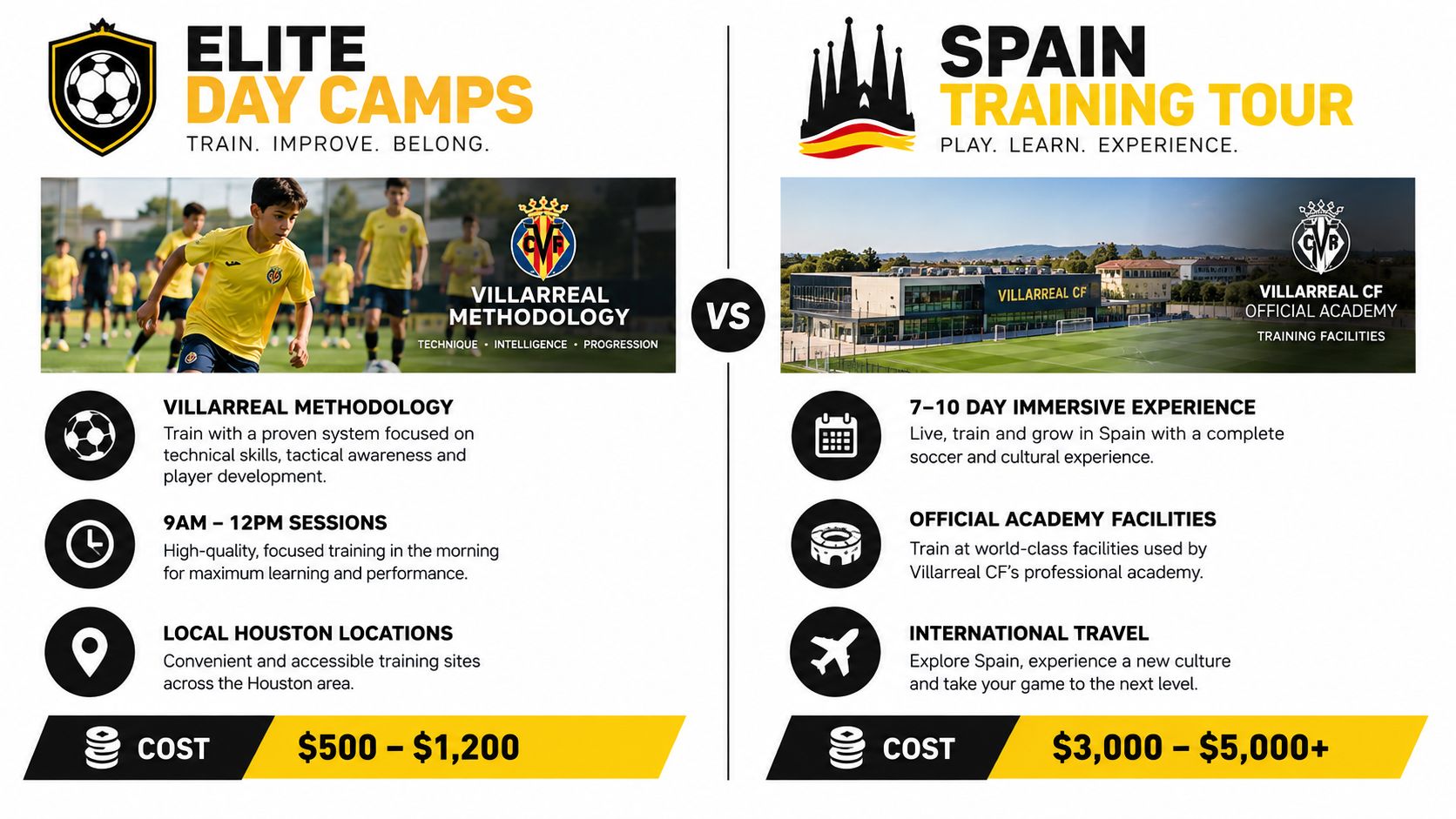
Day camps cost less and fit regular family schedules, while the Spain tour offers deeper immersion at a much higher price.
Before registering:
Reserve early, especially for U10-U14 groups.
Match the camp level to your child’s goals.
Add conditioning beforehand so fatigue does not limit learning.
Ask coaches about progression into select teams.
2. Competitive Select Team Tryout Camps
Villarreal Houston Academy’s select team tryout camps are intensive soccer camps in summer for players pursuing higher-level competition. Coaches assess technical ability, tactical understanding, physical capacity, and mental resilience through training exercises and competitive match play. Players receive feedback and a clearer route toward academy team placement.
These camps suit athletes ready for regional tournaments, travel teams, and year-round development. Villarreal Houston Academy select teams have helped players progress into tournament competition, while some U14 participants have drawn college recruitment attention. Learn more about select soccer teams in Houston.
Treat tryouts as an evaluation and a learning opportunity, not just a one-day decision about team placement.
Before attending, players should:
Build conditioning gradually so fatigue does not affect performance.
Review Villarreal CF’s player-development approach.
Attend an open clinic to become familiar with the coaching staff.
Request feedback after the evaluation.
Try again next season if the first attempt does not result in selection.
This option deserves consideration when a player wants measurable feedback and a direct pathway into competitive soccer. Training beforehand should include small-sided games, repeated sprint work, first-touch practice, and decision-making under pressure.
3. Technical Skills Bootcamp Intensives
Technical Skills Bootcamp Intensives give players concentrated repetitions in ball mastery, first touch, dribbling, and passing accuracy. Spanish academy programs, including Villarreal CF’s youth methodology, often place skill development before complex tactics, using stations, rondos, and small-sided games that require quick control and decisions.
These soccer camps in summer suit U8-U10 players building confidence and older athletes correcting weaknesses before select-team tryouts. A player struggling with the weaker foot, for example, can receive repeated passing and receiving work instead of spreading practice across too many topics.
Set one measurable target, such as completing 30 accurate weak-foot passes, and track it between sessions.
Parents can help players gain more from the intensive format by:
Repeating assigned drills at home between camp days.
Filming short sessions for review with a coach.
Pairing technical training with a later tactical clinic.
Scheduling the bootcamp before competitive team evaluations.
Young players often show faster ball control, while graduates may enter competitive programs with cleaner first touches and more reliable passing. The approach works best when families commit to practice outside camp and choose a program with clear progressions rather than random drills.
4. Spain Training Tour Experience Camps
Spain Training Tour Experience Camps take soccer camps in summer beyond Houston, placing players ages 10-18 inside Villarreal CF’s academy environment for 7-10 days. Participants train alongside Spanish academy players, play competitive matches, tour professional facilities, and experience coaching standards that demand quick decisions and technical precision.
Villarreal Houston Academy players often return with greater confidence, sharper technique, and stronger awareness of different playing styles. Families can learn more about international soccer training, while a family travel guide offers expert advice for Spain families planning the trip.
Choose this experience when your player is ready for intensive training, cultural exchange, and competition outside the usual local setting.
The international setting may also support select-team placement or generate college recruitment interest, especially when players apply lessons after returning home.
Before registering:
Begin planning four to six months ahead for visas and logistics.
Prepare physically with prior-season training.
Learn basic Spanish football terms.
Coordinate with traveling players before departure.
Keep a journal, then debrief with coaches after returning.
5. Goalkeeper Specialist Camps
Goalkeeper specialist camps give young keepers focused instruction that general soccer camps in summer may not provide. Sessions typically cover set position, footwork, handling, diving technique, distribution, positioning, communication, and decision-making, with coaches offering individual corrections throughout the day.

Villarreal Houston Academy’s goalkeeper training reflects European position-specific methods. Players can work on playing out from the back, organizing defenders, and responding after mistakes. Families can learn more about goalkeeper soccer training.
Choose a specialist camp when your player needs repeated goalkeeper reps, not just occasional turns in goal during team practice.
A keeper who improves distribution accuracy and positioning can earn more starts or move into a select-team goalkeeper role. Training may also support stronger save percentages, communication, and confidence under pressure.
Before registering:
Check that gloves, cleats, and protective equipment fit correctly.
Practice basic footwork and short distribution at home.
Add field-player clinics to understand passing lanes and defensive expectations.
Record selected sessions for review with a coach.
Ask how coaches build leadership and communication skills.
Confirm whether the camp suits beginners, experienced keepers, or both.
6. Parent & Family Integration Workshops
Parent and family integration workshops pair player training with practical education for guardians. During these soccer camps in summer, children train with academy coaches while adults attend sessions on Villarreal methodology, nutrition, sports psychology, competition mentality, and college recruitment. Families can explore Villarreal Houston Academy for current program details.
Parents may leave with a clearer view of a four-year development pathway and learn how to replace sideline criticism with specific, constructive feedback. Psychology-informed guidance can also reduce performance anxiety by helping adults support effort, preparation, and player autonomy.
The best support gives players informed guidance without taking ownership of their soccer away from them.
After each session, discuss one takeaway with your child and try one strategy at home. Ask coaches targeted questions about technical progress, position changes, and next-step teams. Taking notes on recruitment timelines can also help families plan realistically for high school and college opportunities.
Before registering:
Confirm whether parent workshops run concurrently with player training.
Ask for a sample agenda and coaching credentials.
Share workshop lessons with other caregivers at home.
Record questions about development pathways and tryouts.
Respect your child’s goals while offering informed support.
7. Beginning/Recreational Development Camps
Beginning and recreational soccer camps in summer give children ages 4-8 a relaxed first experience with the sport. Sessions use playful activities, movement games, simple dribbling, and small-sided play to build coordination, confidence, and basic teamwork without competitive pressure.
For young players, success may mean joining a game, stopping the ball, or making a new friend. Villarreal Houston Academy’s youth development initiation reflects a Spanish age-based approach that introduces skills through play and positive reinforcement. Families can review current camp options and schedules at Villarreal Houston Academy.
Choose a beginning camp when your child needs enjoyment and confidence before formal competition or select-team training.
Children ages 4-6 benefit from groups of roughly 8-10 players per coach. After one or two seasons, recreational campers may be ready for more advanced clinics, academy sessions, or team evaluations.
Before registering:
Look for “beginning” or “recreational” in the camp description.
Confirm that coaches prioritize fun and encouragement.
Pack comfortable athletic clothing, water, and properly fitted cleats.
Set realistic expectations: participation and enthusiasm matter more than technique.
Take photos or short videos to celebrate progress afterward.
Ask about the next program level for the following season.
8. Tournament Preparation & Match Strategy Camps
Tournament-focused clinics prepare competitive players for the demands of match day. These specialized soccer camps in summer use opponent analysis, set-piece rehearsals, pressure scenarios, and tactical games to connect training habits with tournament decisions.
Villarreal CF’s match-preparation methodology places attention on positioning, game management, and mental readiness. Teams may improve results after addressing weaknesses from a previous event, while repeated corner and free-kick practice can produce more dangerous scoring chances.
Schedule this type of camp two to four weeks before a major tournament, leaving enough time to recover and apply the lessons.
Before registering, ask whether coaches can review match video, study a known opponent, and build sessions around your team’s specific problems. Players should also visualize key situations daily and practice assigned set pieces at home. Families may find a soccer tournament wagon with bench useful for organizing tournament-day equipment and rest.
Before registering:
Bring video or notes from the last tournament.
Practice corners, free kicks, and defensive restarts between sessions.
Review training footage for positioning errors.
Allow recovery time before the first tournament match.
8 Summer Soccer Camp Options Compared
Camp Type | Implementation Complexity 🔄 | Resource Requirements ⚡ | Expected Outcomes 📊 | Ideal Use Cases 💡 | Key Advantages ⭐ |
|---|---|---|---|---|---|
Elite European Methodology Day Camps | Moderate; structured age-based training with small groups | Local facilities, certified coaches, 9 a.m.–noon or full-day attendance | Improved technical skills, decision-making, confidence, and game intelligence | Players ages 6–18 seeking European methods without international travel | High-quality methodology, flexible scheduling, convenient locations, progressive development |
Competitive Select Team Tryout Camps | High; combines training, match play, evaluation, and placement | Elite coaches, assessment systems, physical preparation, significant follow-up commitment | Player evaluations, team-placement opportunities, and competitive progression | Competitive players ages 8–18 pursuing select or travel teams | Clear pathway to elite teams, professional feedback, competitive exposure |
Technical Skills Bootcamp Intensives | Moderate to high; repetition-based stations and progressive drills | Specialized coaches, training stations, balls, video-analysis tools, focused attendance | Faster improvement in ball mastery, first touch, dribbling, and passing | Recreational or competitive players ages 4–18 addressing technical weaknesses | Measurable skill gains, broad accessibility, strong technical foundation |
Spain Training Tour Experience Camps | Very high; requires international travel, accommodation, and multi-day coordination | $3,000–$5,000+, travel documents, guardians, academy facilities, 7–10 days | Intensive development, cultural awareness, confidence, and international experience | Ambitious competitive players ages 12–18 seeking immersive European exposure | ⭐ Elite facilities, professional culture, networking, and transformative experience |
Goalkeeper Specialist Camps | Moderate to high; position-specific programming and individual feedback | Goalkeeper coaches, specialized equipment, small groups, video or match simulations | Better positioning, distribution, decision-making, communication, and confidence | Goalkeepers ages 8–18 committed to position-specific development | Dedicated expertise, individualized attention, leadership development |
Parent & Family Integration Workshops | Moderate; combines player training with coordinated educational sessions | Academy coaches, sports psychologists, nutrition specialists, workshops, family participation | Better parent-player communication, pathway clarity, and informed support | Families of players ages 6–18 navigating competitive development | 💡 Holistic education, practical guidance, family engagement, and community building |
Beginning/Recreational Development Camps | Low to moderate; play-based activities adapted for beginners | Youth coaches, small groups, basic equipment, flexible single-week attendance | Increased confidence, enjoyment, movement skills, and basic soccer familiarity | First-time players ages 4–8 and families seeking low-pressure introduction | ⭐ Fun-first environment, accessibility, social development, and low commitment |
Tournament Preparation & Match Strategy Camps | High; requires tactical planning, simulations, analysis, and timing | Competitive teams, coaching staff, video tools, tactical facilities, 2–4 weeks of preparation | Improved match readiness, set pieces, pressure management, and team cohesion | Select players ages 10–18 preparing for specific tournaments | 📊 Direct competitive application, tactical clarity, mental preparation, and leadership growth |
Turn the Shortlist Into a Summer Plan
Choosing among soccer camps in summer works best when the decision starts with the player, not the camp name. Match each option to the athlete’s:
Age and current experience
Position and clearest development need
Competitive goal, such as learning the basics, preparing for tryouts, or improving match performance
Preferred schedule and travel tolerance
Family budget
Use the Camp Type to Set the Goal
A beginning or recreational camp can provide a positive first introduction to soccer. A technical skills bootcamp makes more sense when a player needs focused work on dribbling, finishing, passing, or first touch.
Day camps built around European methodology can develop broader game intelligence through decision-making and structured play. Competitive select tryout camps and tournament preparation clinics are better fits for players pursuing higher-level teams, roster opportunities, or stronger match habits.
The Spain training tour should be treated as a major international commitment, not an automatic next step. Consider readiness, school and family schedules, travel requirements, and the player’s ability to gain from training abroad before registering.
Before paying, confirm the details directly with the provider:
Current dates, remaining availability, and exact location
Age brackets, daily hours, and supervision arrangements
Equipment requirements and what the registration fee includes
Cancellation, transfer, and weather policies
Final pricing, including any travel or optional costs
Choose one measurable summer objective, such as completing 50 controlled passes with both feet, improving goalkeeper distribution, or earning a select-team evaluation. That target will make it easier to judge progress after camp.
The best camp is not always the most intensive option. It is the one that matches the player’s current needs and gives the family a clear next step.
Contact Villarreal Houston Academy to compare summer soccer camps, training pathways, and competitive opportunities in the Houston area. Its programs can help families select an appropriate starting point, from introductory development to advanced preparation for higher-level play.
Comments