


International Soccer Training: Your 2026 Guide to Elite

Your child has come home from practice asking about a camp in Spain. You start researching and quickly find academy partnerships, short-term camps, exchange programs, tours, trials, and promises of elite exposure. The excitement is real, but so is the confusion. A famous destination doesn't automatically make a program appropriate for your child's age, readiness, recovery needs, or long-term goals.
International soccer training can be valuable when it gives a player a clear development purpose. The right experience should connect coaching, competition, education, safety, and player welfare rather than treat overseas travel as proof of progress. Families should evaluate the pathway first, then the destination.
What International Soccer Training Actually Means
Consider two players with the same travel itinerary. Both fly overseas, attend training sessions, and play matches against unfamiliar opponents. One returns with a clearer understanding of his position, useful feedback from coaches, and a plan for continuing development at home. The other returns with photos, fatigue, and no answer to the question, “What should we work on next?”
The difference is structure. International soccer training isn't just playing in another country. It can include a local academy partnership connected to a foreign club, an immersion program, an exchange placement, a tournament tour, or a carefully designed training block. Each format should have a purpose, an age-appropriate workload, qualified coaching, and a way to connect the experience to the player's normal environment.
Modern international development systems increasingly organize youth training around age-specific pathways. UEFA reports that all 55 member associations participate in its Elite Youth Player Development Programme, which supports players mainly in the U-14 to U-16 range. UEFA describes a model that combines technical, tactical, and fitness training with psychological and nutritional support, welfare oversight, and stronger links among national academies, local clubs, and schools. The programme provides €100,000 per season to each association, rising to €150,000 per season in the 2024–2028 HatTrick cycle, according to UEFA's Elite Youth Player Development Programme.
From travel experience to development pathway
That model illustrates an important change. International training used to be associated mainly with occasional exchanges, overseas tournaments, or a memorable camp. Those experiences can still help, but stronger pathways connect the training philosophy before, during, and after travel.
A family should be able to answer four questions:
What is the player learning? The programme should identify technical, tactical, physical, or psychological priorities.
Why does the international setting matter? The answer might involve a different coaching methodology, a new tactical environment, or stronger competition.
How will coaches measure progress? Feedback should be specific enough to guide home training.
What happens afterward? A useful experience changes the next stage of the player's plan.
Geography is only one part of the value. The primary benefit comes from access to a coherent development framework, repeated coaching language, meaningful competition, and a realistic progression route. For younger players, that may mean a short, supported introduction. For older athletes, it may involve deeper integration with an academy environment, provided the player can handle the workload and independence.
Practical rule: Choose the programme that explains how the experience fits your child's next season, not the one that offers the most impressive destination.
The Four Pillars of Player Development
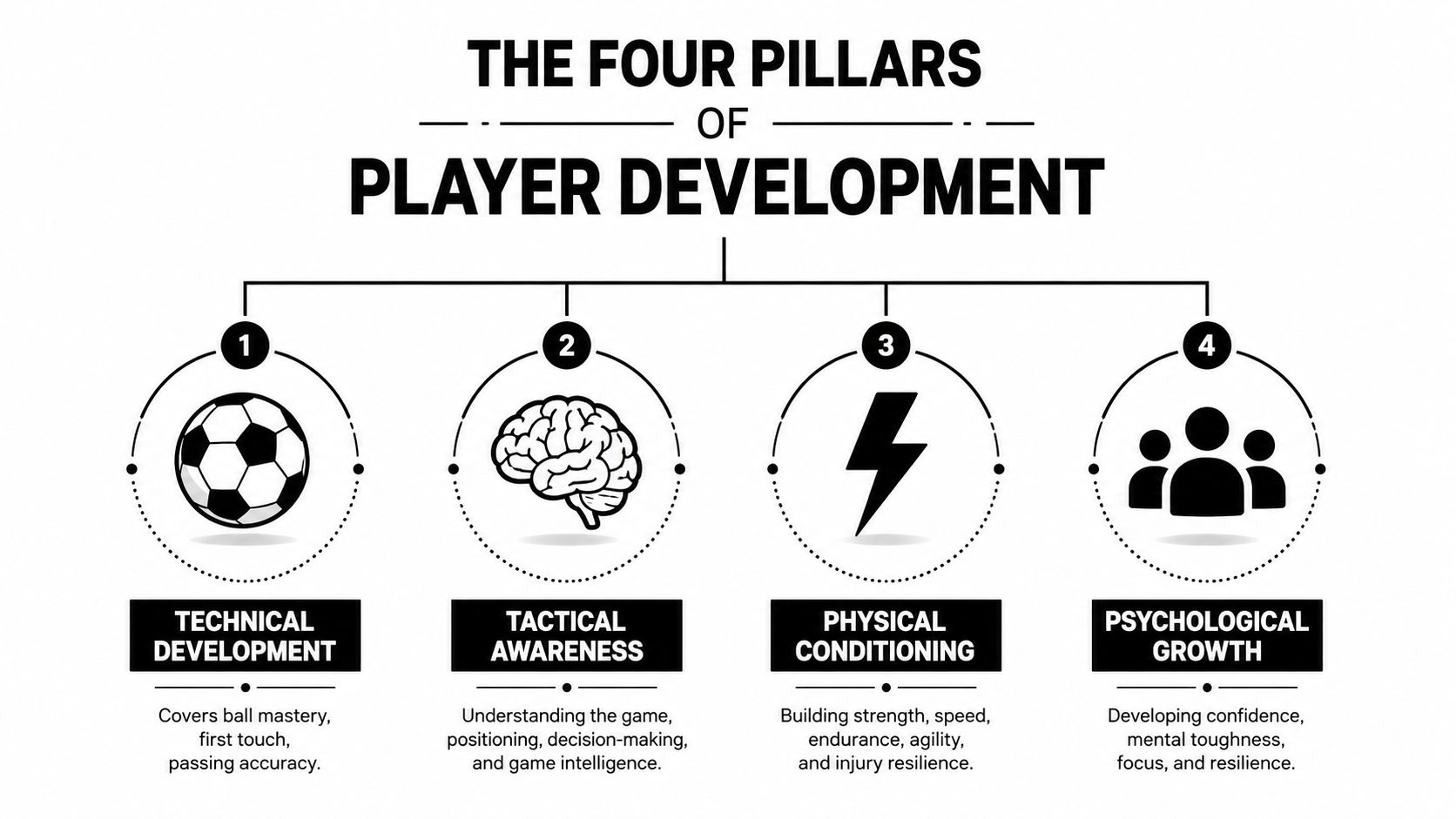
A serious international pathway develops more than a player's ability to strike a ball. Elite systems connect technical development, tactical awareness, physical conditioning, and psychological growth, then use cultural exposure to make those qualities more adaptable in unfamiliar environments.
Technical development
Technical work includes ball mastery, first touch, passing accuracy, receiving under pressure, and position-specific execution. A player may know how to complete a pass in a familiar local match, but international training can expose whether that technique remains reliable when opponents close space quickly or teammates use different movement cues.
Small-sided games are especially useful here. A 2025 study of highly trained youth players reported improvements in sprint performance, agility, and technical outcomes through small-sided games, including significant gains in passing accuracy and interceptions compared with circuit-style training, as detailed in the published small-sided games research. Reduced space and fewer players increase decisions, ball contacts, transitions, and pressure-based actions in the same exercise.
Tactical awareness and physical conditioning
Tactical learning asks a player to recognize space, anticipate danger, choose when to pass, and adapt to different styles of play. A Spanish academy may ask a midfielder to scan before receiving, create a third-player option, or move immediately after releasing the ball. The lesson isn't a new trick. It's a faster, more useful decision.
Physical conditioning should support those decisions. FIFA youth guidance notes that a typical session often lasts 80 to 100 minutes including the warm-up, while total daily training for young players in formation should usually remain within 120 to 150 minutes when there are two sessions in a day. The guidance also says that U-13 and U-14 players should generally have one session per day, with recovery microcycles reducing training volume for players aged 13 to 15, according to FIFA's youth football training manual.
Families planning a demanding year can use this performance plan for 2026 as a general planning resource, then adapt it with the child's coach and medical professionals.
Psychological growth and cultural exposure
Confidence grows when players receive clear feedback, solve problems, and experience manageable challenges. A player who trains in another country also learns to communicate across language barriers, respond to unfamiliar coaching styles, and stay composed when routines change.
That cultural exposure matters because professional environments rarely feel identical from week to week. Players need curiosity, humility, resilience, and the ability to absorb instruction. A programme that focuses only on technical repetition misses the habits that help a player use those skills under pressure.
Types of International Training Programs
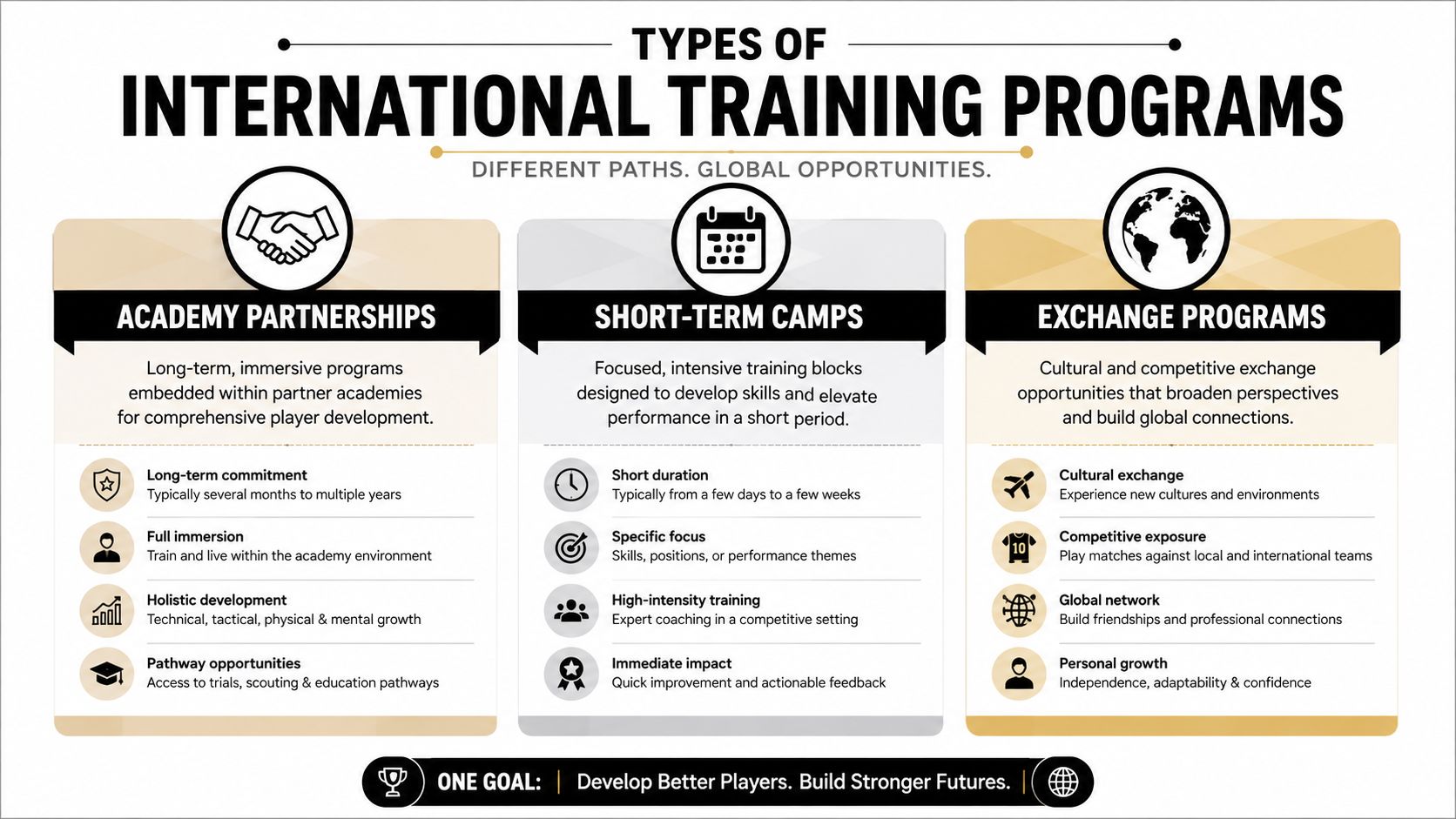
Families often compare programmes as though they were interchangeable. They aren't. An academy partnership, a short-term camp, an exchange, and a tour create different levels of continuity, supervision, competition, and disruption to school and home training.
Programme type | Best fit | Time commitment | Likely development value |
|---|---|---|---|
Academy partnership | Players seeking ongoing, structured development | Year-round local work with possible overseas progression | Consistent methodology, coach continuity, and a clearer pathway |
Short-term camp | Players seeking focused exposure or a first international experience | A concentrated training block | Feedback, new coaching ideas, and a test of readiness |
Exchange programme | Mature players comfortable adapting to a new environment | An extended stay while maintaining a home connection | Daily immersion, cultural learning, and competitive adaptation |
International tour | Teams or players who need match experience | Travel built around training, tournaments, and cultural activities | Competition under unfamiliar conditions and team growth |
How the formats differ
An academy partnership usually suits a player whose family wants development to continue at home. Coaches can observe progress over time, establish common terminology, and decide whether overseas training is appropriate. This format is more demanding for the club to deliver well, because the international connection must influence regular coaching rather than appear only in marketing.
A short-term camp can work for a recreational player who wants exposure or for a competitive player testing a new environment. It shouldn't be treated as a professional assessment unless the organizer clearly explains what coaches evaluate and how families receive feedback. Camp intensity also needs to match the player's normal training load.
An exchange programme asks more from the player and family. The athlete must manage unfamiliar routines, communication, homesickness, school responsibilities, and recovery. It can suit an older teenager with established habits, while a younger child may need a shorter, more closely supervised introduction.
An international tour blends matches with travel. That makes it enjoyable and valuable, but the schedule can become crowded. Ask whether players have meaningful recovery time and whether the coaching staff uses the matches to teach, not merely to collect results.
For families comparing pathways, this overview of European youth soccer development can help clarify how academy structures differ from one-off travel experiences. The appropriate choice depends on the player's readiness, goals, school calendar, and ability to recover.
How to Evaluate International Training Programs
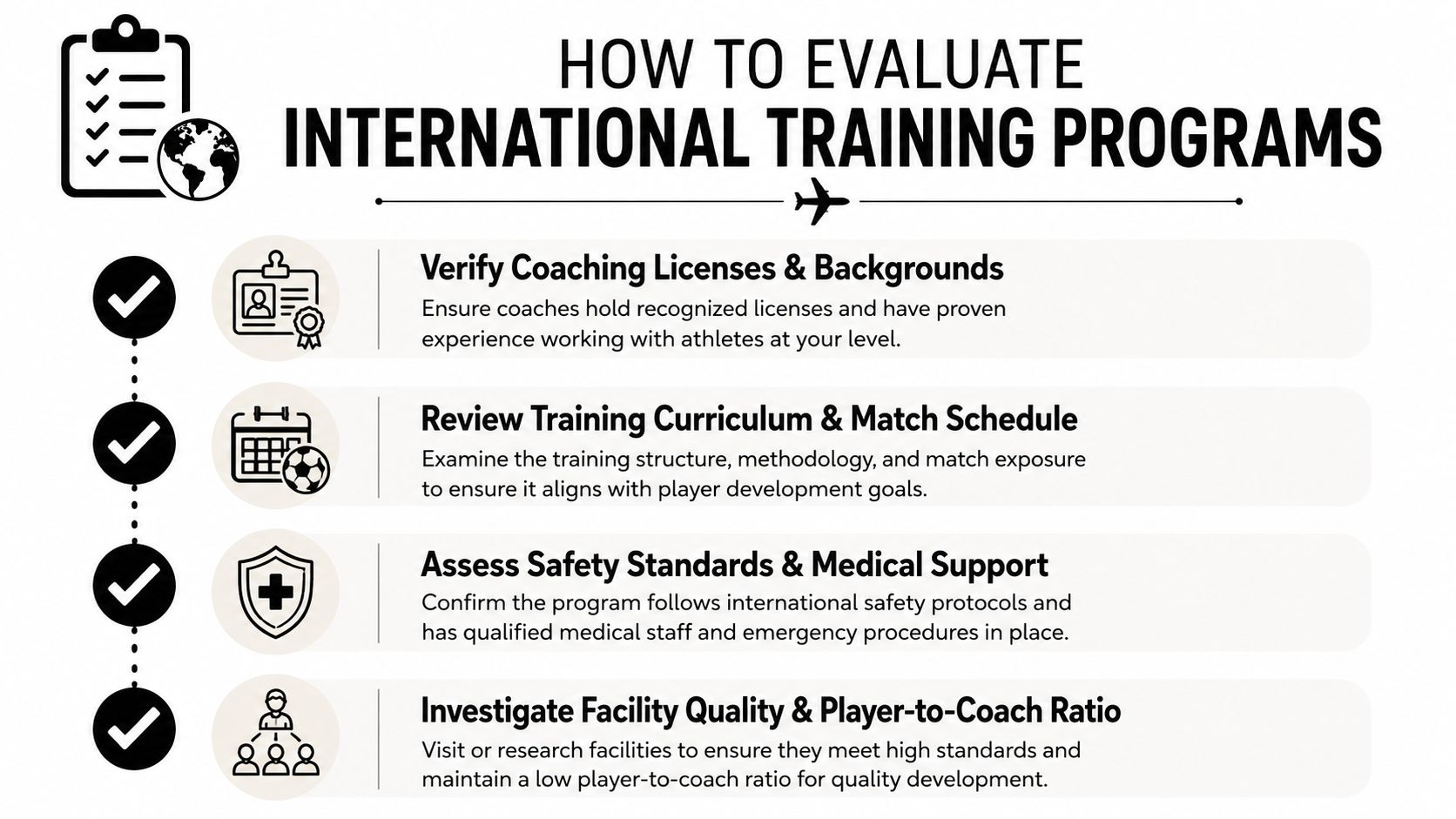
Start with the programme director, not the brochure. A polished website can describe facilities and destinations, but only a detailed conversation reveals whether the staff understands youth development.
Begin with the coaching model
Ask who will coach your child, what qualifications they hold, where they've worked, and whether the same methodology appears across local and overseas sessions. A famous club name matters less than consistent instruction. Your child should hear clear, age-appropriate coaching rather than receive disconnected drills from a different instructor every day.
Request a sample training week. Look for a balance of technical work, tactical learning, physical preparation, recovery, and match play. FIFA's guidance emphasizes age-appropriate scheduling, and its broader talent-development work highlights the importance of expanding meaningful training opportunities rather than assuming that every talented player receives equal access through FIFA's talent development resources.
Check workload, supervision, and safety
A five-season analysis of 456 player observations from a top academy found meaningful differences on match day minus three and match day minus four. U15 players showed lower session RPE, while U19 players had shorter session duration, indicating that coaches periodize workload by age and proximity to competition rather than applying one schedule to everyone, as reported in the academy workload analysis.
Ask these questions before paying:
Who supervises players off the field? Get names, responsibilities, and overnight arrangements.
What medical support exists? Confirm injury procedures, emergency contacts, and access to qualified care.
How is workload managed? Ask how coaches respond to illness, soreness, heat, poor sleep, and travel fatigue.
How are parents updated? Establish communication methods, response expectations, and escalation procedures.
What does accommodation include? Check room arrangements, meals, supervision, transport, and safeguarding policies.
A legitimate provider should answer directly and provide written policies. Vague responses about “elite intensity” or “nonstop exposure” deserve caution, especially for younger players.
Review the money and the claims
Build a complete cost sheet that separates programme fees from flights, visas, insurance, meals, local transport, equipment, and personal spending. Ask about payment schedules, cancellation terms, refunds, scholarships, and expenses that arise if a player is injured or cannot travel.
Scholarship language also requires careful reading. A genuine merit or need-based opportunity should explain eligibility, selection, deadlines, and what the award covers. Be cautious when a programme implies that attendance guarantees a contract, a professional trial, or a fixed scouting outcome.
Use this guide to top soccer development programs as one comparison point, then contact each programme directly. The strongest choice will explain its curriculum, safety plan, selection process, and follow-up without asking you to rely on prestige alone.
Preparing Your Child for International Training
Preparation should begin when the experience is still an idea. Rushing from an invitation to a departure gate can turn a promising opportunity into an avoidable physical, academic, or emotional strain.
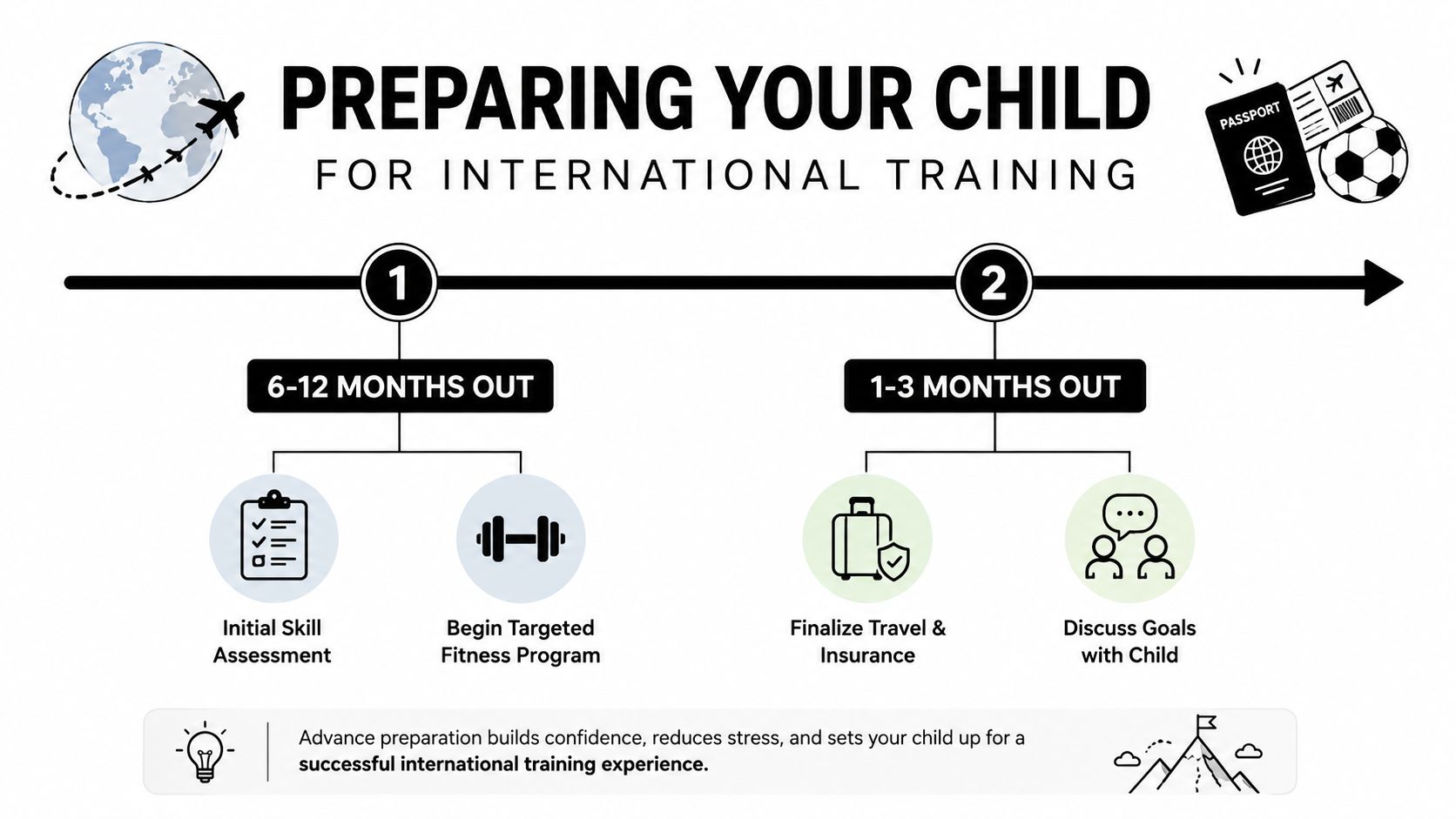
Six to twelve months before departure
Start with an honest skill assessment. Ask the player's coach to identify strengths, weaknesses, position-specific needs, and the type of international experience that matches current readiness. A player doesn't need to arrive as the finished product. The family does need a specific learning target, such as receiving with the far foot, recognizing pressure, or improving defensive positioning.
Establish a sensible fitness baseline with qualified guidance. Don't copy an adult or professional programme. The training plan should support the player's regular schedule, leave room for recovery, and account for growth, school, other sports, and existing matches.
Three to six months before departure
Move to administration. Check passport validity, visa requirements, medical clearance, vaccination records, travel insurance, medication rules, and school obligations. Ask the organizer for a written itinerary, emergency contacts, chaperone information, accommodation details, and the process for contacting your child.
School coordination matters more as the programme becomes longer. A teenager may be able to manage missed work with advance planning, while a younger player may need a shorter experience during a school break. The right travel window protects both learning and enthusiasm.
One to three months before departure
Prepare mentally and culturally. Learn basic football vocabulary used by the host coaches, discuss food and daily routines, and explain that the player may make mistakes while adapting. Set realistic goals that focus on behaviors rather than selection outcomes.
A useful goal sounds like, “I will scan before receiving and ask for clarification when I don't understand.” An unhelpful goal sounds like, “I must earn a contract.”
In the final month, confirm packing, communication, emergency procedures, and coach meetings. Younger children usually need more parental involvement and a shorter first experience. Teenagers may handle greater independence, but independence should be earned through reliable habits, not assumed because of age.
Family checkpoint: If your child can't explain what they hope to learn, how they'll recover, and who they can ask for help, the trip needs more preparation.
A Real Pathway from Houston to Spain
A local-to-international pathway gives families a way to test fit before committing to a major overseas experience. In the Greater Houston area, Villarreal Houston Academy delivers Villarreal CF's methodology through local youth programming, then creates opportunities for appropriate players to train and compete in Spain. The model matters because the relationship can continue after the trip instead of ending when the flight home lands.
A player may begin with local training, receive feedback from academy coaches, and build consistency through competitive team play. Selection for international opportunities should reflect evaluation, tournament performance, coach observation, and daily habits, not merely a parent's ability to purchase travel. Families can learn more about the club's broader structure through Villarreal CF's youth academy pathway.
What continuity changes
During a Spain experience, players may train with Villarreal CF coaches, encounter a different competitive rhythm, and work alongside academy players. The useful question isn't whether the child gets a photo at a famous facility. It's whether coaches identify transferable lessons, such as quicker scanning, better spacing, stronger receiving technique, or more disciplined defensive decisions.
The home academy then has a responsibility to help the player apply those lessons. Coaches can revisit the same concepts locally, compare performance before and after travel, and adjust the next development target. That feedback loop separates a pathway from a one-off camp.
The pathway also needs room for different outcomes. A player may return more confident, discover that a particular position fits poorly, or learn that the intensity of an extended programme isn't appropriate yet. All three outcomes can be useful when coaches and parents treat the experience as education rather than a promise of professional advancement.
For families in Houston, the practical evaluation is straightforward. Ask what local training looks like before travel, how players are selected, what happens in Spain, how education and supervision are handled, and how coaches reintegrate the player afterward. A sustainable route connects those answers into one development plan.
Common Questions About International Soccer Training
When should a child start?
There isn't one correct starting age. Younger players generally benefit from local skill development, enjoyment, and short, well-supported exposure rather than long periods away from home. An older player may be ready for a more immersive experience when they can manage recovery, communication, school responsibilities, and unfamiliar routines.
Readiness matters more than the prestige of the destination. If a child is anxious, physically overloaded, or no longer enjoying the game, postponing travel may protect development.
Can international training fit with school?
Yes, but the family must plan early. Coordinate dates with teachers, identify missed assignments, and decide how the player will maintain sleep and study routines. A programme that expects children to train constantly without considering education or recovery isn't demonstrating a complete development model.
Is the investment worthwhile?
Evaluate the learning value, not the travel story. Compare the coaching quality, player feedback, safety arrangements, competition level, follow-up support, and total cost with what your child can access locally. A shorter programme with clear objectives may be more useful than a longer trip with an overloaded schedule.
What happens afterward?
The player should return to regular training with a small number of priorities. Share the coach feedback with the home club, observe whether the child applies new habits in matches, and schedule a follow-up conversation. Progress comes from repeated application, not from the trip itself.
International training doesn't guarantee a professional contract, and younger isn't always better. More travel can also create fatigue, missed school, and pressure if the experience isn't matched to the player. When overseas training isn't suitable, local academy partnerships, high-quality small-sided training, competitive leagues, clinics, and targeted coaching can continue development without unnecessary disruption.
Villarreal Houston Academy offers local training guided by Villarreal CF methodology, competitive programming, and opportunities for suitable players to train and compete in Spain. If you're evaluating an international soccer pathway for your child in the Greater Houston area, visit Villarreal Houston Academy to explore teams, camps, clinics, tryouts, and development options.
Comments