


Travel Soccer Team Tryouts: A Complete Parent Guide

The registration window opens, and suddenly your family calendar looks like a tournament bracket. One club has a weekday evaluation, another schedules sessions across a weekend, school activities occupy the same evenings, and your child is asking whether making one roster means giving up every other option. Meanwhile, every club describes its program with different labels, fees, promises, and pathways.
That pressure is understandable. Travel soccer team tryouts are selective, time-sensitive, and emotionally loaded, but the most important decision isn't always which team offers the highest label. It's whether the environment gives your child meaningful development, appropriate challenge, confidence, and a sustainable place in the game. Youth soccer already serves a broad participation pipeline in the United States. A 2024 surveillance review found that soccer was among the most commonly reported organized sports, while high school soccer participation reached 877,956 athletes in the 2024–25 school year according to the review's cited participation data (2024 youth sports surveillance review).
The right approach is practical. Track the calendar, understand what coaches evaluate, prepare without cramming, compare pathways fairly, and treat every roster decision as information rather than a final verdict.
Why Travel Soccer Tryouts Feel Overwhelming and How to Take Control
A parent I often meet has three tabs open on a laptop, a club registration form half completed, and a child who has already attended one evaluation. The family is comparing a familiar club with a new program, trying to decode team names, and wondering whether missing one session will eliminate the player. A message arrives saying roster decisions may come soon, while another club has a registration deadline that afternoon.
The anxiety usually comes from several uncertainties arriving together:
Limited roster spots: Your child is competing in a selection process, not just signing up for a recreational team.
Conflicting calendars: Tryouts can overlap with other sports, school commitments, camps, and family obligations.
Unclear pathways: “Select,” “academy,” “competitive,” and “developmental” can mean different things from one club to another.
Emotional stakes: A child may interpret a roster decision as a judgment on talent or potential.
Those concerns deserve a system, not more frantic searching. Start by separating the decision into two questions: Can my child make this team? and Should my child want this environment? The first depends partly on current performance. The second depends on coaching, playing opportunities, schedule, cost, communication, and development fit.
Selection is a filtering process
Higher-level soccer selection narrows quickly. One U.S. youth soccer and Olympic Development Program participation summary described state-level examples involving 2,000 to 3,000 tryout participants from roughly 90,000 registered youth players, with a single age-gender group sometimes containing 100 to 300 players. The same summary reported examples in which about 23 players were selected for a final state team, with approximately 10% to 25% advancing to a state team, about 7% reaching a regional level, and the combined men's and women's national teams representing about 0.1% of registered players (U.S. youth soccer participation and ODP summary).
Those figures aren't a prediction for your child or a reason to discourage participation. They show why families should maintain perspective. A player can be developing well and still miss a particular roster because of positional needs, age-group structure, timing, or competition on that day.
Practical rule: Don't let one tryout result decide whether your child belongs in soccer. Let it inform your next decision.
Replace prestige chasing with fit
Take control by writing down the factors your family can and can't accept before registration. A prestigious name doesn't compensate for a schedule your family can't sustain, a coach who doesn't communicate, or a roster where your child rarely plays or learns.
Your decision should account for:
Development: Does training teach technical execution, tactical understanding, and decision-making?
Role: Will coaches explain the player's likely position, expectations, and route for improvement?
Access: Can your family consistently reach training and matches without creating chronic stress?
Pathway: Does the club explain movement between teams, future evaluations, and alternative entry points?
Child's response: Does the environment make your child eager to train, compete, and recover after mistakes?
That framework turns tryout season from a status contest into a family decision. You still want your child to perform well, but you won't confuse the loudest label with the best long-term choice.
Finding and Registering for the Right Tryouts
A family can register for three tryouts in one week, then discover that two overlap with school events and the third requires a long weekly drive. Finding an opportunity is easy. Choosing one your child can attend consistently, afford financially, and use for meaningful development requires a plan.
Start with official club websites, state association calendars, email lists, and social channels. Local parent networks can point you toward programs, but treat recommendations as leads. Read the club's own instructions before registering.
Tryout windows usually gather around roster planning for the next season. Clubs may later announce supplemental evaluations when spaces open. Monitor several programs early instead of waiting for one preferred club to publish every detail.
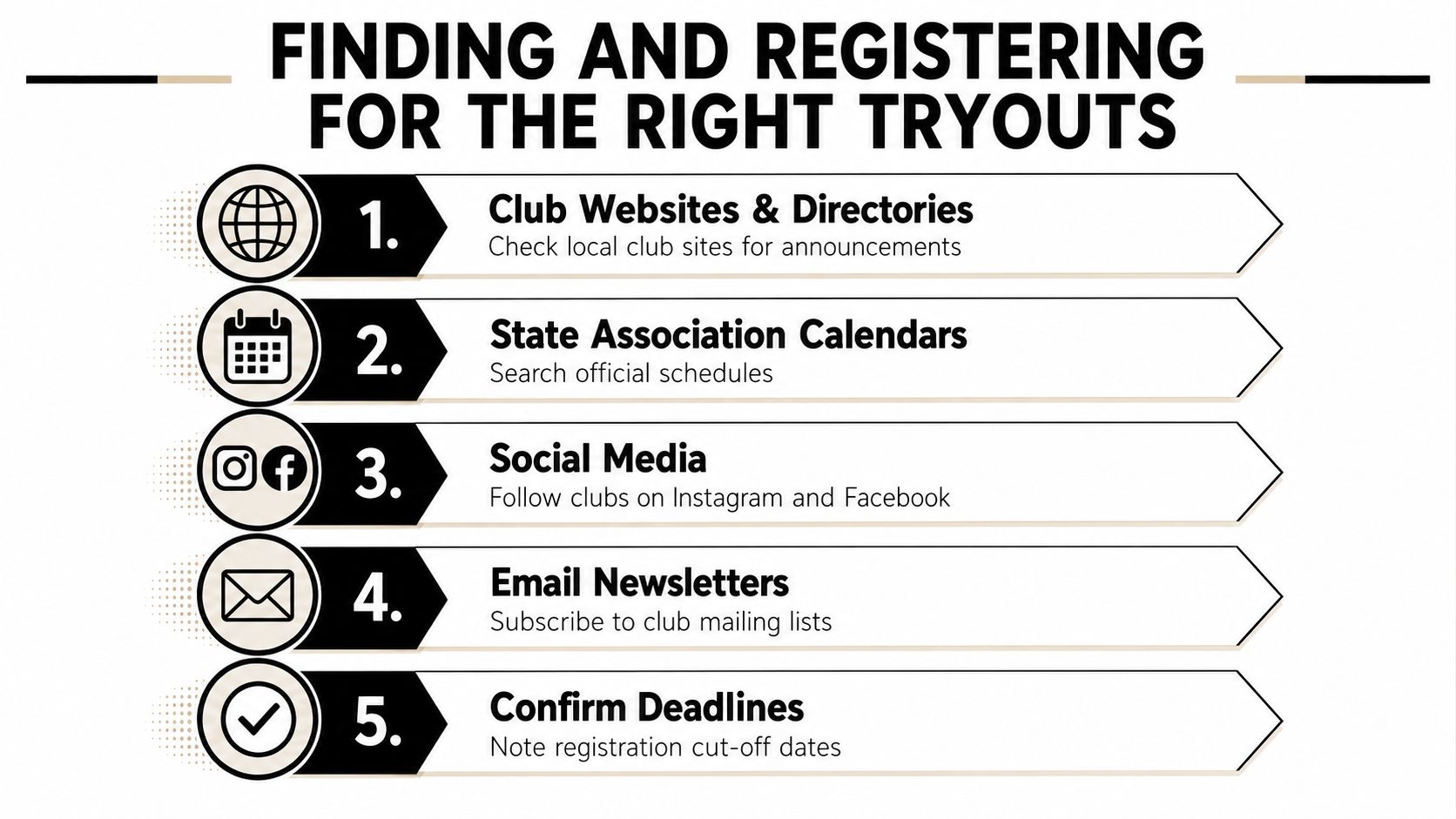
Use a registration checklist
Create one row for each club and one calendar entry for every session. A shared spreadsheet or phone note keeps the family aligned and prevents a confirmation email from being mistaken for a completed registration.
Find the official notice: Record the published age groups, locations, session dates, and registration instructions.
Verify the age group: Check the birth-year or age-band rule. Team names can be misleading.
Complete the player profile: Enter the player's position, current club, contact details, and background information accurately.
Review requirements: Confirm medical forms, waivers, equipment, attendance rules, and required documents.
Confirm payment and attendance: Save the confirmation email, registration number, receipt, and check-in instructions.
Add reminders: Record cutoff dates, arrival times, parking details, and the date the club expects to communicate decisions.
FAQ pages reveal the practical issues families must settle before tryout day, including missed sessions, paperwork, fees, in-house registration, and conflicts with other sports (club tryout FAQ example).
Research the environment before paying
Do not let a select label make the decision for you. Read coaching biographies, training descriptions, team pages, policies, and player-development information. Find out how often teams train, how rosters are formed, whether players can move between levels, and what happens when a child needs a different challenge.
A soccer club membership guide from Villarreal Houston can help families organize questions about fit and enrollment. Apply that same standard to every program. A polished website does not prove that the environment suits your child.
Check the calendar against school, family, and other-sport commitments before paying. Then ask the club:
What happens if a player misses one evaluation session?
When will roster decisions be communicated?
What fees are due, and when?
Are camps, clinics, or later assessment opportunities available?
How does the program support players who develop at different paces?
How does it handle multi-sport athletes and schedule conflicts?
Clear answers show practical organization. Evasive answers are a warning. Choose the program your family can sustain and your child can use, not just the program with the most competitive label.
What Coaches Actually Look for During Tryouts
Coaches aren't selecting a highlight reel. They're evaluating how a player solves football problems repeatedly, with teammates, under pressure, and after something goes wrong.
Technical ability remains essential. Coaches watch the first touch, passing quality, ball control, dribbling choices, receiving posture, and the player's ability to execute when an opponent closes space. Tactical awareness shows up in less obvious moments: scanning before receiving, recognizing space, offering a useful angle, selecting the appropriate pass, and recovering position after possession changes.
Physical qualities matter, especially short acceleration. A longitudinal academy study found that 30-meter sprint speed was the strongest overall predictor of selection, correctly classifying 72.7% of U10 athletes and 77.6% of U11 athletes. In its U12 example, players faster than 4.845 seconds had an 82.4% selection chance, compared with 16.6% for players slower than 5.035 seconds (longitudinal academy selection study). That doesn't mean speed guarantees a place. It means a club using short acceleration tests alongside game observation may be applying a more evidence-based process than relying only on an all-around impression.
A separate prospective youth-soccer study reported future selection success of only about 9% overall, while selected players still outperformed non-selected players in tactical skills, kicking skills, and sprint performance, with prognostic effect sizes of at least moderate strength, d ≥ 0.61 (prospective youth soccer selection study). The practical message is blunt: one spectacular drill won't carry a player through the process.
Coaches compare observable behaviors
Small-sided games, technical stations, and full-field scrimmages reveal different information. A station may expose a player's repeatable technique. A small-sided game shows speed of thought and involvement. A larger scrimmage reveals positioning, defensive responsibility, communication, and whether a player understands the team's shape.
What Coaches Actually Evaluate | Common Misconceptions |
|---|---|
First touch, passing, receiving, and control under pressure | Fancy moves automatically earn a roster place |
Scanning, positioning, decision-making, and space awareness | The player who scores most must be the best player |
Acceleration, agility, movement quality, and repeat effort | The biggest or fastest player is always preferred |
Communication, coachability, resilience, and team behavior | Quietness means a player lacks confidence |
Defensive recovery, support for teammates, and response to mistakes | Attacking moments are all that matter |
Match actions across different formats | One isolated drill determines the whole evaluation |
A 2025 academy study cited in the research brief found selection differences in match ratings, left-foot use, pass frequency, successful aerial duels, and accurate crosses. Those findings reinforce a point parents often miss: in-context actions can matter as much as isolated technique.
The player coaches remember
Players stand out when they listen quickly, attempt the instruction, communicate respectfully, and stay engaged after losing the ball. Body language matters because it tells coaches how the player may respond to correction, competition, and adversity.
Parents shouldn't coach from the sideline or ask the player to force a goal-scoring moment. Encourage simple priorities: scan, make the next useful action, defend when possession is lost, and support teammates. Coaches can see effort without theatrical behavior.
Age-Specific Preparation Drills and Timelines
Preparation should build repeatable habits, not create a fitness panic. Start roughly 6 to 8 weeks before tryouts, then use moderate, consistent work that fits the player's age, school schedule, current training load, and recovery needs.
For U9 to U12 players, prioritize touches and confidence. A wall provides a reliable partner for passing and receiving. A small space supports dribbling patterns, changes of direction, and controlled 1v1 moves. Older players should still polish technique, but they also need exercises that connect technique to decisions.
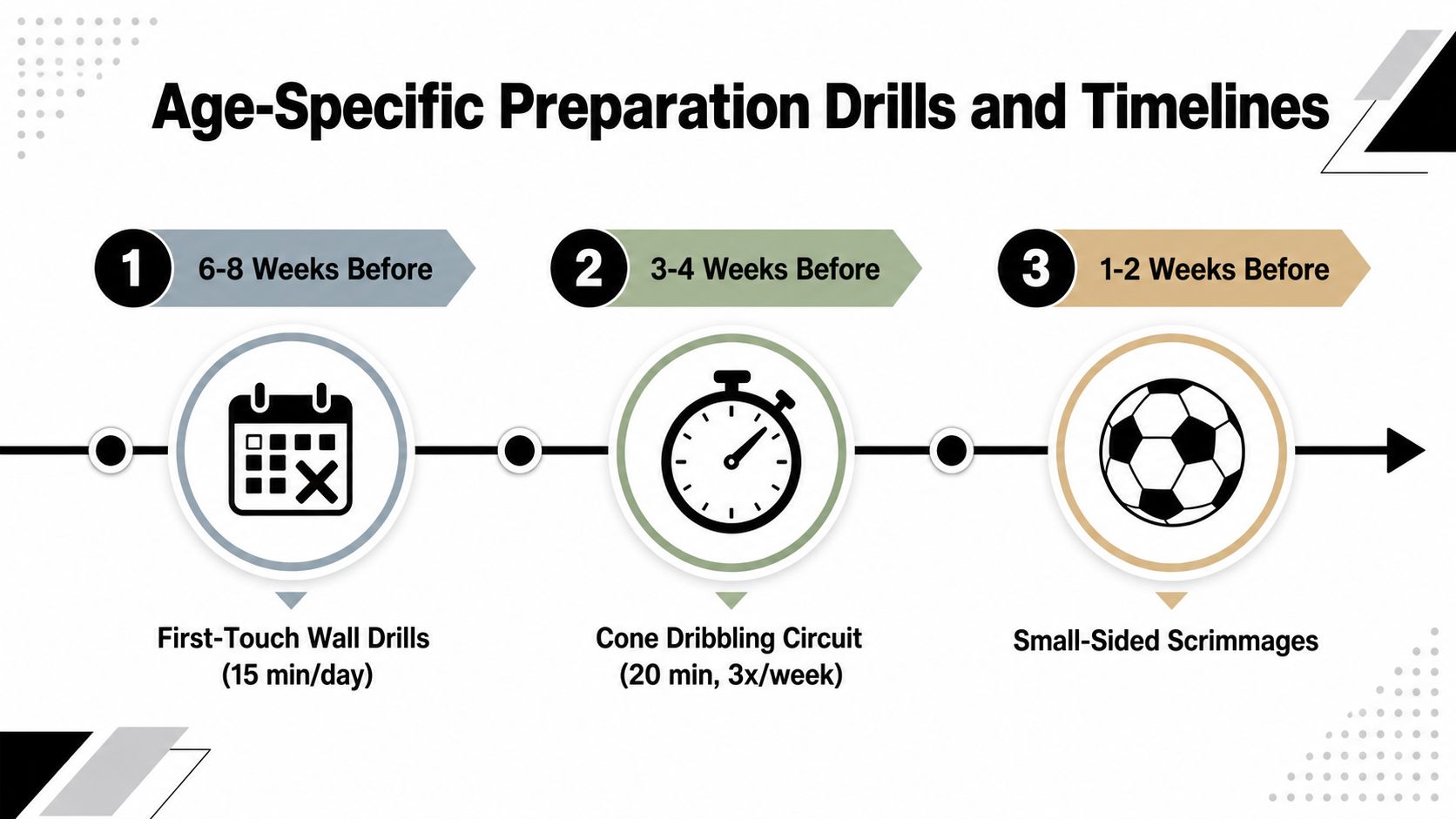
A practical preparation sequence
Weeks 6 to 8: Build a technical base. Younger players can alternate inside-foot passes, receiving across the body, and controlled turns against a wall. Add cone dribbling with both feet, then finish with a short 1v1 move against a parent or sibling. U13 to U16 players should include scanning before receiving, positional rondos, and passing exercises that require a decision before the ball arrives.
Weeks 3 to 4: Add game context. Use small-sided games, directional targets, and transition exercises. Ask older players to identify the next pass before receiving, check their shoulder, and react immediately after a turnover. Fitness should come through soccer actions and controlled running, not punishment sessions.
Weeks 1 to 2: Reduce volume and protect sharpness. Keep touches crisp, play short competitive games, and rehearse the pre-tryout routine. Avoid adding hard conditioning or unfamiliar drills. The player should arrive fresh, not sore.
This age split is consistent with the principle that development should match the athlete's stage. Families can find an age-oriented explanation of training priorities in this soccer development by age resource.
Drills that need little equipment
Wall receiving: Pass with the right foot, receive with the left across the body, and play the next pass. Progress by receiving at an angle or checking away before the ball returns.
Cone gates: Place objects as gates rather than building a complicated course. Dribble through one gate, change direction, accelerate to the next, and use both feet.
Scanning rondo: A parent points to a target before the player receives. The player checks the target, receives, and passes toward it.
Transition game: Create two small goals. After losing the ball, the player must recover immediately before attacking again.
Decision finish: A parent calls a color, number, or direction as the player approaches the ball. The player chooses the appropriate turn, pass, or finish.
Recovery is part of preparation. Use a normal meal pattern, drink water regularly, sleep consistently, and stop a session when pain changes movement. On tryout day, a familiar light meal and steady hydration are safer choices than experimenting with supplements or a heavy breakfast. A young player who feels ill, unusually fatigued, or injured needs an adult decision, not pressure to prove toughness.
Choosing the Right Development Pathway for Your Child
A top roster can look like the obvious choice on tryout day. It may be the wrong choice if your child spends the season watching, receives little feedback, and stops enjoying training. A slightly less advanced team can offer more meaningful minutes, more decisions with the ball, and clearer coaching.
Compare each pathway by the experience it provides every week:
Evaluation Factor | Green Flags | Red Flags |
|---|---|---|
Coaching quality | Coaches explain decisions, correct behavior, and teach the game | Coaches focus on winning while offering little instruction |
Training design | Sessions include technical work, decision-making, and age-appropriate competition | Every session looks like conditioning or unstructured scrimmaging |
Player movement | The club explains how athletes can move between teams as they develop | Team placement feels permanent or secretive |
Playing opportunity | The coach explains role, expectations, and realistic competition for minutes | Families hear only about prestige, rankings, or trophies |
Communication | Staff answer schedule, fee, attendance, and feedback questions clearly | Important information arrives late or changes without explanation |
Long-term fit | The pathway accounts for maturation, injuries, and multi-sport participation | The program treats current status as a permanent judgment |
Ask the director what happens if a player is not ready for the top roster. A credible plan could include targeted training, placement on another team, a camp, a later evaluation, or a scheduled review. “They'll have to prove themselves” describes pressure, not development.
Measure the daily experience
For younger players, give serious weight to enthusiasm and willingness to learn. For older players, ask how the club handles physical maturation, position changes, injuries, academic demands, and late-developing athletes. A program that rewards early physical maturity can overlook players whose technical and tactical abilities emerge later.
Calculate the opportunity cost before accepting a roster spot. Compare the weekly commitment with schoolwork, family travel, other sports, and recovery. Tryout attendance can also create conflicts with existing activities, so decide in advance which absences the club permits and which sessions are required. Get those expectations in writing if the schedule is unclear.
A select label does not justify every sacrifice. If the commute, fees, training load, or missed activities leave little room for school, rest, or family life, the pathway may not serve your child. Ask whether the added demands produce better coaching and learning, or only a more competitive name.
Ask about the actual curriculum
A serious program should explain what it teaches at the player's age, how coaches assess progress, and how developmental teams connect to competitive teams. Villarreal Houston Academy describes a structured pathway with age-appropriate training, qualified coaches, sports-psychology support, competitive teams, camps, clinics, and opportunities connected to Villarreal CF's academy in Spain. Use that as an example to investigate, not as a substitute for your own questions.
Ask for a clear explanation of the training environment, player movement, feedback process, and likely role. The most useful question is simple: What will my child learn here that they aren't learning now? If the answer is only “more competitive games,” keep looking.
Tryout Day Execution and What Comes Next
Tryout day should feel organized before the player steps onto the field. Pack the familiar boots, shin guards, water, appropriate clothing, and a backup layer. Eat a normal light meal with enough time to settle, arrive early enough to find the field and check in, and let the player complete a dynamic warm-up rather than exhausting themselves before evaluation.
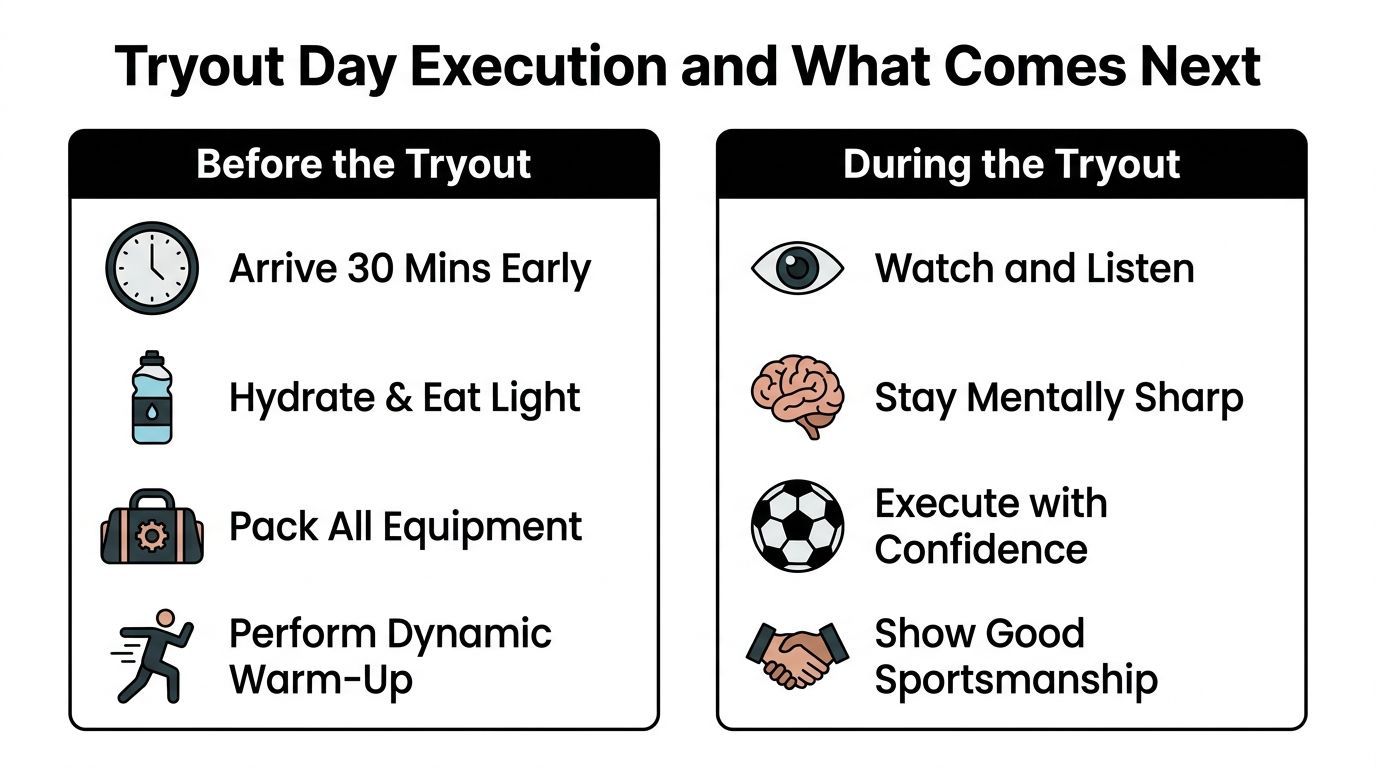
During technical stations, execute cleanly and listen for changes. In small-sided games, scan before receiving, offer support, and make the next useful play. In full-field scrimmages, coaches notice whether players recover defensively, communicate, stay connected to teammates, and respond constructively after mistakes.
On the field: Coaches don't need a perfect player. They need evidence that the player can learn, compete, and contribute.
A missed pass is normal. The revealing moment is what happens next. Does the player jog back, blame someone, or disengage? Or do they recover, communicate, and try the next action? That response can tell an evaluator more than a rehearsed trick.
For a fuller walkthrough of the setting and common formats, review this guide to what happens at soccer tryouts.
Read the offer carefully
Roster decisions may arrive through email, a club portal, or a phone call. Don't assume an offer is complete until you understand the team, coach, season dates, training schedule, competition calendar, financial obligations, uniform requirements, refund rules, and acceptance deadline.
Ask direct questions before committing:
Is this a guaranteed roster offer or an invitation to another evaluation?
What position or role does the coach currently see?
How does the club handle player movement?
What happens if the player is injured or misses a session?
Are there camps, clinics, or later entry points if the player needs more development?
How much travel is expected, and which commitments are mandatory?
If your child isn't selected, let them feel disappointed without turning the result into a family crisis. Request specific feedback, then look for constructive alternatives such as a development camp, clinic, guest-playing opportunity, or a later assessment. The goal is to keep the player training, competing, and learning while preserving confidence.
A roster decision is one data point in a long development journey. The right response is not to chase every available badge. It is to identify the next environment where the player can work, play, receive honest coaching, and return to the process stronger.
Villarreal Houston Academy offers boys' and girls' tryouts, competitive teams, camps, clinics, and a structured development pathway across the Greater Houston area. Visit Villarreal Houston Academy to review current programs and choose a practical next step for your child's development.
Comments