


Youth Soccer Development Academy: How to Choose One

You're on the sideline at a Humble or Atascocita field on a Saturday morning, coffee in one hand and three flyers in the other. Each one says academy, select, or elite pathway. Your child is still tying their cleats, and you're already guessing whether next season looks like this field or a completely different week.
The flyers look alike, but the promises don't share a definition. Before a season rewrites school nights, you need a way to see what the program really does for a child at this age.
Why Parents Struggle to Tell Academies Apart
Those three flyers are the problem in miniature. Recreational leagues, travel clubs, and full-time programs all print the word academy. No single licence sits behind that word, so the label alone tells you almost nothing about coaching, playing time, or what happens when a child gets hurt.
Getting it wrong has a real price. You can spend a year of fees, hand over evenings that used to belong to homework, and put a training load on a body that isn't ready for it. A season isn't a small experiment when it crowds out sleep and other sports.
You'll leave this walk-through with a plain definition, a side-by-side look at other program types, and a picture of what training should ask from ages 4 to 18. You'll also get criteria for coaching, curriculum, facilities, psychology, and pathway claims, plus a way to trial a program before you sign.
Villarreal Houston Academy appears later as one worked case, not the only option on the north side of Houston. Keep one question in front of you. What does this academy actually deliver for this child at this age?
What a Youth Soccer Development Academy Is
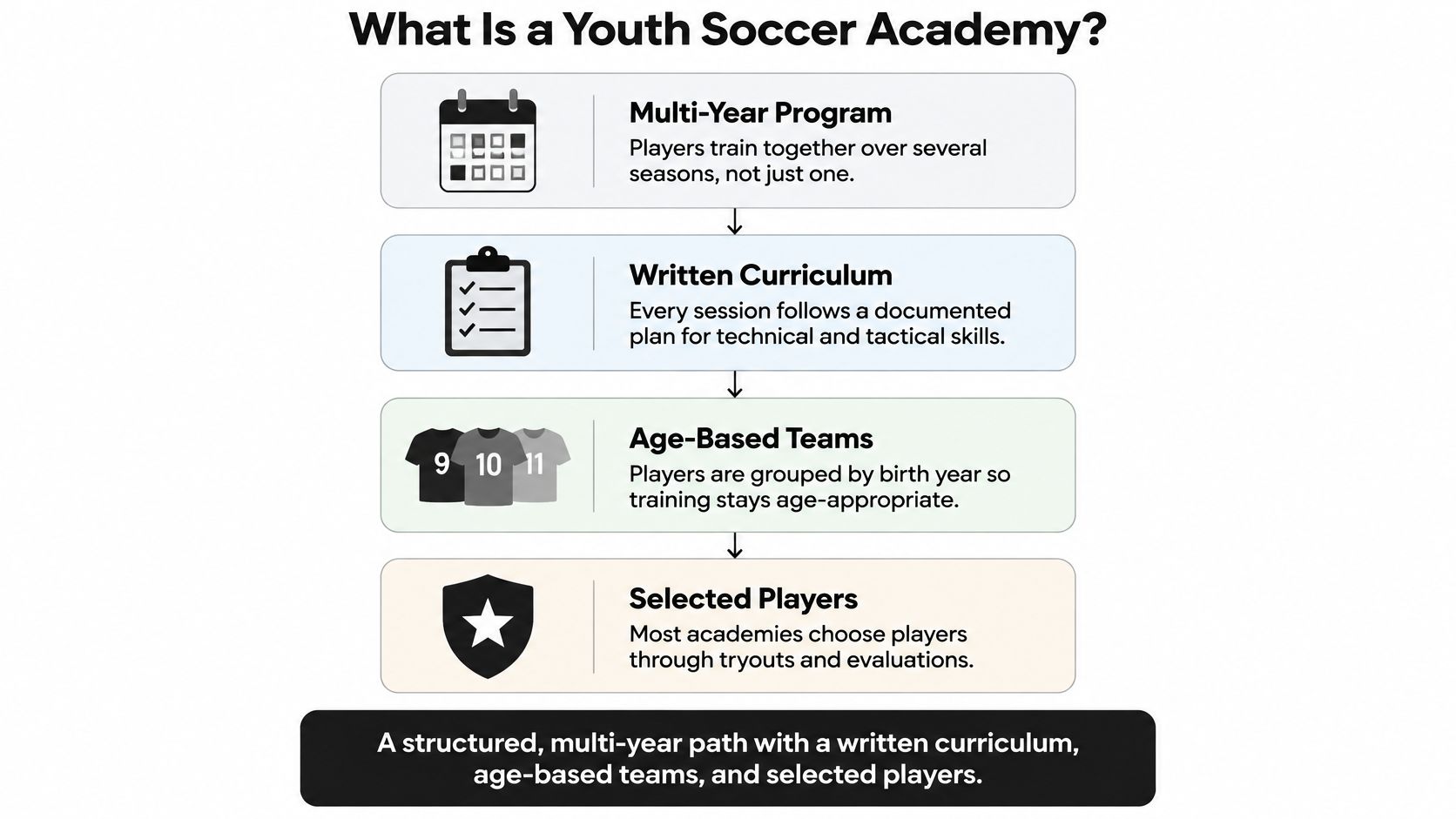
A youth soccer development academy is a multi-year program that trains players on a written curriculum, groups them into age-based teams, and usually selects them through tryouts. It also states a pathway toward higher levels, so families can see what the next stage is supposed to look like.
A pickup game is like playing in the yard with friends. An academy is closer to school. There are grade levels, a syllabus, progress checks, and a shared idea of what comes next. The fun can still be there. The difference is that someone has written down what this age group is supposed to learn, and the next age group builds on it.
Six parts worth naming
Break the model into pieces you can verify.
Coaching methodology: A shared way of teaching the game, not a different idea on every team.
Qualified staff: Named coaches with licences, background checks, and enough tenure that players aren't starting over each fall.
Curriculum: A year plan that repeats and progresses across age groups.
Facilities: A home base you can find on a weeknight, with a backup when weather turns.
Pathway: A stated route upward, backed by numbers from recent seasons, not one famous name.
Character and well-being: Standards for how adults speak to children, and a written plan for injury and stress.
The U.S. Soccer Development Academy, created in 2007 after a national review of elite player development, began with two boys' age groups and 125 teams, added U-13/14 in 2013 and U-12 in 2016, and by the 2017–18 season had grown to approximately 197 clubs and 900 teams across six age categories. That growth shows development organized across several age stages, not only in the oldest teams.
The word academy has since spread to programs of very different quality. Since no single licence defines it, you have to check what the name promises on the page in your hand.
Academy vs. Recreational, Club and Travel Programs
Programs share the word soccer, but they optimize for different goals. Read the plan, not the logo.
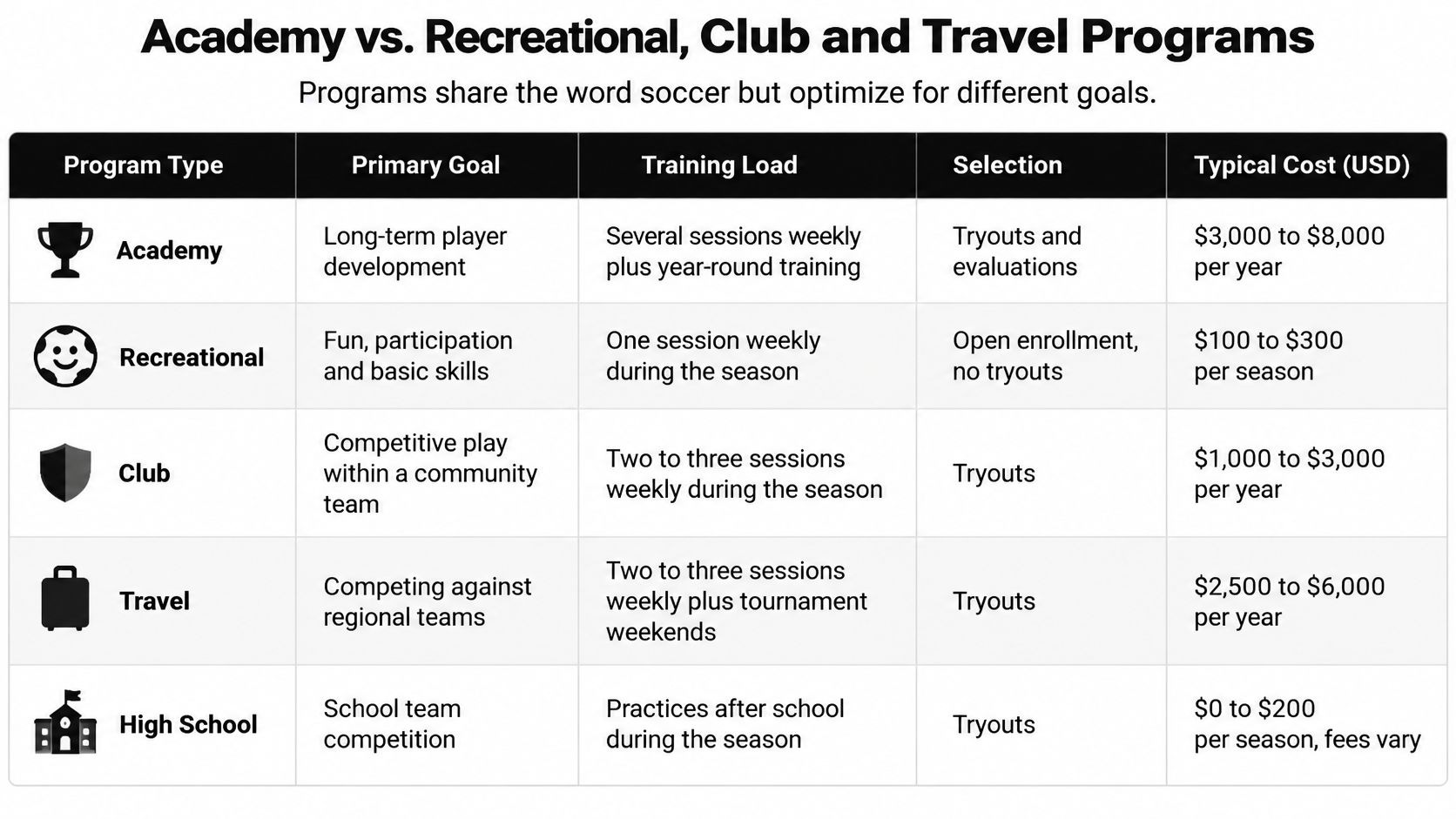
Program types compared on the criteria families weigh
Criterion | Academy | Club or select | Recreational | Travel or showcase |
|---|---|---|---|---|
Main goal | Long-term development along a stated pathway | Competitive results and team placement | Fun, fitness and friendships | Exposure to higher-level competition and scouts |
Typical training | Usually 2–4 sessions a week plus matches, with a written plan | Usually 2–3 sessions a week plus matches | Usually 1 session plus a game | Built around tournament weekends, with midweek sessions in between |
Selection | Tryout, often tiered by ability | Tryout | Open enrolment or lottery | Invitation or paid entry |
Coaching structure | Shared curriculum across age groups | Coach-led, team by team | Volunteer or part-time coaches | Coach-led, team by team |
Cost level | Moderate to high, and some trips abroad | Moderate to high | Low | Highest once tournament and travel fees are added |
Best-fit family | Committed players seeking a pathway | Players who want competitive games | Beginners and casual players | Players seeking exposure to scouts |
Which week actually fits
Match the program to the child in front of you, not to the most impressive flyer.
Weekly fun with friends: Recreational soccer, one session and a game, is enough. Open enrolment keeps the door wide.
Competitive games without a ten-year plan: A club or select team, with tryouts and two or three sessions, fits a player who wants a harder game and a family that can handle moderate fees.
Scout exposure this season: Travel and showcase soccer judges the weekend. Budget for hotels and entry fees before you budget for coaching.
A long pathway and a higher weekly load: An academy fits when the child wants multi-year teaching and the household can protect sleep, school, and at least one other activity.
An academy is judged by how a player develops over several years. A travel team is judged by results and exposure inside a season. Labels overlap in practice. A club can run an academy track, and a travel club can offer a development curriculum. A clear soccer programs menu should show age bands and session types in plain sight. Compare that plan, not the name on the jersey.
How Development Changes From Age 4 to 18
A good academy changes what it asks as the body and the game change. A 6-year-old and a 16-year-old should not train the same way. If the session plan looks identical from the youngest team to the oldest, the curriculum is a photocopy, not a pathway.
Development focus by age band
Age band | Development focus | Training emphasis | Specialization stance |
|---|---|---|---|
4–7 | Movement, ball mastery and enjoyment | Play-based, small-sided games, minimal tactics | Multisport strongly encouraged |
8–11 | Technical foundation, first touch and 1v1 skills | Skill repetitions, small-sided games, loose positions | Multisport still encouraged; soccer as a main sport is fine |
12–14 | Tactics, decision-making and team shape | Positional roles, larger-sided games, recovery built in | Limited specialization; keep other sports where possible |
15–18 | Performance, position specialization and match-speed decisions | Higher load, strength work, individual plans | Specialization decided with load monitoring and school in view |
Say a 9-year-old spends the session in 1v1s and small-sided games, with positions that stay loose. That matches the table. The same child drilled in a rigid 4-3-3 for ninety minutes is being asked to play an older player's game.
Workload, not the word specialize
A 2025 review reports that intensive specialization can be associated with overuse injuries, burnout, anxiety, depression, sleep disruption, and reduced academic performance, and it cites substantially higher burnout among athletes training more than 20 hours weekly. The same review describes a prospective study of 80 youth soccer athletes across two competitive seasons that found no injury-incidence difference between specialized and multisport groups after accounting for training load. The lever you can actually pull is weekly load, not a slogan about playing only one sport.
Practical rule: If hours across team training, camps, and school sport climb past what sleep and homework can absorb, slow the pathway before you add another session.
Watch for persistent fatigue, declining performance, sleep trouble, irritability about training, and recurring niggles that never quite heal. Ask the coach how intensity changes during a growth spurt, and how total weekly load across teams, camps, and school is tracked. A schedule that looks fine on one flyer can be too much once you add the other two.
Coaching, Curriculum, Facilities and Support to Inspect
Claims on a website are a starting point. A visit, or one direct question, tells you more than a trophy photo. Treat workload limits, injury rules, and psychological support as selection criteria, right beside licences and pathway claims. Those are the parts most academy marketing leaves out.
Inspection criteria with green and red flags
Area | What to ask | Green flag | Red flag |
|---|---|---|---|
Coaching | Licences, background checks and staff tenure | Named staff with licences and multi-year tenure | Vague credentials and frequent coach changes |
Curriculum | Is there a written plan by age group? | Year plan with progression and match review | Methodology described but no documents |
Facilities | Dedicated or shared fields, lighting, indoor backup | Consistent home base with clear booking | Shared fields with unclear schedules |
Pathway | How many players moved up in the last two seasons? | Specific numbers and examples given | Only one famous alumnus cited |
Sports psychology | Is a sports psychologist on staff, and how is access arranged? | Named psychologist with regular access for players | No mental-skills support, or only a motivational talk |
Well-being | Is the injury and well-being policy in writing? | Written return-to-play and check-in process | No written answer, or a vague promise |
Ask for the year plan on paper. A methodology you can't hold in your hands is a slogan.
Coaching is the fastest tell. Named staff, current licences, background checks, and coaches who have stayed more than a season mean the teaching has a memory. A new face every August means your child relearns the same habits.
Pathway answers should be countable. "How many players in this age group moved to a higher team in the last two seasons?" is a fair question. One professional alumnus from a decade ago doesn't answer it.
Facilities are a family logistics problem as much as a soccer one. Ask whether fields are dedicated or shared, whether there is lighting and an indoor backup, and how far the home base sits from your weeknight. Consistent training amenities, with parking and a booked indoor option, matter more than a highlight reel of a borrowed stadium.
Watch a full training session, not only a match. Training shows how coaches teach, how they correct a mistake, and how they speak to a player who is struggling. A polished game can hide a session that runs on shouting.
How Academies Protect Players During Injury and Setbacks
After an injury, three questions matter more than the facility tour. Who makes the return-to-play decision? How are confidence and fear of reinjury handled? Does the player still get support after they are back in the lineup, with school, sleep, and family stress in the picture?
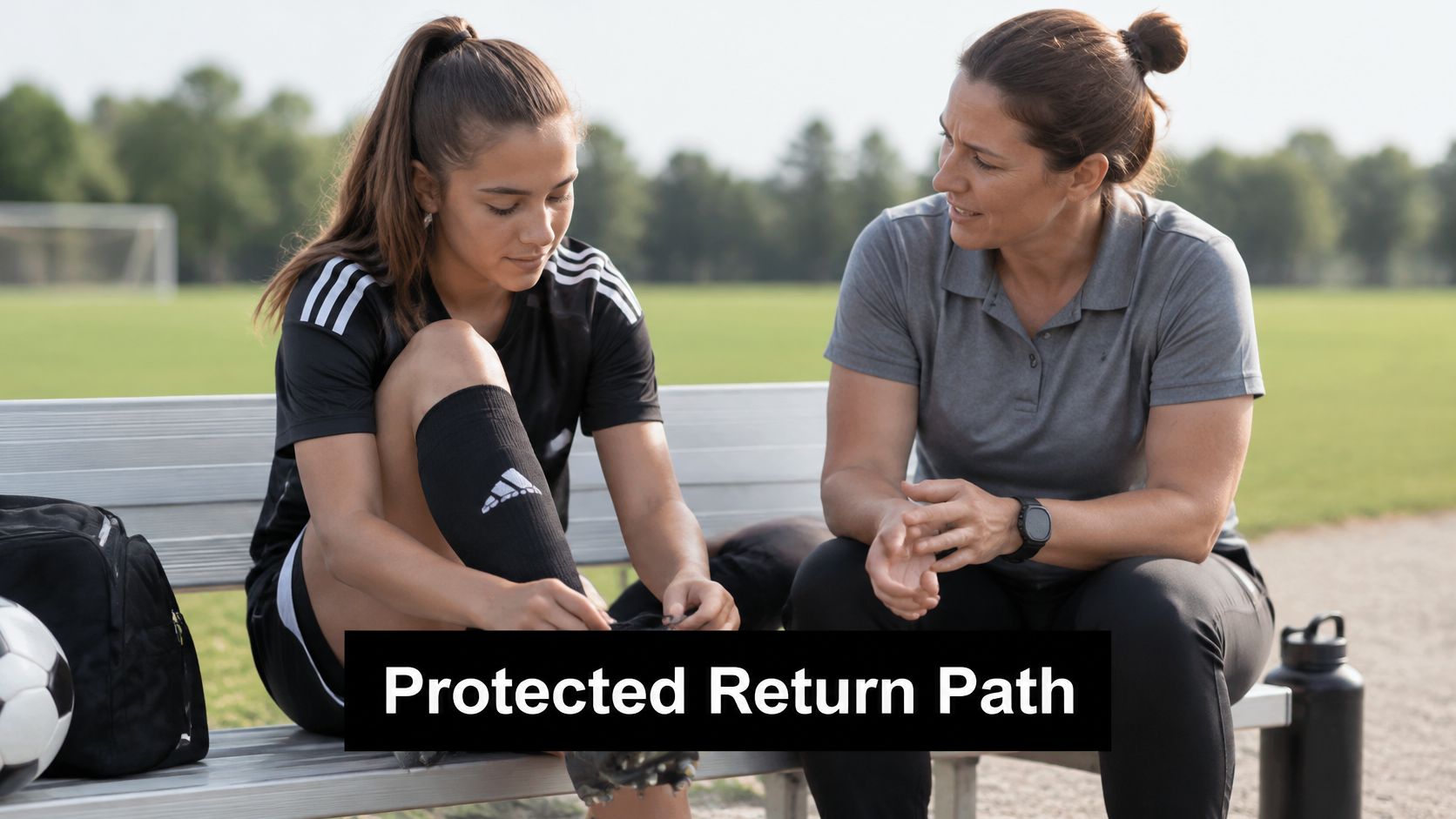
The relationship runs both ways. Injuries can contribute to anxiety, depressive symptoms, sleep problems, lower confidence, a disrupted sense of identity as a player, and trouble returning to sport. Poor well-being and disturbed sleep can also sit alongside new injuries and slower recovery. A child who looks "cleared" on a form can still be playing scared.
A 2024 report on more than 650 elite youth athletes found that athletes with injuries in the prior six months reported higher anxiety and depression than uninjured athletes, including after return to play, and that greater injury severity and multiple injuries were linked with more serious symptoms. The gap isn't only medical. It is how adults talk to the player on the way back.
What a written protocol includes
A sound protocol is boring on purpose. You should be able to read it without a medical degree.
Shared decisions: Coaches, medical staff, the athlete, and the family hear the same return plan.
Rehab that fits the age: A 12-year-old doesn't follow an adult strengthening sheet.
Gradual reintegration: Training comes back before full matches, and minutes rise on purpose.
Mental-skills support: Fear of reinjury gets named, not waved off as softness.
Life outside the pitch: School load, sleep, and family stress are part of the check-in.
An escalation path: If distress lasts, someone besides the team coach is the next call.
A readable injury-and-well-being protocol is a better signal of quality than the phrase high performance.
A short conversation between a coach and a player, away from the huddle, is what that protocol looks like on a Tuesday. If you want to hear how return-to-play decisions get explained to families, this briefing walks through the questions worth asking before the next season starts.
If the club can't hand you the protocol, treat "high performance" as marketing. Protection during a setback is part of development, not a side service.
How Villarreal Houston Academy Applies the Model
Villarreal Houston Academy is the official partner academy of Spain's Villarreal CF in the Greater Houston area. It offers select and competitive programs for boys and girls from age 4, using the club's methodology built around intelligence, skill, and character, with sports psychologists involved in the environment. Programs include teams, camps, clinics, and tryouts.
Training is based in Humble, Fall Creek, Cypress, and Tomball. The academy has also described added sites for spring 2026 in Kingwood, Porter, and New Caney, including a partnership with 365 Sports Complex in Porter and teams for the 2018–2020 birth years. For a family in Atascocita or Kingwood, the nearer site is the one that decides whether weeknights stay workable.
Two pathway cases, with a limit
A 2009-born Summer Creek High School player was invited to Villarreal CF's Player Development Program after two Villarreal coaches independently recommended him, following performances at the Villarreal Academy Cup and Yellow Cup in Spain. Separately, five girls were selected for the Majorca International Football Cup after Spanish coaches evaluated them at the Villarreal North American Select event in Las Vegas.
Invitations like these are selective. Travel is earned through evaluation. Enrolment doesn't guarantee a flight, a camp spot, or a look from a first-team coach. Ask what happened to players in your child's own age group, not only to the names on the poster.
Book a Trial and Confirm the Fit Before Committing
Use the inspection flags you already have. Don't rebuild the checklist from memory at the field.
Shortlist two or three academies by location, age band, and training days that fit your actual week.
Request the written age-group plan, coach credentials, and the injury and well-being policy. Score each answer against the green and red flags.
Visit a full training session, not only a match. Note how coaches correct mistakes and how they speak when a player struggles.
Ask how many players moved up in the last two seasons, then add one follow-up. What happened to players in your child's age group?
Add kit, tournaments, camps, travel, and any trip abroad, and set that total against the household budget.
Book a trial or tryout. Afterward, ask the child what they enjoyed and what felt hard.
After two or three weeks, check energy, sleep, schoolwork, and mood. A good session that wrecks the next morning is still a bad fit.
Commit for one season, with clear exit terms, before you sign anything longer. A multi-year contract locks in a training load before you've seen how your child copes. That is the riskiest step on the list.
For this academy, ask about tryouts and trial sessions, and pick the nearest site from the locations above, including the spring 2026 Kingwood, Porter, and New Caney teams if they sit closer to home. One season, with an exit you understand, tells you more than a glossy pathway slide.
Villarreal Houston Academy runs select and competitive soccer for boys and girls from age 4 in the Greater Houston area, with age-based training, a written club methodology, and sports psychology support alongside the pathway. If you're weighing a youth soccer development academy against rec, club, or travel options, start by watching a session and reading the injury policy before you commit. Visit Villarreal Houston Academy to check programs, locations, and upcoming tryouts.
Comments