


Youth Soccer Academy Tryouts: A Complete Parent Guide 2026

Your child has just finished a youth soccer academy tryout. They're replaying every missed pass, while you're standing beside the car wondering whether the coach saw the same potential you see at home. You may also be asking a bigger question: even if your player receives an offer, will this academy communicate clearly, develop them appropriately, and provide an environment your family can trust?
Youth soccer academy tryouts aren't only auditions for players. They're an opportunity for parents to evaluate the club's process, coaching standards, communication, and fit. The strongest decision considers both sides of the relationship, not just the roster outcome.
Navigating Registration and Preparation
Registration day often creates more stress than the first whistle. A parent searches for the correct age group, completes forms, uploads documents, confirms the field location, and discovers that an incomplete application can delay the information they need. The practical response is simple: treat registration as the first part of preparation, not as clerical work to finish at the last minute.
Youth soccer remains intensely competitive because the participation base is so large. Recent national data shows that participation among youth ages 6 to 14 rose from 21.1 million in 2022 to 22.1 million in 2025, with soccer among the most common youth sports nationwide, according to Sports & Fitness Industry Association research. That scale makes early organization useful, especially when clubs publish limited evaluation dates or group players by birth year.

Remove avoidable friction
Before the session, confirm the player's registered age group, arrival location, field surface, check-in instructions, and required equipment. Pack cleats appropriate for the surface, shin guards, water, a ball if the club requests one, and a change of clothes. Check whether the academy needs medical information, emergency contacts, or signed educational sports consent forms, particularly when a child is trying out outside their current club.
The youth soccer registration guidance from Villarreal Houston is a useful example of the information families should look for before registering. A well-run process should make the next step clear instead of forcing parents to chase basic details.
Preparation shouldn't turn into a private boot camp. Give the player a normal training routine, encourage sleep and hydration, and explain that coaches want to observe how they play, communicate, and respond to the game. The best mindset is curiosity: play the next action, listen carefully, and compete without trying to perform a different personality.
Understanding Coach Evaluation Criteria
A player can have an attractive first touch and still struggle to earn a place if they can't move effectively through the session. Research on elite youth selection reports that motor criteria such as sprint speed and agility often influence initial decisions more than purely technical reputation, while psychological criteria also rank highly among selectors, as described in this scoping review of youth soccer selection.
That doesn't make technique unimportant. It changes how coaches interpret technique. A clean pass matters more when the player creates space, checks their shoulder, receives under pressure, and makes the next decision quickly.
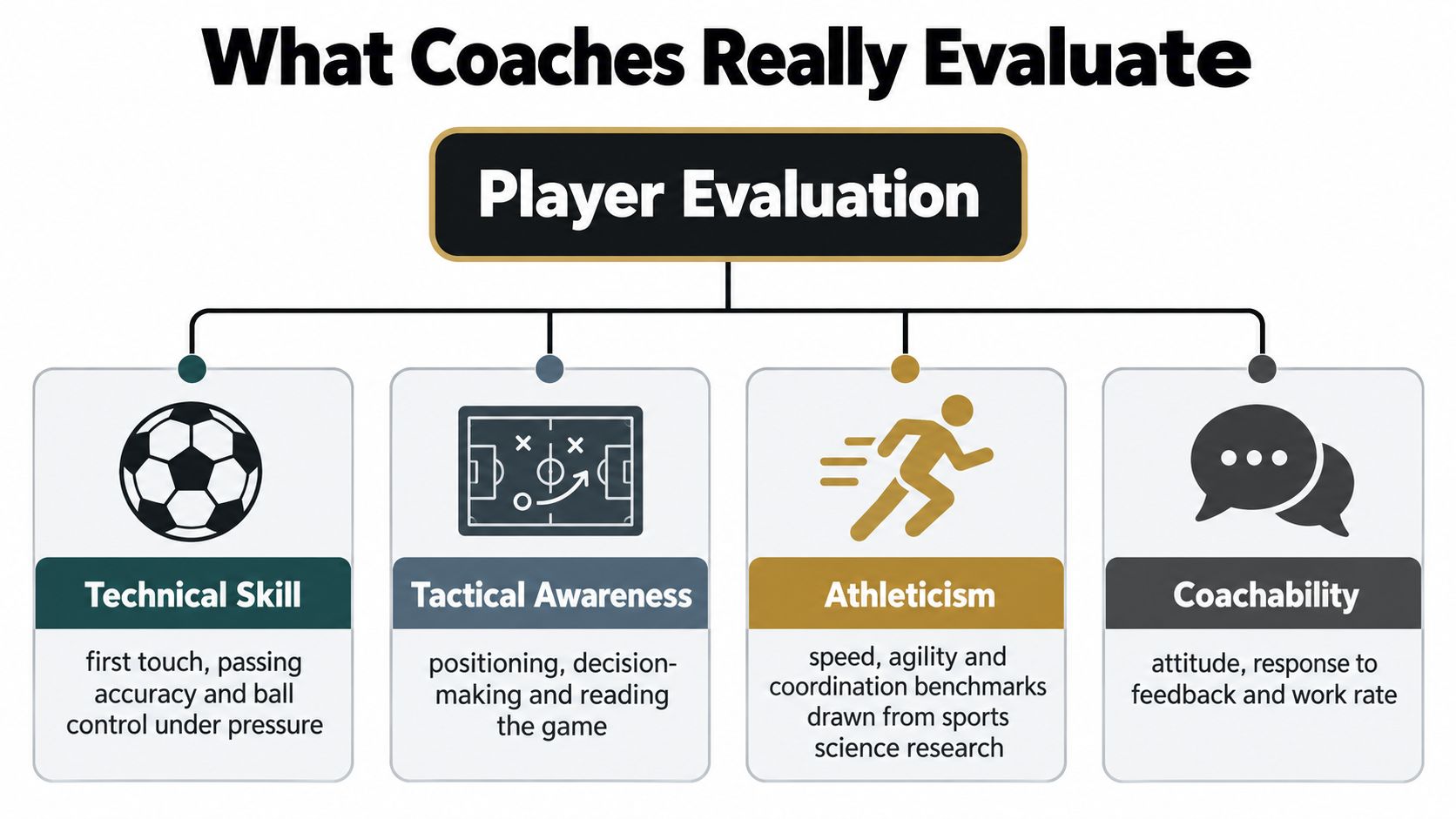
The four lenses on the field
Technical skill includes first touch, passing weight, dribbling control, finishing technique, and the ability to protect the ball. Coaches usually learn more from repeated actions in small-sided games than from a single impressive trick.
Tactical awareness appears in positioning and timing. Does the player create a passing lane? Do they recognize when to play forward or keep possession? Can they adjust after losing the ball?
Athleticism includes acceleration, agility, coordination, deceleration, and the ability to repeat actions. Coaches aren't only watching who wins a sprint. They're watching how efficiently the player changes direction and whether movement quality holds up as the session progresses.
Coachability is visible immediately after instruction. A player who listens, attempts the adjustment, and keeps working after a mistake gives staff useful evidence about development potential. Body language, communication, and work rate help coaches distinguish a temporary error from a pattern of disengagement.
Practical rule: Players shouldn't chase spectacular moments. They should make useful decisions repeatedly, respond to feedback, and stay involved when the ball is elsewhere.
Parents can use a structured youth talent identification guide to understand why clubs combine observation with measurable movement qualities. For a more detailed evaluation framework, see soccer player evaluation at Villarreal Houston.
Timeline and Age-Group Expectations
A tryout usually unfolds as a sequence, not a single verdict. The exact calendar varies by academy, but parents can expect several recognizable stages.
Registration and information gathering. The family submits the request, selects the appropriate age group, and confirms the location and session requirements. This is the point to ask whether the evaluation is for a particular team, a broader academy placement, or a future opportunity.
Check-in and grouping. Staff verify the player's information, provide a bib or group assignment, and direct players to the correct field. Efficient check-in gives coaches more time to observe and gives families an early signal about operational quality.
Training-based assessment. Players may complete technical activities, movement tests, small-sided games, and larger match scenarios. The format should reflect the age group. Younger players need room to demonstrate coordination, enjoyment, and basic decisions, while older players face more complex pressure and tactical demands.
Staff review. Coaches compare observations rather than relying on one dramatic action. Research identifies sprint capacity as an important discriminator across age categories, with 30-meter sprint performance emerging as a primary indicator of selection into elite youth levels, according to recent research on youth soccer talent identification. That result should inform assessment, not replace the wider picture.
Roster, invitation, or waitlist communication. A responsible club explains what the decision means, when families should expect contact, and whether a waitlist can change as places become available. A waitlist isn't automatically a rejection of development potential. It can reflect roster balance, position needs, or limited spaces.
Age grouping also matters because physical growth isn't synchronized. One player may look advanced in a particular season and then be matched by peers later. Parents should ask how the academy handles development over time rather than treating one evaluation as a permanent label. The youth soccer age-group guide can help families understand why birth-year placement and developmental expectations influence the process.
The Villarreal Houston Development Pathway
A useful comparison starts with the difference between a recreational experience and a methodology-driven academy. A recreation program may prioritize broad access, enjoyment, and simple game exposure. A select academy adds formal evaluation, position-specific development, stronger training demands, and a clearer route toward competitive teams. Neither option is automatically right for every child, but the family should know which experience it is choosing.
Villarreal Houston Academy is the official partner academy of Spain's Villarreal CF in Greater Houston. Its stated pathway serves boys and girls from age four upward and emphasizes intelligence, skill, and character through age-appropriate training, competitive teams, camps, clinics, and tryouts. The academy also describes opportunities for players to travel to Spain to train and play alongside Villarreal CF's elite academy.

What parents should compare
Area | General recreational setting | Methodology-driven academy |
|---|---|---|
Evaluation | Broad participation and basic observation | Structured assessment across technical, tactical, physical, and behavioral qualities |
Training aim | Enjoyment and fundamental exposure | Progressive development and competitive readiness |
Communication | Varies by volunteer or local structure | Should explain placement, expectations, and next steps clearly |
Player pathway | May remain within the local program | Can include competitive teams, clinics, camps, and international opportunities |
The important question isn't whether a club uses impressive language. Ask what coaches do with that methodology during a normal week. Do sessions include decision-making rather than isolated drills? Do coaches explain how players move between levels? Does the club recognize character and learning behavior alongside current ability?
A premium environment also carries trade-offs. Competitive training can demand more travel, time, and emotional resilience than a local recreational schedule. Parents should weigh those commitments against the child's enthusiasm, school responsibilities, recovery needs, and willingness to accept coaching. A pathway only works when the player can participate consistently and still enjoy the game.
The Reality of Competitive Pathways
The numbers surrounding elite progression deserve honest treatment. A medical-society review notes that as many as 4 million children ages 6 to 17 may play soccer in the United States, while only about 18,000 youth players are involved in MLS NEXT development organizations, according to the American Orthopaedic Society for Sports Medicine. The same source estimates that roughly 10% continue to collegiate play, and less than 1% make an NCAA Division I roster.
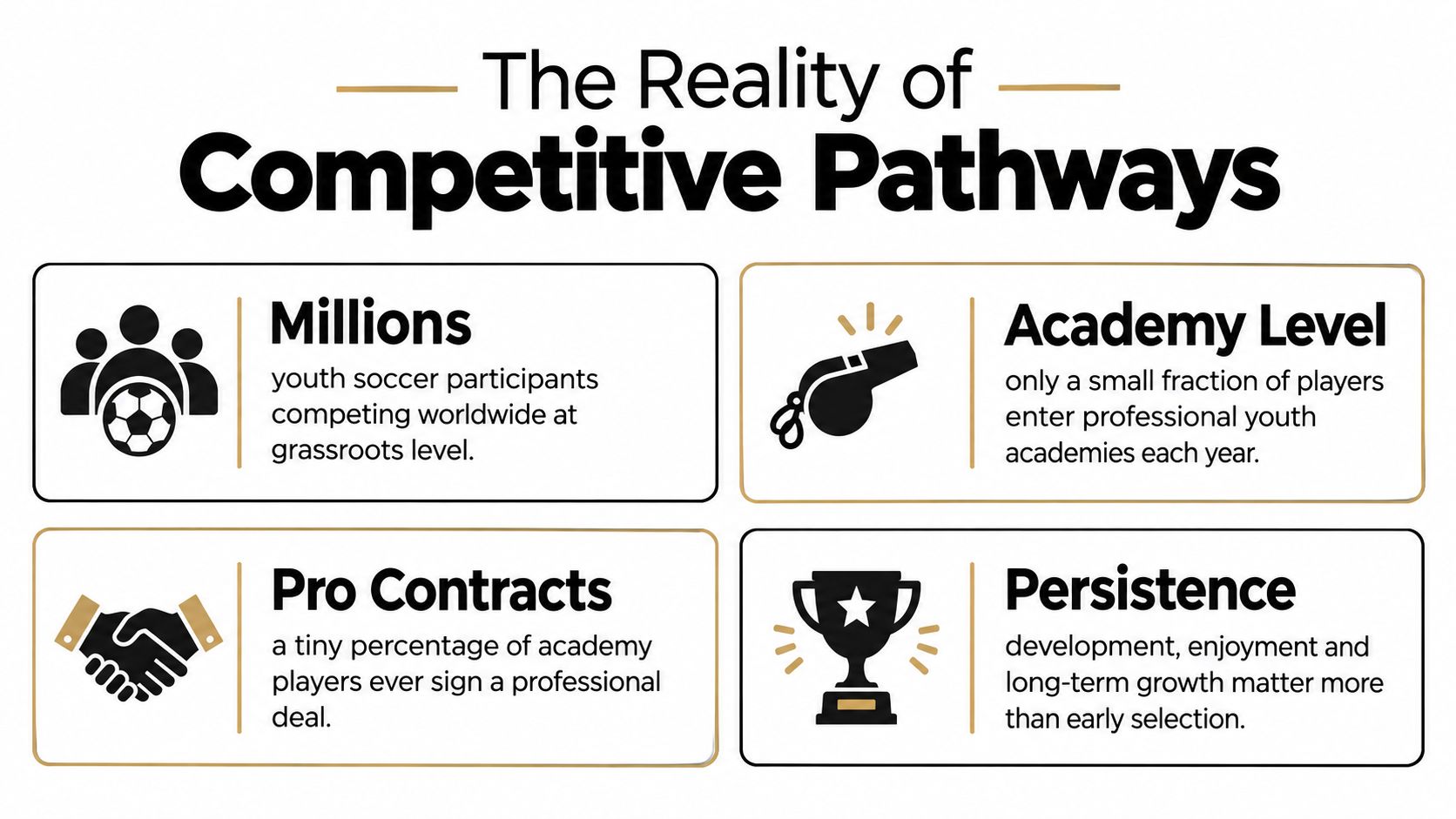
Those figures aren't a reason to turn a tryout into a high-pressure referendum on a child's future. They're a reason to define success more carefully. A player may develop confidence, discipline, fitness, friendships, tactical understanding, and a lasting relationship with the sport without reaching an elite roster.
Selectivity changes the parent's job
Parents should challenge two unhelpful ideas. The first is that an early selection guarantees a professional future. It doesn't. The second is that a non-selection proves a player lacks potential. It doesn't either. Growth, maturity, position, coaching fit, motivation, and opportunity all shape a long development path.
The better response is to ask whether the academy provides useful feedback and a realistic next step. If the answer is yes, a player can use the outcome as information rather than identity. They might need improved speed, more decisive passing, stronger defensive habits, or greater consistency under pressure. Those are development targets, not verdicts.
A strong academy experience should also protect enjoyment. Coaches can demand effort and accountability without making children feel that every session determines their worth. Parents should look for that balance before committing to a program.
Parent Behavior and Sideline Etiquette
Parents influence a tryout before the player touches the ball. A child who hears constant instructions from the sideline has to divide attention between the coach, the game, and the parent. That interference can make the player hesitant, especially when the evaluation already feels unfamiliar.
Public tryout guidance often covers arrival time, equipment, and sideline conduct, but gives less attention to how families should judge fit and communication quality after the session, as noted in neutral youth soccer tryout guidance. The parent's role is therefore two-sided: create calm conditions for the player, then assess whether the club treats families with the same professionalism it expects from athletes.
During the session
Arrive prepared: Give the player enough time to check in, hydrate, and settle without creating a frantic mood.
Stay quiet during play: Don't shout tactical instructions, corrections, or criticism. Let the coach observe the player's decisions.
Support effort afterward: Ask how the player felt before asking whether they scored or made the team.
Respect the field boundary: Follow staff directions about where parents stand and whether photographs or video are permitted.
Families can preserve positive memories without turning the tryout into a media production. If the club shares approved images, tools for branded galleries for sports teams can organize team moments while respecting the academy's privacy rules.
After the final whistle
Ask the coach specific questions:
What did you notice about my child's strengths?
Which two development areas should they prioritize?
What does the placement decision mean in practical terms?
How does the academy handle waitlists or later opportunities?
Who should we contact if we need clarification?
Notice whether the answer is specific, respectful, and consistent with what the staff observed. A club doesn't need to promise a particular outcome, but it should explain its process without dismissing reasonable questions. Communication quality is part of the evaluation, not an administrative extra.
From Local Fields to International Stages
A serious pathway is easiest to understand by following the sequence rather than jumping straight to the destination. A young player begins by learning to control the ball, recognize space, and enjoy competing with teammates. Later, academy staff ask for sharper decisions, stronger movement, and greater responsibility when the game becomes faster.
At Villarreal Houston, the pathway connects local training in the Greater Houston area with the methodology of Villarreal CF. Players develop through age-appropriate programs and competitive teams, then may earn opportunities to travel to Spain for training and matches alongside Villarreal CF's academy. The progression matters because international experiences become meaningful only after the player has built reliable habits at home.
What the journey actually requires
A player who reaches an event such as the Majorca International Football Cup hasn't skipped the ordinary work. They've attended training, accepted correction, handled selection pressure, learned to contribute when they aren't the central player, and stayed committed through periods when progress felt slow. Parents support that journey by valuing preparation and learning over photographs or status.
The international stage also tests qualities that tryouts reveal in smaller form. Can the player adapt to unfamiliar teammates? Do they communicate when tired? Will they keep making decisions after a mistake? Technical ability opens opportunities, but character and coachability help players use them.
That is why the first tryout should be viewed as the beginning of a conversation. The academy evaluates the player's present level and potential, while the family evaluates whether the club's standards, schedule, coaching, and communication fit their needs. The right outcome isn't just an accepted roster spot. It's a development environment where the player can work hard, improve genuinely, and keep wanting to return to the field.
Villarreal Houston Academy offers boys' and girls' competitive soccer programming from age four upward, with age-appropriate training, tryouts, teams, camps, clinics, and a pathway connected to Villarreal CF in Spain. If you're evaluating youth soccer academy tryouts in Greater Houston, visit Villarreal Houston Academy to review current programs and request information about the next opportunity.
Comments